Family Holdings #48 - Three earnings updates and holding companies benefit from record stock market rally

This week's topics:
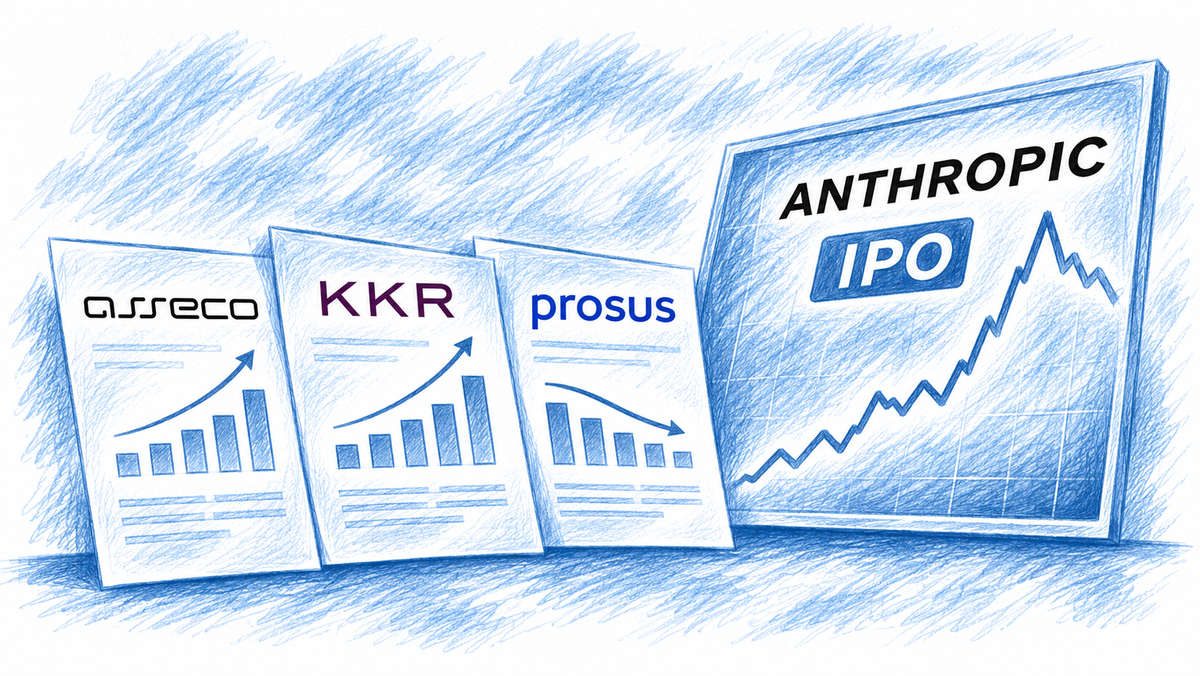
KKR posted record results for the second quarter in a row, even as sentiment around private markets was predominantly negative in 2026. Co-CEO Scott Nuttall expects clients to increasingly concentrate their money with a small group of winners, and KKR is showing that it belongs in that group. This year it is expected to distribute a record USD 40 billion to its fund investors. We also discuss how KKR is absorbing the sale of USI, why it deliberately continues to invest its own capital, and how it keeps its exposure to AI and software limited.
The half-year results of Prosus show what the stepped-up investment in food delivery is costing. iFood's profitability has nearly vanished, cash flow excluding Tencent is negative, and management gave no guidance for next year. What struck us even more was the tone of CEO Fabricio Bloisi, who repeatedly placed the blame outside Prosus. Tencent itself is also under pressure from record AI investment and tighter US chip rules.
Anthropic, the company behind the AI model Claude, completed the largest IPO ever and showed in its first days of trading just how volatile a new listing can be. Through Alphabet, Amazon, Scottish Mortgage and Sofina several companies we write about had already invested in Anthropic long before its IPO. In addition, Stripe, an important indirect holding of Sofina and Scottish Mortgage, is in talks over a new valuation of more than USD 200 billion.
In brief:
Addtech (Stockholm: ADDT-B) announced three acquisitions this week. Addtech is acquiring Italy's Beta Cavi, which makes niche cables mainly for the security sector and also supplies fibre-optic and data cables. Addtech is also acquiring the German companies Lott-Lacke and BaSyTec. Lott-Lacke produces custom special industrial coatings that cure using UV or LED light or electron beams, or are water-based. BaSyTec develops systems used by battery manufacturers, industrial companies and researchers to test batteries.
Lifco (Stockholm: LIFCO-B) also signed for three acquisitions. Lifco is acquiring Germany's Decorative Products, which supplies surface materials for aircraft cabins and generated revenue of around €10.6 million in 2025. Lifco is also acquiring Spain's Colortec Química, which produces colour concentrates (masterbatches), pigments and custom additives for plastic products and generated revenue of approximately €9.3 million in 2025. In addition, Lifco is acquiring Italy's EG Medical, which makes trays for surgical instruments and generated revenue of around €11.9 million in 2025.
Constellation Software (Toronto: CSU) announced three new acquisitions this week. Through its subsidiary Wincar Automotive ICT, Volaris acquired the Netherlands' Tailwind Apps, a supplier of software for car dealerships. Tailwind Apps links the call centre to the dealer management system and also provides digital work orders and self-check-in kiosks for customers. Volaris also acquired Barcelona-based Win Systems of Spain, which makes casino management software. Win Systems' WIGOS platform is one of the largest in Latin America and is used in more than thirty countries. Finally, Vela, through its subsidiary Juniper Travel Technology, acquired Spain's Ventus Technologies. Ventus provides the technology linking distribution systems and travel providers, making data traffic more efficient for hotel chains and tour operators, among others.
Brookfield (New York: BN) and KKR (New York: KKR) this week both showed different sides of the private equity business. Through its main private equity strategy, together with its subsidiary Brookfield Business Corporation, Brookfield acquired Indian glass packaging maker PGP Glass from Blackstone for $1.7 billion. PGP makes glass packaging for perfume and cosmetics, speciality foods and beverages, and pharmaceuticals. KKR, meanwhile, completed the sale of CIRCOR Aerospace for $2.55 billion. KKR paid $1.8 billion for the whole of CIRCOR in 2023 and is keeping the industrial and maritime operations. In other words, one division alone fetched more than the entire company cost at the time.
Berkshire Hathaway (New York: BRK.B) made two acquisitions this week. Subsidiary McLane, one of the largest distributors in the United States, is acquiring virtually all the assets of Willow Run Foods. Willow Run Foods, based in Kirkwood, New York, has been in business since 1949, is employee-owned and supplies restaurants in fourteen states across the north-east of the country. The employees still need to approve the sale, but McLane expects to complete the acquisition in January 2027. Subsidiary LiquidPower Specialty Products also made an acquisition. This company makes products that make it easier for oil to flow through pipelines and bought out the stakes held by the founders and another shareholder of Safe Marine Transfer. Safe Marine Transfer has a patented system for injecting these products into oil pipelines on the seabed. LiquidPower now owns the company outright, together with offshore company Subsea7.
Asseco Poland again posts strong results
Asseco Poland (Warsaw: ACP) published its results for the first nine months of 2026 this week, once again delivering an excellent quarter. Revenue growth eased somewhat in the third quarter, but profitability kept rising and net profit came in above analysts' expectations. As usual, we use Asseco's proportional figures, in which the results of subsidiaries are only included in proportion to Asseco's economic interest in them.

Over the first nine months, proportional revenue rose 11.3% to PLN 5,433.9 million, of which 8.1% was organic. After the first half of the year, organic growth still stood at 12%, so the third quarter was clearly weaker than the two preceding quarters. This also becomes apparent when you work out the figures on a quarterly basis. In the third quarter, revenue rose 4.6%, but after stripping out currency effects and acquisitions, only about 1% of that remained organic. That says more about the strong spring than about any deterioration. At software companies that grow mainly through acquisitions, such as the companies in the Constellation family, organic growth typically sits in the low single digits. With 8.1% organic growth over nine months, Asseco performs exceptionally well in that company.
The 'slowdown' is also not unexpected. At the half-year results, management had already indicated that investments under Poland's recovery plan (KPO) would peak in the second quarter and then taper off. Moreover, the decline is concentrated mainly in the least attractive revenue. Including currency effects and acquisitions, revenue from own software and services still grew 9% in the third quarter, while resale of hardware and third-party services shrank by more than 11%. For profit, this is a favourable shift, as Asseco earns relatively little on that resale business.
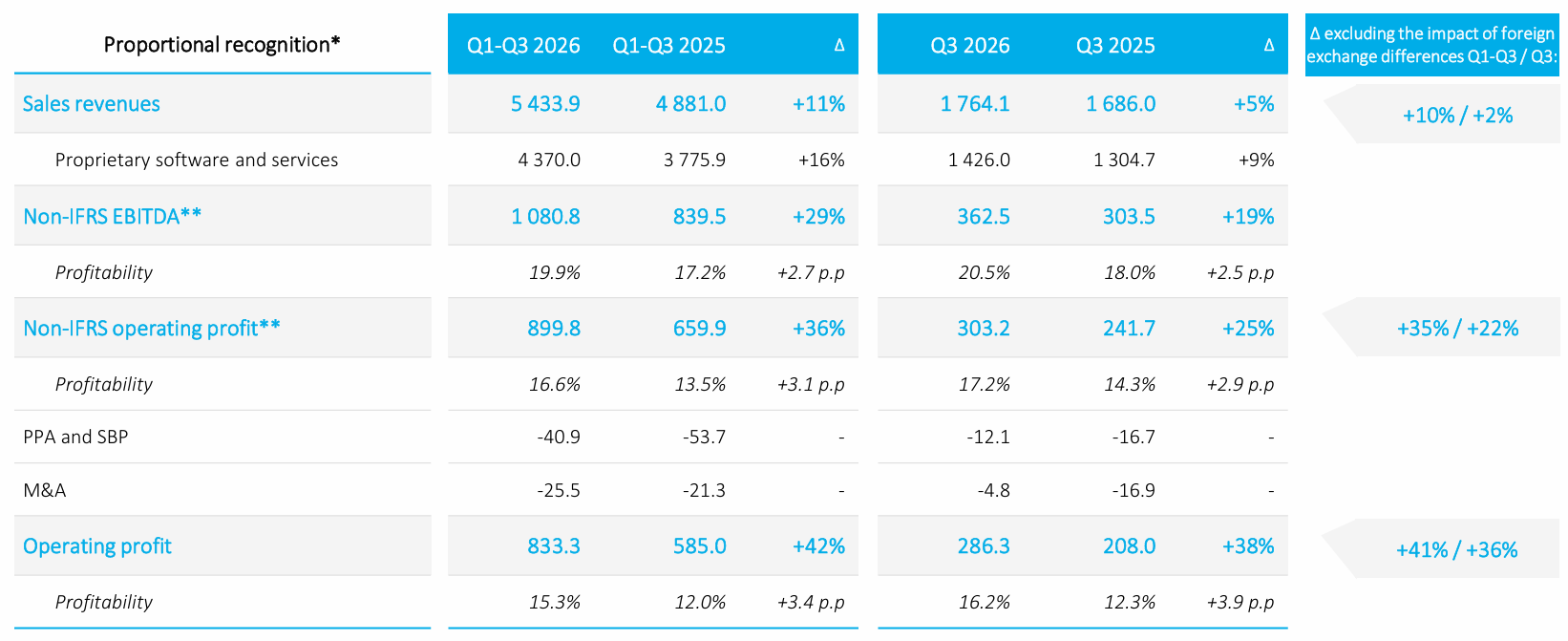
This shift is clearly reflected in the margins. The operating margin excluding acquisition effects (non-IFRS EBIT) rose to 17.2% in the third quarter, up from 14.3% a year earlier, and to 16.6% over nine months, up from 13.5%. This is not solely the result of a different revenue mix, as profitability also improved within the segments. At the Polish division, the margin rose to nearly 25% in the quarter, and at Asseco International it rose from 10.8% to 14.2%. Since the partial acquisition by Topicus, Asseco has not had a single quarter without operational improvement, and that trend continued even in a quarter with barely any revenue growth.
The order book also inspires confidence for the fourth quarter and beyond. At constant exchange rates, it stands 13% higher than a year ago. The biggest increase, at 21%, is in the Polish division, the segment with the highest margins. At Formula Systems, order book growth slowed from 9% in August to 6%. Besides organic growth, Asseco also continues to make acquisitions. According to Maciej Kaszyca of Asseco, the count now stands at ten this year. These are mostly smaller companies, such as Polish software provider for petrol stations and hospitality businesses Mc Comp, Slovak IT outsourcing company 8Seneca, and a series of Israeli software and technology companies added to the group through Formula Systems.
All in all, Asseco shows that a quarter with little revenue growth can still be a good quarter. The slowdown had been flagged in advance and is concentrated mainly in revenue that generates little profit. At the same time, margins keep rising, in-house software continues to grow, and the most profitable division is expanding its order book the fastest. Investors accordingly responded enthusiastically to the results.
KKR on the right side of the ledger
The American investment holding company KKR (New York: KKR) invests on behalf of pension funds, insurers and private individuals in unlisted companies (private equity), infrastructure, real estate and loans. In return, KKR receives management fees and a share of the profits generated. The company recently reported record results for the second consecutive quarter, even as coverage of firms that, like KKR, invest outside the listed markets was predominantly negative in 2026. According to management, KKR's share price therefore fails to reflect the company's performance. At the presentation of the quarterly results and at conferences hosted by banks Barclays in September and BMO in November, KKR explained how this discrepancy can be accounted for.
KKR earns its money from three business lines. The largest is investing money on behalf of clients, for which KKR receives management fees and a share of the profits achieved. In addition, KKR owns Global Atlantic, an insurer that sells annuities and life insurance policies and has KKR invest the premiums. The third segment is Strategic Holdings, through which KKR uses its own capital to hold long-term stakes in companies and receives dividends from them.
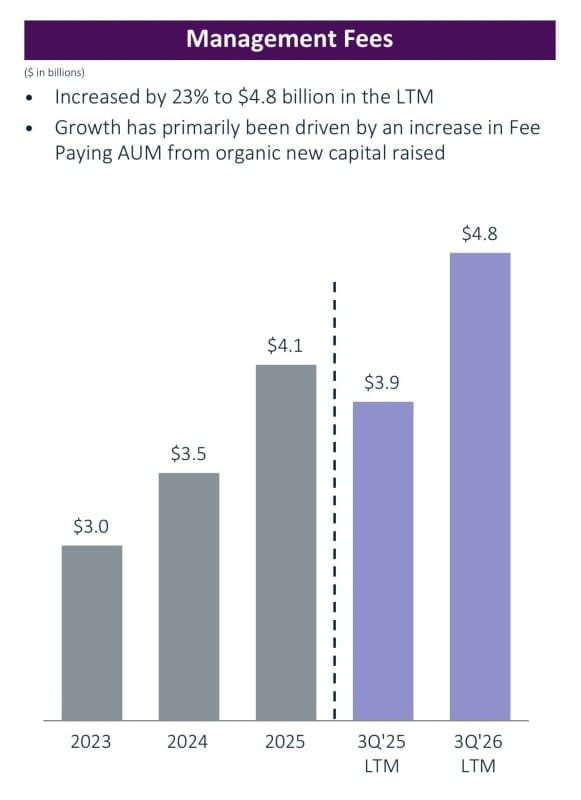
Profit from management fees (fee related earnings) rose 24% year-on-year in the third quarter to USD 1.42 per share. The margin on those management fees came in at around 71%, the highest in KKR's history. Including the results of Global Atlantic and Strategic Holdings, total operating profit grew by 21% to USD 1.88 per share. From management fees alone, KKR received USD 1.2 billion in the quarter, as much as in the whole of 2019. Those fees depend on assets under management, which at the end of September stood 11% higher than a year earlier, at USD 804 billion.
Not all of the profit growth stems from higher management fees. Part of it is related to a change in how performance fees from the private equity funds that KKR sells to retail investors are accounted for. Since the second quarter of 2026, KKR has included these in profit from management fees. As a result, employees receive a compensation share of 15 to 20% on this, instead of the previous 70 to 80%. KKR estimates that this will leave shareholders with roughly USD 300 million in extra profit in 2026. New capital is important, because KKR earns management fees on it in future. However, newly raised capital fell in the third quarter from USD 43 billion a year earlier to USD 25 billion, although that earlier figure was the highest quarterly total in over four years.
Fifty years of experience
During the discussion of the quarterly results, KKR co-CEO Scott Nuttall addressed the critical coverage at length. In 2026, investors were concerned, among other things, about whether software companies losing customers to AI would still be able to repay their loans. In addition, retail investors were withdrawing money from private credit funds, and private equity managers were struggling to sell their companies. There are also fears that the rise in interest rates is putting pressure on returns in the sector.
 Michael Gielkens
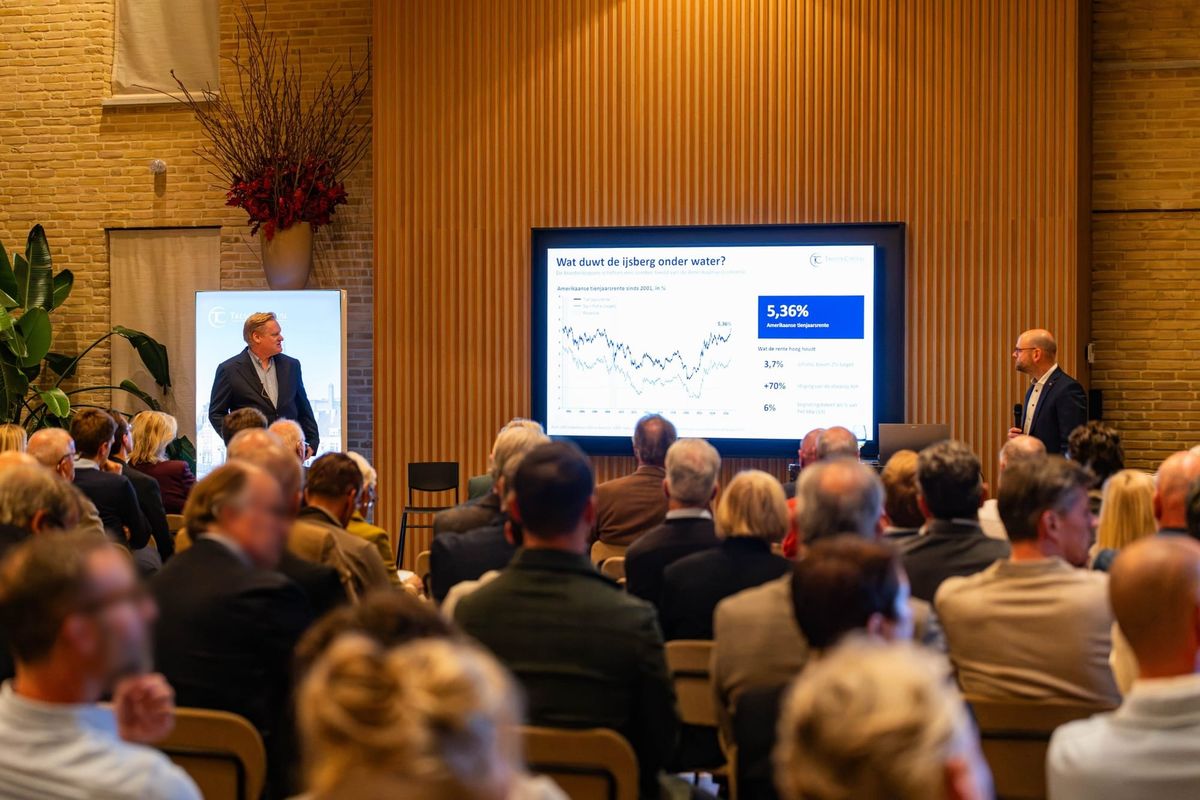
The gap between KKR's fundamental performance and its share price was also discussed at our relationship day
Scott Nuttall offers a historical perspective on this. Since KKR's founding in 1976, the yield on ten-year US Treasury bonds has averaged 5.8%. From the start of 2010, that average stood at 2.7%. In early November, the yield of around 5% was therefore below the fifty-year average. However, most private equity managers only went public around or after the 2008 financial crisis. As a result, investors know them as listed companies almost exclusively from a period with interest rates of at most 3%.
Moreover, more than 65% of private market firms were founded after 2009. Fewer than a fifth existed during the 2001 recession. These firms have therefore never invested through a genuine economic downturn. In the fifty years since its founding, KKR has lived through, among other things, oil crises, the real estate crisis of the early 1990s, and a period with a US base rate of more than 20%.
"It works in our favour that our sector is now developing like a K, with the winners taking market share from the laggards."
Scott Nuttall, co-CEO of KKR
Scott Nuttall observes that clients are increasingly placing their new money with a smaller number of firms that keep performing well despite the turmoil. He expects this trend to continue. That choice has major consequences for clients, since under normal market conditions the difference in returns between the best and worst quartile of private equity managers can amount to 16 to 18 percentage points. Between 2010 and 2020, that difference was barely noticeable, because the whole market had the wind at its back and almost every firm achieved good returns. According to Scott Nuttall, luck was therefore quickly mistaken for skill in those years. Now that interest rates are higher, the differences in quality between firms are becoming visible.
Record amount returned to clients
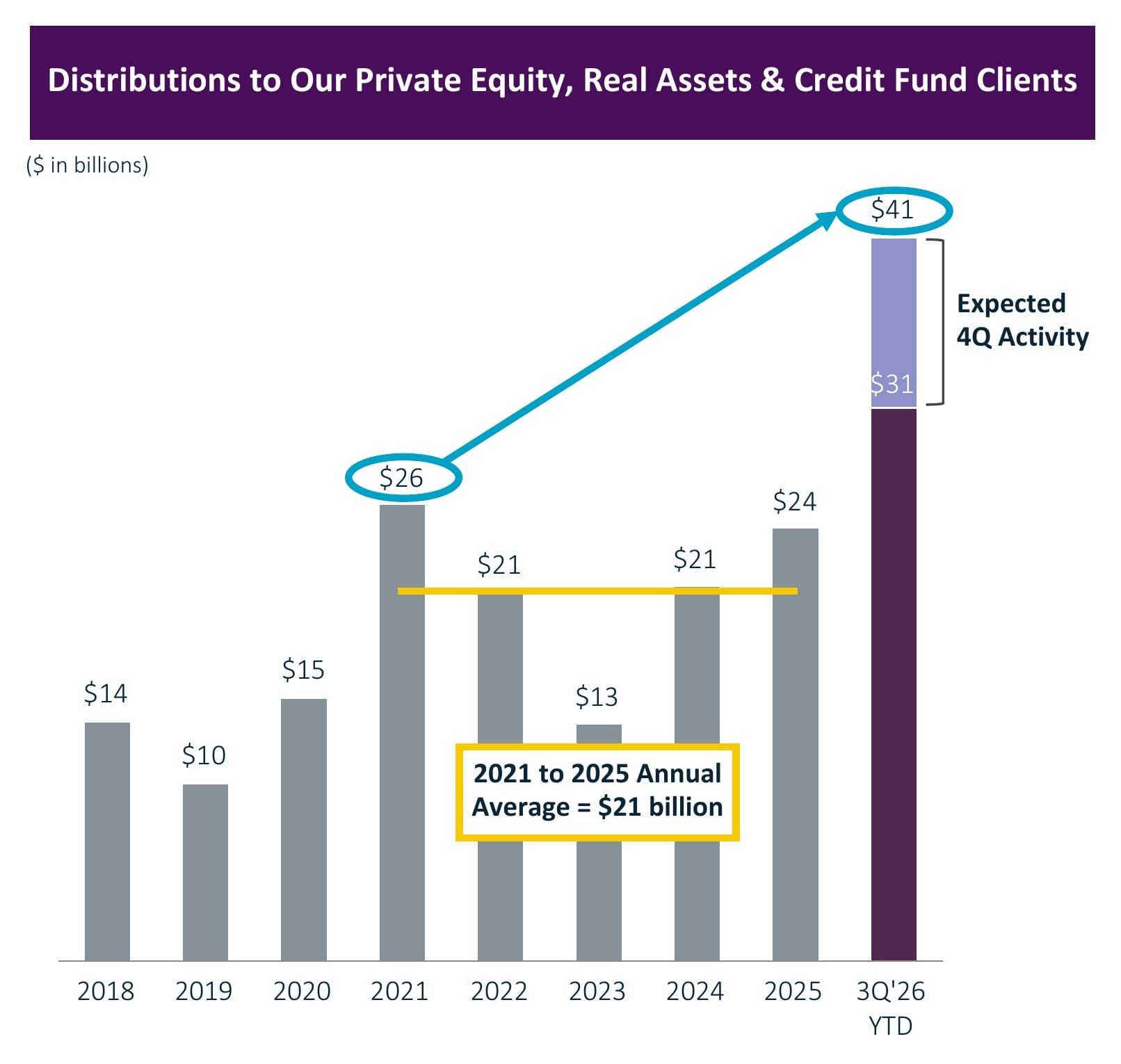
For investors in private equity funds, what ultimately matters most is how much money they get back when the portfolio companies are sold. In this respect, KKR clearly stands out from other firms. Through early November, KKR distributed USD 31 billion in 2026 to investors in its private equity, infrastructure, real estate and credit funds. For the whole of 2026, KKR expects just over USD 40 billion, an increase of more than 50% compared with the previous record set in 2021. Elsewhere in the sector, selling off stakes is proving much harder going.
The most widely discussed sale came from Strategic Holdings, KKR's own portfolio of businesses, which the American press has dubbed a mini-Berkshire Hathaway, a reference to Warren Buffett's investment holding company. KKR sold the American insurance broker USI Insurance Services for USD 17 billion to its larger industry peer Aon, completing the transaction recently. USI had been KKR's first investment in 2017 with a much longer investment horizon than typical private equity holdings. Over the past twelve to eighteen months, investors had wondered whether KKR was overvaluing USI, given that AI could affect the insurance broking industry. The price Aon paid removed those doubts, coming in 33% above USI's most recent valuation. On its original investment, KKR earned back roughly six times its stake. After tax, KKR will receive approximately USD 3.3 billion in cash and will book a profit of around USD 2 billion.
However, the sale also removes the operating profit that USI contributed to Strategic Holdings each year. According to BMO analyst Brennan Hawken, this amounted to roughly 40% of the operating profit expected from that division in 2026. This has a significant impact, since KKR aims to grow Strategic Holdings' operating profit from just over USD 350 million in 2026 to more than USD 1.1 billion in 2030. USI's expected 2030 profit had been included in that target. KKR CFO Rob Lewin addressed this in detail at BMO's conference.
“We expect that three recent investments in Strategic Holdings will contribute almost as much operating profit to KKR in 2030 as USI would have done that year. What's more, we have invested less capital in these three businesses than we freed up through the sale of USI.”
Rob Lewin, CFO of KKR
By 2028, the three new investments should already offset about half of that lost profit. For Strategic Holdings, KKR looks for businesses with stable earnings that depend little on the economic cycle and in which it is willing to stay invested for a long time. According to Rob Lewin, the three new investments meet those criteria and sit in sectors that KKR knows very well. The first new investment is Integer, which develops and manufactures medical devices on behalf of manufacturers. KKR also took a stake in Gen II Fund Services, which provides fund administration in North America for funds that invest outside public markets — a field KKR knows from its own experience. Finally, KKR bought a stake in A1, which installs and maintains garage doors for private customers. As a result, despite selling USI, KKR is sticking to its target of more than USD 1.1 billion in operating profit for Strategic Holdings by 2030.
KKR can also use the proceeds from USI to buy back its own shares. Management believes KKR is undervalued on the stock market and expects earnings per share to rise over the long term as the number of shares outstanding falls. When KKR decided to sell USI in August, the share was trading around USD 110. By early November, the price had fallen below USD 100, making share buybacks even more attractive, according to Rob Lewin. From the start of 2026 through 4 November, KKR had already bought back more than USD 900 million worth of shares at an average price of USD 92 per share. Shortly afterwards, KKR increased its share buyback programme by USD 500 million.
Employees' interests are aligned with those of external shareholders, as staff themselves own a large part of KKR. In November, this stood at around 30%, and the most recent share awards to senior staff only fully vest once the share price is above USD 250. They therefore only benefit in full once shareholders have also seen substantial gains.
More than an asset manager
At the BMO conference, Brennan Hawken also asked Rob Lewin why KKR uses its own capital to hold an insurer and corporate stakes (a so-called capital heavy, or capital-intensive, business), while many competitors only manage client money (capital light). Brennan Hawken says he is getting asked this more and more often by investors.
“Whether KKR should be capital heavy or capital light isn't up for debate within our company. We simply look at where we can best invest the capital that becomes available. That's something our management team is exceptionally good at.”
Rob Lewin, CFO of KKR
Rob Lewin stresses that the industry is currently growing fast, but that this pace won't last forever. When growth slows, KKR, with Global Atlantic and Strategic Holdings, has sources of profit that depend less on fresh client capital. Rob Lewin expects that investors will then start asking competitors why they didn't invest more in their own businesses while they had the chance, as KKR has done. In his view, the capital heavy companies will therefore come out on top in the long run.
Global Atlantic is a good example of how KKR allocates its capital. The insurer invests the money clients pay into an annuity mainly in bonds. Global Atlantic earns money on the difference between the return on those bonds and the interest it pays to clients. In the first half of 2026, that spread was too small according to KKR, which kept Global Atlantic cautious about writing new annuities. In September and October, both government bond yields and the extra compensation companies must pay investors for their debt rose. This made new annuities profitable again, and Global Atlantic sold so many to individual customers in those two months that, on an annualised basis, it amounts to roughly USD 20 billion.
AI without overconfidence
KKR is investing heavily in data centres and in the energy supply needed for them. An analyst therefore asked how much KKR has invested in AI infrastructure and what happens if new restrictions slow the construction of data centres. Scott Nuttall was level-headed in his response.
"We expect there to be both winners and losers among AI investments, but we let our experience guide us. That means parting ways with companies that are put at risk by AI, and also selling the winners a little too early rather than a little too late. You pay close attention to what could go wrong, and you stand ready to act when others run into trouble. That is usually where the most interesting opportunities arise."
Scott Nuttall, co-CEO of KKR
Four to five years ago, KKR assessed for every company in its portfolio whether AI represented an opportunity, a threat or a question mark, and sold a number of companies from the latter two groups. In 2026, KKR also sold its stake in the Japanese chip equipment maker Kokusai Electric for roughly twenty times the fund investors' original outlay. KKR also sold its stake in CoolIT Systems, which makes cooling systems for data centres, for fifteen times the original outlay. Both companies had in fact benefited strongly from investment in AI.
At the start of November, the seven data centre companies in the portfolio accounted for just 6% of the assets KKR managed in infrastructure. Including Global Atlantic's investments, all AI-related holdings together account for 1 to 2% of total assets under management. As a result, the risk remains limited if the construction of data centres slows down. Of the long-term lease agreements, 90% have been signed with governments or hyperscalers (the large cloud service providers) with high creditworthiness, which keeps the risk of default low. KKR also does not build data centres without a tenant already in place, so that it is never left holding empty buildings.
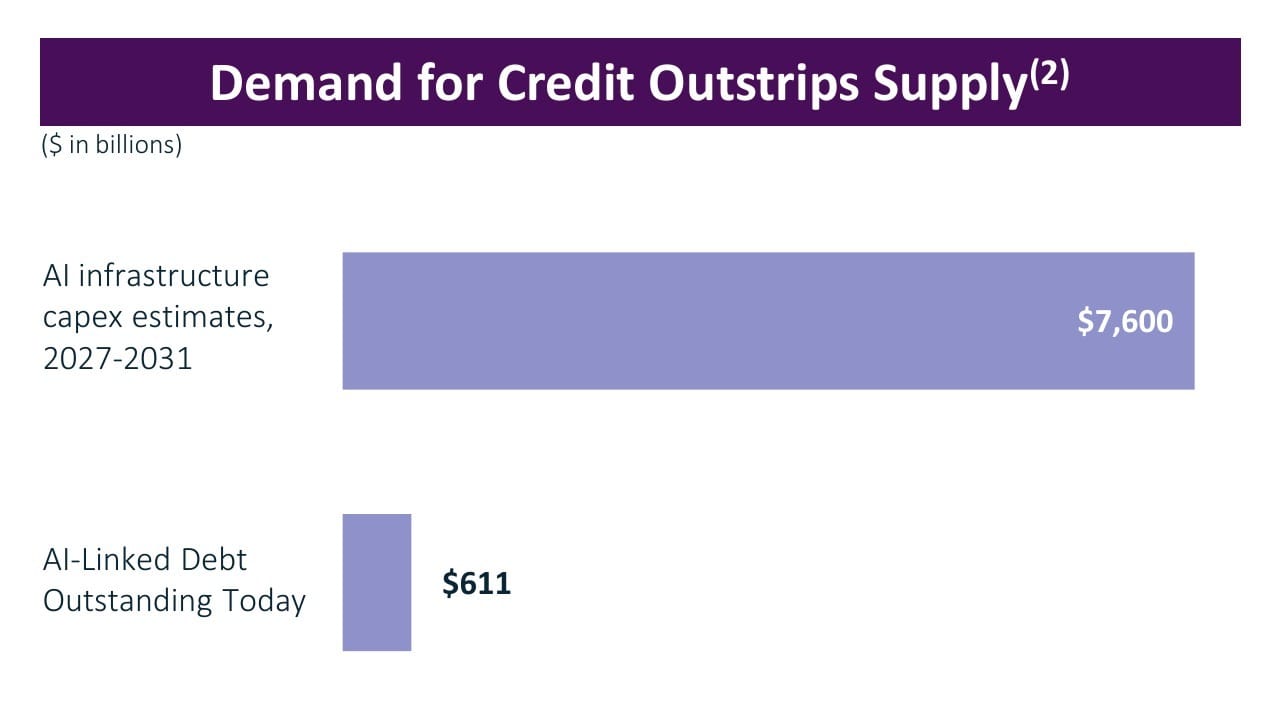
At KKR, Chris Sheldon co-leads the credit division together with a colleague. That division lends money to companies and invests in bonds and other loans. At the Barclays conference in September, Sheldon spoke about the financing of AI infrastructure, which he described as an enormous growth market for the division. According to estimates, the hyperscalers will invest around USD 7,600 billion in AI infrastructure between 2027 and 2031. For a large part of that, he said, they will turn to private investment grade, the market for off-exchange loans to parties with high creditworthiness.
"When financing a data centre, it is very straightforward to assess the creditworthiness of the tenant if that tenant is one of the hyperscalers. It is much harder to get to grips with the data centre itself, such as its location and where its power comes from. That is where the risks increase, because this market has opportunistic players active in it who lack all that expertise."
Chris Sheldon, co-head of Credit & Markets at KKR
For such financings, KKR therefore brings together the expertise of its infrastructure, real estate and credit teams.
The unease surrounding software companies also affects the credit division directly, since KKR itself finances many such companies. That unease was at its peak in the first quarter of 2026, when the market feared a sharp rise in the number of defaults on loans to software companies.
"Software stores an organisation's data and links its various sources together. AI only becomes truly useful once those connections are in place and the data is of high quality. As a result, many software companies are becoming indispensable for using AI, which will often fuel their growth. There will certainly be casualties, but generally speaking, the more a software company manages its customers' data, the better an investment in it tends to turn out."
Chris Sheldon, co-head of Credit & Markets at KKR
This matches the view we have expressed on several occasions in our newsletters regarding software companies such as Constellation, Topicus, Asseco Poland and Chapters Group.
Even so, KKR is cautious about lending money to software companies. Many lenders also lend to software companies that are still loss-making, because such companies have steady subscription income. KKR hardly ever does this and lends mainly to software companies that already generate enough cash to cover interest and principal repayments. KKR also lends proportionally less to software companies than other lenders do. In mid-September, around 20% of the money KKR lends directly to companies went to software companies, compared with around 25% for the market as a whole. At that point, KKR had not noticed any sign, within its own loans to software companies, of the feared rise in defaults.
Prosus pays the price for the battle in Brazil
Earlier this year, Prosus (Amsterdam: PRX) announced that it would significantly increase its investment in the ecosystem of food-delivery and other platform companies in order to counter mounting competition. In a later letter to shareholders, CEO Fabricio Bloisi gave a first update on those investments and on the competitive battle. At the time, we raised some concerns, because the letter was mainly reassuring and contained hardly any figures that would allow an investor to check progress. With the half-year results covering the period up to and including 30 September, the bill is now on the table, and it turns out to be heavier than the tone of management would suggest.
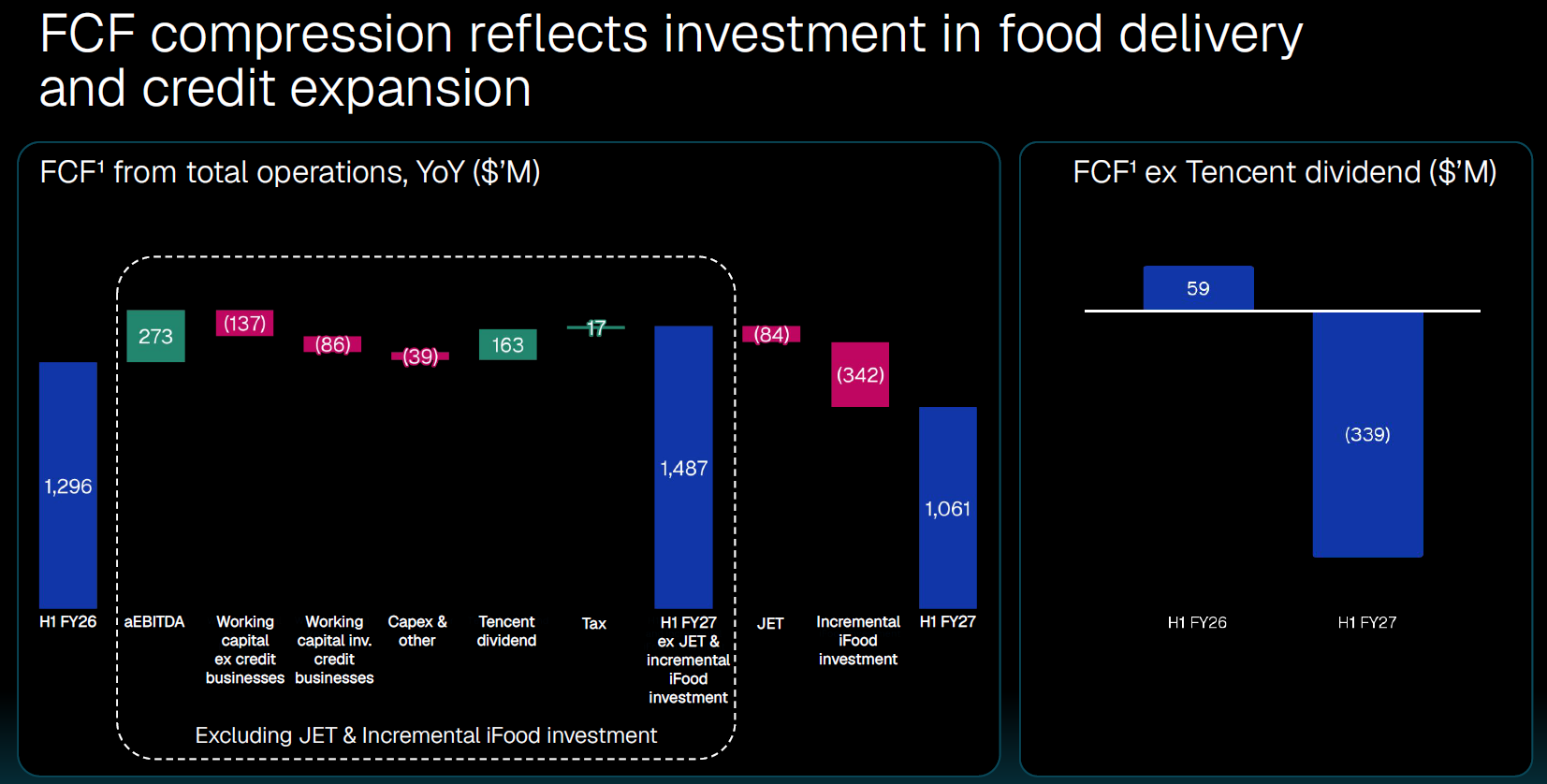
At first glance, the half-year looks strong, with ecosystem revenue growth of 59% to $5.7 billion. That growth, however, stems largely from the consolidation of Just Eat Takeaway (JET), over which Prosus has had control since December 2025. Excluding acquisitions and currency effects, revenue grew by 10%. More telling is adjusted EBITDA (operating profit before depreciation, amortisation and one-off items), the figure most analysts focus on. That fell from $530 million to $492 million, even though JET was included in this year's figures but not in last year's. The difference lies in the $344 million that Prosus invested additionally in iFood and JET, most of which went to Brazil. At iFood, adjusted EBITDA consequently fell from $184 million to just $28 million.
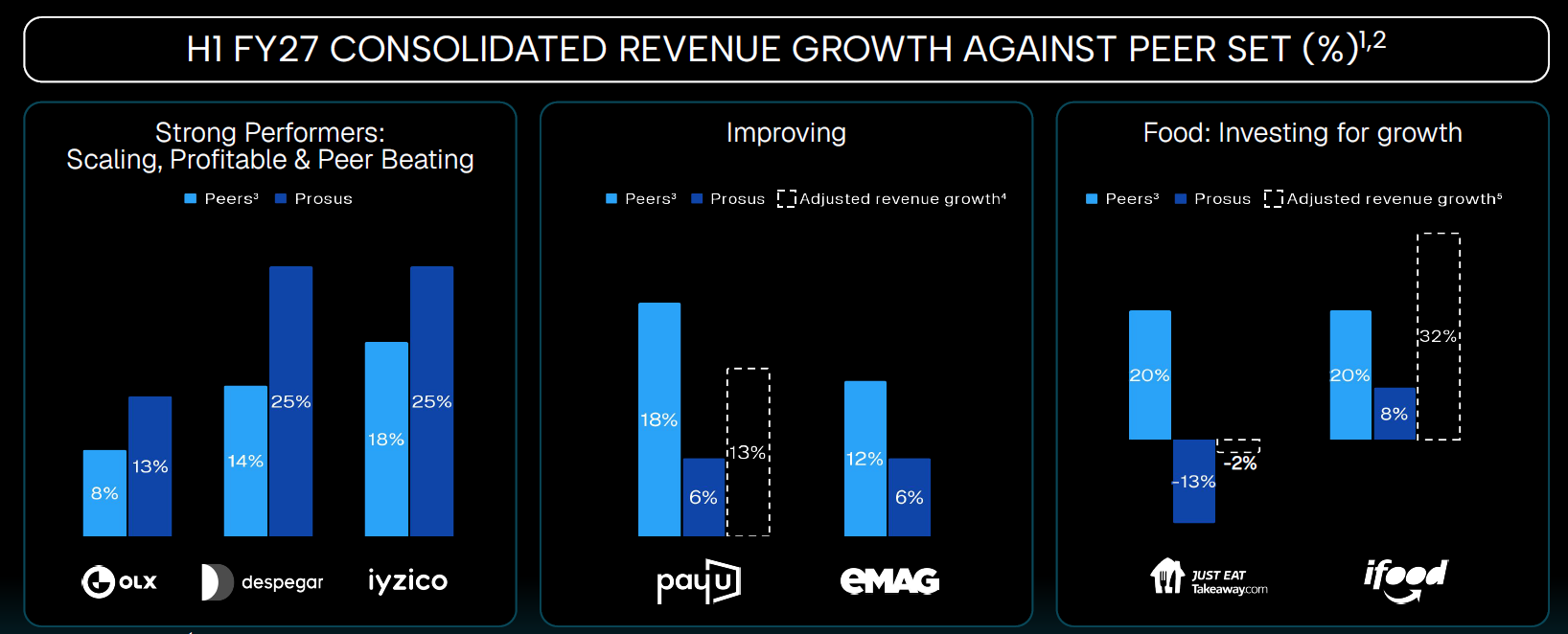
The full-year guidance for iFood, just over $100 million in adjusted EBITDA, moreover includes a one-off Brazilian tax benefit of $79 million. Asked where that windfall came from, CFO Nico Marais explained that it relates to a tax arrangement from the Covid period, on which Prosus gained clarity this half-year. According to him, that windfall also gave management the confidence to invest a bit more. In this way, a one-off tax item is offsetting part of an investment that management itself describes as anything but one-off. Asked whether iFood can grow in financial year 2028 without that $79 million, Marais said no more than that this is "certainly the ambition".
This also puts renewed pressure on one of the key proof points of "Prosus +". Last financial year, the ecosystems excluding Tencent still generated a positive free cash flow of $275 million, which management used to demonstrate that the rest of the portfolio could stand on its own two feet. This half-year, that turned into an outflow of $339 million. Marais expects a return to positive cash flow in the second half, but admitted that the year as a whole will likely still come in negative.
The profitability picture is little better, as Marais described adjusted EBITDA of $1.1 billion as "the low end of my expectation". Following the $1.3 billion recorded last financial year, financial year 2027 will therefore be a year of decline. For the years after that, management offers little to go on. It gave no figure for financial year 2028, although Marais said during the presentation that he expects competition to persist and iFood to keep investing to defend its position. Bloisi put it in his own words: "We're not giving guidance today, because we are committed to winning. We don't want to commit today to next year's profitability."
That statement is typical of the tone of the entire call, in which, according to Bloisi, the cause of the disappointing figures repeatedly lay outside Prosus. The lower profit was, in his words, a deliberate sacrifice: "I could simply have delivered one and a half billion dollars or more this year. That was entirely within my reach." Asked what options iFood has if competitors again spend some $1.5 billion next year, he turned the question back on the competitor: "Call them and ask them what the options are." He also blamed the market for the discount to intrinsic value, which keeps widening despite billions in buybacks. According to him, the market is willing to value companies that lose tens of billions on AI at trillions, yet is unable to value any ecosystem outside California. About his own role, he left no doubt: "I am the best operator in Latin America, India and Europe." According to him, Prosus has moreover "never performed this well".
That a CEO places the blame entirely outside the company and calls himself the best, in a half-year in which operating profit falls, cash flow excluding Tencent is negative and the discount keeps widening, strikes us as a serious red flag. Moreover, that confidence does not always square with the company's own figures. For instance, Bloisi cited the new low-cost meal format Hits as proof that iFood can now compete with virtually no subsidy, since the product reportedly now has a positive gross margin. Prosus's own presentation, however, shows that the operating margin per order in September was still negative. So the product is improving, but it is still losing money per order. Nor is it likely that the battle in Brazil will blow over quickly, since other major players in Latin America, such as MercadoLibre and Sea Limited (Shopee), are also currently investing heavily to defend their position in the region.
As long as that investment continues, the "Prosus +" story we wrote about earlier remains unproven, although there are certainly bright spots. OLX raised its margin to 51%, PayU posted a positive adjusted EBITDA of $12 million for the first time, and the cross-selling between iFood and Despegar is demonstrably working, with 27% of Despegar's Brazilian consumer revenue now coming in via iFood. However, these amounts pale in comparison to what is being invested in delivery. The share buyback also points in that direction. Of the $5 billion earmarked for this year, $3.2 billion has been spent, roughly half of which is being funded through the sale of Tencent shares. Bloisi called it "the best buyback we've ever done", precisely because it increases the exposure to Tencent per share.
However, Tencent's own figures from last week also paint a less rosy picture. Revenue grew by 8%, less than expected, and adjusted net profit fell by 6%. Investment rose by 527%, leaving free cash flow negative for the second quarter in a row. According to president Martin Lau, this level of investment will remain high through 2027.
That same week brought a fresh setback, as Washington tightened chip rules once again. Since 19 November, a US licence is required to supply advanced AI chips to data centres in Indonesia, Malaysia, Singapore, Thailand and Brazil. In addition, Chinese companies are no longer allowed to simply access chips remotely in foreign data centres. This closes off the route through which, among others, Tencent rented computing power from Nvidia in Southeast Asia. Lau was notably blunt about it: "It sets everyone in China back." According to him, this means it will take Tencent longer to bring out the next version of its model. Tencent does expect cloud revenue to barely suffer, since that business mainly relies on applying existing models, which require fewer chips.
So the company is currently investing record amounts in AI, while access to the best chips is being restricted further and further. Domestic alternatives will narrow that gap over time, but until then the return on current investments becomes more uncertain, precisely at a time when Tencent is pouring a large share of its cash flow into them.
New valuations in private holdings
Anthropic (New York: ANT), the company behind the AI model Claude, made its stock market debut on Thursday 19 November. This followed the largest IPO ever. The company raised $81.3 billion at $83 per share. That was above the previously announced range of $70 to $78 and implied a fully diluted valuation of around $1.5 trillion. Demand for the share was strong on the first day of trading. The opening price was $111.50 and over the course of the day the share rose to $115.10. That briefly valued Anthropic at over $2 trillion. After that it fell quickly, with the share dropping below the offer price by the fourth trading day, towards a low of $74.
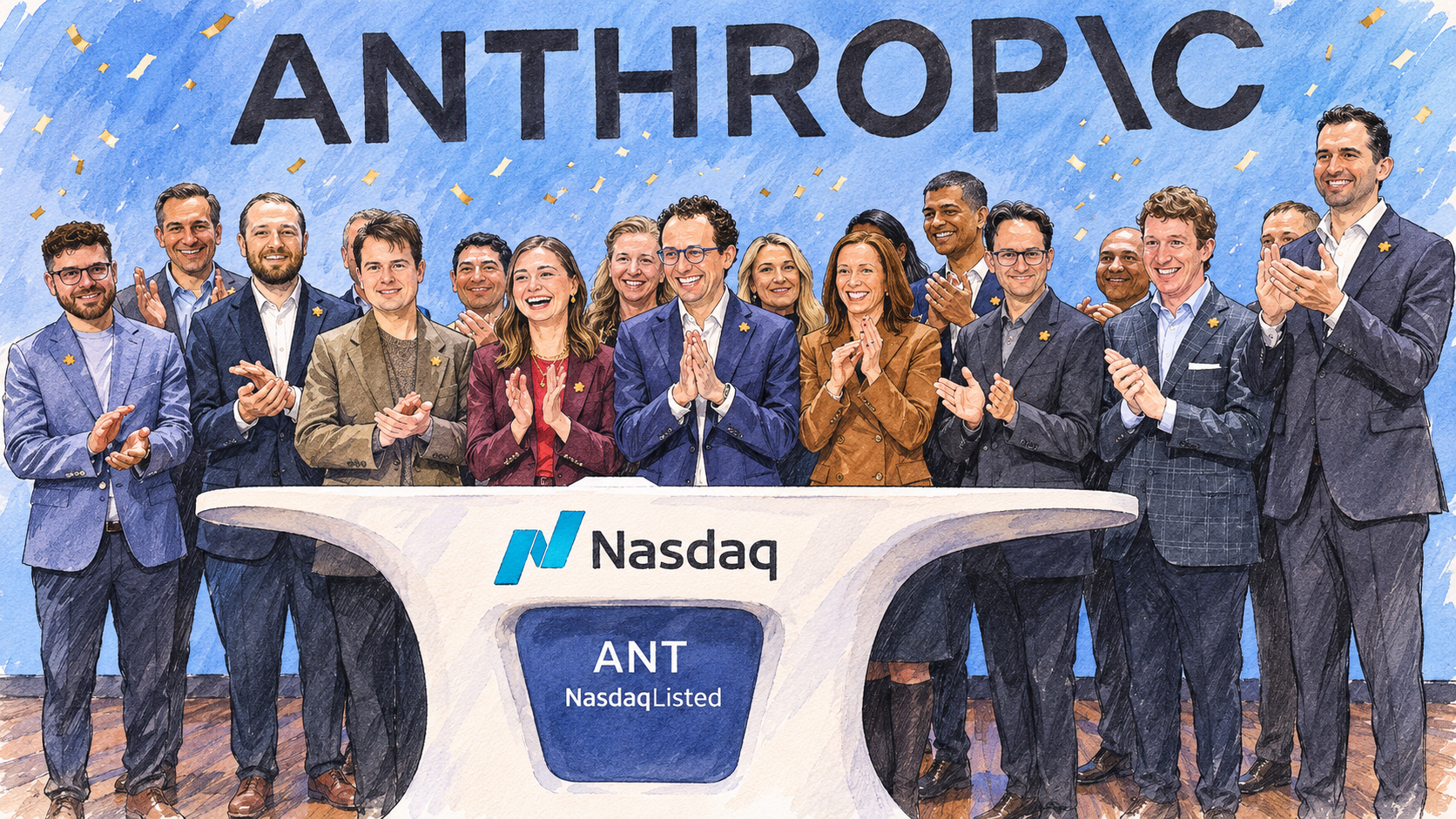
We are following this development closely, because four companies we regularly write about had already invested in Anthropic well before the company went public. According to the prospectus, Alphabet (New York: GOOGL) holds 13.7% of Anthropic following the listing, and Amazon (New York: AMZN) holds 14.7%. Amazon can expand that stake via convertible loans to 23.8%, but only if it lifts the agreed cap on its own holding. With these stakes, every dollar of share price movement in Anthropic is worth approximately $1.9 billion to Amazon and $1.8 billion to Alphabet. At Scottish Mortgage (London: SMT), Anthropic accounts for roughly 4 to 5% of the portfolio, while at Sofina (Brussels: SOF) it is, through its stakes in private funds, the fourth-largest underlying position. For both holding companies, the listing mainly changes the way the stake is valued. Until now this happened periodically, based on the most recent funding round. From now on, the value will move in line with the share price, and with it the net asset value of Scottish Mortgage and Sofina.
In addition, there is another private company in the portfolios of Scottish Mortgage and Sofina heading for a substantially higher valuation: Stripe. Through its venture capital funds, Stripe is Sofina's third-largest indirect position, and at the end of October it accounted for 2.6% of Scottish Mortgage's portfolio. According to The Wall Street Journal, Stripe is in advanced talks over a new tender offer, which would allow employees to sell part of their shares. The valuation in this offer is expected to come in above $200 billion. That is at least 26% more than the $159 billion from the previous tender in February, and a multiple of the roughly $50 billion seen in 2023.
Receive weekly insights in your inbox
Exclusive analyses and updates on family holding companies and global market developments.
Would you like more information about our services?
Get in touch
Disclaimer:
No rights can be derived from this publication. This is a publication of Tresor Capital. Reproduction of this document, or parts thereof, by third parties is only permitted after written consent and with reference to the source, Tresor Capital.
This publication has been compiled by Tresor Capital with the greatest possible care. The information is intended in a general sense and is not tailored to your individual situation. The information should therefore explicitly not be regarded as advice, an offer or a proposal to purchase or trade investment products and/or to take up investment services, nor as investment advice. The authors, Tresor Capital and/or its employees may hold positions in the securities discussed, for their own account or on behalf of their clients.
You should carefully consider the risks before you start investing. The value of your investments may fluctuate. Past performance is no guarantee of future results. You may lose (part of) your invested capital. Tresor Capital disclaims any form of liability for any inaccuracies or errors. This information is purely indicative and subject to change.
Read the full disclaimer at tresorcapitalnieuws.nl/disclaimer .
This article was originally written in Dutch and automatically translated into English with the help of AI. In case of any difference, the Dutch original prevails.