Family Holdings #47 - European formulas on their way to the US


This week's topics:
MBB (Frankfurt: MBB) published its full third-quarter report, after the German family holding company had already raised its 2026 profit guidance for the second time earlier on. At IT subsidiary DTS, revenue fell by more than 25% in the first nine months due to delayed investments and a shortage of memory chips, but the margin nevertheless rose to 17.8%. Strikingly, MBB's share price is almost equal to the net cash position at holding company level plus the listed stake in Friedrich Vorwerk, meaning investors effectively get DTS and the other holdings thrown in for free. We also cover a recent interview with Vorwerk CEO Torben Kleinfeldt, who still expects decades of work from the energy transition, and discuss the acquisition of Hamburg-based Rapa Baudienst and Vorwerk's first step into North America.
In Brief:
Addtech (Stockholm: ADDT-B) is acquiring all shares in the UK's Hardall International through its Industry division. The company designs, manufactures and installs bespoke chutes for household waste, recyclable material, laundry and medical waste. Hardall also provides maintenance, repair and replacement of existing chutes. The Dunstable-based company has 60 employees and annual revenue of approximately GBP 13 million.
Chapters Group (Frankfurt: CHG) raised EUR 70 million in equity at the end of last week by issuing 1,590,908 new shares at a price of EUR 44 each. According to Chapters Group CEO Jan Mohr, the equity the company raised in July has by now been almost fully invested. Over the past few weeks, the directors of the platform companies put forward several acquisition candidates that boost earnings per share far more strongly than had been expected at the start of the year. At the board's request, they also outlined how, with the help of AI, they could develop a broader offering for customers around their existing software businesses, organised by industry. In doing so, Chapters Group increasingly aims to deliver complete solutions rather than standalone software products, with AI in some cases independently carrying out tasks for customers. The major shareholders once again took part in the capital raise. This week, Jan Mohr also personally bought EUR 462,608 worth of Chapters Group shares, at the same price as the capital raise (EUR 44 per share).
Markel Group (New York: MKL) is expanding its existing share buyback programme by USD 2.5 billion. The company decides for itself when and for what amount it buys back its own shares, depending on market conditions and its capital needs. In 2026, through to the end of September, the company had already bought back USD 685 million worth of its own shares, of which USD 315 million in Q3 2026. That meant the pace in Q3 2026 was notably higher than in Q2 2026, when Markel bought back USD 237 million worth of its own shares.
Alphabet (New York: GOOGL) has once again invested a significant amount in Isomorphic Labs, which was spun off from Google DeepMind in 2021 and develops new medicines with the help of AI. Isomorphic Labs raised USD 5 billion in total, around six months after an earlier funding round of USD 2.1 billion. The company intends to use the money to test its first candidate medicines in clinical trials with patients. Programmes in the fields of cancer and immunology have already shown positive results in preceding laboratory research. Novartis, Eli Lilly and Johnson & Johnson already work with Isomorphic Labs. Google also acquired the start-up Howie this week, whose AI software automatically schedules appointments via email the way a personal assistant would. Howie was valued at just USD 14 million in 2024, so this acquisition is primarily about the technology and the staff. Google aims to use that expertise to further improve its AI software for small businesses.
Constellation Software (Toronto: CSU) recently acquired six companies, including three Australian businesses. The acquired company SpinifexIT, based in Chadstone, develops software that helps companies manage their HR and payroll administration within SAP. In Newcastle, Australia, it acquired PDS, which supplies software for maintaining and monitoring mining installations. In Sydney, it went on to acquire The Coding Company, which makes software that healthcare institutions use to code medical diagnoses and treatments. In Sweden, it acquired the listed company Triona, which provides software and advisory services to companies in the infrastructure, transport and forestry sectors across Northern Europe and generated revenue of approximately USD 25 million over the past twelve months. Penso Tecnologia, acquired in Brazil, manages IT systems and cloud infrastructure for companies and government bodies and protects them against cyberattacks. Finally, in the US, it acquired Aspenware, which makes software for online sales, guest registration and trip planning for ski resorts.
3i Group buys back own shares and increases stake in Action
It has been a while since we last had an update on Action, as 3i Group (London: III) opted out of the Private Equity Capital Markets Seminar this year, which in previous years always gave a brief interim update on Action. The half-year results for the first half of financial year 2027, covering the period from April to September 2026, now fill that gap. The holding company achieved a total return of 5% on equity, lifting net asset value per share to £31.54. Adjusted for exchange rates, the return came to 7%.

How good the figures are depends on the perspective you choose, and we would describe them as in line with expectations. They are not outstanding, but given the circumstances they are certainly not poor either. CEO Simon Borrows pointed to the situation in the Middle East, which has sharply driven up energy prices and disrupted supply chains. According to him, the inflationary effect of this has “weighed heavily on consumers and acted as a brake on spending and confidence”.
Against that backdrop, the capital allocation is a clear sign of confidence in the company's own figures and in its business model. As we reported earlier in the newsletter, 3i continues to increase its stake in Action, and during this period the holding company bought a further 2.1% for £764 million, bringing its stake to 67.5%. 3i paid with new shares issued at the net asset value of £31.31, while over the same period it bought back £742 million worth of its own shares at an average of £24.95. Issuing at net asset value while buying back at a discount delivered shareholders a benefit of roughly £150 million by our calculation. Management also immediately announced a second buyback programme of up to £750 million, running until the end of May 2027, which at the current market value of approximately £25.75 billion amounts to around 2.9% of the company. Borrows described buybacks as “very attractive” as long as the share price remains below the value of the portfolio.
Action's results
Since Action accounts for more than three-quarters of that portfolio, we focus in particular on the concerns surrounding the chain. The first of these concerns like-for-like sales growth, which is no longer growing at the 6 to 8%, and in some periods even more than 10%, seen in previous years. This year's target was accordingly set lower, at 4 to 5%, and after a weak first quarter with a very late but extremely warm summer, it quickly became clear that the outcome would likely be at the lower end of this range. Through week 45, the tally stands at 3.7%, compared with 3.4% at the end of September, and management now expects “around 4%” for the full year. By our rough calculation, that requires growth of 5 to 6% in the final seven weeks, roughly the same pace as over the past six weeks. The comparison base helps here, as the fourth quarter of last year was weak.
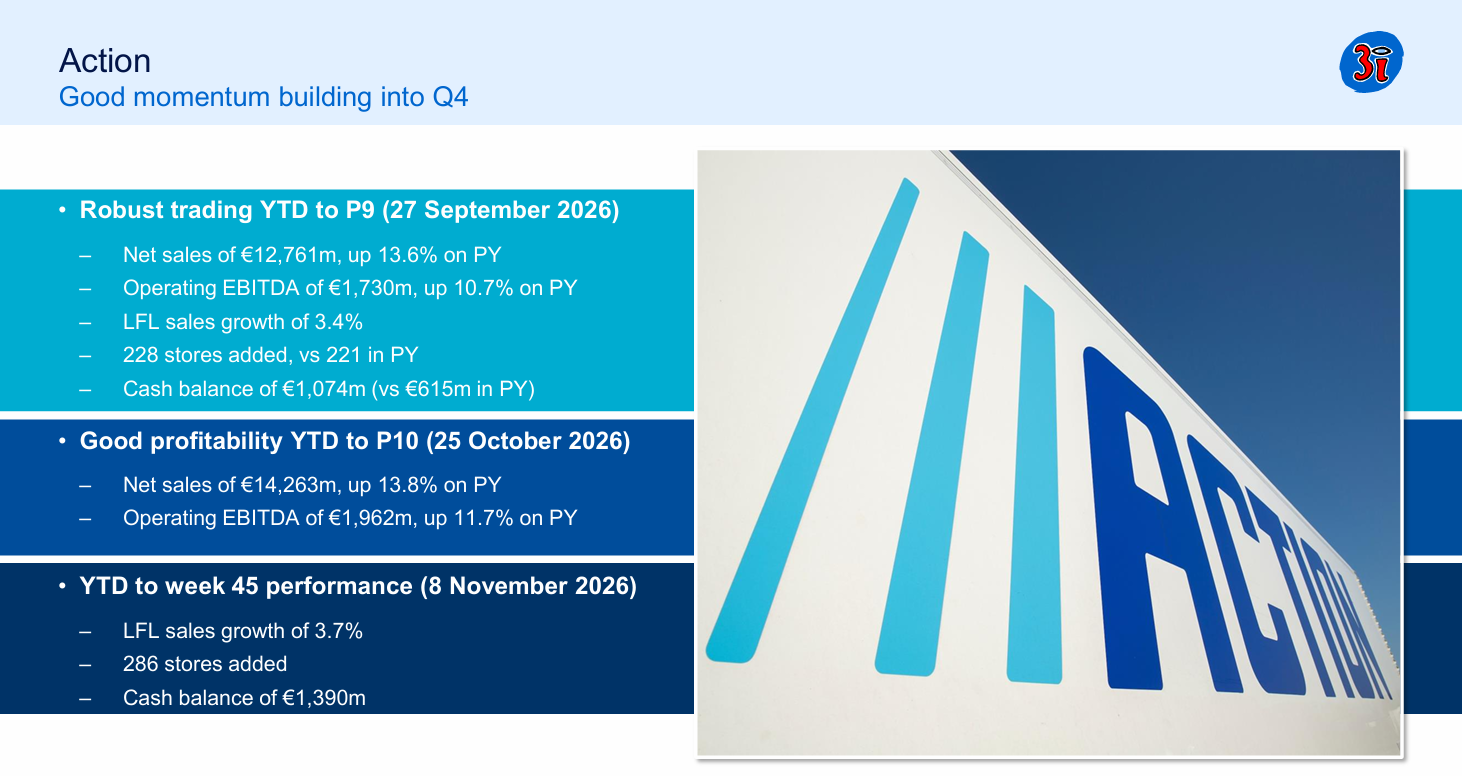
That 3.7% figure already reflects the poor last week of September and the first week of October, when energy and fuel price caps were lifted in several countries and both footfall and sales declined. Borrows described this as an exception that stood in sharp contrast to the weeks before and after it.
On the unrest in France, he said that trading there has “so far not been materially disrupted”. Action did see fewer visitors on specific days, but according to the half-year report the disruption remained limited to a small number of stores, and market share in France actually increased further. France, like Germany, therefore remains a market where like-for-like growth is positive but clearly lags behind the rest of the network. The strength at the moment lies in the Benelux, where growth, despite the maturity of these markets, averages a single-digit percentage, and especially in Southern Europe, which is growing at double digits, led by Spain. Action is also holding its own in Poland, where despite the price war being fought between two major supermarket chains, like-for-like growth remained positive, and according to Borrows the chain is gaining market share.
These growth figures come with the caveat that Action has cut prices significantly this year. Over nine months, more than a thousand items, roughly half of the core range, were reduced in price, typically by 5 to 10%. As a result, like-for-like growth comes entirely from the number of transactions, which in every country is rising faster than revenue. The average number of weekly visitors increased from 20.6 to 23.2 million. According to Borrows, Action can do this without materially affecting its business model, thanks to increased purchasing power and higher volumes following each price cut – direct evidence of the economies of scale the company benefits from.
The second point worth watching is the margin, which through to September had visibly lagged behind the full-year target of 14.8%. Over the first nine periods, the operating margin (EBITDA) came in at 13.6%, versus 13.9% a year earlier, with the shortfall arising mainly in the third quarter. Borrows did not point to the more than a thousand price cuts, since purchasing costs have in fact fallen sharply thanks to increased scale. Instead, he cited three other causes: lower-than-expected revenue due to the persistent heat, a jump in shrinkage (stock losses from theft and breakage, among other things) in certain countries, and high sickness absence, which required more expensive temporary staff. He regards these factors as temporary, and in October the margin had already climbed back above 15%. Since November and December are the months with the highest revenue and margin, management expects 14.7% or 14.8% for the full year.
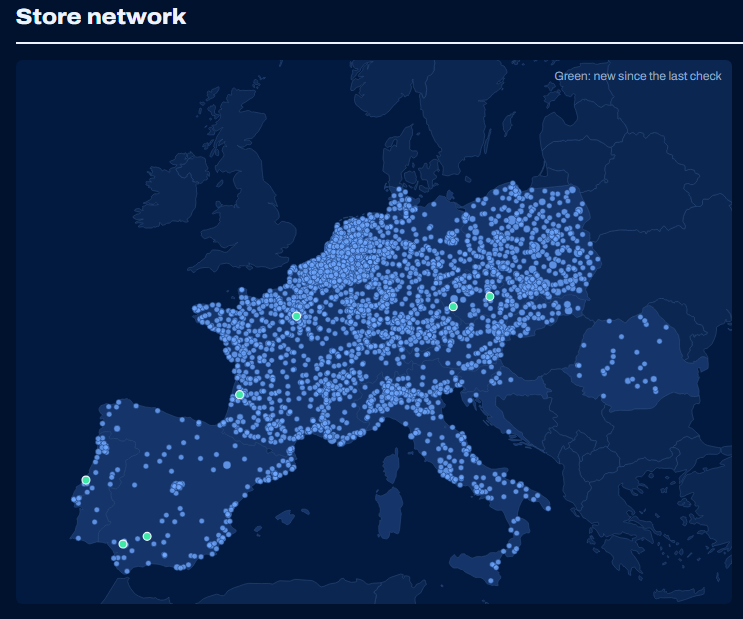
While the margin still has something to prove in the final quarter, the catch-up on store openings is already visible, after it had long looked as though Action would miss its target. At the end of September there were 228 new stores, and by early November 286, but in the two weeks that followed another 73 were added, bringing the tally to 359. To reach the target of at least 400, only 41 more need to open in the remaining weeks of the year, which looks achievable. The new stores are performing above expectations and still pay for themselves within a year. This year saw two new countries added, Croatia and Slovenia, where Action now has eight and four stores respectively. Next year will see at least Bulgaria and the United States follow, and possibly Greece as well.
Remaining private holding companies
The rest of the portfolio, worth around £5 billion excluding Action and Royal Sanders, held up well. Of the portfolio, 96% of the value showed profit growth and there were no material write-downs. Royal Sanders reached agreement on the acquisition of Zwitsal, its tenth under the 3i Group banner, expected to be completed in the first quarter of 2027. In addition, 3i invested £118 million in the French supplements brand Nutergia. The infrastructure arm achieved a 13% return, driven mainly by the share price rise of 3i Infrastructure.
Conclusion
All in all, we give this half-year a 7. That is not an outstanding score, but in a climate where the European consumer is visibly under pressure, most of the figures are in line with expectations. Whether the year as a whole ends up at an 8 or higher depends on the final quarter. The 400 store openings look within reach, so it will mainly come down to a margin of 14.8% and, above all, comparable growth of 4%.
Energy transition keeps MBB subsidiary Vorwerk busy for decades to come
We recently wrote about the preliminary third-quarter figures of the German family holding company MBB (Frankfurt: MBB), which, thanks to its subsidiary Friedrich Vorwerk, raised its profit forecast for the whole of 2026 for the second time. MBB has since published its full quarterly report, which also includes detailed results for its other subsidiaries.

DTS supplies cybersecurity, cloud services and IT system management to mid-sized German companies and public authorities, using its own data centres to do so. In the first nine months of 2026, revenue fell by 25.2% to €67.6 million. Many customers postponed their investments because of economic uncertainty stemming from the conflict surrounding Iran. In addition, projects were delayed by a shortage of memory chips, which meant some components arrived late and became more expensive. As a result, DTS still has a number of projects on hand that it can only complete once the required components arrive.
Even so, DTS's profitability held up well. Operating profit fell by only 5.2% in the first nine months to €12 million, lifting the margin from 14% a year earlier to 17.8%. In Q3 2026 the margin even came in at 19%, even though revenue in that quarter fell by 32% to €22 million. This improvement is the result of efficiency measures and a shift towards proprietary software and services.
MBB CFO Torben Teichler expects DTS to complete the projects for which it is still awaiting components as the overdue deliveries come in, but he describes the situation as still difficult for the time being. Public authorities, however, continue to invest in their IT, and Teichler also expects a few more orders towards the end of the year. Earlier in 2026, DTS already signed a €30 million framework agreement in the public sector. As the number of cyberattacks increases, MBB views the growing demand for IT security as a structural development.
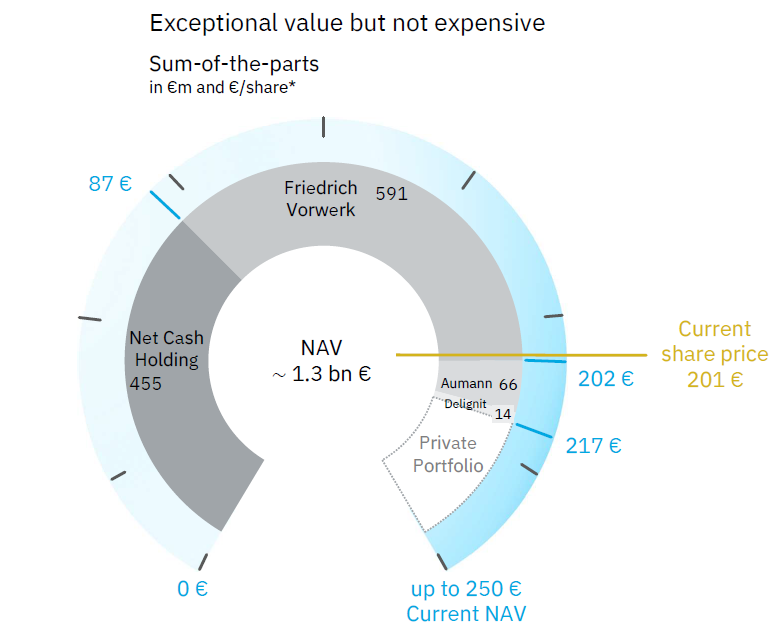
At the current share price, investors effectively get DTS for free when buying an MBB share. In the presentation accompanying its quarterly results, MBB calculated that the share price of €201 on 12 November was almost exactly equal to the cash available at holding level after deducting all debt, plus the market value of the stake in Friedrich Vorwerk. The same applies to the stakes in machine builder Aumann, wood processor Delignit and the Polish tissue manufacturer Hanke. Including all these stakes, MBB's combined parts add up to a value of as much as €250 per share.
Interview with CEO Vorwerk
This week, Friedrich Vorwerk CEO Torben Kleinfeldt gave an interview to Business Focus Magazine, in which he spoke openly about the company's opportunities and challenges. Vorwerk was founded in 1962 and today employs around 2,500 people. It has sixteen locations, mainly in northern Germany, and also operates from Poland and the Netherlands. The company designs, builds and manages the pipelines, cables and installations used to transport and distribute gas, electricity and hydrogen.
 Artwork
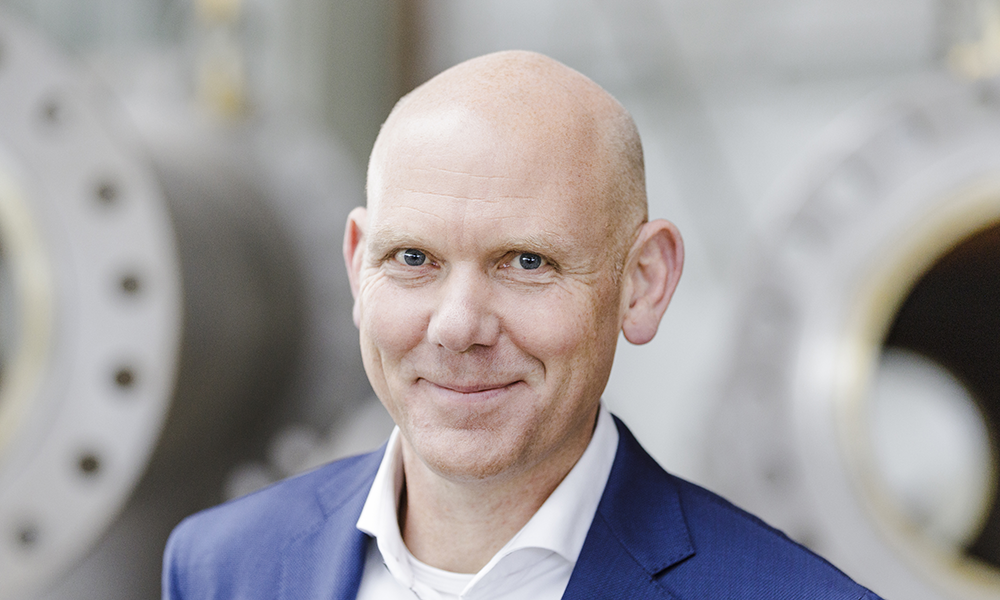
According to Kleinfeldt, Vorwerk stands out because it carries out a project from the initial study all the way through construction, and can then maintain and manage the installations for many years afterwards. Vorwerk is often well ahead of its time. For example, the company has been working on hydrogen since 2008.
The activities around CO2 capture, for which the company builds pipelines and installations that separate out the greenhouse gas, are relatively recent. Part of the captured CO2 is purified for use in beverages such as beer and soft drinks. Kleinfeldt sees CO2 capture over the coming years mainly as a transition technology that allows companies to keep using natural gas and other fuels for longer. For some industries, he believes capturing and storing CO2 will also remain necessary in the long term, because they cannot avoid their emissions.
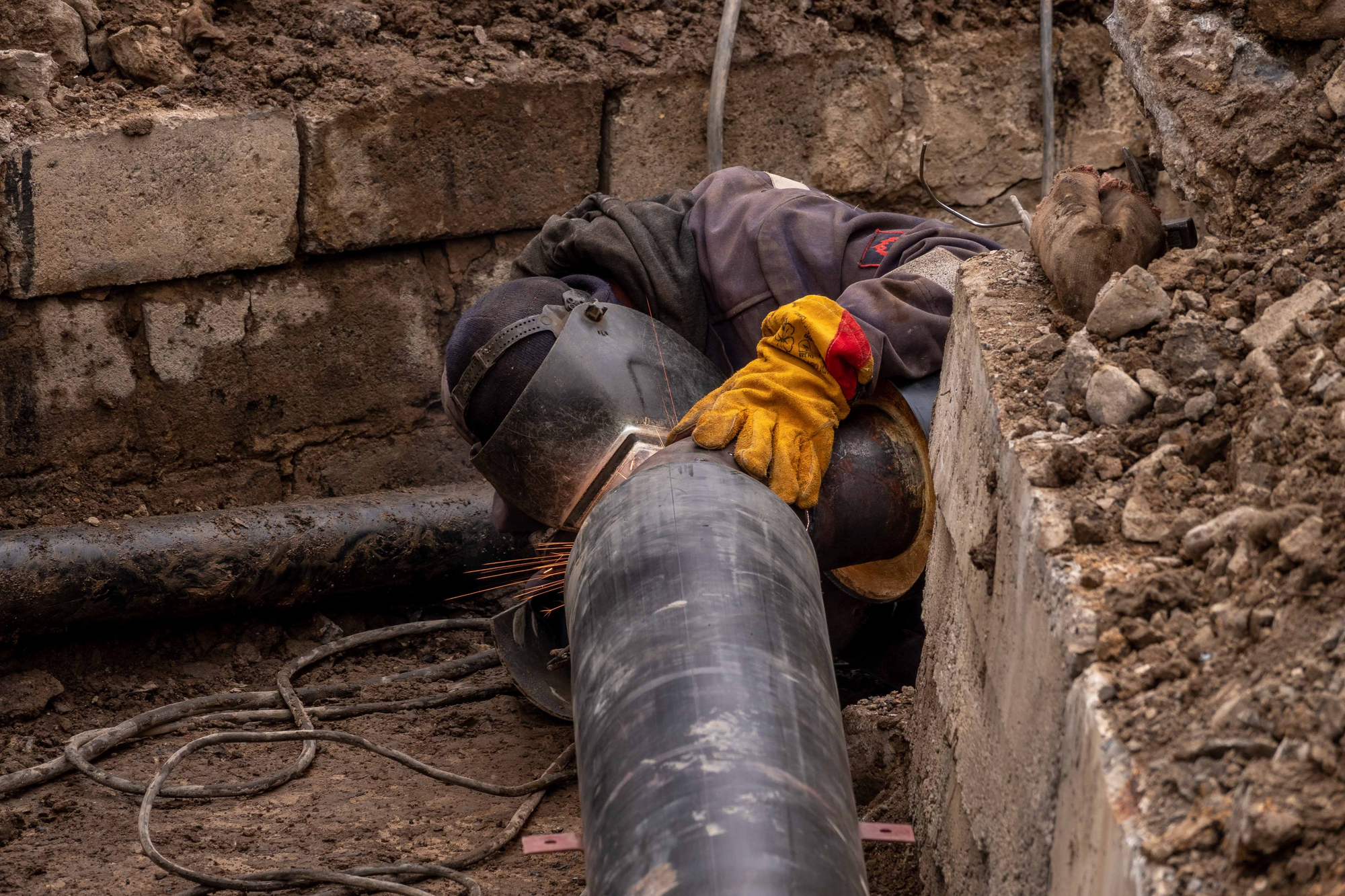
Kleinfeldt is also strikingly open about the problems Vorwerk faces. For large pipelines and cable connections that cross a national border, politics is consistently the biggest obstacle. Obtaining permission to use landowners' land often causes delays, while the company has already scheduled its people and machinery one or two years ahead. He regards such delays as simply part of the business. That is why Vorwerk deliberately plans in somewhat more work than it can handle simultaneously with its own capacity.
In addition, since the coronavirus pandemic it has become harder to find people willing to be away from home for an extended period for a project. Vorwerk therefore has to recruit more staff abroad, which makes projects more complex due to differences in language and culture. In countries outside the European Union such as Turkey, good skilled workers are available, but it takes a long time before they can start working in Germany. In his view, the solution lies in investing more in training and language skills.
Kleinfeldt expects Vorwerk will not run short of work in the coming decades. A larger share of the electricity grid needs to run on sustainable energy, and coal, gas and oil need to be replaced. The storage and conversion of energy are also becoming increasingly important. He also takes into account that the European Union may fail to meet its goal of climate neutrality by 2050, and expects work on the generation, conversion and transport of energy to continue until the mid-2050s.
“You could say that we are the ones delivering the energy transition.”
Torben Kleinfeldt, CEO of Friedrich Vorwerk
Kleinfeldt also thinks further ahead than his own career, which fits with being an owner-operator who himself holds 18% of the shares. Over the next twenty years, Vorwerk wants to attract and train enough of its own skilled workers to be able to carry out multiple large hydrogen, natural gas and electricity projects simultaneously and at a high standard. In doing so, Kleinfeldt is also looking at European projects, such as possible pipelines for importing hydrogen from Denmark, Finland and other countries in northern Europe.
Acquisition and expansion into the US
Vorwerk recently strengthened the company with the acquisition of Rapa Baudienst from Hamburg. Rapa has been working for construction companies in northern Germany since 1982. It mills away road surfaces, cuts through asphalt and concrete with diamond saws, creates trenches for cables and pipes, and then fills these trenches back in with mortar after laying. The two companies had already been working together for years on numerous construction projects.
Because Rapa's owner is due to retire soon, Vorwerk acquired the company together with its existing team. In doing so, the subsidiary is applying the same succession approach as parent company MBB, which has been acquiring medium-sized family businesses whose owners are seeking a successor since 1995. With Rapa's experienced skilled workers, Vorwerk is strengthening its position in inner-city construction projects.
 Michael Gielkens
In addition, Friedrich Vorwerk has recently become active in North America through its subsidiary 5C-Tech, which has been developing machines that largely automatically weld pipeline tubes together since 2022. In October, 5C-Tech set up the joint venture 5C-Tech Americas together with experienced American partners. That company will operate out of Texas, serving contractors building large transmission pipelines in the United States, Canada and Central and South America.
In the United States alone, new pipelines are expected to come into service in 2026 and 2027 that together will be able to transport around 1.3 billion cubic metres of natural gas per day. These are pipelines running hundreds of kilometres in length. Over such distances, every weld that is made faster and at a consistent quality counts, as this shortens construction time and reduces risks at the building site. 5C-Tech supplies the machines, process development and experienced technicians, while the partners bring in customers and qualified personnel and ensure that projects comply with local standards. The first project is expected to start as early as the first quarter of 2027.
Receive weekly insights in your inbox
Exclusive analyses and updates on family holding companies and global market developments.
Would you like more information about our services?
Get in touch
Disclaimer:
No rights can be derived from this publication. This is a publication by Tresor Capital. Reproduction of this document, or parts of it, by third parties is only permitted after written consent and with reference to the source, Tresor Capital.
This publication has been compiled by Tresor Capital with the greatest possible care. The information is intended in a general sense and is not tailored to your individual situation. The information should therefore explicitly not be regarded as advice, an offer or a proposal to purchase or trade investment products and/or to make use of investment services, nor as investment advice. The authors, Tresor Capital and/or its employees may hold positions in the securities discussed, for their own account or on behalf of their clients.
You should carefully consider the risks before you start investing. The value of your investments may fluctuate. Past performance is no guarantee of future results. You may lose (part of) your investment. Tresor Capital disclaims any form of liability for any inaccuracies or errors. This information is purely indicative and subject to change.
Read the full disclaimer at tresorcapitalnieuws.nl/disclaimer .
This article was originally written in Dutch and automatically translated into English with the help of AI. In case of any difference, the Dutch original prevails.