
Economy & Markets #46 - Shockwaves after the midterms and Huang's departure


Midterms: victory for the Democrats in both chambers, but what now?
As expected, the US midterm elections have resulted in a firm rebuke of President Trump's economic and foreign policy. Many Americans associate Trump's team with self-enrichment and an opportunistic course in the Middle East, while the sharp divide in the US economy (the so-called K-shaped economy) has not been addressed. The 'K' here stands for wealth-driven consumption at the top versus households heavily dependent on wages and credit at the bottom. Strong growth and investment at the top are pushing inflation, and with it interest rates, higher. It is precisely that elevated interest rate level that weighs heavily on the purchasing power and credit burden of the bottom group. Without the strong rise of the US AI sector (more on that later), there would actually be an economic recession.
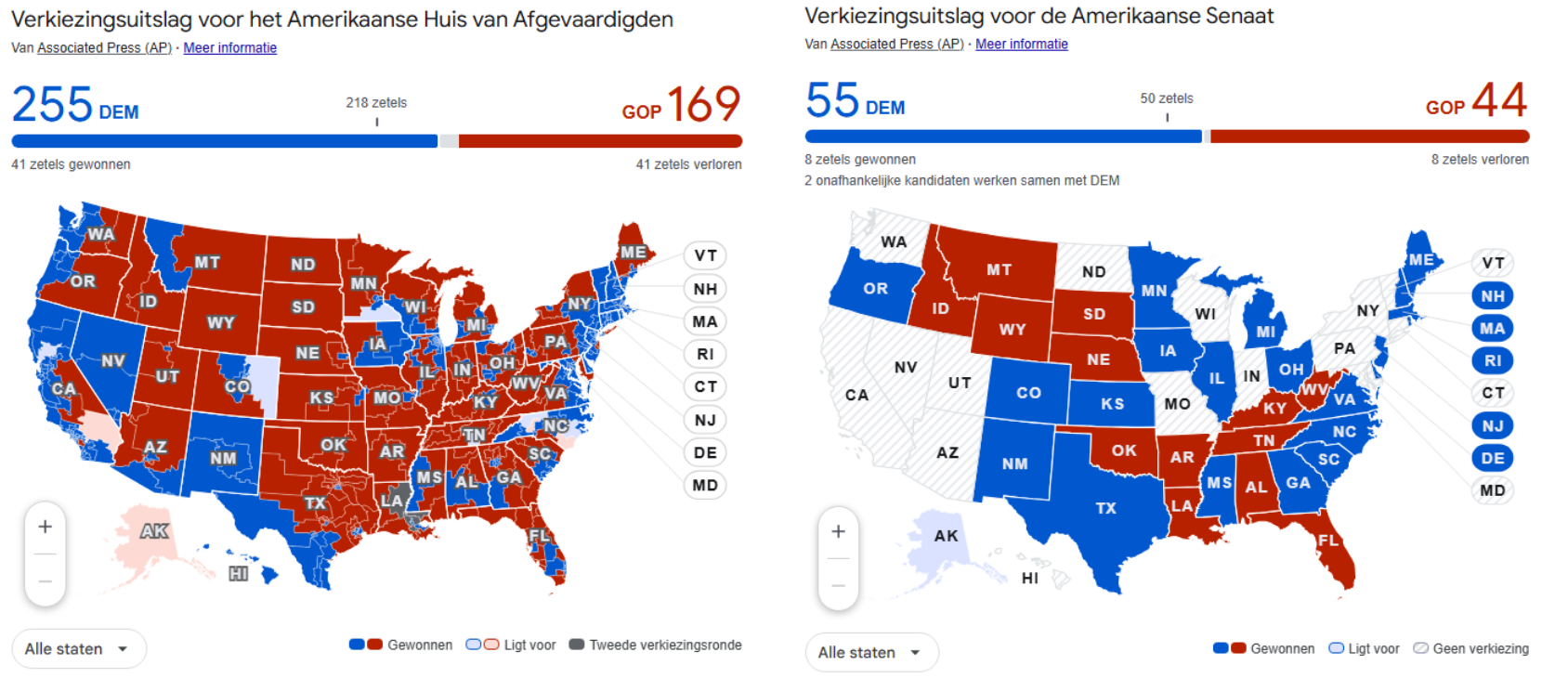
It is above all the scale of the Republican loss that is surprising, as even traditionally red strongholds such as Texas, Kansas and South Carolina turned blue. However, the Democratic victory in both the Senate and the House of Representatives has different implications. In the Senate, it concerns a limited number of statewide races; in the House, hundreds of local districts. Moreover, a Democratic majority in both chambers does not mean unlimited room for policy. Presidential vetoes and procedural rules remain decisive, particularly in the area of foreign policy. President Trump can still decide unilaterally, by decree, to for instance attack Iran or halt military support to Ukraine.
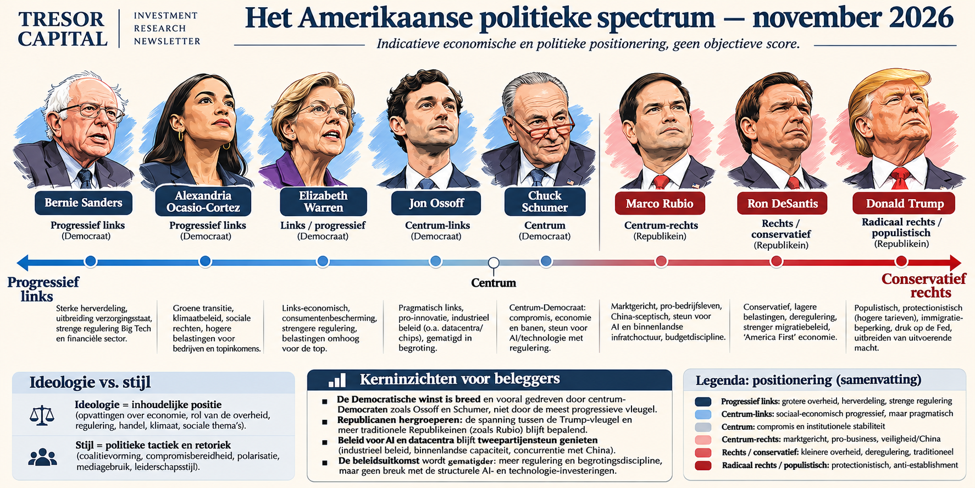
Different factions are also becoming visible within the Democratic Party. More pragmatic, centre-left candidates such as Talarico, Cooper and Ossoff achieved the biggest wins in traditionally dominant Republican states. They won on themes such as purchasing power, employment, energy security and workable infrastructure, which could pull the party towards a more moderate, centre-left course. This stands in contrast to outspoken left-wing candidates and newcomers such as El-Sayed, Flanagan, Sanders and Ocasio-Cortez. They scored precisely by emphasising consumer protection, labour conditions, concentration of market power and the environmental impact of data centres, including a call for a construction moratorium. The fact remains that the broad 'blue wave' is, for now, mainly a rejection of President Trump's policies and the current status quo. The coming period will show how the Democratic Party manages to translate this election victory in the Senate and the House into coherent local, regional and federal policy.
Last Monday (9 November 2026), the US Senate voted 73 to 25 in favour of taking up a bill that speeds up permits for energy projects and data centres, while tech companies will henceforth bear the costs of the power grid themselves. However, this was only a procedural vote to open debate and does not yet mean the law has been definitively adopted. Moreover, this vote was cast by the current, sitting Senate (in which 22 Democrats voted in favour). The newly elected Democratic senators, who specifically oppose the rapid rise of energy-guzzling data centres, will not take office until January 2027. As a result, final approval in the new Congress remains highly uncertain.
AI data centres: is computing power becoming internationally more mobile?
The Democratic election victory in the US midterms could mean that the years-long race between American states to attract billions in data centre investment is about to turn into a period of slowdown and stricter regulation. Some Democrats even won on the promise of a complete moratorium on the construction of new data centres. According to energy research firm Cleanview, after the elections 41% of planned data centre capacity is located in states where voters have elected a governor in favour of a (temporary) building freeze.
In growth states such as Texas, Ohio and Georgia, the new Democratic governors first want to hit the pause button in order to review the burden on the power grid and the generous tax breaks for big tech. At the same time, voters supported restrictions in 40 of the 41 local referendums. For now, this change of course does not appear to be bringing the enormous investment wave to a complete standstill, but is mainly resulting in new projects being better aligned with local communities. In states such as Michigan, Wisconsin and Iowa, incoming governors are demanding that tech companies henceforth bring their own power generation, give up tax exemptions and offer transparency on water use and contracts. This is intended to prevent ordinary households from footing the bill for grid upgrades through higher energy bills. According to investment bank Morgan Stanley, this is creating a split within the United States: in many states, tech companies will first have to negotiate hard over costs and transparency before construction can proceed, while states with more lenient rules are becoming more attractive to investors.
In the public debate, warnings are regularly voiced that stricter rules will lead to an exodus of AI capacity abroad, comparable to the earlier relocation of American manufacturing and industrial jobs to Asia. However, that comparison only partly holds, because AI infrastructure consists of two very different phases:
- Training AI models: This requires enormous amounts of electricity, but involves no direct interaction with end users; latency over long distances plays no role here. As a result, this heavy computational work can relatively easily be moved to regions with cheap, reliable power and scalable infrastructure.
- Inference (application): When a trained model is actually run and used by customers, the situation is exactly the opposite. Users expect a response within fractions of a second, meaning large physical distances lead to unacceptable delays (latency). In addition, strict security requirements and export legislation mean that confidential corporate data and defence applications may not be processed outside US jurisdiction.
A complete exodus of AI infrastructure is therefore unrealistic. However, a partial, strategic spread is already well underway: tech companies are not steering towards a fully American scenario, but towards a geographic split based on cost, speed and national security. The decisive metric is shifting towards the total cost per usable unit of computing power (compute), which immediately raises the question of which regions stand to benefit.
Areas that combine cheap, readily available energy with ample cooling capacity and fast permitting in particular find themselves in a strong starting position. The Middle East, for instance, is attracting an increasing number of large-scale AI projects thanks to its abundant power, deep capital reserves and decisive government direction. Energy-rich parts of North America, such as Texas and Canada, also remain attractive to parties wanting to combine low energy costs with direct proximity to the US market, thanks to their cheap hydropower and naturally cool climate.
Q3 results: sharp profit growth and confirmation of investment plans
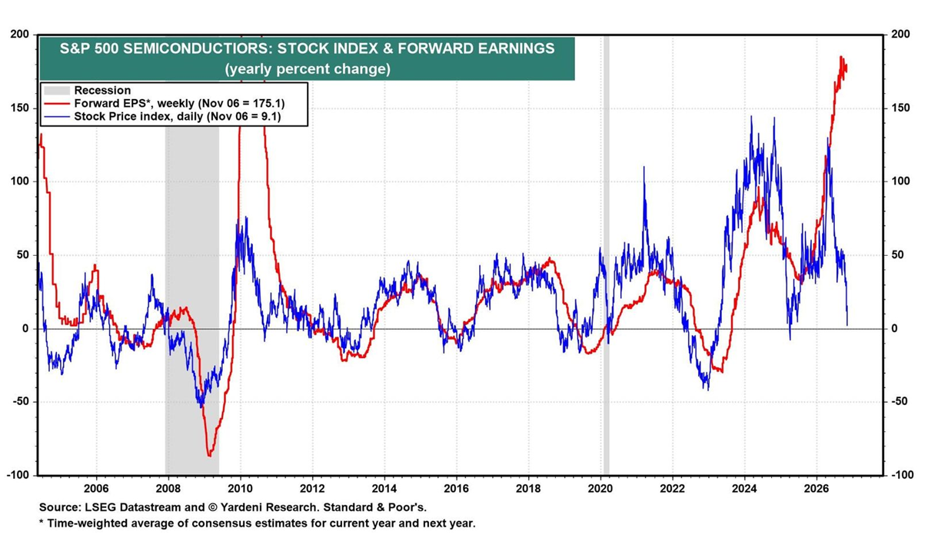
The results for the third quarter of 2026 have so far shown strong performance for the tech sector, while the enormous wave of investment continues unabated. Chipmaker TSMC, for instance, reported revenue of approximately $46.7 billion for Q3 2026, earnings per share (EPS) growth of 68.7% year-on-year, and a gross margin of 66.4%. With a revenue forecast of $52.3 to $54.3 billion for the fourth quarter, demand for advanced chip capacity remains undiminished, although this is no guarantee for 2027.
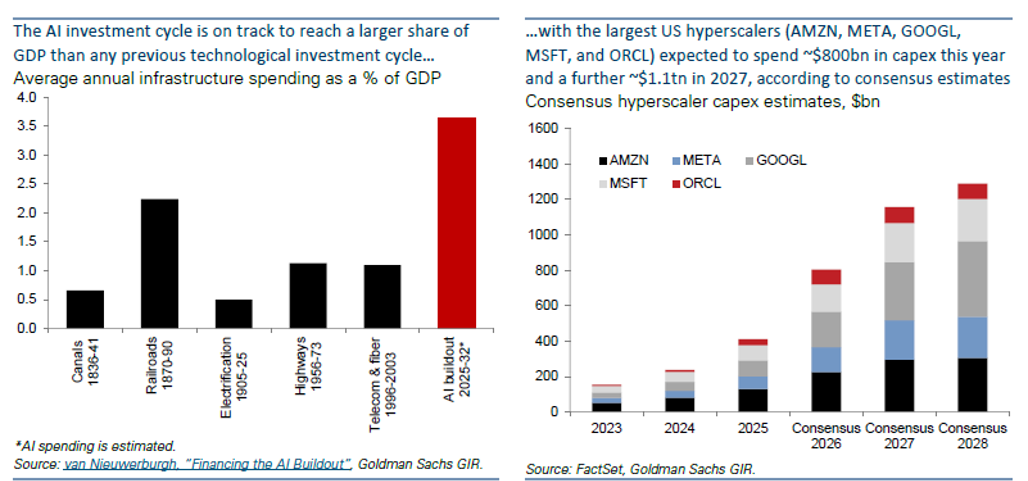
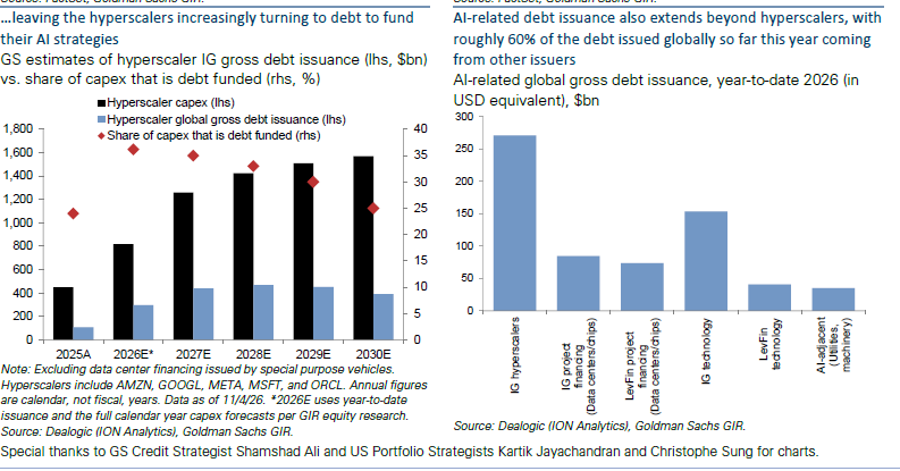
At the major hyperscalers, reported earnings per share currently tell only part of the story. Because accounting profit figures are distorted by one-off items, and because investments only weigh on profit later through depreciation, profit growth often looks more stable than the underlying cash flows. The enormous investments in data centres, after all, come directly at the expense of free cash flow. These record investments for 2027 show that management is, for now, counting on strong future demand and an attractive return on invested capital (ROIC). At the same time, fierce competition is forcing companies to invest billions upfront to defend their market position.
Together, the indicative investment plans for 2026 point to around $720 to $740 billion for these four companies. While a clear combined forecast for 2027 is not yet available, total spending currently appears set to rise to around $1,000 billion.
The wider supply chain benefits too
That demand for data centre capacity still outstrips supply is also evident from the quarterly figures of specialised AI cloud players (neoclouds). CoreWeave saw revenue rise by 168% in Q3 2026 to $3.66 billion and raised its full-year guidance, although high debt and rising interest expenses weigh on net income. Nebius also reported strong revenue growth (+571% year-on-year to $980.8 million) and has raised its investment budget for 2027 to $40–45 billion. At the same time, Nebius had to slightly temper its revenue outlook for 2026, as delivery and power delays at third-party sites are pushing part of the capacity into early 2027.
It is precisely these physical bottlenecks around power and cooling that are translating directly into record orders at industrial suppliers. Siemens booked record order intake of €34.8 billion (+58%) in its fourth quarter, helped in part by a doubling of data centre orders for power distribution and cooling technology (worth more than €8.5 billion over the full financial year). GE Vernova is benefiting in a similar way from global electrification and data centres' hunger for power: quarterly orders rose 96% in Q3 to $29.3 billion, while the total order backlog is growing towards $200 billion.
The common thread running through all the quarterly results and political developments is clear: even after the midterms, demand for AI capacity remains undiminished, but the pace at which energy and cooling infrastructure is delivered determines the rate of growth. For investors, the crucial analysis in 2027 is therefore not just about how much capacity is being built, but above all about whether accelerating cloud growth, operating margins and free cash flows are sufficient to genuinely earn back the rapidly rising depreciation and financing costs.
Correction in tech stocks: debt leverage and positioning dominate
Despite strong earnings figures and the confirmation of enormous investment plans, a sharp correction occurred in tech stocks at the end of October and the beginning of November 2026. The largest sell-off on the Nasdaq in November took place on Thursday 5 November 2026. On that day, the Nasdaq Composite plunged 5.52% and the Nasdaq 100 lost more than 6%. This sell-off exposed how vulnerable crowded AI and technology positions (crowded trades) are to sudden de-risking. According to data from both Morgan Stanley and Goldman Sachs, global equity hedge funds cut risk in the first week of November at the fastest pace in more than ten years. In total, the mechanical selling pressure across all market participants rose to more than $100 billion.
When an overcrowded position comes under pressure from political or macroeconomic shocks, four market mechanisms act as a flywheel on the price decline:
- Shared positions and large-scale unwinding via prime brokers: Research firm PivotalPath points to a sharply increased overlap between the portfolios of the ten largest multi-strategy hedge funds. According to Goldman Sachs, hedge funds sold around $20 billion net in technology stocks over a two-week period. US fundamental long-short funds cut their gross debt leverage by 8.7 percentage points in a single week to 207.5%, while net leverage plunged by 5 percentage points in a single trading day to 42%. According to Morgan Stanley, the total gross equity position of long-short funds has shrunk by 10.7% since the end of June, leaving them net underweight AI for the first time since early 2023.
- The analogy with South Korea: The structure of the shock bears strong similarities to the sharp correction on the South Korean stock market (KOSPI −6% on 5 November, with opening declines of 10% for Samsung Electronics and SK Hynix). There, margin calls and stricter collateral requirements (with regulators forced to temporarily suspend the 140% collateral rule for margin loans) led to forced liquidations, without the underlying end demand for memory chips having actually collapsed.
- Negative gamma hedging in the options market: Due to the large volume of short-dated call and put options on popular AI stocks, options traders must continuously hedge their positions during sharp price declines by selling off underlying shares or futures, which further accelerates the decline along the way.
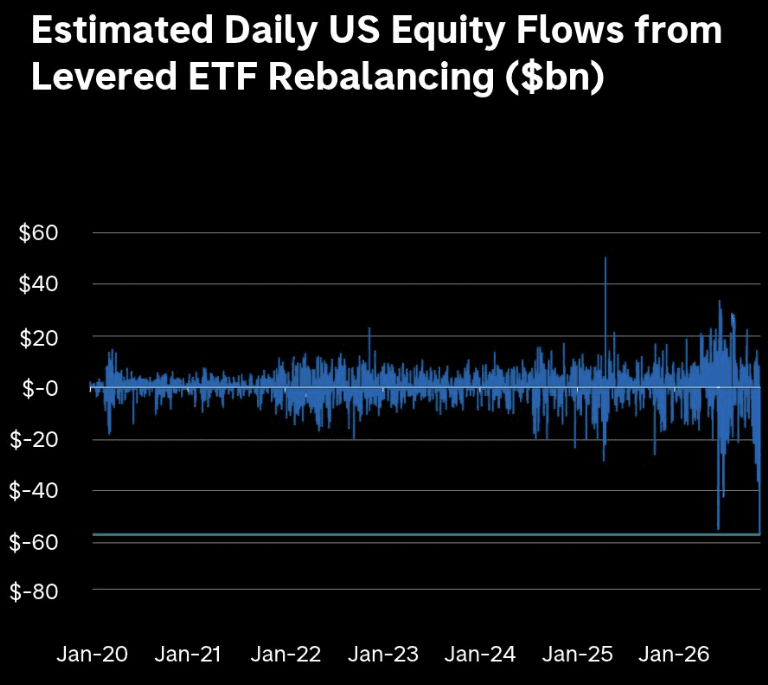
- Procyclical rebalancing of leveraged ETFs: Daily leveraged funds on chip and AI indices (such as 2x and 3x long ETFs) must automatically reduce positions at the end of each down trading day to restore their fixed leverage ratio. According to estimates by JPMorgan, leveraged ETFs sold more than $60 billion in equity exposure in the first week of November, of which around 90% consisted of technology stocks. These mechanical sell orders coincide with the market close and amplify the downward swings on red days.
The sell-off in October and early November left deep marks on the hedge fund industry. Not only concentrated tech funds posted double-digit losses; large multi-strategy giants (pod-shops) that are normally seen as relatively stable also ended up in the red at the same time. Although outright corporate failures have so far been avoided, several firms took drastic action: an estimated 108 internal investment teams (pods) were shut down, entire strategies were discontinued, and major capital providers withdrew billions.
Oil price cools sharply after US midterms: what does this mean for investors?
After a turbulent period on the energy markets, the oil price has fallen sharply in the days following the US midterm elections. Whereas a barrel of Brent crude was still trading at around $118 at the end of October, the price recently dropped back to below $90 per barrel – the lowest level since late August (before recovering slightly towards $95).
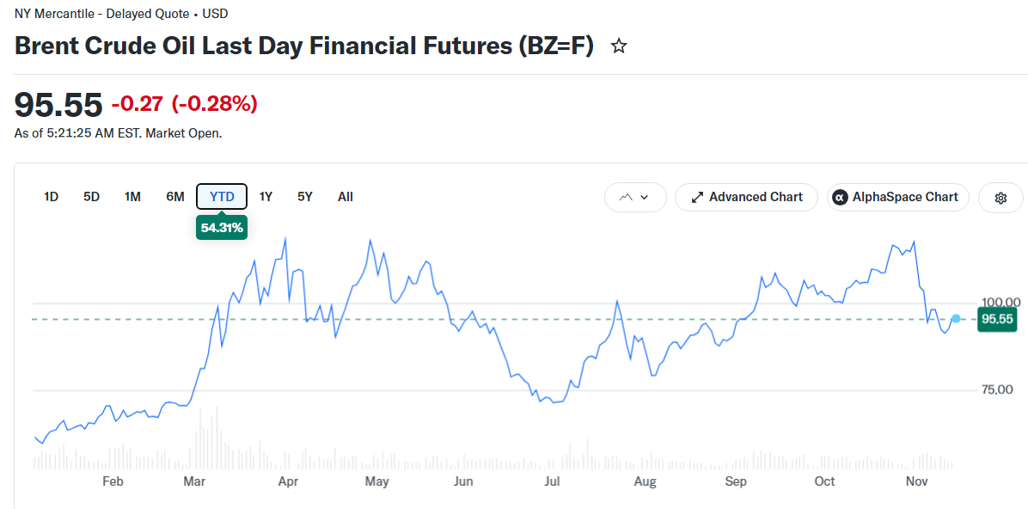
The main driver behind this decline is the fading of the geopolitical risk premium surrounding the Middle East. Now that the Democrats have regained a majority in the US Congress at the midterms, financial markets expect the Trump administration to be politically held back from any further military escalation towards Iran. President Trump himself also eased tensions by indicating that new attacks on Iran are currently unlikely and unnecessary as long as diplomatic talks continue to progress.
Under constitutional law, a US president may only carry out attacks independently as commander-in-chief in the event of a direct threat. According to the Constitution and the War Powers Resolution, Congress has the right to formally declare war, and a military operation without Congressional approval must stop within 60 days. In November 2026, this sparked a fierce political row surrounding Secretary of Defense Pete Hegseth. Republican Congressman Thomas Massie filed eight articles of impeachment against Hegseth, arguing that he was carrying out unlawful orders from Trump by waging war against Iran without Congressional approval and for longer than 60 days. The House of Representatives narrowly blocked that impeachment attempt on 10 November by 211 votes to 204, with Hegseth rejecting the accusations as political sabotage and maintaining that the attacks are legally lawful. Although the current House still backs Hegseth, the scope for new attacks is narrowing: once the Democrats take over the Congressional majority in January 2027, they will be able to reopen investigations and block funding for military operations.
Besides the political de-escalation, supply and demand are also playing a clear role. The escorting of oil tankers through the Strait of Hormuz is running increasingly smoothly, allowing exports from the Persian Gulf to pick up again and US oil inventories to be replenished. At the same time, the drop below the psychological $100 threshold prompted large trading funds to rapidly unwind their speculative positions, which further accelerated the price fall. In its wake, the US ten-year yield also fell from 5.3% to 4.9%.
Upheaval at Nvidia: Jensen Huang's departure puts pressure on the AI engine
Nvidia, the undisputed supplier of the computing power behind the global AI revolution, is experiencing a historic governance crisis. On 12 November 2026, co-founder and figurehead Jensen Huang stepped down with immediate effect as CEO and board member. The trigger was an independent board investigation into both his extramarital relationship with businesswoman Alice Huang, who is suspected by US intelligence agencies of spying for China, and into multiple relationships with his own employees. Chief Financial Officer Colette Kress is taking charge as interim CEO, while investigations by the US Congress and the FBI continue.
For the permanent succession, Ian Buck currently appears to be the frontrunner. Buck helped develop the crucial CUDA software platform and leads Nvidia's hyperscale AI operations. According to analysts consulted by Reuters, that combination of deep technical knowledge and experience with the AI business makes him a very strong internal candidate. Still, several other names are circulating. Within Nvidia, interim CEO Colette Kress herself is also seen as a strong contender, thanks to her solid reputation on Wall Street and her overview of the company's overall operations. In addition, experienced executives such as heads of sales Jay Puri and Deepak Patil are mentioned as internal options. Should the board of directors look outside the company, analysts point in particular to Arm chief Rene Haas, who himself has a history at Nvidia, and former Apple CEO Tim Cook as possible external candidates.
With Huang's departure, Nvidia loses, after 33 years, the architect behind the CUDA software platform and its principal bridge-builder towards major tech clients, Asian suppliers and Washington. Since founding the company in 1993, he built it up from a maker of graphics cards for gamers into the very engine behind the global AI revolution and one of the most valuable companies in the world. His greatest strength was his ability to spot technological shifts years before everyone else and to commit to them fully. Long before artificial intelligence broke through, he invested billions in an indispensable, fully integrated platform of hardware and software. Thanks to an extremely flat organisation free of bureaucracy, Nvidia was able to move at lightning speed, while Huang, through intensive personal diplomacy – including regular 'wining and dining' in Taiwan and South Korea – managed to secure crucial supplies from chip and memory manufacturers. That last point, in a sense, proved his undoing.
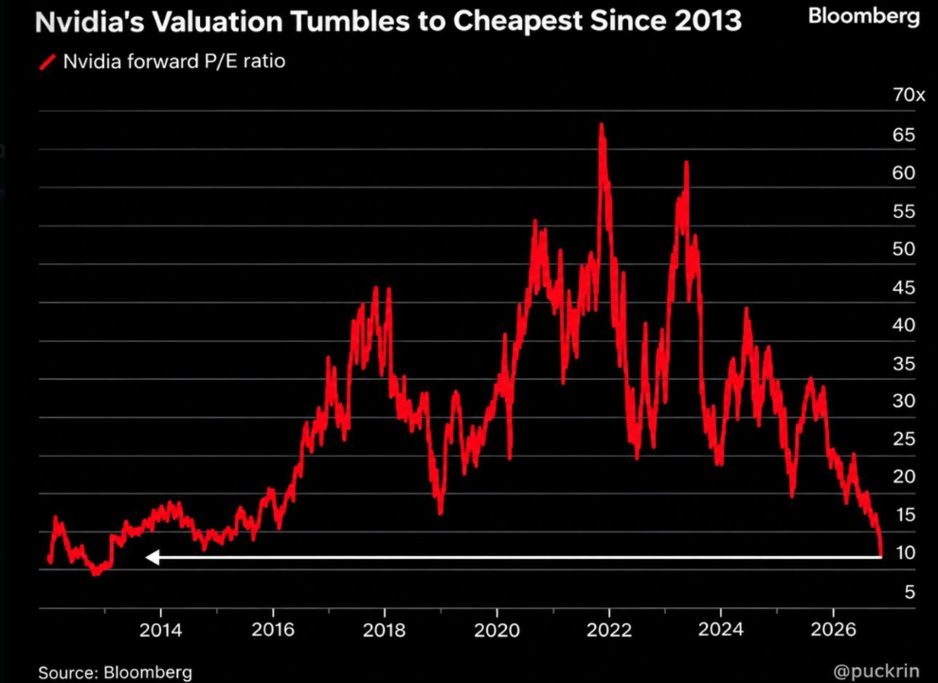
The governance crisis comes on top of broader unease surrounding slower data centre permitting after the US midterms, stricter export rules and competition scrutiny. As a result of the share price fall, the stock's valuation dropped sharply to a forward price-earnings ratio of around 11 (less than half the level seen at the end of 2025), even as Nvidia's technological lead over rivals such as AMD and Broadcom remains intact. For investors, the first major test comes on 17 November: the quarterly results will show whether underlying AI demand remains as strong as ever and whether the board can manage the succession smoothly and without delay.
Receive weekly insights in your inbox
Exclusive analyses and updates on family holding companies and global market developments.
Would you like more information about our services?
Get in touch
Disclaimer:
No rights can be derived from this publication. This is a publication of Tresor Capital. Reproduction of this document, or parts thereof, by third parties is only permitted after written consent and with reference to the source, Tresor Capital.
This publication has been compiled with the greatest possible care by Tresor Capital. The information is intended in a general sense and is not tailored to your individual situation. The information should therefore explicitly not be regarded as advice, an offer or a proposal to purchase or trade investment products and/or to take up investment services, nor as investment advice. The authors, Tresor Capital and/or its employees may hold positions in the securities discussed, for their own account or for their clients.
You should carefully consider the risks before you begin investing. The value of your investments can fluctuate. Past performance is no guarantee of future results. You may lose (part of) your invested capital. Tresor Capital disclaims any form of liability for any inaccuracies or errors. This information is purely indicative and subject to change.
Read the full disclaimer at tresorcapitalnieuws.nl/disclaimer .
This article was originally written in Dutch and automatically translated into English with the help of AI. In case of any difference, the Dutch original prevails.