Family Holdings #46 - Record amounts for acquisitions and share buybacks at Constellation and Berkshire


This week's topics:
Berkshire Hathaway bought back $9.6 billion of its own shares in the third quarter, the highest amount in a single quarter ever and a clear break with the six preceding quarters, in which it did not buy back a single share. Together with the acquisitions of OxyChem and Taylor Morrison, Berkshire spent more this year than it took in, causing its cash pile to shrink under Greg Abel for the first time in years. Operating profit remained almost flat: the insurance division, led by GEICO, is earning noticeably less in an increasingly difficult market, while railroad company BNSF, the energy division and Precision Castparts all grew strongly.
In brief:
The Constellation-family (Toronto: CSU) made several more acquisitions this week. Volaris, through subsidiary SSP, bought the British company IS2, which has been supplying policy administration software to commercial insurers and managing general agents since 1996. Jonas, through Cora Group, acquired the American company Spider Strategies, a provider of strategy execution and performance management software whose clients include the US military. In addition, three previously unreported Harris acquisitions came to light: HighRoads (February), RazorSync (April) and WestCX (November). The latter, with around 370 employees, is considerably larger than the average purchase.
Sofina (Brussels: SOF) is seeing its stake in ByteDance, the Chinese parent company of TikTok, rise in value once again. ByteDance wants to buy back up to $6 billion worth of shares from existing shareholders, at a valuation of around $400 billion, about 20% higher than in a comparable programme a year ago. According to calculations by De Tijd, the 0.17% stake held by Sofina is therefore worth around $680 million, equivalent to roughly €608 million. At the same time, ByteDance is proposing to push back the deadline for a stock market listing, or for the right of external shareholders to sell their entire stake, by four years to 11 December 2030.
3i Group (London: III) announced a second buyback programme of up to £750 million alongside its half-year results, which must be completed by the end of May 2027 at the latest. It follows directly on from the first programme of the same size, under which around 29.5 million shares have been bought back since May for approximately £742 million, at an average of £24.95 per share. On the same day, CEO Simon Borrows himself bought 37,600 shares at £26.74 each, worth just over £1.0 million. According to 3i, the share is trading at a clear discount to what the company itself regards as the underlying value of the portfolio, and Borrows described further buybacks as attractive for as long as that discount persists.
Constellation and Topicus results: good, but need some explaining
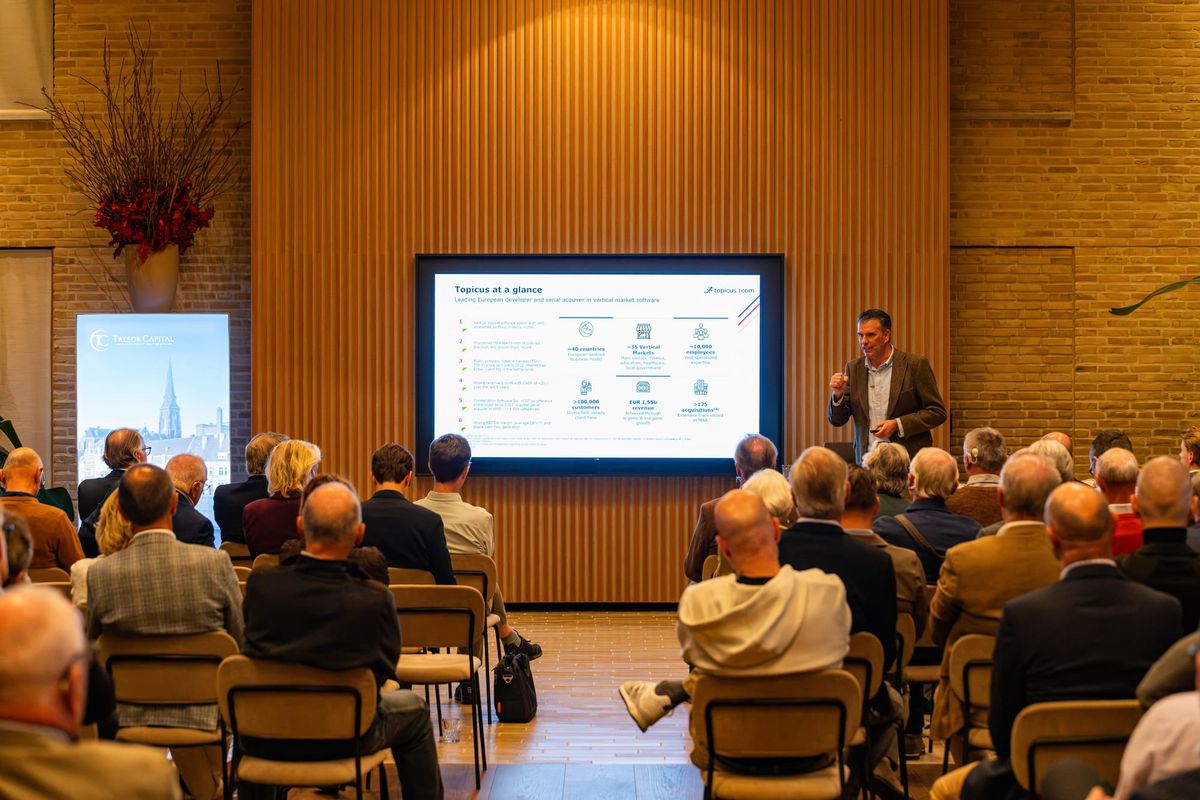
The acquisition machine Constellation Software (Toronto: CSU) and its subsidiaries Topicus.com (Toronto: TOI) and Lumine Group (Toronto: LMN) published their third-quarter results last week. Here too, there is once again no trace of disruption from AI. President Mark Miller was again asked about this during the earnings call and replied that he would love to report a major trend, but that there simply isn't one. Since we already covered this topic in detail last week in our Deep Dive, in which TSS Public-CFO Rob Eijbergen explained at our client dinner how Topicus approaches AI, we now focus on actual performance and the trend of recent quarters.
 Michael Gielkens
The main news at Constellation is the amount the group is spending on acquisitions this year. In the first nine months, the group (including Topicus and Lumine) paid USD 1.9 billion for new businesses, up from USD 755 million a year earlier. In the third quarter alone, this amounted to USD 484 million, well above the USD 1.5 billion in free cash flow that Constellation generated in the same period. After the end of the quarter, the company committed a further USD 673 million to acquisitions in sectors ranging from mining and insurance to municipalities and education.
According to Chief Investment Officer Bernard Anzarouth, this flow is not the result of owners rushing to offload their software businesses. Valuations have barely fallen and private equity is still bidding aggressively.
“I don't see a broad trend of owners giving up. They sell when they themselves are ready to. Our acquisition teams are simply doing an excellent job against the competition.”
– Bernard Anzarouth, Chief Investment Officer of Constellation
President Mark Miller added that Constellation can now also handle larger and more complex transactions, something it lacked the manpower for ten years ago. Outside its familiar (software) niches, the holding company applies extra caution. Anzarouth explained that the worst-case scenario in the financial model is deliberately exaggerated, so that the resulting bid price is automatically lower.
So many acquisitions in such a short time leave their mark on the figures. Revenue rose by 19% to USD 3.5 billion, but costs rose by 20%. New companies usually come in with a low profit margin, after which things are brought into order. CFO Jamal Baksh gave a striking example of this.
“The companies we bought in the first quarter had a combined margin of minus 16%. That group is now at 27%. The acquisitions from the second quarter went from 12% to 21%. So they are improving, but we do so many acquisitions that it still weighs on the total.”
– Jamal Baksh, CFO of Constellation
The same applies to cash flow. Operating cash flow grew by 5% to USD 717 million. That is considerably slower than revenue growth, because USD 157 million was tied up in working capital. Baksh does not see this as a problem with the businesses themselves. According to him, it mainly depends on the timing at which Constellation buys a company. If it buys shortly after customers have paid their annual invoice, it pays a lower price, but it no longer receives that cash itself.
Organic growth came in at 2%. Miller himself called that figure incomplete. He looks at revenue from maintenance contracts and subscriptions, because that shows whether customers continue to use the software. That revenue accounts for 77% of the total and grew organically by 4%. The difference lies in one-off sales.
For the first time, Constellation also broke out its problem children separately. Excluding the American healthcare businesses and hospital software company Altera, maintenance revenue grew by 5%. This core business has grown 5 to 7% every year since 2016, with the coronavirus year 2020 as the sole exception. The American healthcare businesses shrank by 10%, mainly due to two recent acquisitions where Constellation already knew at the time of purchase that they would lose customers (the purchase price was adjusted accordingly, so that the minimum return requirement – the key metric Constellation steers by – was still met). Excluding those two, the decline was 3%. Altera shrank by 8%, following a 19% decline in the second quarter. Constellation expects the departure of several large customers there to be behind it by the end of 2027. With USD 144 million in revenue, Altera now accounts for just 4% of the group. According to president Mark Miller, this decline is fully accounted for and all investments in healthcare remain neatly on track to achieve the targeted return on acquisition.
Then there's the blemish that drew the most attention. Free cash flow to shareholders, which Constellation calls FCFA2S, fell by 16% to USD 443 million. Two items explain that decline. The first is an accounting item. Constellation has an obligation to Joday Group, the vehicle of the Strikwerda family and management that owns almost 30% of Topicus, which it must revalue every quarter. The obligation rises as Topicus's maintenance revenue grows and as shares in the Polish software companies Asseco and Sygnity, in which Topicus holds stakes, become more expensive. This quarter that cost USD 117 million, versus USD 16 million a year earlier. Of that, USD 77 million was due to higher share prices, mainly Asseco's. The second item is working capital, which absorbed USD 157 million this quarter, compared with USD 47 million a year earlier. Excluding the revaluation, free cash flow rose by about 3%. Excluding both the revaluation and working capital, it rose by 21% to USD 717 million. The bridge below, from Anomaly Investment Partners on X, shows how these two items together explain the decline.
Subsidiary Lumine, which acquires software companies for the telecoms and media sector, shows the same picture as its parent. This year it invested over USD 500 million in three acquisitions. At the same time, revenue rose 55% to USD 290 million, maintenance revenue grew organically by 6%, and free cash flow increased by 27%. The two July purchases are weighing on the margin for the time being, but CEO David Nyland indicated that these companies are still at the start of their improvement trajectory.
At Topicus, the picture is exactly the opposite. After the record year 2025 (which included the stake in Asseco and the acquisition of Belgium's Cipal Schaubroeck), the subsidiary spent just €93 million on acquisitions in the first nine months. A year earlier that figure was still €261 million, on top of €168 million for the initial block of Asseco shares. As Eijbergen already explained last week, Topicus has a smaller acquisitions team than Constellation and leaves candidates that the parent company is already in talks with to the parent. He indicated that Topicus could buy a whole string of companies tomorrow, but that doing so would not meet its strict return requirements. The cash available this year therefore went towards reducing debt: net debt fell from €366 million to €137 million.
Meanwhile, the underlying companies are performing excellently. Revenue rose 15% to €445 million and maintenance revenue grew organically by 7%; in none of the past nine quarters has that figure been below 6%. Because few new companies with low starting margins were added, the increase in costs, at 13%, comfortably remained below revenue growth. Poland's Sygnity (73% owned by Topicus) stands out in particular. At this subsidiary, revenue rose 43% to €28 million in the third quarter and pre-tax profit nearly doubled. Sygnity now accounts for 6% of Topicus's total revenue and currently even holds more net cash per share (PLN 12.36) than Topicus paid per share in May 2022, when the company still carried net debt at the time.
At Topicus, too, the cash flow figures require some explanation. Free cash flow fell by 16% in the third quarter to EUR 19 million, but this is a small quarter every year, because customers pay their maintenance contracts in the first quarter. Over nine months, free cash flow rose by 19% to EUR 199 million. That figure, in turn, is too rosy. It includes a dividend of EUR 59 million from Asseco, and without that dividend, cash flow remained roughly unchanged. On the other hand, the interest on the loan for Asseco is deducted from cash flow every quarter, while Asseco only pays out once a year. Net profit of EUR 47 million is likewise not comparable with the loss of EUR 121 million a year earlier, when an accounting revaluation of Asseco cost EUR 222 million.
After the end of the quarter, Topicus completed, or locked in, €16.5 million worth of acquisitions in healthcare and real estate. However, this does not yet include the largest purchase. Two days after the results publication, the company announced via a separate press release that TSS had acquired the Spanish company Softland Inversiones, the parent company of a major business software provider in Latin America. For the loyal follower of the Constellation family, such a separate press release is a crystal-clear signal that it concerns a significant acquisition with annual revenue of more than USD 100 million. The last time Topicus announced an acquisition of this size with its own press release was the record acquisition of Cipal Schaubroeck in 2025. Although the acquisition price has not been disclosed and the news has so far received little coverage, Softland has, according to LinkedIn, between 500 and 1,000 employees, and this deal lays a solid foundation for the figures of the coming quarters.
Anyone who only read the headlines saw free cash flow fall by 16% at both companies. Those headlines obscure the quality of the figures, and anyone who wants to assess them properly needs to dig deeper. Of the two, in our view, Constellation showed the stronger quarter. It is putting capital to work at a rapid pace, while the core of the business keeps growing as it has done for ten years now. Topicus is performing excellently on an operational level, but after the record year 2025 is still building towards its next round of acquisitions. These companies are, and will remain, ones whose quarterly figures can look erratic and messy from quarter to quarter due to the timing of cash flows and acquisitions.
Record buyback at Berkshire Hathaway at a record high
At Berkshire Hathaway (New York: BRK.B), the same question has dominated in recent years: what will happen to the cash pile? Quarter after quarter it kept growing, while Warren Buffett found little that he considered worth the money, including the company's own shares. Since this year, Greg Abel has been at the helm. The quarterly figures Berkshire published last week give a clear answer as to how he is handling that question.
That answer lies not in profit, which remained virtually flat, but in the buyback of own shares. In the third quarter, Berkshire repurchased $9.6 billion worth of its own shares, the highest amount in a single quarter ever. The previous record of $9.3 billion dates back to the third quarter of 2020. The contrast with the preceding period is stark: for six consecutive quarters, from mid-2024 through to the end of 2025, Berkshire did not repurchase a single share. Abel started cautiously in the first quarter with $0.2 billion, followed by $4.5 billion in the second quarter, and now $9.6 billion. Over the first nine months, the total comes to $14.4 billion, at an average of $497.12 per B-share. As a result, 1.3% of the outstanding shares disappeared this year.
As many will know, Berkshire holds no quarterly call and management rarely comments on the figures. The buyback is therefore one of the few moments when the company itself signals what it thinks of its own valuation. Berkshire only buys back shares when the CEO, after consulting with the chairman, judges that the share price is below intrinsic value, "conservatively determined". The programme has no upper limit. The only hard constraint is that the cash position may not fall below $30 billion, and with $352.3 billion in cash, Berkshire remains far from that threshold.
The buyback does not stand on its own. This year Berkshire also acquired chemicals company OxyChem for $9.4 billion and, at the end of July, homebuilder Taylor Morrison for $6.8 billion. Add to that regular investments of over $16 billion and net share purchases of over $11 billion, and Berkshire spent more than $57 billion over nine months, against an operating cash flow of $33.9 billion. As a result, the cash position fell from $369.0 billion at the end of 2025 to $352.3 billion. That is still an enormous amount, but the direction has changed. After years in which the cash pile only kept growing, more money is now going out than coming in.
Operating results
Set against all that spent capital is a profit that looks disappointing at first glance. Net profit fell by 28 percent, although at Berkshire that figure says little, since share price swings in the equity portfolio feed directly into it. Operating profit is the better yardstick, and that fell by 5.8 percent to $12.7 billion. That picture, too, is distorted, this time by currency effects on the loans Berkshire has outstanding in yen and euros; excluding those effects, the decline is just 0.8 percent. Behind that essentially flat result lie two opposing movements: the insurance division is earning markedly less, while the other businesses are earning markedly more.
The weakness among the insurers comes as no surprise. We have noted several times this year that the insurance market is becoming more challenging across the board, as substantial new capital and competition enter the market following several highly profitable years — something Abel already warned about in his first shareholder letter in February. After-tax underwriting result fell by 42.9 percent to USD 1.4 billion, with all three divisions earning less than a year earlier.
Car insurer GEICO had to give up the most ground. Pre-tax profit nearly halved while the combined ratio rose from 84.3 to 91.4 percent. GEICO is therefore still earning well, but is under pressure from two sides. On one hand, claims are rising in both number and size, while the average premium per policy is actually falling. On the other, GEICO is stepping up spending on advertising and commissions in order to win back market share after years of decline. The number of policies is growing as a result, but this has not yet translated into higher premium volume this quarter.
Against that, the other businesses in the portfolio managed to turn the tide, with railroad company BNSF as the main driver. The railroad's profit rose by 19.3 percent to USD 1.7 billion, helped by revenue growth of 14.7 percent that was partly driven by higher fuel surcharges, but also by volume growth of 3.9 percent. The energy division also delivered a solid contribution, earning 8.3 percent more, supported by electricity consumption that is running 4 to just over 7 percent higher this year across the three utilities. Within the broad group of industrial subsidiaries, Precision Castparts stood out in particular, with profit jumping by almost 30 percent thanks to strong demand for aircraft parts and gas turbines for power plants. According to Berkshire, further growth there mainly depends on the pace at which production capacity can be scaled up.
On the stock market, the share appears to be benefiting from the increased uncertainty elsewhere in the market, an environment in which investors more often turn to Berkshire. Since the end of the third quarter, Berkshire's B-share has climbed more than 18% to a record price of around USD 596, while the S&P 500 lost a little ground over the same six weeks. Whereas Berkshire was still trailing the index by more than 16 percentage points at the end of May, it is now ahead by more than 6 percentage points. That rapid turnaround underlines how abruptly the valuation for a rock-solid balance sheet and predictable cash flows can bounce back once the broader market starts to falter.
Receive weekly insights in your inbox
Exclusive analyses and updates on family holding companies and global market developments.
Would you like more information about our services?
Get in touch
Disclaimer:
No rights can be derived from this publication. This is a publication of Tresor Capital. Reproduction of this document, or parts thereof, by third parties is only permitted after written permission and with reference to the source, Tresor Capital.
This publication has been compiled by Tresor Capital with the greatest possible care. The information is intended in a general sense and is not tailored to your individual situation. The information should therefore explicitly not be regarded as advice, an offer or a proposal to purchase or trade investment products and/or to use investment services, nor as investment advice. The authors, Tresor Capital and/or its employees may hold positions in the securities discussed, for their own account or on behalf of their clients.
You should carefully consider the risks before you start investing. The value of your investments can fluctuate. Past performance is no guarantee of future results. You may lose (part of) your investment. Tresor Capital disclaims any liability for any inaccuracies or errors. This information is purely indicative and subject to change.
Read the full disclaimer at tresorcapitalnieuws.nl/disclaimer .
This article was originally written in Dutch and automatically translated into English with the help of AI. In case of any difference, the Dutch original prevails.