Family Holdings #45 – Unease over data centres after the midterms


This week's topics:
Markel posted a strong third quarter in which, for the first time in a long while, a one-off setback was absent. The insurer has now been comfortably profitable for several consecutive quarters, even as parts of the market soften and premium growth has partly relied on temporary war-risk premiums. With an agreement with Enstar, Markel is also largely covering the risk on the reinsurance division it has divested. We discuss what insurance chief Simon Wilson says about pricing pressure in the market, what the Enstar deal costs and delivers, and why CEO Tom Gayner is stepping up share buybacks further.
The Constellation group announced a remarkably large number of acquisitions within just over a week, from Costa Rica to Switzerland. We have put them together for you in a single overview.
In Brief:
Brookfield (New York: BN) signed an agreement on 3 November with the British power producer Drax to build artificial intelligence data centres in the United Kingdom. The plan targets more than 1 gigawatt of capacity in three phases, with an estimated total investment of more than GBP 20 billion including chips. The capital comes from Brookfield's joint venture with Qai, a subsidiary of Qatar's sovereign wealth fund. The plant already has a 4-gigawatt grid connection, something developers elsewhere in the United Kingdom often wait years for. The project is not yet final, as Brookfield first needs to find an anchor tenant and the permit still has to be applied for.
Prosus (Amsterdam: PRX) saw its largest holding, China's Tencent, lose an important source of computing power for artificial intelligence this week. According to the Financial Times, Oracle has, under pressure from the US government, cancelled a five-year lease contract with an estimated value of USD 7 billion. The contract reportedly gave Tencent access to around 100,000 advanced AI chips in data centres in Southeast Asia, chips that are not available within China itself. It illustrates how difficult it is for Chinese companies to get hold of the best chips, and how much geopolitics constrains their room for manoeuvre.
Hyperscalers caught between cloud growth and data centre concerns
Alphabet (New York: GOOGL) and Amazon (New York: AMZN) published their third-quarter results last week. At both companies, the story can be read in two parts. The first part is the traditional cash machine: at Alphabet, advertising around the search engine and YouTube; at Amazon, the online store and its associated advertising arm. The second part is the cloud, where investment in artificial intelligence (AI) needs to translate into growth. The interplay and the trends between these two parts actually matter rather more than the individual divisions' quarterly figures.
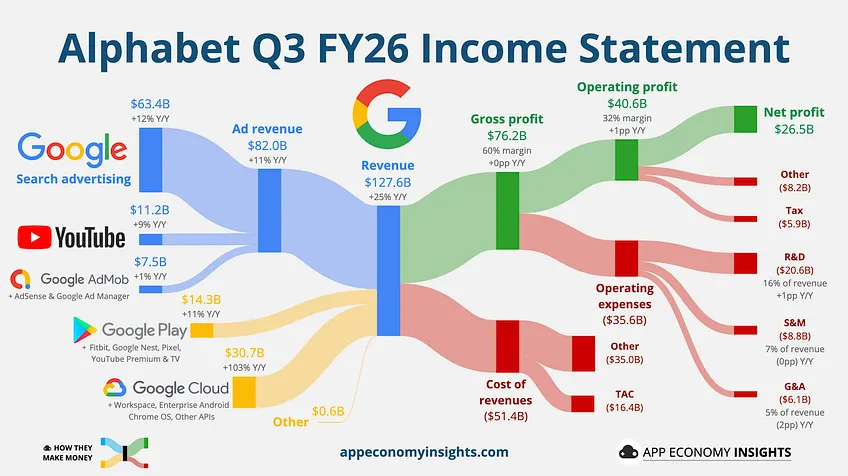
At Alphabet, the first part shows some cracks. The search engine grew by 12% to $63.3 billion and, for the first time, accounted for less than half of group revenue. At first glance there appears to be little cause for concern, as according to CEO Sundar Pichai the number of searches is growing faster than at any point in the past five years. Yet revenue growth slowed, and that is where the worry lies. Google earns money from the search engine when users click on an advertisement. A growing share of queries is now being answered by AI Mode and AI Overviews, where the user receives a written-out answer directly and where advertisements are still barely present. More searches therefore do not automatically translate into more revenue. The number of paid clicks rose by 8%, lagging behind the growth in search volume.
Chief Business Officer Philipp Schindler acknowledged this when an analyst asked about the discrepancy. Alongside currency effects and sector-specific factors, he cited AI itself as a cause. "The strong growth of queries in AI Mode had an impact, because of the lower monetisation we see there," he said. In other words, a query in AI Mode currently earns Google less than a classic search query. Pichai compared the situation to the shift to mobile more than ten years ago, when Google first built the best user experience and only afterwards began monetising it. That ultimately worked out well, but it cost several years of slower growth.
Some analysts therefore spoke of a "code yellow" for investors. They point to cannibalisation. Every query a user puts to AI Mode instead of the classic search engine shifts from a page full of adverts to an environment where Google still earns very little. That users click through less in that environment is also evident outside Alphabet. Reddit chief executive Steve Huffman reported on his own earnings call that in October Reddit was losing more than a million referrals a week from Google, which he attributes to AI Overviews and AI Mode. According to him, AI Mode does not generate traffic, not for Reddit and not for anyone else, because the answer is already on Google's own page. AI Mode is therefore generating plenty of extra queries, but it remains to be seen whether Google can earn as much per query from it as from traditional search. The first tests with adverts within AI queries are now under way for this purpose.
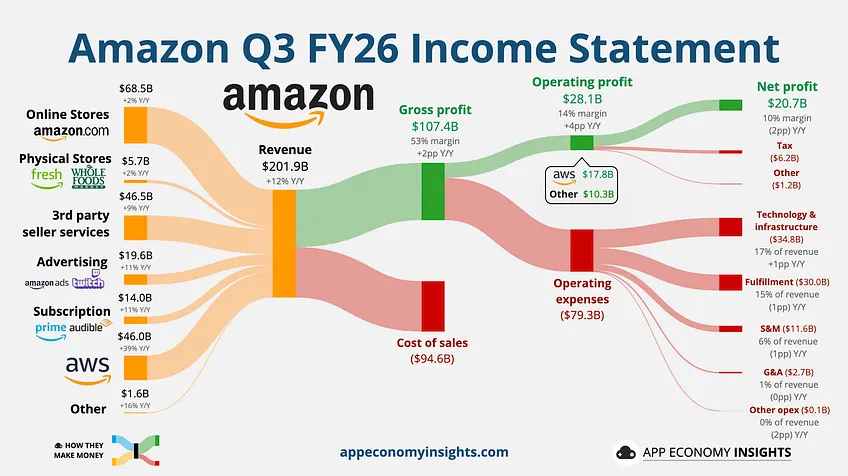
At Amazon this problem is somewhat less visible. The figures for the retail and advertising division were distorted by the shift of Prime Day into the second quarter, which meant advertising revenue grew by only 12%, but for the current quarter management is again counting on growth of close to 20%. Asked whether external AI agents are affecting the advertising division, chief executive Andy Jassy was emphatic. "The answer is no," he said, because few customers currently shop that way and the experience is no better than ordering directly from the store. That picture was confirmed this week by Uber. In the week of Halloween the company processed around 320 million rides and meal orders, of which only four rides and some 500 orders came in via AI agents. Shopping via AI agents so far looks mainly like a solution to a problem that does not (yet?) exist.
The second part of the story
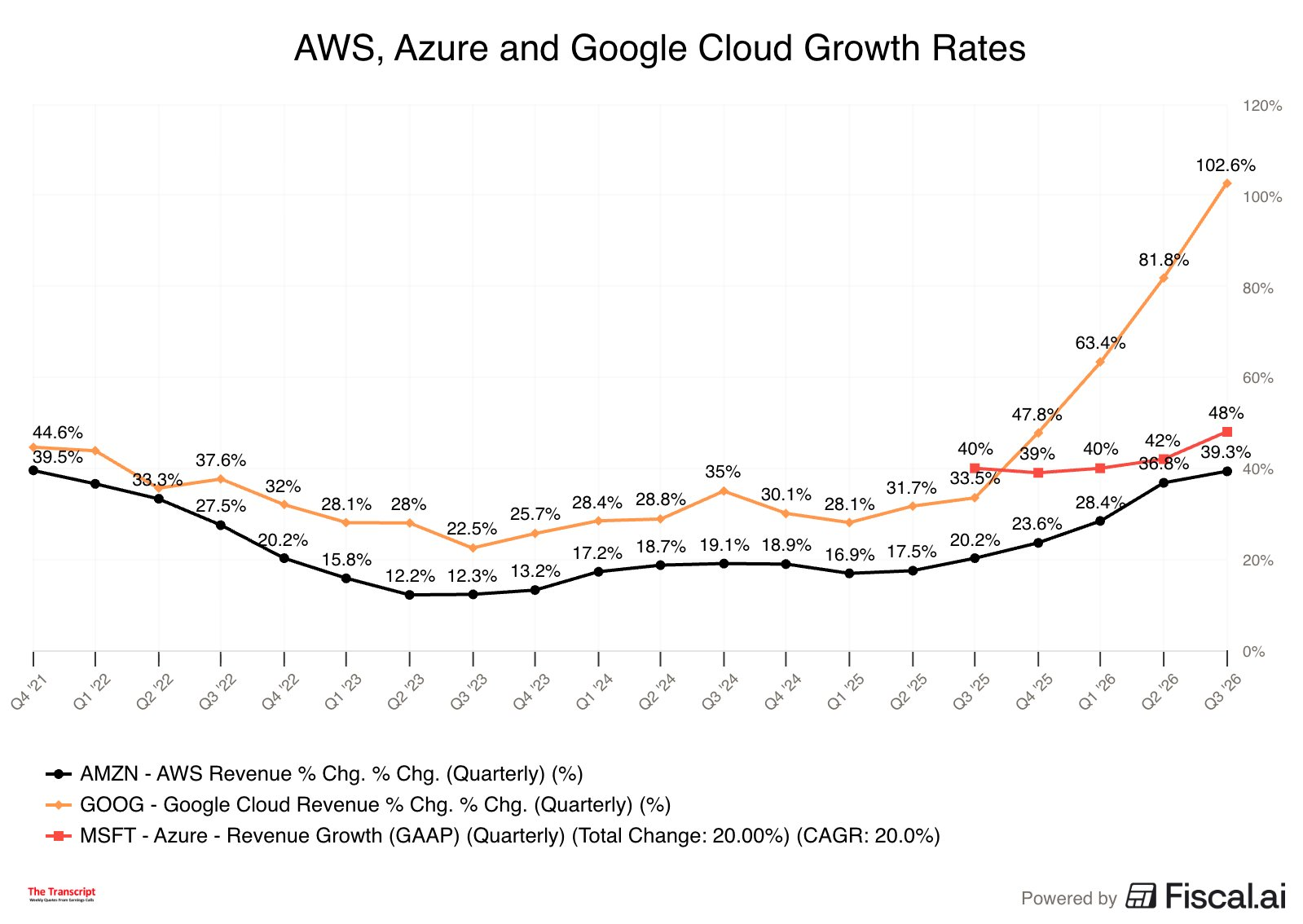
Google Cloud doubled revenue to $30.7 billion, Microsoft's Azure grew 48%, and AWS grew 39.3% to $46.0 billion. It makes sense that the smallest of the three is growing fastest in percentage terms. We find it all the more impressive that AWS, with revenue of $184 billion on an annualised basis, is accelerating for the sixth quarter in a row. Jassy expects growth of more than 40% in both 2027 and 2028 and considers revenue of $1,000 billion achievable within five to ten years. He backed this up with reference to the order backlog. Large blocks of capacity of hundreds of megawatts are reserved well in advance, which Amazon says gives it good visibility into 2027, 2028 and part of 2029.
The margins are equally striking. AWS achieved an operating margin of 38.7%, while Google Cloud came in at 36.2%, up from 23.7% a year earlier. Both companies are tempering expectations, though. Amazon's chief financial officer, Brian Olsavsky, pointed out that AI services carry lower margins than classic cloud services, so their rapid growth is weighing on the overall total. His counterpart at Alphabet, Anat Ashkenazi, expects headwinds in the near term, because Google is renting computing power from third parties owing to a shortage of capacity.
A third factor is the sale of proprietary AI chips. Google now also sells its TPUs as complete systems to customers. According to cloud chief Thomas Kurian, almost a hundred customers use them, including Anthropic and Apple, and Alphabet expects a substantial revenue increase from these sales in 2027. What this does to the margin is unclear, since Alphabet does not disclose the profitability. Analysts asked about it twice and received no figure, only Kurian's assurance that the margin improves as scale increases. The inventory Google is building up for these systems is, however, already weighing on free cash flow. Amazon wants to offer its Trainium chips outside AWS from late 2027, and Jassy openly addressed the trade-off involved. Selling generates revenue sooner, but a chip that runs in Amazon's own cloud for five to six years brings in more revenue and cash flow over its full lifetime.
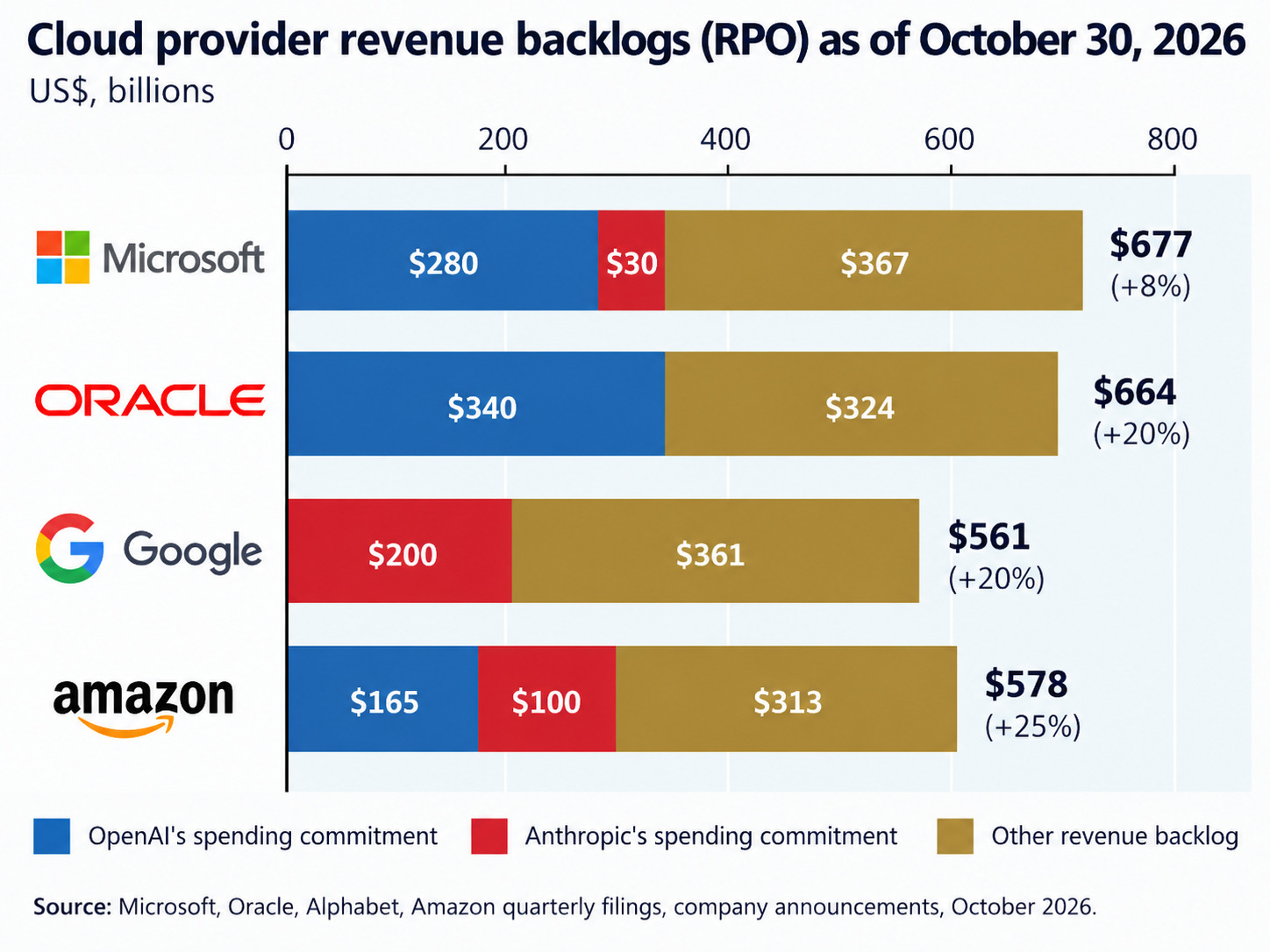
Order backlogs are at record highs everywhere, $578 billion at Amazon and $561 billion at Google Cloud. Alphabet expects to recognise more than 55% of that as revenue within 24 months. That works out at roughly $155 billion a year from existing contracts, against a current revenue run rate of about $123 billion a year. One caveat is the dependence on the frontier AI labs, which are themselves still loss-making. According to an overview based on the quarterly reports, Google's backlog includes about $200 billion from Anthropic and nothing from OpenAI. At Amazon, it comes to $165 billion from OpenAI and $100 billion from Anthropic. Microsoft and Oracle lean much more heavily on OpenAI, with $280 billion and $340 billion respectively, and in our view OpenAI is less strongly capitalised than Anthropic.
The bill for growth, and unease after the midterms
Set against this growth are investments that are making investors nervous. Alphabet booked negative free cash flow of $9.1 billion for the quarter, while Amazon came in at $42.4 billion negative over the past twelve months and saw its long-term debt rise from $65.6 billion at the start of the year to $173.1 billion. Both companies are set to increase investment further in 2027. Jassy acknowledged that it would be more pleasant if this opportunity were spread over 25 years, but added that this is not the world Amazon lives in. Pichai put it the same way back in 2024, when he said that for Alphabet the risk of underinvesting is considerably greater than the risk of overinvesting.
It was against this backdrop that unease followed the US midterm elections, which the Democrats won. The day after, the S&P 500 rose 1.6% and the Dow Jones had its best post-midterm day in 44 years, while the oil price fell more than 8% as investors appeared to bet on more stable policy under a divided government. Reports of peace talks and President Trump's calm reaction to the result helped. Data centre builders and operators already fell that day, as Democrats in key states want to slow down construction, while Alphabet and Amazon rose. That may seem contradictory, but it isn't. If construction slows, the companies that depend on that construction for their revenue suffer direct damage. The parties that pay for the construction would, if it is delayed, actually spend less and therefore need less debt. That does mean less capacity, and therefore less growth, in the long run, but it also means more cash is left over after investments, and investors always value that.
A day later, sentiment turned. The Nasdaq 100 lost 6.4% and the S&P 500 4.4%, with double-digit losses for data centre companies such as CoreWeave and Nebius. The decline in Amazon and Alphabet remained considerably more limited, at 2.2% each.
Moreover, the political resistance is real. In Texas, the state with the largest pipeline of new data centres, Democrat Gina Hinojosa won the governor's election. In the press, she is often portrayed as an opponent of data centres. However, her view is far more nuanced than that. Hinojosa believes that data centres have mainly settled in rural communities without rules that protect residents, and said that Texas should halt its current approach until that protection is in place.
Why Texas really matters. It's set to overtake Virginia as the dominant states for data center. And much of the projects still in early stage (which means, they can be stopped).
— Anna Wong (@AnnaEconomist) November 4, 2026
h/t Derrick Flakoll (BNEF). https://t.co/Q08u9AGjmw pic.twitter.com/E1TxP236gf
In an interview with the programme Big Country Politics, Hinojosa indicated that projects that already have a permit may simply be completed, which covers deliveries in 2027 and probably much of 2028. For new projects, she wants legislation requiring data centres to pay taxes, not burden residents' electricity prices and water supply, and be built with unionised labour. That could indeed cause delays for projects still at an early stage. It is not new or exceptional, however, since comparable rules already apply in many other states and countries.
That the situation isn't as dramatic as it first appears was also evident from a remark by Dina Powell McCormick, president of Meta. She said this week that a newly elected governor, who had made data centres a key campaign theme, immediately asked for a meeting. "Let's talk once the inauguration is behind us, because we don't want to lose this investment," the governor is said to have told her. He stressed that the jobs absolutely need to stay in the region. And should a state or country nonetheless face significant delays, companies with sufficient capital will look at other locations. For instance, Alphabet this week announced $15 billion in investments in Malaysia and $17 billion for a first data centre in Wyoming.
We therefore do not think Texas will have the major impact the market now fears. Coverage attributes more power over data centre construction to the Democrats than they actually have in practice, and Hinojosa's position is more nuanced and moderate than it is being portrayed.
Markel delivers strong results and hedges old risk
Markel Group (New York: MKL) published its third-quarter results, and for the first time in a long while, these are not overshadowed by a one-off setback. In the previous quarter, the USD 205 million provision at subsidiary State National still overshadowed the strong underwriting result. This quarter, operating profit excluding movements in the equity portfolio rose 14% to USD 707 million, with all divisions contributing. In addition, Markel announced an agreement with Enstar that largely hedges the risk on its run-off reinsurance book.
The bottom line was USD 259 million in net profit (USD 18.15 per share), against USD 751 million a year earlier. That difference is due to an unrealised loss of USD 281 million on the equity portfolio, compared with an unrealised gain of USD 433 million a year earlier. That is ordinary stock market volatility and says little about the performance of the underlying businesses.

Insurance profits strong in a weaker market
The insurance division posted a combined ratio of 91.9%, against 92.7% a year earlier. That measure sets claims and expenses against earned premiums. Anything below 100% means that the underwriting itself is profitable, even before investment returns are counted. It is the fifth consecutive quarter that Markel has come in in the low nineties.
The figure is in fact better than it looks, since it includes two sizeable charges. The reinsurance division, which Markel divested last year but whose old policies are still running off, and the losses from the military conflict in the Middle East together cost more than six percentage points. The three divisions with which Markel is moving forward each came in below 90%.
Premium volume grew by 9%, adjusted for the divested reinsurance division and the conversion of the Hagerty programme. That growth does come with a caveat. The international division grew by 45%, largely thanks to additional war risk premiums: surcharges an insurer is allowed to charge on existing marine policies once the risk in a conflict zone rises. According to calculations, those surcharges account for roughly two-thirds of the growth. Without this temporary income, Markel grew by around 3%. The conflict therefore cost Markel in claims, but it also brought in premium income.
In the United States, premium volume at the largest division actually shrank slightly. Insurance chief Simon Wilson called that a deliberate choice during the conference call. “We grow where we see attractive returns and pull back where we don't,” he said.
That restraint has everything to do with where the market currently stands. Insurance has its own cycle. After years of high claims, premiums rise and there is good money to be made, the so-called hard market. That attracts new capital and new competitors, after which premiums fall again and the market turns soft. The key question from analysts was therefore whether Markel can hold on to its current level of profitability now that parts of the market are softening. Wilson was candid about this, especially when it comes to property insurance, where premiums are falling fastest:
“Property certainly no longer has the margin it had a few years ago. I don't think we're at the point yet where it's loss-making. There is still profit to be made, but we are getting pretty close to that point.”
Because of the quiet hurricane season, he expects competition to increase further in 2027. He does not see a turnaround coming until after a major loss event. In liability insurance, the opposite problem applies. Premiums are rising there, but claims are rising faster. In the construction sector, claims costs are climbing by double digits a year, according to Wilson. Markel has therefore been actively scaling back that position over the past year and a half. Wilson believes the portfolio is resilient to this. Markel sells around a hundred different products and is increasingly focusing on small and medium-sized risks, where pricing pressure is less intense than on large policies. He made no promises for next year:
“I can't say with certainty what the results will be next year. But looking at the portfolio, we are well positioned to maintain the consistency of the past five quarters.”
Enstar takes over the tail risk
The weak spot remains the run-off reinsurance book. Markel no longer writes new policies there, but remains responsible for claims on old contracts for years to come. This quarter, too, those claims came in higher than expected, resulting in a loss of USD 54 million.

On 27 October, Markel therefore signed an agreement with a subsidiary of Enstar, a specialist in running off old insurance portfolios. It involves USD 4.8 billion in loss reserves, the money set aside for future payouts on the reinsurance division and a few other discontinued product lines. Markel itself pays slightly more than half of the claims. The rest is transferred to Enstar, together with the investments backing them. If claims ultimately turn out higher than the reserves, Markel is covered for up to USD 1.2 billion extra. It pays a premium of USD 120 million for that cover. The transaction has not yet been completed. Markel expects it to close in the fourth quarter, subject to regulatory approval.
Certainty comes at a price. With the transfer, Markel loses around USD 2.3 billion in float, the premium money an insurer invests until claims are paid out. On the other hand, this frees up capital. Asked whether that was the point of the deal, chief executive Tom Gayner said no.
“We have the capital to do what we want to do. This is about reducing uncertainty.”
Wilson added that Markel chose the timing itself and that the noise from this book will disappear from the figures from 2027 onwards. At State National, the subsidiary that caused the USD 205 million setback last quarter, there was no new write-down. Markel recalculated the entire portfolio using substantially higher loss assumptions and says it is confident in the outcome.
Recovery outside insurance and more buybacks
The businesses outside the insurance arm also contributed this quarter. Together they increased operating profit by 35%. The industrial segment, which had still posted lower profit in the first half of the year, saw profit rise by 29%. According to Andrew Crowley, the head of Markel Ventures, growth came mainly from precast concrete and fire protection, two activities that benefit from the construction of data centres. He described order books as well filled. The market for car-hauling trailers remains in a slump, and over the first nine months profit in the segment is still somewhat lower. One good quarter, then, is not yet a turnaround.
A large part of the freed-up cash flows is going towards share buybacks. In the third quarter, Markel bought back USD 315 million worth of shares, more than in the two preceding quarters and equal to 1.3% of shares outstanding. Gayner left no doubt that the buybacks will continue. He likes to talk about having 360 degrees of options for deploying capital, ranging from investments in the group's own businesses and acquisitions to listed shares and share buybacks.
“When I work out which of those 360 degrees we should focus on, Markel shares seem to come out on top of the list.”
The many acquisitions within the Constellation family
The Constellation group has announced a remarkably large number of acquisitions in just over a week. Constellation Software (Toronto: CSU) bought five companies via Vela, Jonas, Andromeda, Modaxo and Volaris, ranging from Costa Rica to Switzerland. Topicus (Toronto: TOI) acquired Sweden's Twinfinity via TSS and today completed the acquisition of Softland. In addition, Volaris has now obtained all regulatory approvals for its offer for the Swedish listed company Triona. Shareholders can still tender their shares until 12 November, so that offer has not yet been completed.
| Date | Buyer | Target | Activity |
|---|---|---|---|
| 28 Oct | Vela LATAM (CSU) | GTI | Invoicing and tax software, Costa Rica. Over 150,000 customers in Costa Rica, Panama and the Dominican Republic |
| 28 Oct | Vertus (Jonas, CSU) | Not disclosed | Software for clubs |
| 30 Oct | Dark Matter (Andromeda, CSU) | House Numbers | Mortgage processor using AI agents, United States. The CEO becomes Chief AI Officer of Dark Matter |
| 2 Nov | TSS (Topicus) | Twinfinity | Property management software, Sweden. Acquired from Sweco |
| 3 Nov | Modaxo (CSU) | Fiscaltech | Traffic enforcement and monitoring software, Brazil. Active in 25 states |
| 4 Nov | Volaris (CSU) | Allocare | Portfolio and wealth management software, Switzerland. Over 50 banks, wealth managers and family offices as clients |
| 6 Nov | TSS (Topicus) | Softland | ERP and business software, headquartered in Madrid, mainly active in Latin America. Acquisition completed |
| Ongoing* | Volaris (CSU) | Triona | Public offer for Swedish listed software company. All regulatory approvals have been obtained |
*Acceptance period runs until 12 November 2026; the offer has not yet been completed. Source: CSI Tracker by @CJ0PP3L_SUB on X, press releases.
In addition, Lumine and Topicus published their quarterly results this week, while Constellation Software itself only reports after the close of trading this evening. We will therefore cover the figures for the whole group together next week. For Topicus, you can already read our deep dive this week on Rob Eijbergen, CFO of TSS, and his visit to our client event.
 Michael Gielkens
Receive weekly insights in your inbox
Exclusive analyses and updates on family holding companies and global market developments.
Would you like more information about our services?
Get in touch
Disclaimer:
No rights may be derived from this publication. This is a publication of Tresor Capital. Reproduction of this document, or parts of it, by third parties is only permitted after written consent and with reference to the source, Tresor Capital.
This publication has been compiled by Tresor Capital with the greatest possible care. The information is intended in a general sense and is not tailored to your individual situation. The information should therefore explicitly not be regarded as advice, an offer or a proposal to purchase or trade investment products and/or to take up investment services, nor as investment advice. The authors, Tresor Capital and/or its employees may hold positions in the securities discussed, for their own account or on behalf of their clients.
You should carefully consider the risks before you start investing. The value of your investments may fluctuate. Past performance is no guarantee of future results. You may lose (part of) your original investment. Tresor Capital disclaims any form of liability for any inaccuracies or errors. This information is purely indicative and subject to change.
Read the full disclaimer at tresorcapitalnieuws.nl/disclaimer .
This article was originally written in Dutch and automatically translated into English with the help of AI. In case of any difference, the Dutch original prevails.