Family Holdings #43 - MBB accelerates in Germany, 3i under pressure in France



This week's topics:
3i Group (London: III) is under pressure on the stock market due to ongoing social unrest and violent riots in France, raising questions about the impact on subsidiary Action. Although Carrefour's quarterly results show that the physical and financial damage can be considerable, the direct impact on Action is expected to be limited. That said, weaker consumer sentiment does pose an indirect risk to discretionary spending, although Action, as a discount retailer, could actually benefit from consumers switching to cheaper alternatives.
Scottish Mortgage sees AI as the start of a new industrial era in which shortages emerge in chips, power and data centres. The trust expects that it is primarily the suppliers of those physical resources, along with companies with their own data and loyal customers, that stand to benefit, while the AI models themselves largely become cheap. Scottish Mortgage therefore recently took stakes in KLA, DISCO and Bending Spoons, which, like Constellation Software and Topicus, grows by acquiring software companies.
Addtech (Stockholm: ADDT-B) and Lifco (Stockholm: LIFCO-B) both posted revenue growth of around 8%, but at Addtech organic growth is accelerating thanks to full order books in electrification, defence and data centres. At Lifco, organic growth slowed, and a major customer intends to source its purchases from outside Europe from 2027 onwards. We sold Lifco earlier this year and used the proceeds to add to our positions in Addtech and a smaller Swedish serial acquirer, which recently reported excellent results.
In Brief:
Addtech (Stockholm: ADDT-B) acquired, through its Energy division, the British company Connectors & Switchgear, a manufacturer of high-voltage connectors and components for transformer stations and switchgear installations. The Banbury-based company has 42 employees and annual revenue of around GBP 10 million. Its main customers are British grid operators, contractors and manufacturers of transformer station equipment. Connectors & Switchgear will become part of Allied Insulators, an existing subsidiary of Addtech. With this acquisition, Addtech is further capitalising on strong demand for products used to expand the electricity grid.
Constellation Software (Toronto: CSU) has appointed Daan Dijkhuizen as Chief AI Officer and a member of the management team. Dijkhuizen is CEO of subsidiary Topicus within the holding company of the same name, Topicus.com (Toronto: TOI), and also leads VMS Ventures, the arm through which Constellation invests in young software companies. He will remain active in both roles. In his new role, his main task is to grow VMS Ventures into the vehicle through which Constellation invests in sector-specific software companies that are built around AI from the outset (AI-native). In addition, he helps companies across the entire Constellation group apply AI safely and responsibly in their products and internal processes, and encourages the sharing of best practices.
Chapters Group (Frankfurt: CHG) has, through subsidiary Waterkant Software, acquired the Italian company Berenice and its American sister company GEO.works International. Both develop software that governments and utility companies use to manage permits for excavation work, road closures and exceptional transport, with customers including the cities of Milan and Florence and the transport departments of Texas and Montana. The existing management teams will continue to lead the companies, and Waterkant gains teams in Italy, the United States, Canada and the United Kingdom as a result.
Sofina (Brussels: SOF) is involved in two transactions involving companies in its portfolio. Portugal's Cerealis is in exclusive talks over a merger with France's Panzani. Cerealis makes pasta, breakfast cereals and biscuits and is owned by Sofina and two Portuguese families. Panzani is best known for pasta and sauces and belongs to private equity manager CVC Capital Partners. Together, the two would form a European food company with revenue of around €1 billion. CVC will remain on board with a minority stake. In addition, Mérieux NutriSciences has completed the acquisition of North America's Certified Group. Mérieux NutriSciences tests food for safety and quality. Certified Group does the same, operating 31 laboratories and generating revenue of around USD 300 million. Sofina helped finance the acquisition with an additional investment.
Friedrich Vorwerk drives MBB to a second guidance upgrade
The German family holding company MBB (Frankfurt: MBB) published preliminary third-quarter figures this week and raised its profit guidance for the second time this year. Subsidiary Friedrich Vorwerk, which builds energy infrastructure for gas, electricity and hydrogen, was once again the main driver. Investors reacted enthusiastically, with MBB's share price rising by more than 12% after the figures were released.
| Third quarter, EUR million | 2026 | 2025 |
|---|---|---|
| MBB revenue | 318.1 | 316.8 |
| MBB operating profit (EBITDA) | 84 | 67.3 |
| MBB operating profit margin | 26.3% | 21.2% |
| Friedrich Vorwerk operating profit (EBITDA) | 80.9 | 51.3 |
MBB's revenue remained virtually unchanged in the third quarter at €318.1 million, while operating profit rose by 24.7% to €84 million. This brought the margin to 26.3%, up from 21.2% a year earlier. Notably, Friedrich Vorwerk's operating profit increased by almost €30 million, while the operating profit of the group as a whole rose by just under €17 million. This means the other MBB divisions together generated a lower operating profit than a year earlier, leaving the group heavily reliant on Friedrich Vorwerk at present.
At Friedrich Vorwerk, revenue rose by 13% to €228.3 million. The strong growth in operating profit is mainly due to the company carrying out more projects in partnerships with other contractors, from which it receives a share of the result, and to material costs falling sharply as a proportion of revenue. Friedrich Vorwerk also raised its own 2026 guidance for the second time, and now expects operating profit of €220 to 230 million, up from the previously expected €180 to 200 million. However, the order book stood at €907.2 million, lower than the €1,101.5 million recorded a year earlier.
 Joep Dikken

In the first nine months of the year, MBB's operating profit grew by 40% to €201.1 million. On that basis, management now expects an operating profit margin of 22 to 24% for full-year 2026, up from the previously expected 18 to 20%. Expected revenue remains at €1.1 to 1.2 billion. The financial position also remains particularly strong. After deducting all debt, the group held €793.4 million in cash at the end of September, of which €454.7 million was held at the holding company level itself. This leaves MBB, which we discussed in the article above, with more than enough resources for new acquisitions.
Riots in France put pressure on retail chains
The British holding company 3i Group (London: III) has had a difficult time on the stock market lately. The company is under fire because it is heavily dependent on a concentrated European retail portfolio, which means the share is quickly sold off whenever European macroeconomic figures are weak and sentiment deteriorates. On top of that, a wave of unrest and discontent has swept across Europe. Although this wave of discontent is labelled a protest, that term does not come close to capturing reality. This is not a peaceful march with banners and chants, but violent rioting involving large-scale looting of shops. This is causing major problems not only for the French government but is also weighing on overall market sentiment.

The first concrete figures on the impact of these riots on businesses came this week from Carrefour. The supermarket chain presented its third-quarter results, which at first glance appeared stable. CEO Alexandre Bompard had not originally planned to attend the call, but given the situation he spoke up himself. He reported that around 50 Carrefour stores were affected on the first day of the unrest. Direct damage to goods and premises in just the first two to three days already exceeded €10 million.
However, Bompard stressed that this is the smallest part of the problem. Even stores that were not damaged are suffering from lower footfall due to shorter opening hours, curfews, preventive closures and accessibility issues. On top of that come higher security and logistics costs. Carrefour estimates the maximum risk to operating profit at €200 million, while in a more favourable scenario it would be €80 million. According to Bompard, the difference between these two amounts depends on"the length and scale of the crisis and, with that, its effect on consumer sentiment".
As chairman of the French retail federation, Bompard has access to data for the entire sector. He noted that the damage at many competitors is considerably more limited, with the number of affected stores sometimes countable on one hand. Carrefour is an exception in this respect, as Bompard himself explained:
"We are the hardest-hit retailer in France. With six thousand stores, we have the largest network and are the market leader in urban convenience stores."
This offers an important perspective for Action. It seems plausible that the physical damage at Action will not reach the dozens of stores seen at Carrefour. Action simply has a different store profile and has less presence in the busy, central shopping streets where the riots mainly took place.
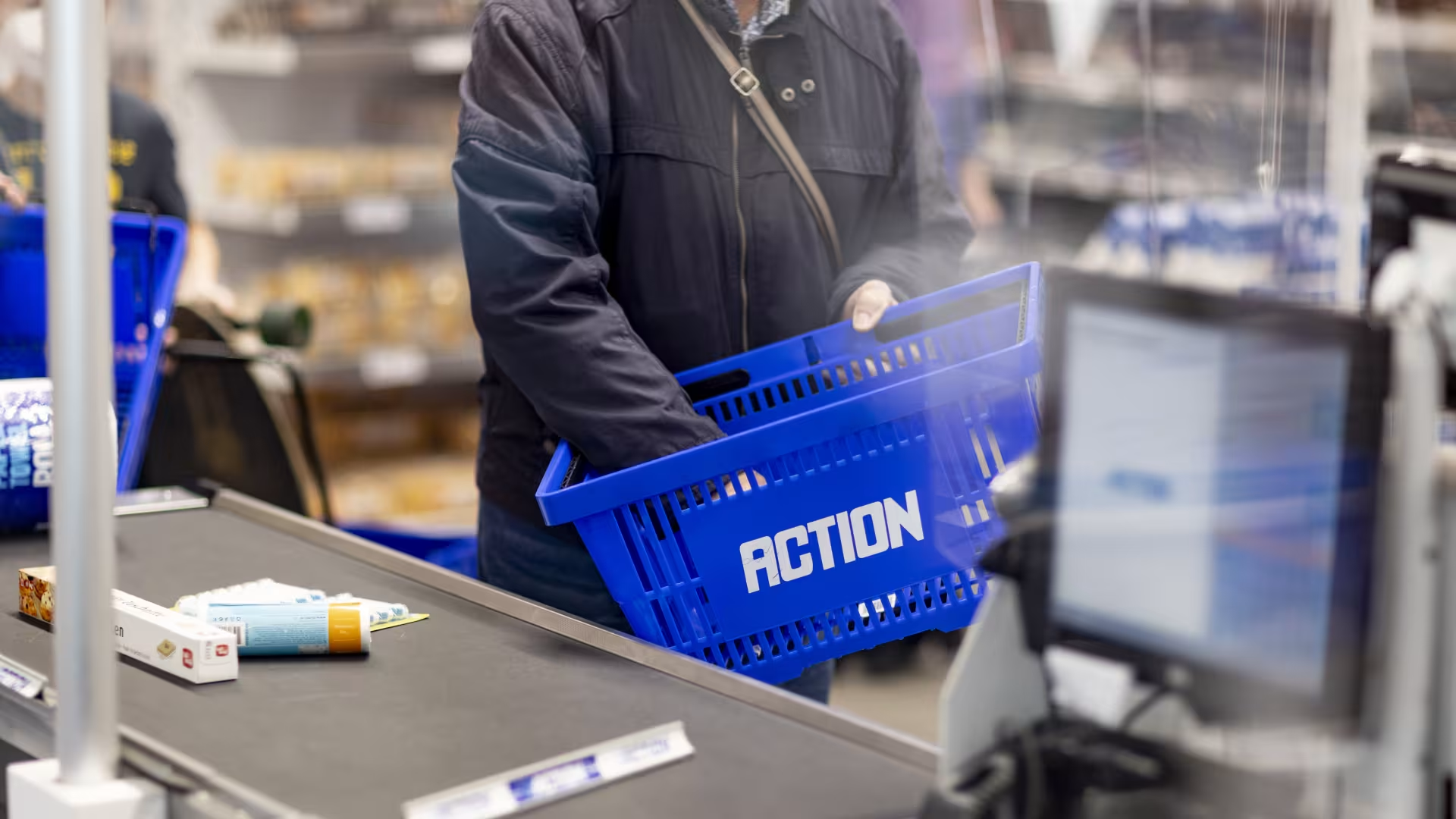
Nevertheless, there will likely still be an impact through the second factor Bompard highlighted: deteriorating consumer sentiment. On the one hand, Action, as France's ultimate discounter, could actually benefit in times of social and economic pressure. As consumers see their budgets shrink, they will be quicker to switch to the cheaper alternatives available at Action. On the other hand, a gloomier mood directly weighs on people's willingness to spend on extras. This particularly affects discretionary spending and sales of seasonal items. In that context, the warning from Carrefour CFO Matthieu Malige about shrinking non-food sales should also be read as a signal. Although Action's product range cannot be directly compared to a supermarket's non-food offering, it does underline that consumers are becoming more cautious.
Whether Action's sharp prices are enough to offset this general caution may only become clear during the Q3 update in November, or otherwise definitively when the fourth-quarter 2026 figures are presented.
How Scottish Mortgage tries to find the AI winners
The British investment trust Scottish Mortgage (SMT) shared its Q3 update this week. Investment specialist Hamish Maxwell indicated that Scottish Mortgage does not see AI as just another software wave, but as the beginning of a new industrial era. For twenty years, growth investors favoured software, because a line of code can be copied at virtually no cost, whereas a factory requires a great deal of capital. AI, however, needs enormous physical infrastructure in the form of chips, power and data centres. As the use of AI keeps getting cheaper, the shortages are therefore arising precisely in those physical resources.
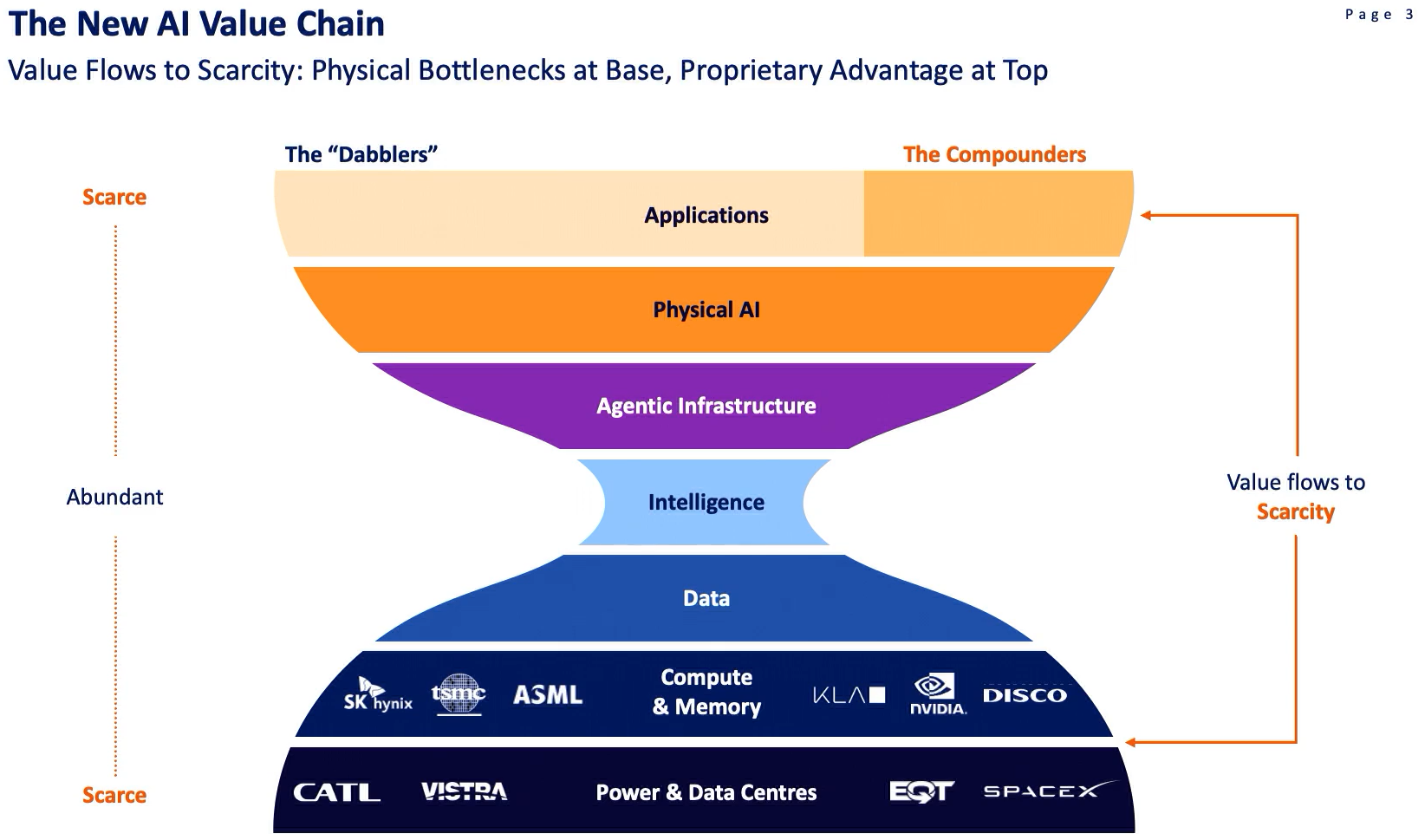
The trust therefore depicts the value chain as an hourglass. At the bottom sit power, data centres, computing capacity and memory, where companies such as TSMC, ASML and NVIDIA operate. Because demand there exceeds supply, these companies, according to the trust, are able to charge higher prices. At the top sit companies with proprietary data, strong customer relationships and applications deeply embedded in their customers' operations. Scottish Mortgage calls these companies the compounders, because AI genuinely strengthens their business model. In contrast stand the dabblers, which merely add AI as an extra feature to their products.
In the narrow middle of the hourglass sits the AI itself, which for everyday tasks such as writing and coding is likely to become cheap and widely available. According to the trust, there is therefore little money to be made there. An exception is formed by the most advanced models, such as Anthropic's, because only a handful of players are able to build models that can solve the hardest problems.
Scottish Mortgage is adjusting its portfolio accordingly. For instance, the trust recently took stakes in KLA, which supplies quality control systems for chip manufacturing, and in DISCO, which grinds and cuts silicon wafers. Both companies sit at the bottom of the hourglass, where the trust expects the biggest shortages. In addition, Scottish Mortgage took a stake in Italy's Bending Spoons, in which Berkshire Hathaway also recently invested. Like serial acquirers Constellation Software (Toronto: CSU) and Topicus (Toronto: TOI), Bending Spoons grows by acquiring software companies. However, Bending Spoons focuses on larger, well-known brands such as Vimeo and WeTransfer, whose costs it cuts sharply after acquisition. Constellation and Topicus, by contrast, mainly buy small companies that make software for a specific industry and that largely continue to operate independently after being acquired.
Nevertheless, all three companies belong among the compounders at the top of the hourglass. According to Scottish Mortgage, companies have an edge above all when their customers find it hard to replace their software, because it holds their data and their employees use it every day. For example, municipalities, healthcare institutions and schools have been running their administration on Constellation's and Topicus's software for years, while Bending Spoons reaches millions of loyal users through its brands. A new AI application therefore cannot simply take over that position.
Full order books at Addtech, a departing major client at Lifco
This week Addtech (Stockholm: ADDT-B) and Lifco (Stockholm: LIFCO-B) published their quarterly results for the months July to September. For Addtech this is the second quarter of the financial year that begins in April, while for Lifco it is the third quarter of the calendar year. At first glance the two companies look quite similar, as both reported sales growth of around 8% that came largely from acquisitions. They do differ, however, in how their organic growth developed and in their outlook for the coming quarters.
| July to September 2026 | Addtech | Lifco |
|---|---|---|
| Sales growth | 8% | 8.3% |
| Organic growth | 2% | 1.6% |
| Operating profit (EBITA) growth | 17% (1) | 10.7% |
| Operating profit margin | 16.7% | 23.1% |
| Operating profit margin a year earlier | 15.5% | 22.6% |
(1) Including a one-off gain of around SEK 55 million. Excluding this gain, operating profit (EBITA) rose by approximately 10%.
At Addtech, organic growth is picking up. After two quarters in which sales from existing businesses remained virtually unchanged, organic growth now came in at 2%. This summer, CEO Niklas Stenberg had already indicated that incoming orders were clearly running ahead of invoiced sales and that these orders would mainly become visible in the figures in the second half of the financial year (more on this in this article). The past quarter shows the first signs of this. Addtech cites investment in the electricity grid, electrification, defence and data centres as the main drivers of demand.
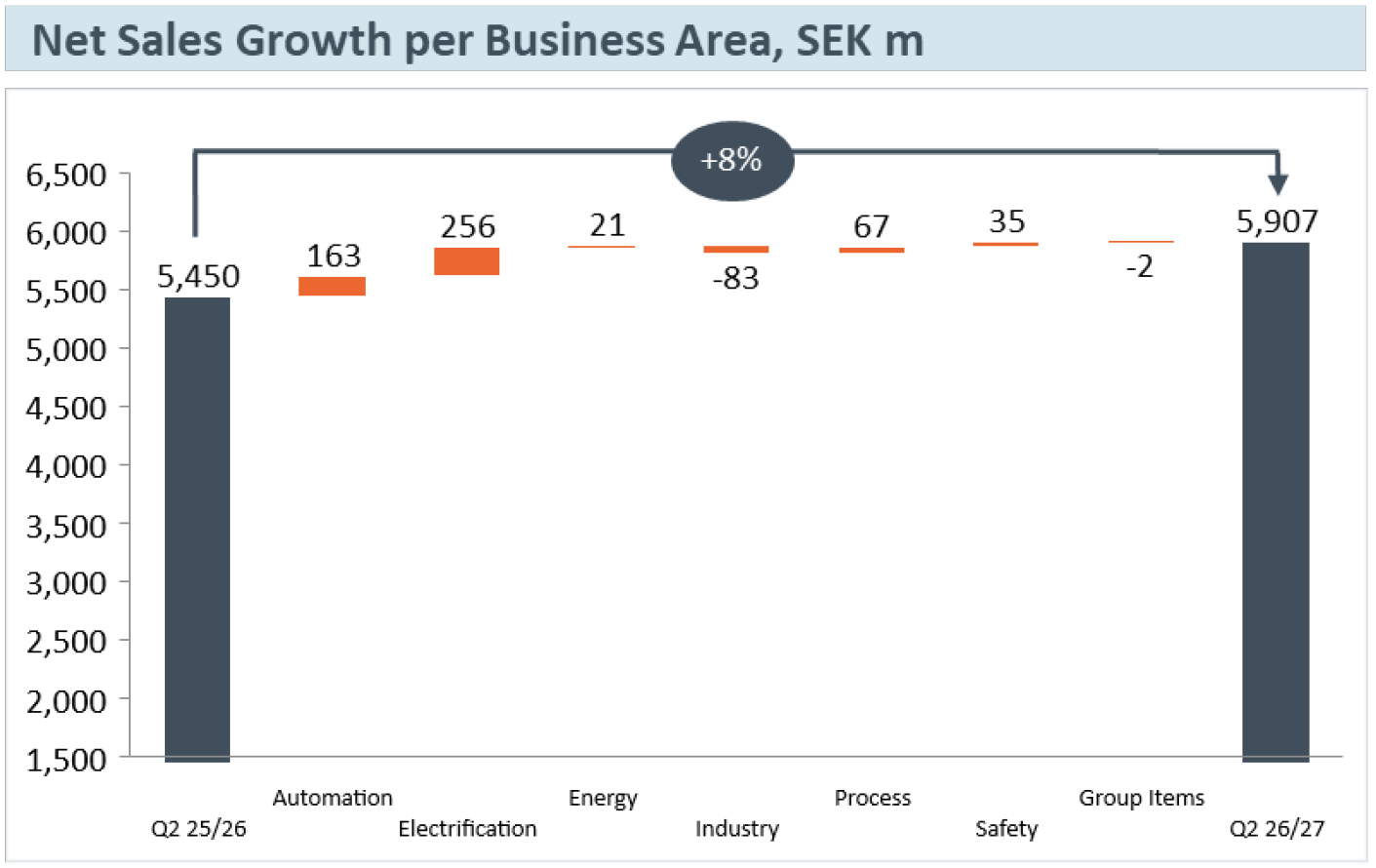
Electrification grew sales by 31% and Automation by 20%. At Automation, the margin also rose from 10.8% a year earlier to 13.9%, thanks to higher margins on the products sold and cost savings implemented earlier. Industry remained the weak spot, with sales down more than 7% as customers in forestry and sawmills continue to postpone their investments.
Operating cash flow fell from SEK 859 million a year earlier to SEK 717 million, as the large number of new orders tied up more cash in inventories and unpaid invoices. During the quarter, Addtech also acquired the UK's RTL Materials, which makes rollable composite structures and extendable masts under the Rolatube brand, mainly for defence. After the end of the quarter came the acquisition of the UK's Mechanical Power Transmission, a maker of custom gears and drive components. Alongside its results, Addtech also announced the acquisition mentioned in the In Brief section.
“The improved market situation and increased demand in various segments create favourable conditions for positive development in the coming quarters.”
Niklas Stenberg, CEO of Addtech
Stenberg nevertheless remains cautious because of rising cost inflation and disruptions in supply chains.
At Lifco, organic growth fell back to 1.6%, after reaching 4.7% in the second quarter. For the first nine months of the year, organic growth came in at 2.5%, with 1.2% in the first quarter. Operating profit rose by 10.7%, driven mainly by Systems Solutions, where results grew by 39.3%. At Transportation Products, the margin fell from 22.9% a year earlier to 20.6%, and Demolition & Tools has been struggling all year with a weak market for demolition robots.
Because organic growth at Lifco has been sluggish for several quarters in a row now, we sold the shares earlier this year. Two other Swedish serial acquirers performed clearly better on fundamentals over the same period, while their valuations were more attractive according to our calculations. These include a smaller acquisition machine that we do not name in this newsletter (available to clients only).
More important for the period ahead is an announcement regarding the Contract Manufacturing division. A customer accounting for roughly 5% of Lifco's total revenue has lowered its forecasts from January 2027 onwards and wants to shift its purchasing to suppliers outside Europe. As a result, Lifco expects a negative effect on the revenue and profit of Systems Solutions in 2027. Even if only part of that revenue disappears, it will noticeably weigh on organic growth next year, which is already proving sluggish this year.
Both companies have a strong balance sheet and a well-filled acquisition pipeline. At Addtech, order intake and management's comments point to further accelerating organic growth in the coming quarters, whereas Lifco, after a quarter of slowing organic growth, also has to reckon with headwinds in one of its largest divisions next year. Our investment case for Addtech is that it is better positioned for structural megatrends, which is also reflected in the (organic) growth figures.
The smaller Swedish serial acquirer we bought with the proceeds from Lifco recently reported excellent results, after which the share price rose sharply. We deliberately do not write about this company in this newsletter, as it is only available to our clients.
Receive weekly insights in your inbox
Exclusive analyses and updates on family holding companies and global market developments.
Would you like more information about our services?
Get in touch
Disclaimer:
No rights can be derived from this publication. This is a publication of Tresor Capital. Reproduction of this document, or parts thereof, by third parties is only permitted after written consent and with reference to the source, Tresor Capital.
This publication has been compiled by Tresor Capital with the greatest possible care. The information is intended in a general sense and is not tailored to your individual situation. The information should therefore explicitly not be regarded as advice, an offer or a proposal to purchase or trade investment products and/or to take up investment services, nor as investment advice. The authors, Tresor Capital and/or its employees may hold positions in the securities discussed, for their own account or for their clients.
You should carefully consider the risks before you start investing. The value of your investments may fluctuate. Past performance is not a guarantee of future results. You may lose (part of) your investment. Tresor Capital disclaims any form of liability for any inaccuracies or errors. This information is purely indicative and subject to change.
Read the full disclaimer at tresorcapitalnieuws.nl/disclaimer .
This article was originally written in Dutch and automatically translated into English with the help of AI. In case of any difference, the Dutch original prevails.