Family Holdings #42 - Operational strength and the AI impact on serial acquirers


This week's topics:
Chapters Group is pressing ahead with the acceleration in its organic growth and underpins its raised guidance with the publication of the full 2026 half-year report. The management's commentary shows that the strength lies in synergies via the Manuscript Method, the forging of specialised business clusters and rapid adoption of AI. Flagship holding Lumeira (accounting for roughly 41% of the group's operational profit in the first half of 2026) serves as the textbook example here. Thanks to brand integration on a new, AI-driven platform, efficiency and synergy benefits are surging. With the ambition of turning Lumeira into an AI-native organisation and eventually building more clusters of this kind, Chapters shows how operational scale and technological innovation go hand in hand.
Following an extensive analysis by the American investment fund Crossroads Capital, we highlight why Constellation Software (CSU) should be viewed not as a risky software company, but as an exceptionally strong investment holding company. Where the market fears the impact of AI on software, the report demonstrates that CSU's core strength lies in consistently reinvesting cash flow into new acquisitions at a return of 17-18%. AI barely threatens the model and may, in time, actually make acquisitions cheaper.
In Brief:
Scottish Mortgage (London: SMT) recently initiated new stakes in American natural gas producer EQT and in Vistra, which operates gas and nuclear power plants. The British investment trust sees power supply as the biggest constraint on building data centres for AI. In July, it also took a stake in the unlisted Hadrian, which makes precision components for the American defence industry. Food delivery company Delivery Hero has been sold due to fierce competition. SpaceX's weighting in the portfolio fell from 25 to 15 percent, pointing to further sales. Moderna returned to the top ten following positive results with a cancer treatment, while AI developer Anthropic and drone delivery company Zipline were valued substantially higher in September.
The Swedish holding company Lifco (Stockholm: LIFCO B) is acquiring the German company Hega Medical, which makes products for cleaning medical equipment in laboratories, clinics and hospitals. The Munich-based company has ten employees and generated revenue of approximately EUR 1.6 million in 2025.
The Canadian investment holding company Constellation Software (Toronto: CSU) acquired the American company Usherpa through Optimal Blue. The Denver-based software company offers mortgage advisers and brokers a platform with which they automate marketing and maintain contact with clients.
CEO and co-founder Christof Nesemeier of the German family holding company MBB SE (Frankfurt: MBB) bought additional MBB shares last week for a total of EUR 297,167.20. He paid between EUR 167.20 and EUR 173.60 per share. Together with co-founder Gert-Maria Freimuth, Nesemeier owns just over 70 percent of the shares. The purchase is a signal that Nesemeier considers the share attractively valued.
Berkshire Hathaway (New York: BRK.B) is investing another USD 330 million in the Italian company Bending Spoons (Nasdaq: BSP), raising its stake to 4 percent. At the IPO in July, Berkshire already bought USD 600 million worth of shares, bringing the total investment to USD 930 million. Like Constellation Software, Bending Spoons is a serial acquirer in software, but it mainly buys larger, well-known brands such as Vimeo and WeTransfer and then cuts costs sharply. Constellation, by contrast, mainly buys small companies with software for a specific industry, which largely continue to operate independently after the acquisition.
Investor AB impresses with recovery at Patricia Industries
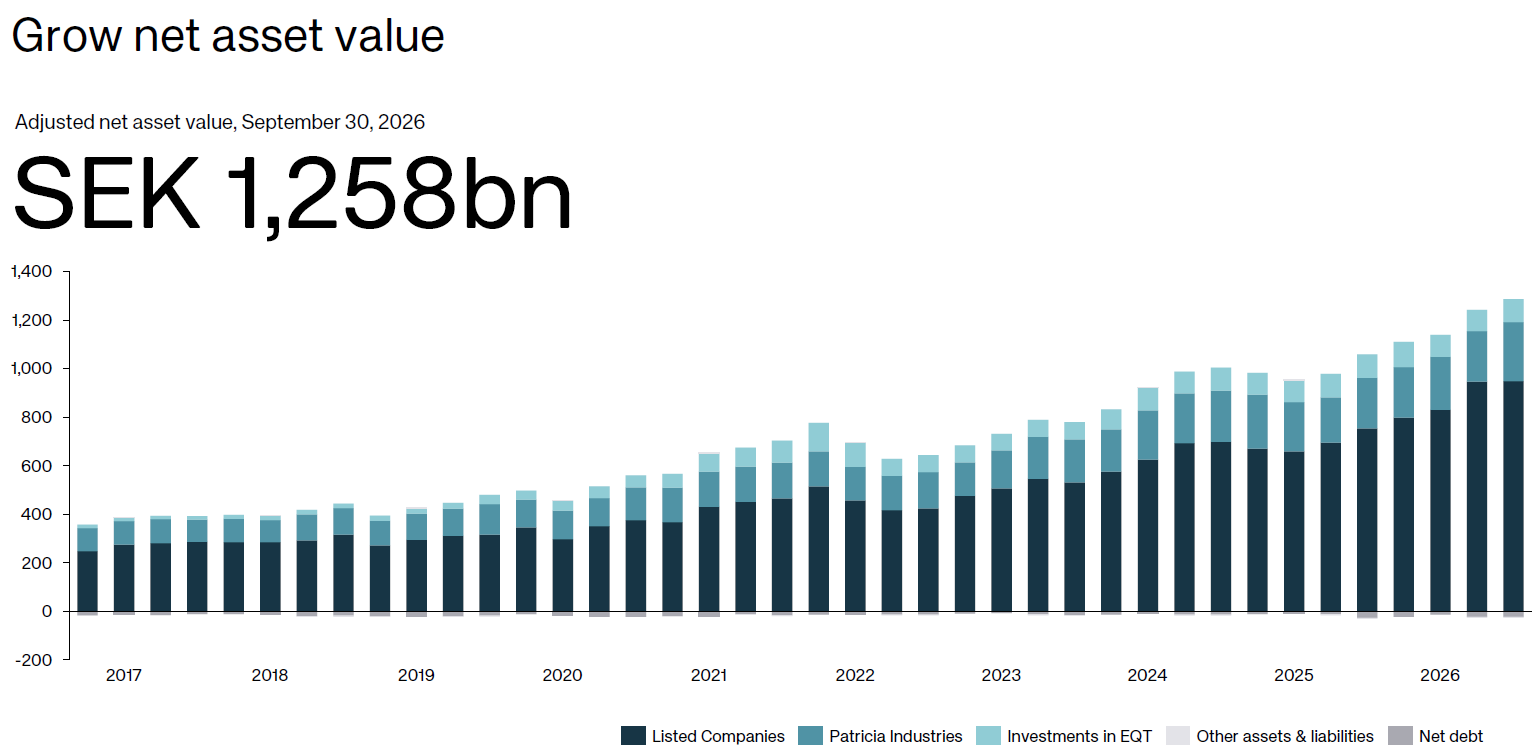
Investor AB (Stockholm: INVE.B) closed the third quarter with a net asset value of SEK 411 per share, 4% higher than at the end of June. The share price rose 1% over the same period. That is the reverse of what we saw in the first half of the year, when the share price increasingly pulled ahead of net asset value: from a 7% discount at the end of 2025 to a premium of over 1% at the end of June. Because the first half of the year was driven by the listed holdings and the private holdings are now also showing good growth, the share price has nevertheless still risen faster than net asset value this year. Over the first nine months of the year, reported net asset value is up 17% and the share price is up 24%. At the moment, then, an investor buying Investor AB shares is buying a: "wonderful company at a fair price" as Warren Buffett once put it.
Little action in the listed holdings this quarter
Investor's listed portfolio, which accounts for three-quarters of total assets, delivered a modest total return of 0.5% this quarter. That lacklustre performance was mainly caused by heavyweight ABB. As the largest position (20% of assets), ABB lost 9.4% after a strong rise in the second quarter. During the results presentation, we asked whether Investor would be willing to trim its ABB position if it became too large or too expensive, just as the holding company buys more when prices fall. CEO Christian Cederholm answered with a clear no, because selling at the margin does not fit Investor's role as an engaged long-term owner. He pointed out that ABB is not a single company, but a collection of different business units.
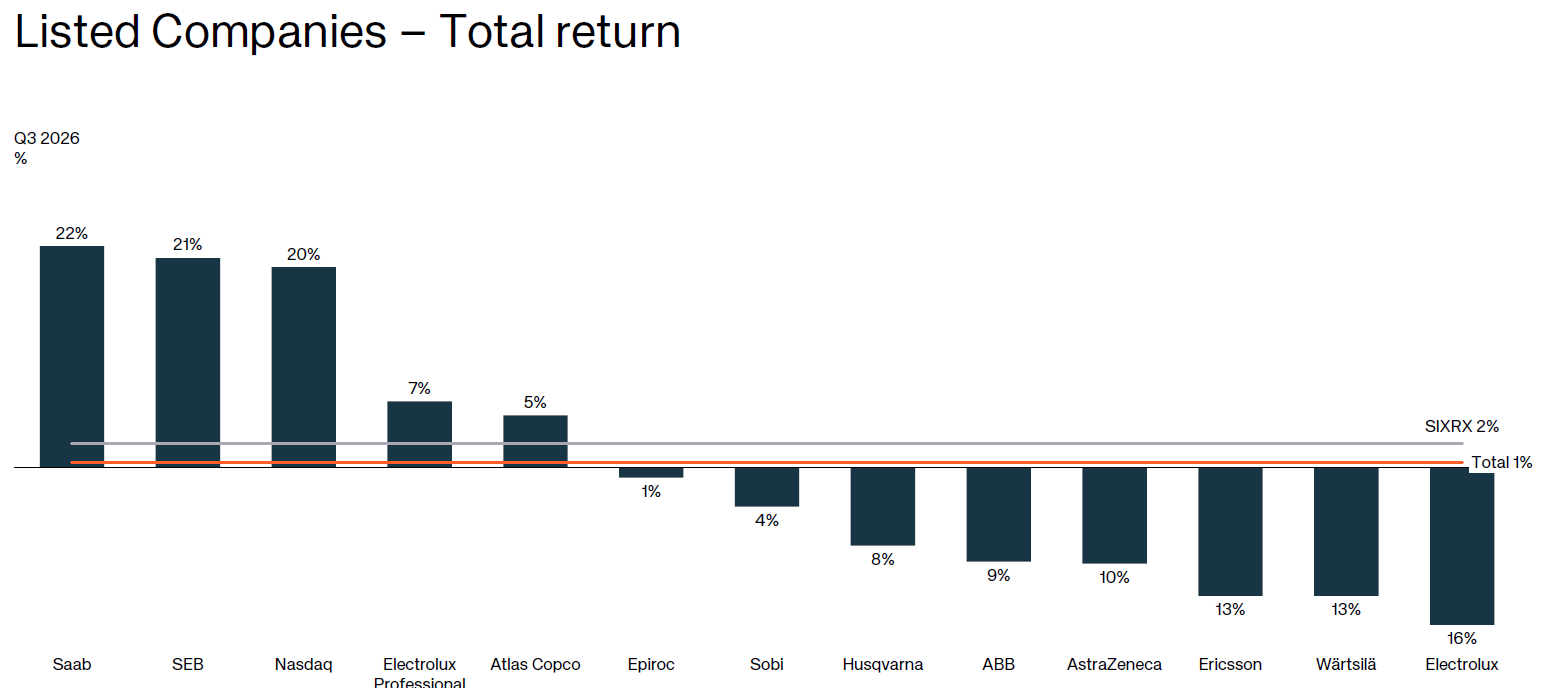
AstraZeneca, Wärtsilä and Ericsson also lost ground, each falling around 10%. Against those declines stood strong gainers such as Saab (+22.1%), SEB (+20.9%) and Nasdaq (+20.0%). Looking at the first nine months of the year, ABB remains the portfolio's standout driver with a return of 40.2% in Swedish kronor, closely followed by Sobi, SEB, Epiroc and Atlas Copco, which all posted gains of between 25% and 33%.
Although the portfolio has performed well over the long term, no new purchases were made in the past quarter. Investor acted solely as a seller, disposing of two million SEB shares for SEK 376 million. In addition, a contract was signed for the sale of a further two million shares, purely to keep the stake at 22% following SEB's own buyback programme. That passive stance came to an end this morning, however. Investor announced that it had acquired 12.5 million shares in EQT AB for approximately SEK 3.5 billion, equivalent to SEK 282.70 per share. With this transaction, the stake climbs back up to 14.98%. This brings the holding back to almost 15%, the level Investor has maintained for some time, after it had been diluted earlier this year when EQT issued new shares to finance the acquisition of Coller Capital.
What is more interesting than the size of this transaction, however, is the way in which it came about. The shares were not bought on the stock exchange, but acquired directly from Wallenberg Investments. That is the asset manager of the sixteen Wallenberg foundations, the non-profit organisations that use their returns to finance scientific research and education in Sweden and which are also the controlling shareholder of Investor. What particularly interests us about this shift is which doors it might potentially open further.


Besides its fund investments, Wallenberg Investments holds a sizeable industrial portfolio worth around SEK 53 billion. This includes stakes in listed names such as SKF (15.2%), Stora Enso (10.2%) and Munters (28.3%), as well as majority or full ownership stakes in private companies such as Höganäs, Nefab, IPCO and Kivra. These are all quality companies that would certainly not look out of place in Investor's portfolio. SKF and Stora Enso were even part of Investor until 2007. Transferring stakes between the two entities is therefore nothing new, although back then it happened in the opposite direction.
The stake in Munters stands out in particular. As a global player in climate control for data centres and pharmaceutical production, Munters fits seamlessly with the same AI infrastructure theme that Investor is promoting this quarter through ABB's new direct current systems. Coincidentally, exactly a month ago we asked Magnus Dalhammar, head of investor relations at Investor, directly: 'why doesn't Investor take a stake in Munters?' We did not get a concrete answer at the time, but today's transaction does prove that a legal and operational framework exists to move stakes smoothly from Wallenberg Investments to Investor. We therefore do not rule out that EQT was merely a first step and that more will follow in the future.
Patricia Industries: Mölnlycke earns its rise in value
The private arm delivered almost the entire net asset value growth for the quarter, with a total return of 16% (excluding cash) and a dividend payout of SEK 33.8 billion. A strong recovery compared with the 4% decline in Q2. Investor cites the main drivers as: profit growth, higher multiples and a positive currency effect from the weaker krona. Operationally, the company is in good shape, with 7% organic growth at the large subsidiaries and 26% growth in operating profit, although recovered import tariffs did provide an extra tailwind here.
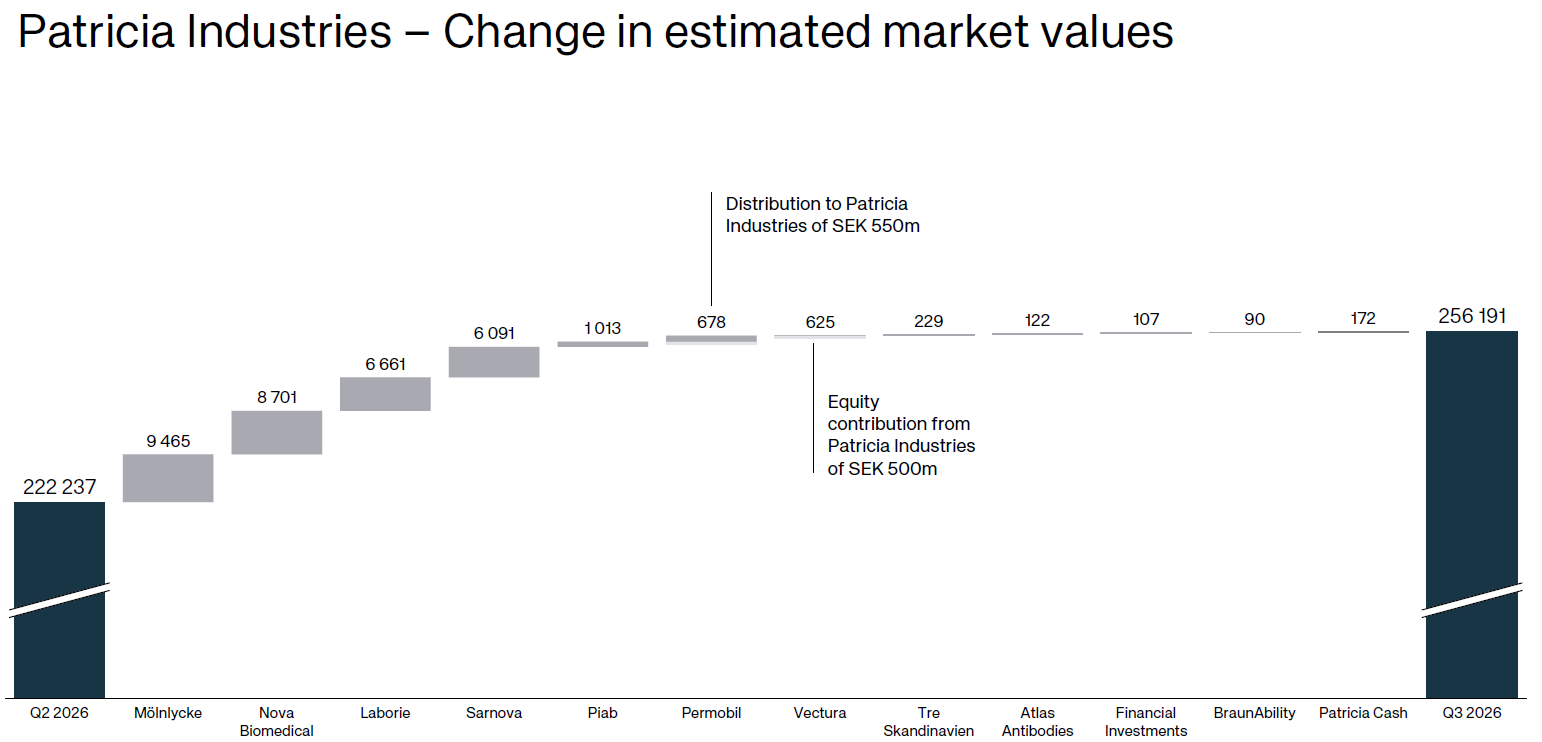
Mölnlycke, which accounts for just over a third of the private portfolio, delivered the most sustainable increase in value. Organic revenue growth accelerated from 2% in Q2 to 5% in Q3, driven by the wound care division (60% of revenue, +6%). Although the profit margin jumped to 28.9%, adjusted for import tariffs and currency effects it was in line with last year. Underlying profitability therefore remained flat. Cash flow, however, did impress. With €148 million in operating cash flow, net debt fell by just over €100 million to €1.8 billion. The valuation multiple applied rose only slightly (from 13.8x to 14.1x operating result) and remains well below the 15.6x seen at the end of March. By our calculations, this means half of the increase in value came from profit and debt reduction, a quarter from currency effects, and only a fifth from a higher valuation.
Investor AB also reported that Mölnlycke is working on spinning off its operating room solutions division (25% of revenue) and its gloves division into a standalone company. Wound care and antiseptics will continue under the Mölnlycke name, while operating room solutions and gloves will be housed under Mölnlycke Surgical. This makes sense, as the faster-growing wound care and antiseptics businesses achieve high margins, while the units being spun off grow more slowly or are more sensitive to raw material prices. By separating out the slower-growing unit, the market can value the faster-growing part on its own merits. Cederholm did stress that the split is not intended to pave the way for a sale of either company, nor to achieve a higher valuation by being grouped with a different set of comparable listed companies. The aim is for both companies to be able to steer more sharply with their own management, their own supervisory board and their own income statement, even though this will lead to extra costs as some functions will need to be duplicated.
For the remaining holdings, the figures were driven much more by rising valuation multiples on the stock market. The table below shows the building blocks of the change in value for each company:
| Holding | Value Q3 (SEK bn) | Δ value Q3 | Organic growth Q3 | Multiple Q2 → Q3 | Multiple effect* | Earnings and cash effect* | Currency effect* |
|---|---|---|---|---|---|---|---|
| Mölnlycke | 84.7 | +12.6% | 5% | 13.8x → 14.1x | +3% | +6% | +3% |
| Nova Biomedical | 40.1 | +27.7% | 14% | 17.2x → 19.3x | +14% | +8% | +3% |
| Laborie | 36.9 | +22.0% | 13% | 15.8x → 17.5x | +13% | +5% | +3% |
| Sarnova | 25.0 | +32.3% | 8% | 13.3x → 15.0x | +18% | +8% | +3% |
| Permobil | 13.3 | +5.4% | 0% | 12.7x → 13.2x | +5% | 0%** | 0% |
| Piab Group | 12.0 | +9.2% | 5% | 17.3x → 17.3x | 0% | +9% | 0% |
| BraunAbility | 11.2 | +0.8% | 10% | 11.6x → 11.4x | −2% | 0% | +3% |
| Tre Skandinavien | 11.1 | +2.1% | n/a | 7.1x → 6.9x | −3% | +4% | 0% |
Source: Investor AB, Q2 and Q3 2026 quarterly reports. *Tresor Capital estimates based on the multiples applied by Investor, trailing twelve-month EBITDA and exchange rates; indicative, the columns do not add up exactly. **Permobil: earnings growth offset by the SEK 550 million distribution to Patricia Industries.
The table shows that this quarter's increase in value came mainly from higher stock market valuations and much less from profit growth. Sarnova, for example, grew organically by 8%, but the increase in the multiple from 13.3x to 15x made the largest contribution. This is normal in itself, since valuation models move in line with comparable listed companies. That is why we look not only at the reported net asset value (NAV), but also make visible which part stems from better business results and which part is the result of stock market sentiment.
Interest rates, Europe and financial strength
In his letter to shareholders, Cederholm points out that interest rates rose sharply over the past quarter, partly due to higher inflation expectations but also because of doubts about the sustainability of government debt and budget deficits in a number of countries. Cederholm sees Europe caught between China and the United States, which are increasingly deploying industrial capacity, technology and capital to expand their national power. Europe, he notes, is held back by fragmented markets for goods, services and capital, high energy costs and restrictive regulation. Still, he believes the continent has strong assets, particularly if the internal market is put to better use. Moreover, there is broad agreement on what needs to happen.
“Moving from ambition to action requires difficult trade-offs and sustained political will and urgency, but the recipe for change does at least seem to be becoming ever clearer.”
Christian Cederholm, CEO of Investor AB
During the Q&A, we asked whether Europe's lag behind the United States and China in growth themes such as the build-out of AI infrastructure has any consequences for the composition of the portfolio, particularly within Patricia Industries. Cederholm largely agreed with that characterisation and acknowledged that Europe is not currently at the forefront. He pointed out, however, that Europe remains an important market for many companies in the portfolio, while most of those companies operate globally and therefore also have to compete on a global scale. In his view, long-term success ultimately depends on how quickly they innovate, how smartly they invest and how well they manage to scale up new technology.
Looking ahead, Cederholm emphasises that Investor is in a strong financial position. The debt ratio stood at 1.8% at the end of September, comfortably within the company's own target range of 0 to 10%, while the cash position came in at SEK 29.46 billion. Credit rating agency Moody's also upgraded Investor's credit rating this quarter, from Aa3 to Aa2. As a result, Investor has ample room to support its own companies and to make attractive investments across all three business areas.
All in all, it is good to see performance at Patricia Industries, where we were still writing about somewhat weaker results in the second quarter, picking up strongly again this quarter. On 4 November, Investor will hold a Capital Markets Day, at which the CEOs of all the North American subsidiaries and of Mölnlycke will present their businesses. We will of course keep you updated.
Chapters Group builds on the lessons from Lumeira
The German serial acquirer Chapters Group (Frankfurt: CHG) has published its full half-year report for 2026. In early September, the holding company had already announced that growth was accelerating further, after which it raised its guidance for this year for the second time. We already discussed all of this in our newsletter of 11 September. New in the report is a letter from management and an interview with the head of Lumeira, the cluster of financial service providers within Chapters.
 Michael Gielkens
The letter from management
In their letter, CEO Jan-Hendrik Mohr and CFO Marlene Carl write that they measure Chapters' progress not only by its acquisitions and results, but also by what the group learns. According to them, the faster organic growth is coming from across the whole group rather than from a single company. In the process, the companies share best practices through Chapters' Manuscript Method. Within Financial Technologies, Chapters also merged three companies serving the same customers into a single cluster. According to management, this resulted in a better offering and significant synergies. Because software companies serving the same customer base can be worth more together than apart, Chapters intends to build more such clusters over time.
The companies within Chapters are already using AI to write software faster and automate processes. However, Mohr and Carl see the biggest opportunity in better products, since many companies within the group have known their customers and markets inside out for years. At the same time, building software is becoming cheaper and faster, which also means customers are coming to expect more.
“What made a software company strong five years ago may no longer be enough in five years' time.”
Jan-Hendrik Mohr (CEO) and Marlene Carl (CFO) of Chapters Group
That is why Chapters wants to be an organisation that learns quickly and adjusts its assumptions as soon as new facts warrant it.
Lumeira as an example
Lumeira was created in May 2025 from the merger of Fintiba and its subsidiary Coracle with competitor Expatrio, the largest transaction in Chapters' history. In the first half of the year, Lumeira accounted for approximately 41% of the group's operating profit before depreciation and amortisation (EBITDA). Its key product is the blocked account, an account on which foreign nationals lock up the money they need to live on for their German visa application. More than 750,000 customers from 190 countries now use Lumeira.
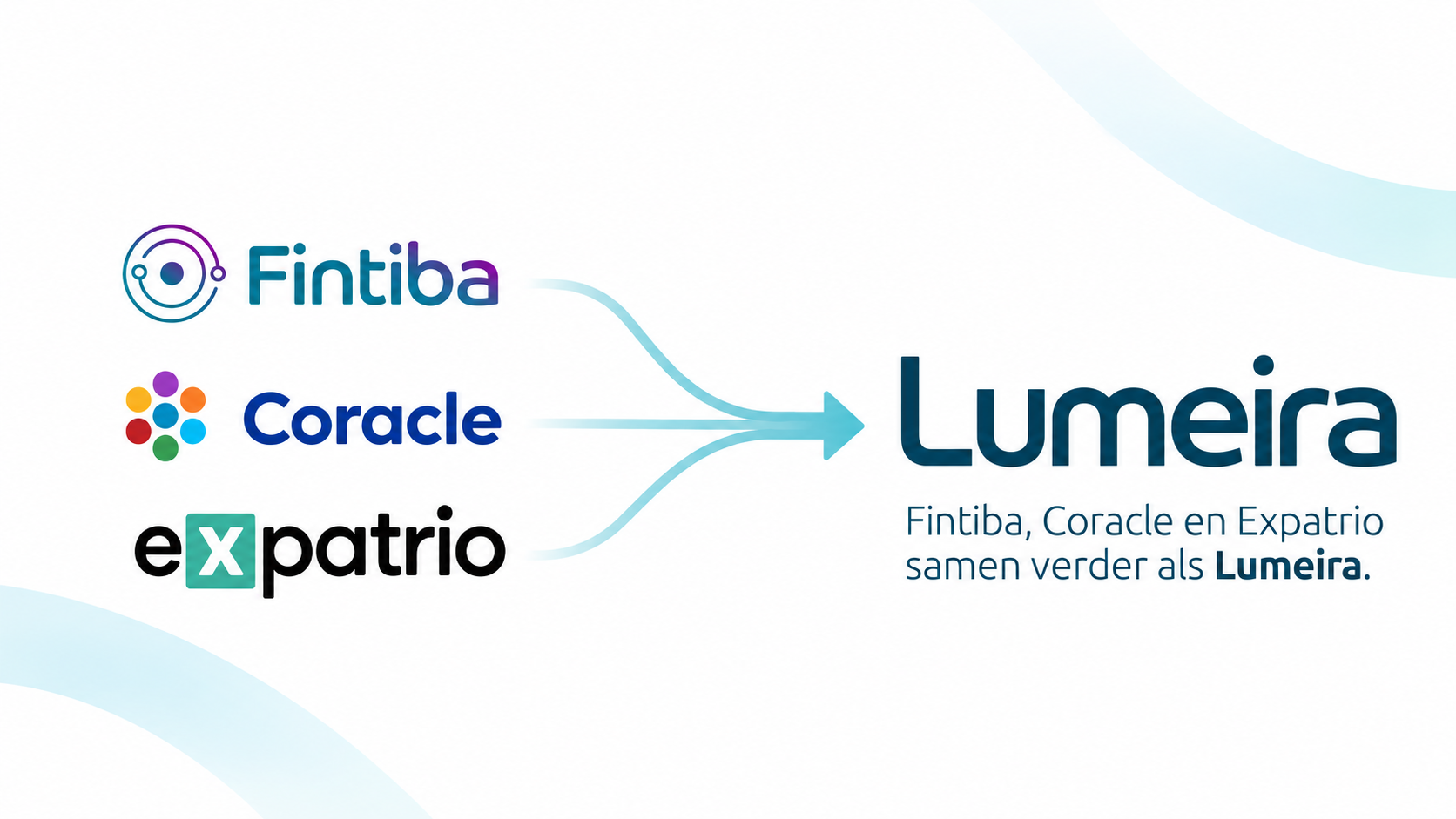
The merger initially ran into delays because each brand used its own technology. Management therefore decided to move all brands onto a new shared platform built with the help of AI. Since then, the merger's synergy benefits have turned out higher than originally expected. Customers still see the familiar Expatrio and Fintiba brands, but behind the scenes all employees now work together within a single organisation using the same systems.
CEO Tobias Fischer, co-founder of Expatrio, has led Lumeira since December 2025. The full interview with him can be read here. In it, Fischer explains that since he took over, more than 90 percent of the integration work has been completed. In his view, the biggest challenge is culture, since the three companies worked in very different ways and had been competitors for more than ten years. Lumeira is given a great deal of freedom by its majority shareholder, Chapters.
After the blocked account, Lumeira wants to sell the same customers other financial products, such as health insurance and a current account. In this way, the company guides students and knowledge workers not only through their visa application, but also in building their lives in Germany. In customer service, AI now drafts the first response to 40 to 50 percent of incoming queries. Around 30 percent of all customer queries are even handled entirely by AI, without any employee involvement. In addition, the teams work with AI agents - programs that carry out tasks independently - allowing the same employees to handle far more work.
“The ambition is not just to use AI, but to build Lumeira as an AI-native organisation.”
Tobias Fischer, CEO of Lumeira
Over the next 12 to 24 months, Fischer mainly wants to grow the number of customers. For him, success means that profit grows faster than revenue as that growth happens.
“We have the chance of a lifetime to reshape one of Germany's largest industries. It won't be easy, but we're ready for the challenge. We're only in the opening minute of the first half.”
Tobias Fischer, CEO of Lumeira
Why Constellation is a holding company rather than a software company
The American investment fund Crossroads Capital recently published an extensive analysis of the Canadian investment holding company Constellation Software (Toronto: CSU). Since the unrest around AI began, many investors have come to see Constellation as an ordinary software company that could be overtaken by this technology. The authors, however, see Constellation as a holding company that buys software businesses with the intention of never selling them. The cash flow from these subsidiaries is reinvested time and again into new acquisitions. According to the authors, it therefore matters less whether AI renders part of the software redundant. The key question is mainly whether Constellation can keep reinvesting that cash flow at a good return.
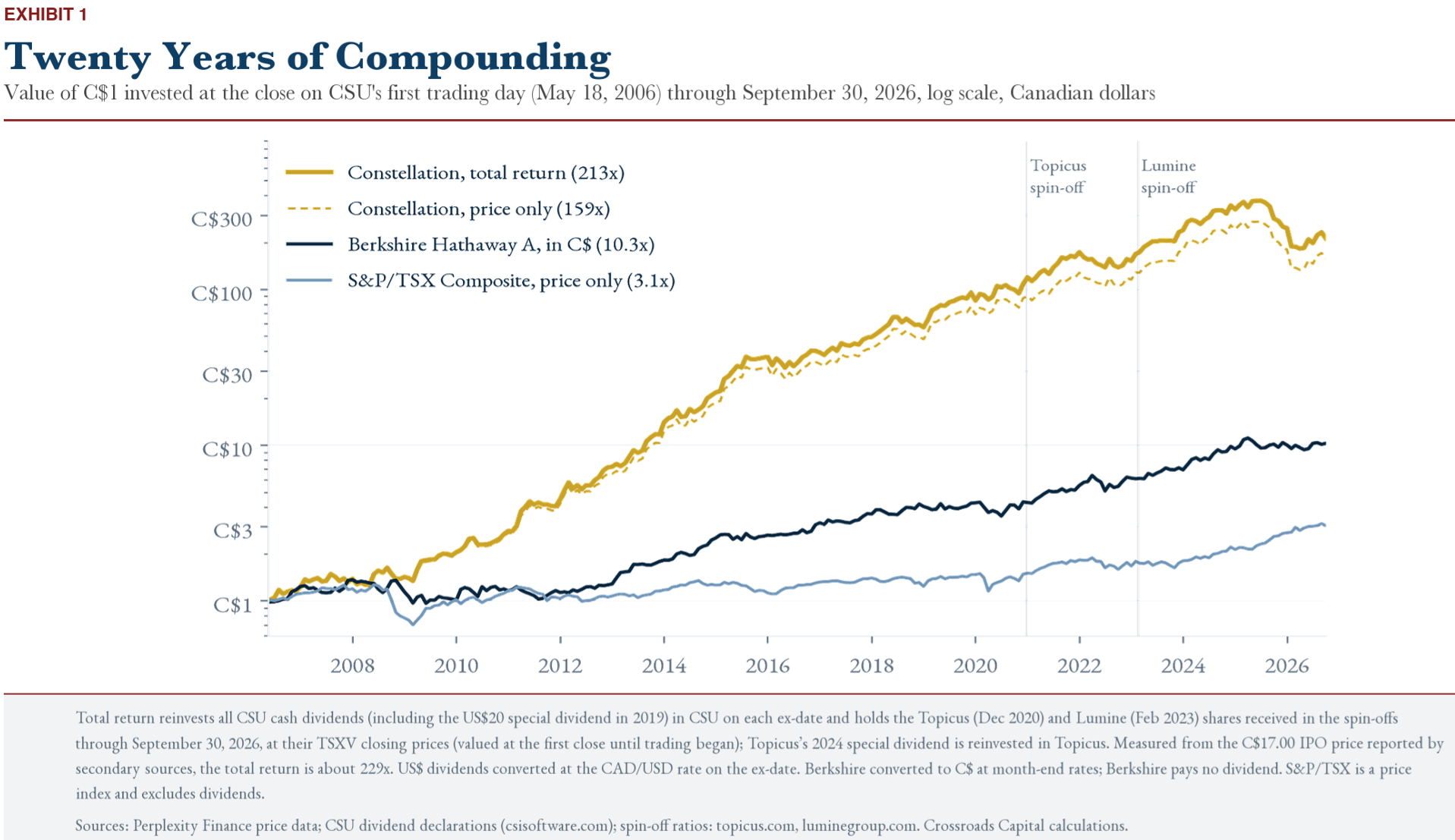
The authors therefore compare Constellation to Berkshire Hathaway. Berkshire, too, buys companies to hold forever, gives the management of its subsidiaries a great deal of freedom, and is very disciplined with its capital. Constellation mainly buys small companies, largely funded from its own cash flow. Berkshire, by contrast, regularly buys large companies, partly funded with the premiums its insurers receive upfront. Since its listing in 2006, Constellation shares have returned around 30% per year on average in Canadian dollars. That return includes the dividends and the Topicus and Lumine shares that shareholders received at the respective spin-offs. In US dollars, the return was around 29% per year, more than the roughly 26% Berkshire achieved in its first twenty years.
Following rather than predicting
Constellation itself does not predict which software companies are best positioned to withstand AI. Founder Mark Leonard explained why during an investor webinar in September 2025.
“Predicting the future is very difficult, especially in times like these, but following what is happening right now is a lot easier.”
Mark Leonard, founder of Constellation Software
Constellation has more than a thousand subsidiaries, each reporting its own figures. This allows the holding company to quickly see which businesses are performing well and to allocate its capital accordingly. It also means Constellation can wait and see which software companies prove resilient before making new acquisitions.
AI could make acquisitions cheaper
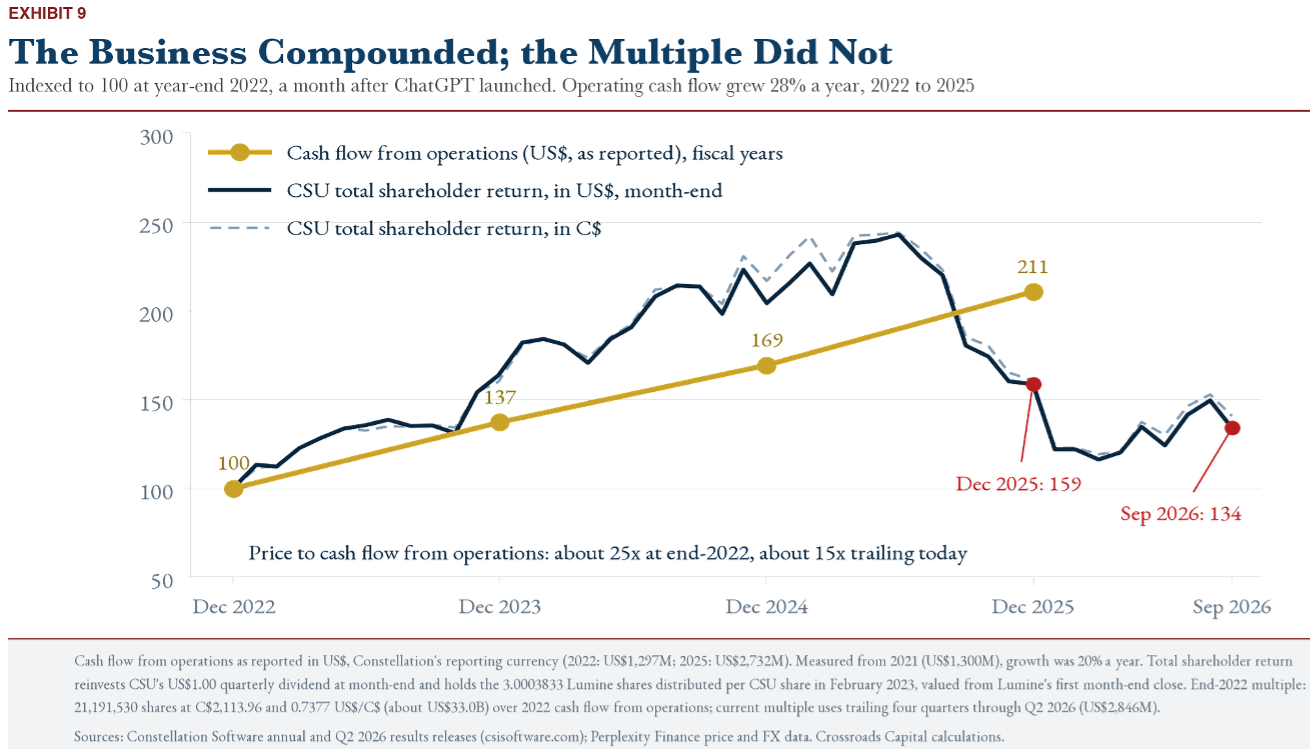
So far, there is little sign of damage from AI in Constellation's cash flow. Since the end of 2022, when ChatGPT came to market, operating cash flow grew from USD 1.3 billion to USD 2.7 billion by the end of 2025, at around 28% per year. At the end of 2022, investors were still paying around 25 times that cash flow. Now it is around 15 times.
According to the analysis, AI affects Constellation in two ways. It could put pressure on the cash flow of current subsidiaries, but it could also make new acquisitions cheaper. Investors are currently focused mainly on the potential damage to existing subsidiaries.
AI has made it far less certain what a software company will still be worth in ten or twenty years' time. For sellers, that uncertainty weighs more heavily than it does for Constellation. For a long time, founders and private equity owners assumed they would later be able to sell their software company for a high price. Now that AI makes that expectation less certain, they may be more willing to sell their company to Constellation at a lower price, even if cash flow has barely declined. Constellation never resells the businesses it acquires, so it does not need to estimate what a future buyer would be prepared to pay for them. For the serial acquirer, the only thing that matters is whether a company's cash flow in the years following the acquisition is comfortably sufficient to earn back the purchase price.
According to the authors, the holding company's return therefore mainly comes from the difference between the price Constellation pays for a company and the cash flow that comes in afterwards. Organic growth plays a much smaller role in this. Historically, recurring maintenance revenue grew organically by around 5% a year. Total organic growth usually remained limited to a few percentage points. Lower prices for software companies are therefore favourable for Constellation, as long as their cash flow holds up. Suppose a software company generates USD 1 million in cash flow each year and Constellation pays USD 8 million for it. Constellation will then have earned back the purchase price after eight years. If the price falls to USD 5 million because of AI, while cash flow remains virtually unchanged, that amount is already earned back after five years. Everything the company generates after that is extra return for Constellation.
When discussing the first-quarter results, Chief Investment Officer Bernie Anzarouth said he had not yet seen a price decline among smaller software companies. Constellation does most of its acquisitions among these companies. In the first half of the year, Constellation did invest much more in acquisitions than a year earlier.
Returns are holding up
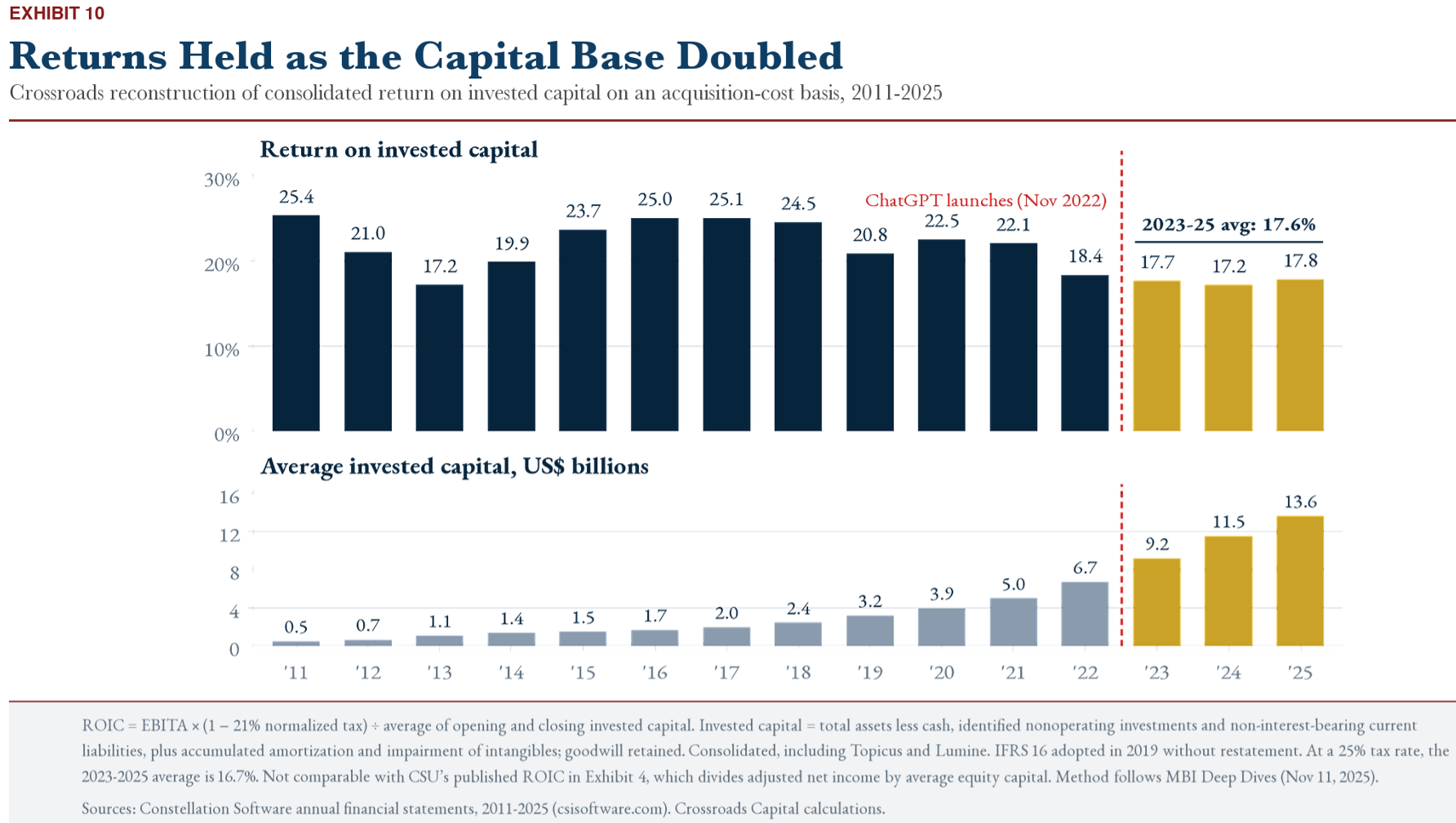
Return on invested capital shows whether Constellation continues to make good use of its cash flow. Constellation has not published this return since 2018. The authors have therefore calculated it themselves based on the financial statements. In doing so, they included every amount Constellation has ever spent on acquisitions. According to this calculation, the return over the past fifteen years has averaged around 21% and has not fallen below 17% in any single year. Over the same period, invested capital grew more than 25-fold.
Since the end of 2022 as well, the return has stayed at around 17 to 18% each year. Average invested capital doubled over that period to approximately USD 13.6 billion. The newly invested money therefore generated almost as much as the capital that had already been invested.
The return is lower than in the years 2016 through 2018, when it stood at around 25%. Leonard wrote about this to his shareholders in 2018.
“If we deploy all of our free cash flow, the return on invested capital plus organic growth should, over time, move ever closer to our hurdle rate.”
Mark Leonard, founder of Constellation Software.
The hurdle rate is the minimum return Constellation requires per acquisition and ranges between 20 and 30%, depending on the size of the transaction. The return of 17 to 18% combined with organic growth of 2 to 3% comes out at the lower end of that range. The decline in returns largely took place before ChatGPT appeared and therefore has little to do with AI. That said, it should be emphasised that very few companies are still able to achieve such a strong return on such large amounts of invested capital. The Canadian serial acquirer thus belongs to a select group.
The biggest AI risk is not customers leaving
The authors do not regard the risk of customers switching to another supplier as the biggest risk from AI. They point instead to customers who start doing their work through an AI agent, a program that carries out tasks independently. Constellation's software then keeps running in the background, but the customer's additional spending goes to the provider of that agent.
Constellation does have an advantage here, though. An AI agent can only carry out tasks independently once it knows which rules apply, who is allowed to approve what, and which exceptions a human needs to assess. After decades of working with customers, that knowledge is already embedded in Constellation's software. AI also makes it cheaper to implement small customer requests that, until now, were not worth the development cost. Anzarouth also addressed this when discussing the 2025 annual results.
“It's all about how you use the tools to get closer to your customers.”
Bernie Anzarouth, Chief Investment Officer of Constellation Software
In these niche markets, Constellation's competitors are often small software companies with limited resources and few developers. Constellation's subsidiaries, by contrast, can learn from more than a thousand sister companies how to apply AI. Small competitors that cannot keep up with that pace become more likely acquisition candidates than threats. Moreover, these markets hold little appeal for new AI companies. AI makes building software cheaper, but that does not make a small market any bigger. Customers still need to be won over one by one.
Investors are paying little for future acquisitions
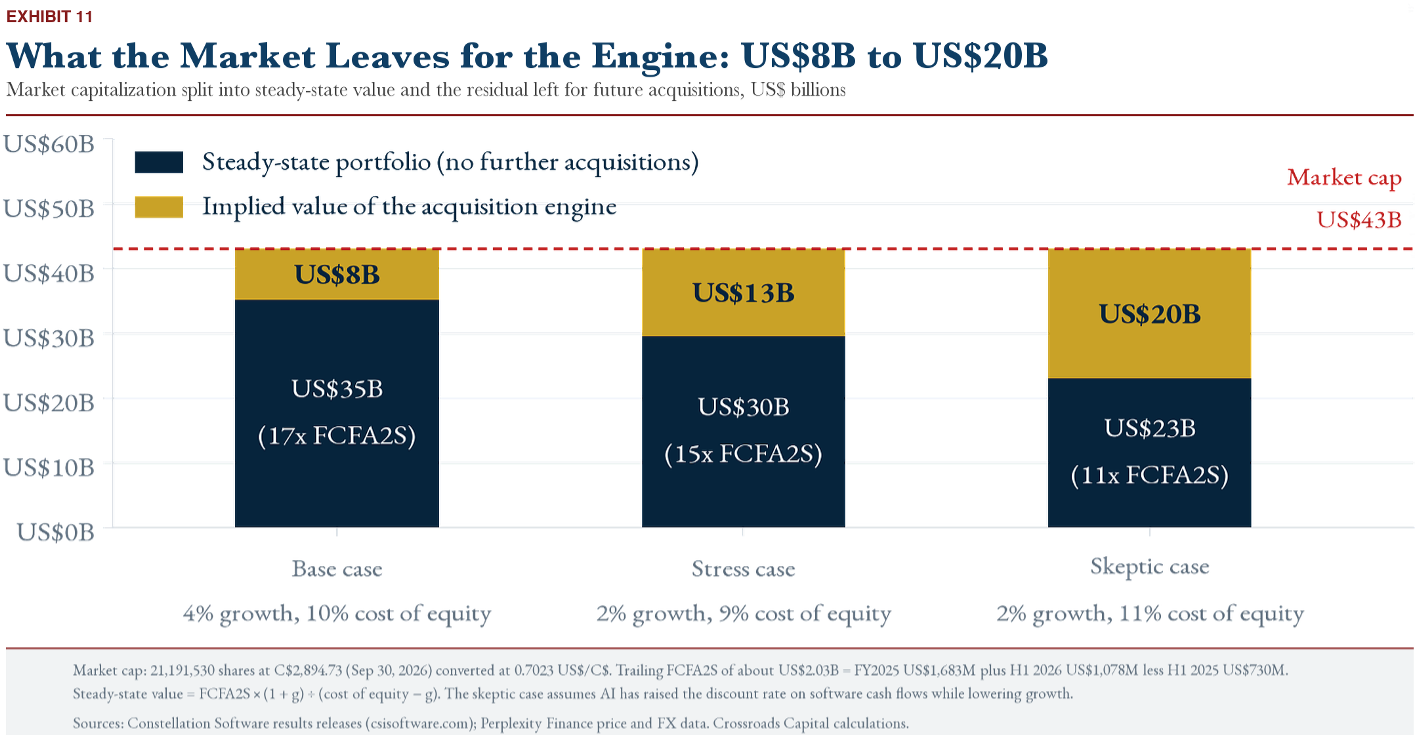
The authors split Constellation's market capitalisation into two parts. The first part is the value of the current subsidiaries, if Constellation were to make no further acquisitions at all. The second part is what investors are paying on top of that for future acquisitions.
At the end of September, Constellation's market capitalisation was approximately USD 43 billion. Over the past twelve months, approximately USD 2 billion in free cash flow remained for shareholders (FCFA2S). Assume that this cash flow grows by 4% per year without any new acquisitions, and that investors demand a minimum return of 10%. In that case, the current subsidiaries together are worth approximately USD 35 billion, around 17 times their annual free cash flow. Investors are therefore paying the remainder of the market capitalisation, approximately USD 8 billion, for future acquisitions.
Against that USD 8 billion stands the value that the new acquisitions add. Constellation invests approximately USD 2 billion per year in acquisitions with a return of 17 to 18%. For an investor satisfied with 10%, such an investment is worth approximately 1.75 times its cost price. Each year, this adds approximately USD 1.5 billion in value. After just over five years, Constellation will therefore already have added as much value through acquisitions as the USD 8 billion investors are currently paying for that. At the current share price, investors are effectively pricing in no more than five years of acquisitions, even though the thirty-year track record in acquisitions is one of the company's most important achievements.
Even if the current subsidiaries grow by only 2% per year and investors demand a minimum return of 11%, the price for future acquisitions remains reasonable. In that case, the current subsidiaries are worth less, meaning investors pay approximately USD 20 billion for future acquisitions. That corresponds to the value Constellation adds through acquisitions in approximately seventeen years.
The return for shareholders therefore does not need to depend on a higher valuation. As long as Constellation keeps reinvesting at comparable returns, cash flow per share will keep growing. Constellation has not issued any new shares since its listing. The growth in cash flow therefore benefits existing shareholders in full.
Conclusion
The authors name three developments that would change their assessment. The first is organic growth in recurring maintenance revenue that, after adjusting for currency effects, remains below 3% for several consecutive quarters, without one-off causes behind it. The second is a return on invested capital that falls below 15% for several quarters, while Constellation is deploying ever larger amounts. The third is that Constellation, under CEO Mark Miller, starts making more decisions centrally or becomes less critical in its acquisitions. The lower growth in maintenance revenue in the second quarter had one-off causes, as we described in our deep dive on those figures.
 Michael Gielkens
Investors are ruthlessly punishing many software companies on the stock market. In doing so, they are throwing the baby out with the bathwater. Moreover, Constellation and its subsidiary Topicus are not just software companies. We have long regarded them in this newsletter as investment holding companies. For a holding company, what matters is not only whether the current subsidiaries withstand the challenges of AI and seize the accompanying opportunities. More important is whether these companies continue to generate enough cash to be reinvested in new acquisitions. Those acquisitions must also achieve a good return.
In that respect, the recent figures on return on invested capital and cash flow growth are reassuring on both counts. We agree with the authors of the analysis: at the current share price, investors are paying (too) little for future acquisitions. We will continue to monitor the key metrics critically, and we look forward to welcoming CFO Rob Eijbergen of TSS/Topicus as a guest speaker at our next client event in a few weeks' time.
NB: The client event is expressly open only to our clients and to individuals who are specifically considering becoming a client.
Receive weekly insights in your inbox
Exclusive analyses and updates on family holding companies and global market developments.
Would you like more information about our services?
Get in touch
Disclaimer:
No rights can be derived from this publication. This is a publication of Tresor Capital. Reproduction of this document, or parts of it, by third parties is only permitted after written permission and with reference to the source, Tresor Capital.
This publication has been compiled with the greatest possible care by Tresor Capital. The information is intended in a general sense and is not tailored to your individual situation. The information should therefore explicitly not be regarded as advice, an offer or a proposal to purchase or trade investment products and/or to take up investment services, nor as investment advice. The authors, Tresor Capital and/or its employees may hold positions in the securities discussed, for their own account or on behalf of their clients.
You should carefully consider the risks before you begin investing. The value of your investments can fluctuate. Past performance is no guarantee of future results. You may lose (part of) your original investment. Tresor Capital disclaims any form of liability for any inaccuracies or errors. This information is purely indicative and subject to change.
Read the full disclaimer at tresorcapitalnieuws.nl/disclaimer .
This article was originally written in Dutch and automatically translated into English with the help of AI. In case of any difference, the Dutch original prevails.