Family Holdings #40 - Intertwined interests in the AI race

This week's topics:
In Brief:
Berkshire Hathaway (New York: BRK.B) has once again expanded its stake in homebuilder Lennar (New York: LEN). This comes on top of the purchases we already reported last week. Between 28 and 30 September, Berkshire bought a further 656,000-plus A shares and over 4,000 B shares, for a total of approximately $53.9 million. According to the most recent filing, Berkshire now owns over 26 million A shares and 553,000 B shares, together worth approximately $2.2 billion.
Brookfield (New York: BN) has taken a new step with nuclear energy company Westinghouse, in which it is co-owner alongside Cameco. The United States and South Korea have signed a framework agreement in which Korea commits up to $120 billion for the construction of eight large nuclear reactors on US federal sites. This involves six Westinghouse reactors, spread across three plants with two units each, and two Korean reactors that also use Westinghouse technology. For those two Korean reactors as well, Westinghouse receives an advance payment, a guaranteed share of the work and a contract for fuel production. In addition, Korea is taking a strategic minority stake of 5 to 10 percent in Westinghouse.
Within Constellation Software (Toronto: CSU), Volaris has made two acquisitions this week. First, through a public cash offer for Sweden's Triona at 45.5 kronor per share (approximately $25.9 million in total, a premium of 30.7% over the closing price of 30 September), which has been unanimously recommended by the board and for which the acceptance period runs from 2 October up to and including 12 November. Second, Volaris LATAM has acquired Brazil's Teknisa, a provider of business software (such as the TECFOOD platform for financial management, HR and accounting) to caterers and food retailers, with over 900 customers and approximately 460 employees.
KKR (New York: KKR) is once again delivering a rock-solid result, with over $750 million in monetisation proceeds between 1 July and 25 September. This marks the third consecutive quarter in which the private equity holding company has posted very strong realisations on sales, comfortably exceeding its multi-year quarterly average of $542 million. This figure moreover still excludes the previously reported sale of USI Insurance Services, a transaction expected to close in the fourth quarter and estimated to generate approximately $2 billion in adjusted net income.
Anthropic's unique entanglement with its own competitors
This week, investors got a genuine first look at Anthropic's books. News agency Reuters obtained the confidential IPO prospectus of the developer of Claude and published several articles about it over the course of the week. The listing is expected to be scheduled after the US midterm elections of 3 November and before Thanksgiving (26 November). Anthropic is reportedly aiming for a valuation of more than $2 trillion. That is more than double the approximately $965 billion at which the company was valued in May. That valuation feeds directly through to the family holding companies we follow, since Alphabet (New York: GOOGL), Amazon (New York: AMZN), Scottish Mortgage (London: SMT) and Sofina (Brussels: SOF) all hold a sizeable stake in the AI giant.
Hypergrowth at a steep price
According to the prospectus, revenue rose in 2025 from $386 million to $4.59 billion, a twelvefold increase compared with the year before. Meanwhile, current annual recurring revenue (ARR) is estimated to already be heading towards $80 billion. Set against this strong revenue growth, however, is a sharply widened operating loss, which rose from $2.98 billion to $8.06 billion. The net loss even came in at $41.97 billion. This enormous figure is largely due to an accounting charge of approximately $34 billion, related to financing instruments that can later be converted into shares. Because these instruments become more valuable as Anthropic's value rises, that increase in value shows up as an expense on the income statement. Paradoxically, the company's success therefore makes the loss look bigger on paper.
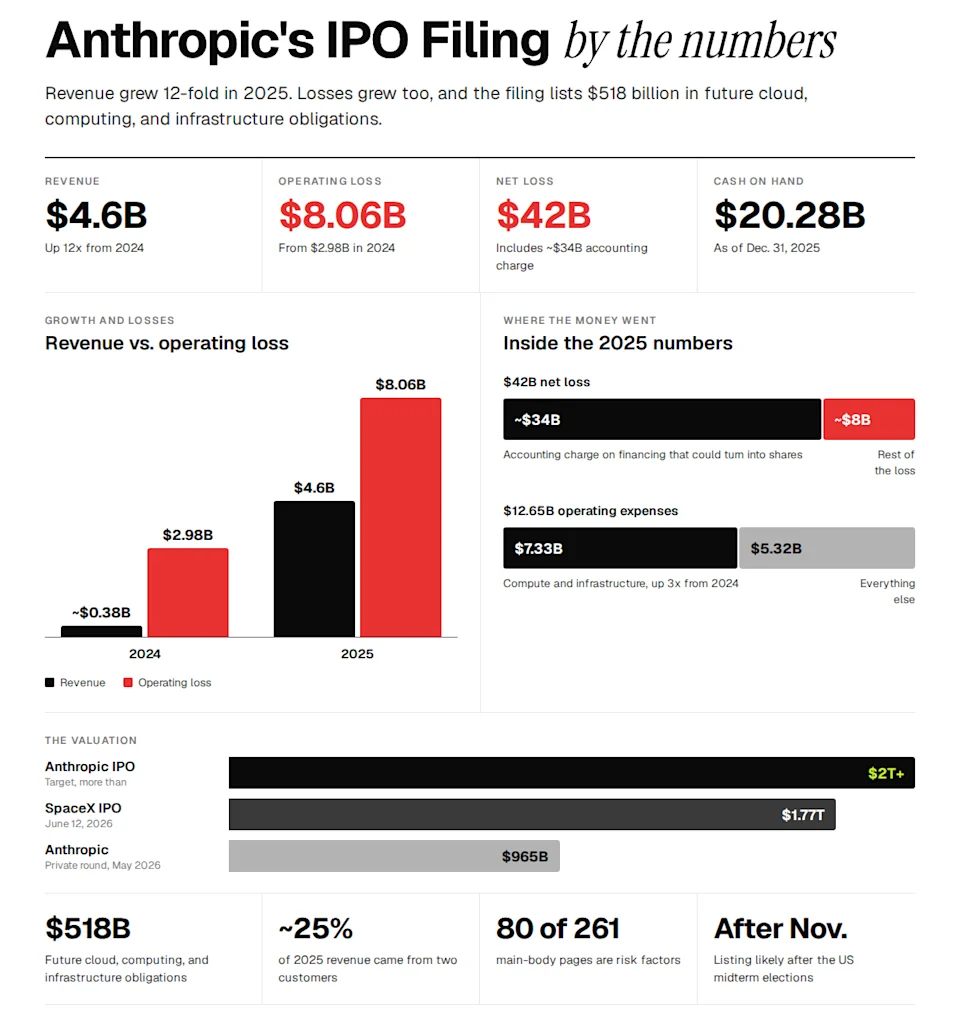
Although no actual cash is involved in this particular expense item, the underlying operating loss remains substantial even without this effect. The biggest culprit is computing power: Anthropic spent $7.33 billion on computing and infrastructure last year, almost three times as much as in 2024. This accounts for 58% of total operating expenses and is around 1.6 times the company's entire annual revenue.
It is striking how relatively little of this revenue comes from fixed subscriptions. Of the $4.59 billion, subscription revenue accounted for $789 million, or just over 17%. The remaining roughly $3.8 billion was generated through a usage-based model, under which customers pay according to the volume of text processed by Claude. These are mainly companies and developers that integrate the AI model into their own software and business processes. The prospectus shows that Anthropic expects this usage-based model to continue to make up the vast majority of revenue in the future as well.
The triangular relationship with Amazon and Google
Furthermore, a large part of this usage-based revenue does not flow directly through Anthropic itself. In 2025, no less than 47% of total revenue was generated via the cloud platforms of Amazon and Google, where existing Amazon Web Services or Google Cloud customers can easily add the Claude AI model to their package. That indirect share has grown enormously in a short period: from 11% in 2023, via 32% in 2024, to almost half last year.
According to an analysis by Reuters, Anthropic paid a steep price for this: distribution fees to these platforms amounted to approximately $351 million, or around 16 cents per dollar sold. Financial processing, too, is increasingly shifting to these partners. Anthropic is becoming ever more dependent on these tech giants to collect its money. Of the $909 million in outstanding customer receivables (invoiced amounts yet to be received) at the end of 2025, 60% was now routed via Amazon and Google, compared with 42% a year earlier.
This shift underscores the growing dependence on a handful of tech giants. The company itself warns that many of its largest customers do not have long-term contracts and can scale back their spending immediately, while Anthropic itself is locked into long-term commitments for computing capacity. Even so, Anthropic presents this intensive collaboration as an important strategic advantage. By offering Claude through the networks of Amazon, Google and, since November, Microsoft as well, the company achieves a level of market penetration it could never have reached on its own. At the same time, the prospectus acknowledges that this dependence brings complex relationships and conflicts of interest. After all, the cloud partners gain direct insight into Anthropic's pricing and commercial terms. That transparency can directly affect how much computing capacity these partners allocate and how actively they promote Claude.
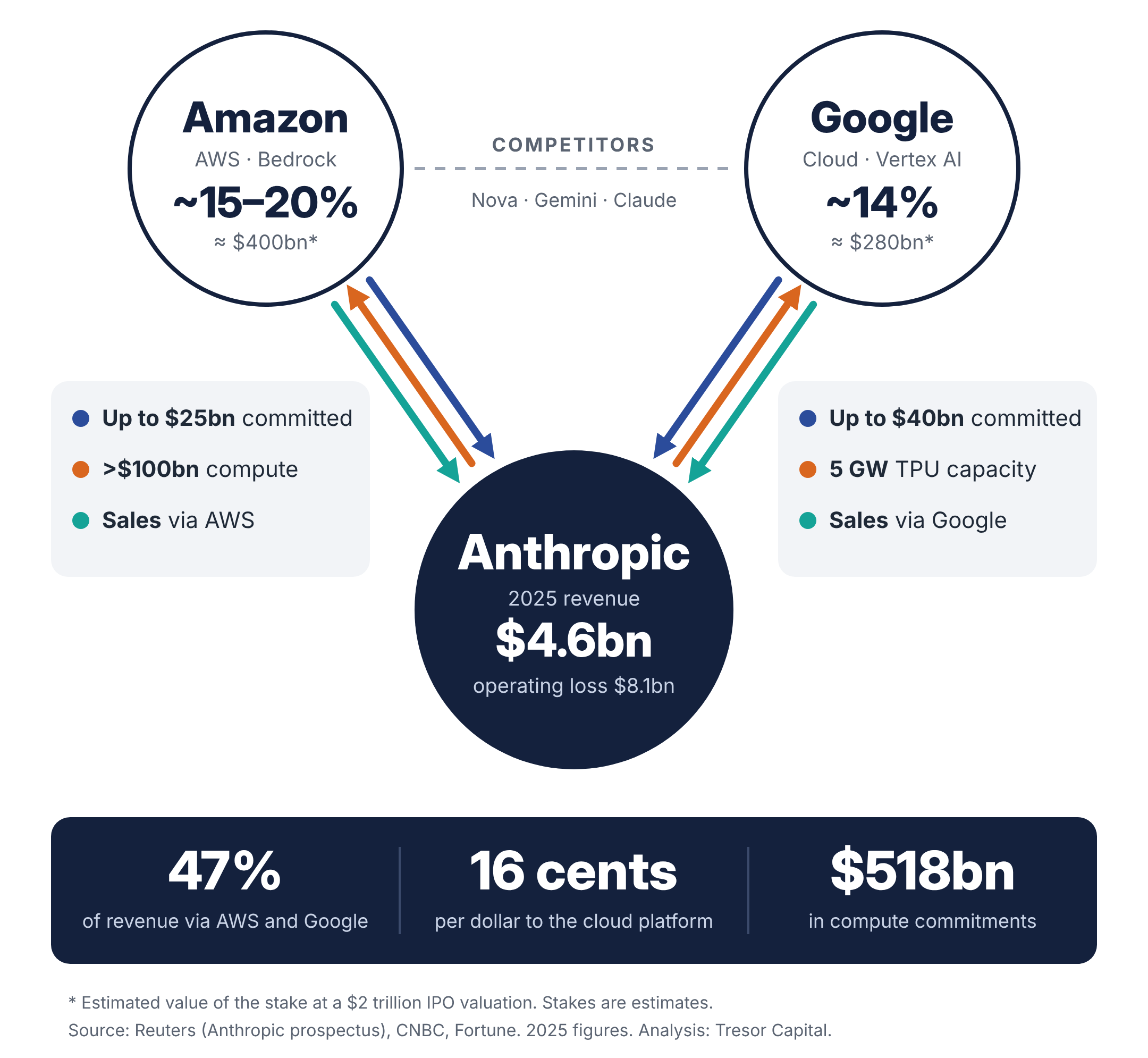
This creates a unique and complex triangle. Amazon and Google simultaneously act as competitors (with their own AI initiatives), suppliers of computing capacity, sales channels and customers of Anthropic. On top of that, both companies are also major shareholders. Both tech giants have invested tens of billions in Anthropic. But Anthropic itself also faces astronomical investments. To keep training and running its models, the company has taken on enormous long-term commitments. The prospectus cites a total of no less than $518 billion in commitments for cloud, computing and infrastructure. In the coming years, a significant portion of this staggering amount will flow directly back to the cloud divisions of AWS, Google Cloud and Microsoft Azure.
For Amazon and Alphabet, this means they earn from Anthropic's success in three different ways. First, their cloud divisions receive distribution fees for selling Claude; second, they see a rapidly growing stream of orders coming in for the supply of computing capacity; and third, their own equity stakes represent enormous value. Amazon reportedly owns around 20% of Anthropic and Alphabet around 14%. Should the IPO take place at a valuation of $2 trillion, that stake would be worth approximately $400 billion for Amazon and around $280 billion for Alphabet.
The battle for computing capacity and capital
On the other side of that $518 billion in commitments stand the infrastructure giants that have to build the data centres. Amazon alone expects to invest more than $200 billion this year, for the most part in chips and data centres for AWS. How heavily these enormous capital expenditures weigh on the balance sheet is evident from a recent report by the Financial Times. Amazon is reportedly in talks with investors to place approximately $8 billion worth of advanced Nvidia Grace Blackwell chips into a special-purpose project company. Under this structure, Amazon sells the chips to that company and then immediately leases them back for use in its American data centres. The company finances the purchase largely with external debt and also offers up to 10% in equity to outside investors.

For Amazon, this sale-and-leaseback arrangement generates immediate cash. Moreover, the group now pays rent instead of having to depreciate the chips over just a few years, which largely shifts the risk of rapid technological obsolescence to external investors. Amazon is not alone in this; other major tech companies are also looking for creative ways to soften the impact of their astronomical investment programmes on the balance sheet. Instead of buying the chips outright and capitalising them as capital expenditure (CapEx), they are now booked through a lease structure. That said, the liabilities don't actually disappear from the balance sheet: depending on the lease rules, they still end up there, but as a long-term rental obligation instead. The shape of the balance sheet changes as a result. The main concern for investors is that this shift in accounting treatment, combined with the use of separate project entities, makes it increasingly difficult to see the true debt burden and overall financial leverage of the hyperscalers.
The battle for energy
Where Amazon is restructuring the financing of computing power, Google is focusing on a completely different bottleneck in the AI race: energy. Last week we already wrote about Project Suncatcher, Google's research into AI computing power in space. In the meantime, the first concrete step has been taken, as the first prototype went into orbit on 1 October aboard SpaceX's Transporter-18 mission. Google has since successfully made contact and reports that the satellite is functioning properly.
Up, up, and away. 🚀
— Google (@Google) October 1, 2026
Today, in partnership with @planet, we launched a prototype satellite carrying four TPUs into orbit on @SpaceX's Transporter-18 rideshare mission. This launch is the first step of Project Suncatcher, our long-term research moonshot to see whether we can one… pic.twitter.com/6WakAX8q7N
That doesn't mean, however, that there is already a flying data centre orbiting the earth. The prototype, about the size of a large refrigerator, carries four of Google's own Trillium TPUs on board. The primary goal of this test is simple: to determine whether the same hardware used on earth can withstand the extreme conditions of a launch and of space. During launch, components must withstand forces of fifty to a hundred times the force of gravity, while once in orbit, radiation and cooling pose the biggest obstacles.
The great appeal of this 'moonshot' project lies in the virtually unlimited solar energy available in space, where panels in the right orbit can generate up to eight times more power than on earth. Yet the economic viability or unviability of the whole concept hinges entirely on launch costs. As Lawrence Burns of Scottish Mortgage pointed out last week, SpaceX has already brought these costs down to around $900 per kilo. However, Google's own calculations show that computing power in space can only compete with a data centre on earth once that price falls below $200 per kilo, a level that, according to Google's calculations, will not be within reach until around the mid-2030s.
Gemini 4 Argon and cybersecurity
Finally, this week Google released the first teasers of Gemini 4 Argon, its newest and most powerful AI model. For now, the model is not yet widely accessible, as only a select group of cybersecurity professionals have access through the so-called Fairwind programme. Google is also taking part in the voluntary US government initiative under which new models are tested for safety in advance.
 Koray Kavukcuoglu
Although benchmark scores in this fast-changing sector are a fleeting measure, since a competitor could easily take the top spot again next week, the specific focus on cybersecurity stands out. Argon is capable of independently detecting, validating and fixing software vulnerabilities. For trusted partners and Google's own internal teams, the model is even released without the usual safety filters in this area. That this approach works was already demonstrated by Wiz, the security company recently acquired by Google. Using Argon, they discovered a critical vulnerability in hospital software used worldwide, a flaw that had been overlooked by earlier AI models.
With this strategic rollout, Google is following in the footsteps of Anthropic, which earlier also made its most powerful model, Mythos, exclusively available to a selected group through Project Glasswing. The fact that leading AI labs are making their most advanced models available to defenders first underscores how seriously they view the risks of misuse.
Finally, the announcement contains a remarkable detail about internal efficiency. A team of Argon agents has carried out memory optimisations within Google's own data centres that have already freed up more than 300 terabytes of capacity. In a market where scarce computing power is the biggest bottleneck, making smarter use of existing infrastructure is, after all, at least as valuable as building new hardware.
Conclusion
Anthropic's prospectus shows just how deeply the major players in AI are intertwined with one another. The biggest risk therefore lies not so much with any single company, but in the system as a whole. Investments, offtake agreements and off-balance-sheet financing structures are increasingly intermingled. The same parties are simultaneously one another's shareholder, supplier and customer. If one link in the chain runs into trouble, the rest of the chain feels it almost immediately.
Should sentiment around AI turn, Amazon and Google are fundamentally better positioned. They have their own infrastructure, a broad customer base and substantial free cash flows to absorb setbacks. Companies that solely develop AI models do not have that buffer. They are locked into hundreds of billions in long-term commitments for computing capacity, while many of their own customers can cancel on much shorter notice. Yet the cloud companies are not immune either. A large part of their future cloud revenue consists precisely of those commitments from AI developers. If a company like Anthropic fails to meet its growth plans, that affects Amazon and Google both in their cloud revenue and in the value of their stake.
Receive weekly insights in your inbox
Exclusive analyses and updates on family holding companies and global market developments.
Would you like more information about our services?
Get in touch
Disclaimer:
No rights may be derived from this publication. This is a publication of Tresor Capital. Reproduction of this document, or parts thereof, by third parties is only permitted after written consent and with reference to the source, Tresor Capital.
This publication has been compiled with the greatest possible care by Tresor Capital. The information is intended in a general sense and is not tailored to your individual situation. The information should therefore explicitly not be regarded as advice, an offer or a proposal to purchase or trade investment products and/or to take up investment services, nor as investment advice. The authors, Tresor Capital and/or its employees may hold a position in the securities discussed, for their own account or for that of their clients.
You should carefully consider the risks before you start investing. The value of your investments may fluctuate. Past performance is no guarantee of future results. You may lose (part of) your investment. Tresor Capital disclaims any form of liability for any inaccuracies or errors. This information is purely indicative and subject to change.
Read the full disclaimer at tresorcapitalnieuws.nl/disclaimer .
This article was originally written in Dutch and automatically translated into English with the help of AI. In case of any difference, the Dutch original prevails.