
Family Holdings #38 - Brookfield's New Targets
This week's topics:
Warren Buffett is stepping down as chairman of Berkshire Hathaway after more than sixty years and will become chairman emeritus, remaining a director and shareholder. His son Howard Buffett succeeds him as non-executive chairman to safeguard the company's culture and values, while CEO Greg Abel holds full operational leadership of the company. This completes the group's succession process, and Buffett has expressed his complete confidence in Berkshire Hathaway's future under the new leadership.
In Brief:
Constellation Software (Toronto: CSU) completed two acquisitions this week. Subsidiary Volaris acquired London-based Matrix Booking, a provider of software for booking workspaces and meeting rooms, primarily for governments and public institutions. Jonas subsidiary Vesta acquired Argentina's Zoo Logic, a supplier of ERP and point-of-sale software to more than 5,000 retailers.
Sofina (Brussels: SOF) is participating in a USD 270 million funding round for Exein, an Italian company that secures AI-driven physical devices such as vehicles, robots and medical equipment. The round, led by Headline and including participants such as Goldman Sachs and the European Investment Bank, values Exein at USD 1.7 billion. Sofina's contribution has not been disclosed; given the number of participants, we assume a fairly modest ticket size.
Prosus (Amsterdam: PRX) saw its subsidiary iFood announce that it will invest 24 billion Brazilian real (just over €4 billion) in Brazil this financial year, 41% more than in the previous cycle. The money will go towards new delivery categories, the financial arm iFood Pago and more than 2 billion real in technology, including an AI model being developed together with Prosus.
Brookfield's New Targets
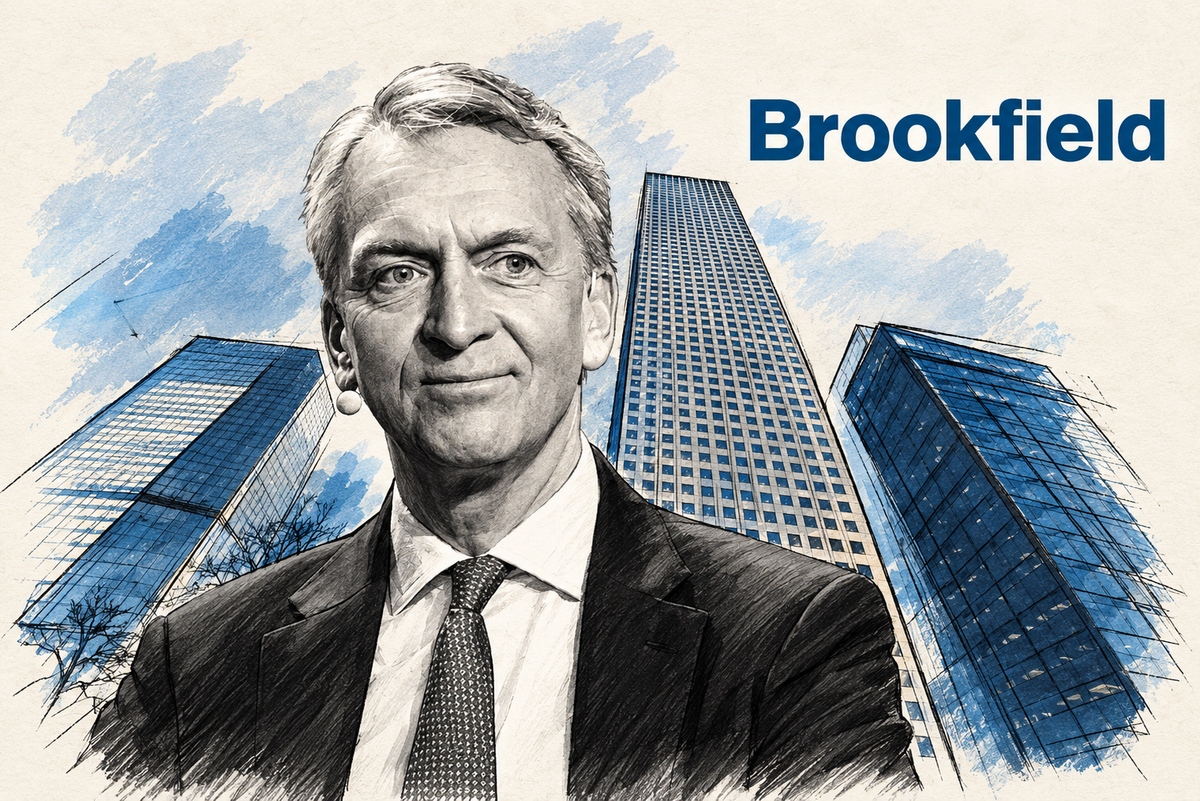
Yesterday, Brookfield Corporation (New York: BN) held its annual Investor Day in New York. Anyone who attended last year would recognise the setting: CEO Bruce Flatt dividing the world into tens of trillions in investment opportunities, BWS chief Sachin Shah explaining why the insurance arm Brookfield Wealth Solutions (BWS) should become the engine behind it all, and president Nick Goodman translating that into a five-year plan that doubles earnings.
Brookfield Wealth Solutions
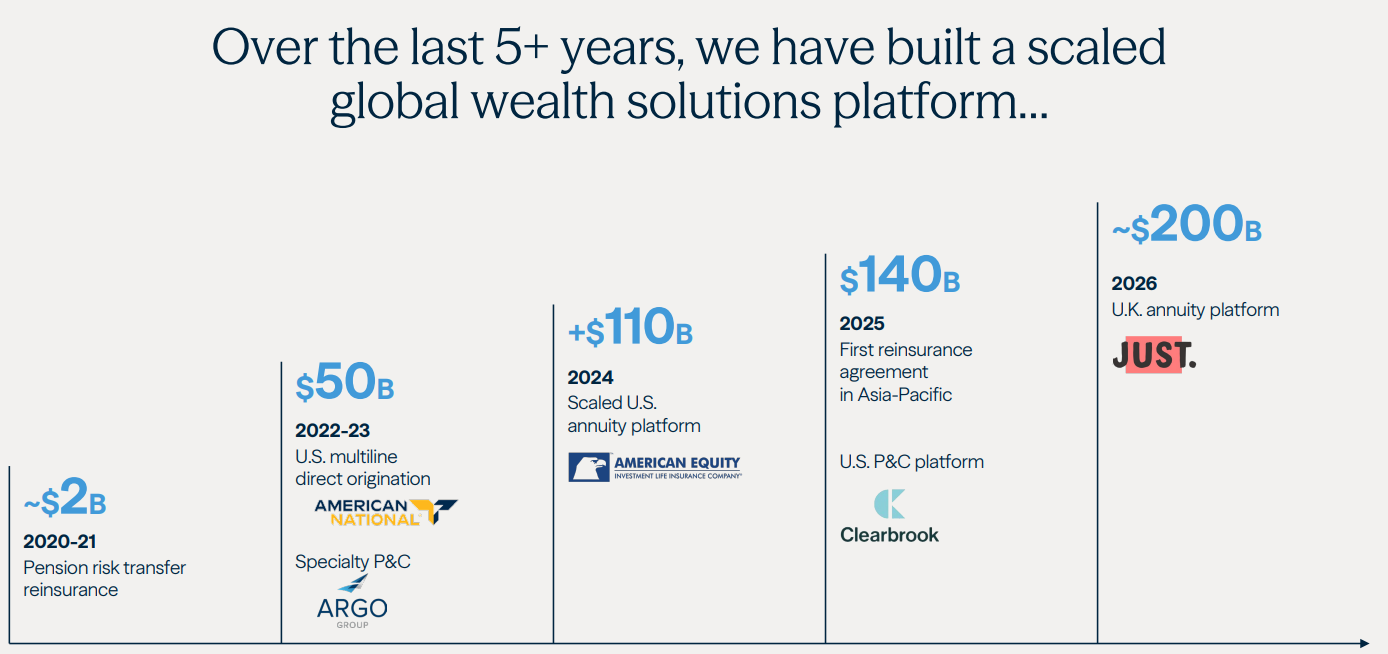
Sachin Shah has led Brookfield Wealth Solutions (BWS) since its founding and opened by putting the success into perspective. In his view, the easy story is that Brookfield simply bought up a series of companies, combined them, and built a large platform that way. The real story is that they acquired companies at an attractive price that are highly scalable in their target markets and align seamlessly with favourable demographic trends.
Now that the platform is in place, Shah's message is clear: "We're now in phase two of this business: organic growth. The M&A is behind us, the seeds have been planted, and we have all the platforms we want to have." BWS no longer needs to chase acquisitions in order to scale.
BWS's organic growth rests on exactly the same fundamental pillars as last year: global ageing, the shift towards defined contribution pensions, and the pressing shortage of scalable annuities and guaranteed income products for individual savers. We already covered this topic in detail last year:
 Joep Dikken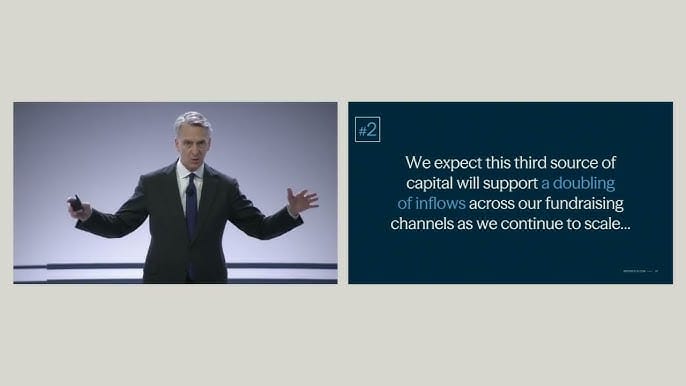
Today, further organic acceleration relies on two engines:
- US distribution: In the US, USD 350 billion in fixed annuities is sold annually, mainly through banks and broker-dealers. Of the USD 25 billion that BWS now raises each year, only 20% comes through these channels. By expanding from five to around a dozen banking platforms, Sachin Shah expects to raise an additional USD 10 to 12 billion annually, which should lift total annual production to USD 35 billion.
- United Kingdom: The acquisition of Just Group added USD 45 billion in assets. In a market where GBP 40 to 60 billion in pension schemes becomes available annually, BWS can use advanced technology to efficiently bundle small schemes. However, Shah remains patient and disciplined on pricing in order to avoid unprofitable growth.
Another important advantage, according to Shah, is that BWS has no external shareholders whatsoever. By building the platform entirely with Brookfield's own capital, rather than relying on third parties or external investors, the organisation can act nimbly and decisively. Moreover, this fully aligns its interests with those of policyholders. For anyone following the sector, this is a clear signal in the ongoing debate about private equity holding companies that insurers are building using third-party capital, thereby taking on unnecessary risks.
The natural hedge in the portfolio
A crucial pillar underpinning this BWS success is the way the platform deals with interest rates. BWS in fact functions as a natural hedge for the rest of Brookfield. To illustrate this dynamic, President Nick Goodman showed one of the most important charts of the day. While distributable earnings before realisations climbed from USD 2.7 billion in 2021 to USD 5.7 billion now, the US ten-year rate rose over the same period from just over 1% to nearly 5%.
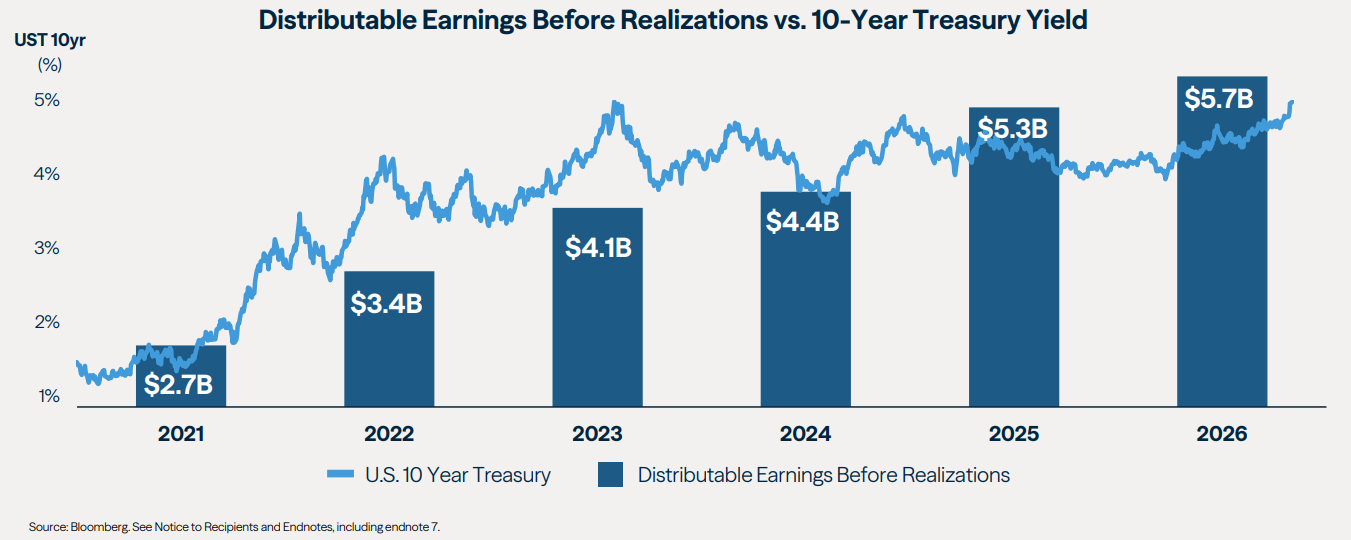
With this, Goodman underscores that the long-term tailwind is simply stronger than the short-term macro environment. Whereas the five-year plan assumed falling rates, profits continued to grow effortlessly despite the increase. This gives management the confidence that the current interest rate climate supports the business. In this context, Goodman explicitly points to BWS as "a natural hedge against the rest of the company" that, in his view, doesn't get talked about enough.
Sachin Shah explained how BWS is concretely capitalising on that starting position. The first step is the smart management of liabilities. The average financing cost on USD 200 billion of long-term BWS liabilities is 4%. To comfortably exceed that threshold, BWS deliberately kept the duration of its assets short, waiting for the yield curve to steepen. Now that the ten-year rate is hovering around 5%, BWS can extend those durations. Shah illustrated this with a concrete example: three years ago, BWS assumed a pension liability at 3.75% for fifteen years, whereas today they can lock in a ten-year government bond at 5%. That delivers a pure margin of 125 basis points instantly, with virtually no additional capital required.
That active interest rate bet has since come to an end, and Shah is now opting for a more neutral course. The durations of assets and liabilities are currently matched almost entirely to absorb the current market noise. Only once the yield curve stabilises will management again consider more active positioning. Flatt put the macro debate into perspective during the Q&A as follows: "When rates rose 350 basis points from zero in 2021, that was hugely material. Today, this is almost irrelevant. Fifty basis points, who cares?" He views the current rate fluctuations primarily as a temporary phenomenon, driven by oil prices and geopolitics. In addition, BWS's real assets portfolio provides built-in protection here: because rental contracts and infrastructure tariffs generally move in line with prices, the group is by nature hedged to some extent against both inflation and rising rates.
New BN
With the creation of "New BN", balance sheet protection is no longer confined to a single subsidiary but becomes the foundation of the entire group. After shareholders approved the merger of Brookfield Corporation's investment activities and its insurance arm on 16 July, completion is scheduled for the fourth quarter. Flatt calls it the crowning achievement of five years of hard work: "We're combining the investment assets we have together with the five years of work that Sachin and his team have put into building a USD 200 billion insurer." Specifically, Brookfield is combining USD 175 billion of permanent capital with USD 170 billion of insurance float, resulting in a generous USD 345 billion of deployable capital.
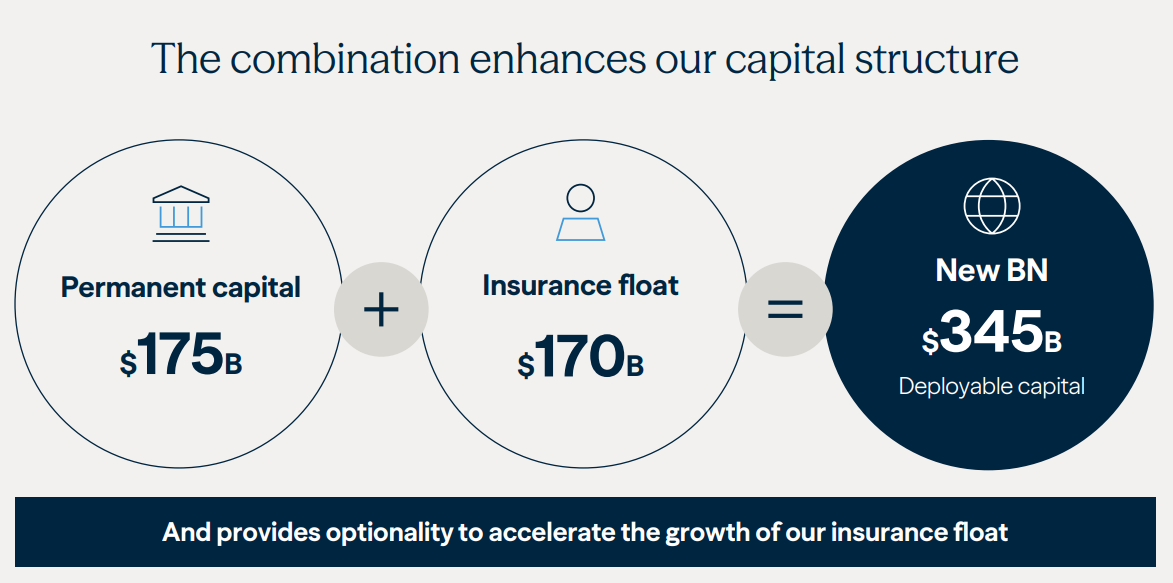
Flatt and Goodman attach three benefits to this simplification: a more efficient capital structure, greater flexibility for large acquisitions and, in time, the prospect of inclusion in broad US indices. The merger enables Brookfield to scale the insurance book up to USD 1 trillion, should the market call for it, according to Flatt.
In response to a question from Morgan Stanley analyst Mike Cyprys on how the insurance business could grow from the planned USD 400 billion to USD 1 trillion, Flatt explained the capital allocation:
1. Capital buffers at insurers
Regulators and credit rating agencies require sufficient equity capital to back every new policy or annuity. As soon as an insurer grows faster than anticipated, that buffer runs out. At such a moment, competitors have to slow down growth, raise additional capital in the market, or issue shares.
2. A built-in capital reservoir at the holding level
New BN creates a clear structure: an overarching parent holding company with the insurance arm (BWS) underneath it. The parent holding company holds more than USD 150 billion in equity. If BWS wants to scale up rapidly (for instance, in the event of acquisition opportunities), it does not need to raise external capital. The parent holding company can inject equity directly. This is done by selling assets at the holding level and channelling through the cash, or by placing suitable assets with predictable cash flows (such as infrastructure) directly on BWS's balance sheet.
3. Full ownership without conflicts of interest
Because Brookfield owns 100% of BWS, there are no conflicts of interest with minority shareholders. This simplifies regulatory approval and makes shifting capital frictionless.
This means New BN removes the capital constraint that normally slows down rapid expansion at traditional insurers. With the buffer of USD 150 billion at holding company level, BWS can take on larger transactions without putting pressure on the solvency or credit rating of the insurance arm. Moreover, the Q&A hinted that this is not the end point, as Brookfield is patiently looking at a possible fourth pillar that combines a high return on capital with clear synergies for the rest of the group, for example in distribution, wealth or another type of financial float.
Music of the future
The foundation has thus been laid, but the crucial question for us as investors naturally remains what all this means for the future value development of the share. Translating all this into figures was the task of Nick Goodman, president of Brookfield Corporation and, for years now, the man who casts the stories of Flatt and Shah into a single model on Investor Day.
Goodman kicked off with the operational targets. Under the new five-year plan, core earnings before realisations must climb from the current annualised USD 5.3 billion to USD 11.6 billion in 2031. That amounts to a compound annual growth rate (CAGR) of 17%. As outlined earlier, the insurance arm is set to become by far the fastest-growing pillar in this process.
What really gives the plan its leverage, however, is the acceleration of performance fees. Last year, Goodman already indicated that carry was "approaching an inflection point"; this year he firmly stated that the turning point has now arrived. Whereas Brookfield generated a total of USD 4 billion in carry over the past ten years, USD 25 billion is pencilled in for the coming ten years, of which USD 5 billion in the first three years. "The value has already been created," Goodman emphasised, pointing to the USD 7 billion in already accrued, unrealised carry that is simply waiting for the right moment to be sold.
To make the intrinsic value per share transparent, Brookfield uses its so-called Plan Value (its own sum-of-the-parts calculation). This currently stands at USD 67 per share, made up of the following components:
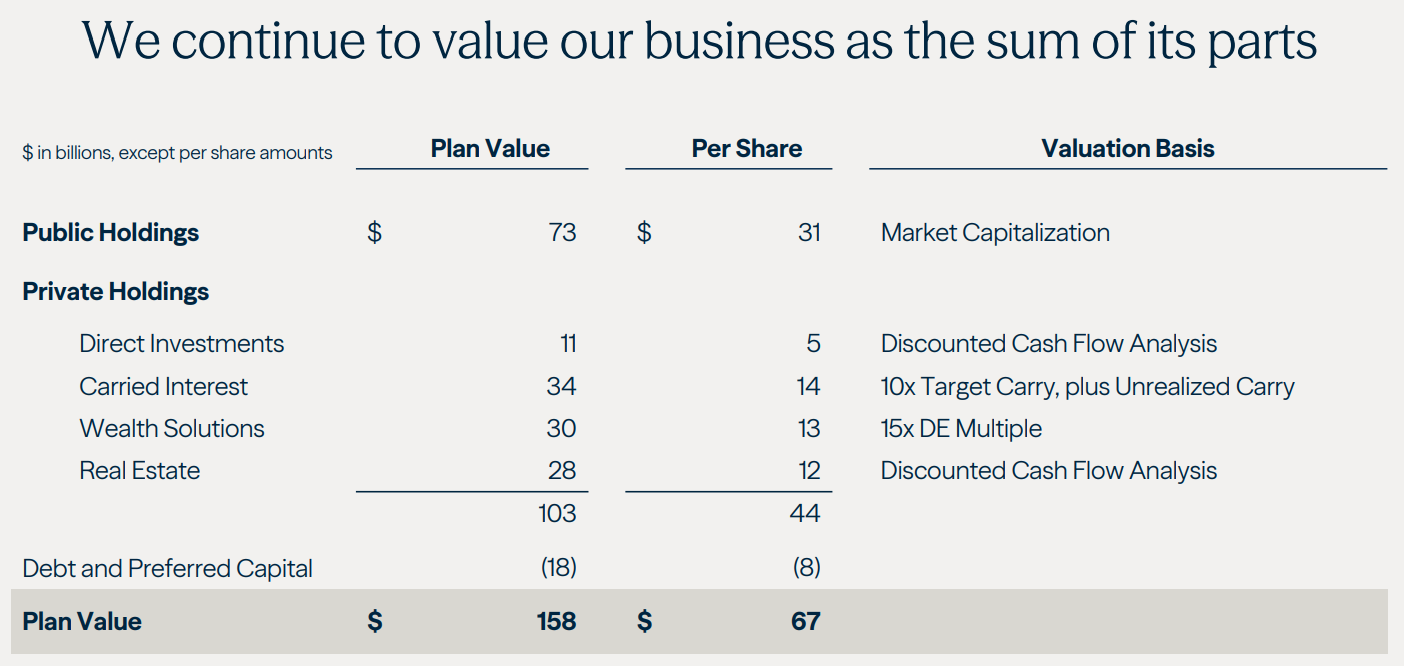
Goodman calls these valuation multiples conservative. That is of course always open to debate. However, Brookfield does have a strong track record when it comes to achieving its Plan Value. Even so, that was not the case last year. The target of reaching USD 140 per share has in fact been delayed by a year and pushed back to 2031.
The fact that this target has been pushed back by a year is notable but easy to explain. The Plan Value fell by a net one dollar because listed interests are recorded at market value. The largest listed subsidiary (the 73% stake in BAM) fell by more than 20% on the stock market last year. That share price decline in effect wiped out a year's worth of value accretion; a delay that will be recovered as soon as the share price rebounds.
If we take the Plan Value of USD 140 per share in 2031 as our starting point, the return depends not only on the underlying value creation but also on the movement in the valuation discount. With a simple calculation exercise (explicitly not an assumption or expectation on the part of Tresor Capital), various scenarios can be easily mapped out. The table below shows the expected annual return (CAGR) from the current share price to 2031 under different end scenarios for this discount:
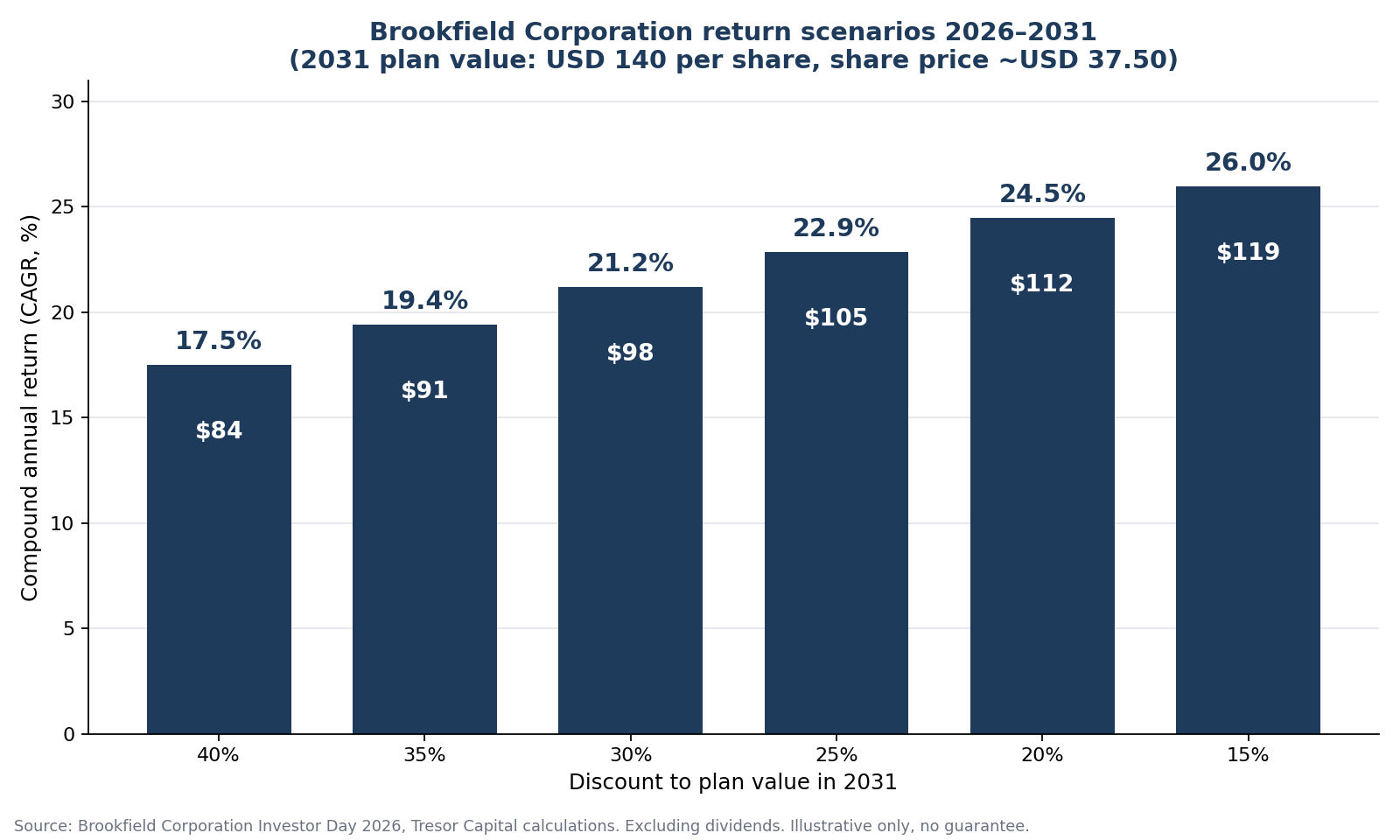
Under a base scenario of a 25% discount, this means that if the forecasts are realised, investors can expect an annual return of around 23%. Last year, that same base scenario came out at around 18%; the difference is explained by the lower entry price, with the target remaining unchanged.
These scenarios are explicitly a calculation exercise, not a forecast or investment advice. The outcomes depend entirely on two assumptions that are beyond our control, and both, as the past year has shown, can move in the opposite direction. The calculation excludes dividends and does not take into account currency fluctuations, taxes or your personal situation.
The end of the Buffett era
After more than sixty years at the helm, Warren Buffett is stepping down as chairman of Berkshire Hathaway (New York: BRK.B). The 96-year-old investor becomes chairman emeritus with immediate effect, remains a director and shareholder, and hands over the chairman's gavel to his son Howard Buffett, who has served on the board of directors since 1993. This completes the succession that began in May 2025 with the announcement of Greg Abel as CEO. You can download and read the full official announcement below.
"I have served Berkshire since 1965," Buffett writes in his farewell letter to shareholders. "That's more than sixty years, and I still have the best job in the world. Time always wins, but it has been generous to me. It gave me the chance to see Berkshire grow to a point where I have more confidence than ever in its future." He also puts his age into perspective with a wink: "I recently celebrated my 96th birthday with family and friends, including a one-year-old great-grandchild. He moves rather faster than I do these days."
On Abel, who has held operational leadership since the start of this year, he is unequivocal: "My expectations were sky-high from the outset, and he has exceeded them." According to Buffett, Abel has been making the decisive calls for quite some time already. He sums up the future division of roles clearly: "Greg runs the business; Howard guards the culture and the values; both are worth more than anything on our balance sheet." He describes Howard as "an insurance policy that shareholders own and hopefully never have to call upon."
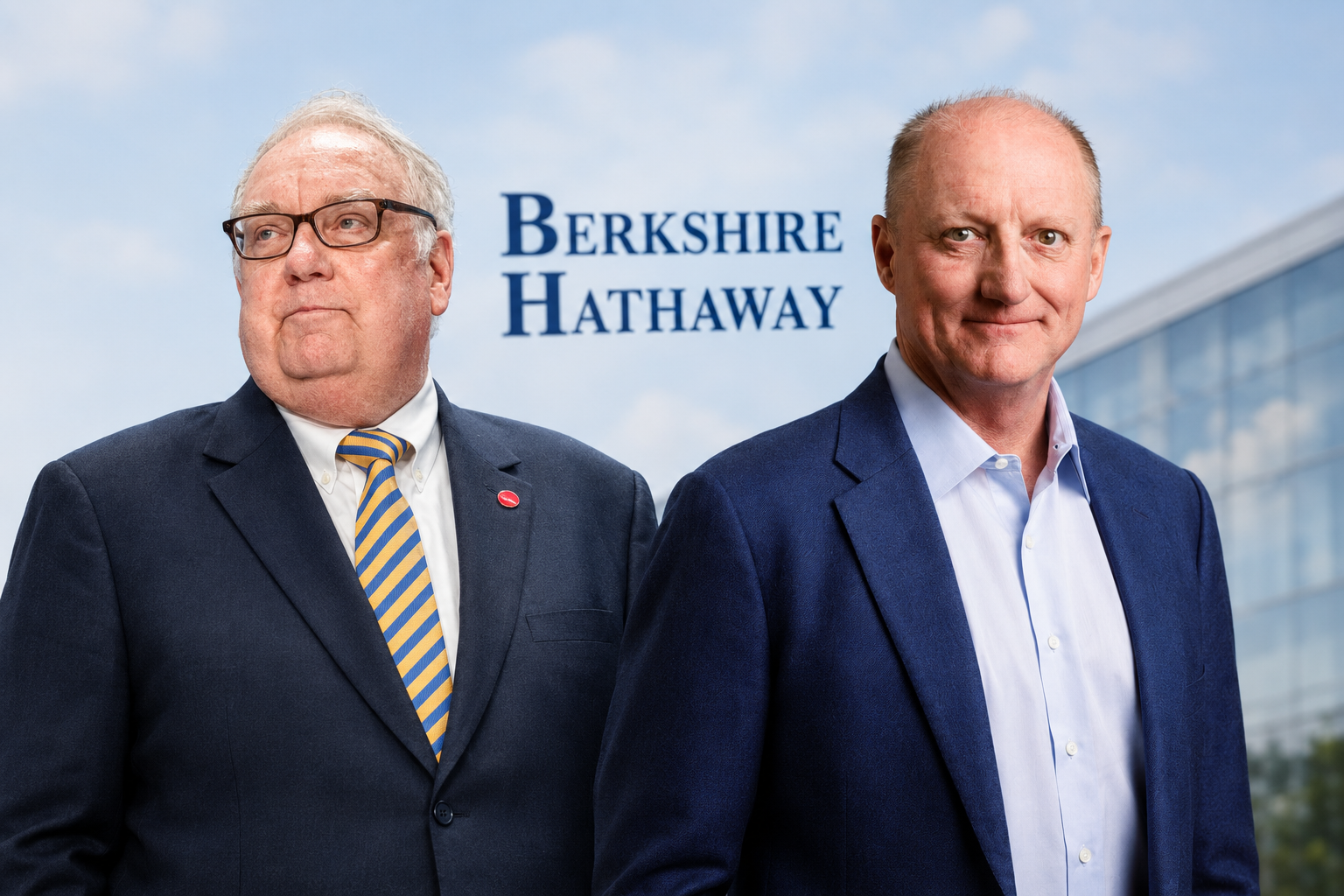
Howard Buffett (71) already indicated in 2024 how he sees the role: not as an executive director, but as support for Abel. His life as a farmer in Illinois, philanthropist and frequent traveller will have to make way for this. "I will not run the company as non-executive chairman. My job is to support Greg in every possible way."
Buffett closes his letter as he began it, as a shareholder among shareholders: "It has been the privilege of my life to serve as your chairman, and I have never taken your trust for granted. The company is in excellent hands, and I look forward to remaining a shareholder alongside you."
Receive weekly insights in your inbox
Exclusive analyses and updates on family holding companies and global market developments.
Would you like more information about our services?
Get in touch
Disclaimer:
No rights can be derived from this publication. This is a publication of Tresor Capital. Reproduction of this document, or parts thereof, by third parties is only permitted after written consent and with reference to the source, Tresor Capital.
This publication has been compiled by Tresor Capital with the greatest possible care. The information is intended in a general sense and is not tailored to your individual situation. The information must therefore explicitly not be regarded as advice, an offer or a proposal to purchase or trade investment products and/or to make use of investment services, nor as investment advice. The authors, Tresor Capital and/or its employees may hold positions in the securities discussed, for their own account or on behalf of their clients.
You should carefully consider the risks before you start investing. The value of your investments can fluctuate. Past performance is no guarantee of future results. You may lose (part of) your invested capital. Tresor Capital disclaims any form of liability for any inaccuracies or errors. This information is purely indicative and subject to change.
Read the full disclaimer at tresorcapitalnieuws.nl/disclaimer .
This article was translated automatically from Dutch using AI. In case of any difference, the Dutch original prevails. Read the original in Dutch.