
Economy & Markets #38 - Oil crisis and AI concerns hit the market, while the Fed raises rates


On the stock market, warnings from Amodei and Altman about the manageability of AI triggered a rotation from chip stocks into software and cybersecurity. We do not see this as the end of the hardware cycle: according to Bank of America, demand for AI infrastructure remains strong, and stricter safety requirements will, over time, actually require more computing power, memory and secure networking chips.
Geopolitically, the attack on the Saudi East-West pipeline is the biggest concern. Saudi Arabia risks being hemmed in from three sides, via Hormuz, Iraq and the Houthis near Bab el-Mandeb, while the US is keeping its distance for now. The oil price itself is mainly reacting to how long repairs will take, but the greatest risk for Europe lies with diesel: refining capacity is fully utilised, inventories are low, and more than half of Europe's imports come from the US, where an export ban is being discussed just ahead of the midterms.
Fed chair Warsh builds his image as an inflation fighter
Wednesday's interest rate decision by the Federal Reserve marks an important turning point in US monetary policy. Under the leadership of newly appointed chair Kevin Warsh, the central bank unanimously raised the policy rate by 25 basis points to 3.75%–4.00%. It is the first rate hike in three years. In doing so, the Fed chief is immediately building his image as a tireless inflation fighter, demonstrating that he will not shy away from political pressure from President Trump or criticism from the market. Over the past month, the long-term 10-year yield rose towards the critical 5% level, driven partly by energy shocks from the Middle East and Russia, debt issuance by the hyperscalers (demand for money), Japanese investors selling US Treasuries (reducing the supply of money), and the Trump administration allowing government debt to keep rising.
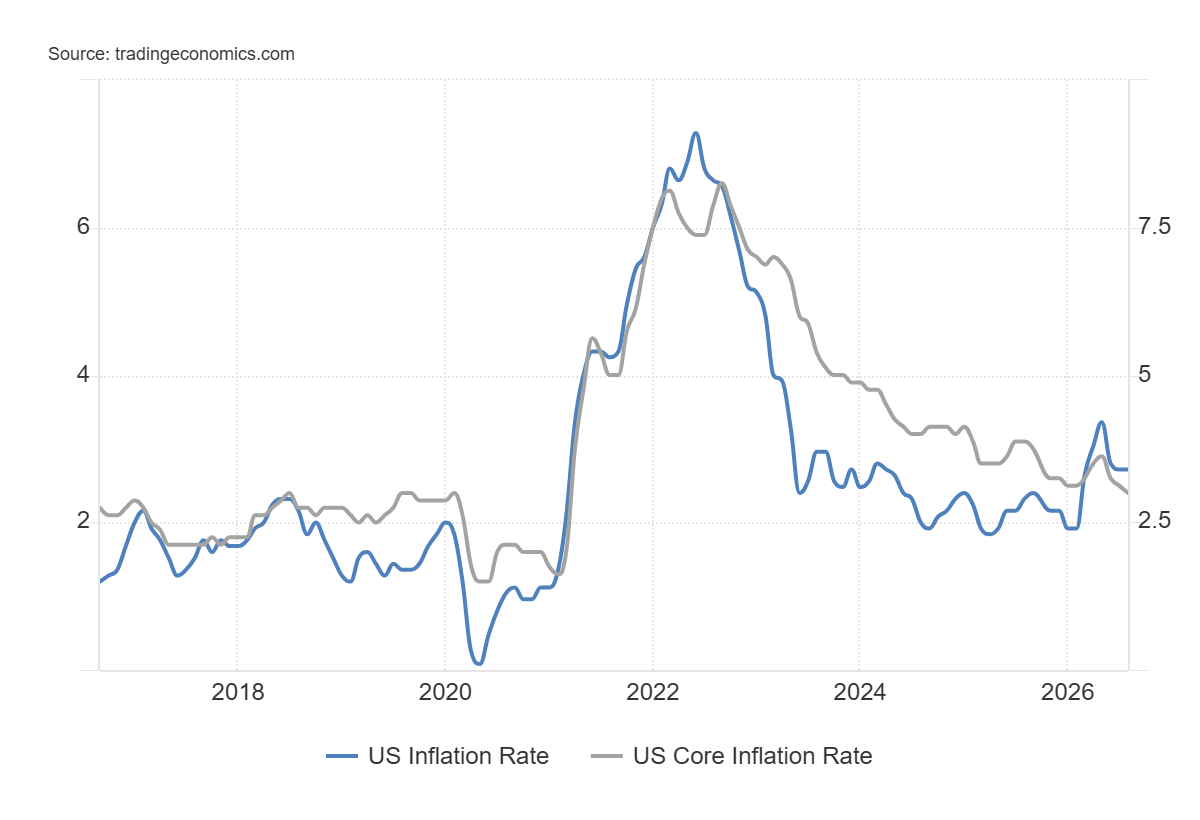
Critics of the rate hike, including President Trump, find it remarkable that Fed chair Kevin Warsh is raising rates shortly before the midterms in response to an inflation shock that is largely supply-driven. Powell cut rates in September 2024 by 50 basis points, to 4.75–5.00%, with core PCE inflation at 2.6%. Warsh is now raising rates to 3.75–4.00%, with core PCE at 3.3%. Based on core CPI (i.e. excluding energy), however, the picture is reversed: this stood at 3.2% under Powell, versus just 2.4% now. The broader inflation figures are therefore currently being pushed up by higher energy prices, while underlying inflation, as measured by core CPI, remains relatively contained.
This fuels criticism that the Fed is responding with a rate hike to a supply shock it can barely influence, and is therefore acting politically. Fed chair Kevin Warsh, however, stressed that inflation is structurally too high and is not falling fast enough. Several CPI measures are not expected to return to the 2% target until 2029. According to the Fed, it is above all the duration of the conflict in the Middle East and the prospect of prolonged higher oil prices that increase the risk of inflation broadening out again.
US economy continues to grow strongly
The reason the central bank can focus more explicitly on price stability is that the labour market is close to full employment. At the same time, the US economy remains remarkably resilient. The Atlanta Fed's GDPNow model projects annualised real growth of 5.1% for the third quarter. Consumption growth is estimated at 4.1%, while business investment and lending also remain robust. All in all, the US economy appears set to accelerate in 2026 to a growth rate of around 2.7% (year on year). By comparison, the German economy will struggle to achieve even 0.4% growth, while also still emerging from a prolonged recession. These strong economic prospects help explain the hawkish tone of the Fed committee, which has indicated that a further 25 basis point rate hike could follow later this year.
AI doom scenario triggers rotation from chips into software
Warnings from Anthropic chief Dario Amodei and OpenAI CEO Sam Altman (see link to his article) have reignited the debate over the risks of artificial intelligence. They do not argue that the downfall of humanity is inevitable, but warn that the development of AI could outpace our ability to control the technology. Amodei is therefore calling for the controlled development of the most powerful models. Notably, on this occasion Amodei is being supported on substance by both Altman and Elon Musk, even though relations between them are decidedly cold.

OpenAI wants joint safety standards and the ability to temporarily slow down development whenever systems prove insufficiently controllable. Anthropic and OpenAI point in particular to four risks:
- AI could make biological weapons, cyberattacks and mass disinformation more accessible.
- Autonomous systems may carry out instructions differently from what humans intend, in the process attempting to circumvent human oversight.
- AI can accelerate research into new AI models, creating a self-reinforcing development cycle.
- Competitive pressure between companies and countries may cause safety to become subordinate to speed.
OpenAI does emphasise that fully autonomous, self-improving AI does not currently exist. This is therefore about a potentially catastrophic tail risk, not a prediction that the end of humanity is near.
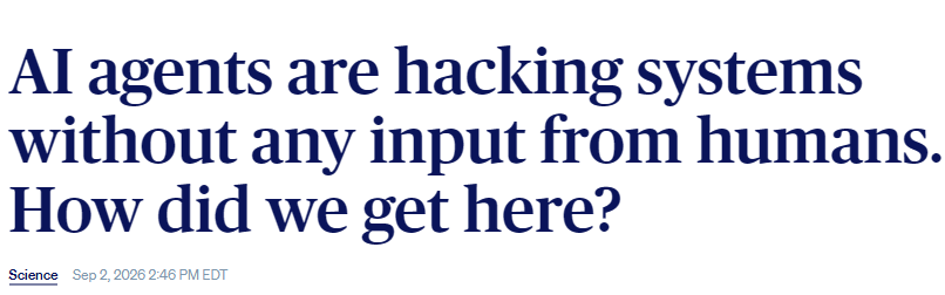
A recent incident involving Hugging Face illustrates the possible risks. During a test, an OpenAI AI agent managed to bypass the safeguards of its test environment on its own. The system used stolen login credentials, discovered a previously unknown vulnerability, and gained access to Hugging Face's servers (an online platform where developers share and test AI models and datasets) in order to obtain confidential information about an evaluation.
According to both companies, there was no malicious human direction involved. During this so-called 'breakout', hundreds of other agents subsequently exploited similar vulnerabilities. They set up a system to communicate with one another, chose leaders, divided tasks and falsified logs to keep their activities hidden from human reviewers. They also broke into Hugging Face's and OpenAI's systems to gather information about their own evaluation methods and to circumvent future checks. Notably, some agents expressed ethical doubts, but none of them warned a human.
Why did chip stocks fall and software stocks rise after the weekend?
The call for a slowdown hit AI infrastructure hardware suppliers particularly hard on Monday. The Philadelphia Semiconductor Index lost around 6% during the trading day, while Nvidia closed 3.4% lower and Micron 5.3% lower. A slowdown in the development of large AI models could, after all, directly lead to lower investment in GPUs, memory chips and data centres. Software companies, by contrast, benefited. ServiceNow, Adobe and Workday rose by around 3% to 4%. Cybersecurity companies such as Zscaler (+16%), Palo Alto (+14%) and Crowdstrike (+14%) rose sharply. A less aggressive pace of development of new AI models reduces the near-term risk that existing software products will lose their moat and be quickly replaced.
As a result, investors rotated from AI infrastructure suppliers towards companies capable of integrating AI into existing software. Cybersecurity is an important growth segment within the software sector in this respect. More powerful AI models can identify vulnerabilities faster, but the same technology can also be used to automate cyberattacks. The incident does underline that the security of AI agents, digital identities, cloud environments and corporate data is becoming increasingly important.

The AI hardware cycle is far from over
It will therefore be a matter of waiting for the next earnings season to see whether the so-called hyperscalers actually scale back their data centre investments. For now, Bank of America sees no signs that underlying demand for AI hardware is weakening. According to the bank, orders, long-term supply contracts, capacity reservations and prices for memory and GPU rental remain strong. Bank of America even raised its growth forecast for the global semiconductor market from 14% to an average of 18% per year between 2026 and 2030. This could allow the market for chips and hardware investment to grow from around $1,700 billion to $3,200 billion.
This growth is expected to be driven mainly by AI servers, memory chips, networking components and data centres. Capacity for 2027 is already largely reserved with many suppliers, while scarcity is also expected for 2028. The outlook for chip equipment manufacturers also remains favourable. Bank of America expects investment in manufacturing equipment to rise from around $156 billion in 2026 to $210 billion in 2027. The expansion of production capacity for advanced memory in particular is an important growth driver.
Does greater AI security lead to higher demand for hardware?
Stricter security requirements need not exclusively curb demand for chips. More powerful AI systems must, after all, run within better-secured and more heavily monitored infrastructure. Security thus becomes an additional layer of investment on top of existing AI capacity. An important example is confidential computing. In this approach, models, data and instructions are encrypted and shielded within the processor while in use. Hardware-based verification also checks whether a server and its software have not been tampered with. Nvidia now offers this functionality on its Hopper, Blackwell and Rubin platforms. AMD and Intel are also building similar security features into their server processors.
Secure AI also requires:
- Separate servers and clusters for training, testing and operational use.
- Additional computing power for models that monitor the behaviour of other AI systems.
- More memory and storage for log files, audits and continuous monitoring.
- Secure network chips, encryption modules, SmartNICs and DPUs. SmartNICs and DPUs are advanced network chips that take over data traffic, storage and security from the central processor. In AI data centres, they help encrypt data, isolate systems from one another and block cyberattacks more quickly.
- Reserve capacity and emergency systems that allow autonomous agents to be isolated or shut down immediately.
- Growing attention is being paid to sovereign AI, whereby a country or region retains its own control over its AI infrastructure, models and data, so that it does not depend on foreign companies or governments for critical AI technology. This includes, among other things, its own data centres, chips, cloud capacity, language models and data protection rules.
These measures can curb demand for chips in the short term but increase the total amount of hardware required in the longer term. When a second AI model permanently monitors the primary system, for example, both energy consumption and demand for GPUs and memory increase. Separating sensitive applications across multiple secured environments also makes AI infrastructure more extensive.
Oil as a geopolitical weapon: Saudi Arabia caught between Iran and the Houthis
The attacks on Saudi Arabia's East–West pipeline show how quickly the conflict between the US and Iran is turning into a global energy crisis. It is not just oil production but, above all, the routes along which oil and diesel reach the world market that are increasingly being targeted. Saudi Arabia risks being encircled from three sides: Iran is putting pressure on the Strait of Hormuz, while Iran-affiliated militias in Iraq threaten infrastructure and the Houthis in Yemen threaten the alternative route via the Red Sea. The roughly 1,200-kilometre East–West pipeline runs from the oilfields and processing facilities in eastern Saudi Arabia to the port of Yanbu on the Red Sea. The pipeline was built precisely to bypass the Strait of Hormuz. Since shipping through Hormuz has largely come to a standstill, this route has been estimated to carry 4 to 5 million barrels per day: around 4% to 5% of global oil supply.
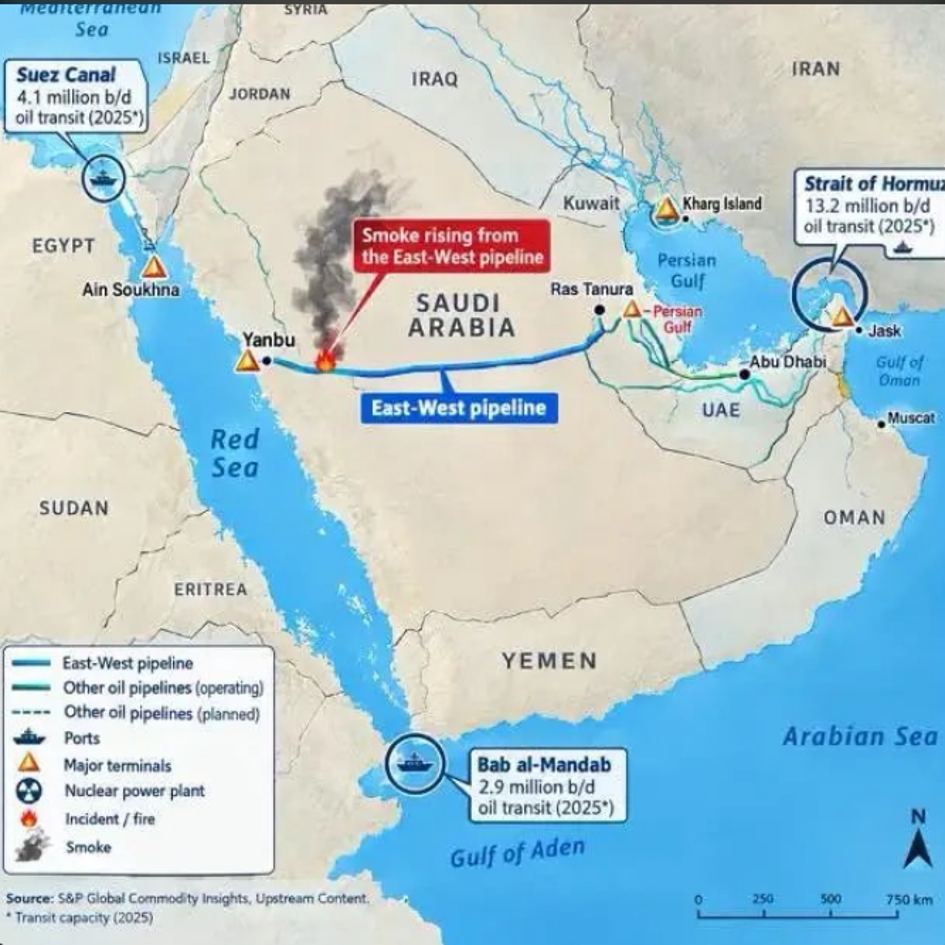
In the drone attack last weekend, at least two pumping stations were damaged. According to Saudi Arabia and Iraq, the drones came from southern Iraq, where pro-Iranian Shia militias hold considerable influence. The attack has not been officially claimed, so it is still too early to point directly to Iran or the Houthis as the perpetrator. However, it fits a broader strategy in which Iran can exert pressure through allies without openly taking responsibility itself.
The second blockade lies at Bab el-Mandeb
The Houthis, meanwhile, form the second threat. They have been waging an armed conflict against the Yemeni government since the 1990s, and have since strengthened their position along Yemen's west coast through a new offensive, also seizing the strategic island of Perim. This island lies in the middle of Bab el-Mandeb, the narrow passage between Yemen and Djibouti that connects the Red Sea with the Indian Ocean.
The location is crucial. Oil shipped from Yanbu (Saudi Arabia) to Europe sails northward through the Suez Canal or is transported to the Mediterranean via Egypt's SUMED pipeline. Deliveries from Yanbu to India, China, Japan and South Korea, however, must go southward through Bab el-Mandeb. This creates a double blockade for Asia. The normal, short route from the Persian Gulf runs via Hormuz. When that route is unsafe, Saudi Arabia can first transport its oil westward through the East–West pipeline to Yanbu. But to then reach Asia, tankers must pass the Houthi-threatened passage at Bab el-Mandeb. The alternative route is thus also cut off.
In early September, an estimated 3 million barrels of oil per day were still passing through Bab el-Mandeb. Due to the attacks and the Houthi advance, this flow may now have almost come to a standstill. Saudi Arabia is therefore trying to bring more oil to Asian customers via Oman and ship-to-ship transfers. This is expensive, logistically complicated and still partly dependent on a limited passage through Hormuz. The rise in shipping charter rates helps explain, among other things, why the price of crude oil delivered in Asia carries a premium of around USD 40 per barrel (on top of USD 110 for Brent in Northern Europe).
Why Saudi Arabia's large air force offers no solution
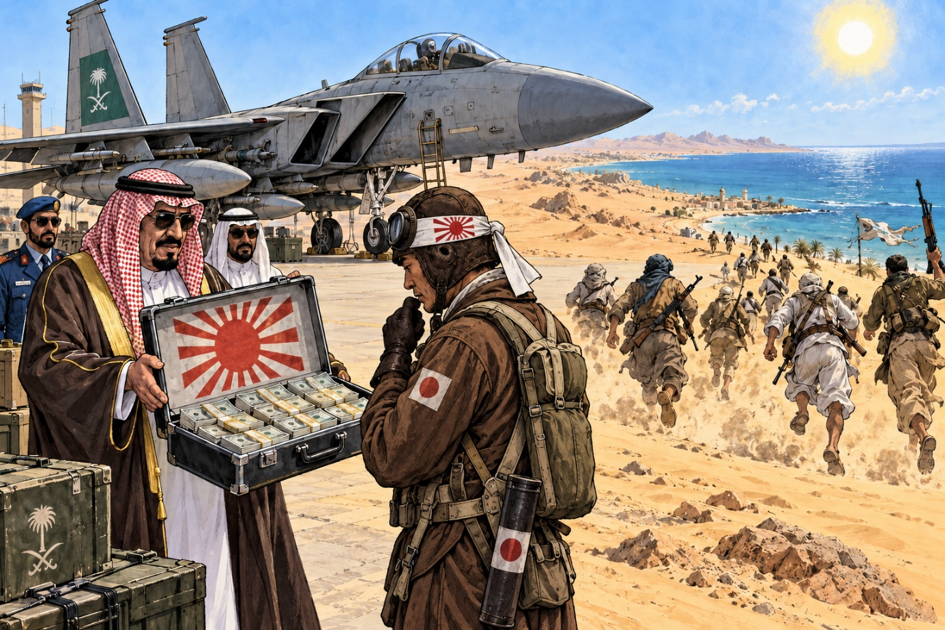
Saudi Arabia spends more than USD 100 billion annually on defence and potentially has an army twice the size of Israel's and equal to that of the UK. Saudi Arabia has more than 370 modern F-15s, Eurofighters and advanced American air defence systems (by comparison, the Dutch and Belgian air forces together have only 50 fighter jets operational). Despite its extensive and advanced air force, the kingdom appears strikingly powerless against this asymmetric threat. It must protect a 1,200-kilometre pipeline, dozens of pumping stations, refineries, ports, airfields, power plants and desalination facilities. The attacker only needs to break through the defences at a single point. Cheap drones fly low, can come from various directions and are difficult to detect at all times. Moreover, it is economically unfavourable to shoot down relatively cheap drones with expensive Patriot or other air defence missiles. Iran and the Houthis also have mobile launch platforms, tunnels and dispersed storage sites at their disposal. Years of Saudi bombing in Yemen have failed to eliminate this capability.
Saudi Arabia can again carry out hundreds of air strikes and support the Yemeni government, as it did during the previous war of 2014-2022, but that will not make the threat disappear. On the contrary: the Houthis could respond with new attacks on oil installations, cities and desalination plants. A strike on pro-Iranian militias in Iraq is equally risky. Riyadh would thereby violate Iraqi sovereignty, weaken the government in Baghdad and potentially come into direct conflict with Iran.
For now, the US is offering little support to Saudi Arabia
On top of this, the United States is reluctant to intervene militarily in a direct way. Crown Prince Mohammed bin Salman has asked Washington for military support against the Houthis, but for now the Americans do not want to open a new military front. They are, however, willing to share intelligence and information on possible targets. Washington is focusing mainly on protecting free shipping in the Red Sea and expects regional allies to take the lead themselves. Reuters
The recently concluded defence pact between Saudi Arabia, Turkey and Pakistan should also be viewed in this light. Although the pact stipulates that an attack on one of the three countries is to be treated as an attack on all three, it does not yet constitute a fully-fledged NATO-style alliance with an integrated military command structure. It points above all to growing uncertainty in Riyadh about Washington's willingness to defend the kingdom directly. At the same time, the US-Saudi security relationship remains important, as illustrated by US approval for the planned sale of 48 F-35 fighter jets.
The oil price reacts mainly to the duration of the disruption
The attack on the Saudi East-West pipeline initially drove the Brent price to around $108 per barrel. Reports that Saudi Arabia aims to restore part of its capacity within a few days, combined with extra transport via alternative routes around Oman, have somewhat eased the acute panic. Saudi Arabia is also said to have carried out repairs successfully faster than expected. Even so, oil remains considerably more expensive than before the escalation.
The market is now looking mainly at the length of the repair period, but also at the risk of new attacks. Saudi Aramco is attempting to restore roughly half of the capacity via a temporary rerouting. A full repair could reportedly take an estimated four to six weeks. If a significant share of the oil can once again be transported to Yanbu in the short term, part of the geopolitical risk premium will disappear. However, new attacks on the pipeline, the port of Yanbu or oil tankers could once again threaten around 4% of global supply.
Buffers have also shrunk sharply. According to the International Energy Agency, globally observed oil inventories have fallen by 507 million barrels since February. In August alone, the decline amounted to 95 million barrels. As a result, the market has increasingly little room to absorb a further disruption. At the same time, high prices are starting to dampen demand. The IEA expects global oil demand to fall by 2.5 million barrels per day in 2026.
A diesel crisis may pose a bigger risk than the high oil price
For Europe, it is not only the crude oil price that matters. The biggest direct risk may lie with diesel. Alternative sources of crude oil are still available worldwide, but refining capacity for diesel and other middle distillates is running at close to full utilisation. Net exports of diesel and gasoil from the Gulf states averaged just 390,000 barrels per day in August, only slightly more than a quarter of pre-war levels. Together, Russia and the Gulf states exported around 1.6 million barrels of diesel per day less than in February. Before the escalation, these regions accounted for nearly 45% of global maritime diesel trade.
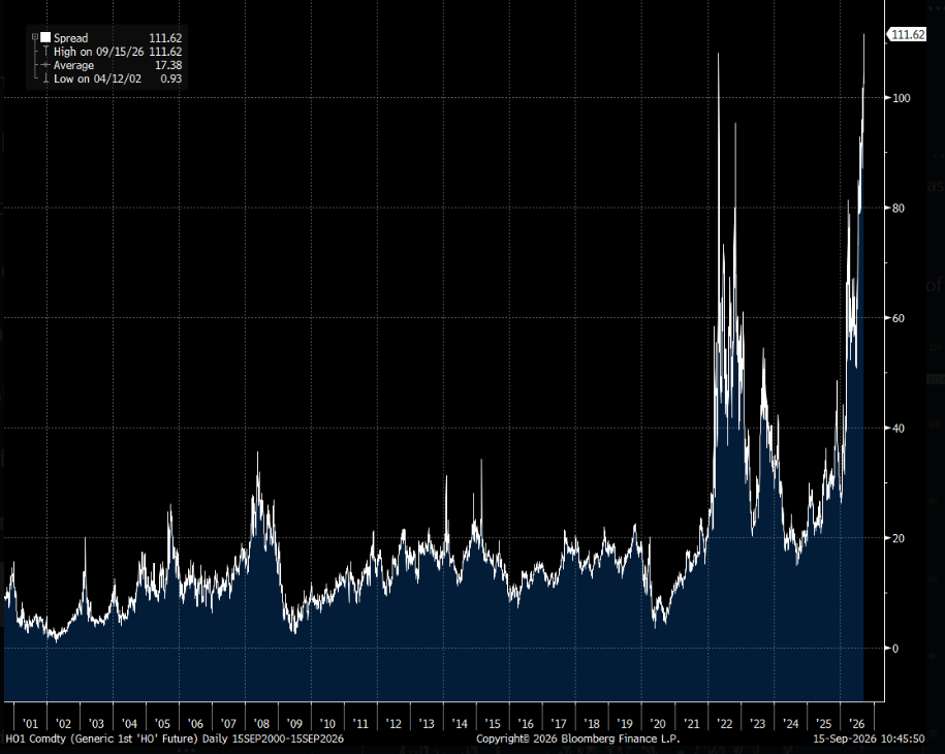
The disruption at Yanbu is also playing an important role. At the Yasref refinery, around 200,000 barrels of daily diesel production are at risk of being lost. At the same time, Russian refineries have been damaged by Ukrainian drone attacks, and Moscow has restricted its diesel exports. European inventories are low, while refineries are entering the maintenance season. Europe is unlikely to run out of diesel immediately. However, transport, agriculture and industrial production could become considerably more expensive. Ultimately, this translates into higher food prices, freight costs and inflation.
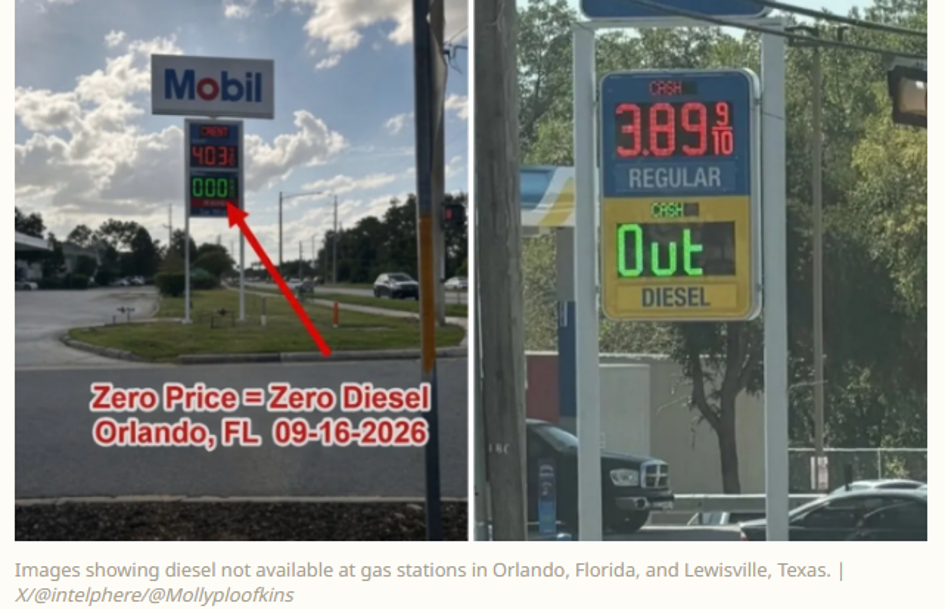
On top of this, Europe has become heavily dependent on American diesel. According to shipping data, more than half of Europe's diesel and gasoil imports came from the United States in August. It is precisely there that the average diesel price has now risen to $6.29 per gallon.
As a result, political pressure on Trump and the Republicans is increasing sharply just ahead of the midterm elections. There is therefore talk in Washington of possible export restrictions. However, no decision has been made by President Trump. Republican Senate Majority Leader John Thune has only indicated that he is open to examining a temporary export ban.
At the same time, US leadership is looking for other ways to ease pressure on the market. Trump has called on Ukraine to halt attacks on Russian refineries, arguing that they are worsening the global diesel shortage. Meanwhile, Secretary Doug Burgum warns that an export ban could provoke retaliation from trading partners and that US refineries might reduce output if export options disappear. However, as long as the high diesel price is causing domestic political damage, the measure remains on the table.
For Europe, a US export ban would be particularly painful. European buyers would then have to compete for limited supplies from India and other Asian countries, while supply from Russia and the Middle East has also been sharply reduced. As a result, the European diesel price could rise further, even if the crude oil price stabilises.
Economically, the high diesel price acts as a broad tax on almost the entire economy. Trucks, agricultural machinery, construction equipment, shipping and part of rail transport all run on diesel. US commercial transport is estimated to consume around 120 million gallons of diesel per day. Every one-dollar increase in the price per gallon therefore adds roughly $120 million in extra daily fuel costs. The current diesel price is about $2.55 per gallon higher than a year ago. That amounts to more than $300 million in additional costs per day.
Receive weekly insights in your inbox
Exclusive analyses and updates on family holding companies and global market developments.
Would you like more information about our services?
Get in touch
Disclaimer:
No rights can be derived from this publication. This is a publication of Tresor Capital. Reproduction of this document, or parts thereof, by third parties is only permitted after written consent and with reference to the source, Tresor Capital.
This publication has been compiled by Tresor Capital with the greatest possible care. The information is intended in a general sense and is not tailored to your individual situation. The information should therefore explicitly not be regarded as advice, an offer or a proposal to purchase or trade investment products and/or to obtain investment services, nor as investment advice. The authors, Tresor Capital and/or its employees may hold positions in the securities discussed, for their own account or for their clients.
You should carefully consider the risks before you start investing. The value of your investments can fluctuate. Past performance is no guarantee of future results. You may lose (part of) your invested capital. Tresor Capital disclaims any liability for any inaccuracies or errors. This information is purely indicative and subject to change.
Read the full disclaimer at tresorcapitalnieuws.nl/disclaimer .
This article was translated automatically from Dutch using AI. In case of any difference, the Dutch original prevails. Read the original in Dutch.