
Family Holdings #41 - MBB: "We're always a man short"


This week's topics:
In a recent letter to shareholders, Prosus-CEO Fabricio Bloisi provides an update on two major investor concerns, namely the acquisition of Just Eat Takeaway and the fierce competitive battle at iFood. At JET, modest growth of 0.1% in September finally breaks the negative trend after 55 months of decline, although hard figures on revenue and profitability are still lacking. At the same time, iFood in Brazil, despite a dominant market share of around 80%, had to give up about 5 percentage points to aggressive competitors, who according to Prosus are spending around $150 million a month on this.
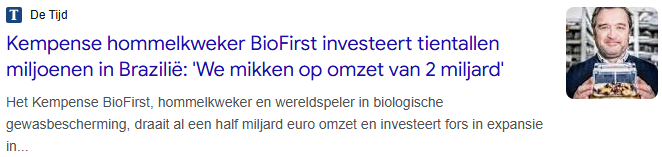
Sofina-holding BioFirst, the former Biobest, which breeds bumblebees, beneficial insects and micro-organisms for biological crop protection, aims to reach €2 billion in revenue within roughly ten years, according to an interview with CEO Jean-Marc Vandoorne in De Tijd. That is four times the current €497 million. After the acquisition of Brazil's Biotrop, the company is now focusing on open-field arable farming, a market that is a hundred times larger than greenhouse cultivation.
In Brief:
This week the Constellation family was once again active on three continents. Topicus.com (Toronto: TOI) acquired Spain's Cimkey, based in Barcelona. The company makes ERP software (Enterprise Resource Planning, company-wide administration software) as well as safety and regulatory compliance software for the chemicals and food sectors. Sygnity (Warsaw: SGN), in which Topicus holds a majority stake, acquired Germany's g.on experience, based in Münster. This was done through the newly established Dutch entity Tessara Blue B.V. Topicus had already been holding g.on on Sygnity's behalf for some time, but the transfer had been delayed. g.on supplies geodata and process management software to, among others, RWE Power, Evonik and Fraport. Finally, Constellation Software (Toronto: CSU) made its first acquisition in Argentina through Vela LATAM. It acquired Axoft, maker of the widely used ERP package Tango Software. Axoft has around 310 employees and says it serves more than 60,000 customers.
Alphabet (New York: GOOGL) is considering a new financing round for Isomorphic Labs, the AI drug-discovery company it previously spun off from DeepMind. According to Bloomberg, early discussions are taking place around a valuation of at least $40 billion, potentially rising to $50 billion. Just five months ago, Isomorphic already raised $2.1 billion, largely from Alphabet itself. How large Alphabet's eventual stake is remains undisclosed. The company now works with pharmaceutical giants such as Eli Lilly and Novartis, but has yet to bring any medicines to market. The timing of this round coincides with renewed interest in the sector, fuelled by recent news about Moderna's cancer vaccine.
KKR (New York: KKR) has reached an agreement to acquire Gen II Fund Services at an enterprise value of $5.1 billion. Gen II provides fund administration for more than 275 asset managers that together manage over $2 trillion. The sellers are Hg and General Atlantic. Since their entry in 2020, Gen II's revenue and EBITDA (operating result before depreciation and amortisation) have quadrupled. KKR is acquiring the company through its Core Private Equity strategy, the part of KKR that holds companies with long-term capital for much longer than a classic buyout fund. With this deal, KKR is acquiring a provider that serves the entire private markets industry.
For Investor AB (Nasdaq Stockholm: INVE B), SEB, one of its largest listed holdings, has unexpectedly been left without a CEO. Johan Torgeby stepped down with immediate effect on Tuesday evening after nearly ten years at the helm, for personal and family reasons, just ahead of the scheduled presentation of quarterly results on 22 October. Vice-CEO Jonas Ahlström is taking over his duties for now. There are so far no indications of an internal conflict or a strategic rift, and the share price reaction was correspondingly limited. Since Investor AB is the largest shareholder with a stake of just over a fifth, and Marcus Wallenberg chairs the board of directors, a smooth succession over the coming months will be an important point of attention for the investment company.
Addtech (Stockholm: ADDT.B) has acquired 82% of the UK's Mechanical Power Transmission. Under the name DePe Gear, the company makes custom gears, transmissions and drive components for, among others, defence, energy, rail, aviation and mining. MPT is based in Stoke-on-Trent, has 57 employees and around £10 million in annual revenue. The transaction was completed on 2 October and, according to Addtech, will have a slightly positive effect on earnings per share.
How a bankruptcy shaped MBB's thrifty DNA
In an episode of the Smart Investieren podcast by broker LYNX, CFO Torben Teichler gave a behind-the-scenes look at MBB SE (Frankfurt: MBB). This family holding company from Berlin has seen its equity grow from EUR 35.3 million at its stock market listing in 2006 to more than EUR 1 billion at the end of March 2026.
In 1995, founders Nesemeier and Freimuth started their own company in Berlin. Two years later, they bought the electronics company MBB Gelma from Daimler-Benz Aerospace. Daimler's condition was that the two men, both in their thirties, would first inject DEM 1.5 million in capital into the company, but no bank was willing to lend that amount. In the end, a lawyer they had previously worked with arranged the money. In fact, the founders never wanted to sell MBB Gelma, which made systems for time registration and access control, but around 2000 Dorma (now dormakaba) made an offer that was too good to refuse. After that, they took over bicycle and lawnmower production from the bankrupt Kynast, but within two years that business went under as well.
Teichler sees that painful experience as the source of MBB's DNA. Ever since, the holding company has wanted to stand on multiple legs, prefers to look at a candidate two or three times, and will walk away from an acquisition if in doubt. MBB finances acquisitions largely with equity, because the holding company wants to remain independent of banks. It therefore deliberately avoids the private equity practice of loading companies up with debt. Because the founders together still own more than 70% of the shares, MBB, according to Teichler, sometimes resembles a listed family office, where discipline takes precedence over growth.
The holding company itself has only ten to twelve employees. "We're actually always one person short, and that keeps the pressure on," says Teichler. Almost everyone on that team is responsible for a subsidiary and acts as a sparring partner for its management there. Directors preferably come from within the company itself and are often shareholders too, so that they have skin in the game. At subsidiary Hanke Tissue in Poland, which makes napkins, tissues and toilet paper, Nesemeier handed over leadership shortly after the 2006 acquisition to a newly hired management assistant, promising to support him along the way. That assistant now owns 7% of the company through a long-term incentive plan.
The greatest success of that approach is Friedrich Vorwerk, which builds gas and electricity pipelines for Germany's energy transition. When MBB took a majority stake in 2019, the company had revenue of less than EUR 100 million. CEO Torben Kleinfeldt actually didn't want to sell at the time, so MBB devised a structure under which he remained at the helm with a substantial stake of his own. He still owns 18% of the shares. Immediately after the acquisition, Vorwerk, with MBB's support, bought its largest regional competitor, Bohlen & Doyen, after which revenue came in at EUR 704.3 million in 2025. The largest order since then amounts to EUR 600 million, more than six times the annual revenue of that time.
To put capital to work, MBB distinguishes four options. Its preference is to acquire a new company. In addition, the holding company buys extra shares in its own listed subsidiaries when they are undervalued. This happened particularly when interest rates rose rapidly in 2022 and 2023. "It was completely absurd," says Teichler. In the private market, sellers were still asking very high prices, while investors were dumping German stocks en masse. During that period, MBB mainly increased its stake in Friedrich Vorwerk and, to a lesser extent, in machine builder Aumann. Thirdly, MBB buys back its own shares once the discount to intrinsic value becomes too large. The most recent share buyback programme, worth EUR 25 million, ended in May. Finally, the holding company invests roughly 30% to 35% of its cash position in shares of large companies, with a certain emphasis on the United States, as a counterweight to its strongly Germany-focused subsidiaries.
MBB is also one of the few German dividend aristocrats, companies that have raised their payout to shareholders for many years in a row. This year, the base dividend rose for the sixteenth consecutive time, to EUR 1.21 per share. In the event of strong results, a bonus is added on top, as happened in 2025, when shareholders received three times the base dividend to mark the company's 30th anniversary.
According to Teichler, investors are best placed to assess MBB through the sum of the parts, the total of all its business units. At the end of March, the holding company had EUR 415.6 million in cash, equivalent to roughly EUR 78 per share. Together with the stake in Friedrich Vorwerk, the value came to around EUR 174 per share in mid-July, while MBB itself was trading at around EUR 171. Including the stakes in Aumann and the also listed wood processor Delignit, the sum rose to around EUR 192. As a result, investors effectively got the unlisted subsidiaries, with IT security provider DTS as the largest, thrown in for free. Given that cybersecurity companies have been one of the best-performing sectors on the stock market this year, that is all the more an indication of the hidden value within the MBB portfolio.
Prosus provides an update, but little insight
CEO Fabricio Bloisi of Prosus (Amsterdam: PRX) sent a letter to shareholders this week about meal delivery. The letter addresses the two main concerns investors currently have. Was the acquisition of Just Eat Takeaway (JET) a good purchase? And how much does it cost to defend iFood in Brazil?
JET: the first month of growth
The good news comes first. According to Bloisi, the number of orders at JET had fallen year-on-year for 55 months in a row. When Prosus took control in December, the decline stood at 9%. In September, the number of orders grew again for the first time, by 0.1%.
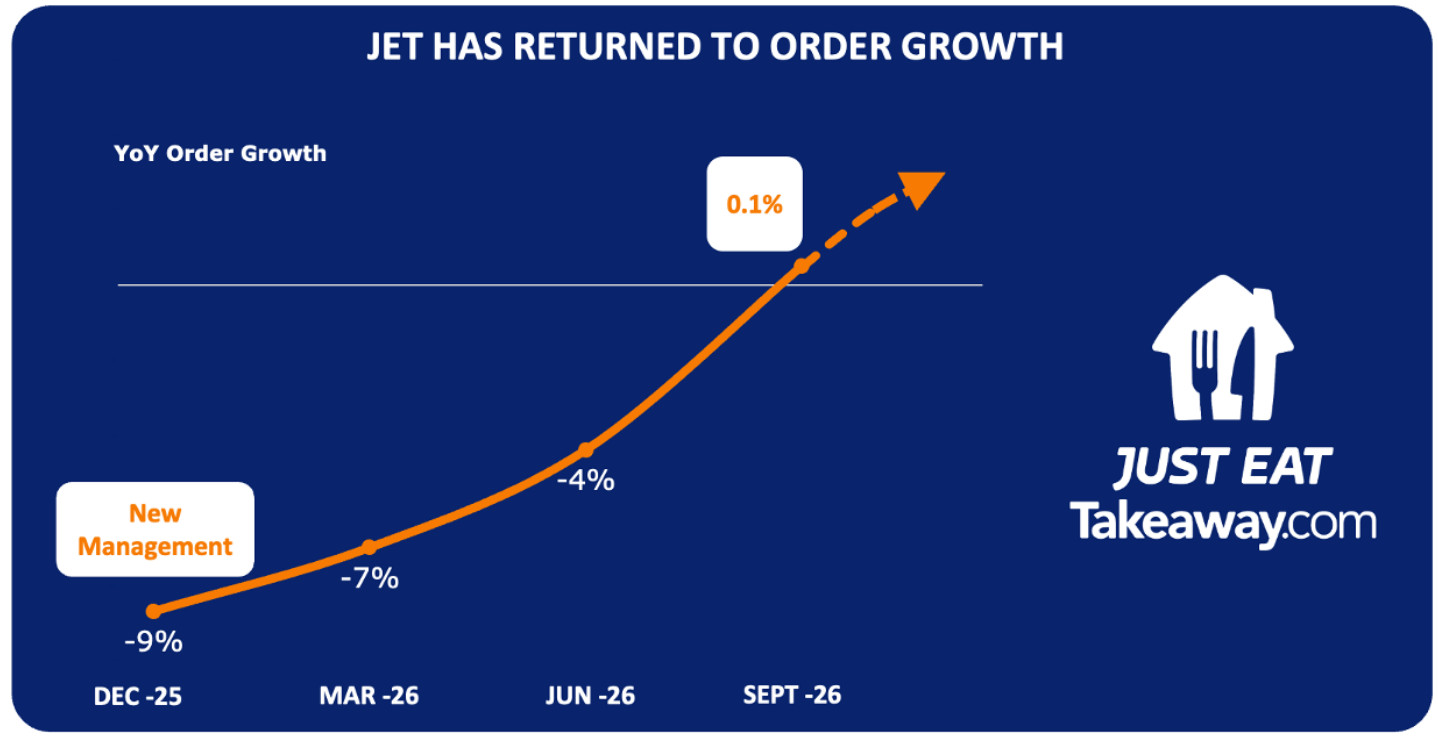
Bloisi rightly calls this “just the first step”. According to him, the improvement came from changes to technology, logistics, product, customer retention and marketing. He expects these effects to build up further in the coming period.
The fact that the downward trend has been reversed is a milestone in itself, but there is reason for some scepticism. After one month, growth remains barely above zero, and that is against a particularly weak comparison base. What's more, the letter says nothing about revenue, order volume in euros or profitability. CEO Fabricio Bloisi does emphasise that Prosus wants to make every order more profitable, but how margins actually stand at the moment remains unmentioned.
iFood: eighty percent, but five points fewer
The second topic in the letter is iFood. Bloisi acknowledges that competition in Brazil has increased considerably over the past year and a half. Competitors are burning through roughly $150 million a month and losing “a huge amount of money”, he says. He expects this to continue, but says iFood is prepared for it: “We've been through this before.”
His main argument is market share. According to Prosus, iFood still holds around 80% of the delivery app market and has given up only about 5 percentage points of that. For comparison, Prosus points to market leaders in China, the United Arab Emirates and Saudi Arabia. Under similar pressure, the company says, those lost between 10 and 30 percentage points.
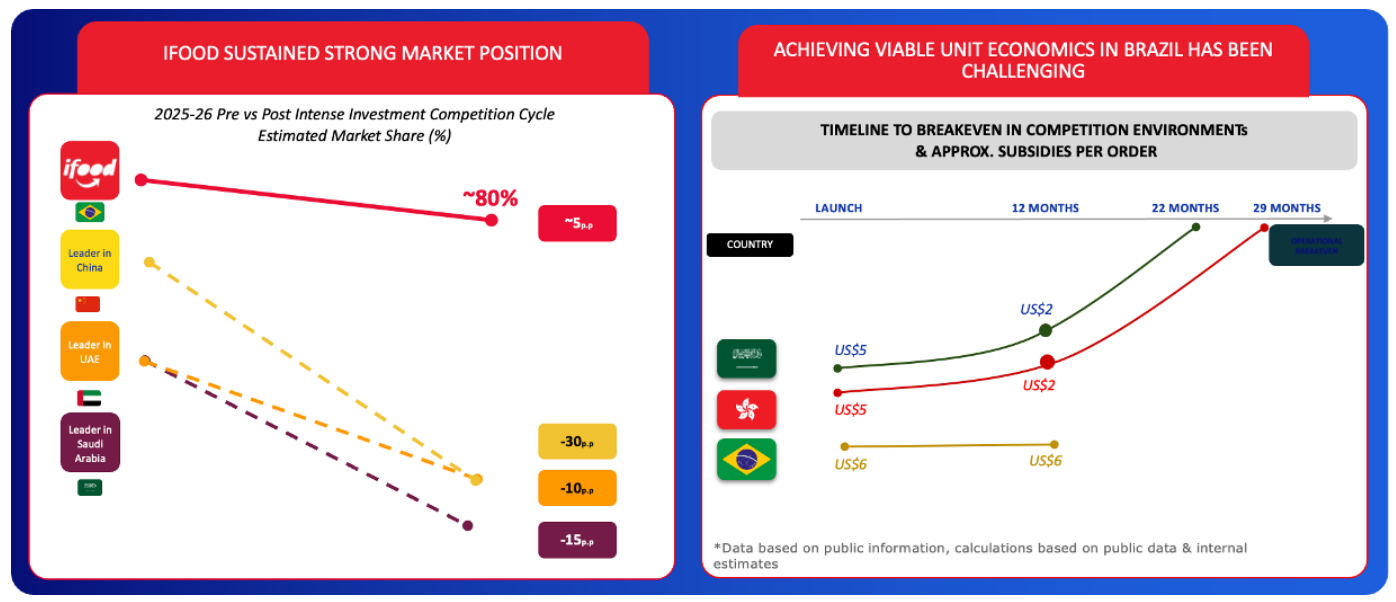
That comparison says little, since the markets differ greatly in size, maturity, geography and competition, and the chart offers no context on any of this. To judge whether the comparison even holds up, an investor would first need to establish whether the conditions in those markets are actually comparable. What is certain, in any case, is that iFood lost around 5 percentage points of market share in a short period of time, a significant drop for a player that had held the market almost entirely to itself for years.
Sofina holding targets fourfold increase in revenue
BioFirst, formerly Biobest of Westerlo, aims to reach €2 billion in revenue within roughly ten years. That is according to CEO Jean-Marc Vandoorne in an extensive interview with De Tijd. The company generated €497 million in revenue and €96 million in EBITDA (operating result before depreciation and amortisation) in 2025. The target thus amounts to a fourfold increase.Sofina (Brussels: SOF) has been a shareholder since 2023, alongside parties including Belgian holding company Floridienne, Mérieux Equity Partners, Tikehau and M&G. Below, we set out the key points. The full article from De Tijd can be found below.
BioFirst is now active in seventy countries worldwide and, under the leadership of Vandoorne, who joined in 2009 when revenue stood at barely €30 million, has grown into a global player in biological pest control through the breeding of bumblebees for greenhouses and beneficial insects, mites, bacteria and fungi. The real acceleration in growth began in 2023 with the acquisition of 85% of Brazil's Biotrop, which marked the step into open-field farming for soybeans, maize, sugarcane and cotton. According to Vandoorne, that market is a hundred times the size of greenhouse cultivation, and with the recent acquisition of the remaining 15% of Biotrop, the company has put the finishing touches on its position in front-runner country Brazil, which accounts for a third of group revenue.
With future revenue of €2 billion, BioFirst could rank among the global top ten in crop protection alongside chemical giants such as Syngenta, Bayer and Corteva. Although Vandoorne is reluctant to commit to an exact timeline, he consistently works from bold long-term goals that give direction to the whole team. The sector in any case has strong tailwinds, as the market for biological crop protection is growing 10 to 15 percent a year, driven by stricter regulation, bans on chemical agents and increasing resistance. For Sofina, this success story underscores the type of long-term investment its capital is keen to support: companies with a strong entrepreneur that structurally benefit from a world becoming more sustainable.
Receive weekly insights in your inbox
Exclusive analyses and updates on family holding companies and global market developments.
Would you like more information about our services?
Get in touch
Disclaimer:
No rights can be derived from this publication. This is a publication of Tresor Capital. Reproduction of this document, or parts thereof, by third parties is only permitted after written permission and with reference to the source, Tresor Capital.
This publication has been compiled by Tresor Capital with the greatest possible care. The information is intended in a general sense and is not tailored to your individual situation. The information should therefore explicitly not be regarded as advice, an offer or a proposal to purchase or trade investment products and/or to make use of investment services, nor as investment advice. The authors, Tresor Capital and/or its employees may hold positions in the securities discussed, for their own account or for their clients.
You should carefully consider the risks before you start investing. The value of your investments may fluctuate. Past performance is no guarantee of future results. You may lose (part of) your investment. Tresor Capital disclaims all liability for any inaccuracies or errors. This information is purely indicative and subject to change.
Read the full disclaimer at tresorcapitalnieuws.nl/disclaimer .
This article was originally written in Dutch and automatically translated into English with the help of AI. In case of any difference, the Dutch original prevails.