Family Holdings #29 - Buffett sees Alphabet as the winner of the AI race
This week's topics:
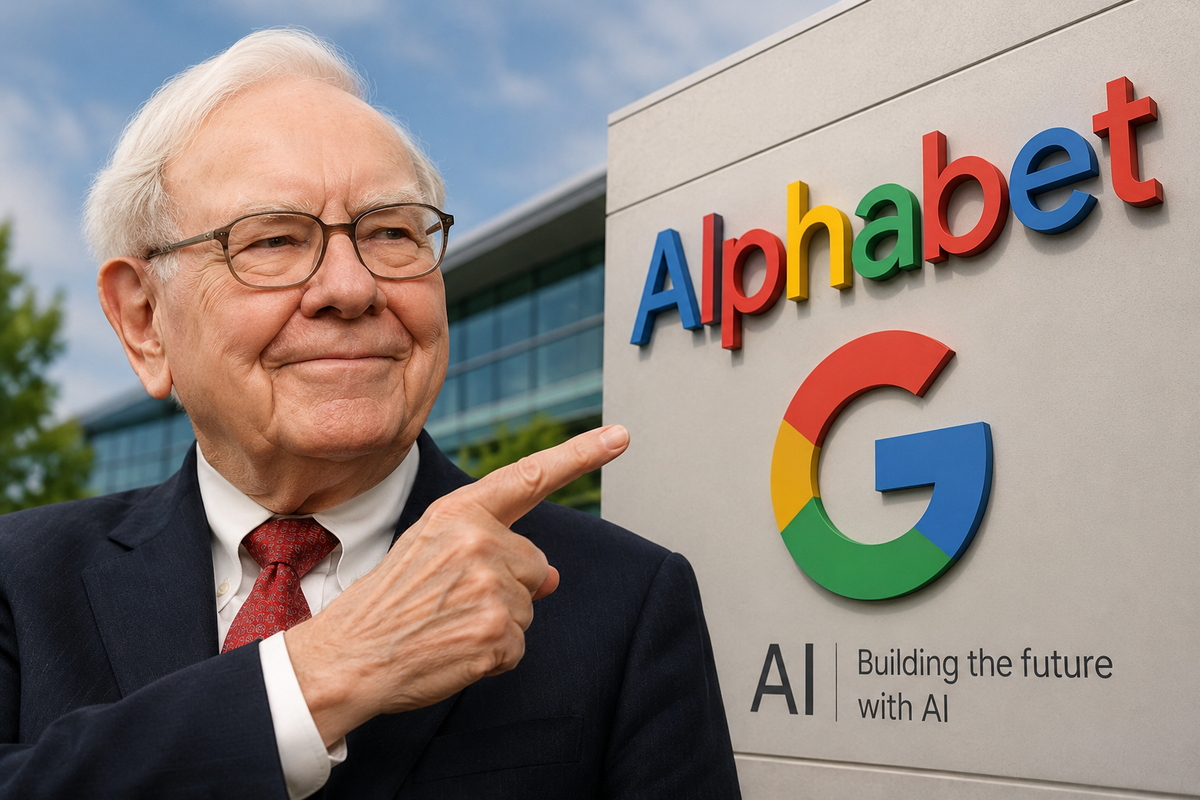
Warren Buffett has announced that he will accelerate the giving away of his remaining stake in Berkshire Hathaway, with a final deadline of the end of 2034. This strategic shift is made possible by his unconditional confidence in successor Greg Abel. In addition, Buffett gave a remarkable explanation of his new investment in Alphabet (over $30 billion); he sees the tech sector shifting from asset-light to capital-intensive, a transition he considers necessary for the long-term survival of these companies, even though he remains critical of the general gambling culture on today's stock market.
In Brief:
MBB SE (Frankfurt: MBB) has recently seen insider purchases by Executive Chairman and CEO Christof Nesemeier. The transactions show that a total amount of EUR 753,727 was bought at a price of approximately EUR 167 per share, corresponding to the purchase of 4,508 shares.
CHAPTERS Group (Frankfurt: CHG) this week raised its outlook for organic growth in adjusted operating profit (EBITDA) for 2026 to above 22%. The details of this raised outlook will be discussed in detail next week in a separate update. In addition, the company has made an investment in Stockholm-based Float, an AI-native platform that helps tech SMEs with growth capital and the automation of financial operations through real-time banking and accounting links.
According to estimates from RBC, Constellation Software (Toronto: CSU), following its recent acquisition of TouchBistro, allocated USD 646 million to acquisitions in the second quarter, after which a further USD 270 to USD 347 million was invested. With total capital allocation of USD 1.63 billion so far, the group is on track to spend USD 3.12 billion on acquisitions in 2026, breaking the record of USD 2.46 billion set in 2023.
Prosus (Amsterdam: PRX) has made an irrevocable commitment to sell its remaining 16.8% stake in Delivery Hero to Uber. Uber's takeover bid values the shares at EUR 41.50 each, which for Prosus is an effective way of meeting the commitments made earlier to the European Commission. The total proceeds amount to EUR 2.12 billion.
Scottish Mortgage (London: SMT) has, in a recent video update, officially confirmed that Korean chipmaker SK Hynix is part of the portfolio. Although Baillie Gifford's interest in the company's ADR had been known for some time, deputy manager Lawrence Burns now confirms that the stock will be visible in future updates of the Scottish Mortgage portfolio as a crucial part of their view on the ongoing, exponential rise in demand for computing power and chips. The video also gives a good overview of Scottish Mortgage's view on AI and the exposure the portfolio has to it. Manager Tom Slater also shared, in a video, a look back at the past twelve months, which were marked by both opportunities and disruption.
Improvements at Addtech and Lifco in a challenging climate
This week both Lifco and Addtech (Stockholm: ADDT-B) reported their quarterly results. Lifco (Stockholm: LIFCO-B) showed revenue growth of 10.8% in the second quarter, with an organic component showing the first signs of normalisation. This rose by 4.7% compared to Q2 2025, bringing organic growth over the first half of the year to 2.9%. Higher organic growth generally makes it easier for companies to improve margins, and that is exactly what happened. The serial acquirer's already high EBITA margin climbed further to 23.1% (22.5%). Addtech had a somewhat quieter quarter. Revenue rose by 6%, almost entirely driven by acquisitions, as organic growth remained flat for the second quarter in a row. Despite the lagging organic growth, Addtech too managed to improve margins across the group, reaching an EBITA margin of 16.6% (15.8%). On balance, then, solid to good results for both names, without significant negative surprises.
Despite the absence of organic growth, order intake at Addtech was broadly good across the board. CEO Niklas Stenberg notes that the book-to-bill ratio (the ratio between newly received orders and invoiced revenue over a period; a value above 1 means the order book is growing faster than revenue) was "clearly above 1" and has also shown sequential improvement over recent quarters. This could mean that the company's organic growth will gradually improve over the coming quarters of the financial year. Stenberg confirms this assumption, with the caveat that the current orders will probably only become visible in the figures in the third and fourth quarters.
At Lifco, organic growth was actually the positive surprise of the quarter. CEO Per Waldemarson states that at Dental this is due to a favourable product mix, with revenue increasingly coming from the sale of the company's own products rather than the distribution of third-party products, resulting in organic growth and higher margins. He says that across the whole group they have the feeling that the sectors are picking up again this year and normalising to some extent. This follows what Waldemarson himself describes as "probably the toughest year for our industrial businesses since the IPO in 2014." The image below nicely illustrates the developments across the segments. Dental has served as a stable but slower-growing base for years, while Demolition & Tools is the only one of the five segments to have shown contraction or stagnation in recent years.
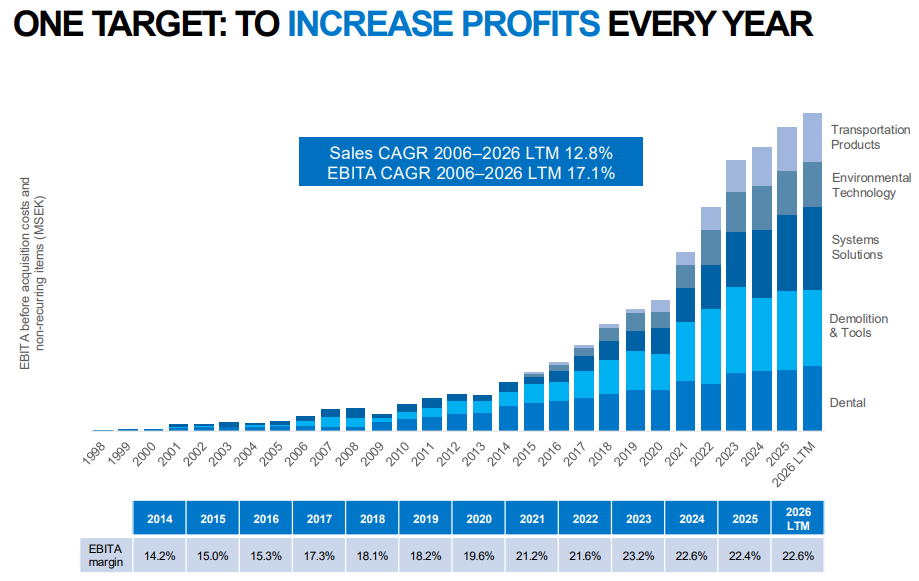
As shown, this last segment has therefore been under pressure for some time, and that is nothing new. Waldemarson notes that they are still far removed from the levels the sector achieved three years ago, and Addtech's Stenberg likewise reports that the sawmill market in particular within their industrial segment is very weak. The more difficult results within these sectors are partly attributed to geopolitical unrest. Both CEOs note that companies are postponing major investments due to this uncertainty. As a result, pressure on the margins of these divisions could persist for some time yet.
The other divisions of both companies, however, are showing margin improvements. Below you will find an overview of the EBITA margins of the divisions within the companies.
| Division | Margin current | Margin previous year | Δ (percentage points) |
|---|---|---|---|
| Lifco — Q2 2026 | |||
| Dental | 22.7% | 21.5% | +1.2 |
| Demolition & Tools | 25.3% | 25.1% | +0.2 |
| Environmental Technology | 26.9% | 25.4% | +1.5 |
| Transportation Products | 23.0% | 22.2% | +0.8 |
| Systems Solutions | 22.5% | 22.0% | +0.5 |
| Addtech — Q1 2026/2027 | |||
| Automation | 13.6% | 10.2% | +3.4 |
| Electrification | 16.2% | 14.4% | +1.8 |
| Energy | 19.5% | 19.1% | +0.4 |
| Industry | 20.9% | 21.2% | −0.3 |
| Process | 14.3% | 14.8% | −0.5 |
| Safety | 14.9% | 12.5% | +2.4 |
For the rest of the financial year, Stenberg gave a fair picture per division during the Q&A session of what shareholders can expect. In his view, Automation should be able to show a slightly better margin than the rolling twelve-month average, whereas for Safety that rolling average is itself already a representative benchmark. For Industry, the situation is different. As long as the sawmill machinery market fails to pick up, Stenberg does not rule out a further slight margin decline, although he does not expect a dramatic change. At Electrification, he himself flagged a caveat regarding this quarter's strong margin, since it was partly boosted by an exceptionally well-performing recent acquisition in Germany, combined with a seasonal effect that will fade again in the next quarter.
A similar nuance came up at Lifco when Waldemarson was asked about the strong margin at Environmental Technology. He explained that organic growth simply feeds through into better utilisation of the fixed costs within the sales organisations and product development, whereas organic contraction puts precisely those same margins under pressure. The current margin is therefore less a structurally new level and more a direct reflection of the organic growth that returned this quarter.
On the acquisition front, both companies are currently running below their own long-term average pace of investment on a twelve-month basis. Both CEOs stress, however, that this kind of data is highly volatile on a quarterly basis and that the pipeline of potential acquisition targets remains undiminished in size. Waldemarson even says he is having more conversations than ever before, but is unwilling to commit to when these will lead to completed deals and prefers to remain disciplined rather than buying at any price. Stenberg sounds at least as optimistic and expects to be able to sustain Addtech's high pace of acquisitions, given the strong balance sheet and what he himself calls a promising acquisition market.
All in all, it was a solid quarter for Addtech, without any notable positive surprises but certainly also without negative ones, with strong margin improvements as a constant. For Lifco it was a good quarter thanks to the return of higher organic growth, which in turn led to further margin improvements.
Buffett on the sale of his shares and the Alphabet investment
In a conversation with CNBC on 15 July, Warren Buffett looked back on a series of developments at Berkshire Hathaway (New York: BRK-B) since May and commented on one of the largest new positions in the portfolio, his confidence in successor Greg Abel and the state of the markets.
Selling his stake
Alongside his revised donation policy, Warren Buffett announced a second, far-reaching change: he is accelerating the pace at which his remaining stake in Berkshire Hathaway is being given away. Whereas the previous arrangement stipulated that his shares would be distributed no later than ten years after his death, the horizon now shifts to the end of 2034. This means that his entire fortune, currently standing at $140 billion, will largely be transferred while he is still alive.
Since Buffett began his systematic donations in 2006, he has given away $67 billion. To distribute the remaining $140 billion within eight years requires an average annual payout of $17.5 billion. Buffett stressed, however, that $17.5 billion is merely an arithmetic lower bound. Because that calculation assumes a static share price, the actual amount will turn out significantly higher if Berkshire Hathaway's share price rises. Buffett remarked that assuming a stagnant share price is not realistic. He pointedly noted that even a risk-free investment in government bonds already yields 5%; the idea that a company like Berkshire would post no growth at all over those eight years simply does not square with reality.
Buffett cites two reasons for this acceleration, and describes the second as the decisive one. The first is the reality of his age and health. At 95 years old, and after a recent leg fracture, he soberly acknowledges that preserving his sharpness is not a given.
The second, and for him more important, reason is his unconditional confidence in Greg Abel. As long as Buffett was uncertain about a suitable successor, retaining voting control through the family served as a necessary safeguard to protect the continuity of Berkshire Hathaway. Now that he is one hundred percent convinced that Abel is the right man in the right place, that necessity falls away.
Buffett claims the initiative for the Alphabet purchases
Notably, Buffett largely takes credit for the position in Alphabet (Nasdaq: GOOGL). Whereas analysts, including ourselves, had until now attributed the investment to the new course set under Greg Abel, Buffett states that he took the initiative for this position himself. With a value of over $30 billion, including the recent $10 billion private placement, this is a substantial addition to the portfolio. Buffett qualified this, however, by stressing that there is close interplay between the two of them: he undertakes nothing without Abel's agreement, and vice versa.
In the interview, Warren Buffett gave an illuminating explanation of his investment in Alphabet, a striking choice for someone who avoided technology for decades. The core of his reasoning is that the large technology companies have changed from asset-light businesses into capital-intensive giants. They are committing hundreds of billions of dollars, a scale that, according to Buffett, even dwarfs Berkshire Hathaway's railway division. This forces the sector into a strategic game that its participants have little choice but to play.
"In many cases they're now playing a game they'd really rather not be playing. IBM would have loved nothing more than to just keep playing the game of the 1930s through the 1960s, until someone else figured out how to deliver a better outcome for the customer."
Buffett argues that a company's right to exist ultimately depends on customer satisfaction. "The customer isn't stupid, unlike Wall Street," is how he characterises the market.
Buffett pointed out that he saw sentiment shift at a time when Alphabet was barely committing any capital. Back then, the company was actually criticised for investing too little, while the market applauded it. Now that capital expenditure has risen sharply, those same shareholders are dissatisfied. Buffett believes there is a good chance that these companies, judging by their track record, will end up among the ultimate winners, while a large part of what Wall Street recommends as promising fails to live up to that expectation. His fundamental criticism of analysts is that they fixate on quarterly figures, whereas the real question is what structural return on capital a company achieves.
Although Alphabet now represents a position of more than $30 billion, Buffett does not put the company at the top of his ranking. He indicates that he currently rates at least four or five other Berkshire holdings, including Apple, American Express and his railway arm, more highly. That reticence stems from his well-known philosophy about the too-hard pile. He readily admits that he finds it harder to grasp the technological moat of an AI company than that of a simple consumer product. He compares it to selling sweets: a better sweet is, in his view, easier to predict than a technological innovation that competitors would spend sleepless nights trying to copy.
Market view and scepticism
On the market in general, Buffett was cautious. He argued that the human propensity for gambling structurally means that there is more money to be made from cultivating gamblers than from cultivating investors. As an example, he cited the broker of forty years ago: that broker had earned exactly one commission and then had to spend the rest of their career advising their client to simply do nothing. "It gets harder to find value when everyone would rather gamble," he concluded.
Buffett also levelled sharp criticism at the government, which in his view "cynically" profits from lotteries and gambling to plug shortfalls. Such practices, he argued, undermine trust in the system.
Receive weekly insights in your inbox
Exclusive analyses and updates on family holding companies and global market developments.
Would you like more information about our services?
Get in touch
Disclaimer:
No rights can be derived from this publication. This is a publication of Tresor Capital. Reproduction of this document, or parts of it, by third parties is only permitted after written consent and with reference to the source, Tresor Capital.
This publication has been prepared by Tresor Capital with the greatest possible care. The information is intended in a general sense and is not tailored to your individual situation. The information should therefore explicitly not be regarded as advice, an offer or a proposal to purchase or trade investment products and/or to make use of investment services, nor as investment advice. The authors, Tresor Capital and/or its employees may hold positions in the securities discussed, for their own account or for their clients.
You should carefully consider the risks before you start investing. The value of your investments can fluctuate. Past performance is no guarantee of future results. You may lose (part of) your investment. Tresor Capital disclaims any form of liability for any inaccuracies or errors. This information is indicative only and subject to change.
Read the full disclaimer at tresorcapitalnieuws.nl/disclaimer .
This article was translated automatically from Dutch using AI. In case of any difference, the Dutch original prevails. Read the original in Dutch.