Family Holdings #32 - Brookfield and Scottish well positioned in the AI bottlenecks


This week's topics:
ASML serves as the indispensable printing press of the AI era, with CEO Christophe Fouquet emphasising that advanced AI chips are impossible without its EUV technology. The extreme complexity of the machines gives it a technological lead over competitors that lasts for years, underpinning the expected revenue growth to EUR 36 to 40 billion in 2026. Scottish Mortgage Investment Trust regards the holding as an agnostic royalty on computing power, despite the industrial volatility and geopolitical risks surrounding China, which accounted for 33% of revenue last year.
In Brief:
Amazon (New York: AMZN) has fully funded its committed investment in OpenAI, bringing its stake in the maker of ChatGPT to roughly 5 percent. The company invested $15 billion in February and put a further $35 billion on the table, contingent on certain milestones being met, such as an IPO or a technological breakthrough. According to insiders, the renegotiation of OpenAI's contract with Microsoft in April was decisive, as it cleared the way for other cloud providers, including AWS, to serve OpenAI.
Constellation Software (Toronto: CSU) continues to expand at a rapid pace. Operating group Vela acquired Brazil's Cobmais. Founded in 2015 and based in São Paulo, the company supplies CRM software for collections, credit management, recovery and invoicing to businesses, lenders and credit advisers.
For our portfolio companies Scottish Mortgage (London: SMT) and Alphabet (New York: GOOGL), SpaceX's first-quarter results were highly relevant this week. Although SpaceX's revenue nearly doubled to $7.8 billion, its number of Starlink subscribers rose from six to twelve million, and its loss halved to $541 million, the market reacted cautiously due to the enormous investment pressure and generous valuation. Scottish Mortgage also disclosed the exact size of its position for the first time this week: 37.4 million shares as at the end of June, equal to roughly 0.30% of the company. Since the results were published, manager Baillie Gifford is permitted to sell up to a maximum of twenty percent of this stake, but whether it has actually done so we will only find out in about a month's time.
Brookfield's flywheel
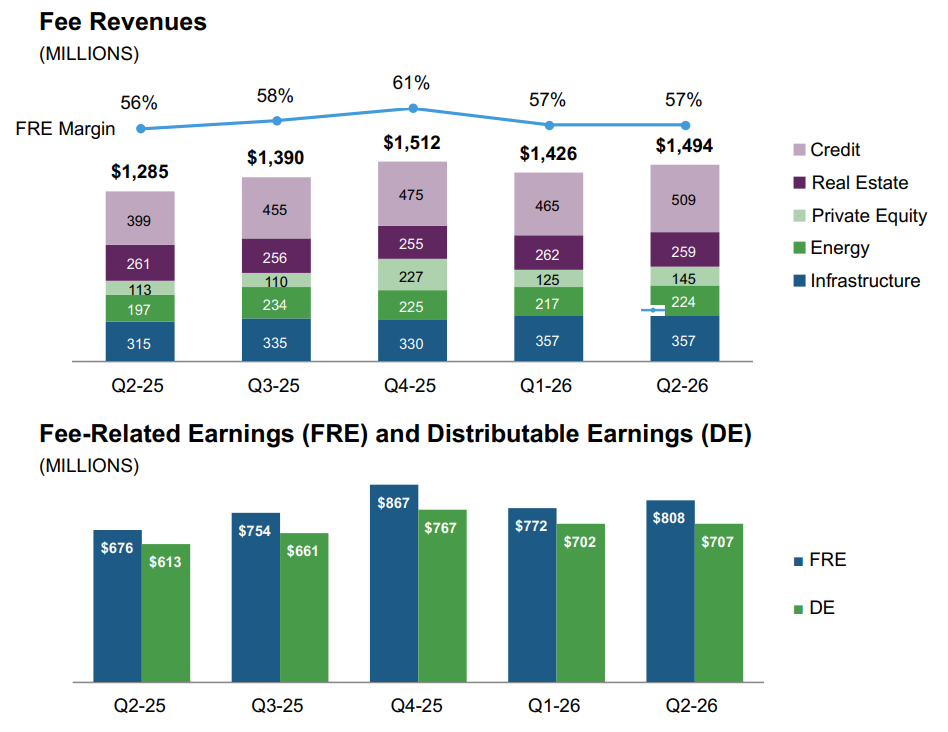
Brookfield Asset Management (New York: BAM), the 72% subsidiary of investment holding company Brookfield Corporation (New York: BN), published its second-quarter results this week. Fee-related earnings (FRE), the predictable profit from asset management fees, rose by 20 percent to $808 million, or $0.50 per share. Distributable earnings (DE), the measure of profit that can actually be paid out, came in 15 percent higher at $707 million, or $0.44 per share. Fee-bearing capital (FBC), the assets under management on which fees are actually collected, grew by 19 percent to $672 billion.
For an asset manager, the inflow of new capital is one of the most important predictors of future growth, and here too Brookfield posted strong figures. In a single quarter it raised $77 billion, the highest amount ever, taking the year-to-date total to $98 billion and the trailing twelve-month figure to $163 billion. By comparison, $112 billion was raised over the whole of 2025, and the previous record dates back to 2024 at $137 billion. One caveat, also noted by management itself, is that $40 billion of this came from a single mandate, that of the British pension insurer Just Group. BAM CEO Connor Teskey pointed out that the quarter would still have been a record for organic fundraising even without that mandate.
Teskey then added a remark that is not reflected in the figures themselves and which, in our view, was one of the most interesting moments of the call. Carried interest, the share of investment profit that the manager receives once investors have achieved their minimum return, normally only materialises late in a fund's life. Because several strategies have been performing considerably better than expected since Brookfield Corporation's spin-off at the end of 2022, that threshold is being reached sooner than planned.
"We expect to generate and realise carry sooner than we previously projected, with some of that realisation occurring already this year, and with a significant shift of larger realisations from the latter part of this decade into the coming years. That will certainly be a boost to our earnings that we probably didn't have in our forecasts six or twelve months ago."
Not everything went off without a hitch. At the non-traded BDC, an unlisted credit fund for retail investors, redemption requests rose to just under the permitted quarterly limit of 5 percent. Brookfield fully complied with this, and the fund represents less than 1 percent of fee-bearing capital, but the figure fits into the broader picture of retail investors withdrawing from private credit products.
Another hot topic was artificial intelligence. According to Teskey, Brookfield was already investing in clean energy thirty years ago, before anyone spoke of "renewables", and it spent decades in real estate, power generation and data centres before that combination came to be called AI infrastructure. In his view, an investment in a digital toll road, pipeline or processing facility is not fundamentally different from an investment in its physical counterpart, meaning the same underwriting discipline applies. The only thing that is truly different about this moment, he says, is the mismatch between supply and demand, and it is that mismatch that determines who profits. What matters here is not whether the capital behind the projects is available, but the credibility of the operators who can deliver these very large projects on time and within budget.
Asked what happens if large tech companies unexpectedly scale back their investments, Teskey responded calmly. Because global demand already far exceeds the pace at which projects can actually be built, that underlying tightness will persist for the time being regardless, even if demand growth flattens somewhat. That structural scarcity allows Brookfield to operate extremely selectively, by limiting itself to the very best projects with the strongest counterparties, without making any concessions on the scale of the total investments.
"We don't build on speculation. We only build against long-term revenue contracts that are already in place," said Teskey.
Even so, the discussion about possible overcapacity is not brushed aside. Sikander Rashid, global head of AI infrastructure, explicitly drew a comparison with nineteenth-century railway construction and the fibre-optic wave around 2000, noting that it is inevitable that some capital will ultimately be poorly spent. In his view, the firm's own strategy does not require Brookfield to predict the AI market flawlessly, but rather that the company maintains iron discipline in the choices it makes and the risks it accepts.

Oaktree acquisition completed
On 3 August, Brookfield completed the acquisition of the remaining stake in Oaktree Capital Management. In practice, little changes for the company itself, since Brookfield had already held around three-quarters of it since 2019, and Teskey noted that the integration has been under way since October last year.
More telling than the completion of the transaction itself is what full control now makes possible within the broader holding company. Of the $51 billion that the credit division managed to raise this quarter, no less than $45 billion came from Brookfield Wealth Solutions: the insurance arm that sits directly under Brookfield Corporation. Where this entity holds the assets and liabilities on its own balance sheet, BAM manages this capital for a stable, recurring fee.
What was missing from that machine was a credit platform large enough, in terms of scale and diversification, to absorb those enormous capital flows from the insurance arm in a targeted way. That gap is now being closed, now that Oaktree can be embedded without any restraint into Brookfield's distribution channels and product development.
Nuclear IPO
It was also announced this week that one of Brookfield's portfolio companies has filed for a listing in the United States. This concerns Westinghouse Electric Company, a supplier of reactor technology, maintenance, service and fuel to nuclear power plants worldwide.
Westinghouse ended up in bankruptcy in 2017 under Japanese ownership by Toshiba, following cost overruns on two US projects. In 2018, Brookfield Business Partners, the private equity arm of the Brookfield group, bought the company out of that bankruptcy for $4.6 billion including debt. In the years that followed, Westinghouse was stripped of its construction activities at a fixed price and refocused on maintenance, service and fuel fabrication for existing reactors, a shift that, according to Brookfield, nearly doubled its profitability.
In November 2023 came the resale to a consortium of uranium company Cameco and Brookfield Renewable Partners at an enterprise value of $7.9 billion. Cameco acquired 49 percent; Brookfield Renewable and its institutional partners the remaining 51 percent. Brookfield Business Partners raised approximately $1.8 billion from its 44 percent stake. Of that 51 percent, Brookfield Renewable itself held around 10 percent, while the rest went to funds and institutional partners. The purchase price of just over $2 billion therefore came, for the most part, not out of its own coffers, yet Brookfield does direct the company, provides the operational management and appoints three of the six directors. On the capital of those co-investing partners, the group also receives management fees and, if sold at a good price, a share of the profit.
This clearly illustrates how the Brookfield mechanism works. The high-risk phase, the bankruptcy and the restructuring, were borne by the entity set up for that very purpose, which may in turn demand a commensurate return. Once the company had been transformed into a predictable service business, it moved to the permanent capital of the renewable-energy arm, where that risk profile fits better. A market-conform price was paid for that transfer, so that the return from the first phase was actually realised without the stake leaving the group. Every step earns the asset manager fees, and every step places the asset with the party whose mandate fits it best.
An IPO would be the third harvest from the same file, this time with the public market as counterparty, and its timing is remarkably favourable. Demand for power for data centres and renewed political support for nuclear energy have made Westinghouse one of the most sought-after names in the sector in a short space of time. Last month the US Department of Energy pledged up to $17.5 billion in financing to accelerate the construction of ten large commercial reactors, with Westinghouse expecting that this could bring commissioning forward by as much as three years. In addition, the announced agreement between the US government and Saudi Arabia opened up the prospect of billions in orders for the US nuclear industry.
Bruce Flatt, CEO of Brookfield Corporation, summed up the underlying driver in one sentence on CNBC this week.
"Power is the biggest need in America today."
Valuations circulating in the market point to more than $30 billion by the end of this decade, nearly four times the $7.9 billion enterprise value from 2023, and equivalent to a return of over 25 percent per year for both Cameco and Brookfield Renewable.
Receive weekly insights in your inbox
Exclusive analyses and updates on family holding companies and global market developments.
Scottish Mortgage positions ASML as the printing press of the AI age
British investment trust Scottish Mortgage Investment Trust (London: SMT) recently published a new episode of its podcast Invest in Progress under the title "The printing press of the AI age". Manager Lawrence Burns speaks in it with CEO Christophe Fouquet of ASML (Amsterdam: ASML), for years one of the trust's top positions. CEO Fouquet has been at the helm for two years and has worked at the company for eighteen years. Under his leadership, ASML grew into the most valuable company in European stock market history, and the group recently raised its revenue forecast for 2026 to EUR 36 to 40 billion.
What ASML actually does
Chips consist of billions of transistors, tiny on/off switches that together deliver computing power. Chipmakers such as TSMC, Samsung and Intel build up a chip from tens to hundreds of layers, printing a pattern onto a silicon disc for each layer. That printing process is called lithography, and the machines used to do it come from virtually nowhere but Veldhoven in the Netherlands. Hence the comparison with a printing press, although this printing press operates on a scale that defies imagination. A nanometre is 20,000 times thinner than a human hair.
ASML supplies two families of machines. The DUV systems (deep ultraviolet) are the workhorse of the industry and account for by far the largest share of units delivered. Machines that are forty years old are often still running at customers' sites. For the most critical layers of an advanced chip, EUV (extreme ultraviolet) is required, a technology in which ASML has been the world's sole supplier for almost ten years. To generate that extreme ultraviolet light, a laser strikes a droplet of tin the size of a grain of pollen 60,000 times per second with three consecutive pulses. The light produced in the process normally occurs only in space.
CEO Fouquet does not mince words in the conversation. "Without EUV you have no 3 nanometre, no 2 nanometre, and therefore no AI."
The newest generation, High NA EUV, is now being delivered to customers. This machine weighs as much as a blue whale and took ten years to develop. Meanwhile, ASML's internal roadmap already looks ahead to 2035 and 2040.

Moore's Law on steroids
Moore's Law, named after Intel founder Gordon Moore, comes in several versions according to CEO Fouquet, and everyone picks the version that suits them best. The version stating that the cost of a chip halves every two years has been dead for years. The version stating that transistor density doubles every two years is very much alive, and even accelerating. In Nvidia's most advanced AI chips, CEO Fouquet doesn't see a doubling every two years, but a factor of 16. In his words, Nvidia has put Moore's Law on steroids. Interestingly, founder Moore himself already foresaw that transistor density would come not only from shrinking components, but also from smarter integration of chips. Both forces keep the law alive today.
A lead of 700,000 parts
In academic circles, EUV machines are considered the most complicated machines in the world. They contain more than 700,000 parts, and their optics are a thousand times more advanced than those of the Hubble Space Telescope. The platform carrying the mask with the chip information accelerates at 32g, while a fighter jet reaches 4 to 5g. A human would not survive that acceleration. Yet the platform stops and starts with nanometre-level precision. Scottish Mortgage manager Burns adds an image about the mirrors. If you stretched such a mirror to the size of a country, the largest irregularities would still have to remain well under a millimetre.4

That complexity explains why the lead is so durable. According to industry experts, anyone who got hold of an EUV machine today would need ten to fifteen years to replicate it, while ASML simply keeps moving forward during that period. The company today spends more on EUV research and development than it did ten years ago, when the technology still had to prove itself. Moreover, ASML retains control over its own supply chain, partly through a stake in optics partner Carl Zeiss SMT.
Buying at a time of uncertainty
Scottish Mortgage invested more than thirteen years ago, when it was far from certain that EUV would succeed commercially. Competitors Canon and Nikon had discontinued their EUV programmes, and the first generation of machines failed to reach the intended production speed. More than twenty years ago, former CTO Martin van den Brink had chosen EUV out of three candidate technologies, precisely because only that technology could scale up in the event of success.
SMT's Burns is honest that the trust could hardly assess the technical chances of success itself at the time. The clearest signal came from the customers. In 2012, Intel, TSMC and Samsung jointly invested EUR 4 billion in ASML and committed to co-financing its development. In doing so, the industry's biggest players were effectively saying that EUV was the only way forward. On top of that came the asymmetry, since in the event of success, the long-term return would amply compensate for the risk taken.
Burns draws a broader lesson from this. Every truly major investment made by the trust involved an element of risk and uncertainty. Sometimes that turns out badly, but when such exceptional companies succeed, the returns are fantastic.
A royalty on demand for AI
Burns divides the AI value chain into three layers. At the top are the applications, companies applying AI in, for example, self-driving cars or healthcare. Below that are the model builders, where at the frontier only three players are still keeping pace: Anthropic, OpenAI and Google with Gemini. The bottom layer is the chip industry's supply chain. It is precisely there, he says, that the bottlenecks lie, with exceptionally strong competitive positions, high margins and robust free cash flow.
"Whatever happens at the level of the applications or the models, whether it's OpenAI, Anthropic or Google, ASML wins. They will keep needing lithography machines to build the chips. It is, in effect, an agnostic royalty on demand for AI, and more broadly on demand for computing power."
Notably, Scottish Mortgage itself has exposure to multiple layers at once. The trust holds stakes in model builder Anthropic, in xAI via SpaceX, and in Meta.

Cycles and geopolitics come with the territory
Despite all the euphoria, CEO Fouquet remains level-headed about the cyclical nature of the industry. As soon as players spot a major opportunity, they pile in en masse, and at some point everyone pauses simultaneously. He expects those cycles to persist, even now that AI is driving exceptional structural demand. Burns admits that it was precisely this cyclical nature that initially made the trust hesitate too long before investing in ASML. His lesson is not to try to time the cycle, but to focus on the structural growth in demand for computing power, at most trimming a bit at the top and buying more at the bottom.
Geopolitics is meanwhile playing a bigger role than ever. Last year, China was ASML's largest market, accounting for 33 percent of revenue, while EUV machines cannot be delivered there at Washington's request. In April, a group of American lawmakers also proposed subjecting the most advanced DUV machines to restrictions. Fouquet warns that overly aggressive export restrictions mainly spur a country to redouble its own efforts, thereby provoking new competition elsewhere.
Burns puts that risk into perspective. Even if China were to develop its own EUV machine, it would likely be barred from the factories of TSMC, Samsung and Intel under American pressure. The damage would then remain limited to Chinese revenue, which is already declining anyway.
To conclude
Perhaps the finest moment in the episode is the story of why CEO Fouquet applied to ASML eighteen years ago. During a factory visit in Albany, in the United States, he spotted, among all the identical machines, a strange contraption covered in pipes, something between a spaceship and a nuclear fusion reactor. It turned out to be ASML's very first EUV test model. A day later he sent in his CV, impressed by a company with the nerve to build something like that.
Receive weekly insights in your inbox
Exclusive analyses and updates on family holding companies and global market developments.
Would you like more information about our services?
Get in touch
Disclaimer:
No rights can be derived from this publication. This is a publication of Tresor Capital. Reproduction of this document, or parts thereof, by third parties is only permitted after written consent and with reference to the source, Tresor Capital.
This publication has been compiled by Tresor Capital with the greatest possible care. The information is intended in a general sense and is not tailored to your individual situation. The information should therefore explicitly not be regarded as advice, an offer or a proposal to purchase or trade investment products and/or to acquire investment services, nor as investment advice. The authors, Tresor Capital and/or its employees may hold positions in the securities discussed, for their own account or for their clients.
You should carefully consider the risks before you start investing. The value of your investments may fluctuate. Past performance offers no guarantee for the future. You may lose (part of) your investment. Tresor Capital disclaims any liability for any inaccuracies or errors. This information is purely indicative and subject to change.
Read the full disclaimer at tresorcapitalnieuws.nl/disclaimer .
This article was translated automatically from Dutch using AI. In case of any difference, the Dutch original prevails. Read the original in Dutch.