Economy & Markets #17 - Chipmakers lead the way from risk off to risk on

This week's topics:
After a brief two-month pause, I am picking up the pen again. In this update I will briefly look back at the key market developments of the past period, but above all look ahead to the themes likely to continue dominating capital markets in the coming months.
Capital markets 2026: from Gulf crisis to chip rally
The positive sentiment in April stands in stark contrast to the volatile market developments in March. Following the arrest of Venezuelan president Maduro, it quickly became clear that President Trump would also target China's other key energy supplier. Israel, of course, was also prepared to prevent Iran from acquiring both its own nuclear arsenal and advanced ballistic missiles within a matter of months. After the twelve-day war between Iran and Israel in June 2025, military strategists already anticipated that the US and Israel would at some point want to deliver a decisive blow. After 28 February, the various scenarios for the military outcome can be weighed, including the associated effects on the global economy, energy markets and capital markets.
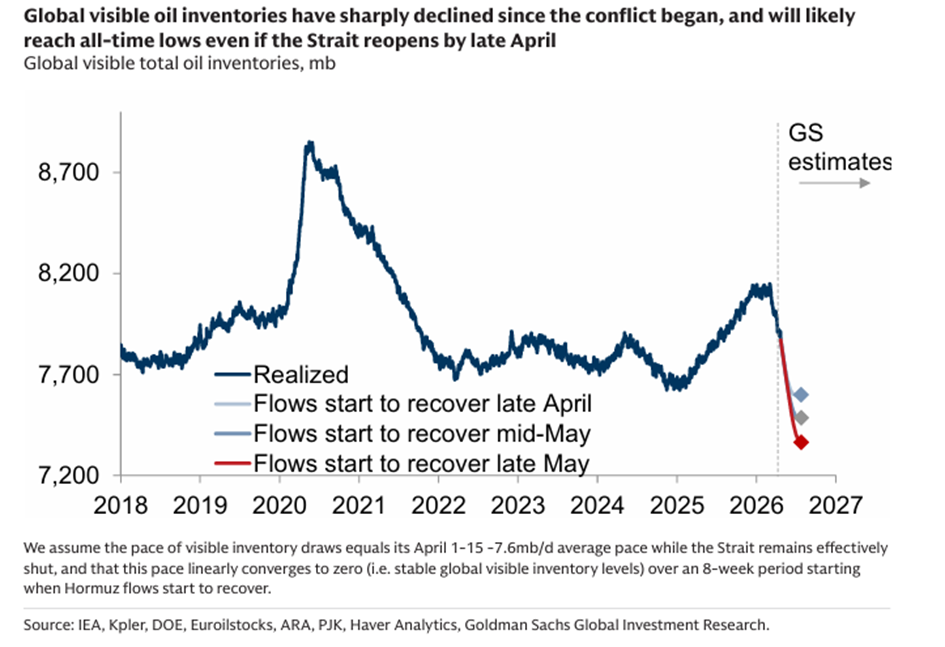
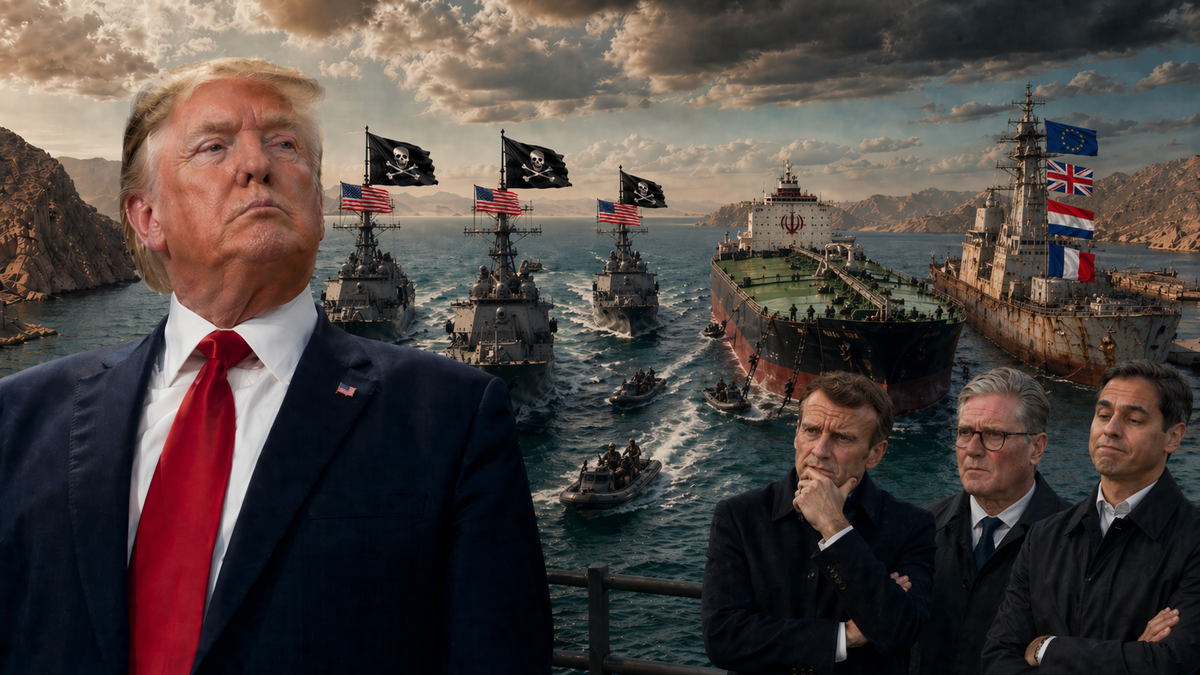
The United States and Israel achieved unprecedented military and technological successes in the first weeks by taking out both the military and political leadership. Surprisingly, Iran's counterattack was directed straight at neighbouring countries in the Gulf region, particularly at infrastructure, energy production and export terminals. Iran appears to be aiming to disrupt the global energy market for a prolonged period, thereby turning a regional military escalation into a global macroeconomic shock in a short space of time. Tehran's aim is to increase the pressure on President Trump. According to the International Energy Agency, energy flows through the Strait of Hormuz fell sharply in early April: from over 20 million to around 3.8 million barrels per day. Alternative routes offered only partial relief.
On balance, this represents a loss of more than 13 million barrels of oil exports per day, on top of a severe disruption to LNG flows. Brent crude prices rose from USD 65 to a peak of USD 139 per barrel on 7 April, before stabilising at around USD 100.
The loss of oil and gas revenues, quickly amounting to around USD 3.5 billion per day, put pressure on liquidity and spending in the Gulf region, both among the wider population and within the wealthy elite. This fed directly through into demand for luxury consumption, putting shares such as Hermès and LVMH under pressure, with declines of around 25%. Gold too, normally a safe haven in times of war, lost its shine. In the run-up to the confrontation, the gold price climbed to USD 5,250, only to fall to USD 4,350 within a month. Central banks in the region had to offset lost revenues and also support their own currencies.
Surprisingly, European defence stocks fell in March, while shares that had lagged in performance in recent years and were frequently shorted by hedge funds rose sharply. These price gains forced short positions to be bought back, further reinforcing the upward move. Such moves are mainly technically driven rather than fundamentally driven, which meant many hedge funds and long/short equity strategies posted relatively weak performance in Q1.
Stalemate looms
After three weeks of intensive bombing, it is clear that Iran's nuclear programme has been severely damaged. Yet a prolonged stalemate looms: with the US midterm elections approaching, the risk of American casualties, and the absence of regime change in Iran, the political upside for Trump remains limited. Iran can easily block the Strait of Hormuz, while Trump feels supported by US energy independence and is placing the consequences mainly on Europe and Asia. A few possible scenarios are:
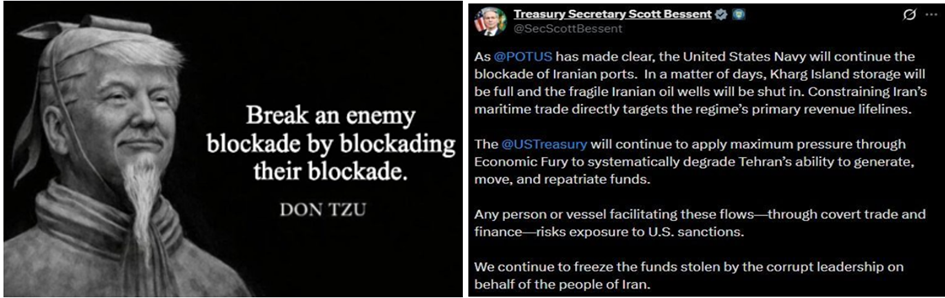
- A prolonged blockade of the Gulf would hit both the Gulf states and Iran hard. It would be a rational move for Trump to counter a blockade with a blockade, hitting both Iran and China. Iran has few financial resources to pay its military and runs the risk that oil fields will be shut down and thereby damaged for future production. In addition, China and India will step up pressure on Iran to grant ships free passage, given that both countries are heavily dependent on energy imports.
- Israel wants to permanently disable Iran militarily and economically, and resumes bombing (nuclear and) oil installations, thereby also aiming to stop the sponsoring of Hezbollah and Hamas. Iran will continue its blockade.
- Gulf states are following Israel's military approach and want to prevent a revival of the Iranian Guard.
- Iran's regime has nothing left to lose, and the hardliners are going to attack more ships.
Strategists are anticipating a prolonged stalemate, comparable to the frozen conflicts between North and South Korea or Russia and Ukraine. For the Gulf states, this means directing more of their oil and gas exports towards the Red Sea and the Mediterranean. This requires costly, long-term infrastructure projects and offers little relief in the short term. In this scenario, Egypt, Oman, Saudi Arabia and also Israel will grow closer together.
Europe the big loser
Until then, the energy crises in Europe will keep exposing the vulnerabilities of the energy transition, causing economic growth to stagnate and inflation to rise. In recent years, the EU has pursued a policy of closing refineries, precisely near major chemical clusters. The effects are proving increasingly problematic.
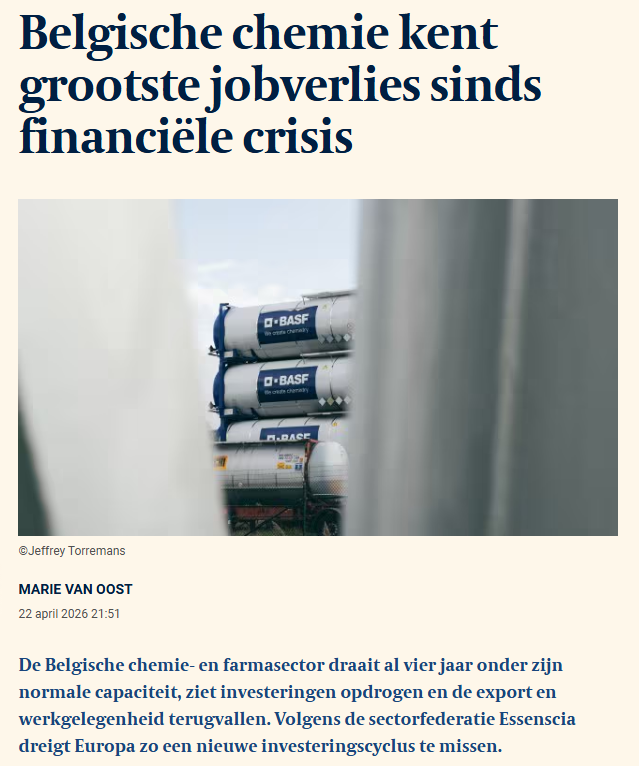
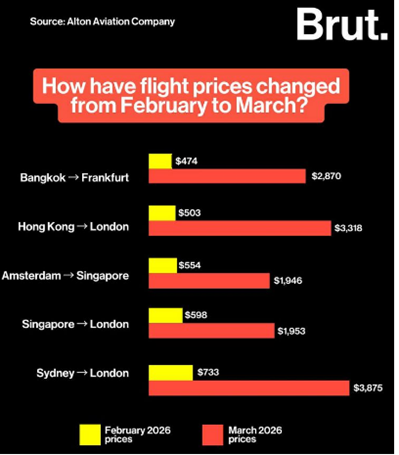
Lufthansa and KLM risk having to keep aircraft grounded for an extended period, while falling demand and nervousness surrounding vulnerable supply chains, ranging from helium for chip factories to kerosene and fertiliser, are further fuelling fears of broader European de-industrialisation.
Receive weekly insights in your inbox
Exclusive analyses and updates on family holding companies and global market developments.
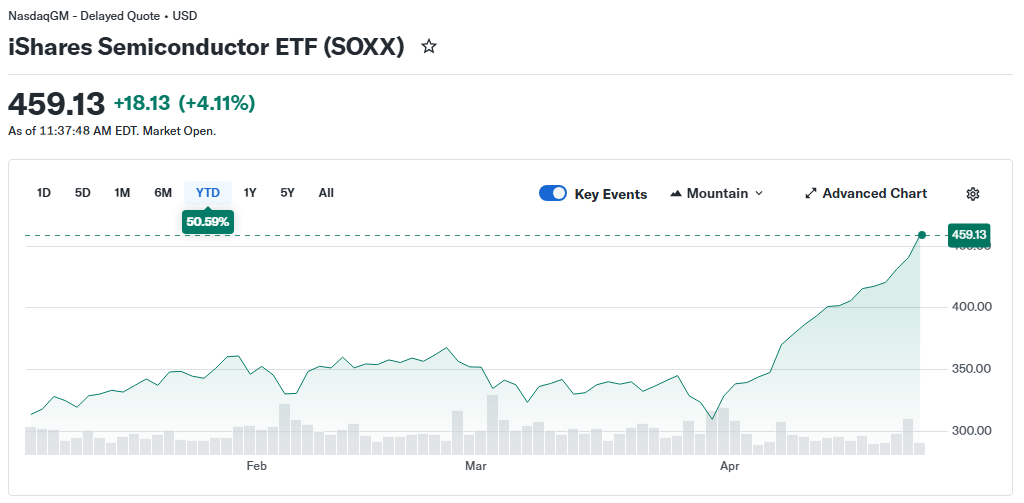
Strong recovery in technology stocks in April
In April, the market increasingly seems to be pricing in a prolonged stalemate around the Gulf crisis. For the US, with its relatively strong energy position and more closed economy, this is less unfavourable in the short term than for Europe and Asia. The Gulf states are going through a period of recession but have the financial resources to reposition themselves.
From the classic risk-on or risk-off regime that characterised the start of the war, investors' focus appears to be shifting back towards the fundamental and secular trends with which the year started off positively. Earnings expectations and quarterly results for American companies continue to rise, driven in particular by the AI investment cycle, in which technology and semiconductors are emerging as the big winners at this stage. Besides American technology companies, Asian chip companies such as Samsung and SK Hynix, as well as Dutch chip companies, also benefited.
US economy benefiting strongly from AI
In the article "AI Market Trends 2026: Global Investment, Risks, and Opportunities", Morgan Stanley no longer views AI as merely a technology theme, but as a broader macroeconomic force. In the bank's view, AI is shifting from a story about chips, software and data centres to a theme that feeds through into productivity, earnings growth, energy consumption, credit markets and geopolitical competition. This makes AI one of the explanations for why markets in 2026 do not fit neatly into a classic risk-on or risk-off regime.
The core of Morgan Stanley's analysis is that the AI cycle is still in an early investment phase. The bank estimates that, towards 2028, almost $3 trillion in AI-related infrastructure investment could flow through the global economy, of which more than 80% has yet to be spent. According to Morgan Stanley, data centres alone require enormous capital expenditure, not only for servers and chips, but also for power supply, cooling, network infrastructure and financing. AI is therefore no longer just a software innovation, but an industrial investment cycle with broad economic consequences. The US and clusters in Asia in particular stand to benefit from this trend.
At the same time, the market is becoming more critical. Morgan Stanley emphasises that investors are no longer prepared to automatically reward every company with AI exposure. The focus is shifting from "AI exposure" to actual monetisation: which companies can translate AI into higher revenue growth, better margins, productivity gains and stronger cash flows? This explains why the market remains selective in 2026. Companies with scale, pricing power, strong balance sheets and demonstrable AI applications are earning a premium, while companies without a clear revenue model or with vulnerable business models remain under pressure.
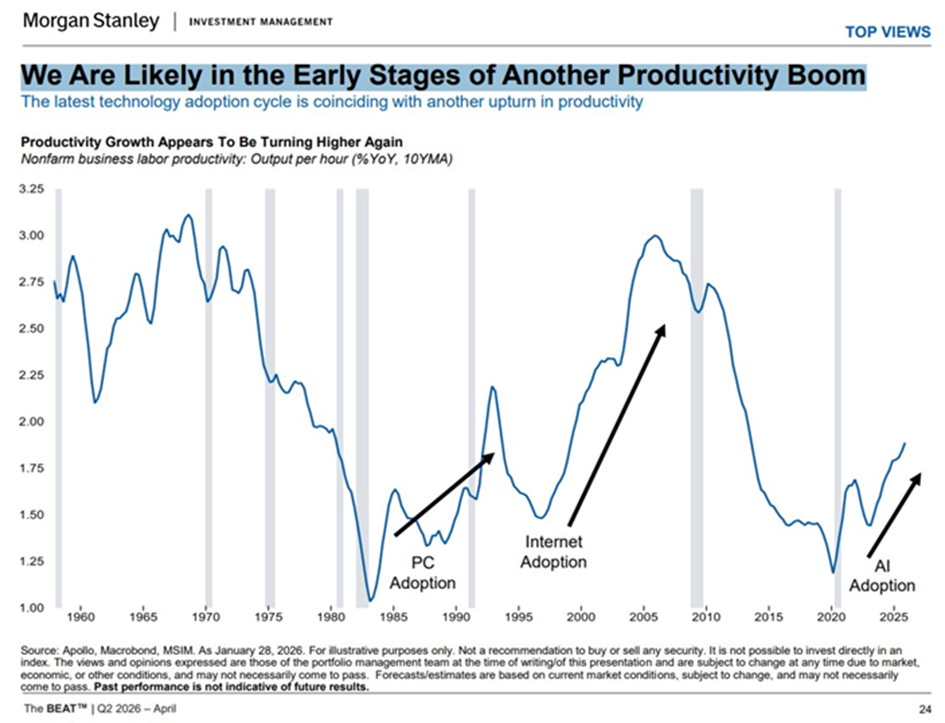
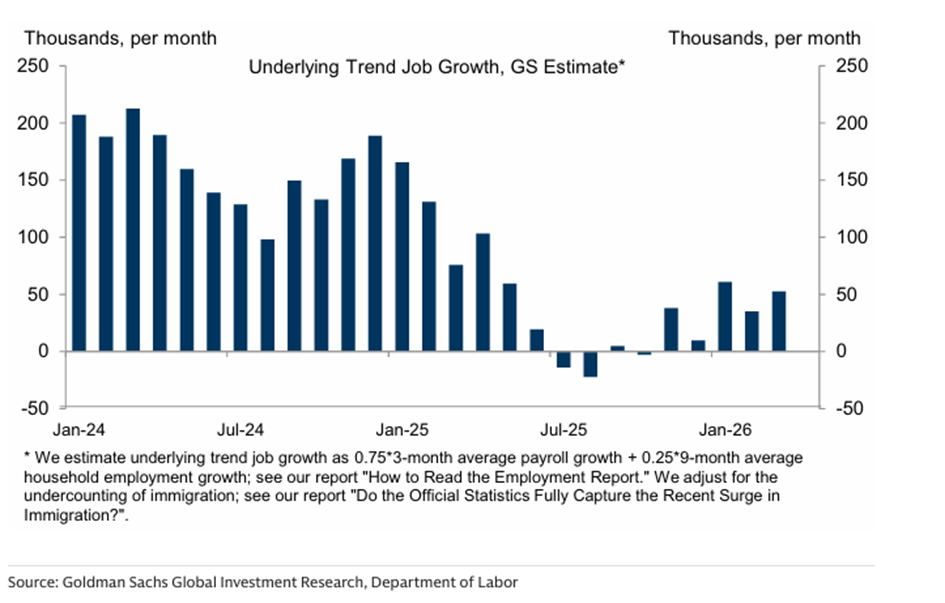
An important part of Morgan Stanley's view is that the first productivity effects are now becoming visible. In a survey of 935 executives in the US, Germany, Japan and Australia, companies reported an average net productivity gain of 11.5% from AI over the past twelve months. This is a powerful data point, as it suggests that AI is not only requiring investment but is already delivering operational efficiency. At the same time, this is not a frictionless story: the same analysis also points to changes in employment and job profiles, with routine and junior roles in particular appearing more vulnerable. That said, the latest US jobs figures surprisingly point to a comeback in job creation.
This fits well within the broader market picture of 2026. High US interest rates, a strong dollar and geopolitical uncertainty would normally be expected to put a firm brake on equities. Yet capital continues to flow into segments where earnings growth is convincing. Morgan Stanley therefore sees AI as a selection mechanism: it is not the entire market that benefits, but primarily the companies that are directly or indirectly part of the AI infrastructure and that can convert the investment wave into earnings growth. This explains the leadership of US megacaps, semiconductors, data centre suppliers and parts of the industrial and financial sectors.
Notably, Morgan Stanley also explicitly links AI to energy and financing. The growth of data centres is increasing demand for electricity, grid capacity and reliable energy sources. This means AI is directly connected to themes such as gas, nuclear, batteries, microgrids and energy infrastructure. At the same time, the enormous capex cycle requires external financing, giving banks, private credit and capital markets a role in the AI story as well. AI is therefore becoming not only a technology theme, but also an energy and credit cycle.
Receive weekly insights in your inbox
Exclusive analyses and updates on family holding companies and global market developments.
Would you like more information about our services?
Get in touch
Disclaimer:
No rights can be derived from this publication. This is a publication of Tresor Capital. Reproduction of this document, or parts thereof, by third parties is only permitted after written consent and with reference to the source, Tresor Capital.
This publication has been compiled by Tresor Capital with the greatest possible care. The information is intended in a general sense and is not tailored to your individual situation. The information may therefore explicitly not be regarded as advice, an offer or a proposal to purchase or trade investment products and/or to acquire investment services, nor as investment advice. The authors, Tresor Capital and/or its employees may hold positions in the securities discussed, for their own account or on behalf of their clients.
You should carefully consider the risks before you start investing. The value of your investments can fluctuate. Past performance is no guarantee of future results. You may lose (part of) your invested capital. Tresor Capital disclaims any liability for any inaccuracies or errors. This information is purely indicative and subject to change.
Read the full disclaimer at tresorcapitalnieuws.nl/disclaimer .
This article was translated automatically from Dutch using AI. In case of any difference, the Dutch original prevails. Read the original in Dutch.