
Economy & Markets #20 - Portfolio diversification, top investors, women at the helm and the recovery of gold


This week's topics:
The classic 60/40 portfolio
Many of our peers still use a 60/40 portfolio, with 60% equities and 40% bonds. However, the strategic asset mix of our defensive and neutral model portfolios shows that at Tresor Capital we are not a strong advocate of holding bonds at current interest rate levels. Only High Yield bonds, Insurance Linked Bonds and Fallen Angels are included in the defensive and neutral profile. This divergent view is based on three key arguments.
- From a tax perspective, bonds are not very attractive
Particularly in Belgium, taxes (withholding tax on securities income, Reijnders taxes) significantly erode net returns relative to gross returns. In the Netherlands too, bonds often only just manage to achieve the minimum required net return. At present, a deemed return of 6% still applies, taxed at a rate of 36%, i.e. +2.16%, which must be paid on invested assets in the Netherlands. Inflation in the Netherlands averaged 3.3% over the past five years, which means bonds must yield at least 5.6% to preserve purchasing power for a private investor in the Netherlands. - European governments are grappling with an enormous debt burden
Including pension obligations, total debt levels in many cases rise to more than 200% of GDP. Due to an ageing population, it is also becoming increasingly difficult to finance the welfare state, and the likelihood of a European credit crisis will only continue to grow. In our view, high inflation ultimately remains one of the few ways to keep the debt burden and financing costs manageable. As a result, we consider the real interest rate on bonds too low relative to future inflation expectations, which in our opinion will rise again.
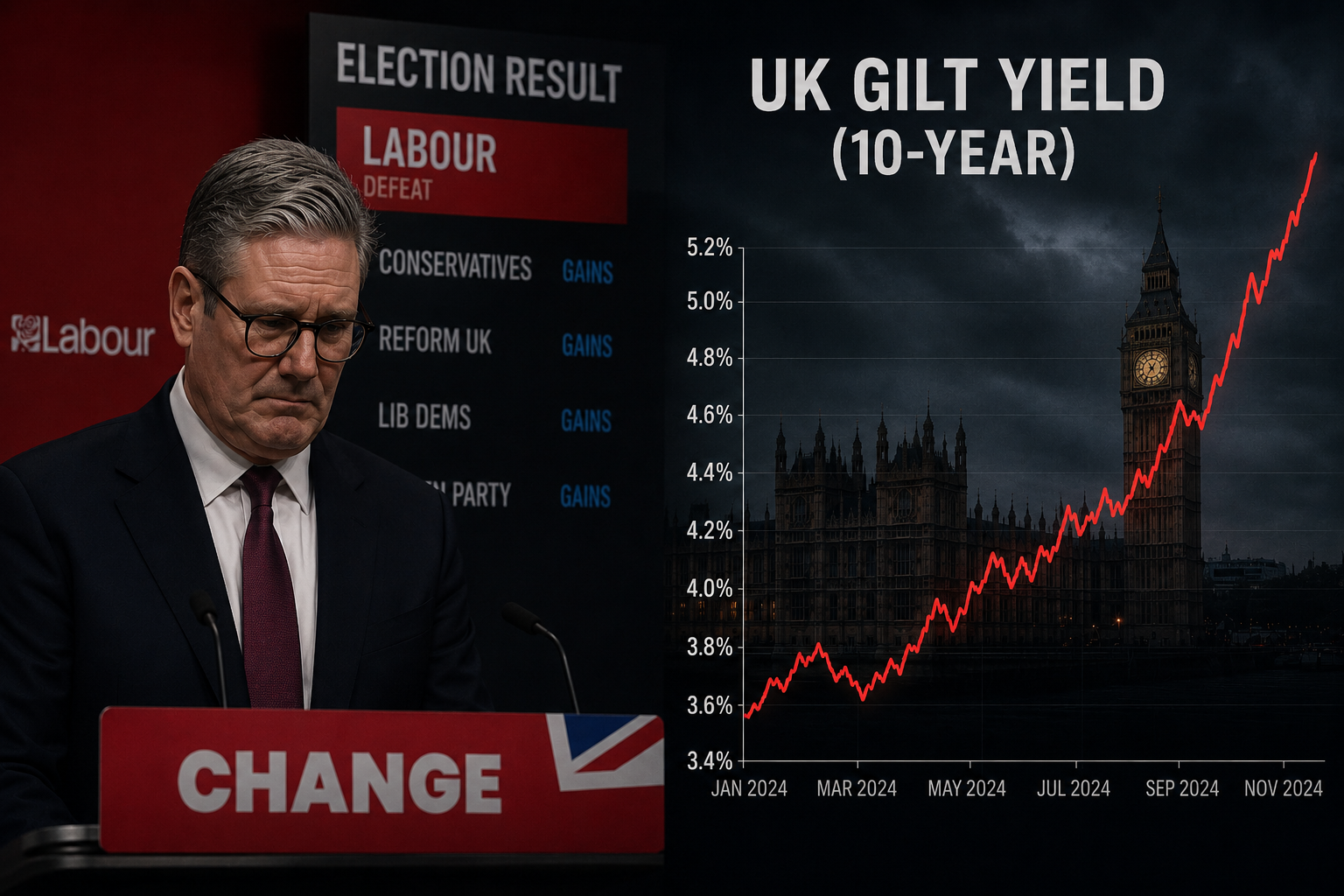
We have also pointed out for some time that Europe's energy transition will bring about substantial greenflation. In the coming years, higher costs for grid connections and electricity will increasingly be passed on to European citizens, leading to new inflation shocks. It is not only European industry that suffers from high energy prices; ultimately, consumers will also be affected. Whereas companies can still relocate their production to the US or Asia, citizens have hardly any opportunity to move to fiscally and economically more attractive regions such as Switzerland, Monaco or Dubai. When they go to the polls, as recently happened in the UK, discontent over high inflation becomes visible. However, this does not automatically lead to a change in policy. Starmer's Labour Party suffered the biggest election defeat ever in the UK, which led to a sharp rise in UK interest rates.
- In our view, bonds offer increasingly less protection when equity markets correct
Due to low starting interest rates and the lack of steep yield curves, the traditional diversification function of bonds has diminished. Rather than providing protection, losses on bonds, as seen in 2022, can actually contribute to broader unrest in equity markets. At present, we see long-term interest rates approaching critical levels in the UK and Japan, but also in Germany and the US. By this we mean that rising risk premiums on long-term bonds have a negative effect on credit provision and thus on the economy of the countries concerned. Rising interest rates combined with high government debt levels are likely to trigger a next equity market crisis as well.
With regard to the third point, the article "A Positive Stock-Bond Correlation Is a Terrible Reason to Add More Equity Risk to Your Portfolio" by Cliff Asness, Daniel Villalon and Antti Ilmanen (8 April 2026) offers an interesting and nuanced counterargument to the popular claim that bonds have lost their usefulness as a diversification tool.
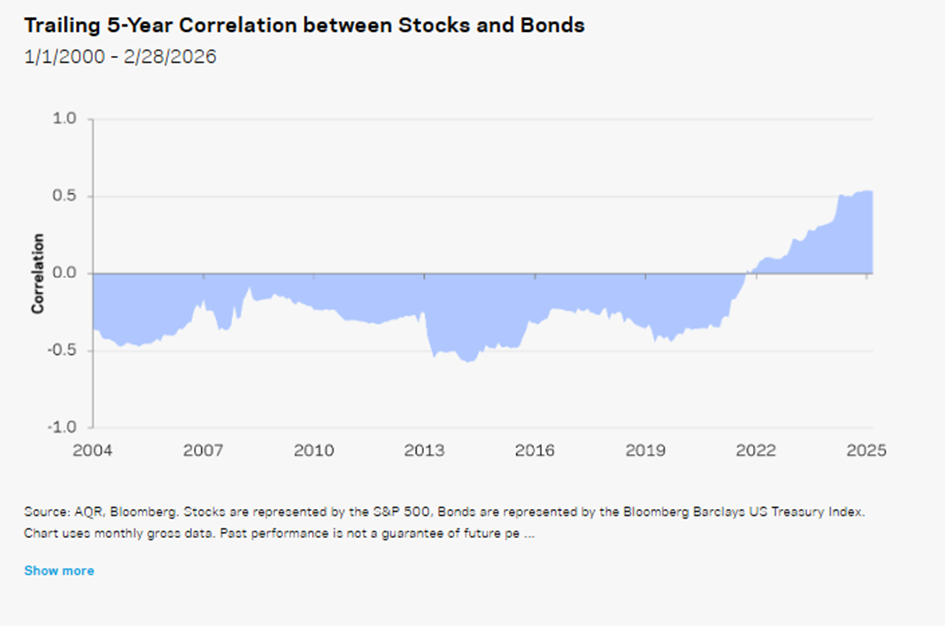
The central thesis of the article is that many investors draw the wrong conclusion from the recent positive correlation between equities and bonds. The reasoning in the market often runs as follows:
- equities and bonds increasingly move in the same direction (highly correlated);
- as a result, bonds diversify less effectively;
- bonds therefore no longer fulfil their role;
- bonds should therefore be replaced by alternative assets or additional equity risk.
According to AQR, it is precisely that last step that is problematic. AQR Capital Management is one of the largest quantitative asset managers in the world, with approximately USD 190 billion under management. The firm was founded by Cliff Asness and colleagues from the University of Chicago tradition and combines academically grounded research with systematic investment models. Its core view is that markets are not fully efficient and that factors offer structural risk premiums over the long term. The company specialises in absolute return and factor strategies, including market neutral, managed futures and style premia, and is regarded as a pioneer in factor investing (value, momentum, quality, carry and trend following).
The authors argue that many of the "alternatives" currently being promoted as popular, such as private credit, buffer funds and even bitcoin, in reality have a much higher implicit equity exposure (equity beta) than investors realise. By reducing the bond weighting, portfolios appear better diversified, while in reality they become even more dependent on the direction of the equity market.
Their main point is that one should not only look at correlations, but above all at the underlying risk exposure. An asset class may have a different name or structure, yet still be highly dependent on the same economic factor: rising equity markets. In that sense, many alternative investments are, in their view, disguised equity beta. As long as equity markets rise, the alternatives will rise along with them due to their high beta, but what if equity markets correct downward? In such a scenario, the overall mix is actually riskier than the 60/40 asset mix.
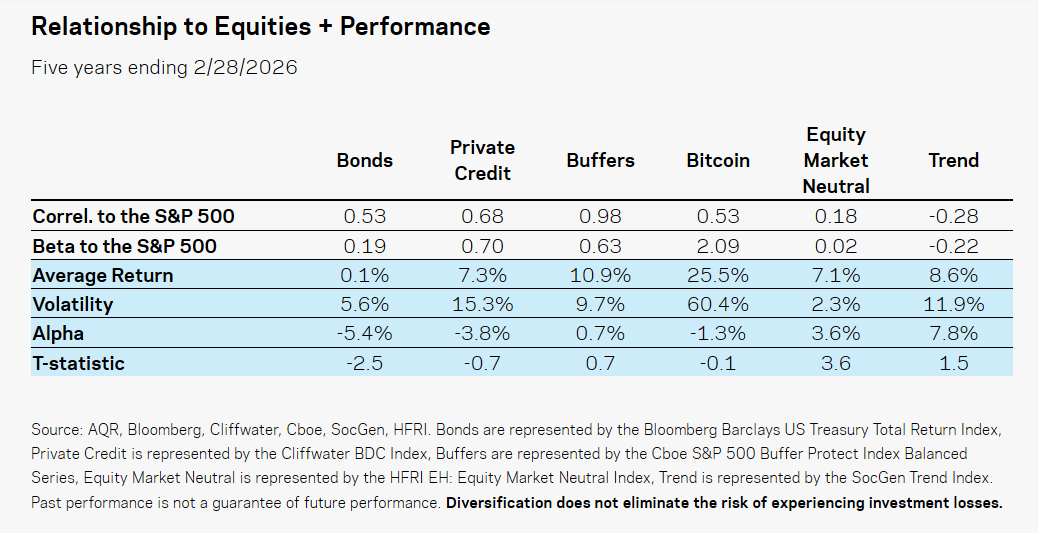
What is interesting is that AQR does not deny the problem with the 60/40 portfolio. They explicitly acknowledge that the diversifying effect of bonds has weakened in an inflationary regime. Looking at the table, one might conclude that private credit, buffers (equities + options) and bitcoin, given their high returns, are a good substitute for bonds. Their advice, however, is not to take on more equity risk, but to seek out assets and strategies with a genuinely low or even negative correlation with equity markets. In doing so, they put forward two alternative strategies in particular:
- Equity Market Neutral strategies
Long/short equity strategies that largely neutralise market beta and aim to generate returns from relative valuation differences between stocks. - Trend-following / managed futures
Systematic strategies that respond to price and momentum trends in equities, bonds, currencies and commodities, and have historically often performed well during periods of crisis or strong market trends.
According to AQR, it is precisely these strategies that offer far better diversification than alternatives such as private credit or crypto, because their equity beta has historically been very low or even negative. Trend following in particular stands out, as it often delivers positive returns in crisis scenarios when traditional assets are under pressure.
Tresor is also seeking diversification through absolute return strategies
It will come as no surprise that since 2025 we have added several long/short equity managers, absolute return funds and volatility managers to the strategic mix. That said, we would note that even AQR's approach cannot be applied blindly. Systematic strategies performed poorly during the so-called quant winter, the period between 2018 and 2020, during which systematic and factor-based hedge funds and quant strategies underperformed for a prolonged time. When selecting absolute return strategies, we will therefore need to look at capacity, costs and the shift from equity beta to factor beta. In addition, we continue to include alternatives such as gold and real estate in the model portfolios.
The greatest investors of all time
This week, a pyramid featuring the greatest investors of all time has been circulating on social media. It was immediately clear that it contained an AI error. We naturally had ChatGPT correct it (we appreciated the humour in the Twitter account; hopefully you'll understand our adjustments too 😉).
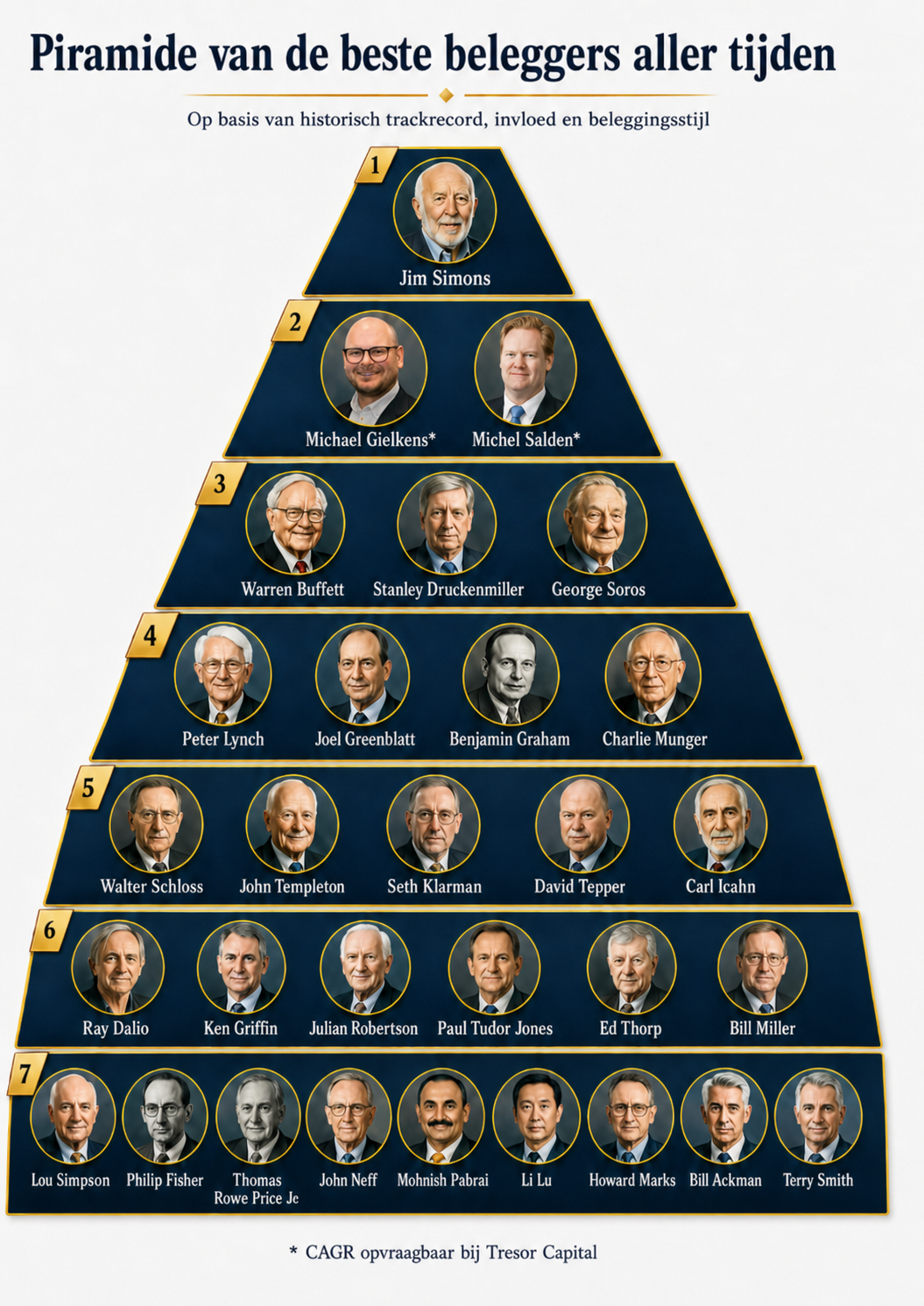
| Investor | Track record / period | Style & explanation |
|---|---|---|
| Jim Simons | Medallion Fund, 1988–2018. CAGR ±39% net. | Quant / statistical arbitrage. Probably the strongest performance history ever, with extremely high returns and low correlation. |
| Warren Buffett | Berkshire Hathaway, 1965–2024. CAGR 19.9%. | Quality value / capital allocation. Best public compounder on a large scale and over a very long period. |
| Stanley Druckenmiller | Duquesne, 1981–2010. CAGR ±30%. | Global macro. Exceptional combination of return, flexibility and risk management. |
| George Soros | Quantum Fund, c. 1969–2000. CAGR ±30%. | Global macro / reflexivity. Known for large asymmetric macro positions. |
| Peter Lynch | Fidelity Magellan, 1977–1990. CAGR 29.2%. | GARP / growth. One of the best mutual-fund runs ever. |
| Joel Greenblatt | Gotham Capital, 1985–1994. CAGR ±30–50%. | Special situations / value. Strong in spin-offs, restructurings and event-driven value. |
| Benjamin Graham | Graham-Newman, 1936–1956. CAGR ±20%. | Deep value / net-nets. Founder of value investing and margin of safety. |
| Charlie Munger | Wheeler Munger, 1962–1975. CAGR ±19.8%. | Concentrated quality. Crucial to the shift towards quality compounding. |
| Walter Schloss | WJS Partnership, 1955–2000. CAGR ±15%. | Classic Graham value. Discipline, simplicity, low costs and staying power. |
| John Templeton | Templeton Growth, 1954–1992. CAGR ±14–16%. | Global contrarian value. Pioneer in international investing at low valuations. |
| Seth Klarman | Baupost Group, 1982–present. CAGR ±16–20% historically. | Distressed / value. Known for downside protection and cash discipline. |
| David Tepper | Appaloosa, 1993–present. CAGR ±25% historically cited. | Distressed credit / macro. Very strong in crisis and recovery situations. |
| Carl Icahn | Icahn Enterprises / activism. CAGR indicative ±15–20%. | Activist investing. Value creation through governance, break-ups and corporate pressure. |
| Ray Dalio | Bridgewater, 1975–present. CAGR not uniformly public. | Global macro / risk parity. Major influence on institutional allocation thinking. |
| Ken Griffin | Citadel, 1990–present. CAGR not uniformly public. | Multi-strategy hedge fund. Exceptional in scale, systems and risk management. |
| Julian Robertson | Tiger Management, 1980–2000. CAGR ±25–30%. | Long/short equity. Father of the Tiger Cubs; strong stock-picking with macro tilts. |
| Paul Tudor Jones | Tudor, 1980s–present. CAGR ±20% historically cited. | Macro / trend following. Known for crisis alpha and trading discipline. |
| Ed Thorp | Princeton Newport / Ridgeline. CAGR ±15–20%. | Quant / arbitrage. Pioneer in options, convertibles and statistical arbitrage. |
| Bill Miller | Legg Mason Value Trust, 1991–2005. CAGR ±15%+. | Contrarian value / growth. Beat the S&P 500 fifteen years in a row. |
| Lou Simpson | GEICO portfolio, 1979–2010. CAGR ±20%. | Concentrated quality value. Praised by Buffett as an exceptional allocator. |
| Philip Fisher | Fisher & Co., long-running. CAGR not uniformly public. | Growth quality. Major influence on qualitative growth investing. |
| Thomas Rowe Price Jr. | T. Rowe Price, 1930s–1970s. CAGR not uniformly public. | Growth investing. One of the founders of professional growth investing. |
| John Neff | Windsor Fund, 1964–1995. CAGR ±13.7%. | Low P/E value. Strong long mutual-fund run with valuation discipline. |
| Mohnish Pabrai | Pabrai Funds, 1999–present. CAGR high but volatile. | Cloning / value. Known for asymmetric value investing. |
| Li Lu | Himalaya Capital, 1997–present. CAGR not uniformly public. | Concentrated value. Strong focus on compounding, quality and China. |
| Howard Marks | Oaktree, 1995–present. Credit returns, not a pure equity CAGR. | Distressed debt / credit. Master of cycles, risk assessment and distressed credit. |
| Bill Ackman | Pershing Square, 2004–present. CAGR high but cyclical. | Activist / concentrated quality. Big winners, but also steep drawdowns. |
| Terry Smith | Fundsmith, 2010–present. CAGR ±15% historically. | Quality growth. "Buy good companies, don't overpay, do nothing." |
| Michael Gielkens* | Tresor Capital. CAGR available on request from Tresor Capital. | Performance and full track record available on request from Tresor Capital. |
| Michel Salden* | Tresor Capital. CAGR available on request from Tresor Capital. | Performance and full track record available on request from Tresor Capital. |
* True to form, Michel Salden and Michael Gielkens refrain from further comment and refer to Tresor Capital's reporting. One practical limitation: the track record is not public and is only accessible from a minimum investment of €250,000. 😉
What connects these investors?
Our top 30 of the best investors of all time is a tribute to visionary investors who have left a lasting mark on financial markets. From value investing to macro strategies and quantitative models: each of them developed their own approach and achieved exceptional results over a long period. This list shows that successful investing is not just about an information edge or perfect forecasting, but rather about discipline, character and controlling one's emotions. Warren Buffett is known for his patience and long-term vision, Charlie Munger for his rational thinking power and multidisciplinary insights, Stanley Druckenmiller for his sharp macro view and flexibility, and Jim Simons for his revolutionary data-driven and quantitative approach. Despite their differences, they therefore share the same core qualities: discipline, independent thinking and the ability to see opportunities where others see doubt.
Incidentally, the pyramid is explicitly meant to be indicative and light-hearted. As far as we are concerned, Warren Buffett and Charlie Munger equally deserve the (shared) first place, certainly when taking into account how much value they have created over decades. Moreover, investors' track records are not directly comparable one-to-one, because they were built up in different periods, market conditions, cost structures, benchmarks, risk profiles and scale. A return from the 1970s–1990s is difficult to compare with a return in today's market, in which information is available faster, competition is greater and technology and data analysis play a much larger role. Likewise, CAGR and alpha say little without context on leverage, liquidity, drawdowns, fees, concentration and capacity. An exact ranking therefore remains subjective by definition. In other words: each of these personalities offers plenty of material for further study, learning and inspiration.
Further reading via podcast
At Tresor, we regularly write about Buffett and Munger. A number of the investors in this pyramid have also been discussed in the very informative podcast Jong Beleggen, de podcast, in its series on great investors. This makes the podcast a practical complement to the pyramid: the episodes provide extra context on the investment philosophy, way of thinking and strategy of these top investors.


Among others, Warren Buffett, Charlie Munger, Peter Lynch, Nassim Nicholas Taleb, Terry Smith, Aswath Damodaran, Chuck Akre, Stanley Druckenmiller, Li Lu, Chris Hohn, Chris Mayer, François Rochon and Sir John Templeton have been covered in the podcast. There is also a broader episode on investment gurus, in which lessons from, among others, Howard Marks, Mohnish Pabrai, Joel Greenblatt, Nick Sleep, Tom Gayner and Jean-Marie Eveillard are discussed. These podcast episodes can be used to deepen your understanding of the pyramid. They show how various top investors think about valuation, risk, long-term returns, the quality of companies, capital allocation and behavioural psychology. As a result, the pyramid becomes not just an overview of well-known names, but also a starting point for better understanding their investment principles.
Why are there no women in this pyramid?
The fact that there are no women in this pyramid does not mean that women invest worse. On the contrary: several studies show that, on average, women often invest quite strongly. An analysis by Warwick Business School of 2,800 retail investors found that female investors outperformed male investors by an average of 1.8 percentage points over three years. An important explanation was that women, on average, invest less speculatively, trade less often and more frequently take a long-term perspective. Fidelity found in an analysis of more than 5 million retail accounts over 2011–2020 that women outperformed men by an average of 40 basis points per year.
That said, it should be noted that these studies may suffer from selection bias. Women who invest are perhaps not a random cross-section of all women, but likely a relatively financially aware, interested and possibly more highly educated subgroup, whereas a larger share of the male population opens an investment account much more readily. As a result, their better performance may partly stem from who is in the sample, rather than from gender itself. In addition, an average difference says little about individuals. Even if women as a group perform slightly better, the spread within the groups is likely much larger than the average difference between men and women. There are therefore probably many men who invest better than many women, and vice versa.

Nevertheless, the absence of women in the pyramid is arguably due more to historical visibility and access to the financial sector than to any difference in investment quality. The well-known "canon" of top investors was largely formed during a period in which asset management, Wall Street and fund management were strongly dominated by men. A clear example is Muriel Siebert: she only became the first woman to hold a seat on the New York Stock Exchange in 1967, and for the following ten years she remained the only woman among 1,365 men on the trading floor. Even today, that skewed representation is still visible: Morningstar reported in 2024 that although women make up 44% of the asset management sector, the gap widens considerably in senior leadership and investment roles. On average, women held only 18% of portfolio manager roles at the fund houses examined.
It is therefore fairer to say that this pyramid mainly provides an overview of the most discussed and historically visible top investors, not necessarily of all the best investors. A future version of the pyramid would become stronger and more balanced by also including female investors and financial pioneers, such as Geraldine Weiss, Hetty Green, Muriel Siebert or Leda Braga. That would not only make the pyramid more complete, but also more representative of the reality that good investing is neither male nor female, but is instead primarily about discipline, risk management, patience and rational decision-making.
| Name | Active period | Return / CAGR | Remark |
|---|---|---|---|
| Geraldine Weiss | Active 1966–2002 at Investment Quality Trends | Model portfolio since 1985: gain 11.37× vs. Wilshire 5000 11.26×; 10 years: 12.20% p.a. | Data is from a newsletter/model portfolio, not a fund account. |
| Hetty Green | c. 1865–1916 | Rough CAGR: approx. 4.6%–6.1% p.a., depending on starting capital of $5–10 million growing to >$100 million | Estimate based on wealth growth; no modern performance audit. |
| Muriel Siebert | 1950s–2013 | No meaningful CAGR known | Mainly significant as a broker, entrepreneur and the first woman with an NYSE seat, not as an investor with a public track record. |
| Leda Braga | BlueTrend from 2004; Systematica from 2015 | BlueTrend 2004–2014: over 11% p.a.; 2019: +13.6%; in 2025 temporarily -18.8% YTD and almost -36% from the 2022 peak | Hedge fund data is fragmentary and often not fully verifiable in public. |
| Cathie Wood | ARK founded 2014; ARKK from Nov. 2014 | ARKK Nov. 2014–Apr. 2026: 13.12% p.a., max drawdown approx. -77%; inflation-adjusted 9.85% p.a. | Highly cyclical: strong in 2020, heavy setback in 2021–2022. |
Naturally, it makes no difference to us whether men or women come out on top. As true meritocrats and fully rational investors, we select purely on quality, discipline, integrity and long-term performance. That applies both to the selection of external fund managers and to the composition of management teams within our holding companies. Gender is not a criterion in this respect; demonstrable competence and allocation skill are.
Gold is supposed to be a safe haven. So why isn't it behaving like one?
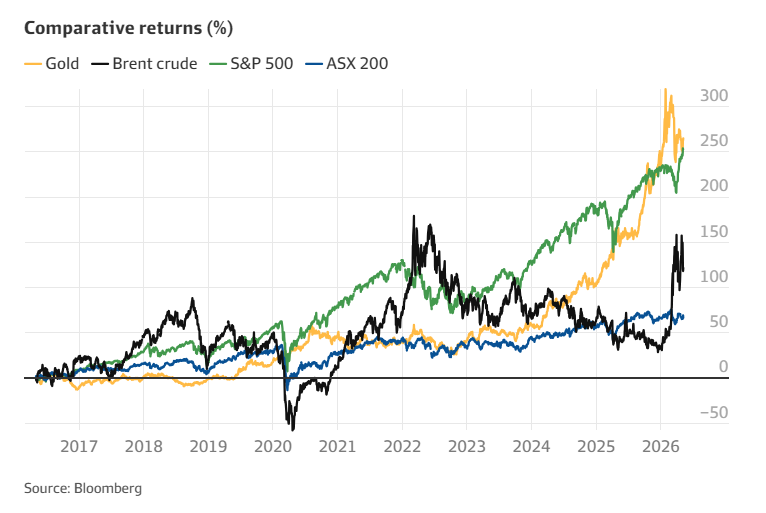
Since the outbreak of the Iran-US war in late February, gold has actually fallen, despite the geopolitical stress. According to the market experts cited, this is because gold is sometimes sold in moments of crisis to obtain liquidity, rather than bought as protection.
Gold is sold to free up dollars
An article on afr.com provides the key explanation: gold is extremely liquid. When markets are shocked, investors, countries or institutions sometimes need to free up dollars quickly. In that case, they sell gold not because they have lost confidence in it, but because it is one of the easiest assets to convert into cash. This also happened around the collapse of Lehman Brothers and at the start of the coronavirus crisis.
A second explanation is macroeconomic. The energy crisis and the war are disrupting income streams, especially for countries dependent on oil and gas exports. This creates demand for dollars. Gold then functions as a balance sheet asset: a reserve that can be monetised to obtain dollar liquidity.
This leads to a more nuanced conclusion: gold does not necessarily fail as a safe haven; it is simply being used differently for a while. In acute stress, gold can fall due to forced selling, margin calls or official sales. Only later, once liquidity pressure eases, can it resume its protective function.
Investment implications
The lesson for investors is that gold is not an automatic hedge against every crisis scenario. It works better as strategic long-term insurance than as a short-term instrument that always rises in times of war or panic. During periods of rising real interest rates, a strong dollar or liquidity stress, gold can actually come under pressure. Morgan Stanley specifically points to higher real rate expectations and energy shocks as factors that can temporarily weaken gold's safe-haven status. This applies, then, to a scenario following an inflation shock.
Since the global financial crisis, however, we have seen central banks cut interest rates more quickly in order to support credit provision and broader sentiment. In other words, real interest rates are being artificially suppressed. Because of the negative correlation between (real) interest rates and gold, this is precisely what brings gold's defensive character to the fore. We therefore expect the gold price to find its way back up once calm returns to the Strait of Hormuz, the dollar weakens and the pressure on the Gulf states to generate liquidity eases.

Receive weekly insights in your inbox
Exclusive analyses and updates on family holding companies and global market developments.
Would you like more information about our services?
Get in touch
Disclaimer:
No rights can be derived from this publication. This is a publication of Tresor Capital. Reproduction of this document, or parts thereof, by third parties is only permitted after written consent and with reference to the source, Tresor Capital.
This publication has been compiled by Tresor Capital with the greatest possible care. The information is intended in a general sense and is not tailored to your individual situation. The information should therefore explicitly not be regarded as advice, an offer or a proposal to purchase or trade investment products and/or to obtain investment services, nor as investment advice. The authors, Tresor Capital and/or its employees may hold positions in the securities discussed, for their own account or for their clients.
You should carefully consider the risks before you start investing. The value of your investments may fluctuate. Past performance is no guarantee of future results. You may lose (part of) your investment. Tresor Capital disclaims any form of liability for any inaccuracies or errors. This information is purely indicative and subject to change.
Read the full disclaimer at tresorcapitalnieuws.nl/disclaimer .
This article was translated automatically from Dutch using AI. In case of any difference, the Dutch original prevails. Read the original in Dutch.