
Economy & Markets #21 - The Netherlands' EuroTrip with the wrong Brüder


This week's topics:
Box 3: higher tax burden and increasing wealth migration
This week, Tresor Capital organised an event in Eindhoven together with Ton Wouters (tax specialist at Zummum Finance & Tax Law), at which the developments surrounding Box 3 were explained.
bThe reform of Box 3 is increasingly turning into a political headache. The Senate (Eerste Kamer) is currently considering whether, from 2028, investors should pay tax on so-called 'paper gains': increases in the value of investments that have not yet been realised. The background to this is twofold. On the one hand, the Supreme Court (Hoge Raad) has ruled that the current Box 3 system, based on deemed returns, is in breach of property rights when the assumed return exceeds the actual return achieved. On the other hand, the government is grappling with a significant budgetary problem: without a new Box 3 system, estimates suggest a fiscal gap of approximately €2.4 billion will arise from 2028 onwards.
For now, the cabinet appears set to start with a tax on actual returns. In practice, this means that not only interest, dividends and realised capital gains could be taxed, but in many cases also annual increases in the value of securities portfolios. There is resistance to this, particularly in the Senate, because taxpayers would then have to pay tax without having received any liquidity. The consequences for the wealth accumulation of private individuals are enormous.
Voor de mensen die denken dat het tarief in Box 3 niet extreem gestegen is hier een vergelijking met de tarieven in de recente historie. Daarbij, rendement is deels geen reëel rendement maar puur inflatie, gemeten in blokjes kaas blijft er amper rendement over. pic.twitter.com/mkrOqzR1QZ
— seven (@seven__) May 19, 2026
The consequences for private investors and entrepreneurs are considerable. Wealth planning is increasingly shifting from a purely return-based question to one of liquidity and structuring. Investors may need to hold cash reserves to be able to pay future tax assessments, even when investments have not been sold. The ability to carry forward losses into the future also appears set to become more limited. In a market environment with volatile but, on balance, sideways-moving equity markets, this would result in annual taxation even though gross wealth effectively continues to fluctuate between, for example, 100–80–100–80–100. The smoothing effect that is common in many private markets to dampen volatility could therefore also become attractive from a tax perspective.
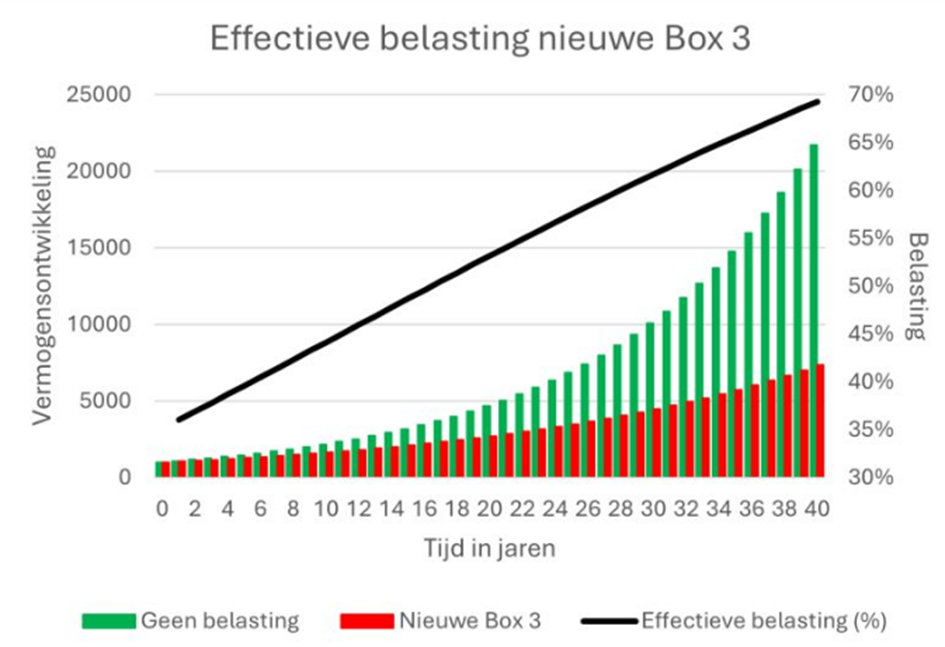
David Blitz, a respected investor at Robeco, sums it up aptly in his LinkedIn post. Because of the loss of return-on-return, the difference widens sharply over longer periods. After forty years, according to his calculations, the effective tax burden could rise to around 70% of accumulated final wealth.
Is the Netherlands thereby following in the UK's footsteps?
As the tax burden rises, concern is growing that the Netherlands is becoming a more attractive country for wealthy individuals to leave. In 2025, around 17,000 multimillionaires left the UK after a new tax law was introduced. The result: tax revenues in the UK fell back and other taxes had to be raised. This risks happening in the Netherlands too. Although large-scale capital flight is difficult to measure precisely, tax advisers and private bankers have for some time been observing growing interest in emigrating to countries with a more favourable tax climate, such as Belgium, Switzerland, Italy and the United Arab Emirates. In this respect, it is not only box 3 (Dutch tax on savings and investments) that plays a role, but also the rising combined tax burden, inheritance tax and uncertainty about future policy. For policymakers, a fundamental trade-off therefore remains: how do you increase tax revenue without structurally weakening the investment and business climate for capital and entrepreneurship?
For a country that invented the stock market and is internationally known for legal certainty and deep capital markets, this is a remarkable signal to send to private investors. The Netherlands is trying to attract foreign companies and international investors – think of Belron, which is likely to list in Amsterdam this year – while at the same time discouraging its own population from building wealth through equities. And all this to plug a budget deficit of around €2.5 billion in 2028, or roughly 0.25% of Dutch GDP. In macroeconomic terms, that is a relatively limited deficit. Even without additional box 3 revenues, the Netherlands would still remain comfortably within the European Maastricht norm of a 3% budget deficit.

While budgetary discipline remains sensible given the ageing population, higher defence spending and the energy transition, it is striking that the Netherlands is primarily taxing its own population more heavily on wealth accumulation. International experience shows precisely that broad participation in capital markets is crucial for long-term prosperity. In countries such as Sweden, Switzerland and the United States, households benefit far more from rising equity markets through pension accounts, private investments and tax incentives. Various European countries, by contrast, struggle with weak private wealth formation, high collective burdens and rising government debt – in short, limited wealth creation.
|
Country |
Budget balance 2025 (% of GDP) |
Maastricht debt 2025 (% of GDP) |
|
Germany |
🟢
-2.7% |
🔴 63.5% |
|
France |
🔴 -5.1% |
🔴 115.6% |
|
Netherlands |
🟢
-1.6% |
🟢
44.4% |
|
Belgium |
🔴 -5.2% |
🔴 107.9% |
|
Austria |
🔴 -4.2% |
🔴 81.5% |
|
Luxembourg |
🟢
-2.0% |
🟢
26.5% |
|
Finland |
🔴 -3.4% |
🔴 88.5% |
|
Ireland |
🟢
+1.8% |
🟢
32.9% |
|
Spain |
🟢
-2.8% |
🔴 101.8% |
|
Italy |
🔴 -3.4% |
🔴 135.3% |
|
Portugal |
🟢
+0.7% |
🔴 93.6% |
|
Greece |
🟢
+1.3% |
🔴 153.6% |
The fundamental question is whether the Netherlands is not too one-sidedly focused on taxing private wealth, while wealth accumulation is actually becoming more important within the European context as protection against inflation, pension uncertainty and rising collective costs. In a monetary union where other countries are more liberal in dealing with deficits and debts, many investors increasingly feel that prudent financial behaviour is being punished rather than rewarded. This means the discussion about Box 3 (the Dutch tax on savings and investments) touches on a broader question: does the Netherlands want to stimulate wealth formation, or does it want to tax private capital more heavily instead?
The Netherlands decided to go on a EuroTrip from Maastricht with the wrong brothers.
When the Maastricht Treaty was designed in the early 1990s, Europe was living through a period of historic optimism. The Berlin Wall had fallen, the Soviet Union was collapsing, and many policymakers believed that economic integration would automatically lead to political stability, peace and growth. The famous "Alle Menschen werden Brüder" from Schiller's Ode an die Freude, later the European anthem, perfectly symbolised the spirit of that era.

The world at the time seemed fundamentally different from today. Globalisation was expected to keep inflation low, international trade would make countries peacefully dependent on one another, and budgetary discipline would follow naturally within a shared currency. The euro was, in effect, built on the trust that all participating countries would ultimately behave according to the monetary discipline of Germany and the Bundesbank. The Maastricht model therefore rested on a few crucial assumptions:
- government debt would remain limited;
- countries would converge economically towards one another;
- structural transfers between countries would remain small;
- and the central bank would remain politically neutral with a strong focus on price stability.
In that world, a currency union seemed logical. Germany was regarded as the anchor of financial discipline. Saving at a Sparkasse was rewarded. Southern European countries would be forced by accession to carry out reforms. Globalisation kept wages and prices low. China was not yet a geopolitical competitor and the United States largely guaranteed Europe's security. That model functioned as long as economic growth was high, populations were younger and interest costs remained low. But in an ageing society with rising government debt, that balance is becoming increasingly difficult to maintain.
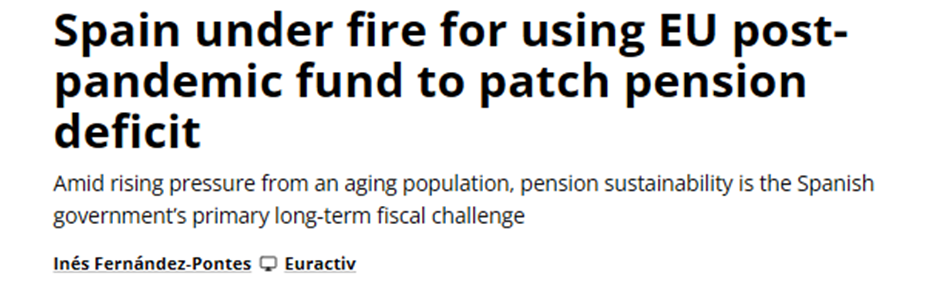
As is so often the case with ambitious politicians, reality unfolded differently. Since the introduction of the euro, economic differences within Europe have tended to grow rather than disappear. Germany is converging towards the Mediterranean region, and several countries are taking advantage of historically low interest rates to build up substantial debts. The European Central Bank gradually evolved from a classic inflation watchdog into a much more activist central bank that buys up government bonds and stabilises financial markets when tensions rise. At the same time, the world changed fundamentally:
- globalisation is stagnating; we increasingly speak of a multipolar world;
- geopolitical tensions are rising;
- energy security is back high on the agenda;
- defence spending is rising sharply;
- ageing populations are putting government finances under pressure;
- and inflation turns out to be far less "dead" than was assumed for many years.
This is also shifting the position of savers and investors. In the 1990s, many Europeans believed that saving in euros would be virtually risk-free. Today, many households instead experience that long-term saving without investing leads to a loss of purchasing power due to inflation and monetary easing. This explains why private wealth formation is becoming increasingly important. It is precisely in this light that resistance to the new Box 3 plans arises. Wealth should not only serve as a luxury, but also as a buffer against inflation, pension uncertainty and economic shocks.
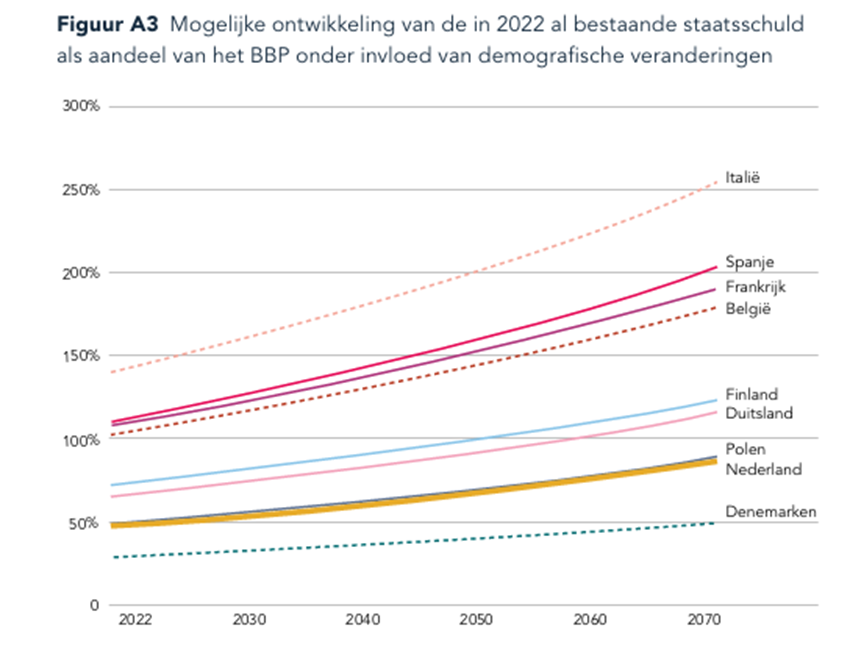
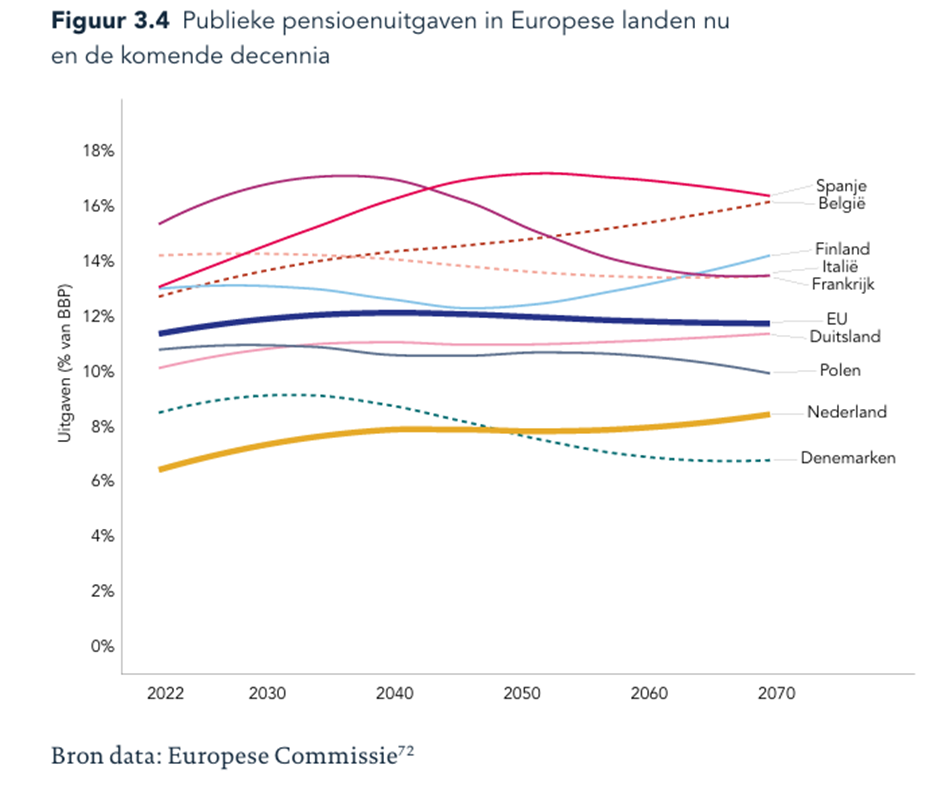
Under normal circumstances, that is sensible policy. Within Europe, the Netherlands remains the well-behaved pupil of the class: low government debt, large pension reserves and budgetary discipline. That is prudent, but discipline does not mean the Netherlands should keep saving exclusively in nominal euro claims within a currency union in which weaker member states partly determine policy. For private households, that lesson is already clear: those who only save see their purchasing power slowly eroded by inflation, financial repression and higher taxes. That is why equities, real assets and international diversification are becoming increasingly important for protecting wealth. The same logic may well apply to government as well. If several eurozone countries are structurally living beyond their means, the question is not only how much the Netherlands saves for the bill that lies ahead, but above all how the Netherlands hedges itself against it.
Japan as a bad example, or not?
Charles-Henry Monchau of Bank Syz points to Japan in this context. At first glance, Japan appears fiscally very vulnerable, with gross government debt of around 230 to 240% of GDP. But that picture is incomplete. Against that debt stand substantial public financial assets as well.
The Bank of Japan, the pension fund GPIF and other public institutions together hold approximately 95% of GDP in risky assets, such as Japanese equities and foreign investments. Japan thereby functions in part as a leveraged sovereign wealth fund: the state borrows cheaply in yen and invests part of the national balance sheet in assets that benefit from global growth, inflation and a weaker currency.
This is of course not without risk. Higher interest rates, a stronger yen or falling equity markets could quickly worsen the balance sheet. Yet this strategy has worked remarkably well since 2012. According to Syz, the Japanese public sector achieved an average return of approximately 4.7% above funding costs between 2013 and 2023, equivalent to roughly 6% of GDP per year. As a result, net consolidated liabilities fell from approximately 117% of GDP in 2012 to approximately 65% in 2025.
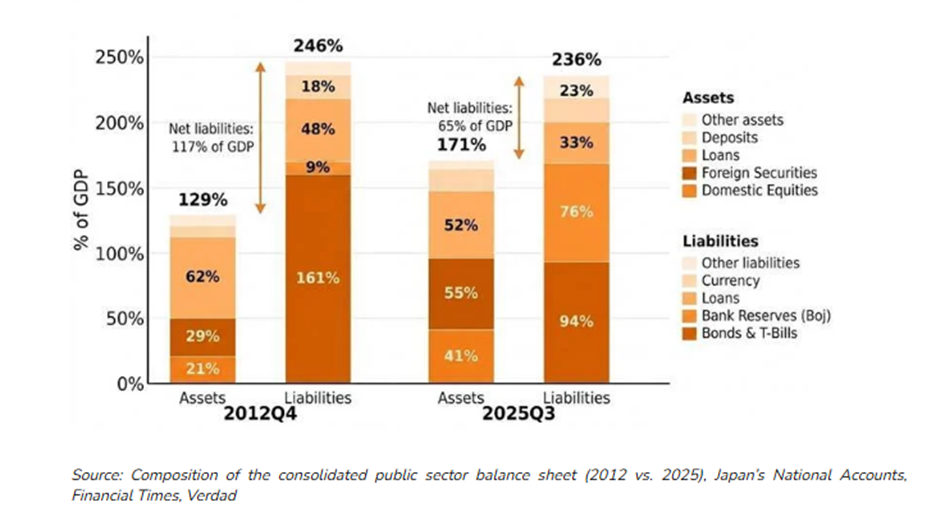
Hedge fund model or Japanese yen-euro carry trade for the Dutch government
The Netherlands, however, starts from a stronger position. It is one of the few large AAA-rated countries within the eurozone, with relatively low government debt, strong institutions and substantial pension and savings assets. Germany formally still holds AAA status, but due to structural economic stagnation, rising defence spending and large pension obligations, it is uncertain whether Germany's debt-to-GDP ratio will remain below 100% of GDP towards 2030.
A Dutch variant need not mean reckless debt financing. It could also mean that the Netherlands deploys part of the national balance sheet more strategically through a professionally managed investment vehicle, focused on global equities, infrastructure, energy, technology, defence, commodities and gold outside the eurozone. If necessary, simply through broad ETFs and gold.
The hedge is relatively simple:
- borrow short-term at ECB-influenced (and artificially low) interest rates;
- invest long-term outside the eurozone in equities and non-currency-hedged real assets;
- benefit from the interest rate and return differential;
- stop once the expectation is that the return on non-euro assets (after the exchange rate effect) will fall below the funding costs.
Precisely investments outside the eurozone can offer protection. If the euro comes under pressure due to rising debt, loose monetary policy or weak growth, the value of foreign assets in euros rises. This makes the Netherlands less dependent on the financial health of the eurozone itself.
This is relevant because Dutch pension funds still lean heavily on nominal European bonds. As a result, the Netherlands is indirectly financing the European debt system, while inflation erodes purchasing power. In a period of prolonged higher inflation and a weaker euro, nominal bonds in particular become vulnerable. A larger allocation to global equities and real assets outside the eurozone is therefore not only a return choice, but also a societal hedge against inflation, financial repression and currency debasement.
Although opportunistic in nature, the Netherlands, as one of the last remaining AAA countries within the eurozone, could borrow an additional approximately 40% of GDP, roughly €440 billion, without Dutch borrowing costs likely rising substantially above the German Bund curve.

The discipline of the bond vigilantes
Last week we already wrote that a next equity crisis could arise from rapidly rising long-term interest rates. That is why, at Tresor Capital, we hold relatively few bonds in the defensive and neutral model portfolios. This risk is further increased by the ongoing uncertainty surrounding the Strait of Hormuz. According to experts, every month of closure this summer could add approximately USD 10 per barrel to the oil price. Higher energy prices directly feed inflation expectations and limit the room for central banks to cut interest rates. In the event of persistent inflation, long-term rates could rise further still, putting pressure on equities, real estate and nominal bonds alike.
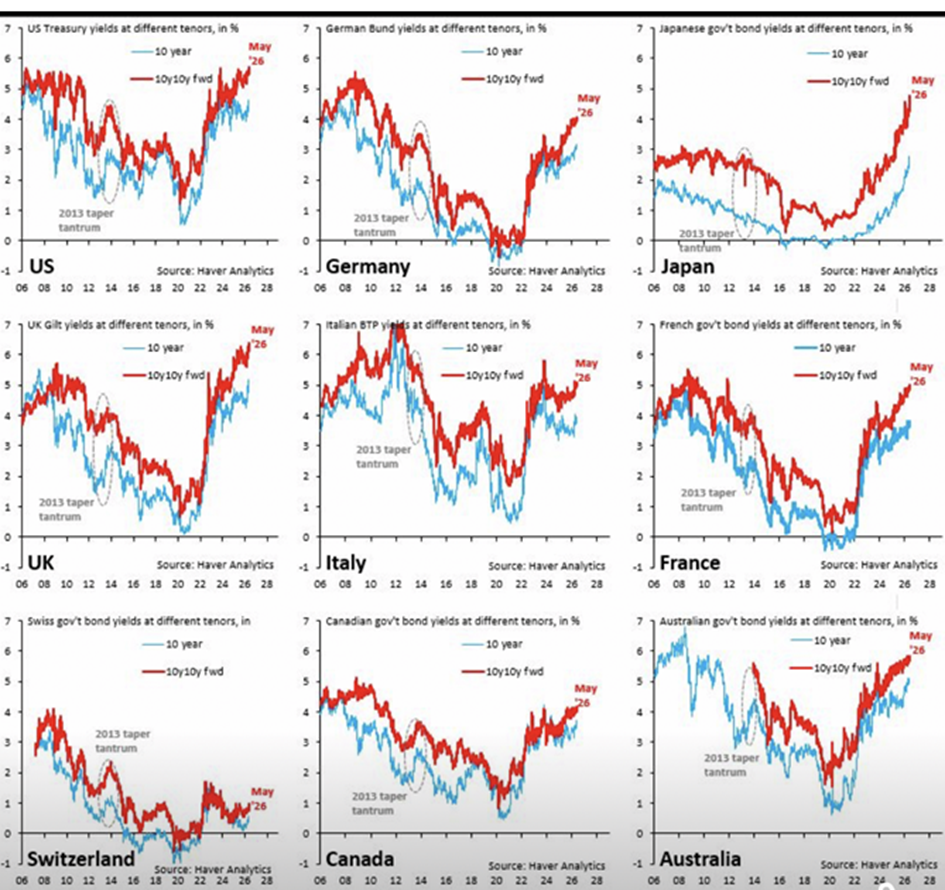
Jamie Dimon, chief executive of JPMorgan Chase, also explicitly warns of this scenario. In his annual letter to shareholders, he states that financial markets are underestimating the risk of structurally higher inflation and further rising long-term interest rates. In particular, the US ten-year and thirty-year rates are considered critical gauges of the stability of the financial system. The Fed should, in effect, raise rates to prevent persistent inflation. The market is therefore watching President Trump's reaction closely. Until recently, it appeared that he backed down as soon as the ten-year rate rose above 4.5%.
Ed Yardeni, in his article Don't Freak About the Bond Vigilantes, is less concerned and remains outspokenly bullish on the S&P 500. According to him, the rise in US interest rates is mainly driven by higher real rates and strong economic growth. The US economy can bear higher rates for the time being, partly given the enormous investments of more than USD 800 billion per year in data centres. Only once there is a clear breakout above 5% would concerns increase. US bondholders therefore appear reassured for now, but for the eurozone, the UK and Japan, vigilance remains warranted.
 Ed Yardeni
Receive weekly insights in your inbox
Exclusive analyses and updates on family holding companies and global market developments.
Would you like more information about our services?
Get in touch
Disclaimer:
No rights can be derived from this publication. This is a publication of Tresor Capital. Reproduction of this document, or parts thereof, by third parties is only permitted after written consent and with reference to the source, Tresor Capital.
This publication has been compiled by Tresor Capital with the greatest possible care. The information is intended in a general sense and is not tailored to your individual situation. The information should therefore explicitly not be regarded as advice, an offer or a proposal to purchase or trade investment products and/or to obtain investment services, nor as investment advice. The authors, Tresor Capital and/or its employees may hold positions in the securities discussed, for their own account or on behalf of their clients.
You should carefully consider the risks before you start investing. The value of your investments may fluctuate. Past performance is no guarantee of future results. You may lose (part of) your invested capital. Tresor Capital disclaims any form of liability for any inaccuracies or errors. This information is purely indicative and subject to change.
Read the full disclaimer at tresorcapitalnieuws.nl/disclaimer .
This article was translated automatically from Dutch using AI. In case of any difference, the Dutch original prevails. Read the original in Dutch.