
Economy & Markets #29 - The Butterfly Effects on the Global Market


Lower US inflation, but Iran once again puts the Fed in a bind
The US consumer price index for June finally brought convincingly positive news last week. With a decline of 0.4% compared with May, we saw the strongest monthly decrease since April 2020, causing annual inflation to fall from 4.2% to 3.5%. Crucially, core inflation, which excludes volatile food and energy prices, came to a complete standstill on a monthly basis. On an annual basis, core inflation also fell from 2.9% to 2.6%. These figures were a positive surprise for economists, especially since they coincided with a cooling of structurally stubborn components.
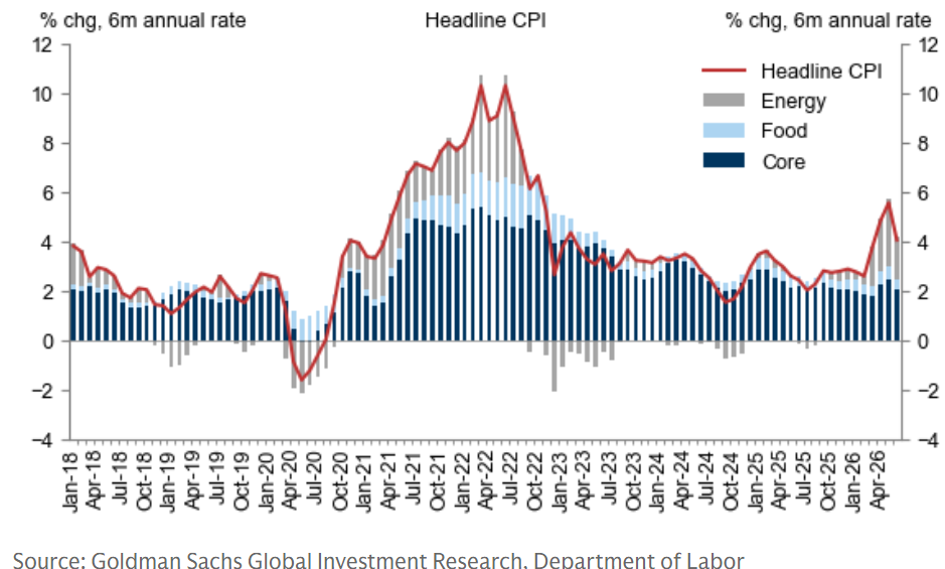
Energy prices fell by 5.7% in June, following a sharp rise in the preceding months. Petrol became 9.7% cheaper and heating oil 9.2% cheaper, while the housing component rose by just 0.1%, the smallest increase since January 2021. Services, such as transport, medical care and car insurance, on average no longer showed any price increase. It is particularly favourable for investors that this decline in inflation coincides with continued strong economic growth in the United States. Because the inflationary pressure is mainly supply-driven, the central bank gains more policy room.
However, the impact of the conflict is not limited to crude oil alone. Before the war, the Gulf states exported around 3.3 million barrels of refined products and 1.5 million barrels of LPG per day, but due to the current blockade, essential resources such as diesel, jet fuel and LPG remain relatively scarce. The global LNG market is also suffering serious disruption; exports from Qatar and the United Arab Emirates have been more than 300 million cubic metres per day lower since early March. This pushed the Dutch TTF gas price up to around 35% above the pre-conflict level in mid-June. These persistent price increases are now forcing sectors such as petrochemicals and aviation into demand destruction. China, Japan and India in particular are being hit hard by this blockade, although China and Japan have substantial strategic oil reserves to absorb the worst supply shocks.
Nevertheless, there is a downside. Although the correction of the earlier price peak in energy explains much of the picture, energy remains considerably more expensive than a year ago. Moreover, the recent flare-up of the conflict between the United States and Iran threatens to undo the gains made on the inflation front. Since 13 July, the US has resumed bombing strategic infrastructure, pushing the price of Brent crude back up towards $87. Iranian retaliatory action and uncertainty over the Strait of Hormuz introduce the risk that 20% of global oil trade could once again grind to a halt.
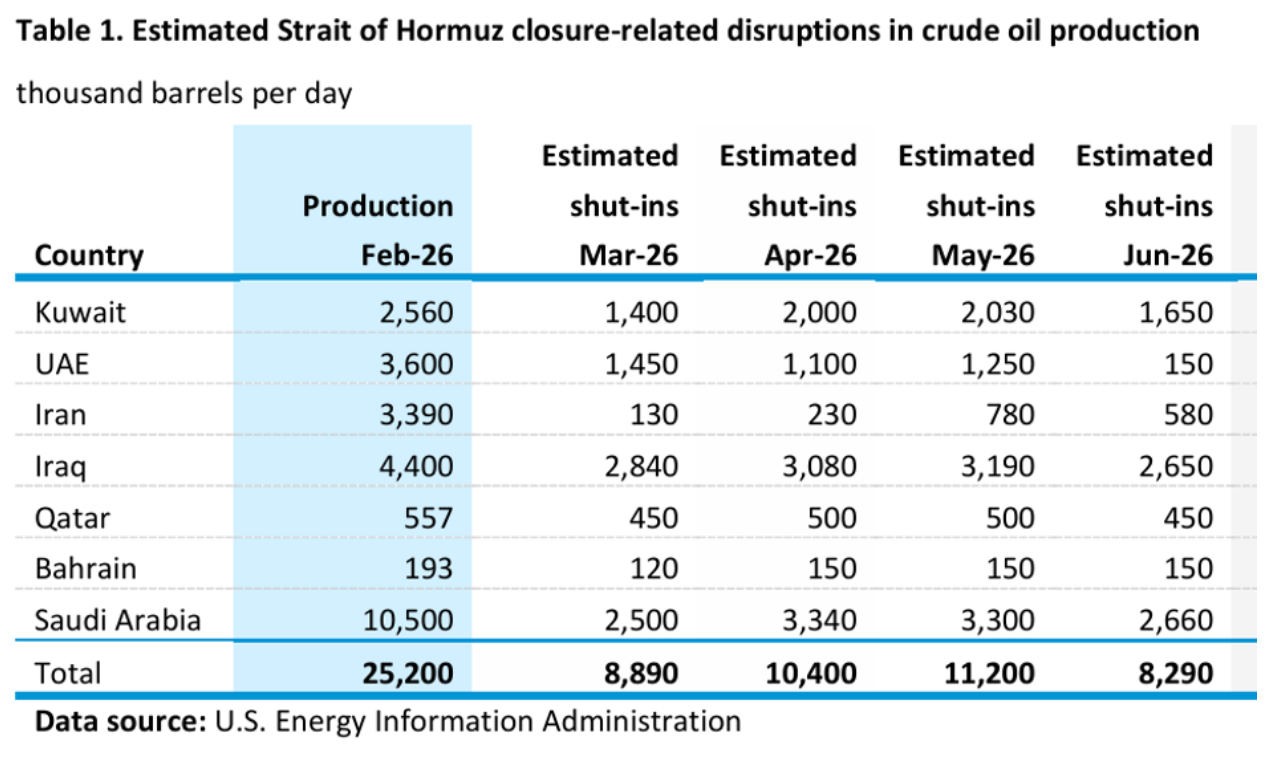
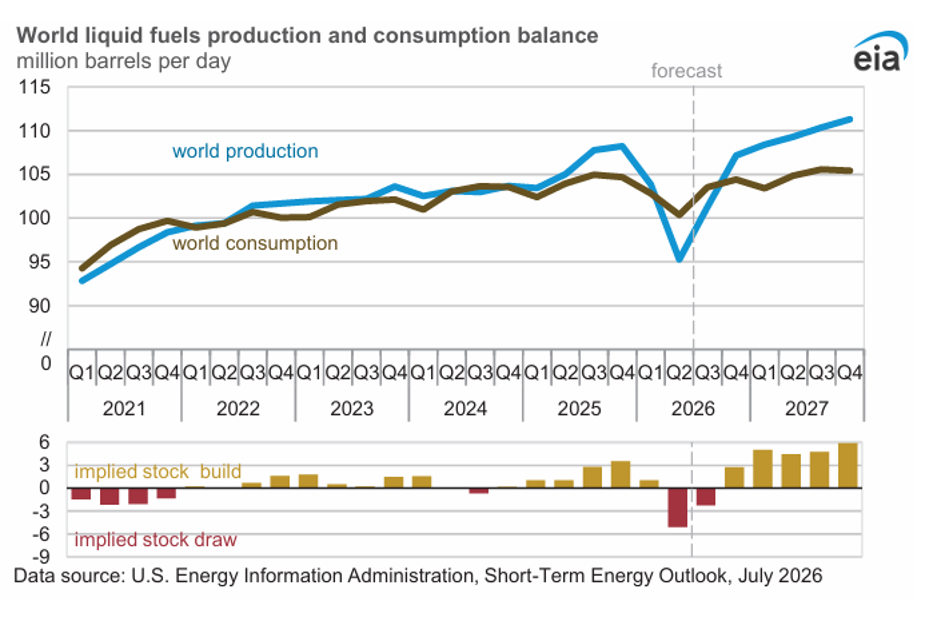
The International Energy Agency warns that global oil inventories are falling at an unprecedented pace, with an average decline of 3.8 million barrels per day since the start of the war. Although countries are trying to increase production outside the Middle East and reroute oil, this does not yet fully compensate for the disruption. In the longer term, however, the EIA foresees a supply surplus, which should ultimately push prices down, provided exports from the Middle East recover.
Given these developments, the favourable consumer price index figures are, for now, insufficient to move the Federal Reserve towards immediate rate cuts. The policy rate currently stands at 3.50% to 3.75%, and it is highly likely to remain unchanged at the meeting at the end of July. Fed officials emphasise that they primarily focus on PCE inflation, which remains well above target, and that the labour market, with unemployment at 4.2%, is not yet weak enough to warrant intervention. Furthermore, the renewed rise in the oil price will only become fully visible in the figures over the coming months.
The end of unbridled momentum trading?
Since early July, a powerful rotation has been unfolding on the stock markets. Extreme daily price swings at SK Hynix and Samsung are causing forced position closures and margin calls in Korea, a wave of selling that has since spilled over into western chip stocks. Although broad indices such as the S&P 500 and the Nasdaq are moving sideways on balance, a fierce rotation is taking place beneath the surface. Investors are selling off, on a large scale, the winners of the first half of the year, producers of semiconductors, memory chips and data storage, while interest shifts towards lagging hyperscalers.
This abrupt turn is being driven by two fundamental factors:
A shifting investment focus: Over the past two years, investors were primarily rewarded for backing companies that invested heavily in AI infrastructure. However, the proportions have become skewed. While the combined market value of the large hyperscalers (such as Google, Amazon, Meta and Microsoft) rose by just $426 billion (+3.7%), memory chip maker Micron alone added roughly $700 billion in market value. Investors are now moving away from this one-sided model and are taking a more critical look at the companies financing the infrastructure, rather than solely at the direct suppliers.
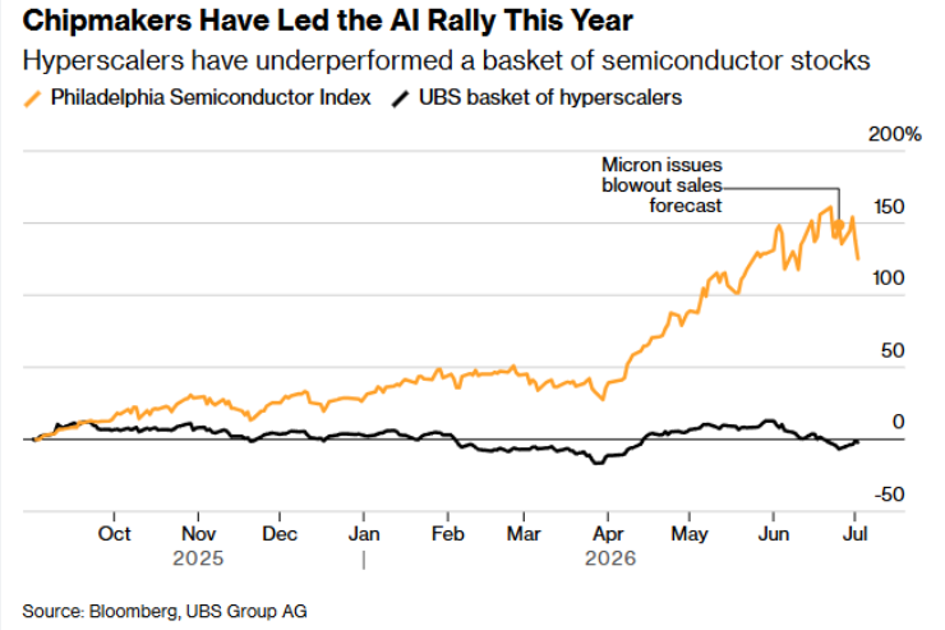
A shift in hedge fund positioning: Goldman Sachs reported that hedge funds' net exposure to broad AI equity baskets has now fallen to its lowest level of 2026. The Invesco S&P 500 Momentum ETF, which posted a record gain of 44% in the second quarter, had already lost 6.6% again by early July. The popular strategy of being 'long' chips and 'short' hyperscalers has thus completely reversed.
This process is being reinforced by technical mechanisms such as profit-taking, the unwinding of leverage, and effects from options trading. The rebound in heavily shorted stocks should therefore be approached with caution: it is a technical signal of a 'short squeeze' rather than automatic proof of a fundamental recovery.
This does not mean that structural demand for AI technology has disappeared. Companies such as TSMC, ASML and SK Hynix are still reporting record figures; TSMC, for example, saw net profit rise by 77% to $22 billion and raised its revenue growth forecast for 2026 to more than 40%. However, the period in which every positive earnings announcement automatically led to a further share price rise for the entire sector is over. Investors are now demanding discipline. From now on, free cash flow, valuation and the actual return on the hundreds of billions in AI investments will carry greater weight. Until the coming quarterly results provide more clarity, the stock market will remain a challenging rollercoaster.
Receive weekly insights in your inbox
Exclusive analyses and updates on family holding companies and global market developments.
Would you like more information about our services?
Get in touch
Disclaimer:
No rights may be derived from this publication. This is a publication of Tresor Capital. Reproduction of this document, or parts thereof, by third parties is only permitted after written consent and with reference to the source, Tresor Capital.
This publication has been compiled by Tresor Capital with the greatest possible care. The information is intended in a general sense and is not tailored to your individual situation. The information should therefore explicitly not be regarded as advice, an offer or a proposal to purchase or trade investment products and/or to take up investment services, nor as investment advice. The authors, Tresor Capital and/or its employees may hold positions in the securities discussed, for their own account or for their clients.
You should carefully consider the risks before you start investing. The value of your investments can fluctuate. Past performance is no guarantee of future results. You may lose (part of) your original investment. Tresor Capital disclaims any form of liability for any inaccuracies or errors. This information is purely indicative and subject to change.
Read the full disclaimer at tresorcapitalnieuws.nl/disclaimer .
This article was translated automatically from Dutch using AI. In case of any difference, the Dutch original prevails. Read the original in Dutch.