
Economy & Markets #3 - What will the dollar do? Applying for jobs again thanks to AI?


This week's topics:
What will the dollar do in 2026?
For many international investors, returns in 2025 fell short of expectations. Despite the strong performance of sectors such as technology and defence, one dominant factor weighed on total returns (in euros): the sharp decline of around 12% in the US dollar against the euro. Whereas an ETF tracking the S&P 500 achieved a return of roughly +17% from a US perspective, this same investment yielded only around +5% on a euro-denominated account. For the same reasons, the MSCI World equity index (around 8% in euros) also lagged well behind European equity indices.
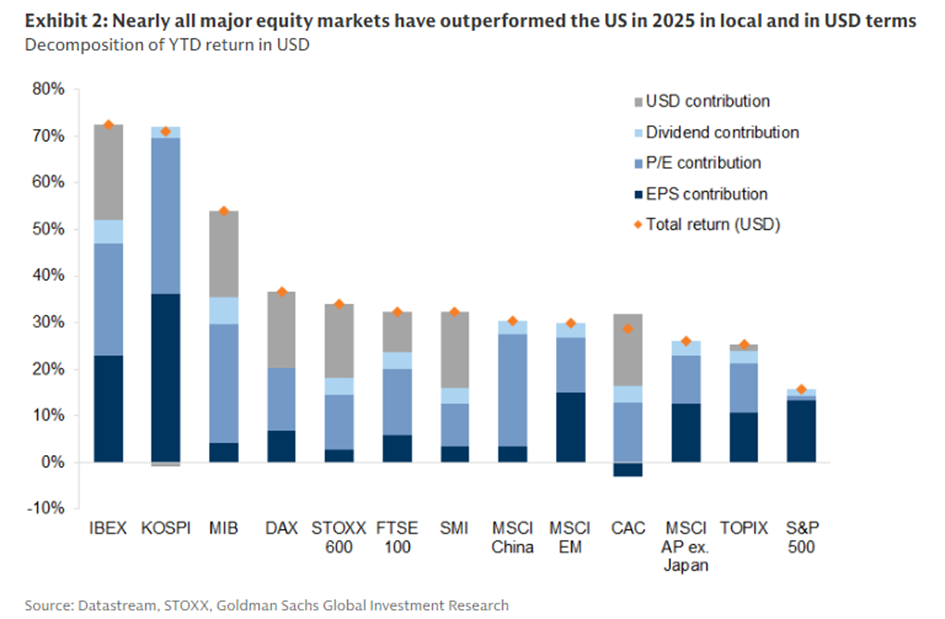
Most investors do not hedge currency risk on equities, particularly when companies operate globally. The rationale is that currency losses can, over time, be offset by higher profits from international operations. For bonds and other defensive investments, currency risk is always hedged, as exchange rate volatility is often many times greater than the volatility of the bonds themselves. In other cases, bond exposure is even scaled back entirely (when the foreign yield curve is clearly above the European one and runs flat or inverted). A key exception is emerging market bonds, which are often deliberately held in local currency because of the additional return and diversification potential.
Looking ahead to 2026, the question of which direction the US dollar will take is once again coming to the fore. From the outset of the Trump administration, it was clear that policy was geared towards dollar weakening, with the aim of reducing the twin deficits: the trade deficit and the budget deficit. A weaker dollar strengthens the international competitive position of US companies and thereby helps improve the trade balance. At the same time, it supports the budget balance by making the US more attractive as a production location, partly through (forced) onshoring.
The United States is in a strong starting position here. The country is a net energy exporter, while energy is traded globally in dollars, which limits the risk of inflation shocks. In addition, the US holds a dominant position in semiconductors, which are largely priced in USD, and is very strong in the export of services. The structural deficit on the goods balance is thereby more than offset by a surplus on the services balance.
This allows the US to afford to let the dollar weaken in order to support its competitive position and domestic economy. Some even suggest that proponents of a weaker dollar, such as J.D. Vance and Stephen Miran, are partly using the trade war as a distraction, while the real adjustment is taking place primarily through the exchange rate. Have you noticed the headlines in which European or Asian central bankers, economists or politicians complain about the weakness of the dollar?
As long as the imported inflation caused by dollar weakening remains manageable, there is room to further lower real interest rates, thereby improving the financing of US government debt. It therefore makes sense that the US government has an interest in lower real interest rates and, by extension, a weaker dollar. US core inflation came in at +2.6% this week, confirming the ongoing disinflationary trend. As expected, the Trump administration will increase pressure on the Federal Reserve to push through an accelerated rate cut. In this context, criticism of Fed Chair Jerome Powell is also mounting; ahead of his retirement in May of this year, he is being held responsible, among other things, for the persistently high (construction) costs of the new Fed building. The implicit message is that he should abandon his ambition to remain as chair.
Trump and Powell bicker over renovation costs.
After the temporary reduction of US assets by foreign investors during the market turmoil around 'Liberation Day' in April 2025, normalisation has since set in, along with renewed inflows into US government bonds and equities. This inflow is mainly driven by the structural appeal of the US economic system and the ongoing interest rate and return advantage relative to other developed markets.
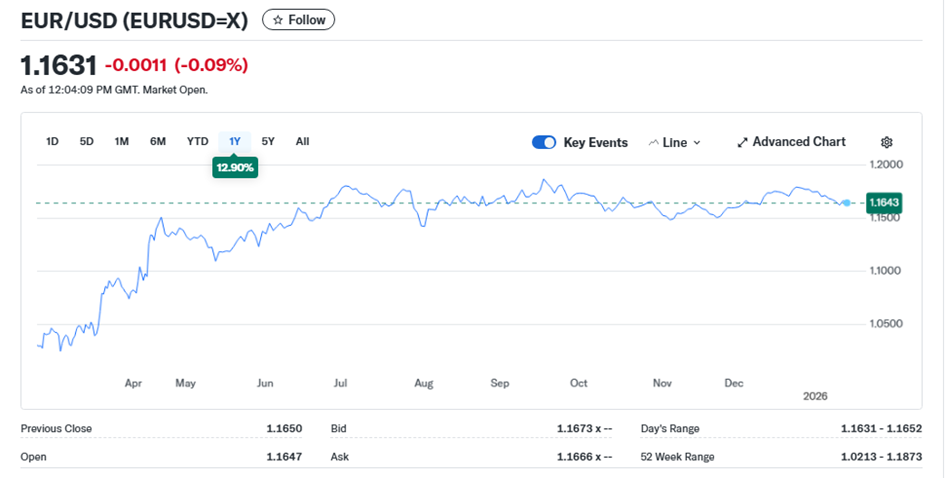
Outlook 2026: what will the USD do (versus the euro)?
Looking ahead to 2026, the central question is once again which direction the US dollar will take. Below, we set out the key factors pointing to further USD weakening against the arguments for a possible revaluation.
Factors favouring further USD weakness
- The US rate-cutting cycle does not yet appear to have run its course; the policy rate is expected to fall from around 3.75% to 3.25% towards the end of the year.
- The Trump administration is explicitly pursuing maximum economic support through a weaker dollar.
- Ongoing concerns about the US budget deficit continue to exert structural downward pressure on the USD.
- The visible power struggle within the Federal Reserve is prompting some investors to draw parallels with earlier political interference in Turkey, which at the time led to a sharp weakening of the lira.
- Rising domestic political tensions in the run-up to the midterm elections in November are increasing uncertainty and could temporarily raise the risk premium on US assets.
- Historically, a sitting US administration often loses seats at the midterms, which, in the event of a potential political deadlock, would limit the policy mandate and scope for policy action during the remainder of the term.

Arguments why the USD could still recover (against the euro):
- There is little confidence that the eurozone can lift structural growth sustainably above 0%. Demographic decline and weak productivity growth are weighing on growth potential, while the US continues to grow structurally at around 2%.
- Europe's energy transition is costly and inflationary, while at the same time it is putting pressure on the competitive position of industrial sectors such as automotive, chemicals and construction.
- European businesses are only modestly positioned for the new economy (AI, digitalisation), which supports structural capital flows towards US capital markets.
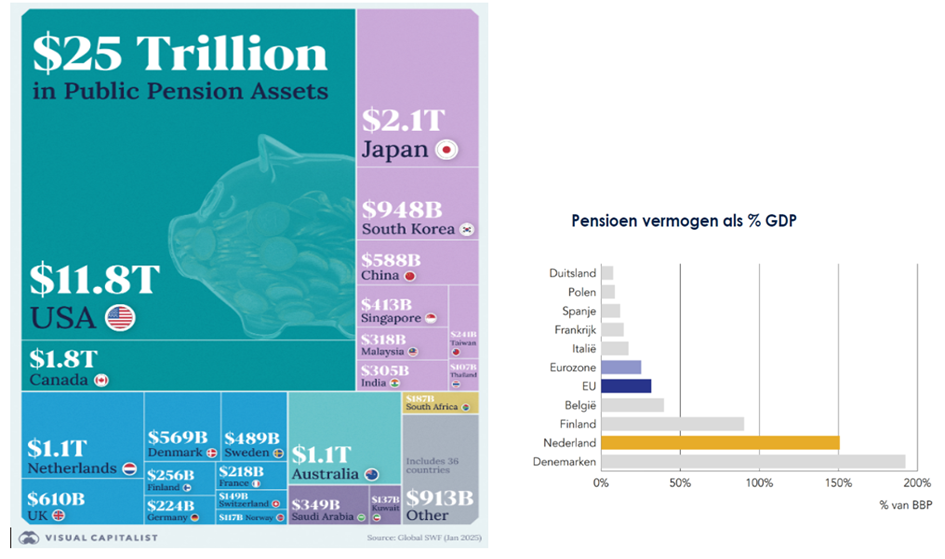
- Demographics are working in the US's favour: American baby boomers are retiring with substantial wealth, which supports consumption. In Europe, ageing populations and large unfunded pension liabilities are instead placing increasing pressure on public finances and the social welfare state. Unfunded pension liabilities in Europe are estimated at more than 200% of GDP.
- The introduction of Eurobonds, partly in the context of financing Ukraine, could over time lead to further joint debt issuance, which may put structural pressure on the euro.
- The recent cabinet formation in The Hague is being followed with interest at the European level. For countries such as France, Spain and, to some extent, Germany, joint decision-making is attractive, as it offers the possibility of indirectly drawing on the relatively strong pension and wealth position of countries such as the Netherlands and Finland through solidarity mechanisms (see image below).
Conclusion
Although market consensus, including major banks such as Goldman Sachs and Citigroup as well as asset managers such as State Street and PIMCO, expects further appreciation of the euro against the dollar, we consider it quite likely that the USD will stage a clear comeback after the midterms. In the run-up to the elections, policy is expected to remain geared towards a weaker dollar, without visible macroeconomic disruption for now. After the midterms, however, it will become increasingly evident that the long-term fundamentals of the United States are stronger than those of Europe, which could accelerate capital flows towards the US and once again provide structural support for the dollar.
Receive weekly insights in your inbox
Exclusive analyses and updates on family holding companies and global market developments.
Artificial Intelligence: in which sector will our children still be able to work in the future?
Artificial intelligence (AI) is advancing at an unprecedented pace, making its ultimate outcome and consequences difficult to predict. Whereas earlier technological innovations, such as the internet, the computer and the mobile phone, spread gradually, we are now seeing an exceptionally rapid adoption of a new technology. In 2022, generative AI, with applications such as ChatGPT, made its definitive breakthrough. Just three years later, more than 900 million people worldwide already use AI tools on a regular basis.
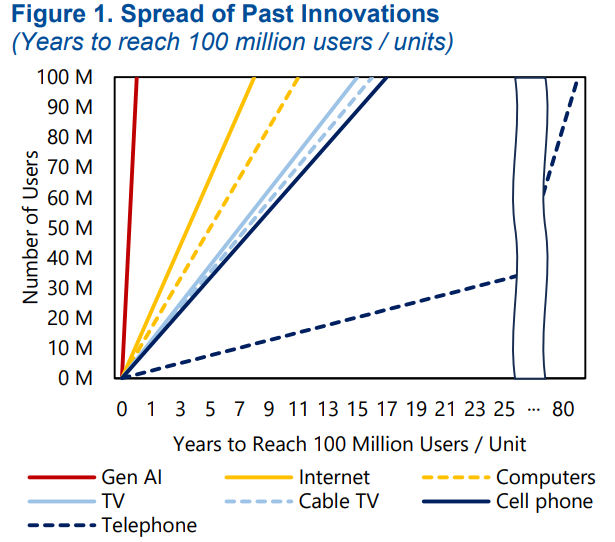
What is now becoming clear, however, is the impact on the economy and the labour market. Companies can boost their productivity and profits with the help of AI, without this automatically translating into more jobs. Tasks such as analysing, writing, coding and customer contact have suddenly become scalable. Or, as it is often summed up: “We are growing, but with fewer people.” As a result, economic growth without proportional job growth, also known as jobless growth, is becoming increasingly realistic.
Moreover, the proceeds of that growth are being distributed unevenly. Economically, AI behaves like capital: it boosts returns for companies and shareholders, while wages and employment lag behind. Large players with the best technology and data benefit the most, without needing much extra staff.
This is creating a clear divide in the labour market. Highly educated, AI-complementary skills are becoming scarcer and better paid, while many middle-tier positions (white-collar jobs) are under pressure. Average wages are barely growing, even as corporate profits increase. It is no coincidence that this is already becoming increasingly visible in the American market. AI is shifting from experimentation to everyday use in sectors such as finance, software and business services, where growth is accelerating but no longer automatically trickles down into jobs and wages.
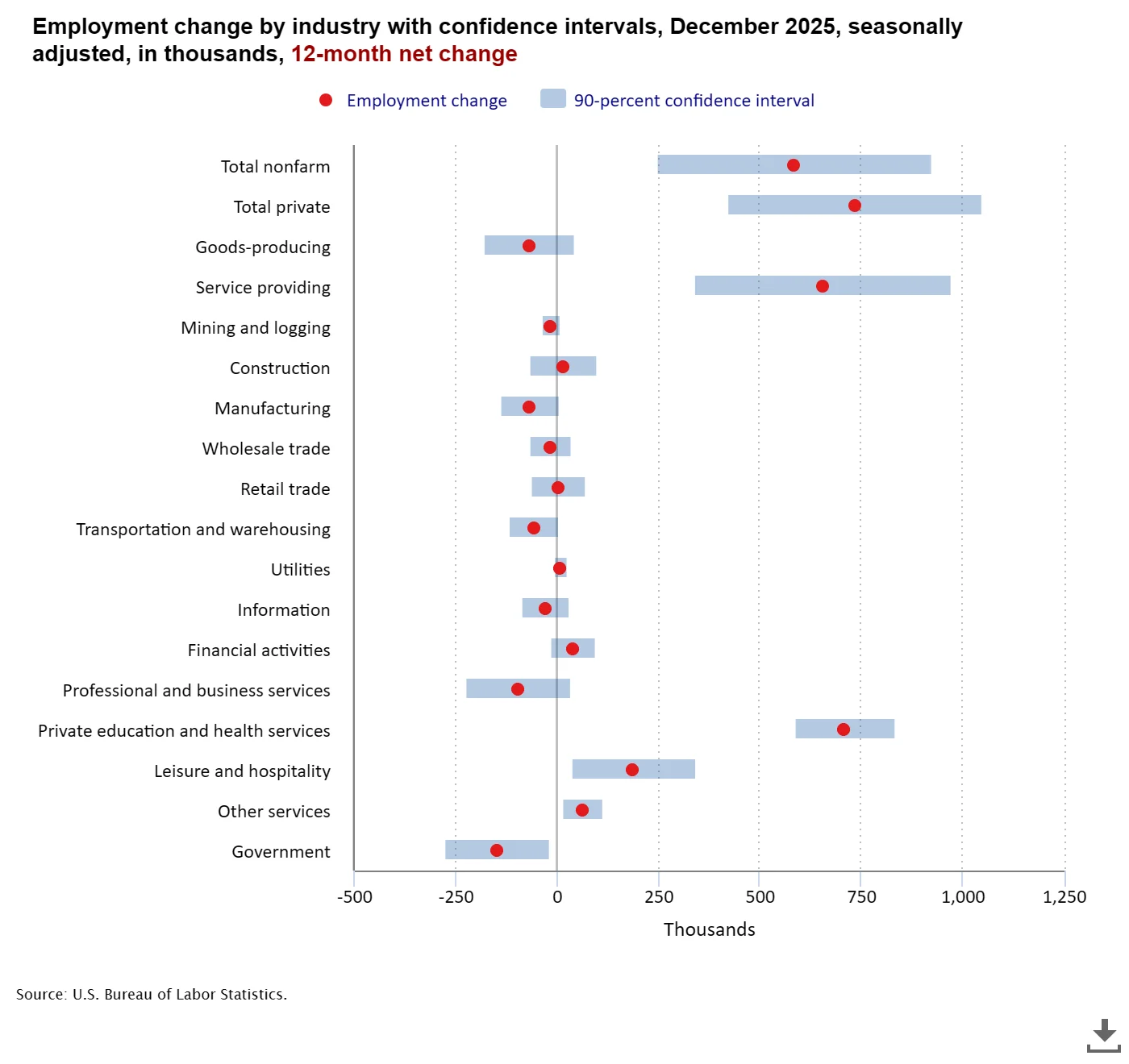
US labour market statistics show that many sectors are barely creating any jobs. Education and healthcare are exceptions. In particular, roles involving a lot of repetitive, digital and cognitive tasks, such as administration, customer support, simple analysis and junior knowledge-based functions, are under pressure. As a result, graduates will more often have to search longer for a job, and will increasingly need to focus on sectors where the labour market is tight and automation remains more limited, such as healthcare, engineering, infrastructure and education.
The effect of AI on productivity and profitability
AI is having an increasingly direct and measurable impact on productivity and profitability. A recent, extensive study by Anthropic, a leading AI company, offers valuable insight into which sectors are benefiting, where productivity gains are emerging, and how investors can look at this.
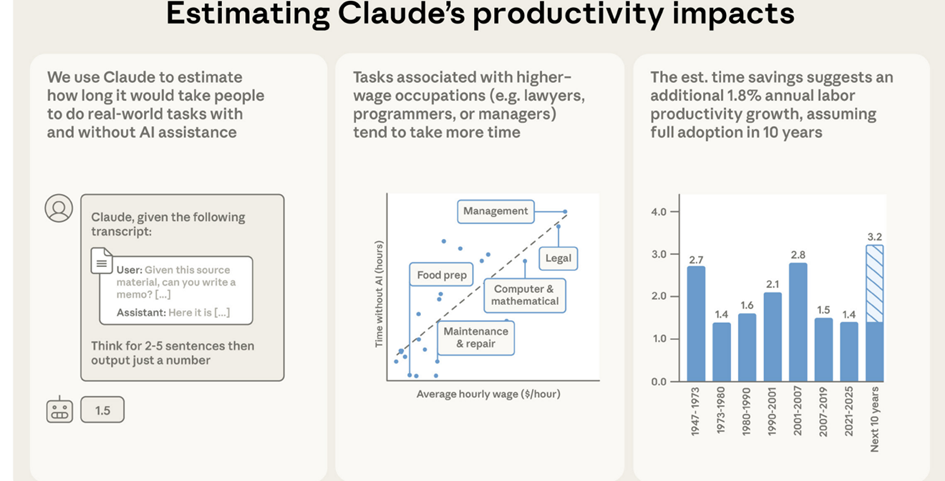
The research shows that AI drastically speeds up the execution of many tasks, saving 80% of time on average, across a wide range of professions. The greatest efficiency gains are achieved in complex cognitive tasks, such as analysis, planning, writing and problem-solving. Precisely where human time has traditionally been scarce and expensive, AI appears to add the most economic value. If these effects take hold broadly, AI could significantly accelerate labour productivity growth in the coming years, possibly to roughly double the pace of the past decade.
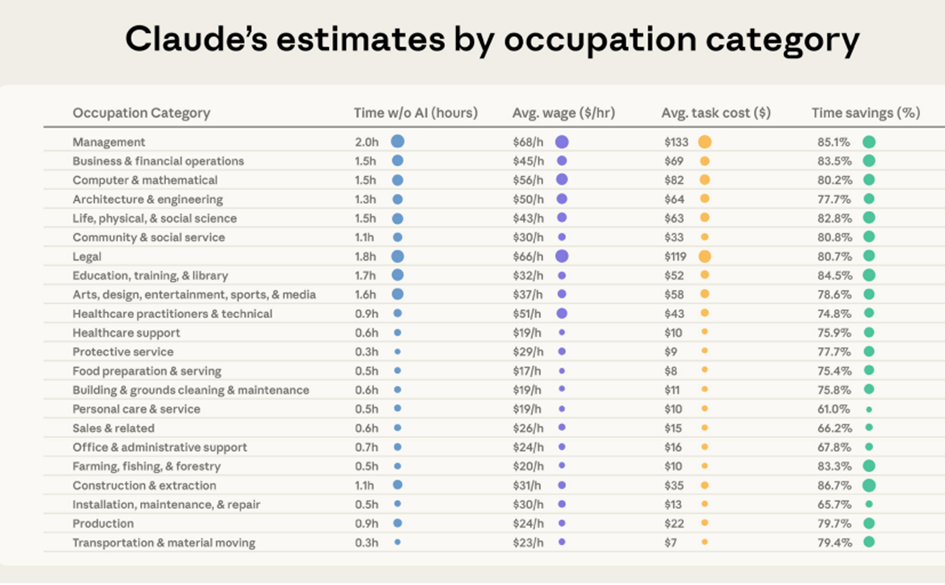
For companies, this means higher output at lower marginal cost, and thus a structural boost to profit margins. For investors, attention is shifting towards sectors and companies that effectively integrate AI into their core processes and achieve economies of scale without a proportional increase in staff costs.
So which sectors should we be applying to now?
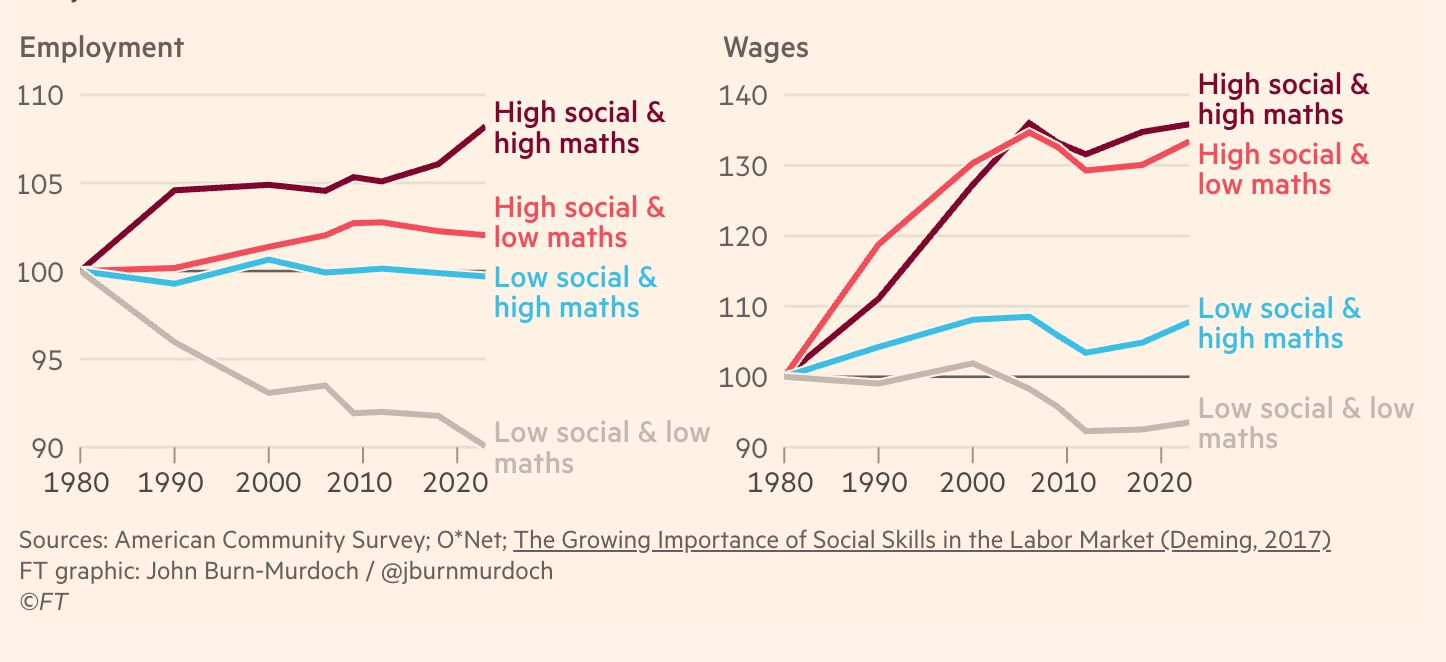
For a long time, being good with people and good with numbers gave you a clear edge in the labour market. At least, that is what follows from the image below, which shows that being good with numbers (maths) is a required skill alongside strong social skills.
The breakneck development of large language models is making traditional programming languages such as Python or C++ increasingly less decisive. Where technical knowledge used to be the key to impact, value is now shifting towards the ability to instruct AI systems clearly, provide context and give direction. In that sense, English, or more broadly, clear language, is becoming the new programming language.
The ability to formulate sharply, ask relevant questions and think conceptually now carries more weight than the ability to write code yourself. This democratises productivity: a much larger group of professionals gains access to advanced technology. At the same time, the importance of judgement, communication skills and analytical thinking is only increasing.
Yet one truth remains: those navigating the labour market would do well to keep applying for jobs themselves in the future too, rather than leaning on AI to do it for them.

Receive weekly insights in your inbox
Exclusive analyses and updates on family holding companies and global market developments.
AI enabled by acceleration in computing power (chips)
The explosive growth of AI is translating not only into the automation of work, but also into massive investment in the core infrastructure that makes AI possible: chips and data centres. Lisa Su, CEO of AMD and one of the key players in the semiconductor industry, introduced the concept of the "YottaScale era". This is a phase in which AI infrastructure is measured in yottaflops, computing power with 24 zeros after the one. According to Su, by the end of this decade the world will need up to 10 yottaflops of AI computing power, roughly 10,000 times more than in 2022. To enable this scaling up, AMD expects the global market for AI data centre chips to grow towards 2030 into an annual market of around USD 1 trillion.

This underscores that AI is not just about software and algorithms, but above all requires a fundamental scaling-up of hardware infrastructure, with substantial investment in advanced chips, data centres and energy supply. A crucial link in this is semiconductor manufacturing. Taiwan Semiconductor Manufacturing Company confirmed this picture this week with strong figures. The company reported record revenue and saw demand for AI hardware accelerate further. In the fourth quarter of 2025, TSMC posted a net profit of around NT$505.7 billion, equivalent to approximately US$16 billion, up 35 percent year-on-year, with revenue growth of more than 20 percent on an annual basis.
In addition, TSMC announced that it is raising its capital expenditure for 2026 to around US$52 to 56 billion, almost 30 percent more than the previous year. As ASML's largest customer, this investment serves as an important barometer for future demand for advanced lithography machines. TSMC's strong figures are therefore an encouraging signal for ASML, which publishes its quarterly update on 28 January.
Both ASML and TSMC form part of the investment portfolio of Scottish Mortgage Trust, and are therefore also indirectly included in the Tresor Family Holding strategy.
Recommended for tech enthusiasts: short video on Moore's Law
How do ever smaller chips deliver exponentially more computing power and greater energy efficiency? And why is that crucial for the further development of AI? In this clear mini-documentary, ASML shows why Moore's Law still sets the pace of technological progress.
Receive weekly insights in your inbox
Exclusive analyses and updates on family holding companies and global market developments.
Would you like more information about our services?
Get in touch
Disclaimer:
No rights can be derived from this publication. This is a publication by Tresor Capital. Reproduction of this document, or parts thereof, by third parties is only permitted after written consent and with reference to the source, Tresor Capital.
This publication has been compiled by Tresor Capital with the greatest possible care. The information is intended in a general sense and is not tailored to your individual situation. The information should therefore explicitly not be regarded as advice, an offer or a proposal to purchase or trade investment products and/or to obtain investment services, nor as investment advice. The authors, Tresor Capital and/or its employees may hold positions in the securities discussed, for their own account or for their clients.
You should carefully consider the risks before you start investing. The value of your investments may fluctuate. Past performance is no guarantee of future results. You may lose (part of) your investment. Tresor Capital disclaims any liability for any inaccuracies or errors. This information is purely indicative and subject to change.
Read the full disclaimer at tresorcapitalnieuws.nl/disclaimer .
This article was translated automatically from Dutch using AI. In case of any difference, the Dutch original prevails. Read the original in Dutch.