
Family Holdings #14 - From record dividends at Asseco to the facts behind the panic in the private credit market


This week's topics:
In 2025, Sofina's total net asset value rose to EUR 10.8 billion, but the value per share remained nearly stable at EUR 305.77 as a result of a strategic capital increase. An underlying increase in portfolio value of 10% was almost entirely wiped out by negative currency effects, resulting in net value creation of 1.9%. With a robust gross cash position of EUR 1.7 billion and a portfolio that combines innovation with defensive stability, the company has sufficient resources for future growth.
The private credit market is currently caught in a negative spiral in which fears over the sustainability of software loans and media pressure are leading to a run on semi-liquid funds. Although quality players such as Brookfield and Oaktree are proving their stability by stepping in with their own capital and applying conservative structures, in market sentiment they are often unfairly lumped together with weaker sector peers. At KKR, actual exposure to the riskiest credit segments is limited, at around 5% of total assets, which management recently underlined with a substantial share buyback of USD 50 million.
In Brief:
At Scottish Mortgage Investment Trust (London: SMT) a significant upward revaluation of the stake in SpaceX has taken place. The valuation of Elon Musk's space company has been increased on the balance sheet; although the exact figures have not yet been disclosed, it is likely to be in the region of $1,000 billion or more. As a result of this increase in value, the weighting of SpaceX within the total portfolio has risen to 19.3%, further reinforcing its already dominant position in the trust.
Following a sharp share price correction at 3i Group (London: III), management is sending a clear signal by buying back shares on a large scale. Peter Wirtz, Head of Private Equity and Senior Partner at 3i Group, expanded his stake in the firm by purchasing 25,000 shares. At a price of £23.39 per share, this investment amounted to almost £600,000. CEO Simon Borrows, however, went even further. Having recently already acquired 30,000 shares, he now bought more than 350,000 additional shares in one go. With this additional investment of nearly £9 million, Borrows underlines his rock-solid confidence in the company's intrinsic value and long-term potential.
The Swedish acquisition machine Addtech (Stockholm: ADDT.B) has, through its Safety business unit, acquired the Dutch company Staka. Staka designs, manufactures and sells custom-made outdoor enclosures for European installers and OEM customers in sectors such as energy, infrastructure and water management. The company has around 60 employees and generates annual revenue of approximately €15 million.
Constellation Software (Toronto: CSU) remains active through its subsidiaries with yet more acquisitions. In the United States, Perseus acquired IronHQ, a North Carolina-based provider of CRM and inventory management software for dealers in the agricultural and construction sectors, while Volaris struck in Germany with the acquisition of zetVisions, a specialist in legal entity management and master data management software based in Heidelberg. Vela, meanwhile, expanded its presence in Croatia through the acquisition of Infoprojekt, a supplier of ERP systems for local governments, and subsidiary Datamine acquired the South African company Mineware, which provides operational software and advisory services to the mining sector.
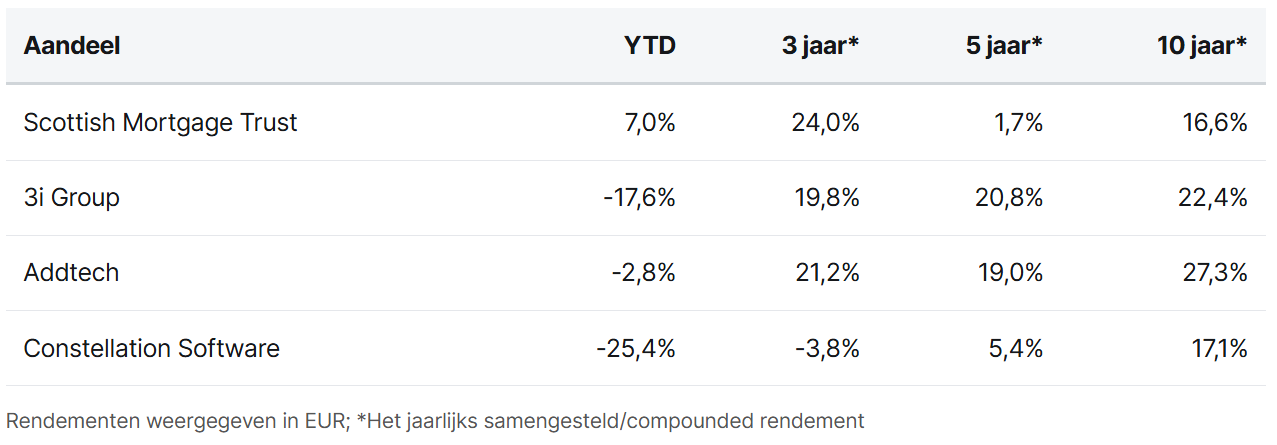
Scottish Mortgage Trust, 3i Group, Addtech and Constellation Software ended the trading week on the London, Stockholm and Toronto stock exchanges at prices of GBP 12.68, GBP 26.87, SEK 320.60 and CAD 2,441.27 per share, respectively.
Strong profits at Asseco lead to record payout for shareholders
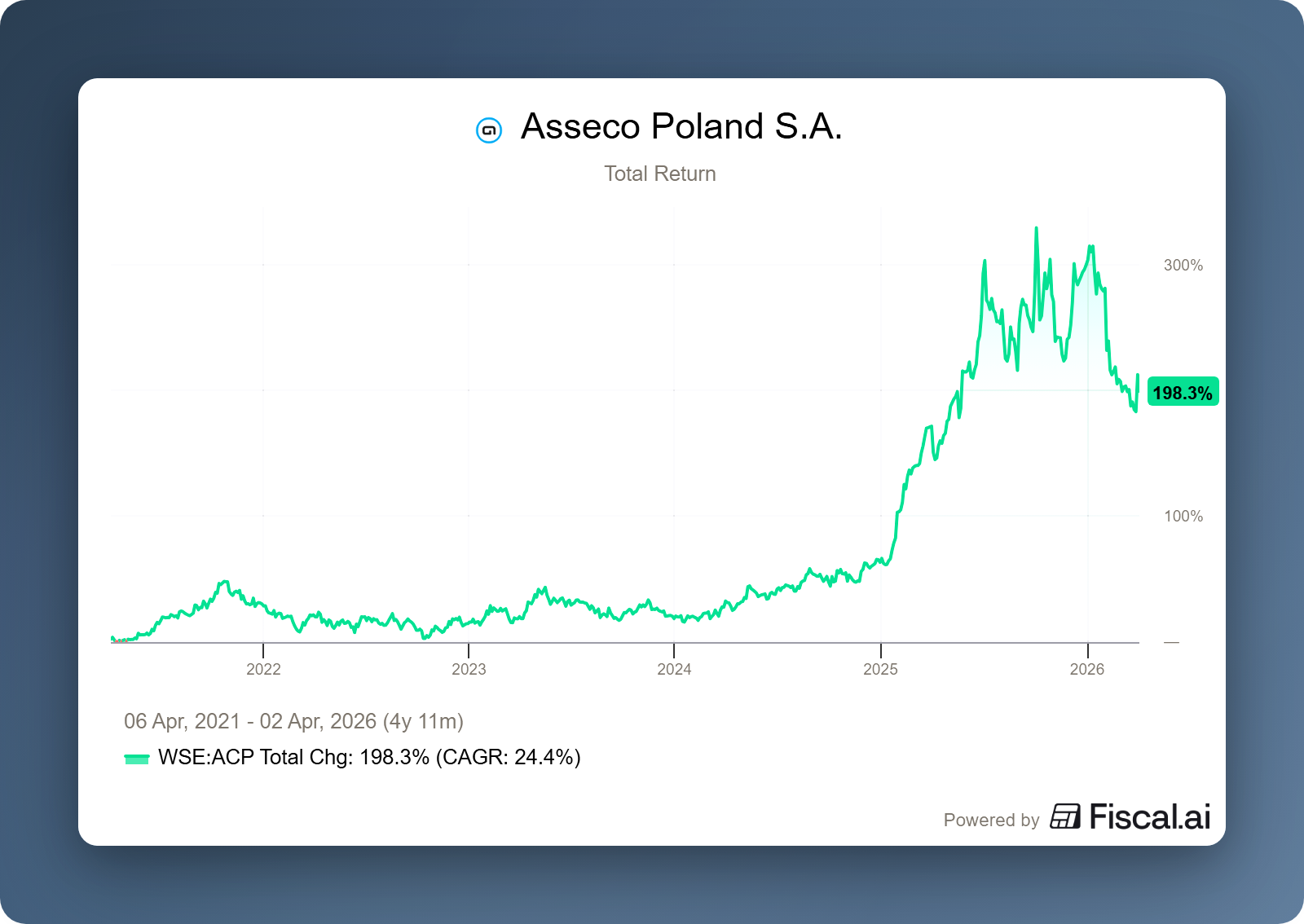
Asseco Poland (Warsaw: ACP) published its full-year 2025 results on 31 March; the timing is such that it could almost have presented them together with its Q1 figures. Looking at the presentation, it stands out that the company is communicating ever more transparently. This is perhaps not entirely uncorrelated with the arrival of Topicus as majority shareholder. That stake indeed forms the core of many investors' investment thesis. The focus at this company is on improving margins, without this hampering growth.
For investors in Asseco Poland, the consolidated figures are only partially relevant. Because the company holds large minority stakes, particularly through Formula Systems, the consolidated results give a distorted picture. Anyone who wants to see the true value of Asseco should therefore look at the proportional results. These show precisely which part of the profit and revenue belongs to the shareholders of the holding company.
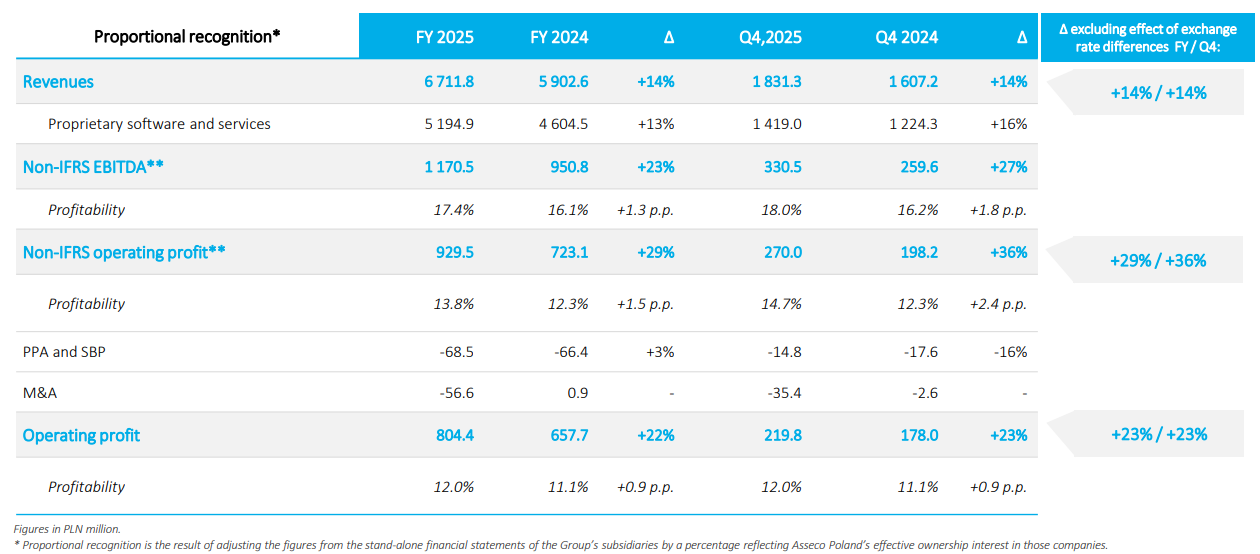
The proportional figures paint an encouraging picture. In 2025, revenue grew by 14% to PLN 6.7 billion, of which 12.4% was even on an organic basis. Something the management is very proud of, but the real focus lies on profitability. On an annual basis, the EBITDA margin rose by 1.3 percentage points to 17.4% and the operating profit margin rose by 1.5 percentage points to 13.8%. On a quarterly basis compared with the last quarter of last year, the margin even improved by 2.4 percentage points.
The Constellation group, and therefore also Topicus/TSS, has always openly communicated that, in its own words, it is able to guide every company in its ecosystem towards an operating margin of around 30%. Asseco is still far from that, but the first quarters under TSS involvement already show the right movement. We saw a similar scenario earlier at the equally Polish Sygnity; after TSS's involvement, this company transformed from a mediocre player into an efficient vertical software machine with high profitability.
Dividend payout favourable for Topicus
It has been known for some time that Asseco will propose a special dividend payout in 2026 and, if approved, will carry it out. This payout stems from the earlier sale of treasury shares to Topicus/TSS and the sale of the stake in Sapiens International at subsidiary Formula Systems in 2025. Last week, management already announced that the sale of the Sapiens stake generated an accounting profit of approximately PLN 500 million for the shareholders of the parent company.
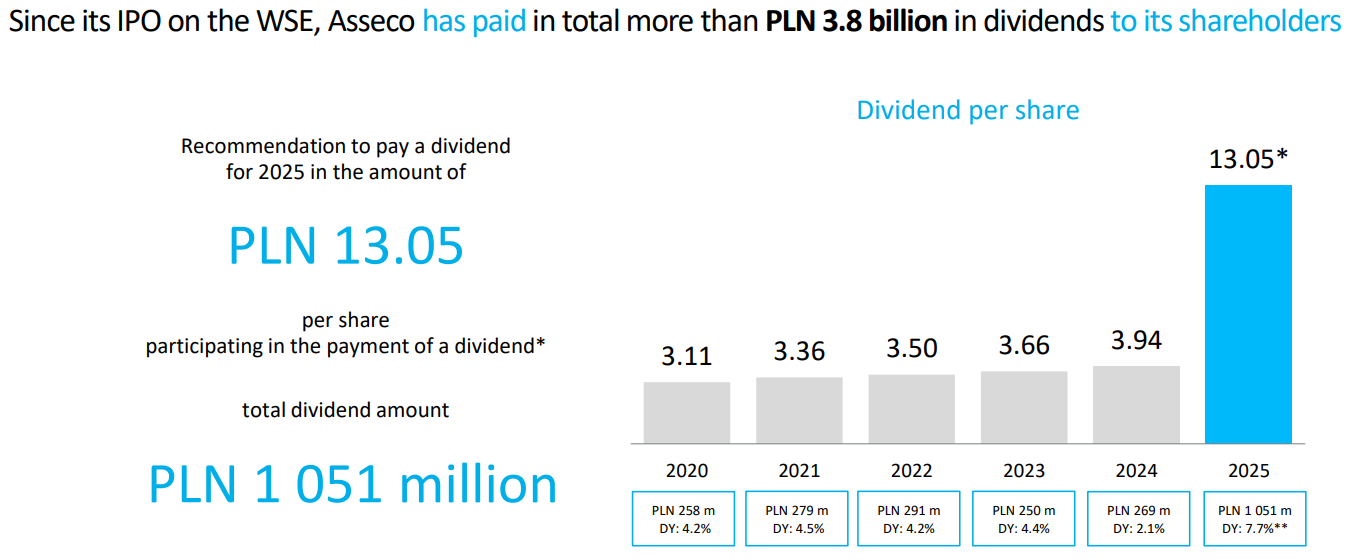
In the meantime, the proposed amount of the special dividend has been set at PLN 13.05 per share. Based on the current share price of around PLN 170, this represents a dividend yield of nearly 8%, and in total the payout amounts to PLN 1.051 billion (approximately EUR 245 million).
For Topicus, which holds a stake of around 25% in Asseco, this proposal means a significant cash flow. Since they made their investment at a purchase price of PLN 85 per share, this single dividend alone returns more than 15% of their original investment directly.
AI as an expertise amplifier
Another striking slide in the report is one about the organisation's use of AI. It is inevitably the most discussed topic within the VMS sector, which readers of our newsletters will not have missed either. The slide shows an overview of internal AI tools that the company has installed and built itself for its own development processes. These range from Mockup.ai for building prototypes to Tester.ai for test automation, AIRena.ai for code quality analysis, and iThreatmodeler.ai for threat modelling and security analysis.
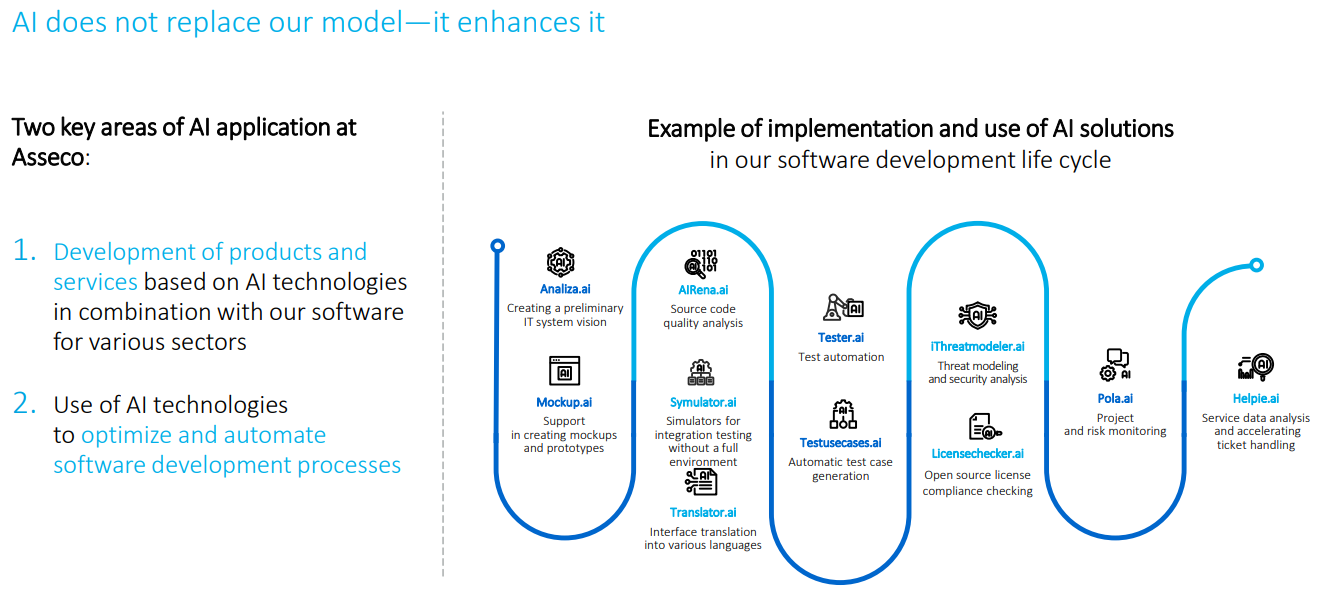
Adam Góral, founder and president of the management board of Asseco, emphasises that the rise of artificial intelligence has an irreversible impact on the sector. He states: "AI absolutely influences our world, and our companies need to respond to that adequately." In his view, however, AI is not a replacement for the human specialist, but a tool to raise the quality of service and improve efficiency. The group's goal is to achieve more with exactly the same team by integrating AI solutions deep into the internal production process.
According to Góral, the foundation of Asseco is the knowledge built up over many years by its more than 30,000 employees, whom he prefers to describe as his "business partners", spread across more than 50 countries. In a sector where 87% of staff work in product-related roles, deep, sector-specific expertise forms the most important barrier against competition. With an average tenure of 12 years at Asseco Poland, the organisation possesses unique knowledge of complex customer processes in sectors such as healthcare, banking and government. This years-long experience and human intelligence form the basis on which AI builds; Góral believes that AI will actually need more time to be able to match or replace such non-standard, specialist solutions.
Asseco Poland ended the trading week on the Warsaw stock exchange at a price of PLN 178.20 per share.
Receive weekly insights in your inbox
Exclusive analyses and updates on family holding companies and global market developments.
Sofina posts solid results for 2025
Sofina's (Brussels: SOF) results for the 2025 financial year show a picture of resilience in a challenging market. While the total Net Asset Value (NAV) rose to €10.8 billion (versus €10.3 billion at the end of 2024), the value per share remained virtually stable at €305.77, compared with €311.77 the year before. Although the total NAV increased in absolute euro terms, this was spread over a larger number of outstanding shares as a result of the recent capital increase.
Without this capital injection, the NAV per share would have been higher, but the deliberate choice for this issue was necessary to fill the "war chest" for future growth. This was a strategic move; Sofina saw dealflow in the market accelerating and wanted to have the necessary firepower to be able to act more actively in the coming years.
To understand the evolution of the past year, let's look at the chart below. It shows the 'bridge' of value development within the portfolio.
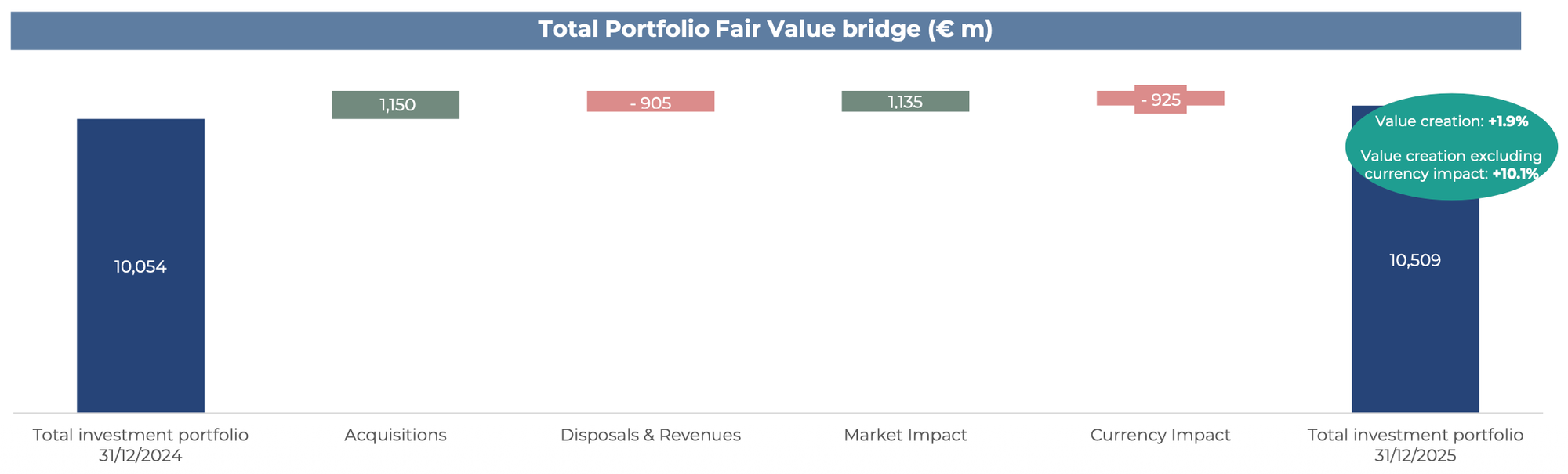
Sofina invested slightly more (acquisitions) than it received back in capital (from sales and capital distributions from funds). What stands out in the chart is the increase in the value of the portfolio by around 10%. "Market impact" reflects that underlying increase in value. However, this was almost entirely offset by the impact of exchange rates, meaning the actual value creation amounted to only 1.9%.
CEO Harold Boël clarified during our client event that this has a neutral effect on operations over the very long term. In an international model, the exchange rate works in your favour one year and against you the next. Sofina's broad geographical spread, with interests in the US, Europe and Asia, together with the fact that Sofina buys and sells foreign currencies such as dollars on a daily basis through the capital calls and distributions of the venture and growth capital funds, acts as a natural hedge that smooths out these fluctuations over time.
Would you like to read more about Tresor Capital's client event and the content of Mr Boël's presentation? You can do so via the link below:
 Michael Gielkens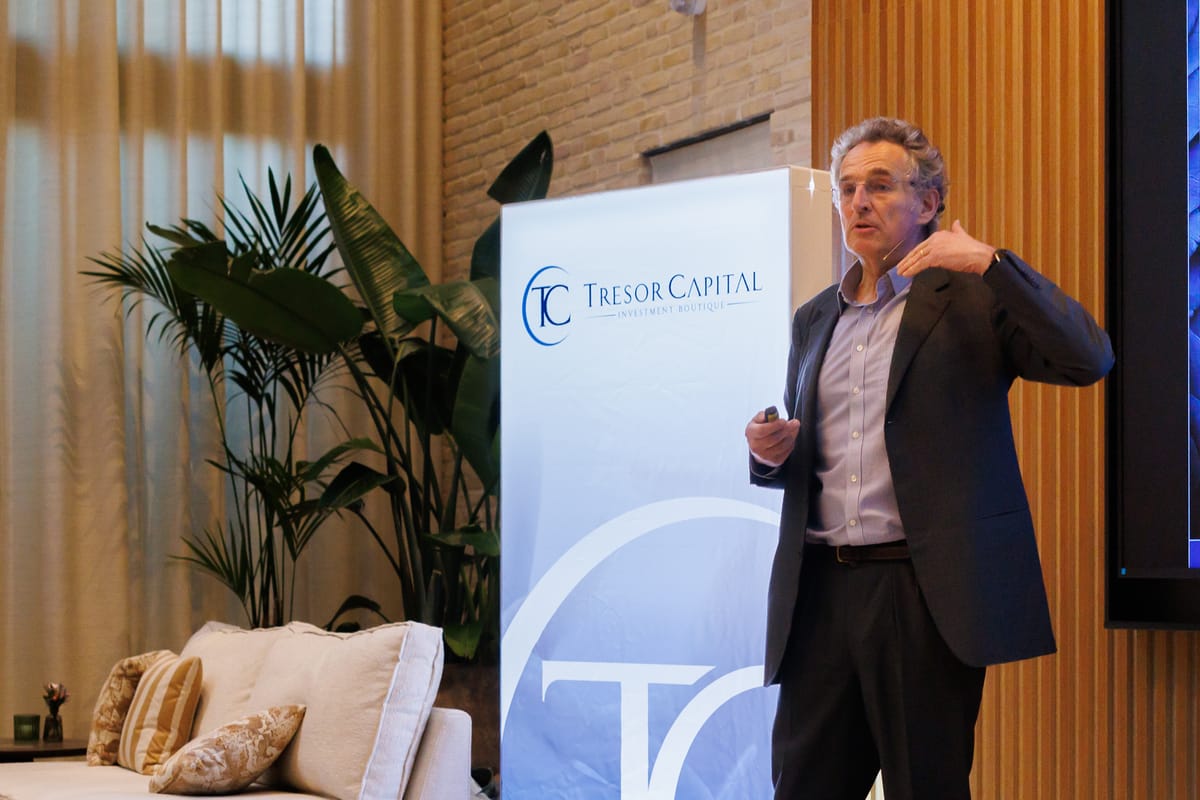
Despite the strong fundamentals and active dealflow, with new investments in companies such as Scalable Capital and listings including Lenskart and Pine Labs, the consensus is that it "could and should be better". With a gross cash position of €1.7 billion and a low Loan-to-Value ratio of 4.1%, Sofina in any case has the firepower to deliver on that ambition in the next cycle.
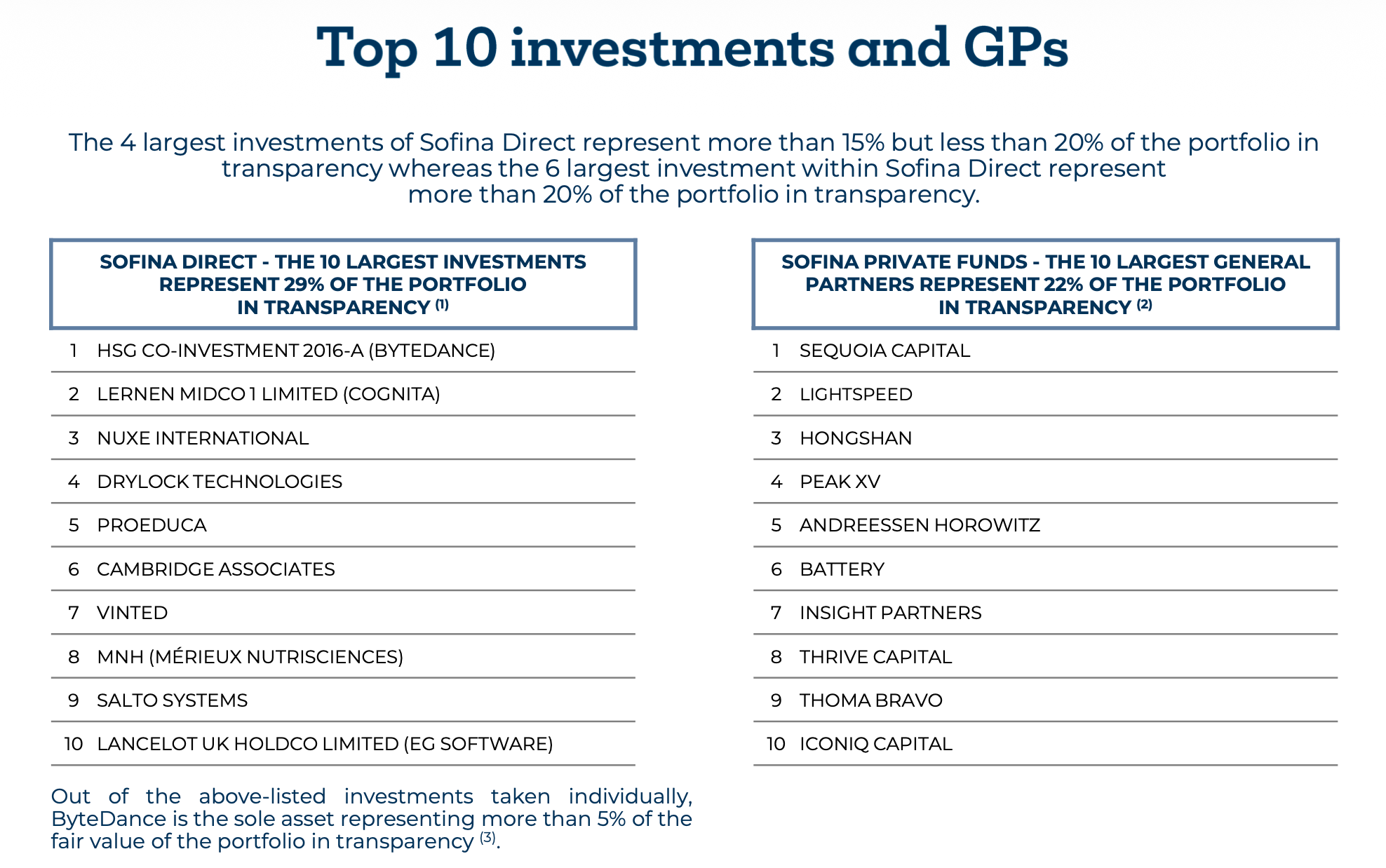
Looking at the concrete composition of the portfolio, we see that Sofina's top 10 positions now jointly represent around 29% of the total value. This concentration shows where Sofina has the greatest conviction.
What makes this breakdown unique is the balance between 'high growth' and defensive stability. While the hundreds of smaller investments via the Sofina Private Funds provide broad exposure to innovation, the bulk of capital is deployed in a targeted way towards structural growth trends such as Digital Transformation (23%) and Education (14%).
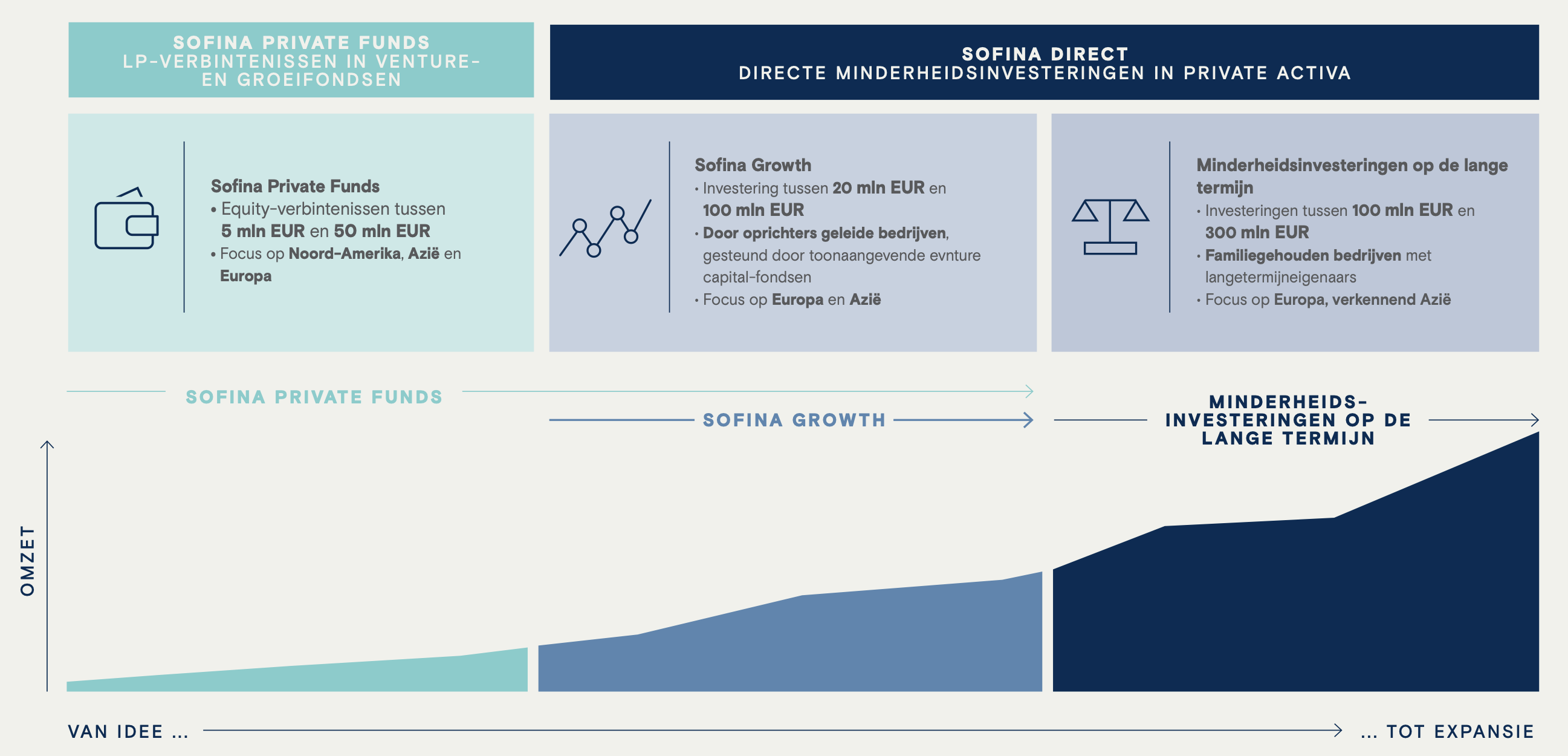
At the same time, the positions in Consumer (22%) and Healthcare (12%) (such as Cognita in the top 10) provide an essential counterweight. These sectors are less cyclically sensitive and form the qualitative anchor of the portfolio. It is precisely this specific mix that explains Sofina's resilience: a combination of aggressive growth opportunities and defensive value creation, underpinned by an extremely strong cash position.
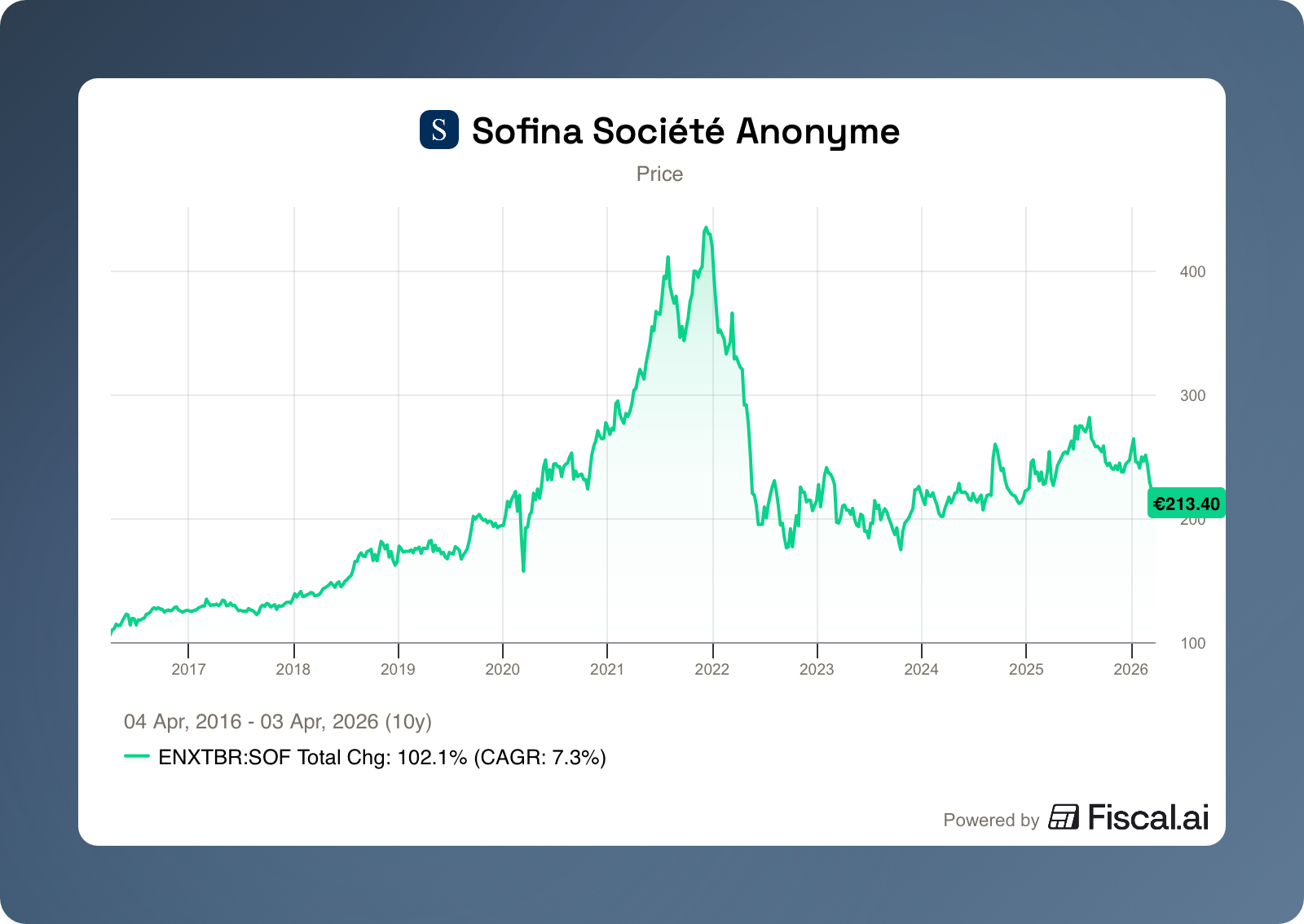
Sofina ended the trading week on the Brussels stock exchange at a price of EUR 214.20 per share.
Headlines fuel fear within private credit
The private credit market is currently under considerable pressure. Whereas classic private strategies typically have a term of around seven years, with distributions only taking place on a quarterly basis after a number of years and without any real exit options, in recent years new semi-liquid funds have been set up to meet the growing demand from individual (retail) investors. These offer investors the option to withdraw up to 5% of the fund's value per quarter for liquidation, a structure that is causing a great deal of commotion in the current market climate.
The prevailing fear is that many of these loans are carried on the balance sheet at values that, partly due to the rapid rise of AI, are no longer sustainable. Investors assume that a large proportion of these loans have been extended to software companies whose market value will, in the near future, be significantly lower than the current book value justifies.
Due to the current market fear, these limits are now being reached at many firms. It is crucial to understand that these limits exist to protect both the fund and its investors. Because the underlying investments have a long-term horizon and are inherently illiquid, a premature unwinding of positions could seriously harm the returns for existing investors. However, an essential distinction must be made here: forced sales of underlying assets should only take place if the manager is unable to absorb the outflow from its own liquidity position or ongoing cash flows.
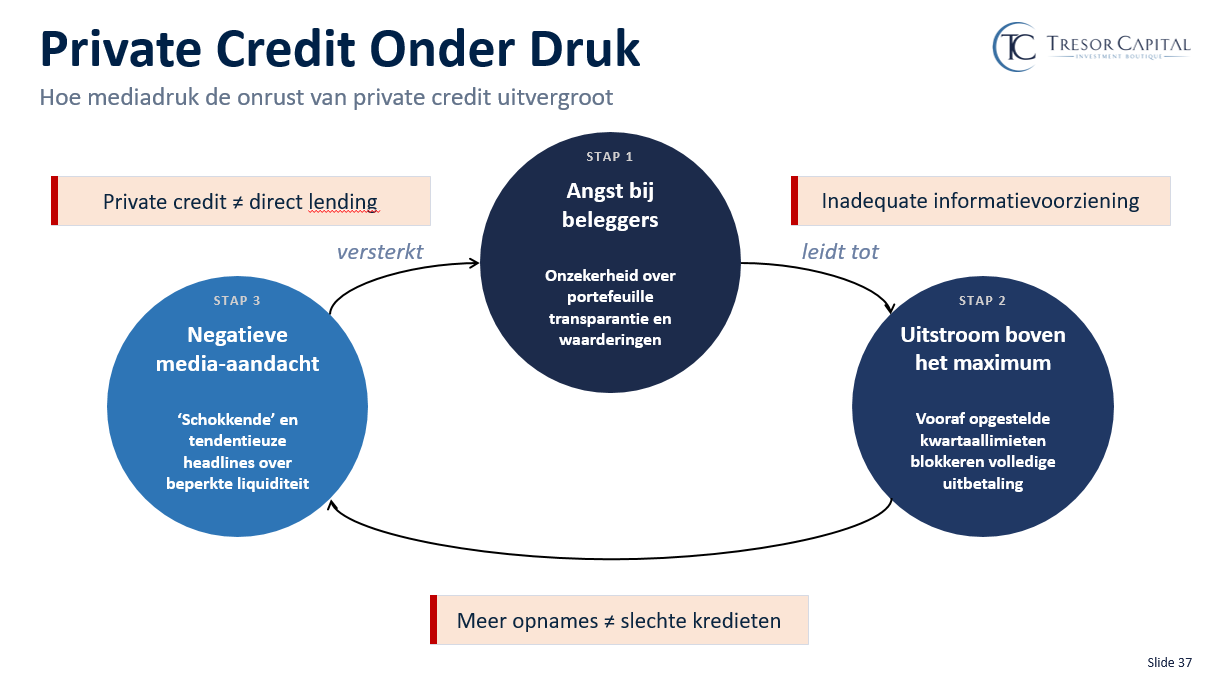
What we are currently seeing in the market is a process in which fear feeds on itself. As the accompanying image illustrates, a damaging dynamic arises: uncertainty about valuations drives investors en masse towards the exit, causing the maximum outflow limits to be hit immediately. As soon as that 'door' closes, the media pounce on it with sensational headlines. In this coverage, terms such as private credit and direct lending are often unjustly lumped together. Moreover, the negative tone suggests that an increase in withdrawals is synonymous with poor-quality loans, which only further fuels panic among investors. This creates a vicious circle in which inadequate information provision and media pressure push markets unnecessarily deeper into the red.
This exposes the fundamental weakness in the information provided by fund managers. Investors have entered funds whose illiquid nature and associated risks they could not fully assess. In this vicious circle, the combination of this structural mismatch and the subsequent media pressure pushes the market downward.
Brookfield
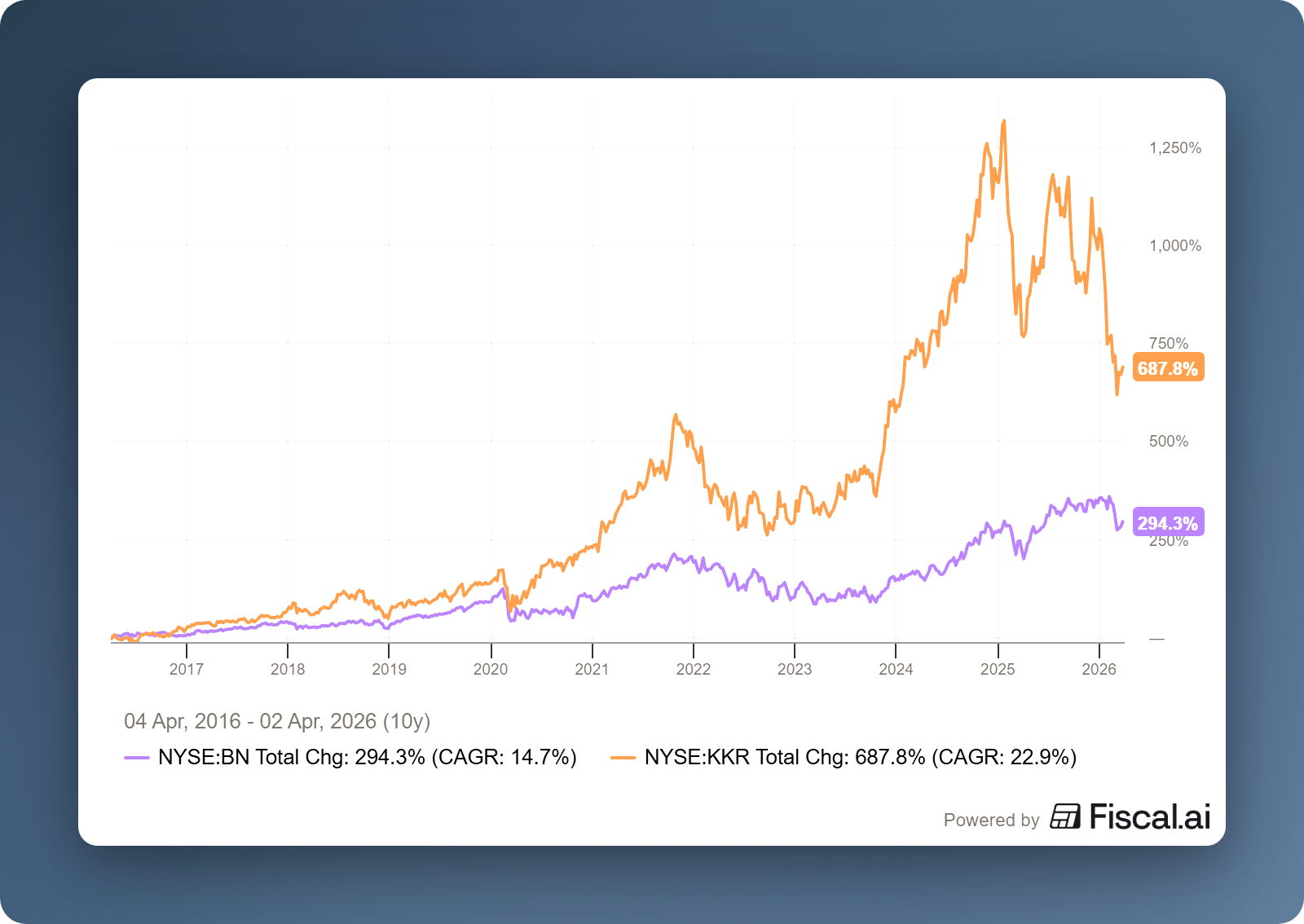
At Brookfield (New York: BN) and its subsidiary Oaktree, we see a reassuring dynamic. They have chosen to partly absorb any liquidity requests out of their own pocket. This 'skin in the game' is a powerful signal to the market that the underlying value of their portfolios is solid.
Armen Panossian (co-CEO of Oaktree) states that we are currently seeing a correction, but that it is not systemic. He specifically points to a difference in performance between loans issued before 2022 and those issued after. Panossian emphasises that Oaktree has prepared for this by putting client interests first: "We couldn't predict exactly what would happen, but we did prepare by operating prudently, holding liquidity, and not overdoing leverage". As a result, they are now able to benefit from the volatility.
Connor Teskey (CEO of Brookfield Asset Management) adds to this from Brookfield's philosophy. He points to the human tendency to misjudge liquidity: "Liquidity is a strange instrument; it is hugely overvalued at times when you don't need it, but it is almost laughably undervalued at the moment when you do need it." Brookfield's strength lies in their focus on the 'backbone' of the economy and carefully de-risking deals so as not to be caught with their back against the wall precisely at those rare moments.
A highly recommended interview with Connor Teskey, CEO of Brookfield Asset Management
In the interview, Teskey states that Brookfield tries to structure deals in such a way that they are only exposed to operational risk. Nevertheless, they cannot escape the negative correlation that comes with the overarching terms private equity and credit; when bad news emerges about structurally worse-managed peers in the sector, general market sentiment regularly and unjustly lumps them into the same camp.
KKR
At KKR (New York: KKR), the situation is more nuanced. Compared with Brookfield, they are slightly more exposed to the current pressure in the market and have not chosen, to the same extent, to immediately offset the full outflow with their own capital. Although this makes KKR more sensitive to market sentiment on paper, it is essential to put this into proper perspective. Relative to their total assets under management (AUM), the exposure remains very manageable. As the image shows, Direct Lending, the segment currently receiving the most media attention, accounts for roughly 5% of total AUM. The BDCs, which are central to the discussion about redemption limits, make up less than 3% of total capital.
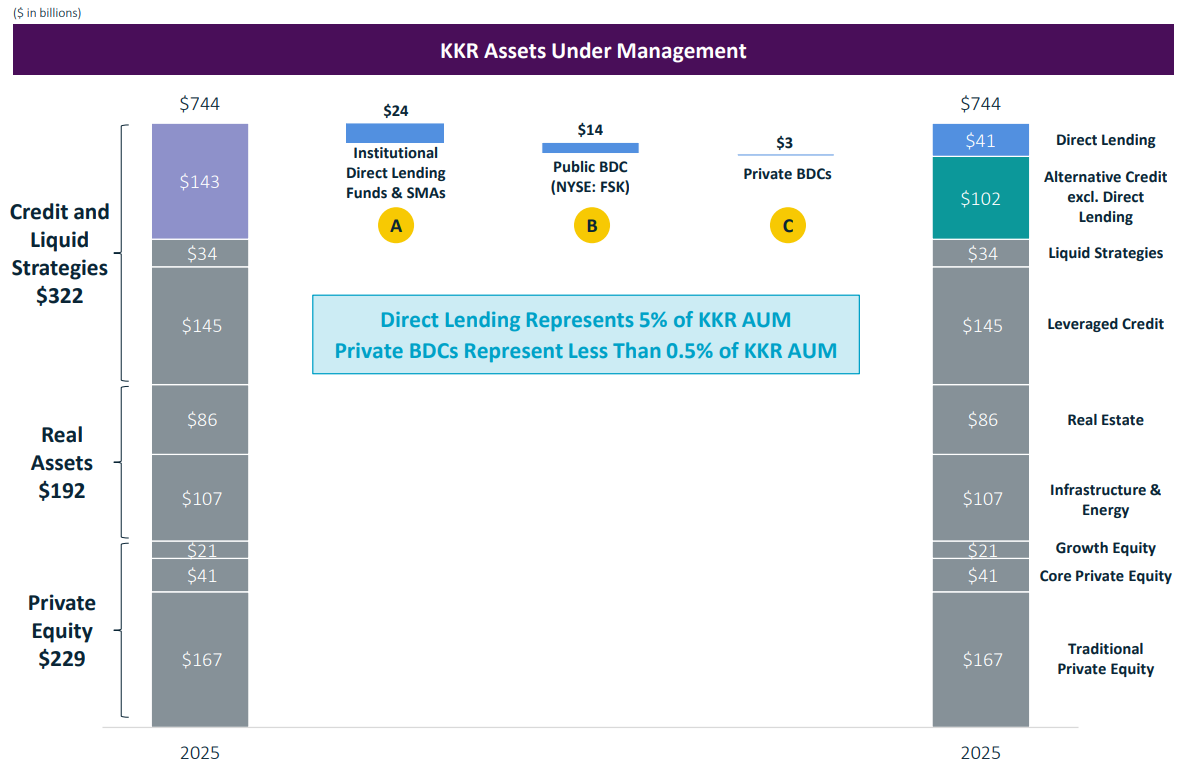
Management has responded to this market dynamic through share buybacks, with the co-CEOs and other insiders recently acquiring more than USD 50 million worth of the company's own shares out of their personal wealth. While the headlines are currently focused heavily on the credit-related segments, the largest part of KKR's portfolio remains allocated to sectors such as infrastructure, energy and traditional private equity, which carry a different risk profile.
Brookfield and KKR ended the trading week on the New York stock exchange at prices of USD 40.89 and USD 91.23, respectively.
Receive weekly insights in your inbox
Exclusive analyses and updates on family holding companies and global market developments.
Would you like more information about our services?
Get in touch
Disclaimer:
No rights can be derived from this publication. This is a publication of Tresor Capital. Reproduction of this document, or parts of it, by third parties is only permitted after written consent and with reference to the source, Tresor Capital.
This publication has been compiled by Tresor Capital with the greatest possible care. The information is intended in a general sense and is not tailored to your individual situation. The information should therefore explicitly not be regarded as advice, an offer or a proposal to purchase or trade investment products and/or to obtain investment services, nor as investment advice. The authors, Tresor Capital and/or its employees may hold positions in the securities discussed, for their own account or for their clients.
You should carefully consider the risks before you start investing. The value of your investments can fluctuate. Past performance is no guarantee of future results. You may lose (part of) your investment. Tresor Capital disclaims any liability for any inaccuracies or errors. This information is purely indicative and subject to change.
Read the full disclaimer at tresorcapitalnieuws.nl/disclaimer .
This article was translated automatically from Dutch using AI. In case of any difference, the Dutch original prevails. Read the original in Dutch.