Family Holdings #21 - Joep visits Scottish Mortgage, Abel puts his own stamp on Berkshire

This week's topics:
Three family holding companies recently received a buy rating from analysts. Chapters Group is praised for its strong growth pipeline within the fragmented European niche software market. Heico is seen as an attractive buy because it gains market share precisely from cost savings in the aviation sector and benefits from higher defence spending. Markel Group is worth buying because the share is historically cheap at 1.2 times book value and has better growth prospects due to its compact market capitalisation.
Berkshire Hathaway underwent a drastic clear-out in the first quarter under new CEO Greg Abel, fully selling fifteen positions, including the entire portfolio of departed manager Todd Combs with quality companies such as Visa and Mastercard. At the same time, the holding company tripled its stake in Alphabet to USD 16.6 billion, which analysts see as a clear bet on the technology holding company's strong positioning in artificial intelligence. In addition, the group opened a striking new position of USD 2.6 billion in Delta Air Lines, a return to the aviation sector that is remarkable given Warren Buffett's earlier negative experiences and views on this capital-intensive industry.
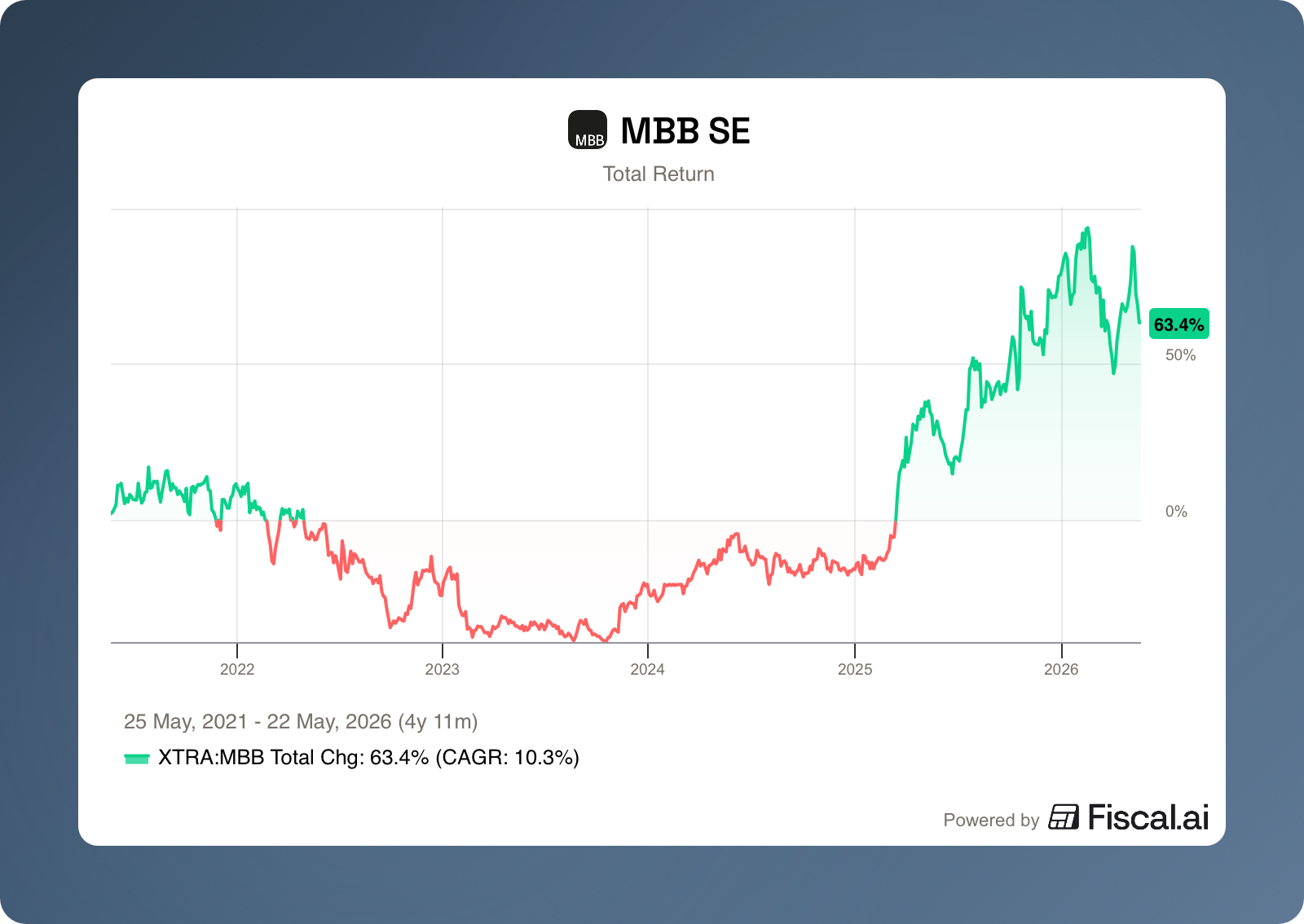
MBB reported for Q1 2026 a revenue decline of nearly 9% to EUR 237.5 million, but a profit jump of 40% to EUR 41.9 million, almost entirely driven by Friedrich Vorwerk (margin rising to 22.8%), while Aumann and DTS IT declined due to the German automotive crisis and chip shortage respectively. Equity passed EUR 1 billion for the first time around the 20th anniversary of its listing, with a net cash position of EUR 766.2 million, an eighteenth consecutive dividend increase and an extensive share buyback programme; despite the strong figures, the share price fell 9.5%, meaning that, according to CFO Teichler's sum-of-the-parts analysis (EUR 211 per share from cash and listed holdings), MBB is trading at a discount whereby DTS and Hanke are effectively included for free.
In Brief:
Constellation Software (Toronto: CSU) has once again completed three acquisitions. Subsidiary Modaxo is taking over the Public Transit division of listed company Conduent for USD 164 million. This involves fare management (known from the fare gates at, among others, SEPTA) and fleet management. It possibly concerns the Transit Solutions division, which generated approximately USD 371 million in revenue in 2025, which would amount to a multiple of just 0.4x sales. That low valuation can be explained by the fact that Conduent is acting as a forced seller following a failed implementation of a USD 1 billion transport contract in Melbourne, about which the Victorian Auditor-General published a scathing report in March 2026. Conduent, spun off from Xerox in 2017, retains its tolling operations. In addition, subsidiary Andromeda has acquired India's Peocit, which supplies multilingual banking software and advisory services to financial institutions, and Volaris acquired Switzerland's Swiss Learning Hub, active in edtech with digital education platforms for businesses and individuals; Swiss Learning Hub was spun off from Crealogix in 2019, and since Volaris already acquired Crealogix in 2024, these operations are now being merged back together.
Also Topicus (Toronto: TOI) has completed a new acquisition. In France, the company acquired Operis. This company supplies a platform for urban planning and land management to more than 60% of all municipalities and local authorities in France. The acquisition marks Topicus's 22nd acquisition in the Francophone region and is also their first step into this specific vertical market segment.
Addtech (Stockholm: ADDT-B) Addtech has acquired the Dutch company Nijhuis Engineering B.V. The company, based in Dronten, develops and supplies patented system platforms for road and rail construction machinery, including systems for safety, load handling and electrical conversion that are sold under its own brand name, mainly within the European rail segment. Nijhuis Engineering employs 23 people, generates annual revenue of approximately EUR 6 million and will be integrated as an addition within the Mobility business unit.
3i Group (London: III) has begun its GBP 750 million share buyback programme. During the first two trading days, the investment company bought back its own shares for just over GBP 15 million. This capital allocation coincides with various insider purchases by Chief Operating and Financial Officer Jasi Halai and persons closely associated with her. Between 14 May and 18 May 2026, they jointly acquired 6,599 shares for a cumulative amount of GBP 141,586. In addition, CEO Simon Borrows also bought extra shares for a total of more than GBP 1 million.
Sofina (Brussels: SOF) has expanded its portfolio with two new strategic investments. It took part in the USD 120 million Series B+ funding round for Shanghai HyperShell Technology, founded in 2021. This robotics specialist is developing the world's first consumer-oriented, AI-driven outdoor exoskeletons that use smart algorithms to reduce joint strain. In addition, Sofina led a USD 100 million Series C funding round for Primer. This platform is developing an integrated, AI-based payment infrastructure to streamline fragmented payment systems for global online retailers, with the capital being used for technological innovation and team expansion in the United States.
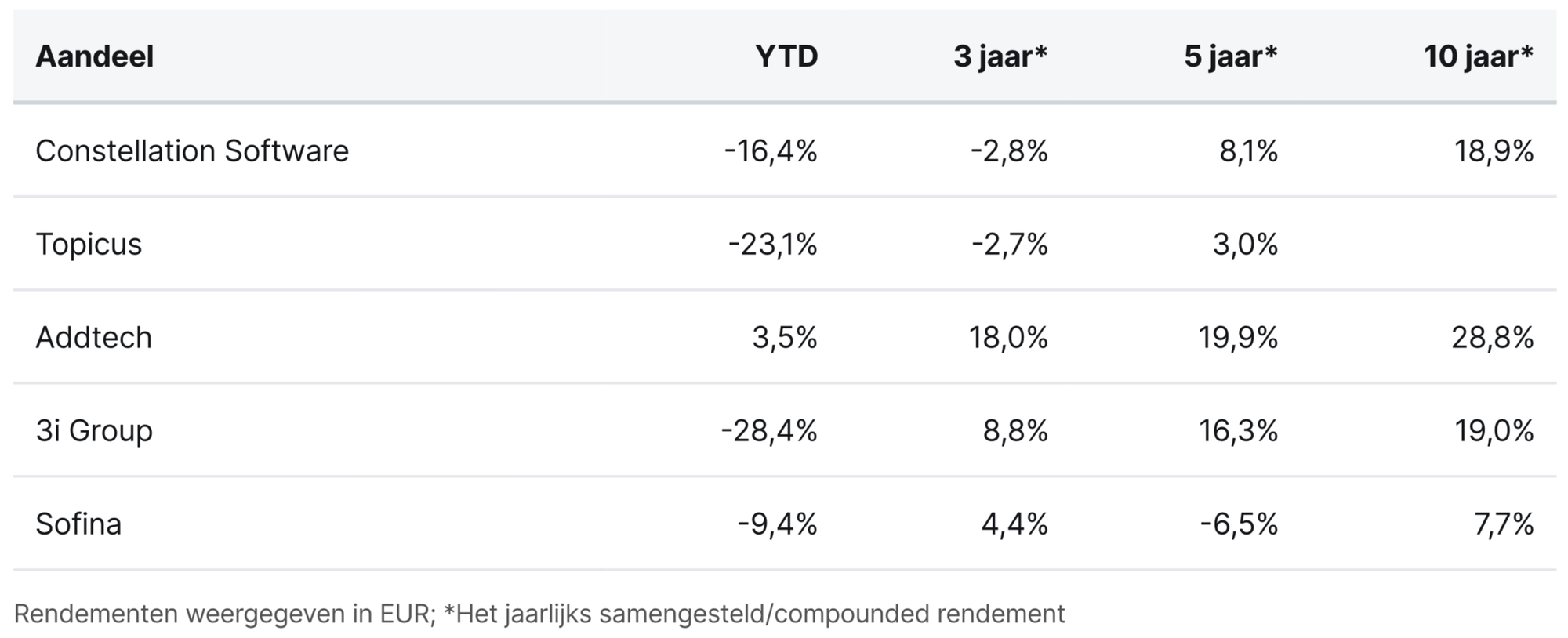
Constellation Software, Topicus, AddTech, 3i Group and Sofina are currently trading on the Toronto, Stockholm, London and Brussels exchanges at prices of CAD 23,724.88, CAD 97.42, SEK 340.40, GBP 23.10 and EUR 223.80 per share, respectively.
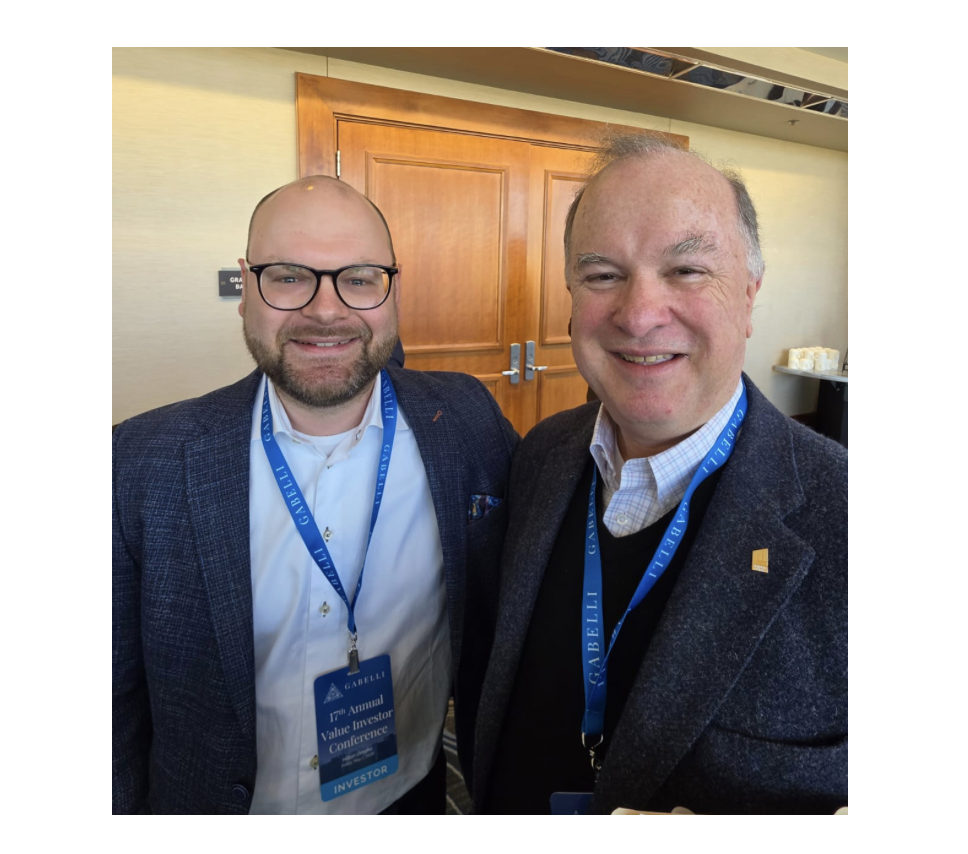
This week, Joep Dikken visited the Quality Growth conference in London. Below is a report of his findings there.
Report on the Quality Growth Conference in London
This week I am writing from a rarely sunny London, where I had the opportunity to attend the annual Quality Growth Conference. I also paid visits to various portfolio companies and prospective companies to discuss the current markets with them. As the name of the conference suggests, various managers speak here, each with their own view, focus and areas of concentration, but who, in the broadest sense of the word, all share a quality bias.
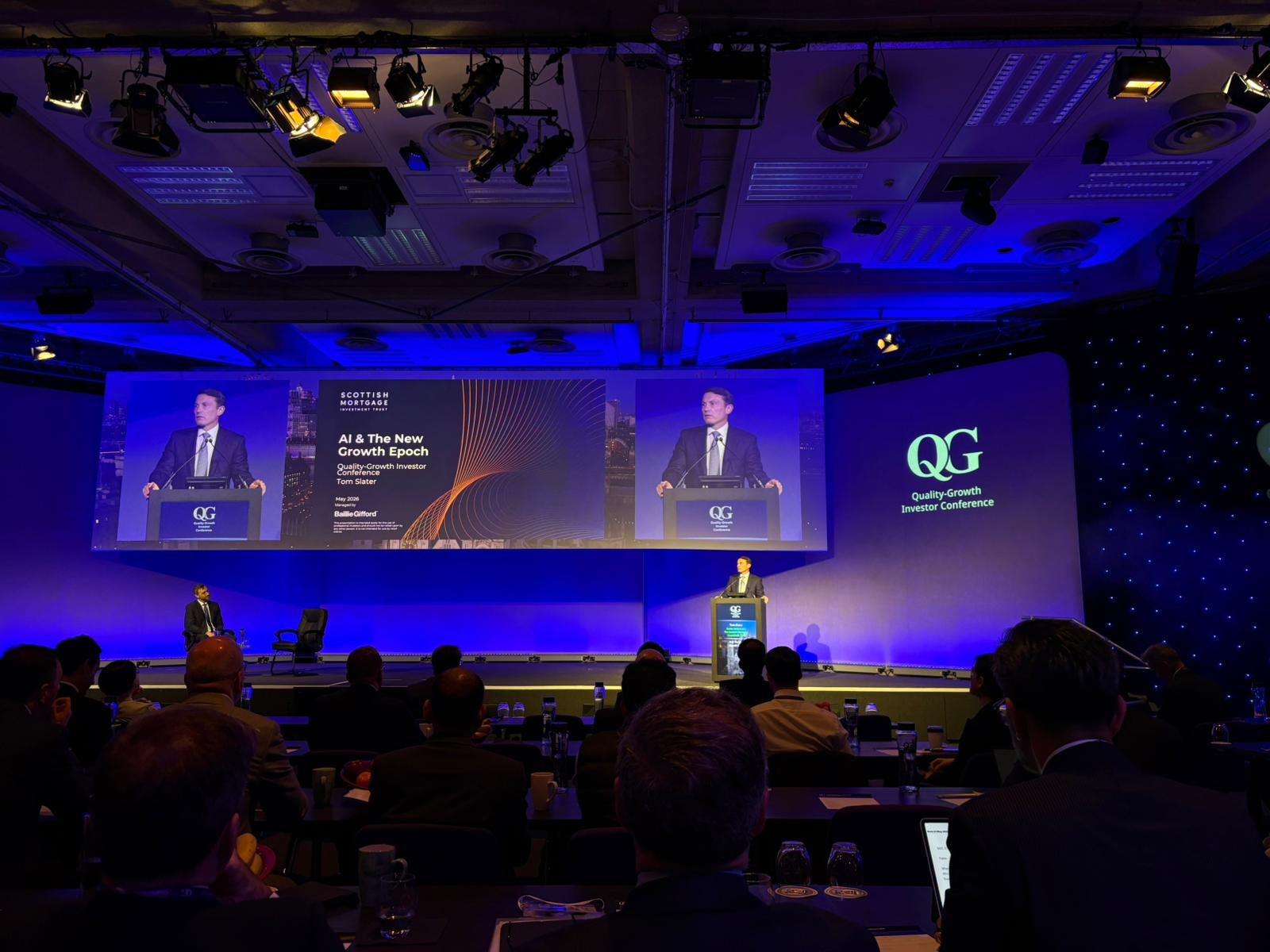
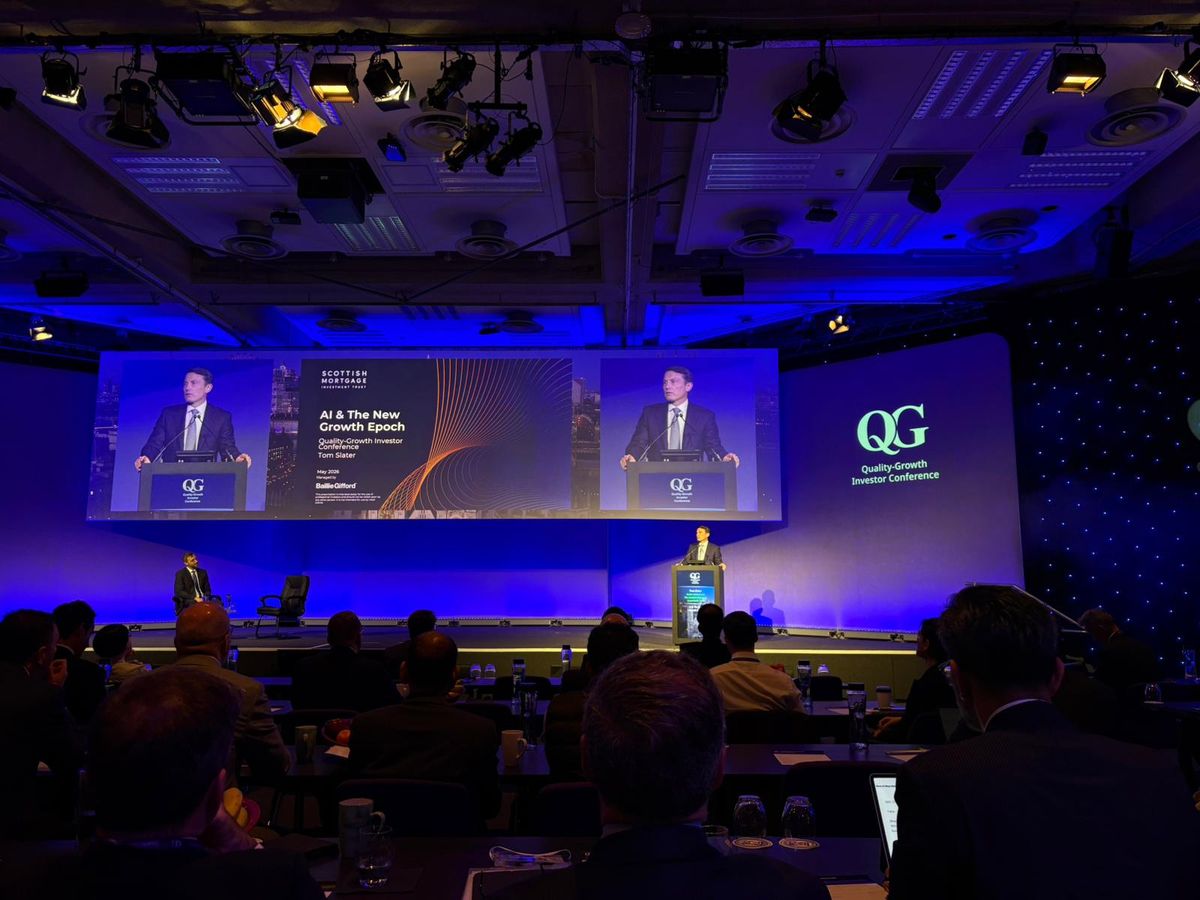
Whereas I can imagine that in previous years the conference had more the character of a Quality Value congress, this year there was of course a great deal of attention for technology. Partly thanks to the presence of Tom Slater, partner at Baillie Gifford and portfolio manager of Scottish Mortgage Investment Trust (London: SMT).
Slater was given the honour of kicking off the conference with the first presentation. Whereas the other managers mainly presented a stock pitch (which is also the idea of the conference), Slater offered a broader view of the investment universe and mainly discussed the remarkable times we currently find ourselves in.
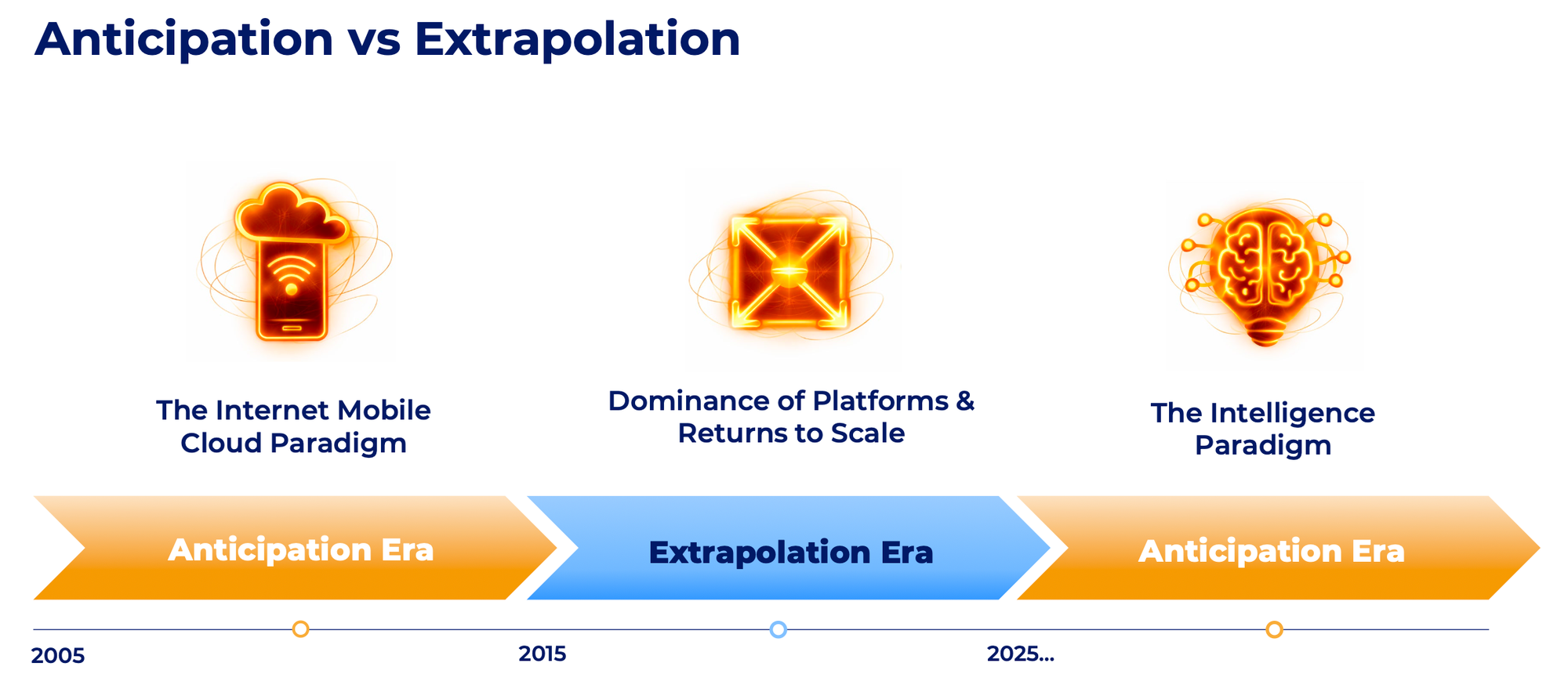
Slater began his presentation by outlining the past few decades, dividing the last twenty years into two phases. The first period ran from 2005 to 2015 and, according to him, was the anticipation phase. Slater labelled this phase the innovation phase: a new technology is developed and it is not yet clear what the ultimate effects will be, or where and when this will normalise. The second phase began in 2015 and ran until 2025: the so-called extrapolation phase. This phase is characterised by 'more of the same'. An enormous wave of investment has taken place for the implementation of the new disruptive technology that has entered the market, and this is now giving way to a broadening of the implementation phase. It stands to reason that the market therefore finds itself in an anticipation phase once again; this time not around software, but around AI.
In this phase, it is crucial that you are on the right side of history, according to Slater. History teaches an important lesson here. When the first internal combustion engine was invented in 1880, it was not a great success. Everyone had a horse and cart and did not want to switch to the new technology, which was unreliable and expensive. It brought only more complexity and inconvenience. Although the vast majority of humanity simply carried on living with horses, and the horse population even continued to grow, the combustion engine kept getting better and cheaper in the meantime. It was not until thirty years later, in 1910, that the tipping point arrived. By then the engine was reliable, affordable, powerful and user-friendly. More and more people bought a car, and over the following twenty years the horse population fell by 90%. Very subtle, small changes, and then suddenly everything at once.
Slater says this is a situation that could potentially also occur at portfolio company Aurora (which focuses on autonomous trucking). In the AI market, however, this phenomenon is already in full swing. On this, he said:
"The most valuable companies are the ones that start as applications and then become the infrastructure."
It started with Dell, which designed the computer. On top of that came Microsoft with its M365 application. The product became so successful that it became the new standard, and thus the infrastructure of software. Microsoft has long been able to enjoy this dominance, but now there is a new disruptor in the form of Anthropic, which is once again applying a new application layer on top of the layer built by Dell and Microsoft, in the form of Claude. Because new technologies and innovations are being developed ever faster, it no longer takes thirty years for the market to realise that a disruption is taking place. The effect of a tipping point will therefore unfold even more quickly than in the 1900s. This is clearly visible in the revenue development of such companies.
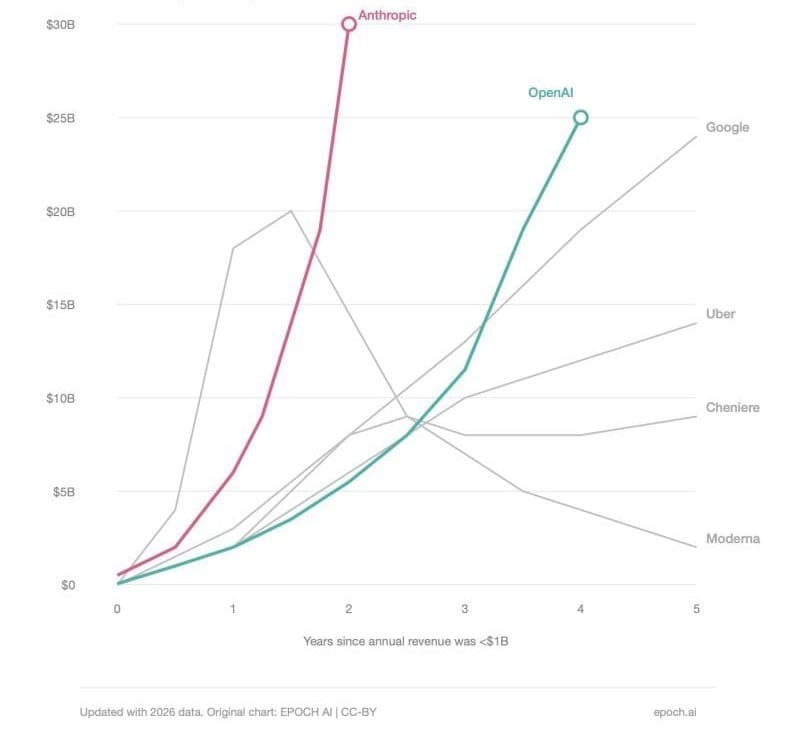
Anthropic is the fastest, and OpenAI the second-fastest company to have grown to USD 30 billion in ARR since being founded. Slater argues that this is because these companies are no longer led by managers, but by founders. Not by entrepreneurs who hire engineers and specialists, but by researchers and technical experts who have become entrepreneurs. A crucial difference. You see this reflected in many companies:

This new wave of founders is crucial in the current anticipation phase. In this context, anticipation is a synonym for innovation capacity. A founder understands the opportunities and risks of their own product or service better than anyone else. Slater labels it a form of moral authority. They have their own vision and develop the company much faster than non-technical leaders, which is a crucial trait in a phase where new technology is developing faster than people can keep up with.
"Non-technical leaders are roughly 12-24 months behind technical leaders, and this gap will not close, it will only widen even more."
This offers a form of flexibility in a time of uncertainty, a rare and powerful combination. This concerns the flexibility to switch between different layers of the build-out: from application to agentic, to data, to compute, and so on. A good example of this flexibility is Alphabet, which has developed over recent years to the point where it now represents virtually the entire AI stack.
Slater closed his presentation with the following points:
- Hiding is pointless: the technology will be implemented everywhere.
- Technical expertise among founders is a must.
- Only a handful of companies will be the absolute winners.
During the event, I also spoke extensively with many members of the Scottish Mortgage Investment team who were present, including portfolio manager Tom Slater and portfolio director Claire Shaw. The timing could hardly have been better. The evening before the event, SpaceX published the official filings for its upcoming IPO.
Scottish Mortgage's portfolio currently consists of almost 20% of its stake in SpaceX. Two weeks ago, they published that little was known about the way in which the company is bound by lock-up rules around its shares, both in the run-up to and after the IPO. Today (22 May 2026) Scottish Mortgage has published an update on this. The S-1 prospectus was officially filed with the SEC on 20 May, and based on this, Scottish is now sharing more details about the lock-up conditions.

Instead of a standard hard lock-up of 180 days, SpaceX has opted for a phased, staggered system in which existing shareholders can sell parts of their position even before the end of the six months. The release is linked to both quarterly results and fixed time intervals. Following the first quarterly figures as a listed company (Q2 2026, expected August/September), 20% of the locked-up shares will be released, or 30% if the share price is at that point at least 30% above the IPO price. After the Q3 figures (October/November), another 28% will follow, regardless of the share price. In addition, at five fixed moments (70, 90, 105, 120 and 135 days after the IPO), 7% of the shares will be released each time. Any remaining shares will be fully released on day 180, expected to be around mid to late December 2026.
Scottish Mortgage does note that the final conditions may still differ from what is currently stated in the preliminary S-1. It is also a good test for the team, which will likely go through a similar process later this year around Anthropic's IPO.
As an investor, it is clear that the IPO relies heavily on hope and expectations. SpaceX noted in the document a Total Addressable Market of no less than USD 2,850 billion, of which USD 2,250 billion in AI solutions; read: data centres in space. SpaceX states that the technology required for this is not complex, and that the current Starlink satellites are even more complex. According to the company, it will therefore not take long before the first data centre satellites are operational. Once these are up and running, they would be capable of delivering 200 GW of capacity per year. An important caveat is that this is a prediction from Elon Musk, and should always be taken with a grain of salt.
Enough to be excited about, but also enough to be concerned about. We are keeping a close eye on developments.
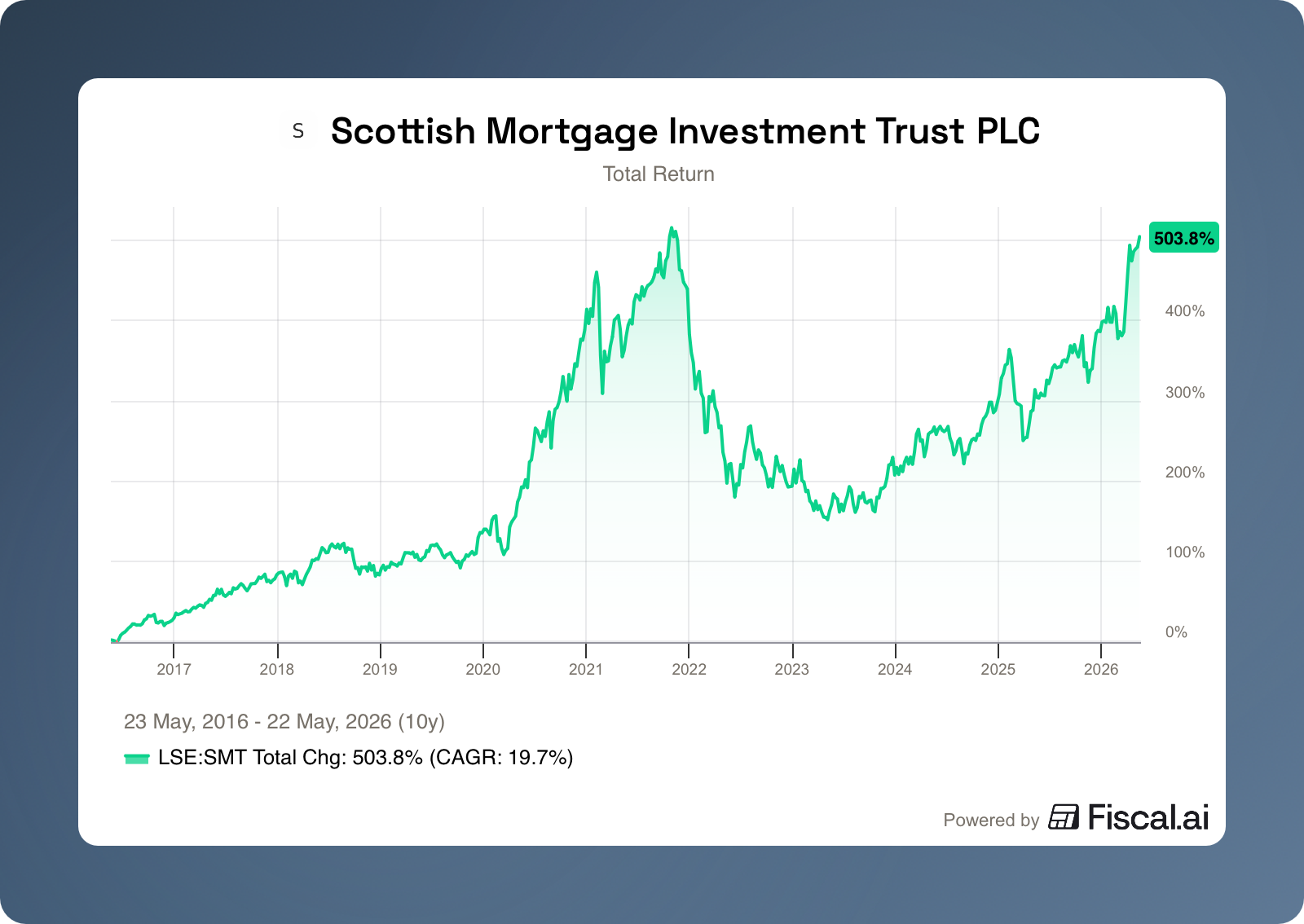
Scottish Mortgage Investment Trust ended the trading week on the London Stock Exchange at a price of GBP 14.98 per share.
Fan mail from analysts for Chapters, Heico and Markel
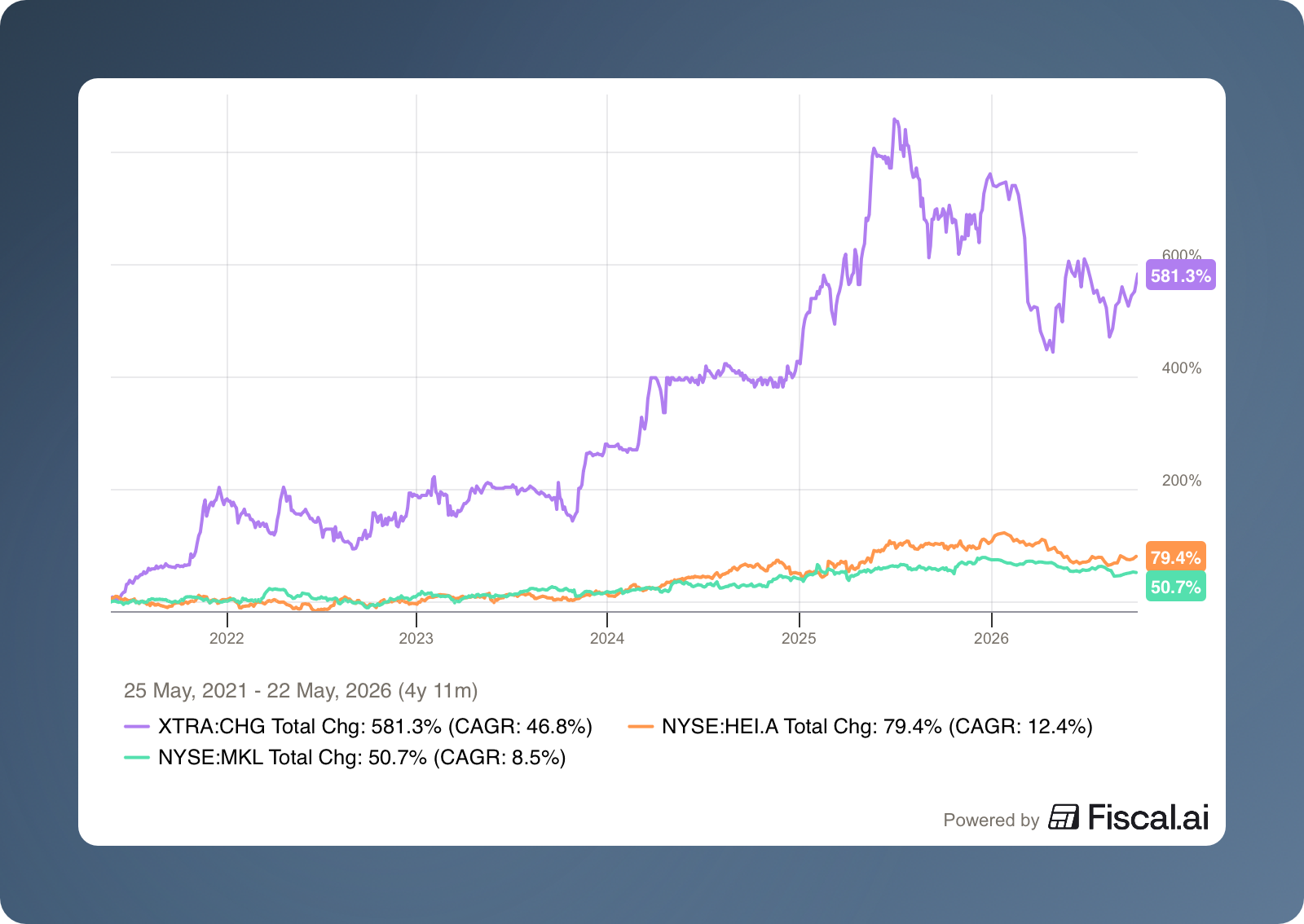
Besides the articles we write ourselves, we of course also read third-party analyses of the family holding companies and serial acquirers that we follow. Recently, Chapters Group (Frankfurt: CHG), Heico (New York: HEI-A) and Markel Group (New York: MKL) were in the spotlight. We share a brief summary here and link through to the full article.
Berenberg initiates coverage of the German software holding company Chapters Group with a buy rating and price target of EUR 42. The analysis points to the growth pipeline in the fragmented European landscape for industry-specific business software. Chapters owns over 60 niche software companies in Germany, France, Austria, Czechia and Slovakia, targets acquisitions below 6.5 times EBITDA and, according to Berenberg, has a potential pool of 15,000 to 22,000 targets. Analyst Andreas Wolf expects revenue to rise from EUR 160 million in 2025 to EUR 350 million in 2027, with annual gross profit growth of over 50 percent between 2026 and 2028, compared with 13 percent for sector peers. The valuation of 19.2 times EV/EBIT 2027 is above the median of 13.9 times, but according to Berenberg is justified by this growth profile. For followers of family holding companies, the shareholder register is especially relevant, with Danaher co-founder Mitchell Rales (14.6 percent), Sator Grove Holdings (15.1 percent) and Spotify founder Daniel Ek through his family office Stravaigin (11.2 percent). The main risks are a slowdown in deal flow, increased competition for acquisitions and the impact of artificial intelligence on switching barriers for software customers.

Rothschild & Co Redburn takes a closer look at Heico with a buy rating and price target of USD 360 (for ticker symbol HEI, not HEI-A), arguing that the recent pullback in the aviation and defence sector offers investors a fresh entry point into this family-run acquisition machine led by the Mendelson family. Analyst Joe Orchard notes that precisely when airline margins come under pressure and airlines shift into cost-cutting mode, Heico's cheaper, FAA-approved parts and maintenance services gain market share, allowing the Flight Support Group to grow faster than the broader replacement parts market. For the Electronic Technologies Group, Rothschild sees tailwinds from increased US defence spending, sector backlogs and cost-plus contracts. The firm expects average organic revenue growth of 9 percent per year between 2025 and 2030, well above the historical average of 6 percent and the consensus estimate of 7 percent. Heico trades at 25 times EV/EBITDA 2026, a premium of around 50 percent to aviation peers and thus well below the average premium of around 100 percent over the past decade. According to Rothschild, that is an attractive starting point given the above-average growth profile and the family's proven acquisition model.
Andrew Bary of Barron's calls Markel Group an attractive buy now that the share trades at 1.2 times its book value of USD 1,450 per share as of 31 March, below its recent average of 1.4 times, with a market value of USD 23 billion and a price-earnings ratio of 13.2 based on estimated 2026 earnings. The trigger is the recent activist letter from Jana Partners, which challenges the "unique flywheel" of insurance and Ventures, argues that the current structure delivers lagging returns and calls for a spin-off. Well-run specialty insurers such as Berkley and RLI, after all, trade at 2.5 times book value, double Markel's multiple. CEO Tom Gayner is sticking with the diversified model and received backing from Berkshire director Chris Davis, who called the split-up idea one of the dumbest suggestions of the past twenty years. Bary acknowledges that Markel does not have Berkshire-quality businesses, but points to an improving insurance story, a strong balance sheet, a market value of only 2 percent of Berkshire's size and, as a result, better growth prospects. The presence of Jana also serves as a warning for Berkshire itself, because if this holding company fails to perform after Buffett's death, it too could become an activist target.
Chapters Group, Heico and Markel are currently trading on the Frankfurt and New York stock exchanges at prices of EUR 32.65, USD 224.84 (A-share) and USD 1,852.28 per share respectively.
Receive weekly insights in your inbox
Exclusive analyses and updates on family holding companies and global market developments.
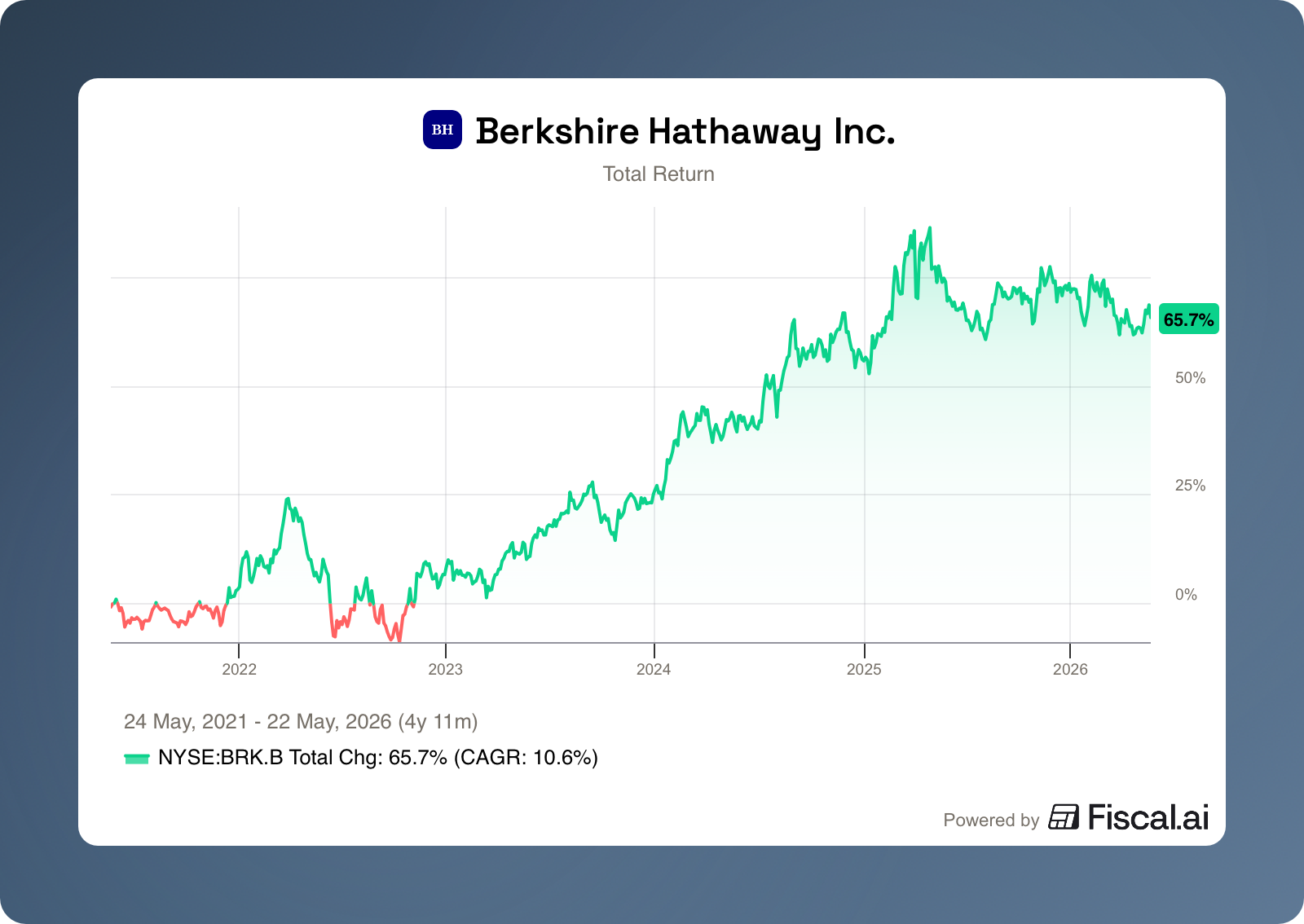
Berkshire Hathaway cleans house under new chief executive
The American investment holding company Berkshire Hathaway (BRK-B) published its quarterly filing with the American securities regulator SEC on 15 May, covering its equity positions as at 31 March. It is the first so-called 13F filing under chief executive Greg Abel, who took over from Warren Buffett on 1 January 2026. Abel confirmed that he consults Buffett on an almost daily basis. Abel manages 94 percent of the listed portfolio, while Ted Weschler is responsible for the remaining 6 percent, as revealed in Abel's first shareholder letter.
The largest change during the quarter was a tripling of the stake in Alphabet. The combined position stood at a market value of USD 16.6 billion at the end of March, making it the seventh-largest position in the portfolio. A purchase of this size is almost certainly a decision made by Greg Abel, whether or not after consultation with Buffett. Analysts read the purchase as an unusually explicit bet on the technology holding company's positioning in artificial intelligence, with building blocks including the Gemini language model, Google Cloud as the fastest-growing of the three major cloud providers, the TPU chips, the self-driving project Waymo, and large stakes in SpaceX and Anthropic. In the short term, this purchase has in fact turned out spectacularly well: Alphabet has risen more than 38 percent since the end of March. As a result of price developments, the stake in Alphabet's A and C shares is now worth almost USD 22.5 billion. An interesting piece of trivia is that Google's founders restructured their company into a holding company after consulting Buffett a little over ten years ago.
What also stands out is the scale of the clear-out. The portfolio shrank from 40 to 26 positions, one of the most drastic changes in years. Berkshire exited fifteen names entirely. According to The Wall Street Journal, Abel decided to sell off all the positions previously managed by Todd Combs in one go, after Combs left for JPMorgan at the end of 2025. Visa and Mastercard were once his very first purchases at Berkshire and reflected large positions from his previous hedge fund, Castle Point Capital, and Amazon too had long been regarded as a Combs position.
Besides the sale of the "Combs portfolio", the stake in Chevron was also cut by 35 percent, an adjustment of 3.6 percent of the portfolio weight and thus one of the largest changes. The oil company's share price peaked at the end of the quarter amid the turmoil surrounding the Iran war, so this can be regarded as profit-taking by Berkshire.
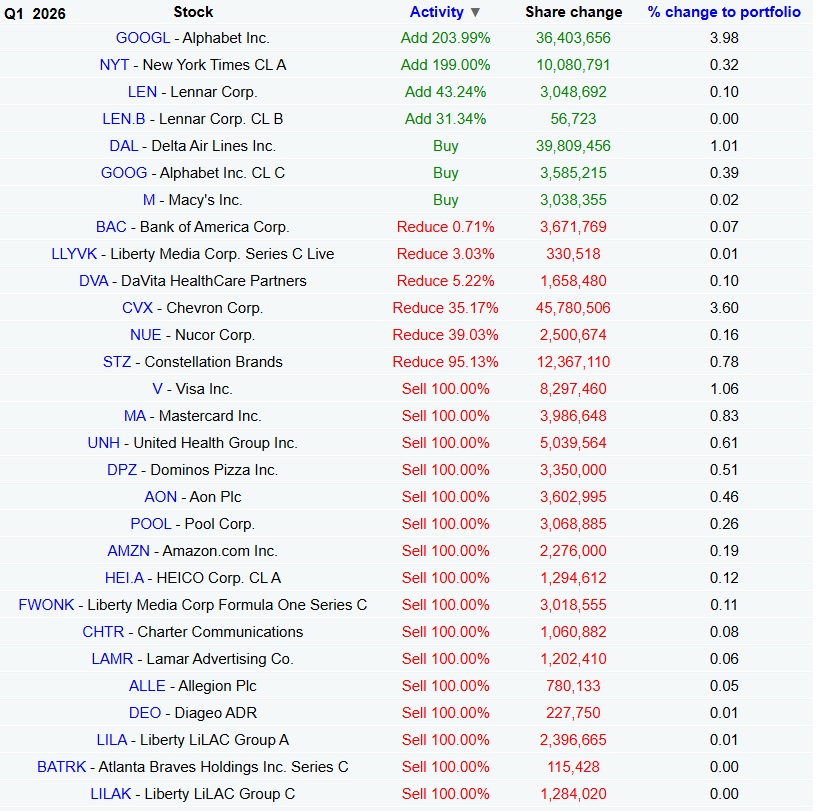
Besides the increase in Alphabet, the return to the aviation sector on the buying side is particularly notable. Berkshire opened an entirely new position in Delta Air Lines of 39.8 million shares, worth USD 2.6 billion at the end of March and accounting for around 1 percent of the portfolio. This is remarkable given that Berkshire sold all its airline holdings (United, American, Southwest and Delta, together worth more than USD 4 billion) during the pandemic in 2020, reasoning that the pandemic had permanently changed consumer behaviour and travel patterns. Buffett had in fact avoided the aviation sector for years prior to that following a disappointing investment in US Airways back in 1989, and wrote in his 2007 shareholder letter about the sector that the worst kind of businesses are those that grow rapidly, require a great deal of capital and then earn little or no money on that capital. The investment in Delta Air Lines is therefore somewhat of a question mark as far as we're concerned.
The market reaction following publication of the 13F shows that the copy-trading behaviour around Berkshire persists even without Buffett as CEO. Delta and Macy's (likely a Weschler purchase) rose sharply after the market reopened on Monday, while UnitedHealth lost more than 2 percent on the news of the exit.
Conclusion
Although we consider it a logical move that Combs's positions were sold after he departed as portfolio manager, we regret the sale of high-quality businesses such as Visa, Mastercard and Heico. Holding onto these companies would always have been preferable to a larger cash position. Given the decades-long position in industry peers such as the listed American Express and full ownership of Precision Castparts, it can be said that there was ample sector knowledge available to maintain these positions, or even scale them up substantially. Fundamentally speaking, Q1 was, if anything, probably a good buying opportunity for these specific companies.
We also find the choice of Delta notable. This is a company in an industry that Buffett himself, of all people, has labelled unattractive. It was during Abel's tenure as vice chairman that the airlines were sold, and now he appears to be the one betting on this sector.
Looking at the largest changes in terms of portfolio impact, however, we do have to give Abel credit. Trimming Chevron at an oil price peak was tactically well timed. Even more important is that, unlike Warren Buffett, he appears to feel comfortable investing in the technology sector. That opens up opportunities given a war chest of more than USD 380 billion. We personally regard Alphabet as one of the best-positioned technology companies, with a broad spread of various business segments that all enjoy a strong competitive advantage. Abel may well regard Alphabet as a new long-term position.
Berkshire Hathaway is currently trading on the New York stock exchange at a price of USD 485.41 per B share.
Receive weekly insights in your inbox
Exclusive analyses and updates on family holding companies and global market developments.
MBB smashes through the EUR 1 billion equity threshold
The German investment holding company MBB (Frankfurt: MBB) presented its first-quarter 2026 results on 12 May. Despite a revenue decline of almost 9% to EUR 237.5 million, operating profit rose by more than 40% to EUR 41.9 million. The operating profit margin thus came in at 17.7%, against 11.5% a year earlier. Nicely timed, right at the moment MBB celebrated its 20th anniversary as a listed company on 9 May, equity crossed the EUR 1 billion threshold for the first time. At the IPO in 2006, this stood at just EUR 35.3 million, an increase of almost 2,760%.
"It's nice and interesting to look back at some of those old IPO presentations and see how much of what was said and promised back then still holds true today."
Torben Teichler, CFO MBB SE
Vorwerk
The largest part of the profit jump is attributable to subsidiary Friedrich Vorwerk. Revenue there rose by 4.6% to EUR 139.2 million, while the operating profit margin surged from 13.7% to 22.8%. CFO Torben Teichler pointed to a favourable project mix, a higher own share in major contracts such as A-Nord, solid contributions from consortiums (ARGE), and a one-off book gain of EUR 1.7 million on the sale of a business site. Notably, founder and Executive Chairman Christof Nesemeier indicated in his interview with Börsen Radio Network that he himself had not expected these results. The weather in January and February was so poor that construction staff and equipment could barely get to work, and yet Vorwerk still generated more revenue and considerably more profit than a year earlier.
"The weather was so bad that we couldn't really put our people and machines to work. Much worse than the comparable spring, and yet we achieved slightly more revenue and a great deal more profit. That shows how much tailwind this company is currently experiencing."
Christof Nesemeier, Executive Chairman MBB SE

Order intake at Vorwerk rose by more than 50% to EUR 195.6 million, while the order book including consortiums stands at more than EUR 1.4 billion. For 2026, the company maintains its guidance of EUR 730 to EUR 780 million in revenue and EUR 160 to EUR 180 million in operating profit, implying a margin of 21 to 25%. Vorwerk's positioning fits seamlessly with everything that is politically prioritised in Germany. The Bundesnetzagentur has now approved the German hydrogen core network with more than 9,000 kilometres of pipeline and expected investments of almost EUR 19 billion, important parts of which are to be brought into operation by 2032. Nesemeier emphasised that Vorwerk is active in virtually all relevant segments:
"We are actually active in all the central growth markets within this specialised infrastructure. That includes overhead cables, onshoring, transformer stations, the entire gas infrastructure, hydrogen, district heating and carbon capture. In that sense, with Vorwerk, we operate in a truly very interesting market."
Christof Nesemeier, Executive Chairman MBB SE
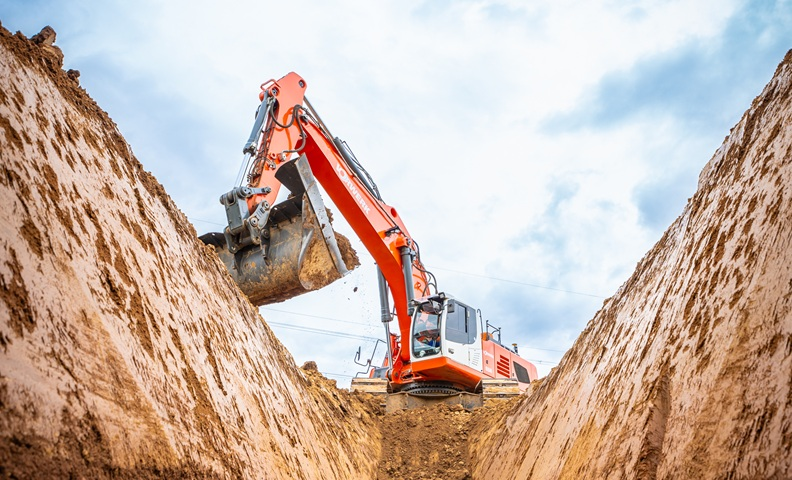
Since MBB took a stake in 2019 at a turnover of less than EUR 100 million, Vorwerk has grown into a company with turnover of over EUR 700 million and an operating profit margin of more than 20%. During the quarter, MBB sold 897,190 Friedrich Vorwerk shares, reducing its stake from 44.3% to 39.8%. According to Nesemeier, this was a portfolio balancing exercise and explicitly not a strategic decision to reduce the stake.
Aumann
At Aumann, turnover fell 38.4% to EUR 37.3 million, hardly surprising given the state of affairs in the German automotive sector. Nesemeier was notably relaxed about this development. He pointed out that, looking two years ahead, Aumann's turnover will decline from over EUR 300 million to EUR 160 million in 2026, with a possible further decline in 2027. However, offsetting this decline is a net cash position of almost EUR 150 million, substantial equity, own premises in excellent condition, and strong technological positions. Aumann's operating profit margin remained virtually stable at 10.7% (was 11.1%), which shows that management has a firm grip on the cost structure. Aumann is fully committed to diversification via the Next Automation segment (cleantech, aerospace, life sciences), where order intake grew by almost 130% to nearly EUR 20 million.
"Aumann has a strong net cash position of EUR 144 million, and this allows management to continue developing these new end markets, not only organically but potentially also through acquisitions."
Torben Teichler, CFO MBB SE

DTS IT
Unlike at Aumann, the slowdown in turnover at DTS was unexpected. DTS reported 25.2% lower turnover (EUR 19.6 million) due to project delays resulting from problems in the memory chip market and the postponement of customer decisions because of geopolitical unrest surrounding Iran. At the same time, the operating profit margin rose from 14.7% to 17.2%, thanks to a favourable shift towards services and software, efficiency improvements, and an increasing internal use of AI. Teichler expects a gradual recovery in Q2 and a strong second half of the year. As for M&A, DTS has shifted its focus from software add-ons to broadening its geographic reach within Germany, with southern Germany in particular now in view.
"We are working on our profit quality, and I think we will see a slight margin improvement this year as we focus on our services and software business, and of course try to increasingly leverage the benefits of AI throughout our organisation."
Torben Teichler, CFO MBB SE
Delignit grew slightly by 4% to EUR 18.1 million in turnover, with an operating profit margin of 6.4%. At the unlisted subsidiaries Hanke Tissue and CT Formpolster, according to Nesemeier, two factors are at play. First, the sharply increased energy and raw material prices, which cannot immediately be passed on in selling prices and are temporarily weighing on margins. Second, subsidised imports from China, which, due to the ongoing trade barriers towards the United States, are now being channelled towards Europe to an increased extent. Nesemeier was notably outspoken about this.
"We hope that the political institutions think carefully about whether it makes sense for toilet paper from China to come to Germany, forcing us to shrink our own factories as a result. In the long term, that clearly makes no sense."
Christof Nesemeier, Executive Chairman MBB SE

Financial position
As at 31 March 2026, the balance sheet shows EUR 1,009.2 million in equity, a solvency ratio of 68.9%, and a net cash position of EUR 766.2 million, of which EUR 415.6 million is held at holding company level. At the Annual General Meeting on 3 June, the board will propose a dividend increase to EUR 1.21 per share, marking the eighteenth consecutive dividend increase. Nesemeier emphasised that this is deliberately not a special anniversary dividend, since MBB already celebrated the company's 30th anniversary last year with a threefold dividend. Instead, MBB is opting for a substantial share buyback programme. This was increased on 13 April from EUR 22 million to EUR 25 million and will continue until 20 May.
"The share buyback programme has a volume that is four times the size of the dividend. If you were to translate that, we are effectively paying out dividend fivefold."
Christof Nesemeier, Executive Chairman MBB SE
Acquisitions
On the M&A side, Nesemeier indicated that he regards the current market climate as favourable for new acquisitions. At the same time, he asked for patience: historically, MBB has not done a particularly large number of deals, but has bought the right companies at the right moment and managed to generate above-average returns with them.
"Acquiring isn't just about buying five companies a year. Personally, I think it's more important to find the right moment for the right target. We weren't particularly active in terms of acquisitions, but when we were active, we often had a good nose for it and caught a durable trend that delivered superior returns for us."
Christof Nesemeier, Executive Chairman MBB SE
Guidance and valuation
For 2026 as a whole, MBB is sticking to its guidance of EUR 1.1 to EUR 1.2 billion in revenue and an operating profit margin of 15 to 18%, although Teichler called the lower end of that margin "rather conservative".
Despite figures that were good on nearly every front, the market reacted coolly. MBB's share price fell 9.5% after publication, while Friedrich Vorwerk lost over 11% to EUR 73.70. The cause therefore lies mainly with Vorwerk (and possibly DTS), where revenue and earnings per share came in just below consensus and the full-year guidance was not raised.
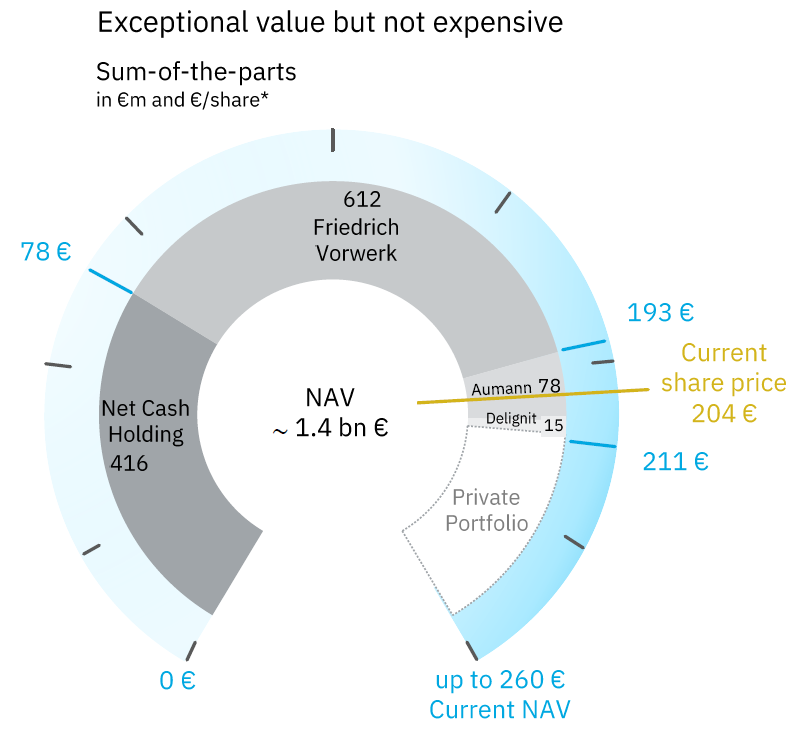
During the results presentation, Teichler concluded with a sum-of-the-parts calculation that appeals to us: the net cash position at holding company level and the value of the listed stakes in Vorwerk, Aumann and Delignit alone already add up to EUR 211 per share. This means MBB is trading around the current share price at a discount to its liquid portfolio alone, with the unlisted stakes in DTS and Hanke effectively thrown in for free on top of that.
MBB SE ended the trading week on the Frankfurt exchange at a share price of EUR 189.40.
Receive weekly insights in your inbox
Exclusive analyses and updates on family holding companies and global market developments.
Would you like more information about our services?
Get in touch
Disclaimer:
No rights can be derived from this publication. This is a publication of Tresor Capital. Reproduction of this document, or parts thereof, by third parties is only permitted after written permission and with reference to the source, Tresor Capital.
This publication has been compiled by Tresor Capital with the greatest possible care. The information is intended in a general sense and is not tailored to your individual situation. The information should therefore explicitly not be regarded as advice, an offer or a proposal to purchase or trade investment products and/or to acquire investment services, nor as investment advice. The authors, Tresor Capital and/or its employees may hold positions in the securities discussed, for their own account or on behalf of their clients.
You should carefully consider the risks before you start investing. The value of your investments can fluctuate. Past performance is no guarantee of future results. You may lose (part of) your investment. Tresor Capital rejects any form of liability for any inaccuracies or errors. This information is purely indicative and subject to change.
Read the full disclaimer at tresorcapitalnieuws.nl/disclaimer .
This article was translated automatically from Dutch using AI. In case of any difference, the Dutch original prevails. Read the original in Dutch.