
Family Holdings #22 - Three international serial acquirers with quarterly results



This week's topics:
Addtech (Stockholm: ADDT-B)'s most recent quarterly results prove that return on capital weighs more heavily than pure revenue growth. Although organic revenue growth was virtually flat, the EBITA margin shot up to a record 17.3% (16.4% after adjusting for an earn-out windfall). Despite macroeconomic headwinds in the construction sector affecting the Safety segment, a record year at the Energy division and a recovery in order intake at Automation delivered strong results. Meanwhile, the proven acquisition machine is shifting into a higher gear outside its Scandinavian home market, with a clear geographic focus on Western and Southern Europe.
Asseco Poland (Warsaw: ACP) had a strong start with proportional revenue growth of 11%, of which 8.2% was organic, with the operating profit margin improving substantially to 14.7%. Although part of this margin improvement stems from the favourable timing of profitable contracts, the efficiency programme launched two years ago is clearly bearing structural fruit. The future is largely secured by an expanding order book that already covers 93% of revenue for the rest of the year. However, the IT group is deliberately hitting the brakes when it comes to acquisitions: due to increased competition from private equity, valuations in Eastern Europe have risen, leading Asseco to prefer strict discipline over growth for growth's sake.
In Brief:
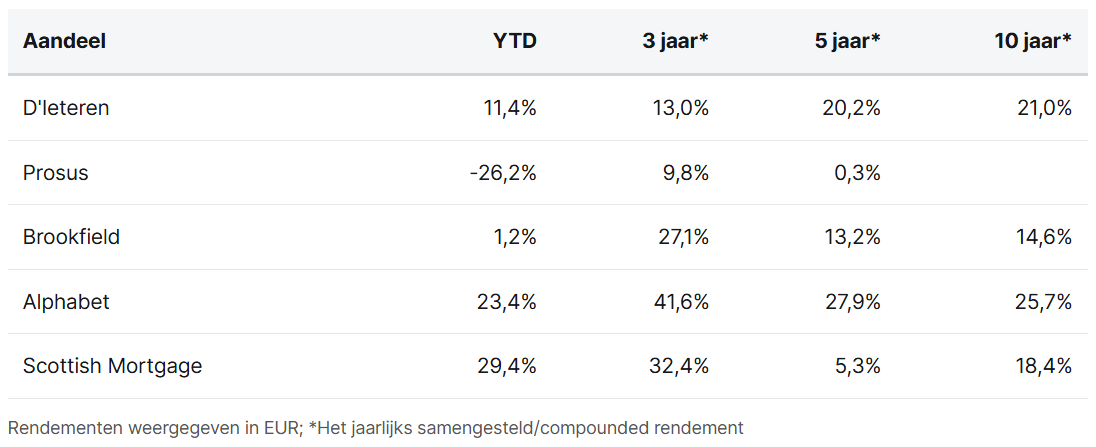
D'Ieteren Group(Brussels: DIE) posted a modest revenue increase of 0.2% to €2,924.0 million in the first quarter of 2026. The growth was driven by strong performances at windscreen repair and replacement specialist Belron, whose reported revenue rose 2.0% to €1,614.1 million thanks to organic growth of 6.9%, and by solid growth at parts distributor PHE (+9.2% to €798.1 million). TVH also grew slightly. These positive trends offset the expected lower volumes at D'Ieteren Automotive (-6.6%) and Moleskine (-4.8%). Total group revenue also suffered significantly across the board from negative currency effects, which, among other things, partly offset Belron's strong organic growth.
Prosus(Amsterdam: PRX) is in the spotlight now that Uber is considering a multi-billion-euro bid for Germany's Delivery Hero, in which the Dutch technology holding company holds a 17% stake. Uber recently made an initial bid of €33 per share and had already sounded out larger shareholders about €38 per share (which would value Delivery Hero at €11.5 billion), but this was rejected as too low. At the same time, Prosus is trying to get the European Union to scrap the mandatory sale of its remaining stake in the food delivery company; this sale condition was previously imposed following Prosus's acquisition of Just Eat Takeaway for €4 billion.
Brookfield(New York: BN) has received approval from the Toronto Stock Exchange for the extension of its share buyback programme (Normal Course Issuer Bid). Between 27 May 2026 and 26 May 2027, the investment company may repurchase up to just over 191 million of its own Class A shares, equivalent to 10% of the public float. The repurchases will take place at the prevailing market price via the exchanges in Toronto and New York.
Alphabet(New York: GOOGL) andScottish Mortgage(London: SMT) are benefiting fully from the spectacular rise of Anthropic, which, following a mega investment round of $65 billion, is now valued at $965 billion. This means the maker of the AI tool Claude has overtaken rival OpenAI as the world's most valuable AI startup. Alphabet previously held a 14% stake in Anthropic. Although the exact dilution following the recent multi-billion-dollar rounds is unclear, this position now represents an immense paper value of around $135 billion. Scottish Mortgage recently saw the AI developer already climb into the portfolio's top 10 (accounting for a 2.6% weighting). As Anthropic's market value shoots towards $900 to $965 billion, this stake is expected to further boost the trust's net asset value in the period ahead.
D'Ieteren, Prosus, Brookfield, Alphabet and Scottish Mortgage are currently trading on the Brussels, Amsterdam, New York and London exchanges at prices of EUR 171.40, EUR 39.02, USD 46.03, USD 382.67 and GBP 15.22 per share, respectively.
TerraVest defies transport headwinds
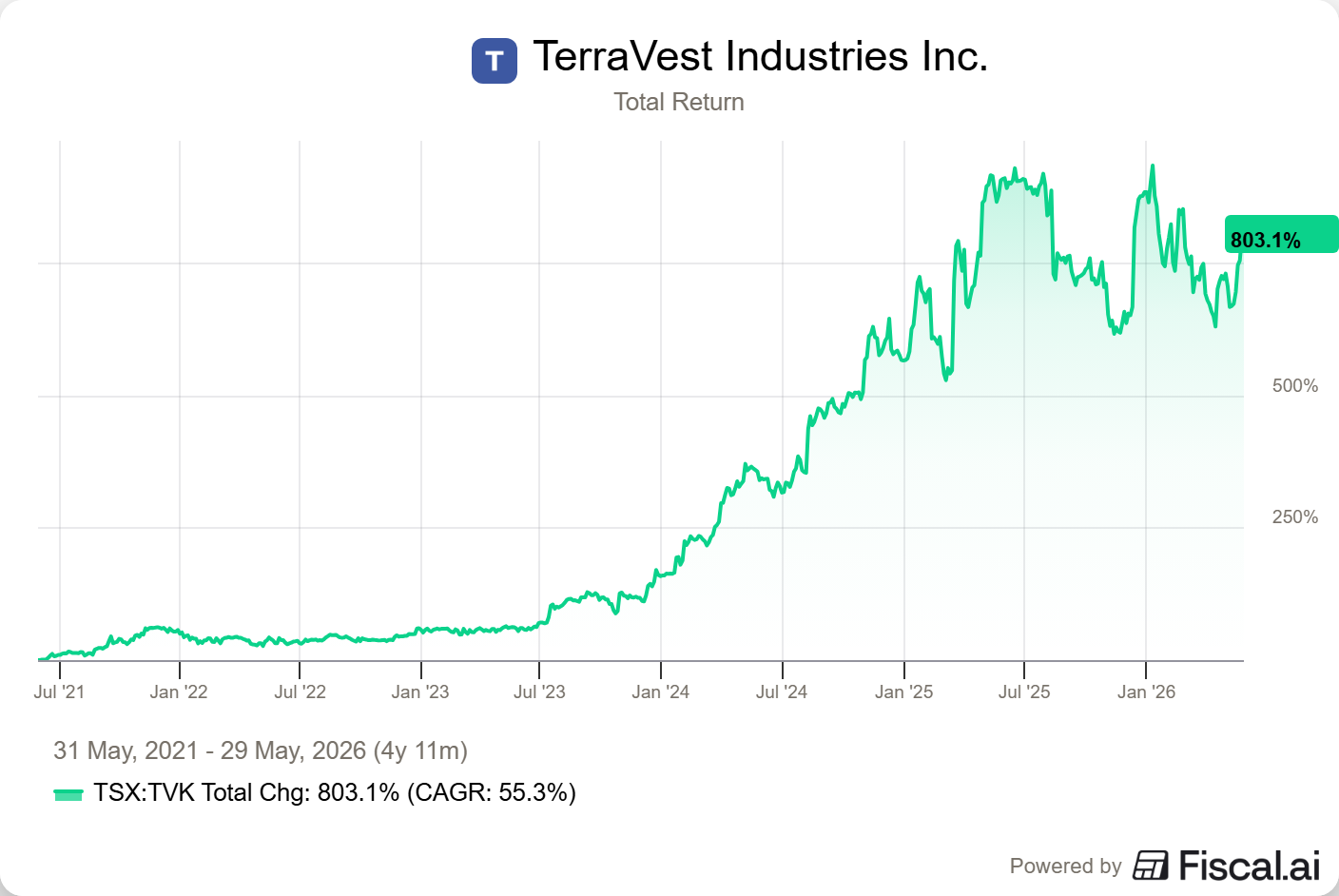
The disciplined, industrial serial acquirer TerraVest Industries (Toronto: TVK) recently reported its second-quarter results. Typical of TerraVest is the absence of an earnings call or Q&A session; the only voice of management comes through the press release and the MD&A (Management's Discussion and Analysis). This means the figures must tell the story rather than the tone of a CEO during a conference call.
Growth through acquisitions, profit under pressure
Revenue for the second quarter came in at CAD 442.6 million, up 42% year on year (and 47% adjusted for the unfavourable dollar-euro exchange rate). Over the first half of the year, the total stands at CAD 850.9 million, an increase of 56%. Virtually all of that growth is inorganic. The acquisitions of KBK, Tankcon, Simplex, LBT and EnTrans, which was folded in in March 2025, together added more than CAD 150 million in revenue, while the existing portfolio actually shrank by 7%. That contraction has a number of concrete causes: customers actively deferring deliveries, pricing pressure in the domestic tank and storage tank markets, the closure of Iowa Steel Fabricators, and a distorted comparison base caused by the timing of project completions in the Processing Equipment division a year earlier.
Net profit fell 62% to CAD 12.7 million, and profit attributable to ordinary shareholders dropped 64% to CAD 10.0 million. Diluted earnings per share fell back from CAD 1.39 to CAD 0.45. It is noted that the causes are largely mechanical in nature, as the acquisitions bring substantially higher depreciation & amortisation and financing costs, on top of which came an unfavourable shift in the product mix and a negative revaluation of an equity stake.
The true strength of the acquisition machine only becomes visible in the cash flow, where the higher depreciation charges weigh on the profit figures but leave the cash inflow intact. Operating cash flow rose 71% in the quarter to CAD 58.5 million, and over the half year by as much as 119% to CAD 155.1 million. After just two quarters of fiscal year 2026, TerraVest has already brought in more cash flow than in the whole of fiscal year 2025 (CAD 111 million), bringing it right up close to the record year 2024. Where operating cash flow in the years before the major acquisitions still fluctuated between CAD 25 and 65 million, it has effectively increased fivefold within a few years as a result of the scaling-up.
The transport cycle remains a headwind, but shows first signs of recovery
In its outlook, management writes plainly that demand for tank trailers remains weak. This mainly affects EnTrans, the platform acquired in 2025 that houses the well-known Heil Trailer and Polar Tank brands.
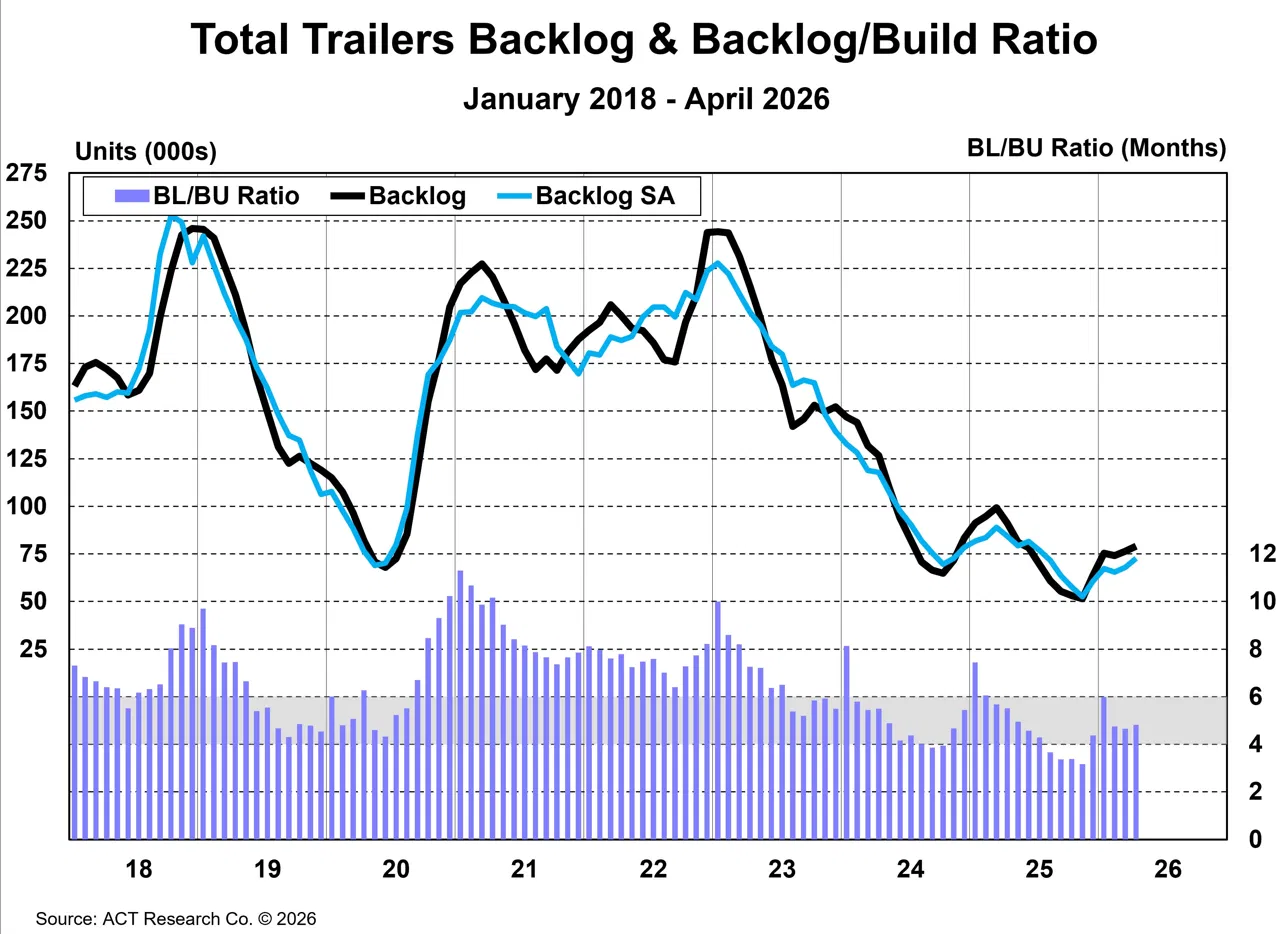
That observation ties in seamlessly with the independent market data from ACT Research. Four months into 2026, the US trailer industry still finds itself in the same challenging climate as throughout 2025, although cautious signs of recovery are becoming visible. Net orders in April came in at 19,400 units, up 3% from March and almost 127% above last year's weak April figure. The latter sounds impressive, but is primarily an arithmetic effect of the extremely low comparison base. On a seasonally adjusted basis, orders stood at 26,800 units, up 43% from the adjusted 18,800 in March — a first sign that underlying demand is picking up somewhat. The cancellation rate fell from 2.3% in March to 1.4% in April, and in three of the four months of 2026 new orders exceeded the number of trailers built, causing the order book to tick up slightly in April for the first time this year, by roughly 2,300 units.
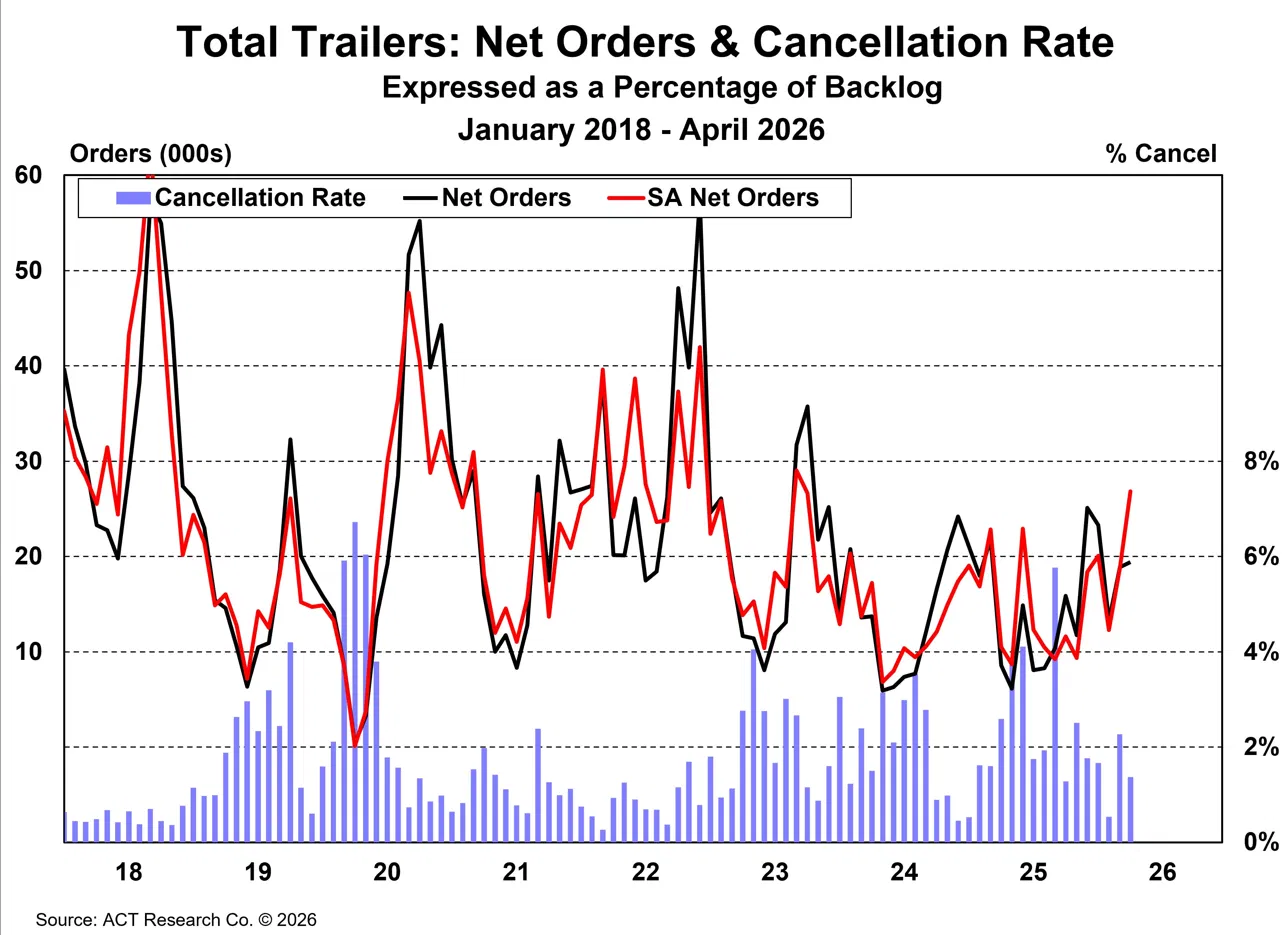
Nevertheless, this nascent recovery has yet to translate into a healthy order book. Total backlog in the first four months of 2026 still declined by more than 13% compared with the same period in 2025, and the backlog/build ratio is, historically speaking, close to a low point. The picture is therefore mixed: the bottom may have formed, but a genuine recovery phase is not yet in evidence. For EnTrans this means the headwind persists for now, but the direction is cautiously turning. Should orders and order books continue to strengthen in the coming quarters, this would offer prospects of volume recovery at the transport division in the second half of fiscal year 2026 and beyond.
New acquisition offers a glimpse of the future
One day after the results, on 15 May 2026, TerraVest announced, through a subsidiary, the acquisition of the Canadian operations of Colter Energy LP. The deal was financed from available cash and a new credit facility; the company did not disclose the exact amounts.
The Alberta-based company has been active since 2003 and ranks among the largest providers of flowback and production testing equipment and services in North America. It designs and staffs complete testing programmes covering stimulation, drill-out, flowback, production testing, workovers and well abandonment. Colter thus supplies both the heavy equipment and the people and maintenance around it.
This means Colter fits a pattern within TerraVest that is becoming increasingly clear and increasingly sizeable. For years, TerraVest's Service segment did not amount to a great deal; it consisted almost exclusively of Diamond Energy Services, a small but stable business that maintained wells in Saskatchewan. The major shift came in 2022, when TerraVest took a majority stake in Ken Wagner's Fraction platform.
Although Fraction is essentially a water management business, the recent acquisitions show that TerraVest is broadening its scope. First with the acquisitions of Aureus (January 2025) and Wave (September 2025), which have already been fully integrated into the existing structure. This was followed by Stimulate (chemical products) and now Colter.
For TerraVest, a future significant shift makes for an interesting story. A serial manufacturer of tanks and wellhead equipment that manages to build services and maintenance around them transforms its earnings model. Part of the revenue shifts from one-off, cyclical product sales to more recurring, relationship-driven service income, which typically carries steadier margins. Moreover, this opens the door wide to cross-selling across North America, something management has also explicitly cited as a motivation in earlier press releases.
TerraVest is currently trading on the Toronto stock exchange at a price of CAD 151.94 per share.
Receive weekly insights in your inbox
Exclusive analyses and updates on family holding companies and global market developments.
Profit quality over revenue growth at Addtech
The recent quarterly results of Addtech (Stockholm: ADDT-B) provide the ultimate evidence of its unwavering focus on return on capital over pure volume growth. While the top line is flattening, margins are shooting up to record highs. This once again underscores the strength of the company's twofold growth model, combining disciplined acquisitions with organic optimisation.
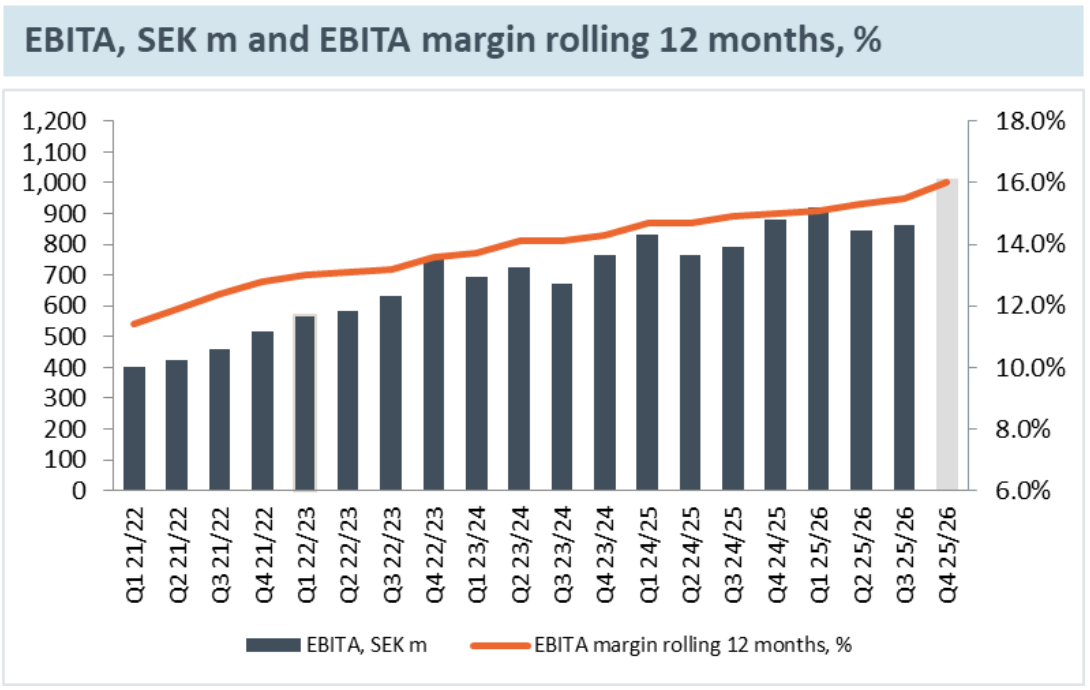
At first glance, the fourth quarter looks modest, with revenue growing by 2% to SEK 5.86 billion, while organic growth was completely flat. For CEO Niklas Stenberg, however, that is exactly the story he wants to tell. At Addtech, it is not about the top line, but about the margin. EBITA rose by 15% to SEK 1,011 million, resulting in an impressive record margin of 17.3% (versus 15.3% a year earlier).
Management is refreshingly transparent about how these figures came about. During the earnings call, it was acknowledged that the margin was partly boosted by a revaluation of earn-outs, with liabilities being reversed because an acquired company underperformed. Even after correcting for this SEK 45 million, however, an underlying quarterly margin of 16.4% still remains. CFO Malin Enarson rightly spoke of a structural margin improvement of 1.5 percentage points.
When asked how this improvement came about, Stenberg and Enarson gave an answer that was as simple as it was powerful. The success is split exactly evenly between organic measures and acquisitions. The key lies in the classic DNA of former parent company Bergman & Beving. Addtech applies iron discipline by deliberately parting ways with business activities that do generate revenue but weigh on margins. There is an unconditional focus on profit growth rather than hollow volumes. Restructurings within the Automation and Safety segments are clearly paying off here, according to management.
Operational dynamics by division
- Energy: An absolute record year, with EBITA growth of 28% and a margin of 19.2%. The 7% revenue decline in the fourth quarter is, according to Stenberg, purely a matter of timing, driven by slow permitting processes and capacity shortages at grid operators, not by faltering demand. The quote pipeline is currently thicker than ever, pointing to a strong year ahead, weighted towards the second half.
- Automation: After a difficult year, momentum has turned. With four consecutive quarters of positive order growth, the division is entering the new financial year in strong shape. The current margin (11.6%) is still below the group target, but the upward trend appears to have taken hold.
- Industry: An excellent EBITA margin of 20.9%, but Stenberg does not shy away from acknowledging its own failures. An earn-out was reversed following a failed acquisition from 2023. The CEO openly admits: "We made a mistake in assessing the people and the culture." New management has since been brought in. This degree of intellectual honesty and self-reflection is something we like to see in capital allocators.
- Safety: This segment suffered heavily from the malaise in the construction and installation sector (more than a third of revenue). Nevertheless, thanks to the restructurings mentioned and an improved product mix geared towards defence, data centres and traffic safety, Addtech managed to increase margins.
In addition, the acquisition machine keeps running steadily, with nine acquisitions in the past financial year, together adding SEK 1,595 million in revenue. The real strategic shift, however, lies in the geography, as growth is clearly accelerating outside the Nordics. A trend we already discussed with the various Swedish CEOs we spoke to in Stockholm earlier this year. Almost all recent acquisitions took place in the United Kingdom, the DACH region, the Benelux and Italy. In the Low Countries, the Dutch companies Kapp, Staka Holding and Nijhuis Engineering, among others, were added to the portfolio.
AddTech ended the trading week on the Stockholm stock exchange at a price of SEK 329.40 per share.
Asseco Poland shows the strength of the Topicus playbook
The Polish VMS company Asseco Poland (Warsaw: ACP) opened 2026 with the most impressive quarterly results in years. Revenue, operating profit and net result all improved strongly, but the real question occupying management during the Q&A was simple: is this structural, or did you just have a good quarter?
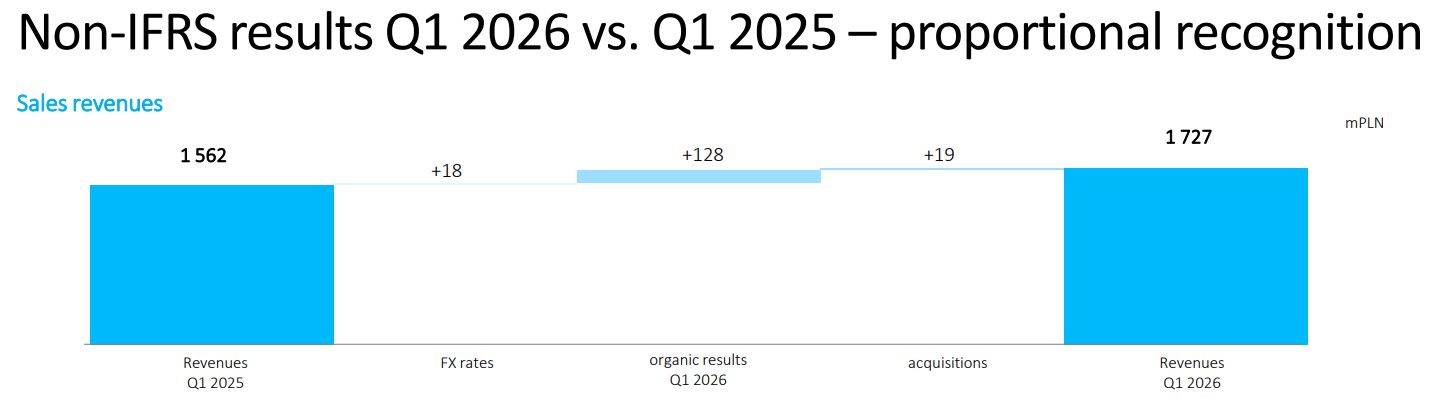
For Asseco Poland shareholders, the proportional results are what matter most, as these reflect the actual value for Asseco Poland's shareholders. In the first quarter, proportional sales revenue rose 11% to PLN 1,727 million. As much as 8.2% of this growth was organic, a very strong result.
At the same time, the proportional operating profit margin improved considerably, from 11.4% to 14.7%. According to management, this increase is partly attributable to favourable momentum from highly profitable contracts that happened to coincide in the first quarter. The main fundamental driver, however, is a structural cost improvement resulting from an efficiency programme launched two years ago, specifically aimed at optimising staff productivity and utilisation rates. The revenue side, by contrast, remains more complex due to the one-off nature of certain contracts and the fact that the timing of revenue recognition depends heavily on client decisions.
The company also benefited from a more favourable effective tax burden, which fell from 22.5% to 20.3% at consolidated level. This followed a revised interpretation by the tax authorities regarding certain historical cost items at Asseco Poland. As a result, corrections can be applied retroactively, meaning this tax benefit will also structurally feed through into margins going forward.
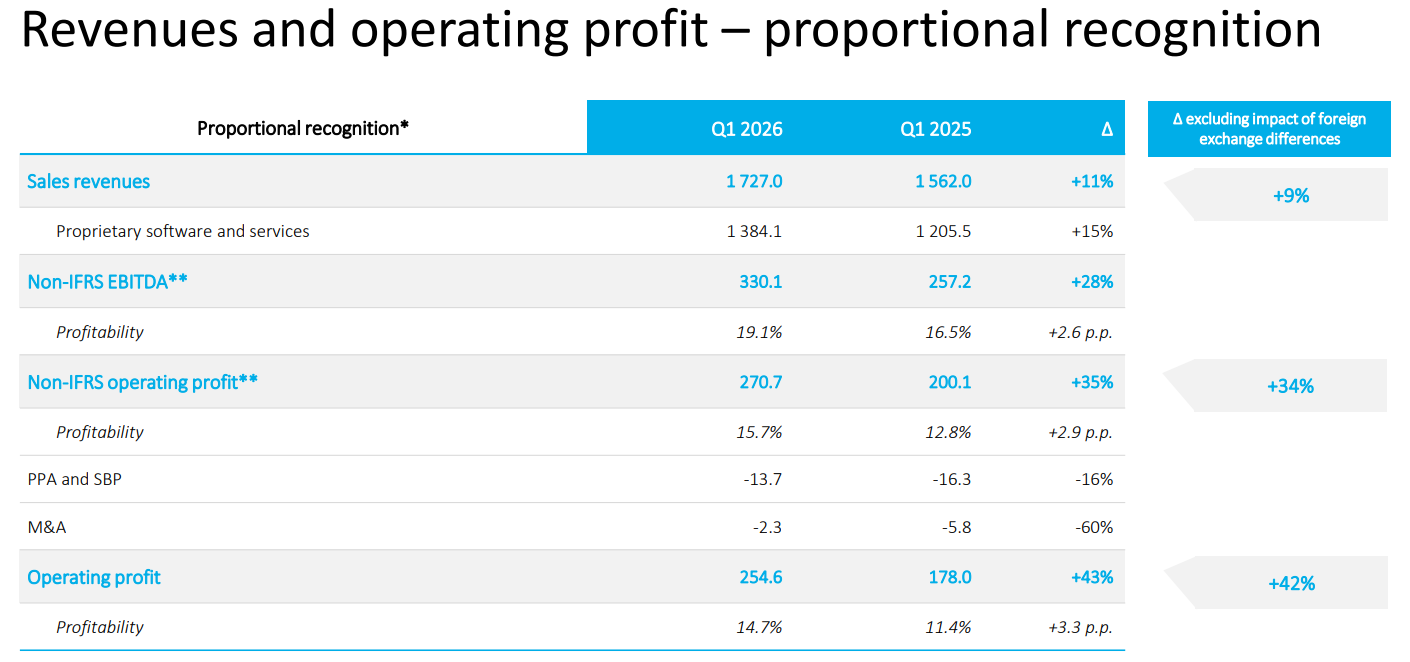
The figures reflect that the Topicus playbook is increasingly bearing fruit. For several quarters in a row now, we have seen a steady margin improvement trend at Asseco Poland, driven by efficiency gains directly inspired by Topicus's way of working. With the structural reduction in the tax burden and the further internal efficiency potential through AI, this process could well accelerate even faster than expected in the coming quarters.
The order book tells a compelling story. On a proportional basis, the backlog grew 13% at constant exchange rates to PLN 4,750 million, and even 16% at variable exchange rates to PLN 4,844 million. The Polish segment stands out most with 20% growth, followed by Formula Systems with 17% and 28% at variable exchange rates, respectively. The ratio between the 2026 backlog and 2025 revenue stands at 93%, meaning Asseco had already largely covered the year before the first quarter was even over.
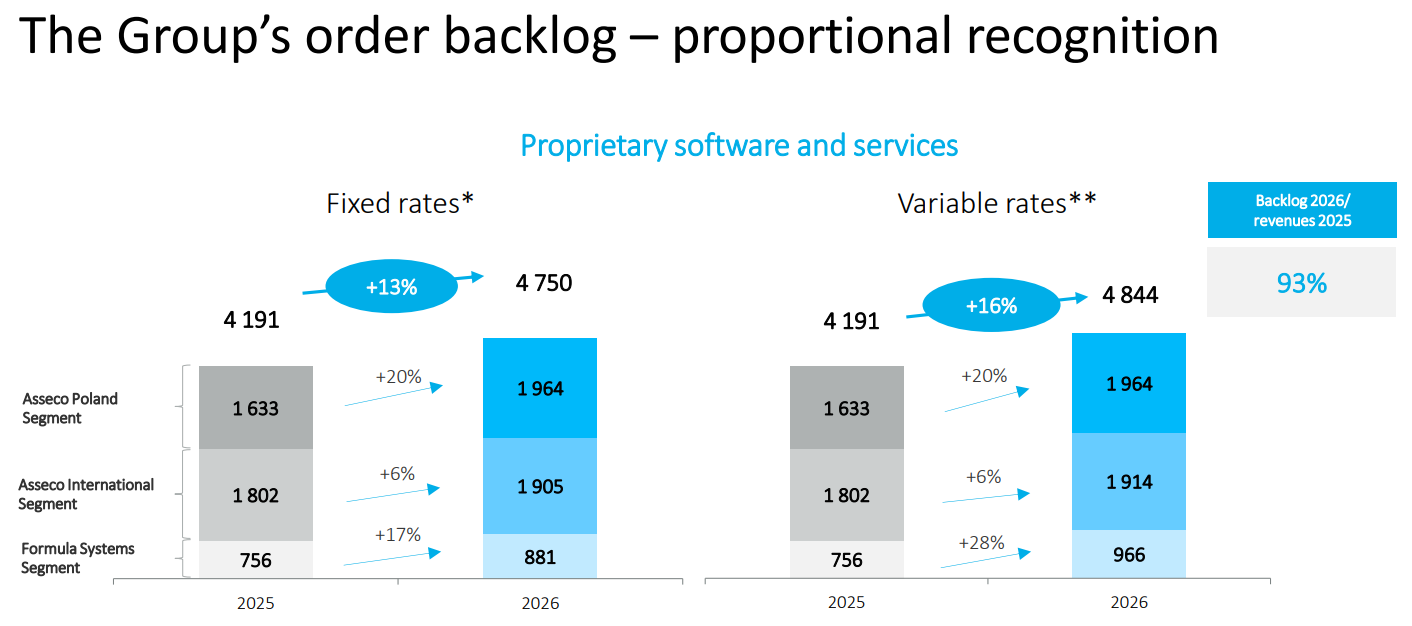
CFO Rzonca-Bajorek did qualify that the order book is not a static figure. Growth is partly fuelled by new contracts in unexpected markets; for instance, after four years of intensive sales efforts, Asseco managed to sign a contract in Togo, co-financed by the Polish national development bank BGK. The healthcare segment, linked to the National Recovery Plan, is still barely visible in the current backlog figures but, according to management, will become clearly noticeable from Q2 onwards.
Regarding acquisitions, however, the picture is somewhat more nuanced. CEO Marek Panek explained during the earnings call that the acquisition market in the region has fundamentally changed. Where Poland, the Czech Republic, Slovakia and the Balkan countries were still quiet markets a few years ago, private equity players, venture capital funds and international parties are now knocking on the door. "We haven't seen that competition before," said Panek, and that is driving up sale prices to levels Asseco considers unacceptable. The group does indeed have letters of intent running in Poland, but Panek was clear: a signed letter of intent is no guarantee of a completed deal. "We are selective, because we want those valuations at a specific level." The discipline around acquisitions is therefore deliberate; Asseco wants good returns for itself and its shareholders, not growth for growth's sake. Exactly what we, as shareholders, like to see.
Asseco Poland ended the trading week on the Warsaw stock exchange at a price of PLN 196.75 per share.
Receive weekly insights in your inbox
Exclusive analyses and updates on family holding companies and global market developments.
Would you like more information about our services?
Get in touch
Disclaimer:
No rights can be derived from this publication. This is a publication of Tresor Capital. Reproduction of this document, or parts thereof, by third parties is only permitted after written consent and with reference to the source, Tresor Capital.
This publication has been compiled by Tresor Capital with the greatest possible care. The information is intended in a general sense and is not tailored to your individual situation. The information should therefore explicitly not be considered as advice, an offer or a proposal to purchase or trade investment products and/or to acquire investment services, nor as investment advice. The authors, Tresor Capital and/or its employees may hold positions in the securities discussed, for their own account or for their clients.
You should carefully consider the risks before you start investing. The value of your investments may fluctuate. Past performance is no guarantee of future results. You may lose (part of) your investment. Tresor Capital disclaims any form of liability for any inaccuracies or errors. This information is purely indicative and subject to change.
Read the full disclaimer at tresorcapitalnieuws.nl/disclaimer .
This article was translated automatically from Dutch using AI. In case of any difference, the Dutch original prevails. Read the original in Dutch.