Family Holdings #28 - The Intertwined AI Interests of the US and China

This week's topics:
Prosus (Amsterdam: PRX) benefited last week from a rally at Tencent, after JPMorgan expressed notably positive views on the Chinese internet giant's AI strategy. The bank sees the narrative shifting from a speculative outlook to a phased rollout with concrete milestones, supported by the launch of the Hunyuan 3 model and a possible acquisition of AI agent developer Manus. At the same time, AI in China remains a subject full of conflicting signals, marked by an erratic interplay of US export easing and Chinese restraint.
In Brief:
TerraVest Industries (Toronto: TVK) bought back shares heavily in the second half of June under its normal course issuer bid (NCIB). Filings show a series of buyback orders between 18 and 30 June, totalling more than 259,000 common shares, which were formally returned and cancelled on 2 July. This means the company repurchased more than 1% of its outstanding shares within a span of a few weeks. That is a strong pace for a normal course issuer bid and underscores that management, despite the ongoing allegations surrounding Executive Chairman Pellerin, is continuing to allocate capital to its own shareholders unabated.
Constellation Software (Toronto: CSU) subsidiary Harris has acquired TouchBistro, a point-of-sale and restaurant management platform serving more than 16,000 restaurants in over 100 countries worldwide. The new owner thereby gains a consolidated, cloud-based system that combines table service, floor plan management, payment processing, online ordering and inventory management.
Topicus.com (Toronto: TOI), through subsidiary TSS, has acquired DiffusionData, a UK-based provider of real-time data streaming for mobile, web and AI applications. The company, founded in 2006 and with around 30 employees, is active in financial services, gaming and transport, and stands out with a patented compression technique that can reduce bandwidth usage by up to 90 percent.
Brookfield (New York: BN) has priced the IPO of data centre company Csquare (CSQR), after we previously reported on the filed listing application. 50 million common shares are being offered at between 23 and 27 dollars each, for proceeds of between 1.15 and 1.35 billion dollars, rising to 1.55 billion dollars if the underwriting banks fully exercise their option on a further 7.5 million shares. Part of the net proceeds will go towards debt repayment, with the rest allocated to general corporate purposes.
Founder Sergey Brin on AI within Google
Sergey Brin, co-founder of Google and still one of the most influential voices within Alphabet (New York: GOOGL) through his shareholding, recently gave a question-and-answer session at an AI event. Brin, who had formally stepped back but has been closely involved with the company again since the relaunch of Gemini, was unusually direct about where Alphabet is leading, where the company is lagging, and how uncertain the development of artificial intelligence really is, even for the people building the models.
A recurring theme was the extent to which specialised AI models are merging into general models. Where Google previously needed separate models for a wide range of scientific problems, the Gemini models now perform at a top level in mathematics and other scientific domains simultaneously. Brin said he had not predicted this convergence in advance and called it incredible to witness. Linked to this is the phenomenon of transfer: training on one skill, such as coding, unexpectedly improves other skills, such as mathematical reasoning, and vice versa.
Striking was Brin's own uncertainty about how to use the models his company builds. He admitted that he himself does not know exactly at what level he can best steer (prompt) the models, and that even internally at Alphabet it is not known exactly where the limits of Gemini's capabilities lie. As an example, he cited chain-of-thought prompting, simply asking the model to reason step by step, a technique that in his view seemed like "the dumbest idea ever", but which nevertheless led to a significant leap in AI capability.
Asked whether transformers (the underlying architecture of the current generation of AI models) are sufficient to reach AGI (artificial general intelligence), Brin answered affirmatively, adding the caveat that the architecture has already evolved considerably since the original research paper. His own definition of AGI does, however, differ from the conventional one: whereas he primarily sees AGI as a system capable of improving itself, he acknowledged that most people instead define AGI as a system that can do everything a human can, which in his view also requires a deeper understanding of the physical world through so-called world models.
Brin was at his most candid when the conversation turned to competitive positioning. He acknowledged that Alphabet was too slow to focus sharply on coding applications, allowing competitors to gain ground. Whereas the Gemini 3.0 and 3.1 models were broadly best-in-class around half a year ago, he admitted that a rival model currently leads on complex coding tasks and long-running, unsupervised assignments. For fast, interactive iterations, however, he positioned Gemini 3.5 Flash as superior to the alternative.
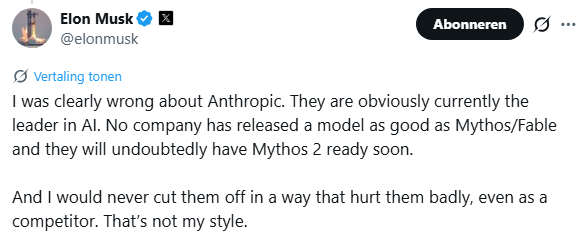
What Brin did not say in so many words, Elon Musk stated out loud this week. Musk, who had previously publicly written off Anthropic, said via X that he had been wrong and now regards Anthropic as the clear leader in AI. This exposes the fact that both within Alphabet and externally, it is recognised that Gemini has fallen considerably behind Anthropic's Claude models. It remains to be seen whether the Gemini team can close this gap with the upcoming update.
AI breakthroughs at Tencent, but the playing field remains complex
Prosus (Amsterdam: PRX), which holds a stake of around 23% in Tencent Holdings (Hong Kong: 0700), saw its share price rise more than 4% last week, riding the coattails of a rally at Tencent itself. The trigger was an optimistic note from JPMorgan on the Chinese internet giant's artificial intelligence ambitions, which sent Tencent's shares up more than 4%.
The core of JPMorgan's thesis is that confidence in Tencent's value-creation strategy has increased substantially since the company began beta testing its WeChat AI Agent in June. According to the bank, enough of the service is now visible to distinguish between what has already been built and what is still under development. This shifts the narrative from an open, speculative outlook to a phased rollout with concrete milestones that investors can track.

This thesis is supported by concrete figures around Tencent's other AI flagship. The Hunyuan 3 model (HY3) was officially launched on 6 July, following a preview on 22 April, with noticeable improvements in both model capability and cost efficiency. Deeper integration within Tencent's AI ecosystem (WorkBuddy, CodeBuddy, Yuanbao, Marvis and QClaw) has led to token consumption roughly twenty times higher since the preview, and WorkBuddy continues to gain users, reportedly reaching 16 to 17 million daily active users. The real point of concern, however, remains monetisation. The Chinese enterprise software market is relatively immature when it comes to paid subscriptions, and a substantial portion of current token consumption is presumably still being subsidised to accelerate adoption.
Tencent, however, is aiming for a broader strategic advantage than model development alone. The company is reportedly in talks to become the largest shareholder in Manus, the developer of autonomous AI agents that was acquired by Meta last year. After Beijing forced Meta to unwind that acquisition, Tencent, together with original investors ZhenFund and HSG, is said to want to acquire the company for at least two billion dollars. For Tencent, this acquisition would mean a direct, accelerated strengthening of its agentic AI proposition, giving its own WeChat AI Agent a strategic boost with globally leading technology.
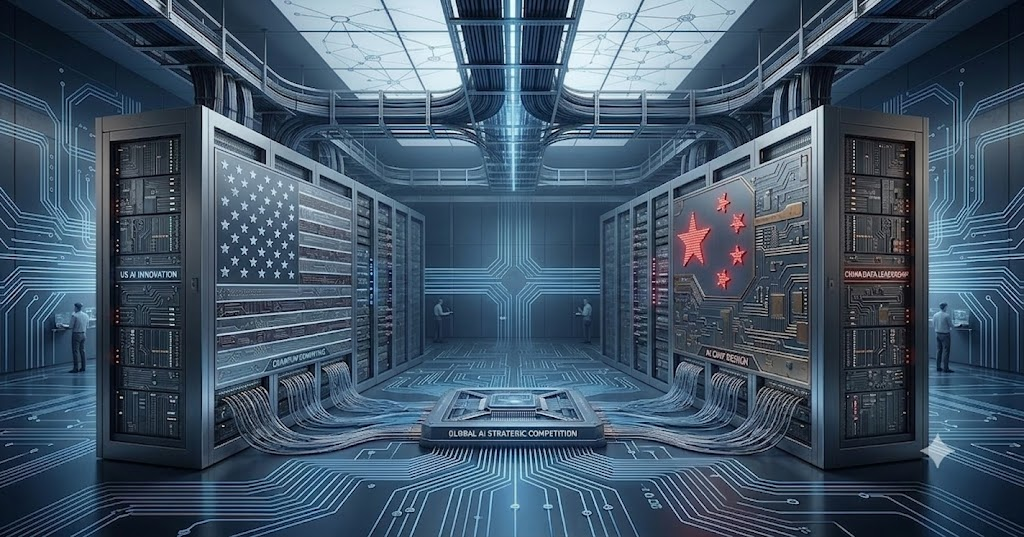
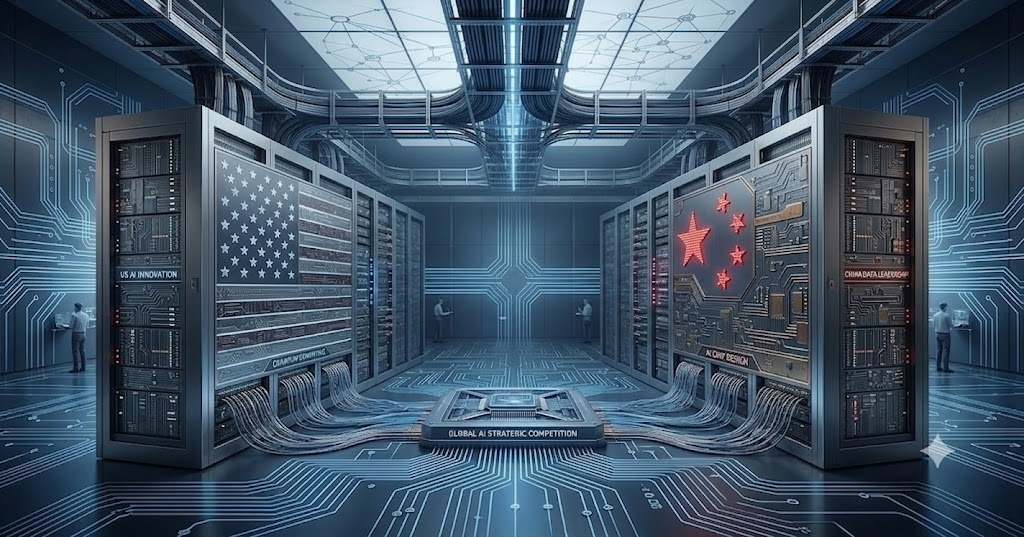
Despite these positive AI developments at Tencent, AI in China remains, and will continue to remain, a complex issue. Several reports from recent weeks reveal that the relationship between the US and China on AI is increasingly being fought out through regulation.
The US government previously blocked the export of advanced Nvidia chips such as the H200 to China entirely. In December, President Trump then gave permission for these chips to be exported after all to approved Chinese buyers. Remarkably, however, concrete orders failed to materialise: the Chinese government itself had not yet given domestic companies permission to actually purchase the chips, in order to protect its own chip industry. Recent policy changes suggest that Beijing is partly easing its restrictive stance. Major AI companies such as Alibaba, ByteDance and DeepSeek have been given permission to import a limited number of H200 chips in the near term. In total this would involve a maximum of 200,000 units, less than half of the original request. Moreover, the deployment of these chips is strictly regulated: they are intended exclusively for training models on public data. Their use for sensitive customer information or for inference tasks is excluded, since domestic alternatives must be given priority for those processes.
At the same time, Beijing remains cautious on another front. The country is considering stricter restrictions on overseas access to its most advanced AI models, including versions that have not yet been released. This dual stance, in which Beijing on the one hand cautiously eases access to American chips while on the other hand tightening the rules on outgoing Chinese AI models, underscores just how much artificial intelligence is now being treated as a strategic national asset.
Receive weekly insights in your inbox
Exclusive analyses and updates on family holding companies and global market developments.
Would you like more information about our services?
Get in touch
Disclaimer:
No rights can be derived from this publication. This is a publication by Tresor Capital. Reproduction of this document, or parts thereof, by third parties is only permitted after written consent and with reference to the source, Tresor Capital.
This publication has been compiled by Tresor Capital with the greatest possible care. The information is intended in a general sense and is not tailored to your individual situation. The information should therefore explicitly not be regarded as advice, an offer or a proposal to purchase or trade investment products and/or to obtain investment services, nor as investment advice. The authors, Tresor Capital and/or its employees may hold positions in the securities discussed, for their own account or on behalf of their clients.
You should carefully consider the risks before you start investing. The value of your investments may fluctuate. Past performance offers no guarantee for the future. You may lose (part of) your invested capital. Tresor Capital disclaims any form of liability for any inaccuracies or errors. This information is purely indicative and subject to change.
Read the full disclaimer at tresorcapitalnieuws.nl/disclaimer .
This article was translated automatically from Dutch using AI. In case of any difference, the Dutch original prevails. Read the original in Dutch.