
Family Holdings #32 – Major acquisitions, insider buying and AI investments



This week's topics:
Prosus is reallocating capital by selling its stake in competitor Meituan in order to strengthen its core food delivery division (Just Eat, iFood), while at the same time investing in a new generation of AI start-ups.
Markel is divesting its loss-making reinsurance arm as part of a strategic repositioning to restore the focus and profitability of its core business, specialty insurance.
In Brief:
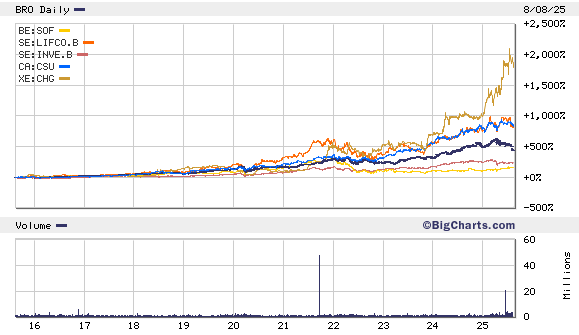
Brown & Brown (New York: BRO) has completed the previously announced acquisition of Accession Risk Management Group for a gross purchase price of USD 9.8 billion. With this strategic acquisition, the American investment holding company gains control of specialty broker Risk Strategies and insurance wholesaler One80 Intermediaries. Although Accession's operations will retain their decentralised sales and service model, they now gain access to the global network and resources of Brown & Brown.
To maximise synergies, Brown & Brown is combining its 'Programs' and 'Wholesale Brokerage' segments into a new 'Specialty Distribution' division. One80 Intermediaries will be integrated into this new division, with key figures from both companies, including John Mina and Matt Power, joining the new leadership teams to steer the integration.
Chapters Group (Frankfurt: CHG) completed two acquisitions this week. The acquisitions of AdFlow Systems and Artificial Intelligence Finance demonstrate a disciplined strategy of building market-leading positions in specific niches.
Through its subsidiary Waterkant Software, the serial acquirer has acquired AdFlow Systems GmbH, a leading provider of advertisement management and production software for media companies. This is the second holding within the 'Newspaper Publishing' sector, pointing to a clear strategy of building a strong platform in this vertical market. Crucially for its success, both founders, Dietmar and Christian, are staying on board to ensure continuity and retain their expertise. The shared goal is to strengthen product development and further develop future themes such as AI.
In addition, listed Software Circle plc, in which Chapters holds a stake of more than 25%, has acquired 95% of the shares of Artificial Intelligence Finance LTD. A total consideration of €5 million was agreed for this transaction, consisting of an upfront payment and an earn-out. Here too, continuity of leadership is an important element; co-founder Karl Deeter is staying on to run the company's day-to-day operations.
Constellation Software (Toronto: CSU) has once again lived up to its reputation as one of the world's most active serial acquirers. In a period of just over a week, its decentralised operating groups, Volaris and Jonas, together completed five acquisitions that underline the global reach of the strategy. Volaris significantly strengthened its presence in emerging markets with the acquisition of ResReserve in South Africa, a provider of software for the hotel sector that will be integrated into the existing Adapt IT portfolio. In addition, Useall was acquired in Brazil, a provider of business management software with more than a thousand customers.
At the same time, Jonas demonstrated the diversity of its M&A approach. The most significant transaction was the acquisition of Uruguay's Geocom by subsidiary Vesta Software, a platform with revenue of more than USD 35 million in 2024 and the ambition to double in size within two years. This was complemented by two more targeted acquisitions: in New Zealand, RxOne was acquired, a provider of pharmacy software that strengthens an earlier carve-out in that sector, and in Texas, the portfolio was expanded with the add-on acquisition of myCAMPapp, a SaaS solution for summer camps. The high frequency and strategic diversity of these transactions once again illustrate the effectiveness of Constellation Software's decentralised model, in which the operating groups continue to add value autonomously.
Lifco (Stockholm: LIFCO-B) has signed an agreement for the full acquisition of the British company MaxiMover. MaxiMover is a specialist company focused on designing and manufacturing bespoke conversions for low-floor vans of up to 3.5 tonnes. With this acquisition, Lifco strengthens its position in a niche market within the transport sector.
The company, based in Lincoln, England, reported net sales of approximately GBP 39 million for the financial year ended May 2025 and employs 47 people. Following completion, which is expected in the third quarter of 2025, MaxiMover will be consolidated within Lifco's Business Area Systems Solutions, in the Transportation Products division.
Investor AB (Stockholm: INVE-B) has recently provided a clear confirmation of the 'skin in the game' principle, with key figures within management expanding their personal stake in the Swedish family holding company. CEO Christian Cederholm bought 2,500 shares on 1 August 2025, while board member Jacob Lund acquired 1,000 shares that same day. A day later, on 2 August, Thomas Kidane added another 1,600 shares to his position.
For us, these transactions, in which management invests its own capital, are more than a formality; they are a powerful signal that the interests of leadership and shareholders are fully aligned. It shows that they are not merely managing other people's capital, but are themselves convinced of the company's long-term value creation. Such actions, where management backs its words with deeds, are an essential criterion in our assessment of the quality and durability of an investment.
Sofina (Brussels: SOF) demonstrates the power of its long-term technology strategy by capitalising on the explosive growth in the AI sector, both through direct and indirect investments. A striking example of its direct approach is its stake in the French AI pioneer Mistral, which is currently in talks to raise capital at a valuation of USD 10 billion. At the same time, Sofina is reaping the rewards of its carefully selected portfolio of venture capital funds, with particular emphasis on its partnership with the renowned firm Sequoia Capital. This strategy provides access to some of the most promising unlisted tech companies in the world.
The value of this indirect exposure is vividly illustrated by recent developments at two prominent holding companies within the Sequoia portfolio. AI company Anthropic is in talks for a new funding round that would value the company at an impressive USD 170 billion, a spectacular jump from the USD 61 billion valuation in March of this year. In addition, Figma, the leading collaborative design software, has completed a successful stock market listing with a valuation of over USD 18 billion. This combined approach, blending high-conviction direct investments in companies with exposure via the world's best fund managers, allows Sofina to participate effectively in the most important technological trends.
Brown & Brown, Chapters, Constellation Software, Investor AB, Lifco and Sofina are currently trading at prices of USD 93.03, EUR 41.80, CAD 4,692.31, SEK 288, SEK 344.60 and EUR 276.20 per share.
Anatomy of innovation: Alphabet's investment in the foundations of AI
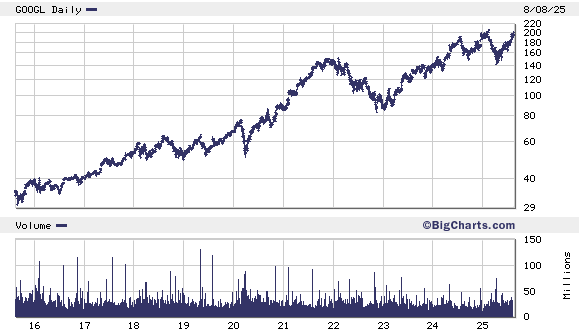
In today's markets, driven as they are by artificial intelligence, it is tempting to focus attention solely on the developers of the large language models themselves. However, the most durable long-term value creation is often found in the companies that supply the essential infrastructure, the "picks and shovels" of the technology gold rush. Recent developments surrounding AI storage platform Vast Data and the strategic positioning of a giant like investment holding company Alphabet (New York: GOOGL) offer a perfect case study in how smart capital finances the backbone of the future.
One of the most closely followed stories in the private tech market is the rise of Vast Data, a company that has specialised in a crucial, though often overlooked, element of the AI revolution: data storage. The company is currently in advanced talks for a new funding round with prominent parties such as Alphabet's venture capital arm CapitalG and existing strategic investor Nvidia. This round could push the startup's valuation to an impressive USD 30 billion, a spectacular leap from its USD 9.1 billion valuation in 2023.
Vast Data's explosive valuation is no coincidence. The company develops specialised storage technology specifically designed to enable efficient data movement between the GPUs (Graphics Processing Units) in large-scale AI data centres. In an ecosystem where the computing power of AI models is the key limiting factor, Vast Data's technology forms an essential link.
Demand for its solutions is underscored by a customer base that includes names such as Elon Musk's xAI and CoreWeave, as well as strong financial health. "The company is reportedly cash-flow positive, and annual recurring revenue (ARR) is expected to grow from USD 200 million in January 2025 to USD 600 million next year."
Alphabet's potential investment, through its growth investor CapitalG, is more than a standalone transaction; it is a direct reflection of the investment holding company's deeply rooted, patient capital allocation strategy. At the heart of this approach lies a focus on "moonshots": highly ambitious, high-risk, long-term projects that seek radical solutions to major global problems.
Within the innovation lab 'X', led by Astro Teller, the mission is to turn science fiction into reality, accepting that the chance of success for any individual project is low, but the potential impact is enormous. Teller elaborated further on the unique thinking behind such 'moonshots' in a recent interview on the 'Inc. Founders Project' podcast.
Over the years, this strategy has produced a number of successful projects and spin-offs that now operate as independent, value-creating entities. The best-known examples are Waymo, the pioneer in self-driving cars, and Wing, the drone package delivery subsidiary. These projects are not merely technological tours de force; they aim to bring about a fundamental shift in society. Waymo could lead to a decline in private car ownership in favour of "transport as a service", while Wing has the potential to change our consumption patterns towards an "access society" rather than an "ownership society".
Even projects that fail to achieve their original, ambitious goals create value within Alphabet's ecosystem. "Project Loon", which aimed to provide internet access via balloons in the stratosphere, was shut down because it proved commercially unviable. However, the knowledge and optical communication technology developed during this project proved invaluable. They formed the basis for the creation of Taara, a company that now delivers cheaper and faster internet connections than traditional methods, using lasers. This ability to learn from failures and repurpose technology is a hallmark of a resilient and sustainable innovation culture.
Ultimately, Alphabet's dual focus – on the one hand internal, boundary-pushing 'moonshots', and on the other external, strategic investments in crucial infrastructure players such as Vast Data – reveals a coherent and mature vision. The company understands that true technological dominance does not stem solely from developing the end application, but also from owning and financing the fundamental building blocks. By investing on both fronts, Alphabet is positioning itself not as a passive participant, but as an active shaper of the technological and societal landscapes of the future.
Alphabet is currently trading on the New York stock exchange at USD 200.98 per A-share.
Prosus in transition: capital allocation shifts from food delivery to the next generation of AI
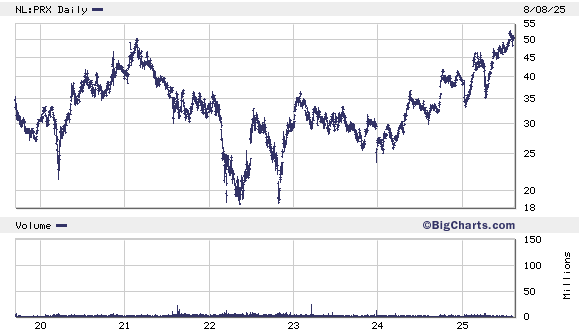
The Dutch investment holding company Prosus (Amsterdam: PRX) finds itself in a dynamic phase of strategic transformation, centred on active and disciplined capital allocation. Recent developments reveal a dual focus: on the one hand, consolidating and strengthening its core activities in the competitive food delivery sector, and on the other, patiently sowing the seeds for future growth by investing in a new generation of specialised AI companies.
One of the most significant strategic moves is the reduction of its stake in the Chinese food delivery company Meituan, worth more than USD 4 billion. This decision is not purely financially driven, but is a direct response to increasing competition. Meituan announced plans to expand into markets where Prosus itself is active, such as Brazil, deploying aggressive marketing campaigns and price cuts in the process. By selling the stake, Prosus is not only reallocating capital, but also ceasing to indirectly finance a direct competitor.
The capital freed up is being used, among other things, for an ambitious consolidation push in the European market. Prosus is on the verge of receiving EU approval for the €4.1 billion acquisition of Just Eat Takeaway. To address the competition concerns raised by regulators, Prosus has offered to gradually wind down its 27.4% stake in competitor Delivery Hero and give up its board seat. This acquisition would transform Prosus into one of the largest food delivery companies in the world and demonstrates its willingness to engage in complex transactions to cement market leadership.
iFood
At the same time, heavy investment is being made in the crown jewel of the portfolio, the Brazilian company iFood. The company has announced a direct investment of BRL 17 billion (approximately USD 3.1 billion) for the period up to and including March 2026, an increase of 25% compared to the previous period. This capital injection is aimed at increasing platform traffic, encouraging repeat purchases and expanding operational areas, with the goal of growing the number of monthly orders from 120 million to 200 million within three years. The investment also includes a significant expansion of the workforce, particularly in the technology sector.
In addition to strengthening its core activities, Prosus is showing a clear vision for the future by investing in the next technological wave: artificial intelligence. This is visible not only in iFood's strategy, which has taken a 20% stake in the Brazilian marketing technology company CRMBonus to integrate AI-driven marketing and loyalty tools, but also in the recent activities of its venture capital arm, Prosus Ventures.
Artificial Intelligence
Through Prosus Ventures, early-stage investments are being made worldwide in a diversified portfolio of specialised AI start-ups. The recent transactions reveal a broad thematic focus. Investments have been made in CodeKarma, a platform that boosts software developer productivity, and in Secures, which focuses on fundamental research laboratories.
In India, the edtech start-up Arivihan was funded, while in Brazil an investment was made in Ursula, a company building "emotionally intelligent digital beings". Another notable investment is in Brainfish, which aims to revolutionise customer service using AI. This series of early, targeted investments reflects a patient approach to building exposure to the potential winners of the future.
Prosus's recent moves paint the picture of an active and disciplined investment holding company. The company is not afraid to make strategic decisions within its mature portfolio, such as divesting a stake in an emerging competitor, in order to then invest heavily in the consolidation and growth of its core assets. At the same time, through its venture capital arm, it is patiently laying the groundwork for future growth by investing in the disruptive power of AI.
Prosus ended the trading week on the Amsterdam stock exchange at a price of EUR 50.50 per share.
Markel backs up its words: divesting reinsurance is the first step in a strategic turning point
For long-term investors, quarterly results are often just noise, but sometimes they reveal the beginning of a fundamental change of course. The recent results from investment holding company Markel Group (New York: MKL), together with the simultaneous announcement of the divestment of its reinsurance arm, mark just such a moment.
After Simon Wilson was appointed as the new CEO of the insurance division earlier this year, a new, ambitious course was promised, aimed at restoring focus and profitability. The recent actions show that this was no empty promise, and that management is willing to make painful but necessary decisions to strengthen the company for the long term.
A result with two faces
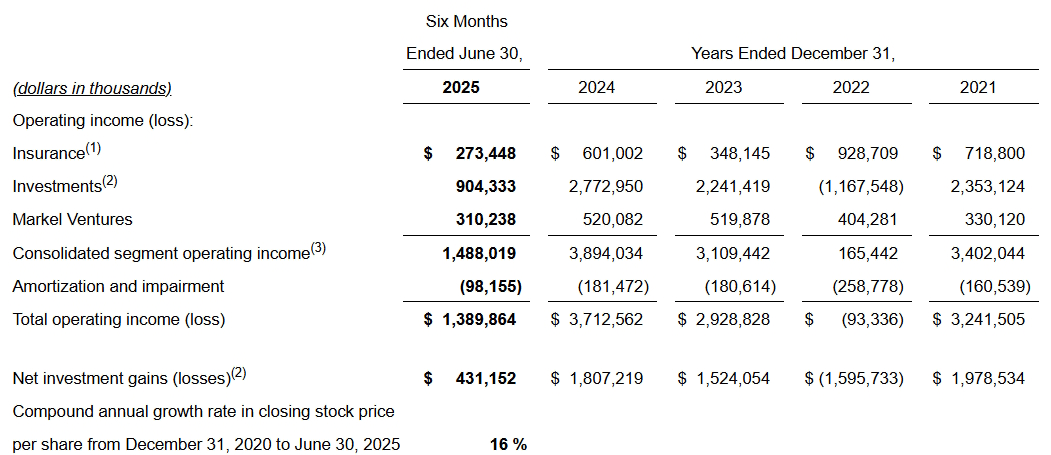
On the surface, the results of the core business, the insurance arm, were weak for the second quarter of 2025. Operating income fell by 27.5% and the combined ratio, a crucial measure of profitability, deteriorated to 96.9%. However, these figures were significantly affected by negative developments at two specific problem divisions that were already being wound down: the Global Reinsurance arm and directors' and officers' liability insurance (D&O). The pain in the figures is therefore an echo from the past and a direct consequence of the clean-up now under way.
At the same time, Markel's diversified model proved its worth, as the weakness in these specific segments was offset by strong performance elsewhere. The Markel Ventures engine, the collection of non-insurance businesses, performed excellently, with operating income growth of 17%, which compensated for the headwinds in the insurance arm. This illustrates the value of Markel's diversified "three engines" model. Within the insurance arm too, the healthy segments, such as State National and Nephila, showed strong growth. The problem was therefore not widespread, but isolated — and is now being addressed surgically.
The strategic choice for focus
The most significant event was the announcement that Markel is selling the renewal rights to its Global Reinsurance business to Nationwide. This marks a definitive exit from the reinsurance market. CEO Simon Wilson was clear on this point: Markel simply lacked the scale to be a leading player in this competitive market.
The division was structurally loss-making, with a combined ratio of as much as 125.7% in the most recent quarter. Divesting this unit is a textbook example of strategic discipline: rather than fighting for a marginal position, capital and management attention are being directed towards the areas where Markel does have a deep and durable competitive advantage.
This move is a logical consequence of the internal reorganisation announced earlier. Wilson's plan to replace the complex corporate structure with a decentralised model featuring clear profit-and-loss accountability per business unit is taking direct shape as a result. Shedding the weakest links is essential to giving the remaining, healthy units the room to excel. The message is clear: the focus is no longer on growth for growth's sake, but on profitable growth within the core market of specialty niche insurance.
Active capital management supports the change of course
While the operational engines are being recalibrated, management is also taking an active and shareholder-friendly approach to capital allocation. The redemption of USD 600 million in costly preferred shares delivers a direct annual saving of USD 36 million in dividend costs. In addition, a record USD 860 million worth of own shares was repurchased in the first half of 2025, a powerful signal of management's confidence in the course set and in future value creation.

Markel's potential rests on three pillars: the investments, Markel Ventures and the insurance division. While the first two have delivered solid performance for years, the insurance engine was the Achilles' heel. The current measures are intended to thoroughly overhaul this engine and bring its performance in line with the best players in the sector. This will take time, but the path taken is the right one. If this operation succeeds, Markel could transform from an ambitious 'mini-Berkshire' into an excellent, standalone investment holding company with three powerful, independent value engines.
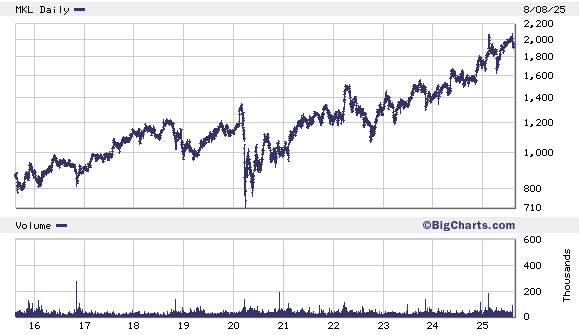
Markel is currently trading on the New York stock exchange at USD 1,916.90 per share.
Receive weekly insights in your inbox
Exclusive analyses and updates on family holding companies and global market developments.
Would you like more information about our services? Please feel free to get in touch.
Get in touch
Disclaimer:
No rights can be derived from this publication. This is a publication of Tresor Capital. Reproduction of this document, or parts of it, by third parties is only permitted after written consent and with reference to the source, Tresor Capital.
This publication has been compiled by Tresor Capital with the greatest possible care. The information is intended in a general sense and is not tailored to your individual situation. The information should therefore explicitly not be regarded as advice, an offer or a proposal to purchase or trade investment products and/or to make use of investment services, nor as investment advice. The authors, Tresor Capital and/or its employees may hold positions in the securities discussed, for their own account or on behalf of their clients.
You should carefully consider the risks before you start investing. The value of your investments may fluctuate. Past performance is no guarantee of future results. You may lose (part of) your investment. Tresor Capital disclaims any form of liability for any imperfections or inaccuracies. This information is purely indicative and subject to change.
Read the full disclaimer at tresorcapitalnieuws.nl/disclaimer .
This article was originally written in Dutch and automatically translated into English with the help of AI. In case of any difference, the Dutch original prevails.