Family Holdings #35 - Exceptional leadership and MBB's strength in energy & cybersecurity



This week's topics:
Berkshire Hathaway has rejected a major rail merger between BNSF and CSX in favour of a capital-efficient partnership. At the same time, capital is being deployed in Japan, where its stakes in large, undervalued trading houses are being further increased.
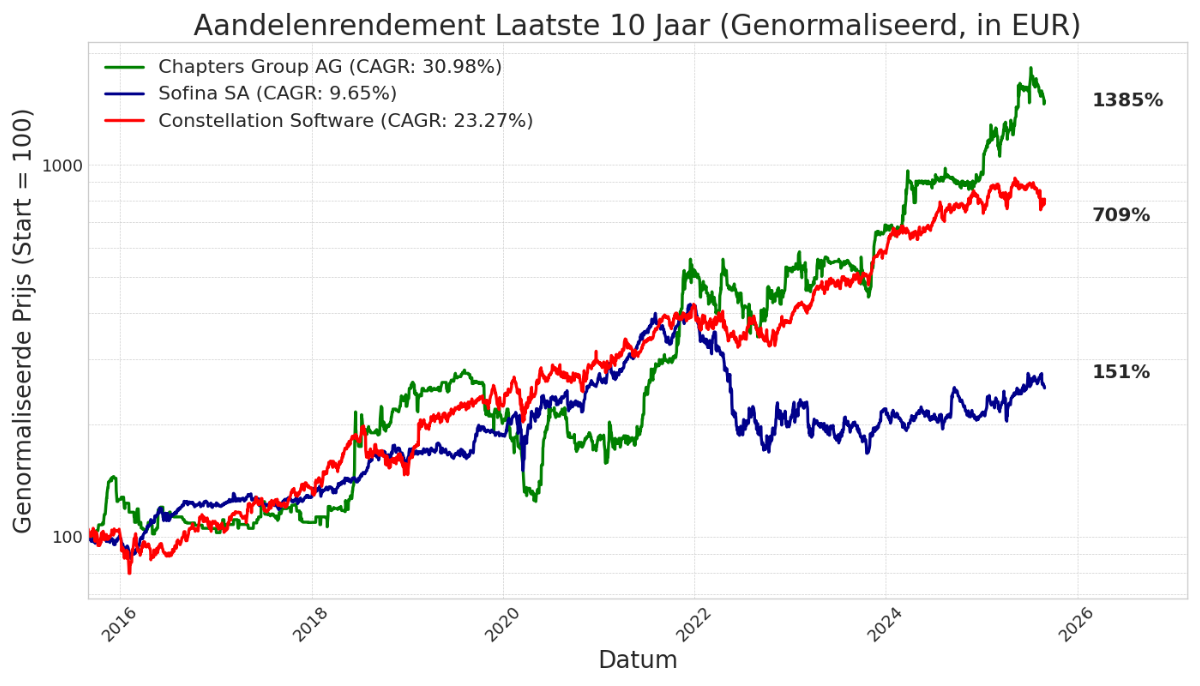
The German serial acquirer Chapters Group has transformed into a promising 'compounding machine' thanks to its unique model. It combines a smart financial structure and a scalable, decentralised organisation with a strong focus on attracting top entrepreneurs who get 'skin in the game'.
MBB reported strong results for the first half of the year, fully driven by its subsidiaries Friedrich Vorwerk (energy transition) and DTS (cybersecurity). These results offset headwinds in the cyclical segments, while management actively managed its portfolio with strategic share sales. The holding company remains significantly undervalued on a sum-of-the-parts basis and has a very strong balance sheet with a substantial net cash position.
In Brief:
Chapters Group (Frankfurt: CHG) has, through its platform company Altamount Software, acquired Somentec Software. Somentec, based in Langen and with around 100 employees, has been a trusted software partner to energy companies and municipal utilities for more than 30 years. The company supplies specialised solutions for billing, customer management and digital services in the energy sector.
For Chapters, this marks another important step in its active buy-and-build strategy. CEO Jan Mohr added that the transaction was made possible in part by the bond issue of a few weeks ago, meaning the group is now immediately putting that capital to work in further profitable growth.

Constellation Software (Toronto: CSU) is continuing its acquisition strategy at a rapid pace. With three recent acquisitions in the last days of August, the total for 2025 has now reached 59 acquisitions. The transactions once again demonstrate the global reach of the model: in Norway, it acquired Maze Feedback, a provider of customer experience software used by retail chains to measure customer satisfaction and improve staff retention.
In addition, it acquired New Zealand's Sportsground, the country's largest sports management platform, which provides online registrations and competition management tools to sports clubs and schools, among others. Finally, in Brazil it acquired Projectus TI, a developer of ERP software for business administration, payroll processing and accounting.

Sofina (Brussels: SOF) continues to feature in the news with two important developments in its portfolio. ByteDance, the parent company of TikTok and Sofina's largest holding, achieved revenue growth of 25% to USD 48 billion in the second quarter, making it the world's largest social media group by revenue. Through a new share buyback programme, ByteDance is now valued at USD 330 billion, an increase of 5.5% compared to six months ago.
In addition, Sofina completed an exit in the medtech sector. OrganOx, an Oxford spin-off specialising in technology for safer liver transplants, was sold to Japan's Terumo for EUR 1.3 billion. Sofina had participated in a funding round at OrganOx earlier this year, but the exact size of its stake is not publicly known.
Chapters Group, Constellation Software and Sofina ended the trading week on the Frankfurt, Toronto and Brussels exchanges at a share price of EUR 39.40, CAD 4,550.34 and EUR 258.50 respectively.
Leadership as the key to value creation
On X (formerly Twitter), Sidecar Capital recently shared an extensive reflection on identifying management quality within companies (view the full post here). A crucial investment principle for long-term investors, but in practice less straightforward than it sounds. After all, financial figures are easy to find and measure, but the quality of a management team cannot be captured in a spreadsheet. Yet it is precisely that quality which often proves the decisive factor for sustainable value creation.
Sidecar draws an apt comparison with Van Halen's famous "no brown M&Ms" clause. The requirement that no brown M&Ms were allowed backstage was not a sign of diva behaviour, but a test: if the organiser hadn't even paid attention to that, then you also needed to double-check the technical safety details.
For investors, it works much the same way. As shareholders, we stand outside the boardroom and don't see how decisions are made on a daily basis. What we do get are indirect signals: the tone of shareholder letters, the manner of communication, the choices around capital allocation. It is these small clues that reveal whether a management team is trustworthy, pragmatic and focused on the long term.

Sidecar himself offers several concrete examples of this. He points, for instance, to the language used in press releases: are results presented factually, or dressed up with superlatives such as 'strong results' in the headline? Another signal Sidecar cites is frugality. He mentions the example of Heico, a leading serial acquirer that deliberately operates out of an unassuming office building. Details like this reveal a focus on efficiency and shareholder value, not on outward display.
At Tresor Capital, we fully subscribe to this perspective. The key point is that none of these signals is decisive on its own. What matters is that, taken together, they form a consistent picture of management's character and priorities. It is precisely this collection of small 'brown M&Ms' in a company's operations that determines whether a business is worth your capital over the long term.
To make this principle tangible, we highlight two recent examples of leadership that we consider exceptional.
EnTrans CEO Ryan Rockafellow
In a podcast interview, EnTrans CEO Ryan Rockafellow offered a glimpse into his style of leadership. Asked about his approach, he says: "We had to change the mentality from 'I work for Heil' or 'I work for Polar' to 'I work for EnTrans'. The only way to do that is by being completely open and honest about the future."
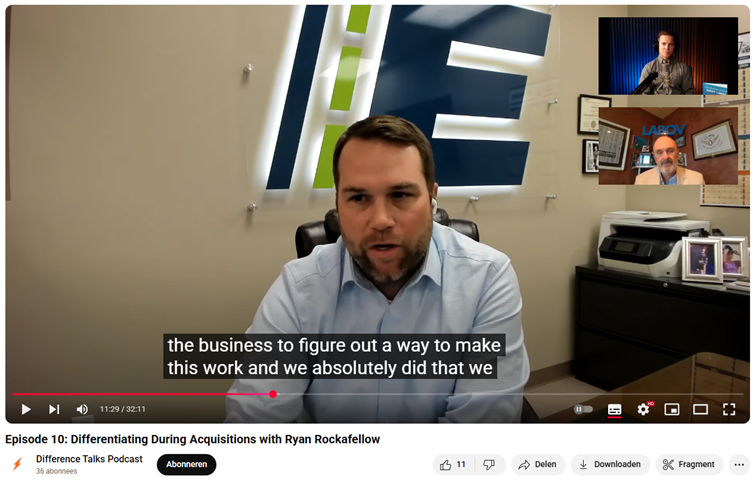
He describes how he successfully brought together Heil Trailer and Polar Tank, two brands that had fiercely competed with one another for decades, without losing the unique value of either brand. Efficiency was pursued wherever possible, but distinctive product features that were essential to customers were preserved. That sent a clear signal: at EnTrans, the long-term relationship with the customer takes precedence over short-term optimisation.
Rockafellow also chose clear communication towards employees. The message was that the merger would bring more production, more market share and more opportunities. That instilled confidence and ensured that people who had stood opposite each other for years came together behind the new direction. The result speaks for itself: a market share of around 50% in the North American tank trailer market and three consecutive record years.
For us, as a shareholder in TerraVest (Toronto: TVK), this confirms that Rockafellow and his team possess rare integration skills and a deeply embedded culture of improvement that strongly recalls the renowned Danaher model, with a relentless focus on Kaizen-like, continuous improvement. This culture manifests itself, for example, in an unrelenting focus on shortening lead times, which directly leads to greater efficiency and customer satisfaction.
This combination of proven integration capability and a deeply ingrained culture is exactly what we look for in exceptional leadership. We are therefore very positive about the value this team will add to the TerraVest platform, both in terms of organic growth and future acquisitions.
Markel CEO Tom Gayner
Tom Gayner, too, demonstrated in a recent interview with Barron's what we understand by exceptional leadership. Gayner gave off several signals that are crucial for us as investors in assessing management quality. For instance, he literally posed the question: "Would you rather have a lumpy 15% or a smooth 10%?" For Gayner, the answer is clear. His priority is not cosmetically smoothing out quarterly results, but genuine long-term value creation, even if that comes with volatility along the way.
We find the way Gayner communicates at least as important. Where many executives hide behind promotional language, he chooses simple wording that gets to the heart of the matter. His explanation of insurance as a 'bucket of money' is a good example of this: premiums come in, claims go out, and the art lies in managing the balance efficiently. It sounds simple, but it is precisely the thinking behind this comparison that shows he keeps a sharp focus on the essentials.
This way of thinking is crucial: it shows that he does not see the company as an abstract entity, but as a practical system in which he, as owner, manages shareholders' capital. Gayner does not mince his words, nor does he make things unnecessarily complex. This is also evident from the way he openly acknowledges that the insurance division has performed disappointingly in recent years, while clearly explaining what measures have been taken.
For us at Tresor Capital, these are precisely the signals that confirm we are dealing with a high-quality management team. Gayner shows that he does not shy away from difficult decisions, that he is consistent in his long-term vision, and that he looks after shareholders' interests in a sensible way. This approach of radical transparency, in which setbacks are openly acknowledged and solutions clearly explained, strengthens our confidence that Markel (New York: MKL) can successfully steer its current repositioning.
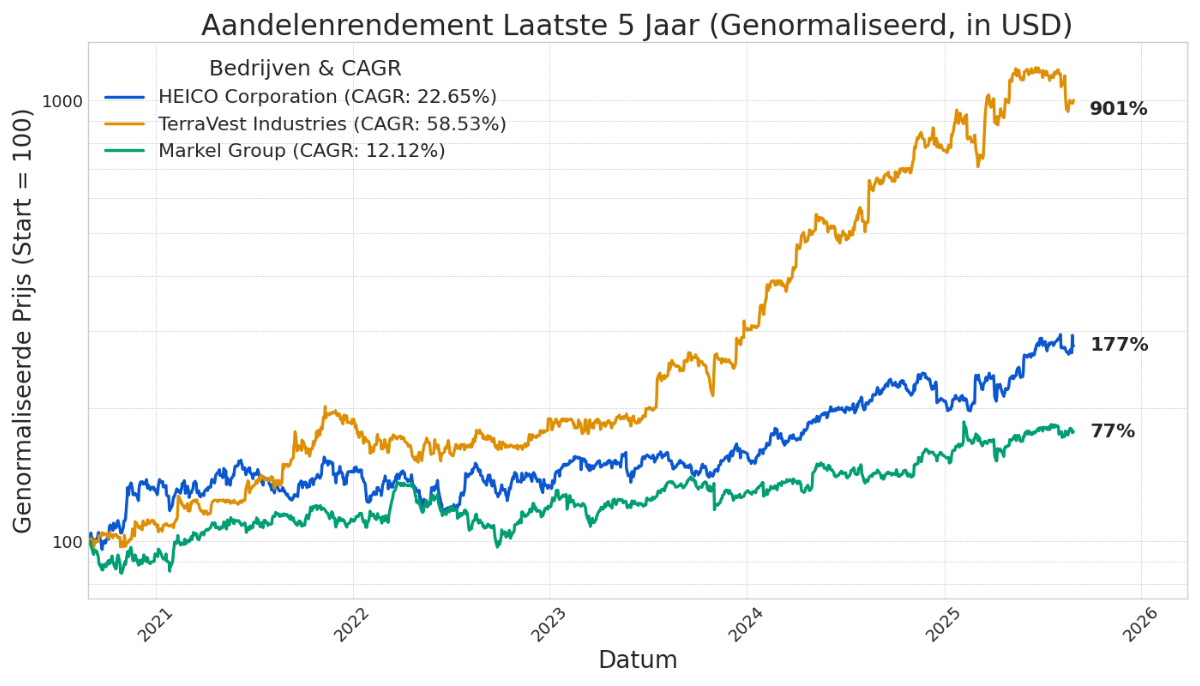
Heico, Markel and TerraVest ended the trading week on the New York and Toronto exchanges at a share price of USD 245.01, USD 1,959.06 and CAD 144.17 respectively.
Berkshire: no merger for BNSF and CSX, but more capital flowing to Japan
The past week offered an illuminating glimpse into the strategic thinking of American investment holding company Berkshire Hathaway (New York: BRK-B). While the market was abuzz with rumours of a monumental takeover in the American railway sector, Warren Buffett and Greg Abel opted for a pragmatic partnership instead. At the same time, on the other side of the world, in Japan, capital was indeed deployed to further expand positions in carefully selected trading houses.
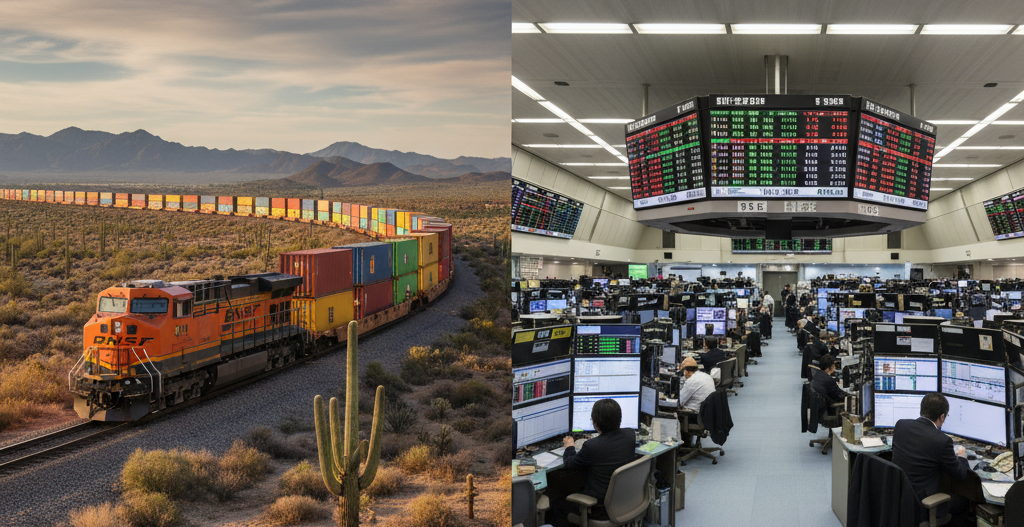
BNSF and CSX: partnership instead of takeover
The American railway sector was recently shaken up by the announcement of a surprising merger proposal between Union Pacific and Norfolk Southern, aimed at creating the first coast-to-coast railway operator. This strategic move was the direct catalyst for widespread speculation in the market: analysts and investors widely assumed that BNSF, the railway giant in Berkshire's portfolio, and rival CSX were under pressure to respond with a merger of their own in order not to fall behind.
However, this speculation was firmly put to rest last Monday. In an interview with CNBC, later confirmed by a spokesperson, Warren Buffett made clear that Berkshire is not interested in acquiring CSX. The market's reaction was immediate: CSX shares fell by 5%, as investors' hopes for a takeover premium evaporated.
Instead of a capital-intensive merger that would be complex to integrate, the companies revealed the true nature of their recent talks: a more intensive partnership. Last Friday, BNSF and CSX had already announced a new Intermodal Service Agreement. This agreement creates new direct coast-to-coast services and significantly strengthens their combined freight network. Buffett confirmed that he and his designated successor, Greg Abel, spoke with CSX chief executive Joseph Hinrichs on 3 August to shape this partnership, making it explicit that a bid for CSX was not on the table.
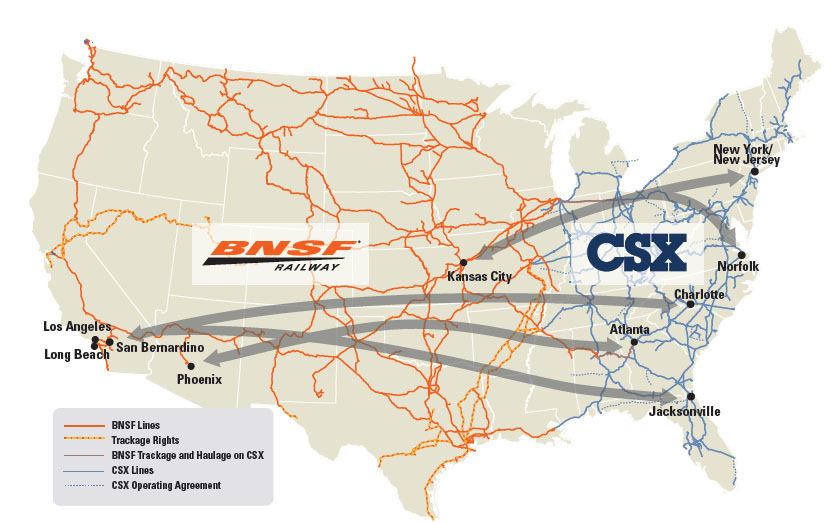
From our perspective, this is a classic Berkshire move. Management chooses to realise the synergistic benefits of a combined network without the risks and enormous capital outlay of a full takeover. It is a pragmatic solution that boosts operational efficiency and protects shareholder value, an approach we greatly appreciate.
Berkshire increases stakes in Japanese trading houses
While Berkshire is keeping a tight grip on its wallet when it comes to mega-acquisitions in the US, it is investing deliberately in Japan. On Thursday, it emerged that Berkshire had raised its stake in Mitsubishi Corp. to above 10% and had also further expanded its position in Mitsui & Co. This move continues a strategy initiated five years ago: building significant stakes in the five largest Japanese trading houses, known as the sogo shosha.
The investment case for these Japanese conglomerates is based on a twofold conviction: a thriving Japanese economy and a corporate culture that is becoming increasingly shareholder-friendly. The sogo shosha are deeply woven into the entire economy, with interests ranging from energy and food to aerospace and logistics. When the Japanese economy grows, these companies benefit optimally.
This appeal is underlined by Morningstar analyst Michael Makdad in a recent Barron's article. He argues that these companies are actively working to raise dividends and buy back shares, while still trading at an undervaluation of more than 20%. This combination of economic exposure, an increasing focus on shareholder returns and an attractive valuation fits perfectly with Berkshire's investment philosophy.
The events of the past week paint a clear picture of discipline and patience. In the United States, Berkshire refuses to join the market-driven merger frenzy and instead opts for a smarter, more capital-efficient solution. In Japan, where the combination of value and a positive evolution in corporate governance is present, capital is in fact being deployed with purpose.
Berkshire Hathaway ended the trading week on the New York exchange at a price of USD 502.98 per B share.
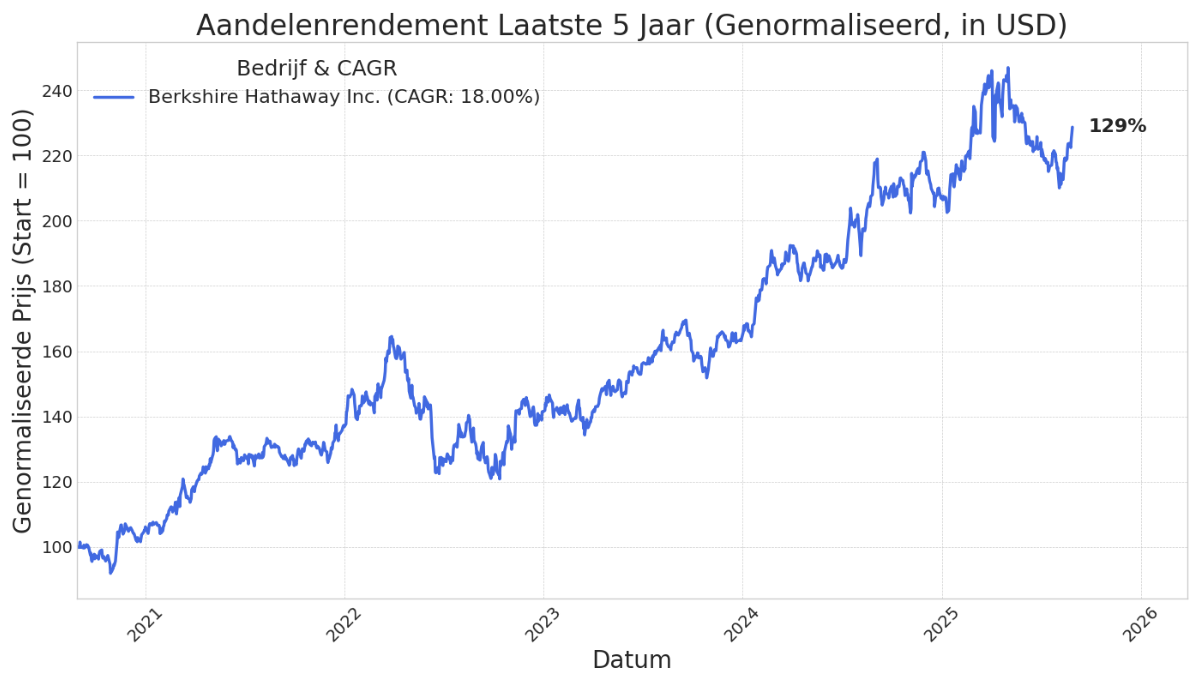
Analysis: the architecture behind Chapters Group's compounding machine
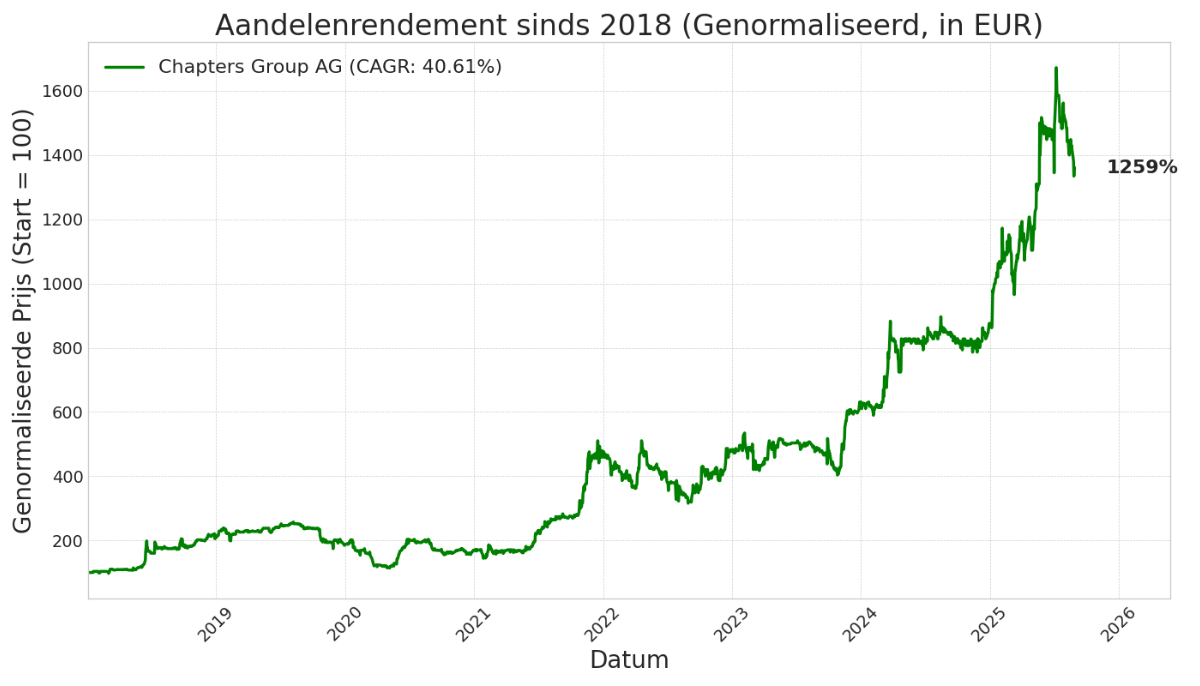
A recent analysis of the German investment holding company Chapters Group (Frankfurt: CHG) by RollUpEurope offers a clear view of the engine behind the company's success. The analysis confirms the well-known success story, but its origins are at least as telling.
It begins in 2018. At the time, the company is still called Medical Columbus, a struggling software micro-cap on the verge of liquidation. It is Jan-Hendrik Mohr, then a young fund manager with a stake in the company, who convinces management to make a radical change of course: invest the proceeds in the 'search fund' model. This pivotal moment lays the foundation for the company as we know it today.
The core of the success rests on three pillars. The first is the ingenious financial structure, aptly described as a "layer cake". In essence, Chapters Group applies proven principles of leverage and multiple expansion, but does so within the superior structure of permanent capital.
Head office raises capital and channels it through to the operating platforms. Once cash flows allow, they refinance this with cheaper bank loans, which maximises returns. An important strategic shift here is the increasing use of 'bullet' loans. These minimise repayment pressure in the early years, allowing cash flows to be reinvested directly in new acquisitions. This significantly accelerates the compounding effect of the flywheel.
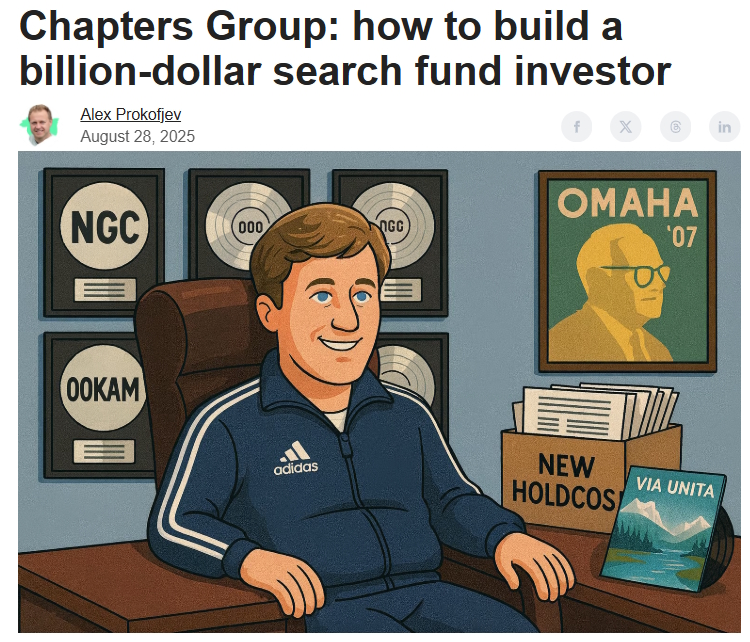
The second, and perhaps most important, pillar is the focus on human capital. At its core, Chapters Group is a machine that identifies, finances and facilitates outstanding entrepreneurial talent. A clear overlap is visible here with successful serial acquirers such as Danaher. It is no coincidence that Mitch Rales (co-founder of Danaher) and Will Thorndike (author of "The Outsiders") are shareholders, bringing with them an enormous source of expertise and credibility.
By giving entrepreneurs a significant minority stake of around 20% in their own platform, a perfect alignment of interests is created (skin in the game). The success of the first platforms, such as Ookam, is living proof that this works. This is underlined by the fact that Ookam's founders have since sold their 20% stake for a very substantial amount.
The remuneration structure is unique in that it adds a put-call option. This gives platform leaders the option to later convert their stake into shares in Chapters Group itself. This creates a double incentive: for local entrepreneurship in the short term, and for the group's overall value creation in the long term.
The third pillar is the decentralised organisational structure. Unlike centralised models, the M&A process is run entirely by the platforms themselves, which makes the model fundamentally scalable.
This allows the management team at holding company level to focus on what really matters at the highest level: capital allocation and spreading best practices. In doing so, Chapters creates a model that combines the best of both worlds: the entrepreneurial freedom of a decentralised approach, but within a central framework of proven methods. This avoids both the chaos of a fully loose structure and the rigidity of a top-down managed model.

As we already indicated in our earlier analysis "Chapters Group: A Promising Software Compounder", the focus on the fragmented European VMS market is a strategic advantage. This is reinforced by the implementation of the 'Manuscript Method', a concrete machine for unlocking latent profit in the spirit of the Danaher Business System.
A striking example of this, described in our "Deep Dive: More than just a German Constellation Software", is the anecdote of COO Marc Maurer, who advised a subsidiary to raise its prices by 84%. The result was 0% customer churn, demonstrating the enormous, untapped pricing power that is now being systematically unlocked.
The strategy is clear, and its execution is what sets Chapters Group apart as one of the most promising serial acquirers in Europe. Together with Asseco Poland, Constellation Software, Topicus.com and a recent addition (which, for now, we share only with our clients), we regard Chapters Group as an integral part of the software group within our family holding company strategy.
Chapters Group ended the trading week on the Frankfurt stock exchange at a price of EUR 39.40 per share.
The unprecedented strength of infrastructure and cybersecurity: how Vorwerk and DTS are driving MBB's growth
The German investment holding company MBB SE (Frankfurt: MBB) has presented its results for the first half of 2025, and the figures show impressive strength at the core of the business, which more than offsets weakness in more cyclical end markets. Consolidated revenue rose by a robust 16.8% to EUR 545.5 million, but the real story lies in the underlying profitability.
Operating profit (EBITDA) jumped by no less than 36.8% to EUR 76.4 million. This resulted in a margin of 14.1%, an increase of 2.1 percentage points and a "historic high for a first half-year", according to CFO Torben Teichler during the presentation of the figures.
The driving force behind this strong performance was the second quarter, in which revenue grew by 9.2%, while operating profit surged by an impressive 40.2% to EUR 46.5 million. This illustrates the operational leverage in the best-performing parts of the group.
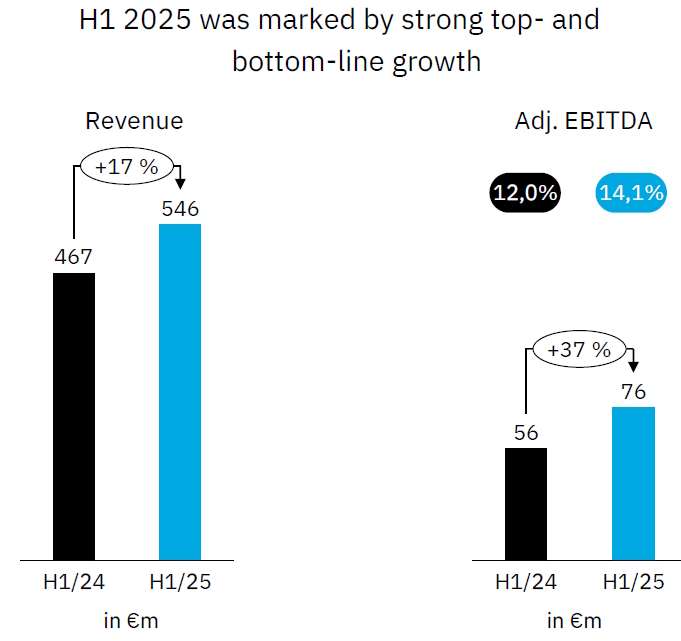
The Service & Infrastructure segment, comprising Friedrich Vorwerk and DTS, was the undisputed engine of the group. In the first half of the year, this segment saw revenue rise by 49% to EUR 361.6 million, while operating profit nearly doubled, growing by 95.4% to EUR 62.4 million.
Friedrich Vorwerk: the pillars of the energy transition
Friedrich Vorwerk, which specialises in critical energy infrastructure, was the absolute standout. In the second quarter alone, revenue grew by 45% to EUR 170 million, with an exceptionally strong operating profit margin of more than 21%.
According to Teichler, this is thanks to "smooth execution", reduced pressure on personnel resources following successful hiring, and "good progress on a number of megaprojects", specifically citing A-Nord and BalWin.
The outlook is supported by an order book of no less than EUR 1.1 billion as at 30 June 2025 and recently secured multi-billion-euro contracts. Examples include the ETL 182 pipeline for LNG transport and a complex section of the SuedLink power cable, where Vorwerk's expertise in HDD drilling is crucial. This strong momentum led management to significantly raise its 2025 guidance to revenue of EUR 610-650 million with an operating profit margin of 17.5-18.5%.
DTS: the digital fortress in a growing cyberwar
The digital world finds itself in a state of escalating conflict. As The Economist recently highlighted, the rise of AI-driven hacking is transforming cybercrime from a niche activity into a widespread, industrial threat. Artificial intelligence "broadens the reach" of hackers, allowing them to hit more targets with less effort. Generating deepfakes, personalised phishing attacks and even self-adapting malware is easier than ever.
This growing threat is fuelling explosive growth in the cybersecurity market. This global trend is confirmed in DTS's home market. According to the German industry association Bitkom, cited in MBB's own report, the security software market is expected to grow by 11% in 2025. This provides powerful tailwinds for DTS, MBB's specialist in this crucial field. DTS focuses in particular on IT security for the German Mittelstand, specialising in network access control.
DTS's performance has been strong, with revenue growth of 20.6% to €58.6 million in the first half of the year and an operating profit margin of 13.5%. A key highlight, and a "game changer" according to Teichler, was winning a five-year contract in the public sector worth between €20 million and €30 million. This is the largest order in DTS's history and serves as a "lighthouse project" that qualifies the company for larger, strategic assignments.
During the conference call, we asked about the strategy for margin expansion. Teichler explained that the focus is on increasing the share of its own, higher-margin software. The recent full acquisition of the remaining 19.66% stake in software subsidiary ISL Internet Sicherheitslösungen, through which DTS now owns 100%, is a crucial step in accelerating this strategy. ISL acts as the "hub" for the development of proprietary software products.
Teichler expects the operating profit margin to rise over time from its current 13–15% as software sales grow disproportionately. He added that the 15% margin is certainly achievable, but that this level could rise further depending on how quickly software sales pick up. In addition, the company is actively looking at acquisition opportunities that could accelerate this process.
Headwinds in cyclical markets
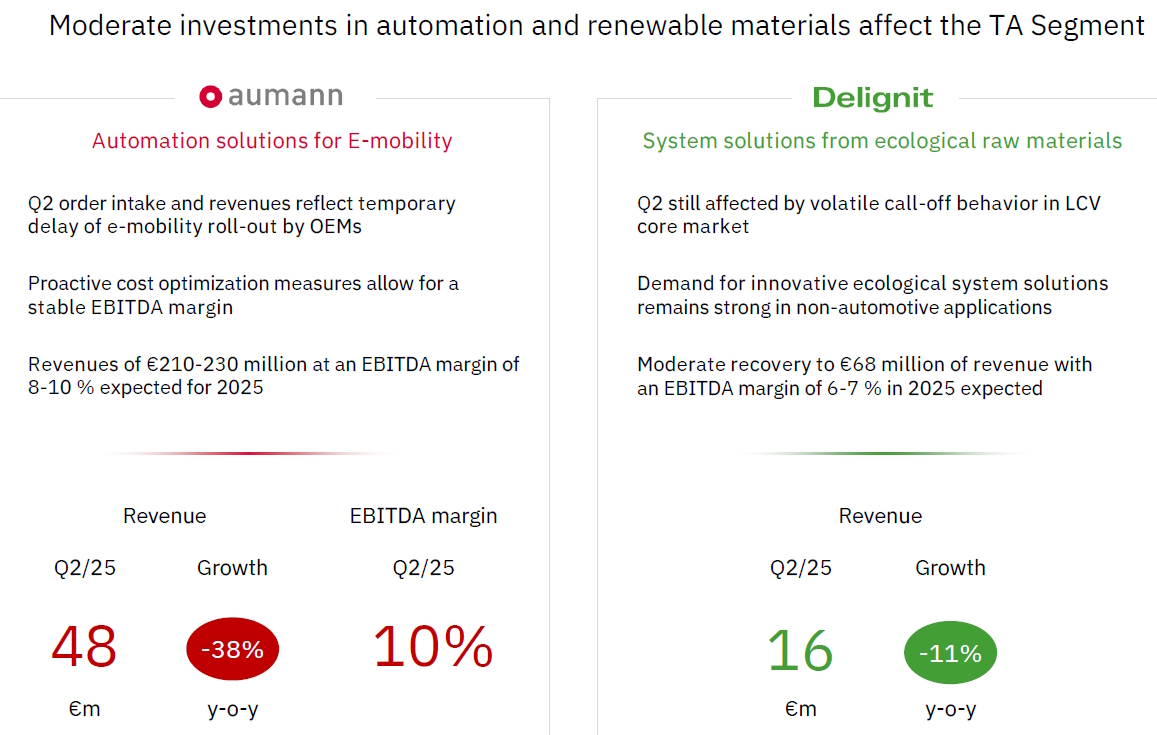
In stark contrast stood the performance of the Technological Applications segment. Revenue fell by 20.3% to €142 million in the first half of the year, mainly due to restraint in the automotive industry.
Aumann saw revenue decline by 23.4% to €108.3 million, but managed through "proactive cost management" to keep its operating profit margin stable at a respectable 10.8%. Although order intake in the automotive sector remains weak, the 'Next Automation' segment is growing by 20%, underscoring the success of the diversification strategy.
The Next Automation segment represents Aumann's strategic diversification away from the traditional automotive industry. It focuses on automation solutions for growth markets such as clean tech, aviation & defence and healthcare. Despite the overall headwinds facing Aumann, this segment is showing positive momentum.
In the first half of 2025, order intake in Next Automation rose by an impressive 20.4% to €21.9 million. This growth was supported by a significant order in the clean tech domain, worth approximately €4 to €6 million. The segment's order book also grew, reaching €47 million. This shows that the strategy of broadening the business is paying off and forms a buffer against volatility in the e-mobility market.
The segment's profitability remains robust, with an operating profit margin of 13.5%. Aumann explicitly states that it wants to further accelerate the expansion of Next Automation, both organically and through targeted acquisitions. The underlying drivers for these markets, such as the energy transition (clean tech) and the modernisation of defence, provide structural long-term tailwinds.
The Consumer Goods segment also faced weak consumer demand and start-up costs for new capacity at tissue producer Hanke, resulting in an operating profit of just €1.4 million, compared with €4.2 million a year earlier.
Active portfolio management & capital allocation
One striking point in the half-year report was the sale of shares in all three listed subsidiaries.
During the earnings call, CFO Torben Teichler, responding to questions from Tresor Capital partner and co-owner Michael Gielkens, provided crucial context on these transactions. The sale in Friedrich Vorwerk, which reduced the stake to 48.55%, was primarily intended to increase the liquidity of the share. Teichler explained that MBB had "been approached by several banks" to do this because of the "strong interest from American investors" since its inclusion in the SDAX index.
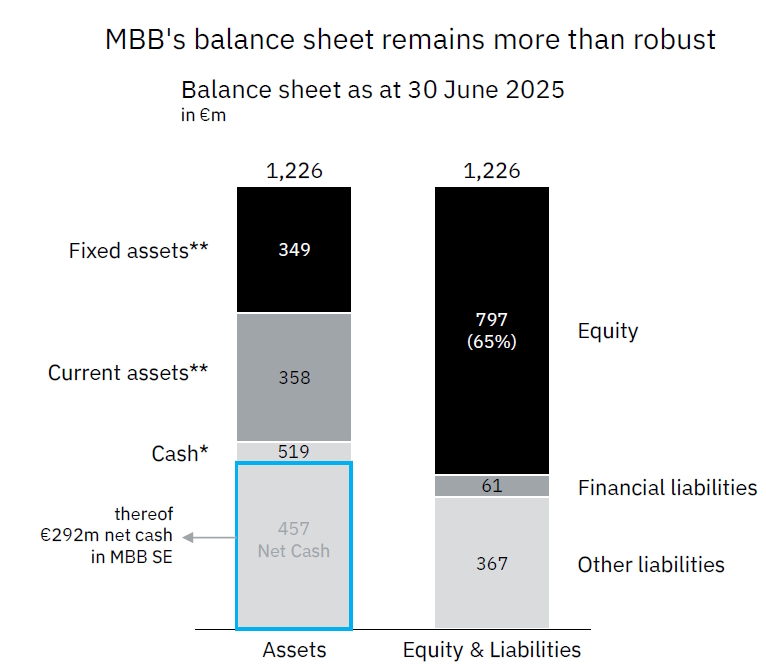
At Aumann, MBB participated in a share buyback programme, which reduced its stake to 48.86%. These sales should therefore not be seen as a signal that MBB is preparing for a major acquisition, but rather as tactical moves to optimise the value of the subsidiaries in the capital markets. With a "rock-solid" balance sheet, with a net cash position of €457.4 million at group level, of which €292 million at holding level, MBB is excellently positioned to capitalise on acquisition opportunities.
MBB's liquid portfolio consists largely of government bonds and corporate bonds, supplemented by a sizeable equity portfolio. We asked Teichler whether MBB could become more transparent about the main positions it holds in this portfolio (including Alphabet and Microsoft as top positions).
According to Teichler, this equity portfolio is largely a "large-cap blue-chip portfolio with a certain American focus", comparable to what one might expect from a conservative institutional investor. The aim is to invest the money responsibly and generate returns until further acquisition opportunities or other ways to deploy the cash are found.
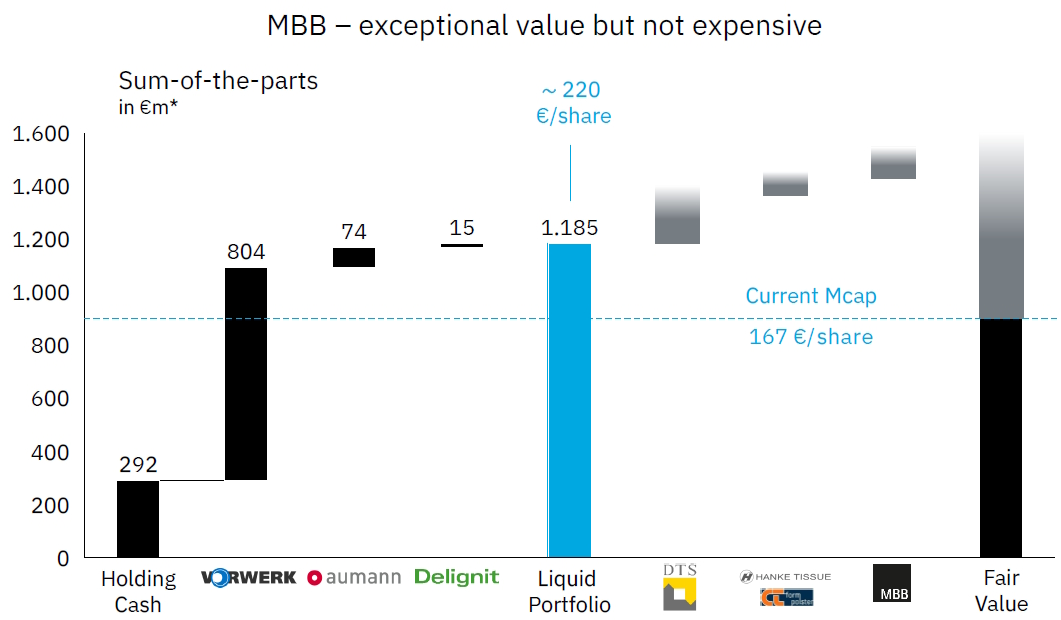
The underlying value of the holding company, as illustrated in the 'sum-of-the-parts' valuation in the company presentation, remains significantly higher than the current share price. The presentation shows a market value of around €167 per share, while the value of the liquid assets (cash and listed stakes) alone amounts to around €220 per share. This implies that the market is assigning a zero or even negative value to the rest of the portfolio, including the profitable and fast-growing DTS.
MBB ended the trading week on the Frankfurt stock exchange at a price of €164.60 per share.
Receive weekly insights in your inbox
Exclusive analyses and updates on family holding companies and global market developments.
Would you like more information about our services? Feel free to get in touch.
Get in touch
Disclaimer:
No rights can be derived from this publication. This is a publication of Tresor Capital. Reproduction of this document, or parts thereof, by third parties is only permitted with prior written consent and with reference to the source, Tresor Capital.
This publication has been compiled by Tresor Capital with the greatest possible care. The information is intended in a general sense and is not tailored to your individual situation. The information must therefore explicitly not be regarded as advice, an offer or a proposal to purchase or trade investment products and/or to make use of investment services, nor as investment advice. The authors, Tresor Capital and/or its employees may hold positions in the securities discussed, for their own account or on behalf of their clients.
You should carefully consider the risks before you start investing. The value of your investments may fluctuate. Past performance offers no guarantee for the future. You may lose (part of) your invested capital. Tresor Capital disclaims any form of liability for any inaccuracies or imperfections. This information is purely indicative and subject to change.
Read the full disclaimer at tresorcapitalnieuws.nl/disclaimer .
This article was originally written in Dutch and automatically translated into English with the help of AI. In case of any difference, the Dutch original prevails.