Family Holdings #36 - Private funds do the work at Sofina
• [cijfer/datum] NL: "Waar Blackstone (New York: BX) in 2025 meer dan $3,5 miljard aan dividend uitkeerde" → EN: "Whereas Blackstone (New York: BX) paid out more than $3.5 billion in dividends in 2025" — The Dutch states 'meer dan $3,5 miljard' which is 'more than $3.5 billion'. The English uses the same figure, but there is a notation change issue if we check carefully. The Dutch uses '$3,5 miljard' (with comma as decimal separator) while the English uses '$3.5 billion' (with period). However, this is a standard notation change which is acceptable per instructions. But the actual issue here is that this is stated as a fact about 2025 - but the article seems to be discussing first half of 2026 developments. However, checking the instructions again, dates in 2026 and later are normal, and this is merely referencing 2025 data in comparison. This appears correct as a notation change.
Tip: na publicatie mag de interne tag #controleren blijven staan; die is onzichtbaar voor lezers.
This week's topics:
As Warren Buffett's successor, Greg Abel paid a strategic visit to Berkshire Hathaway's Japanese holdings, including the five major trading houses, Tungaloy and insurer Tokio Marine. The Japanese strategy launched more than six years ago is delivering excellent returns, and Abel underscored the ambition to further expand these long-term holdings (now the third-largest position in the portfolio) in the future. Financing via yen-denominated bonds remains amply covered by dividend income despite rising Japanese interest rates. In addition, Berkshire is leaving the door open for a possible large joint acquisition alongside Tokio Marine.
With the sale of insurance broker USI Insurance Services to Aon for $17 billion, KKR is cashing in on one of the largest transactions in its history, which upon completion will generate roughly $3.3 billion net of tax for its own balance sheet. Together with the earlier sale of CoolIT Systems, this underscores the course KKR set in 2015 of directing more capital to its own balance sheet rather than to dividends. Whereas many private equity holding companies remain dependent on new fundraising for their growth, KKR is demonstrating with these deals and additional steps the strength of its own capital engine.
In Brief:
The infrastructure arm 3i Infrastructure PLC of 3i Group (London: III) has completed its €263 million investment in the Lefdal Mine Datacenter. At the same time, a minority investor's stake of a comparable amount was acquired. As a result, 3i now holds 90% of the equity: half via 3i Infrastructure and the other half via external co-investors managed by 3i. The remaining 10% stays with an existing shareholder. In addition, 3i Infrastructure has committed a further €19 million in additional financing.
Google (New York: GOOGL) escapes a forced break-up of its advertising arm. The US court rejected the Department of Justice's demands to sell the AdX ad exchange and to open up or spin off the DFP publisher platform. Instead, only behavioural remedies will follow, which definitively removes the structural risk to Google's business model. After earlier failed attempts to break up Meta (Instagram/WhatsApp) and Google (Chrome), this marks the third consecutive defeat for the US competition authorities.
Constellation Software (Toronto: CSU) subsidiary Volaris has acquired Biodiv-Wind, based in southern France, the market leader in real-time detection of birds and bats around wind farms. Using cameras, radar and AI linked to turbine controls, the company helps wind farm operators comply with their environmental permits. Biodiv-Wind has more than 700 systems in operation and is compatible with all major turbine manufacturers. It is a textbook example of the Constellation fishing pond, centred on business-critical niche software with a mandatory character in a market too small for large players.
D'Ieteren Automotive, part of the D'Ieteren group (Brussels: DIE), the Belgian importer of Volkswagen Group, is cutting up to 344 jobs (15% of its workforce) and closing several locations. Management points to structural market changes: the Belgian car market has been lagging since 2020, forcing a shift from new-car sales towards service revenue over the full lifetime of vehicles. The reorganisation follows the Belgian Wet-Renault (Renault Act, which governs collective redundancies) and fits into a broader European trend, with parent company Volkswagen also making sharp job cuts.
Greater transparency on the private heavyweights in Sofina's portfolio
Following the earlier newsletter with preliminary figures, the Belgian family holding company Sofina (Brussels: SOF) published its full half-year report this week. Net asset value came in at €326.48 per share, an increase of 6.77% compared with €305.77 at the end of 2025. To understand exactly where that growth comes from, one really only needs to look at two charts. Twice a year, Sofina publishes a fair value bridge for both the direct portfolio and the fund portfolio, providing a step-by-step breakdown of how value evolved from the start to the end of the period. These two overviews quickly show that the entire return in the first half of 2026 can be attributed to the revaluation on the private side of the portfolio.
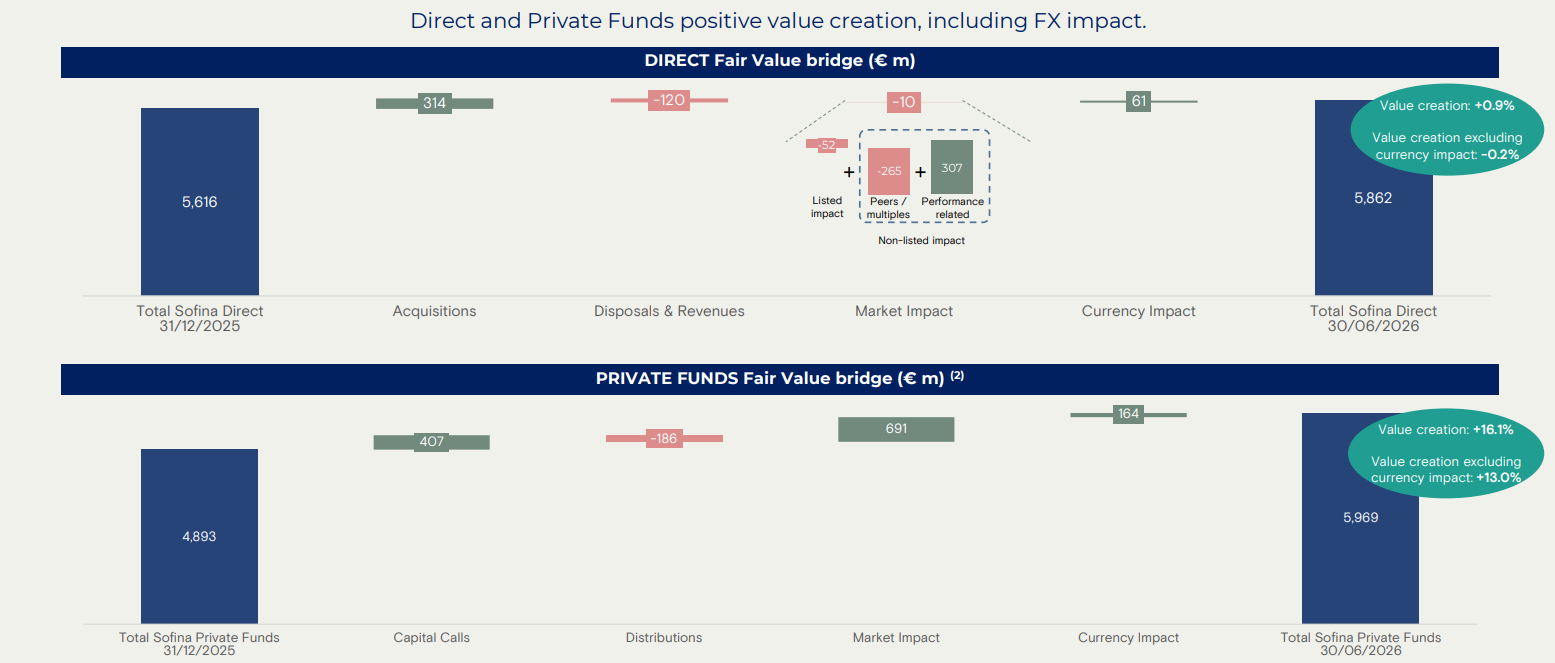
Looking at the underlying funds, we see that they grew by 13% over six months, excluding currency effects. An excellent result for a half-year period. However, an important caveat needs to be made here. Because of the illiquid nature of private investments, most funds are not valued as at 30 June, but instead lag behind with figures as at the end of March or even the end of December of the previous year. Since valuation frequency and methodology differ per fund manager, revaluations do not take place daily. It is therefore quite plausible that part of the actual revaluation has yet to follow, although the exact effect of this remains an estimate even for Sofina.
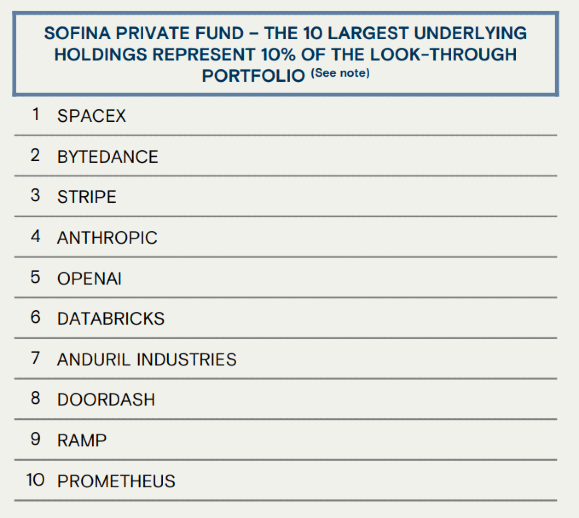
In this report, investors were given considerably more insight into the positions driving private growth. Whereas in the previous newsletter only the names of the most important participations were mentioned, they are now ranked from largest to smallest within the top 10 look-through allocations. Following the motto"whoever does not honour the small does not deserve the great", we happily welcome this extra openness, although it remains partly guesswork since hard figures per position are lacking. It is immediately apparent that SpaceX is the largest underlying exposure. Given that this top ten together represents 10% of net asset value, this quickly translates into an indirect stake of well over €115 million per company for the top positions.
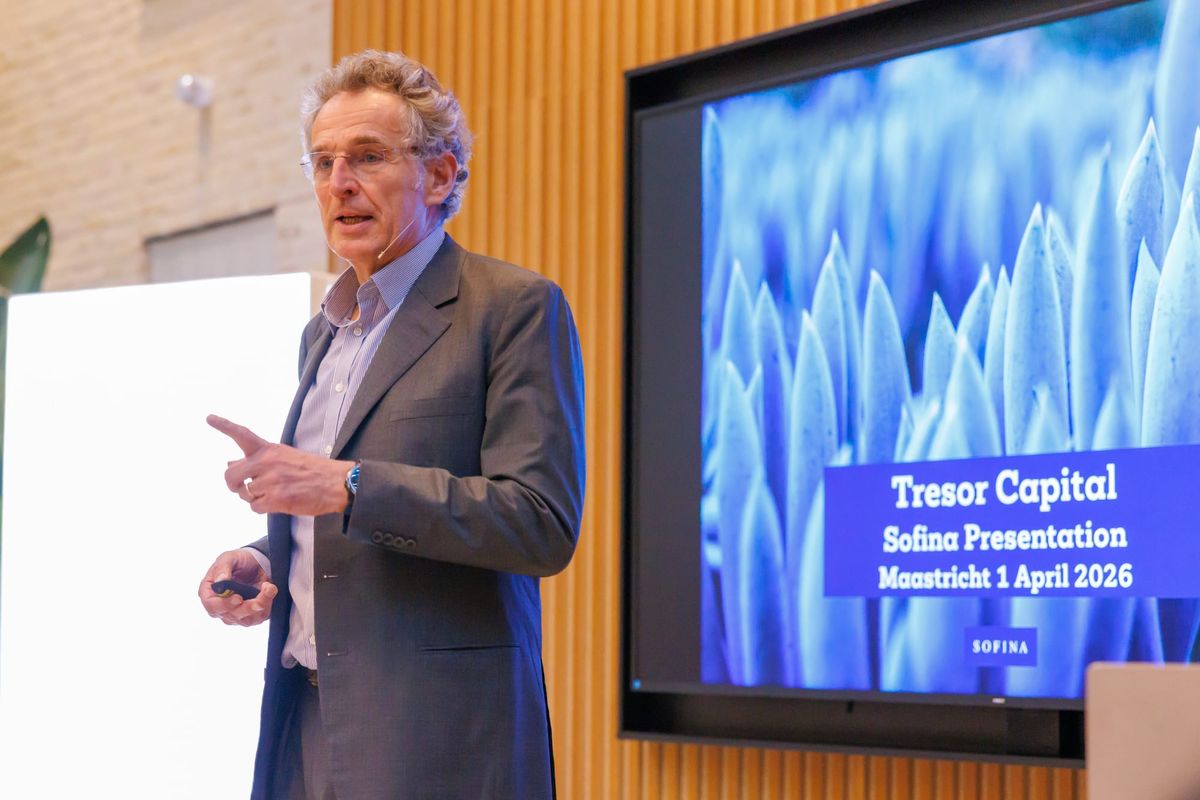
Another prominent holding on this list is ByteDance (the parent company of TikTok), which ranks second within the fund portfolio and is at the same time the largest position in Sofina's direct portfolio. Combined, this Chinese tech company therefore constitutes by far the largest holding of the entire holding company. CEO Harold Boël confirmed that the stake now accounts for between 5% and 10% of the total portfolio and emphasised that Sofina would only become nervous at a concentration approaching 20%. He described the position as a luxury problem, given that ByteDance is simply one of the most successful investments in the holding company's history. At the same time, he admitted that the current structure is not ideal. The direct stake runs through a specific vehicle managed by fund manager HongShan (the Chinese spin-off of Sequoia), over which Sofina has no say whatsoever regarding the timing of liquidation. Given the company's immense scale, an eventual stock market listing seems the most likely route to realising value.
Set against these strongly performing private funds is the direct portfolio, in which Sofina manages the investments in its own name. This division represents around 51% of net asset value, at €5.9 billion, but presents a very different picture. The total revaluation here came out net slightly negative. However, a further breakdown shows that this is not due to the operational performance of the underlying companies themselves. Stronger revenues, higher profits and better cash flows contributed a positive €307 million. Unfortunately, this strong operational performance was undone by lower valuation multiples among listed sector peers, which shaved €265 million off the value, while the listed holdings themselves lost a further €52 million. This is therefore mainly a market-wide valuation correction rather than a fundamental problem at the participations. Nevertheless, it cannot be denied that the direct part of the portfolio made a disappointing net contribution to overall return development.
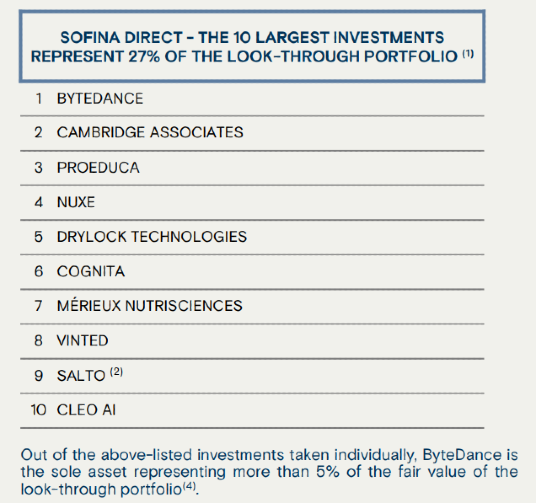
Looking at the specific positions that weighed on the result, Boël mentioned, among others, education group Cognita. This company faces affordability problems among parents in the Middle East and in emerging markets, which is slowing growth. In addition, software companies were under pressure. Although multiples in this sector have recovered from the low point of earlier this year, they still remain below last year's level. A positive exception was Cambridge Associates, which climbed to second place within the direct portfolio. This rise took place without any new funding round, but was the direct result of a combination of strong operational results and higher market multiples. Finally, after the 30 June reporting period, the stake in Salto, a provider of smart electronic access control, was also successfully sold.
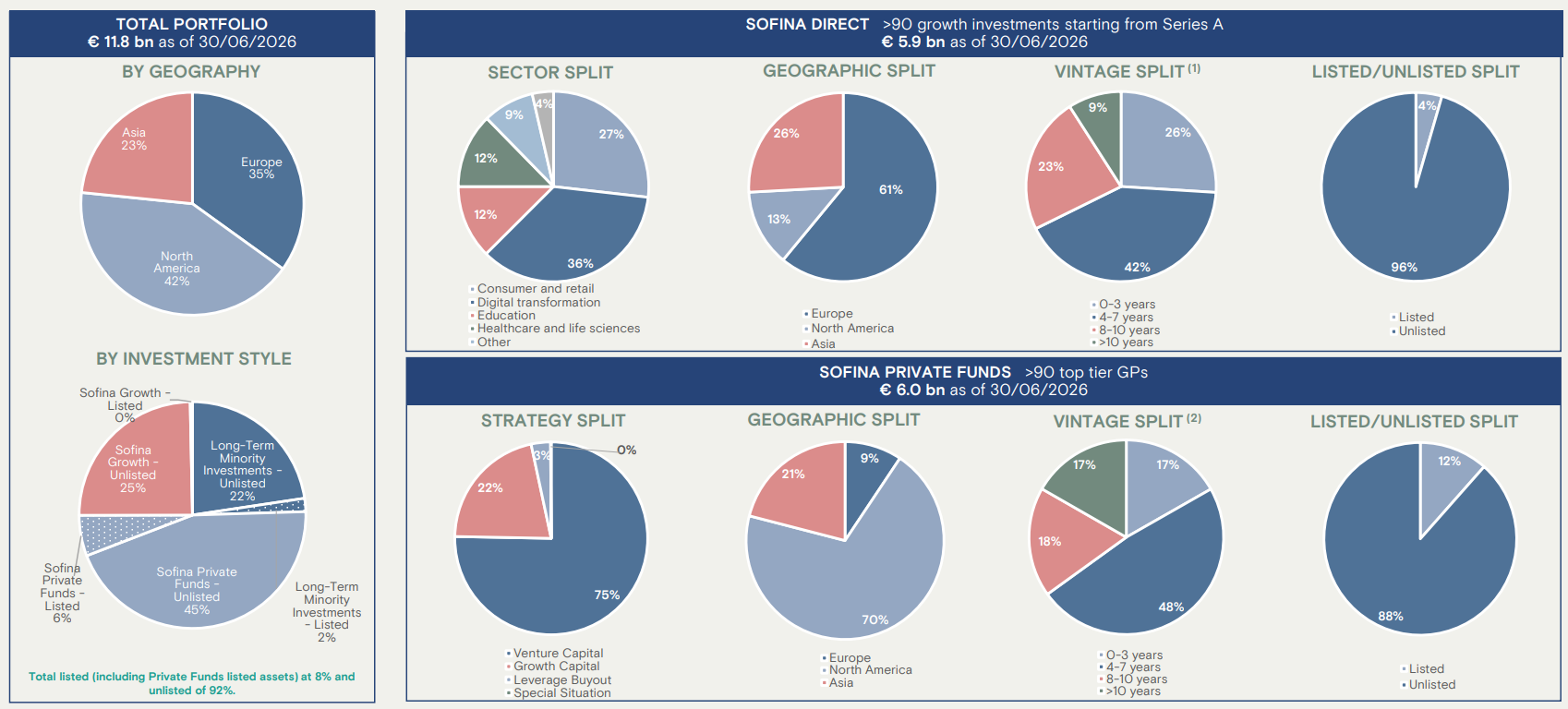
The combination of performance in both portfolios has also left clear geographic traces. For instance, the weight of North America in the total portfolio has risen from 37% at the end of last year to 42% now. That shift is almost entirely attributable to the fund portfolio, in which North American investments make up as much as 70% of the total. The direct portfolio, by contrast, is heavily European-focused, with a share of 61%, while America accounts for only 13% of it.
During the discussion of the results, the question was raised as to why Sofina does not actually make direct co-investments in the United States, especially now that leading venture capitalists such as Thrive and Khosla are setting up special vehicles to invest directly in companies such as OpenAI and Anthropic. Boël indicated that this is a question management regularly asks itself, but he remained firm about the chosen course. Competing directly with parties such as Sequoia, Lightspeed or Thrive on their own home turf requires a proven competitive advantage, a so-called right to win, which Sofina simply does not have in America. Moreover, the holding company aims for a balanced allocation of capital across the various regions. Every euro that Sofina itself would invest directly in the United States comes at the expense of a commitment to the top funds that Boël considers among the best investors in the world.
All in all, Sofina's result currently relies heavily on the outperformance of the private funds portfolio, while the direct investments are lagging due to market-wide valuation pressure. Although the increased transparency regarding top holdings such as SpaceX and ByteDance is welcome, the exact valuations of these illiquid positions remain inherently uncertain. Definitive confirmation of this accumulated value will have to wait for future IPOs (of, for example, OpenAI and Anthropic) and actual realisations.
Berkshire Hathaway continues to benefit from Japanese positions
Greg Abel, who has been active as Buffett's successor at the American investment holding company Berkshire Hathaway (New York: BRK-B) since the start of this year, paid a visit to the Japanese investments this week. He visited the five large trading houses in which the holding company holds stakes (Mitsubishi, Itochu, Mitsui & Co., Sumitomo and Marubeni), insurer Tokio Marine and one of Berkshire's own subsidiaries. Abel was interviewed from Tokyo by news channel CNBC and also spoke with the Japanese business newspaper Nikkei Asia.
A day in Fukushima
Upon arrival, chief executive Abel first travelled to Fukushima. That is where the company Tungaloy is based, a manufacturer of cutting tools for metalworking and part of subsidiary IMC, Berkshire's metalworking group. The company originated from Toshiba and was acquired in 2008 as a relatively small enterprise. Tungaloy now employs around 1,500 people and generates slightly under USD 240 million in domestic revenue, with more than USD 400 million in additional international revenue on top of that.
Six years in the Japanese trading houses
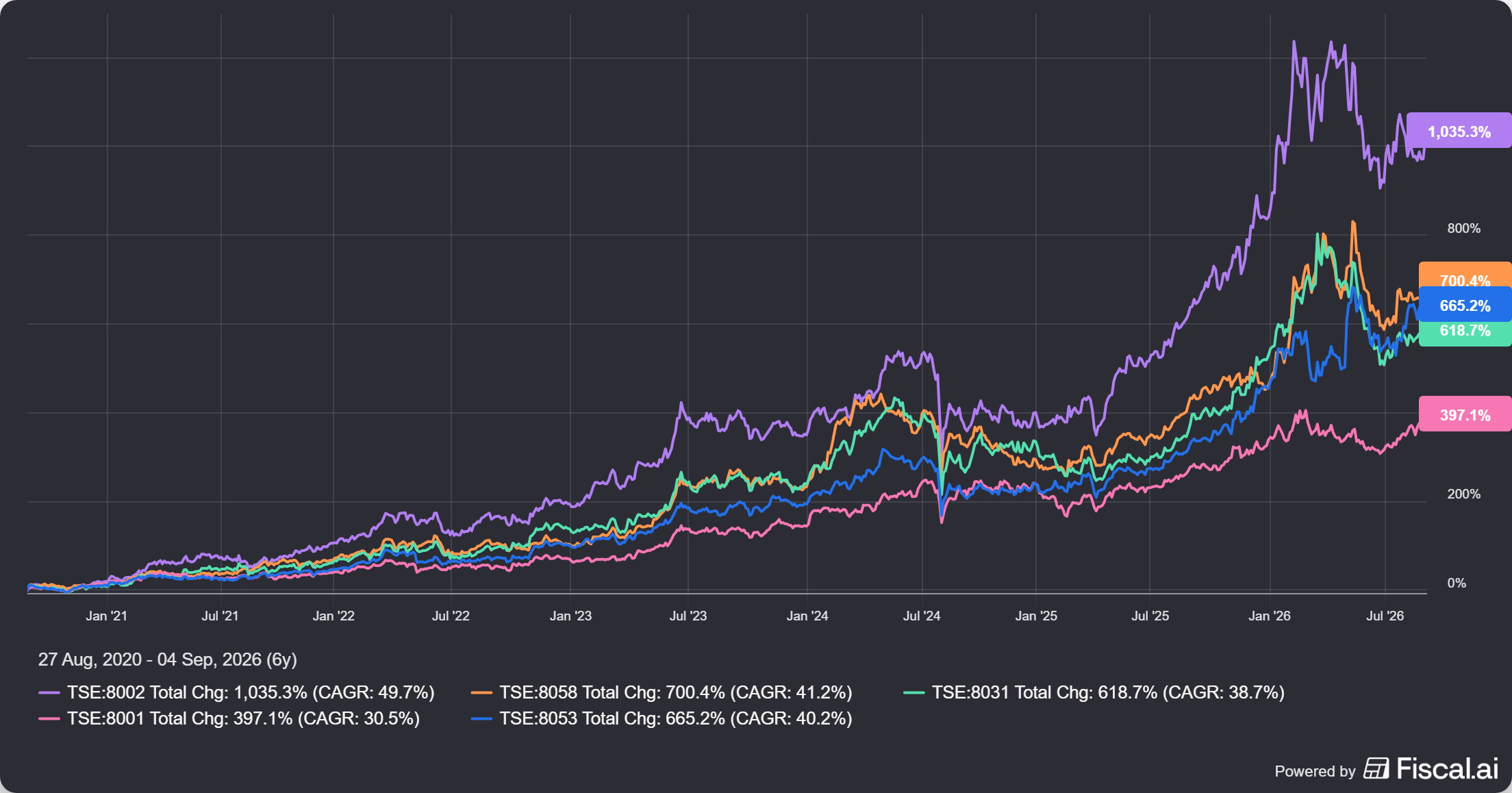
The first purchases in the five so-called sogo shosha were announced more than six years ago, on Warren Buffett's 90th birthday. The returns since then can be called excellent, as shown in the figure above. At the time, it involved just over 5% per company. In 2023, Buffett and Abel visited the five companies in Tokyo, when the ownership stake had passed 7%. Later, in consultation with the companies, Berkshire passed the 10% ownership threshold in all the trading houses, partly due to the companies' own share buybacks. Speaking to Nikkei Asia, chief executive Abel addressed the question of how that stake will develop further.
"Our aim is to continue increasing our ownership stake further. If we're at the meetings in Omaha next month and decide that we'd like a bit more of each company, we will do that."
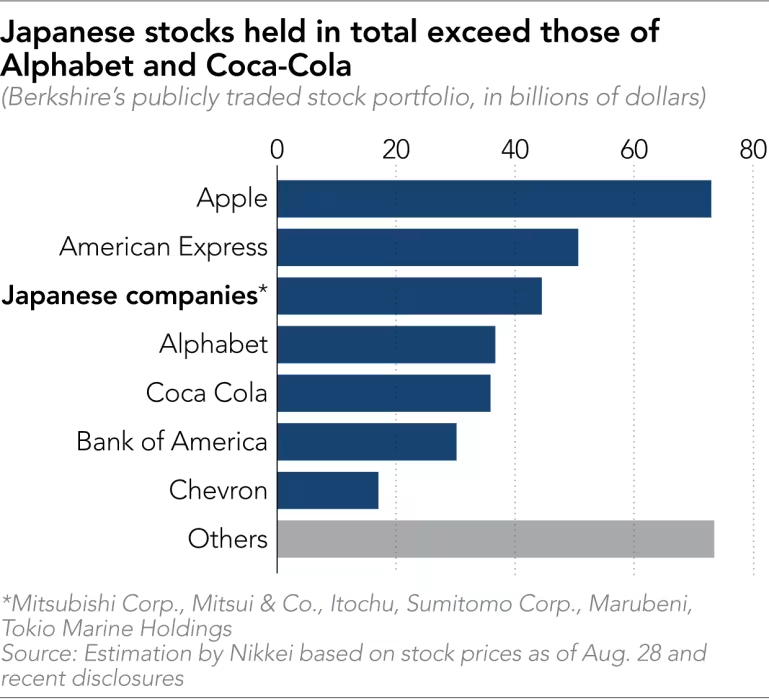
Abel has repeatedly emphasised that these are investments Berkshire intends to hold for many decades. The Japanese trading houses now collectively occupy the third position by weight in Berkshire's equity portfolio, just below American Express and above Alphabet.
At least as important as Berkshire's long-term horizon is the relationship that has been built up with the trading houses over the years, with each visit building on previous conversations and exploring additional opportunities for cooperation, both in Japan and beyond.
What the Japanese trading houses have gained from Berkshire
Nikkei Asia asked the executives of the five trading houses what they had learned from Berkshire. Itochu chief executive Okafuji points above all to the peace of mind offered by a stable long-term shareholder, since his company is not forced to account for short-term results in detail.
Itochu president Ishii points out that Berkshire Hathaway's arrival changed how the market viewed the trading houses, as foreign investors and later Japanese investors as well rediscovered the shares and valuations rose. As an example of long-term thinking, he cites how Berkshire Hathaway, with its recent acquisition of Taylor Morrison, is focusing precisely now on the relatively weak American housing market, in the belief that interest rates will eventually fall again and that during the next home-buying cycle it will once again benefit from recovered demand.
Sumitomo chief executive Ueno appreciates that Berkshire does not interfere in internal business operations and has never, in multiple conversations, asked him to change anything, instead encouraging him to remain faithful to the successful strategy. Marubeni president Omoto cites Warren Buffett's baseball analogy. According to Buffett, the beauty of investing is that you don't have to swing at every pitch and only need to go for the good ones. Marubeni draws inspiration from this and prefers to choose a small number of investments with a high probability of success.
Mitsubishi chief executive Nakanishi said he was inspired by Berkshire to pay more attention to how the company deals with shareholders, and he wants to further improve its disclosure practices. Finally, Mitsui chief executive Hori mentioned the ability to call Berkshire's leadership directly whenever necessary, something he considers particularly valuable in an international context.
Financing in yen
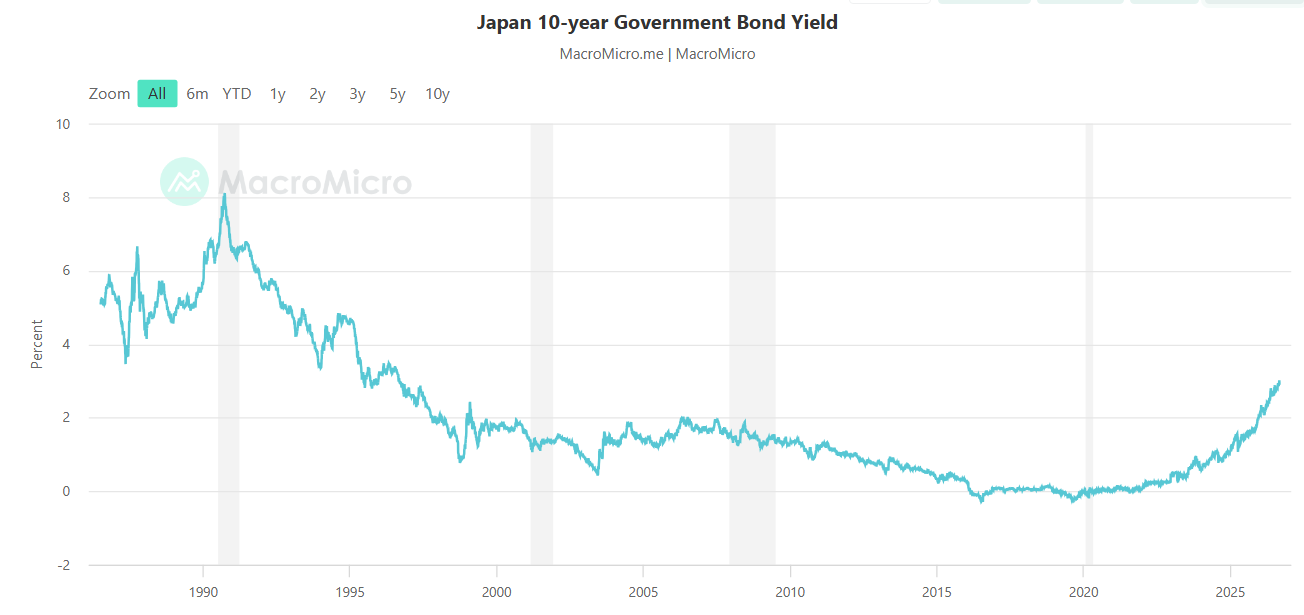
To finance its Japanese holdings, Berkshire regularly issues bonds denominated in yen. According to the latest figures, this amounts to more than USD 15 billion in outstanding debt. The fact that Japan's ten-year interest rate stands at its highest level in thirty years (3%) is a hot topic for investors and the financial press. Remarkably, however, none of the five trading houses raised this as a material concern.
Greg Abel pointed out that the size of the outstanding debt broadly matches the purchase price of the Japanese holdings and that the remaining maturity is still just over five years. As a result, the dividends received still comfortably exceed the interest paid. He does not rule out further bond issuance in yen. He also expects the trading houses' profits to keep growing, with both dividends and share buybacks set to increase further in the coming years.

Tokio Marine keeps the door open for a major acquisition
Various media reports recently emerged suggesting that insurer Tokio Marine is exploring a large-scale acquisition, with Australia's Suncorp and Canada's IAG mentioned as possible targets. Berkshire Hathaway's balance sheet would reportedly support the financing. Abel did not comment on those specific acquisition targets, but he made clear that he is open to a major deal. He emphasised that both parties can put proposals to one another and that he would welcome a transaction that adds value for both companies.
Just before the shareholders' meeting, the two companies entered into a broad strategic partnership. As part of this, Berkshire took a quota share of 2.5% on the insurance policies written by Tokio Marine, meaning that the holding company assumes a fixed percentage of everything the Japanese insurer underwrites for its own account and risk, and it also took a 2.5% ownership stake in the company itself. A joint acquisition makes sense for both companies. Tokio Marine brings the capabilities needed to manage the acquired insurer that Berkshire lacks, while the American investment holding company can put its ample cash pile to work, thereby providing the capital that Tokio Marine lacks to finance such a deal.
You can watch the full CNBC interview with Greg Abel here:
KKR cashes in on its own balance sheet
The American investment holding company KKR (New York: KKR), in which founders Kravis and Roberts hold a controlling stake, announced one of the largest realisations in its history this week. American insurance broker USI Insurance Services is being sold to Aon for approximately $17 billion, including debt. KKR acquired USI in 2017 together with Canadian pension investor CDPQ from Onex for $4.3 billion and has since gradually expanded its stake to become the largest shareholder. Based on annual revenue of approximately $3 billion, Aon is paying around 5.7 times revenue.
Although the deal has been agreed, it still needs to be formally completed. Upon completion, the deal is expected to generate a net cash result of approximately $3.3 billion after tax for KKR. USI is not an isolated case: last March, KKR already sold data centre specialist CoolIT Systems to Ecolab for $4.75 billion, representing fifteen times the equity invested. Two realisations of this scale within six months are highly unusual.

This transaction brings us to a strategic shift that the Financial Times rightly highlighted this week. Private equity houses have traditionally earned most of their money from third-party capital through management fees (management fees) and profit-sharing (carried interest). More than ten years ago, however, KKR decided to also start investing structurally with its own money. Since 2015, the firm has deliberately spent less capital on dividends and more on building up positions on its own balance sheet. That difference is visible in the figures. Whereas Blackstone (New York: BX) paid out more than $3.5 billion in dividends in 2025, KKR stayed below $1 billion, a gap that has only widened since 2021 (see chart below).
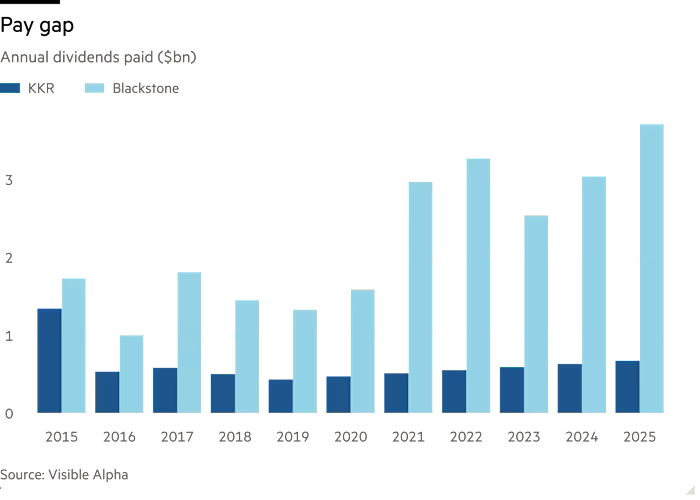
The result of that policy is a balance sheet that has changed character in a short period of time. KKR's own assets, separate from the funds it manages, now amount to more than $400 billion, compared with around $50 billion at the end of 2018. The largest part of that runs through the balance sheet of life insurer Global Atlantic, but operating companies such as Roompot, 1-800 Contacts, biscuit maker Arnott's and software company Exact also sit directly on its own books.
That was not all this week. Wella Company, the hair and nail care group in which KKR has held a 60% stake since 2020, filed for a listing in New York. In addition, KKR sold its 10% minority stake in Nordic Bioscience back to founder Claus Christiansen. The revenue of the Danish biomarker company has doubled since the partnership began in 2021. On the acquisition side, KKR expanded with a minority stake in Malaysia's Avisena Healthcare. These are smaller positions, but together they show that KKR continues to take steps on both sides of the balance sheet.
Investors in private equity holding companies have become very strict about realisations over the past two years. As long as realisations fail to materialise and profit-sharing lags behind, a company's growth becomes entirely dependent on inflows from new fundraising. This week, KKR shows that it does know how to complete that cycle, and that on top of that it has built a second engine that works directly for its own shareholders.
Receive weekly insights in your inbox
Exclusive analyses and updates on family holding companies and global market developments.
Would you like more information about our services?
Get in touch
Disclaimer:
No rights can be derived from this publication. This is a publication of Tresor Capital. Reproduction of this document, or parts thereof, by third parties is only permitted after written consent and with reference to the source, Tresor Capital.
This publication has been compiled by Tresor Capital with the greatest possible care. The information is intended in a general sense and is not tailored to your individual situation. The information should therefore explicitly not be regarded as advice, an offer or a proposal to purchase or trade investment products and/or to take up investment services, nor as investment advice. The authors, Tresor Capital and/or its employees may hold positions in the securities discussed, for their own account or for their clients.
You should carefully consider the risks before you start investing. The value of your investments may fluctuate. Past performance is no guarantee of future results. You may lose (part of) your original investment. Tresor Capital disclaims all liability for any inaccuracies or errors. This information is purely indicative and subject to change.
Read the full disclaimer at tresorcapitalnieuws.nl/disclaimer .
This article was translated automatically from Dutch using AI. In case of any difference, the Dutch original prevails. Read the original in Dutch.