Family Holdings #36 - Why Alphabet is winning the AI race and MBB is a bargain



This week's topics:
The German investment holding company MBB SE combines a disciplined 'buy and hold' strategy with a hands-on entrepreneurial mindset, driven by the megatrends of the energy transition and cybersecurity, and is traded by the market at a steep discount that values its profitable, unlisted companies at a negative figure.
Despite weak quarterly results caused by market headwinds and uncertainty over US tariffs, a striking equity investment on the balance sheet of TerraVest hints at a possible, as yet unannounced strategic acquisition.
In Brief:
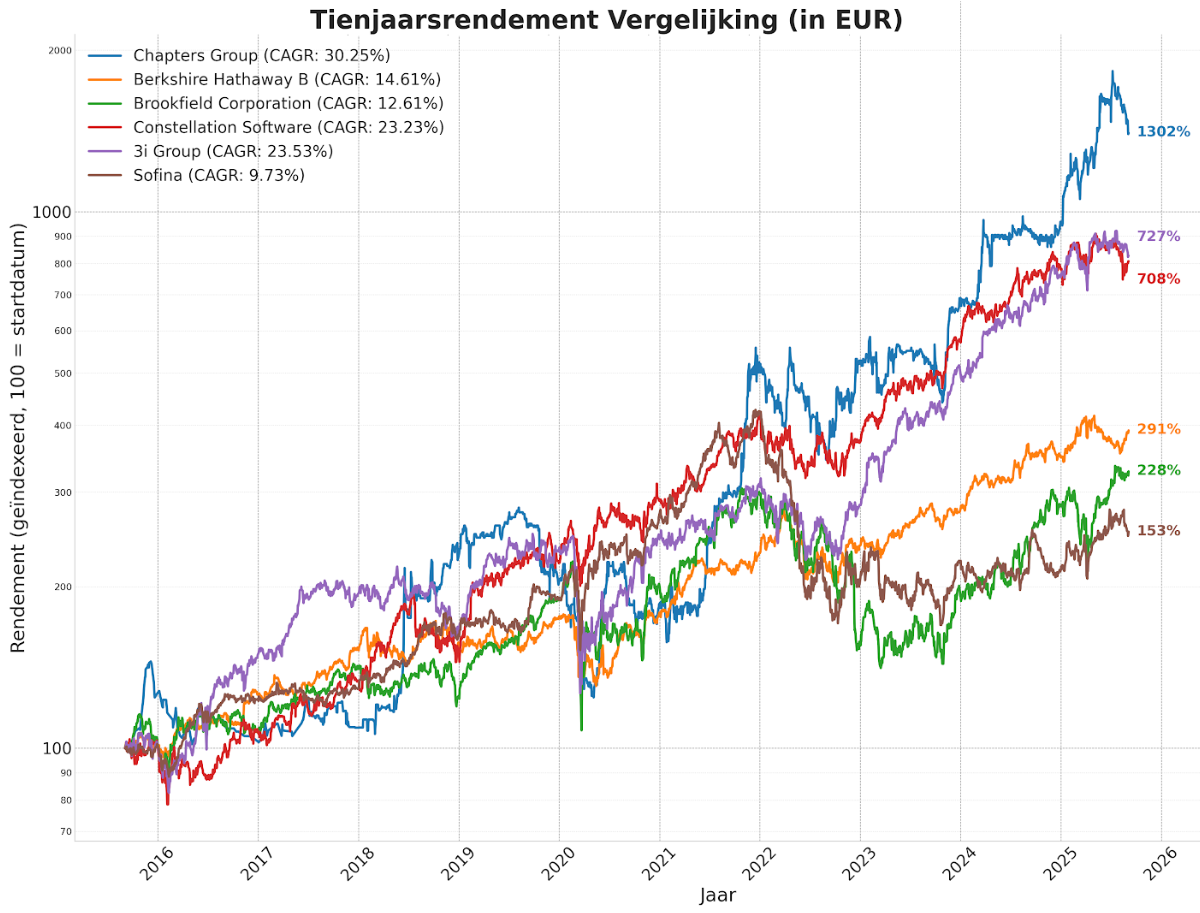
3i Group (London: III) is selling its stake in the German company MAIT following a successful buy-and-build journey. Since its entry in 2021, 14 acquisitions have been made, EBITDA has doubled and the share of recurring revenue has grown significantly. With a return of 2.7x and an IRR of around 27%, the exit becomes one of 3i's most profitable investments of recent years. The new owner will be the holding company Deutsche Beteiligungs AG (DBAG).
Berkshire Hathaway (New York: BRK.B), still the largest shareholder in Kraft Heinz with a 27.5% stake, is seeing the “blockbuster merger” story of 2015 largely dismantled following the announced split. Warren Buffett expressed disappointment at this development. Despite years of support, the stock has lost nearly 70% of its value since the merger. On a possible exit, Buffett said Berkshire will always act in the interest of the company itself and will not accept exception deals.
Brookfield (New York: BN), together with Sumitomo, SMBC Aviation Capital and Apollo, is taking aircraft leasing company Air Lease private. The deal values the company at USD 28.2 billion (including debt). Air Lease owns 495 aircraft and is the fifth-largest lessor in the world. The sector continues to benefit from high lease rates due to tight supply. The transaction is expected to close in the first half of 2026, with Dublin becoming its new base.
Chapters Group AG (Frankfurt: CHG) has sold part of its stake in Software Circle plc, a British serial acquirer focused on niche software companies in the UK and Ireland. The stake has decreased from 103.6 million to 83.9 million shares, leaving Chapters with 21.5% of the shares.
Constellation Software (Toronto: CSU) continues to pursue its acquisition strategy unabated. Several more deals were added in the past week, including Pixeon in Brazil (480 employees, active in healthcare IT) and BMF in Germany (a specialist in data and software solutions for the automotive and e-commerce sector). This brings the number of transactions this year to 61 acquisitions.
Sofina (Brussels: SOF) continues to take part in the European AI race through its stake in Mistral AI. The French company raised EUR 2 billion in a new funding round at a valuation of around EUR 12 billion, more than double last year's figure. Sofina already participated in earlier rounds and is thus among the first institutional investors to back Mistral, alongside the likes of Nvidia and Andreessen Horowitz. Thanks to this early involvement, Sofina directly benefits from the sharp increase in value.
3i Group, Berkshire Hathaway, Brookfield, Chapters Group, Constellation Software and Sofina are currently traded on the exchanges of London, New York, New York, Frankfurt, Toronto and Brussels at prices of GBP 39.22, USD 499.05, USD 65.92, EUR 37.50, CAD 4,596.35 and EUR 252.60, respectively.
Lawsuits turn headwind into tailwind for Alphabet
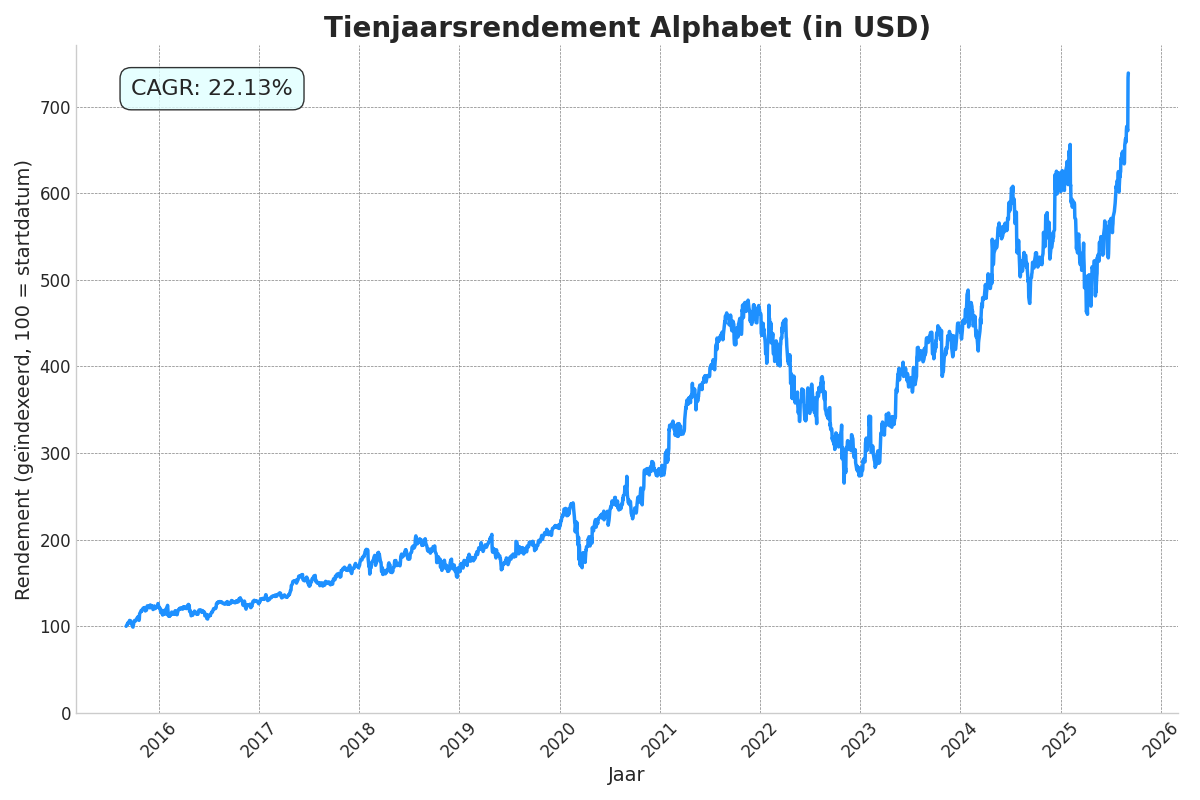
It was an eventful week for the American investment holding company Alphabet (New York: GOOGL), the parent company of Google, YouTube, Waymo and many other businesses. An important legal victory in the United States was overshadowed by a multi-billion fine from Brussels. These conflicting developments paint a complex picture of the challenges and opportunities the company faces. On balance, however, the share price surged sharply. Below is an overview.
Brussels imposes a multi-billion fine on Google after all
Where earlier this week there was still speculation about a postponement, the European Commission has today imposed a tough sanction after all in its long-running investigation into Google's dominance in advertising technology. The Commission has fined Alphabet €2.95 billion for abusing its market power.
According to the regulator, Google has systematically favoured its own online display advertising technology since 2014, to the detriment of competing ad tech companies and online publishers. The decision, which was originally scheduled for earlier this week but was briefly delayed, requires the company to present a plan within 60 days to end the conflicts of interest and the favouring of its own services.
The Commission also maintains its earlier position that a divestment of business units remains a possible structural remedy. However, it will first await Google's proposals before considering further steps. In an initial response, Google called the decision "wrong" and announced it would appeal.
Will Chrome stay with Google thanks to Gemini?
Alongside the developments in Europe, an important breakthrough also took place this week in the United States. There, an antitrust case was underway over whether Google had illegally exploited its dominant position in online search and the associated advertising revenue to suppress competition. The Department of Justice (DOJ) had previously argued that Google effectively maintained a monopoly through exclusive contracts, bundling and technical advantages.
In his ruling, the federal judge acknowledged that Google is still the clear market leader in search and online advertising, but concluded that the market has since changed to such an extent that sufficient new competition has emerged from generative AI models. He explicitly named ChatGPT (OpenAI), Claude (Anthropic) and Perplexity AI. These models are not yet fully-fledged general search engines (GSEs), but are clearly moving in that direction.
On this basis, the court ruled that there is currently no reason to force Google to divest its Chrome browser or to structurally split up the organisation. Rather than imposing hard remedies, the judge sees the market itself already moving towards greater competition. The only concrete obligation imposed on Google is that the company must share data with competitors, so as to create a more level playing field.
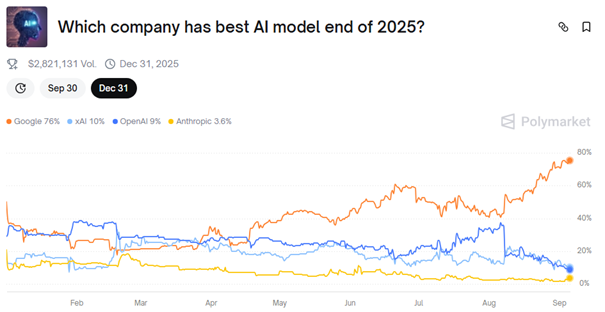
What makes the American judge's ruling so remarkable is that Google's own AI model Gemini has for some time already been regarded as the best model on the market. On platforms such as Polymarket, where thousands of investors and users price in their expectations, Gemini has been firmly in the lead for months. At the end of August, Google's model was quoted at more than a 75% chance of being considered the best AI model by the end of 2025, far ahead of competitors such as xAI (10%), OpenAI (9%) and Anthropic/Claude (3.6%).
This creates a unique paradox. The judge concluded that "sufficient competition" is emerging thanks to the rapid rise of generative AI models, and used this as an argument not to force Google to divest Chrome. Yet within that group of models, Google's own Gemini is already seen as the market leader in terms of the model's technical capabilities. In other words: the competition the judge points to as a counterweight to Google's power in search is, in practice, already partly dominated by Google itself.

Partnership with Apple
This already strong position was further confirmed this week after Apple announced it will launch its own AI-driven web search tool next year. This new functionality is initially set to be integrated into Siri, and later into Safari and Spotlight as well. The idea is to transform Siri from a simple voice assistant into a fully fledged "answer engine".
On paper, this looks like the prelude to direct competition with Google. But behind the scenes, the reality is different. Apple is currently testing a customised version of Gemini as the core technology for the new Siri summariser, and is even considering deploying Gemini more broadly within its AI search architecture. This means Google is not a competitor here, but rather a partner in Apple's new AI strategy.
Revaluation of stake in competitor Anthropic
A final example of Alphabet's position as an AI leader comes via the GenAI model Claude, which was mentioned in the court ruling as one of the models stepping up competition with Google. Claude is the AI product of the company Anthropic, which has developed into a promising player in the sector in a short space of time.
What is remarkable is that Alphabet directly benefits here as well. The company owns approximately 14% of Anthropic, a stake that arose from an investment estimated at USD 2.5 to USD 3 billion in 2023. So Google is not only facing Claude as a competitor, but is also earning alongside it as a shareholder in Anthropic. And this is paying off: the recent funding round valued Anthropic at USD 183 billion, inflating Alphabet's stake to around USD 25 billion, a tenfold increase in barely two years, accounting for nearly 1% of the investment holding company's total market capitalisation.

This position is reinforced by the fact that Google has the largest video data database in the world through YouTube. In a phase where AI models still struggle to fully understand and generate photos and videos, that is an enormous advantage. This content can be used to further train and differentiate Gemini, with video as a potential new frontier for AI. In addition, Google has a unique position in cloud: it is the only one of the three major providers (alongside AWS and Microsoft) with a leading in-house AI model that can be delivered directly to customers through its cloud applications.
We broadly agree with Bill Ackman's view, who recently stated that Alphabet is increasingly convincingly capitalising on its AI potential. From the AI Overviews in Search, which already reach billions of users, to the growth of Cloud with ever-higher margins: Alphabet's moats are not shrinking, but rather widening. The combination of models, proprietary chips and distribution channels is driving ever-stronger differentiation.
Thanks to the potential partnership with Apple, Gemini could also be integrated into hundreds of millions of iPhones and Macs. This would not only provide enormous exposure, but also foster habit formation among consumers. And in a market where the differences between models are barely visible to the average user, it is precisely this habituation factor, the "stickiness", that will determine who the long-term winners are.
Looking ahead, we consider the scenario sketched by @borrowed_ideas to be highly realistic. Developing generative AI models is, and will in all likelihood remain, an extremely capital-intensive process. With the multitude of players, from ChatGPT and xAI to DeepSeek, Perplexity and Claude, future price pressure seems virtually inevitable. Margins will come under pressure and companies without deep pockets will disappear from the market. Ultimately, there is probably only room for two or three global leaders.
Given these developments and opportunities, we are therefore convinced that Alphabet, with Gemini, will be one of them. Despite the recent rally in the share price to new all-time highs, we still see considerable underlying potential. Alphabet combines unmatched scale, access to unique datasets and the financial firepower to not only survive this wave of consolidation, but to emerge from it stronger.
Alphabet is currently trading on the New York stock exchange at a price of USD 233.22 per Class A share.
MBB: an entrepreneurial investment holding company
In the world of listed holding companies, few manage to combine the discipline of a capital allocator so seamlessly with the hands-on mentality of an entrepreneur. The German company MBB SE (Frankfurt: MBB) is just such a rare entity.
A recent interview with Executive Chairman, founder and majority shareholder Christoph Nesemeier and CFO Torben Teichler, held during the Hamburger Investorentage, offered a deeper insight into the engine room of this German holding company. It reveals a philosophy rooted in long-term thinking, operational partnership and an almost stubborn refusal to be guided by the market's short-term whims.
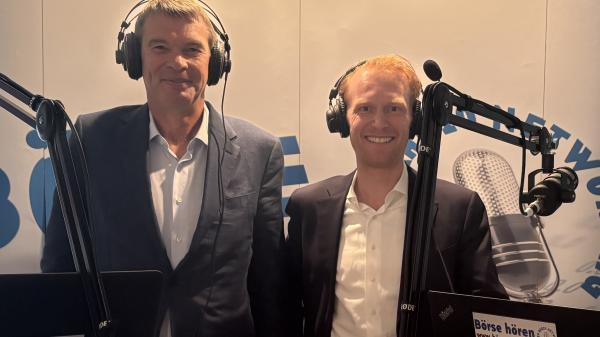
At the heart of MBB's success lies a clear rejection of the conventional private equity model of buying and selling quickly. "We have been a 'buy and hold' company since our founding," co-founder Nesemeier emphasised in the interview. "We have always kept the companies in our portfolio for the long term, because we are firmly convinced that long-term development offers far more scope for design than the brief 'in and out'. You also enter into a different kind of commitment when you invest in a company for the long term." This points to an active 'buy and build' approach.
The most telling example is the evolution of Friedrich Vorwerk. After the acquisition, the company was first strengthened through the takeover of its largest regional competitor, Bohlen & Doyen, creating an undisputed market leader. Access to the capital markets was then sought through an IPO, not as an exit, but as an enabler. This market access provided the financial firepower to fully capitalise on the central role in Germany's energy transition, a capital-intensive megatrend. This methodology, identify a solid foundation, strengthen it strategically and then finance it for dominance in a growth market, is the essence of MBB's value creation.
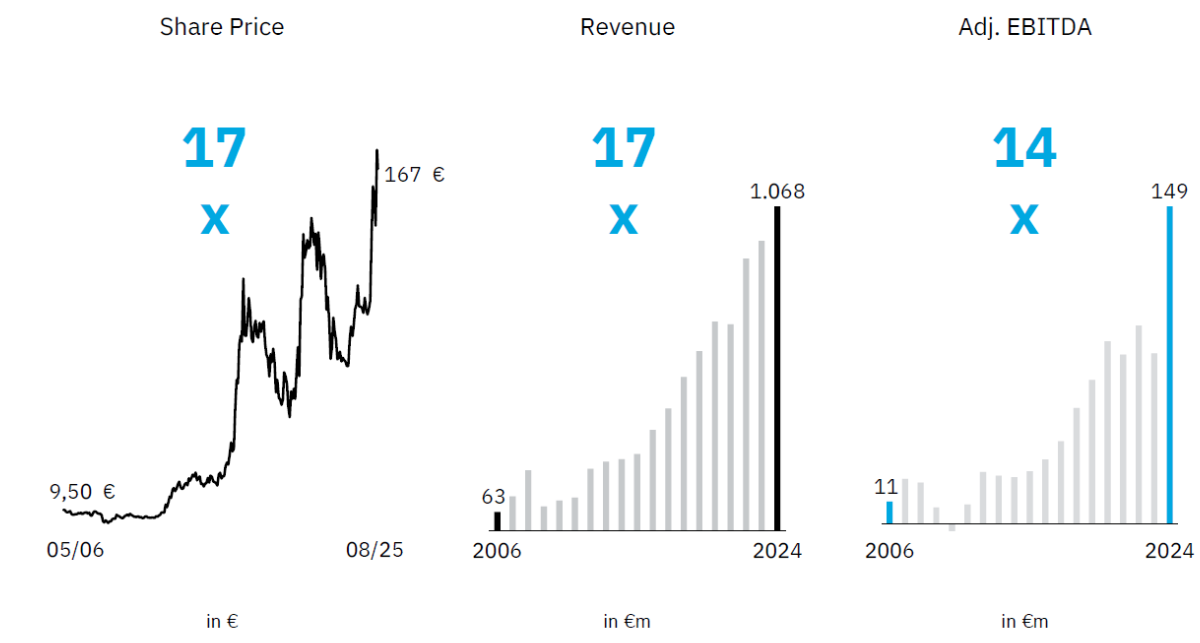
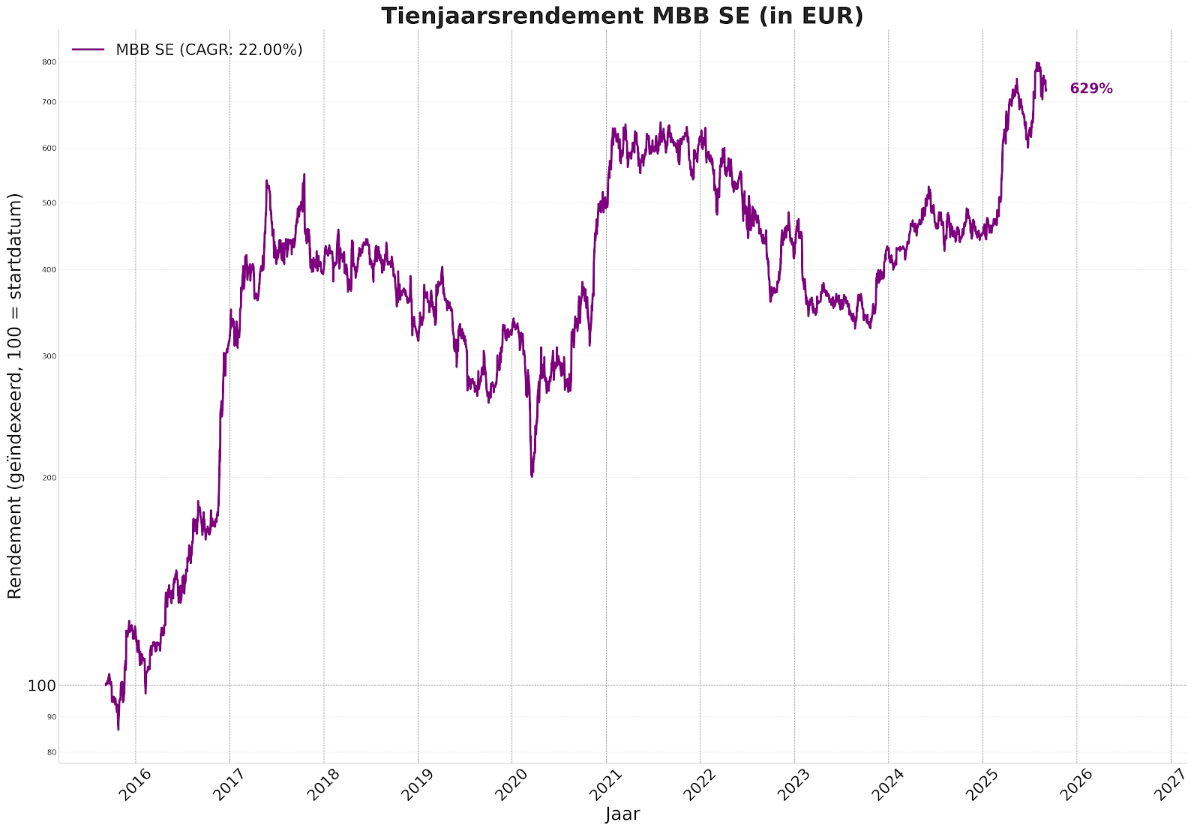
The results speak for themselves (see also the figure below): since the IPO in 2006, both the share price and revenue have grown by a factor of seventeen, and operating profit by a factor of fourteen.
The dual growth engine: the energy transition and cybersecurity
MBB's impressive performance in the first half of 2025, with revenue growth of 17% and a 37% jump in operating profit, is underpinned by two powerful and enduring trends. Friedrich Vorwerk is the architect of the Energiewende, while DTS IT is the digital fortress in a cyberwar.
MBB's strategy rests on identifying and building positions in enduring trends. Christoph Nesemeier explained the two current pillars in the interview. "MBB is in the fortunate position that with Friedrich Vorwerk we occupy a trend, the energy transition, that continues unabated and is even growing larger," he said. "And with our wildcard DTS, we also have a remarkable company in cybersecurity that is developing wonderfully."
CFO Torben Teichler added that DTS is gaining "enormous traction", with revenue growth of more than 20% and the winning of "large, great flagship contracts." These statements are backed up by the hard numbers: the Service & Infrastructure segment, which includes both companies, saw revenue rise by 49% in the first half of 2025, with Vorwerk reporting an order book of EUR 1.1 billion.
The culture
One of the most distinctive factors is MBB's operational culture. The head office in Berlin has just eleven employees. "We work together very collegially and in very flat hierarchies," CFO Teichler explained. "I believe this is an aspect that makes us very fast and successful, especially when it comes to investment decisions. We can act quickly and operate like a speedboat, which many others in more complex structures simply cannot do."
This agility is combined with the direct involvement of the founders and majority shareholders, Nesemeier and Gert-Maria Freimuth, which enables quick, entrepreneurial decisions. This pragmatic culture is also reflected in their investment criteria. They deliberately avoid sectors they do not understand through and through. "You will never find an MBB that is suddenly active in biotech or venture capital," Teichler affirmed. "We like business models that we can understand with sound, intelligent common sense."
Sparring partner
The true strength of the MBB philosophy manifests itself most clearly when subsidiaries such as Aumann and Delignit face headwinds from the automotive sector. Where a typical holding company would focus on cost-cutting, MBB's message is fundamentally different. "We encourage them not to retreat into a corner in despair, but instead to go on the attack, pick up on new trends and have management step aggressively into these themes," Christoph Nesemeier explained.
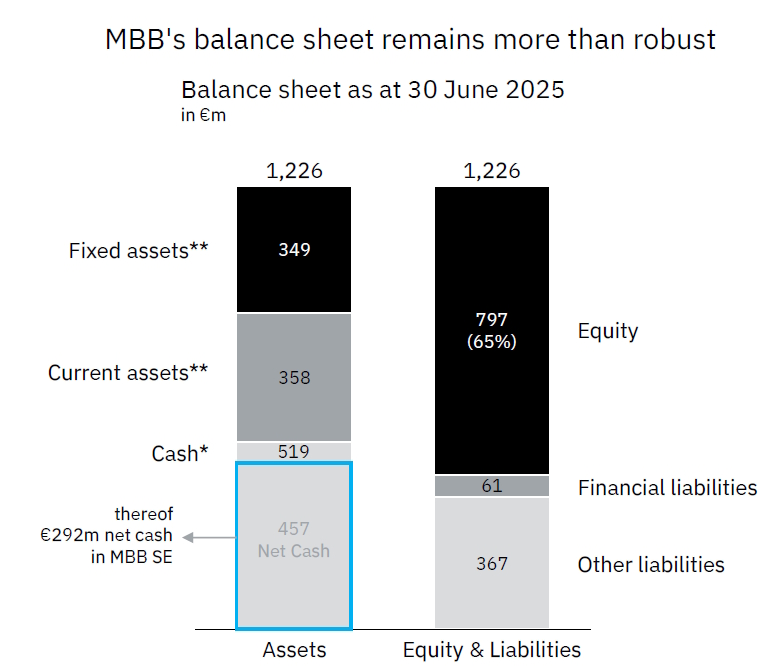
This counter-cyclical, entrepreneurial stance is made possible directly by one of the key pillars of the MBB structure: an exceptionally strong financial position. "We relieve our companies of the burden of negotiating credit with a bank, because they are all equipped on the capital side in such a way that they can save themselves that time."
That freed-up management time is not used to consolidate, but to innovate. A perfect example is the successful diversification at Aumann. While the automotive sector is weak, the 'Next Automation' segment, focused on growth markets such as clean tech, aviation & defence and healthcare, is growing by 20%. This shows that the strategy of broadening out is bearing fruit and forming a buffer.
A sum-of-the-parts analysis, supported by the calculation in MBB's own presentation, quantifies this discount. The share price on 28 August of €167 per share is significantly lower than the value of the liquid assets alone. The €292 million in cash at holding company level and the market value of the stakes in Vorwerk, Aumann and Delignit together form a liquid portfolio of €1.1 billion, equivalent to approximately €210 per share.
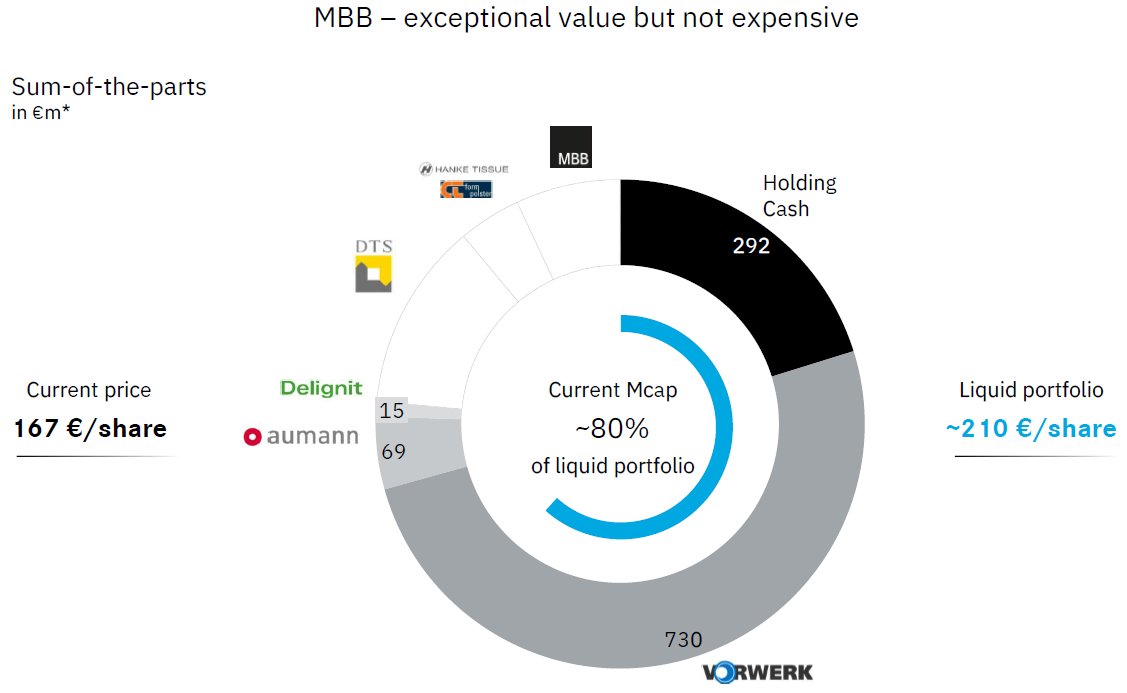
For investors willing to look through the short-term fog, this offers a rare opportunity. MBB embodies the combination of operational excellence, a disciplined owner mentality and an attractive valuation, despite the share price jump of more than 60% in 2025. MBB therefore remains one of the cornerstones of our family holding company strategy.
MBB ended the trading week on the Frankfurt exchange at a price of €162.20 per share.
TerraVest under pressure, but hints at a hidden deal
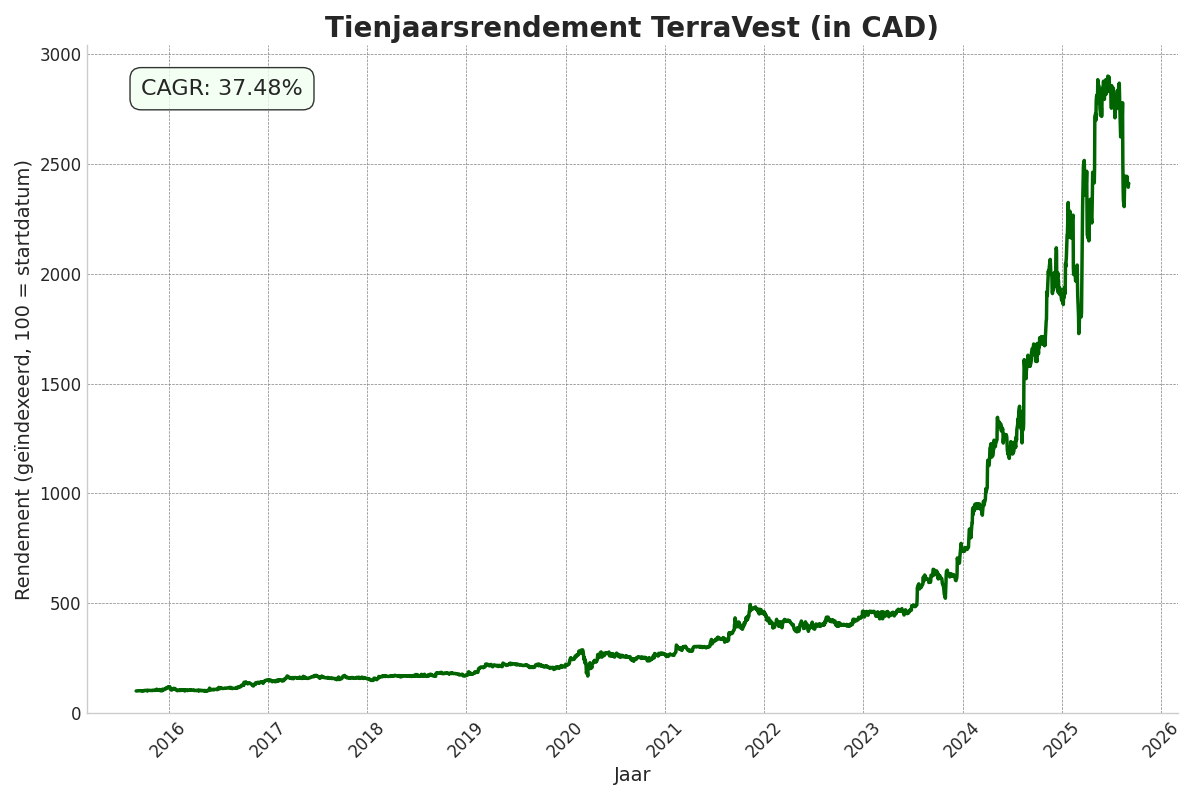
The Canadian investment holding company TerraVest (Toronto: TVK) reported weak Q3 results. Revenue rose by 70% to USD 406 million, largely thanks to the acquisition of EnTrans, but organic growth came in at -2%. This makes clear that the growth is coming from acquisitions, while the underlying portfolio is under pressure. For the first time, management explicitly acknowledged that recent US tariff measures are leading to uncertainty and delayed orders.
According to CEO Dustin Haw, "the portfolio as a whole is still performing well, with recent acquisitions making an important contribution." Synergies between new and existing activities are seen as an important source of future improvement. At the same time, management points out that tariff uncertainty has recently led to weaker demand in a few divisions. Because TerraVest mainly produces products for the domestic market, the direct impact of new tariffs is expected to remain limited, but the tone is clearly less optimistic than in previous quarters.
The company also emphasised that it is responding to markets where it holds a strong position through targeted investments in production efficiency and product lines. Thanks to the new credit facility concluded in March, TerraVest says it is moreover well positioned to continue its acquisition strategy.
The most interesting aspect of the quarterly results is actually an entry in the company's cash flow statement. It records a USD 36.1 million "investment in equity instruments", supplemented by a USD 11.6 million fair value gain. Together, this amounts to USD 58.9 million in equity investments on the balance sheet, which is notable for a serial acquirer that does not normally invest in listed shares. Analysts stress that this is unlikely to be a passive investment, but rather the first step towards a strategic stake. This fuels speculation that TerraVest may be building a position in a listed company, possibly as a precursor to a takeover.
Analysts cut price target but remain positive
Analysts at the National Bank of Canada recently flagged the underlying uncertainty in the market. They lowered their price target for TerraVest from USD 200 to USD 185, but maintained their 'Outperform' rating. The adjustment is mainly driven by expected headwinds in the gas transport and storage segment, which is linked to the heavy trucking market. The analysts expect North American production of class 8 trucks to fall by more than 25% in the second half of 2025, which will temporarily weigh on demand for TerraVest's products. Nevertheless, the bank remains positive over the long term, thanks to the strong acquisition strategy and a proven track record of successfully integrating new companies. The price target is based on expected profitability for 2026.
At Tresor Capital, we remain positive about the outlook despite the weak quarter. TerraVest's growth is likely to continue, but it is crucial that the large recent acquisitions are successfully integrated first. As we already highlighted in our newsletter last week, EnTrans has an exceptionally strong management team, led by a CEO who has previously demonstrated excellent leadership. We view this team not only as valuable for the integration of EnTrans itself, but also as a strategic asset that could help future acquisitions within TerraVest generate better returns.
TerraVest is currently trading on the Toronto stock exchange at CAD 143.67 per share.
Receive weekly insights in your inbox
Exclusive analyses and updates on family holding companies and global market developments.
Would you like more information about our services? Please feel free to get in touch.
Get in touch
Disclaimer:
No rights can be derived from this publication. This is a publication of Tresor Capital. Reproduction of this document, or parts of it, by third parties is only permitted after written consent and with reference to the source, Tresor Capital.
This publication has been compiled by Tresor Capital with the greatest possible care. The information is intended in a general sense and is not tailored to your individual situation. The information must therefore explicitly not be regarded as advice, an offer or a proposal to purchase or trade investment products and/or to take up investment services, nor as investment advice. The authors, Tresor Capital and/or its employees may hold positions in the securities discussed, for their own account or for their clients.
You should carefully consider the risks before you start investing. The value of your investments may fluctuate. Past performance offers no guarantee for the future. You may lose (part of) your original investment. Tresor Capital disclaims any form of liability for any inaccuracies or errors. This information is purely indicative and subject to change.
Read the full disclaimer at tresorcapitalnieuws.nl/disclaimer .
This article was originally written in Dutch and automatically translated into English with the help of AI. In case of any difference, the Dutch original prevails.