Family Holdings #41 - Family holding companies go all in on artificial intelligence
This week was dominated by acquisitions and AI growth. Major holding companies and tech firms expanded their operations through strategic acquisitions, while Alphabet and others invested heavily in AI innovation and data centre expansion.



This week's topics:
Investor AB core holding ABB is selling its robotics division to Japan's SoftBank for USD 5.4 billion. Earlier this year, the holding company discount on Investor AB had widened, which prompted Tresor Capital to increase its position in the Swedish holding company.
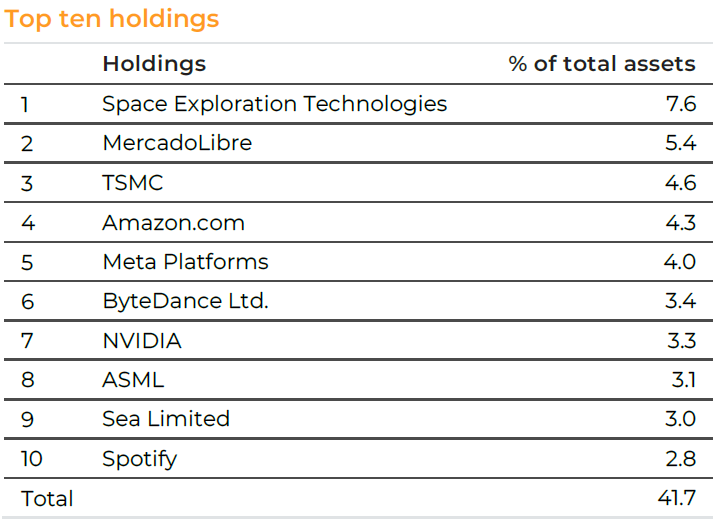
Scottish Mortgage is sharpening its strategy with a focus on the resilience of its portfolio companies. The portfolio is dominated by core holding SpaceX, whose USD 400 billion valuation is justified by its Starlink division alone, while the investment trust remains heavily invested in the AI sector via both infrastructure companies and companies successfully applying AI within their operations.
In brief:
Brookfield Corporation (New York: BN) completed a three-for-two stock split on 9 October 2025. Shareholders received one additional share for every two existing shares through a stock dividend. Fractional shares are paid out in cash based on the closing price on 3 October. The shares have been trading on a post-split basis since 10 October.
Example: an investor who held 200 shares before the split at $60 each (total value $12,000) now holds 300 shares at $40 each after the split, still $12,000.
Brown & Brown (New York: BRO) has, through its European division, acquired All Medical Professionals Limited (AMP). AMP is a digital insurance broker based in Swindon (UK) active in the dental, hospital and life sciences sectors. The company, founded in 2011 by Tom Chaston and Adam O'Keeffe, is known for its technological solutions for medical professionals. The company will continue operating under the name All Med Pro and will be integrated within Brown & Brown's Digital Division.
Chapters Group (Frankfurt: CHG) is further expanding its software portfolio with the acquisition of Haiberg, a German provider of logistics software for publishers. Haiberg will be integrated into HUP GmbH, part of Chapters' media division, strengthening its expertise in publishing and distribution processes. Founder Simon Heinrich remains active as COO and authorised signatory of HUP.
Constellation Software (Toronto: CSU) has, through its division Vela APX, acquired Australia's Vitalcare, a specialist in nurse call and medical alarm systems. Vitalcare, founded in 1979, supplies communication and emergency call systems to hospitals and care institutions in Australia and New Zealand, with around 1,000 installations and 50,000 connected beds. The company has an estimated 50 employees and will continue operating under its existing name.
Prosus (Amsterdam: PRX) is acquiring a 10.1% stake in Indian travel technology company Ixigo (Le Travenues Technology) for approximately ₹1,295 crore (±$155 million). Ixigo will use the proceeds for organic growth, acquisitions, marketing and the development of new AI platforms. The investment strengthens Prosus's position in the Indian digital economy, where it has now invested more than $6.5 billion through stakes in, among others, Swiggy (delivery) and PayU (fintech). India is one of Prosus's key growth markets, and with this transaction it once again adds a fast-growing technology company to its regional portfolio.
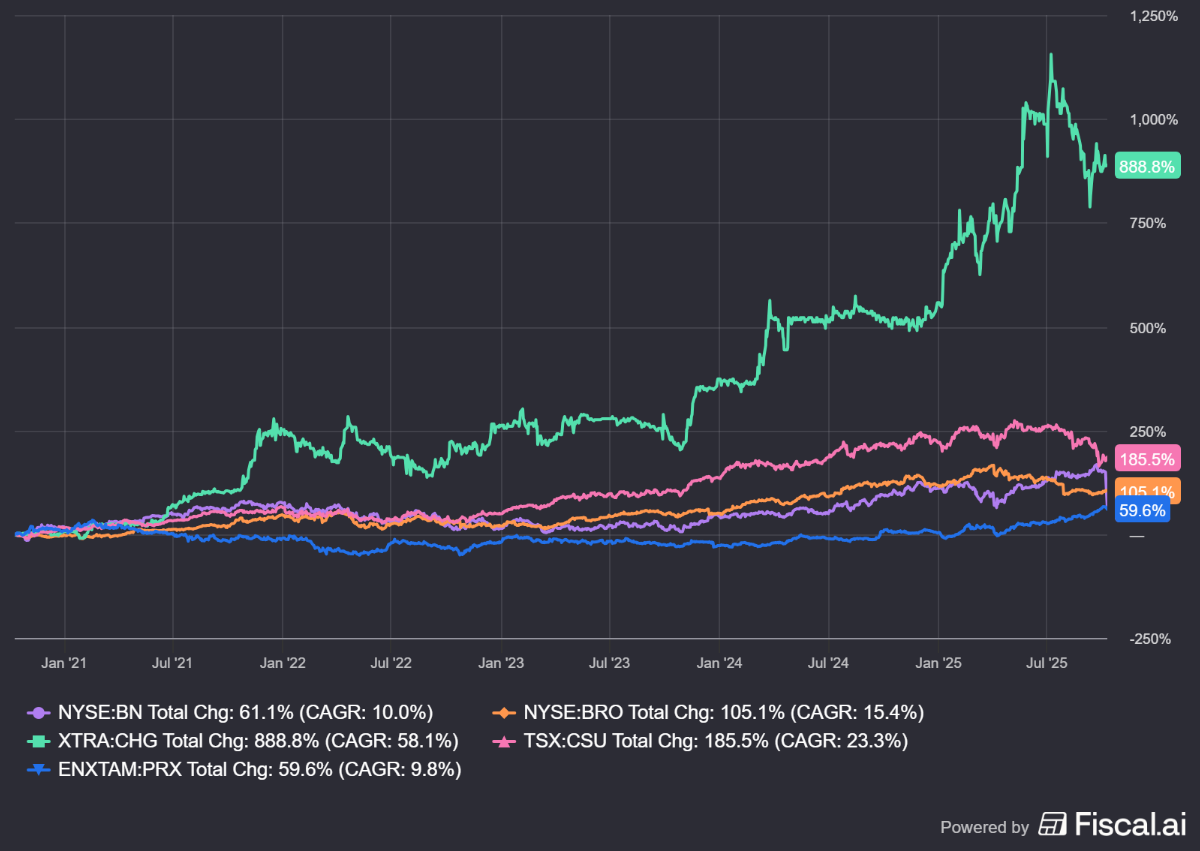
Brookfield, Brown & Brown, Chapters Group, Constellation Software and Prosus ended the trading week on the exchanges of New York, Frankfurt, Toronto and Amsterdam at prices of USD 43.66, USD 96.05, EUR 38.20, CAD 3,962.60 and EUR 59.26 per share respectively.
Alphabet continues its AI acceleration
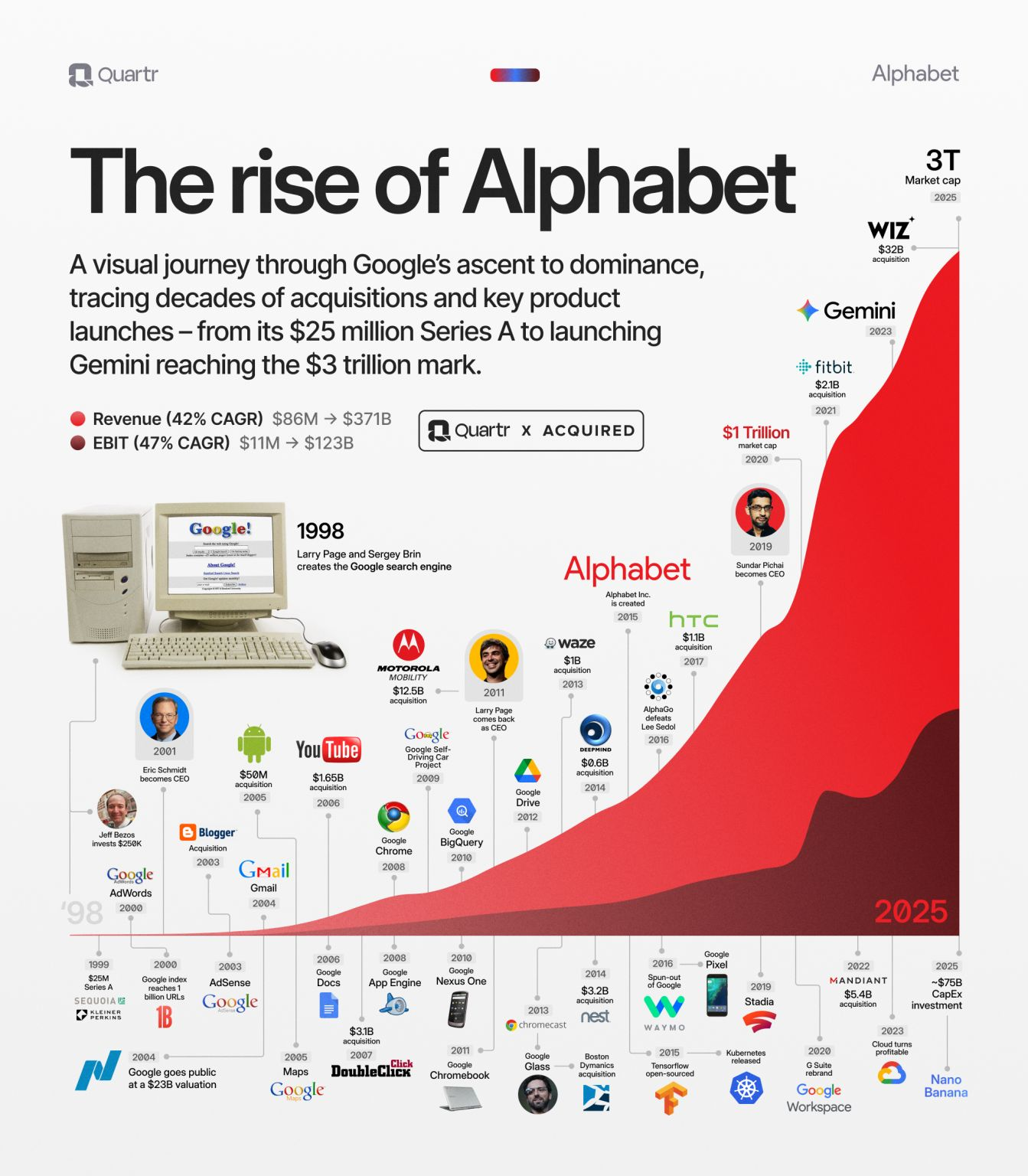
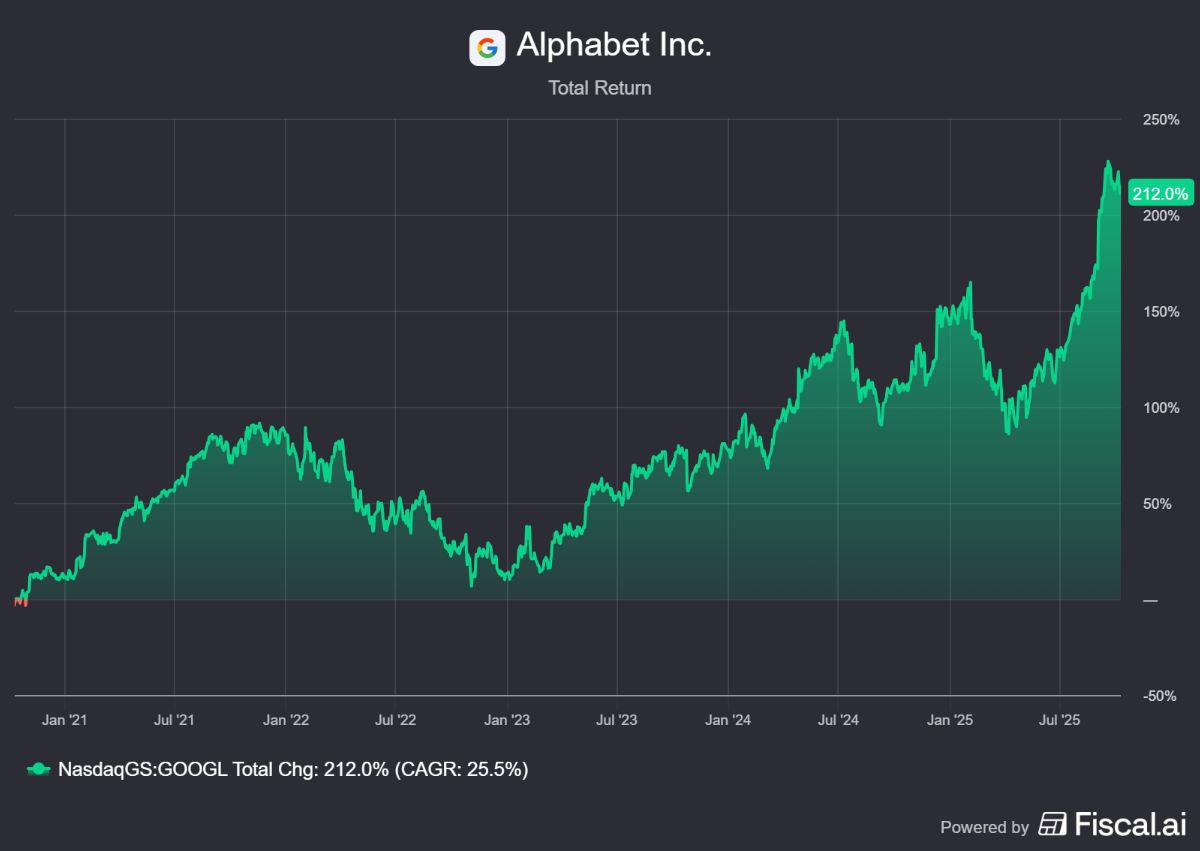
The chart below, "The Rise of Alphabet", shows at a glance how the growth path of the American investment holding company Alphabet (New York: GOOGL) has developed since its founding in 1998 into one of the most impressive trajectories in the history of the technology sector. From its early days as a search engine to the launch of Gemini and a market capitalisation now exceeding $3 trillion, it illustrates a timeline of almost three decades of product launches, acquisitions and continuous scaling.
With average annual revenue growth of ~25%, Google has systematically built on its core competence: organising information and translating it into scalable digital platforms. Where earlier growth phases were driven by advertising revenue, YouTube and Android, the current period clearly marks a new chapter: Alphabet's AI phase.
New in the AI arsenal: Gemini Enterprise and AI Mode
With Gemini Enterprise, launched this week, Google Cloud is positioning itself explicitly as a direct challenger to Microsoft Copilot. Both companies set themselves apart from Amazon Web Services, which remains the only major cloud player without an integrated AI assistant for the workplace. Gemini Enterprise brings together all of Google's AI capabilities in a single integrated environment. Through a chat interface, employees can use AI agents for a wide range of applications, from data analysis to workflow automation. The platform connects seamlessly with Google Workspace as well as external systems such as Salesforce and SAP. In doing so, Google combines infrastructure, its own TPU chips, language models and software into one complete AI solution. The main challenge still lies in growing market share, given that Microsoft holds a strong starting position thanks to its dominance in Office. Technologically, however, Google appears fully able to keep pace with its biggest rival.
Developments are also accelerating in the consumer market. Google has given its core product, Search, a fundamental AI upgrade. The new AI Mode, now available in more than 200 countries and 35 languages, is changing the way users interact with information. Rather than simply showing a list of search results, AI Mode generates summarised answers in which relevant sources are directly incorporated. Users can ask more complex questions, formulate follow-up questions, and click through to the most relevant websites without extra steps. The traditional search function is thus preserved, but enriched with an intelligent layer that makes the process faster and more intuitive.
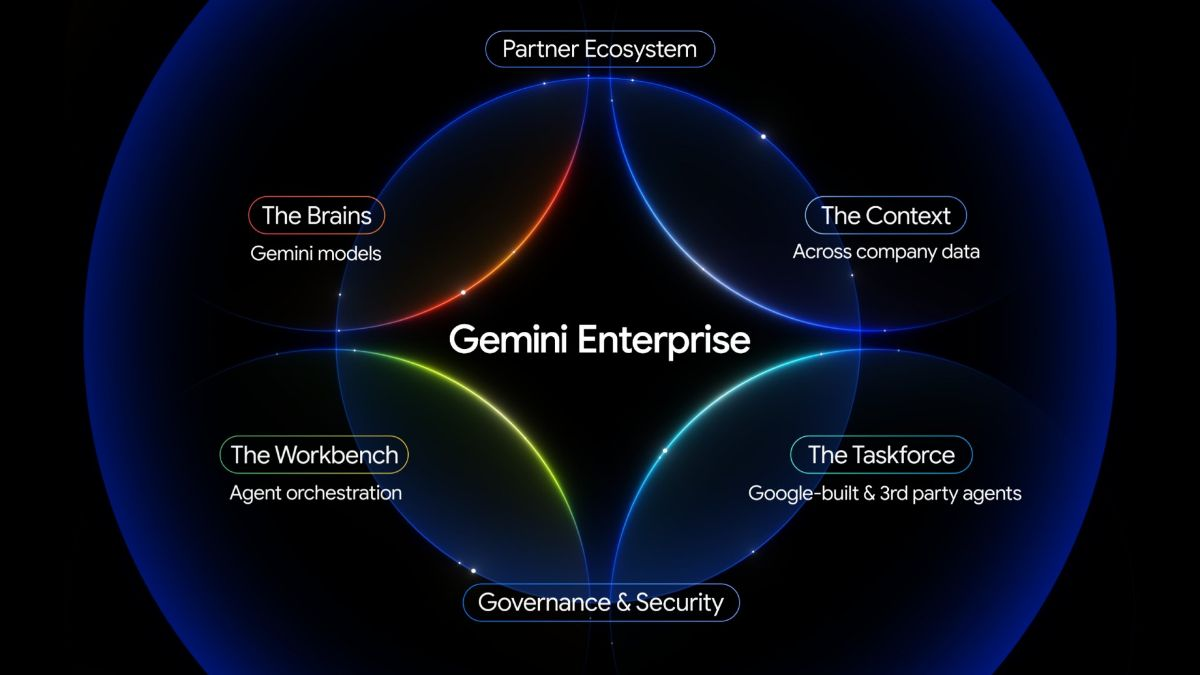
The strategic significance of this expansion lies above all in its accessibility. Billions of people already use Google on a daily basis, yet a large proportion of them have never actively opened a standalone AI platform. By integrating generative AI directly into the familiar search environment, Google is now reaching precisely that broad group which, until now, had remained outside the AI ecosystem. Users no longer need to visit separate websites or apps such as ChatGPT or Perplexity, but are instead offered the option simply within their existing search page. This removes the barrier to using AI altogether. Anyone can benefit from AI-driven answers and recommendations without logging in or learning a new interface. AI Mode therefore amounts to a mass introduction to generative AI, not for a small group of early adopters, but for the internet users who, until now, had barely come into contact with it.
Behind the scenes, Google is also making subtle adjustments to its search structure. In September, the “num=100” parameter disappeared, which had previously allowed users and external parties to view up to a hundred results per page. Since then, the maximum has been ten. At first glance, this looks like a minor technical change, but its consequences are far-reaching. Many AI systems, including those of OpenAI and Perplexity, partly rely on Google's search index. As a result of this restriction, their access to the so-called long tail of the internet has been reduced by an estimated 90%. These models are thus confronted with higher costs and more limited data access, while Google's own AI Mode naturally retains full access.
The first results underline this advantage. The Gemini models now process more than 1.3 quadrillion tokens, an increase of 30% since July. Moreover, around 65% of all Google Cloud customers now use at least one of the company's AI products. This shows how quickly Alphabet is scaling up generative AI in practice, and how directly it is contributing to the growth of its cloud business.

Accommodating growing AI use through data centre expansion
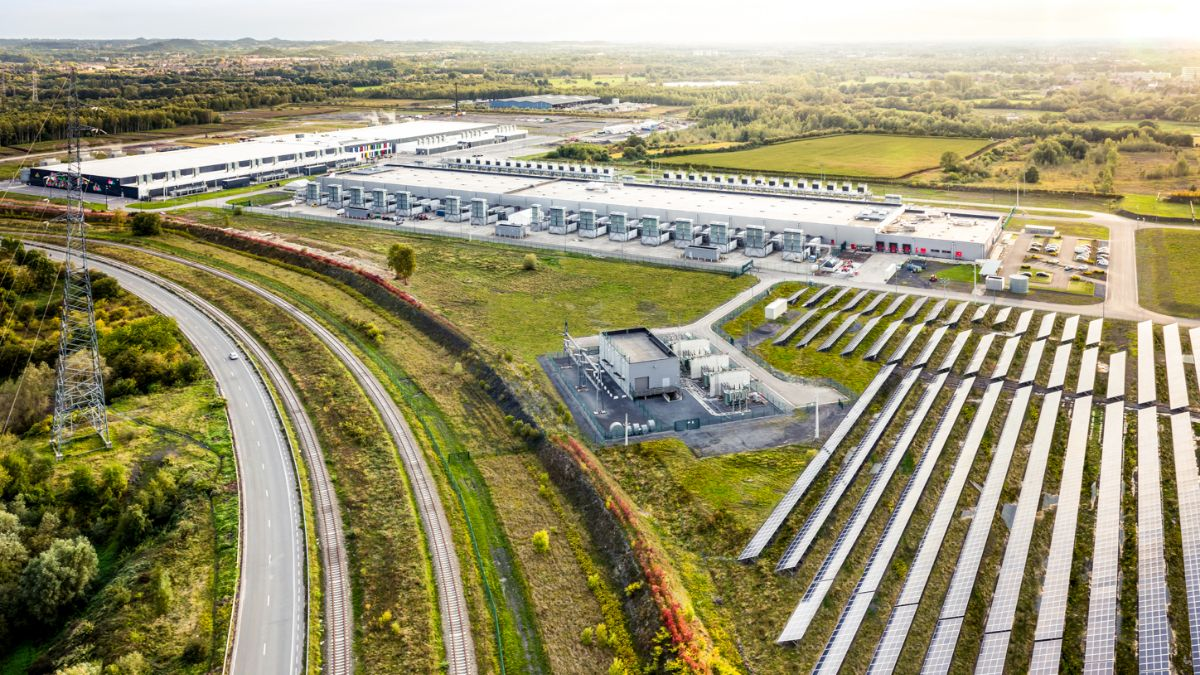
To keep pace with this explosive growth in AI applications and cloud usage, Alphabet is investing aggressively in its infrastructure. New data centres and cloud regions are being opened or planned worldwide, often with a focus on AI workloads and sustainable energy supply:
- India: Google has announced its first major data centre cluster in India, an investment reportedly of between $6 billion and $10 billion in the coastal city of Visakhapatnam. The project comprises three campuses with a combined 1 GW of data centre capacity, plus an additional $2 billion for renewable energy to power the site. This will become Asia's largest data centre in terms of capacity, underlining the importance of the Indian market.
- United States: In the US, Google is expanding into new regions beyond the traditional tech hubs. A $4 billion investment in West Memphis, Arkansas has recently been announced. Here, Google is building its first data centre in the state, on a campus spanning 4.45 million square metres. The project is described as an “AI data center”, with a focus on running AI models and cloud services, and will be accompanied by a 600 MW solar energy park to partly cover its enormous power needs. Alongside the infrastructure, Google is supporting the local community through a $25 million energy innovation fund and free AI training programmes for residents and students.
- Belgium: Google has announced that it will invest an additional €5 billion in its Belgian data centre campus near Saint-Ghislain in 2026-2027. The expansion includes new data centres (there are already five on the campus) and the creation of 300 additional full-time jobs. Google is also working with Belgian energy companies to develop new wind farms, so that the extra capacity can largely run on green electricity. The Belgian prime minister described it as a "strategically important" investment.
- United Kingdom: Also in October 2025, a new Google data centre opened in Waltham Cross, Hertfordshire (UK), as part of a £5 billion investment package spread over two years. This investment covers not only the data centre itself but also R&D. The new data centre is intended to support the growing demand for AI services in the UK, from Google Cloud to Search and Maps. At the opening, the government emphasised that the project supports around 8,250 jobs a year and is set to drive the UK's AI economy. In the UK, Google also struck a deal with Shell for innovative battery storage, allowing surplus renewable energy on the campus to be fed back into the grid.
Expansion through partnerships
Alphabet is also strengthening its position in AI and cloud through a series of strategic partnerships with leading companies across a wide range of sectors.
- Klarna, the Swedish fintech, now uses Google's full AI stack to create personalised shopping experiences. Generative tools within Google Cloud, including Gemini 2.5 Flash, are being used for dynamic product catalogues and marketing imagery. Pilot projects are showing promising results, with up to 50% more orders and 15% longer session durations. In addition, Klarna uses Google's AI hardware for fraud and money-laundering detection, meaning the partnership also adds value on the back end.
- Affirm, also active in the payments market, is working with Google on the Agent Payments Protocol (AP2). This protocol enables AI assistants to make payments on behalf of users, with Affirm's "buy now, pay later" option integrated directly into AI-driven shopping experiences. The partnership supports Google's long-term vision of seamless, AI-managed transactions.
- Figma, the popular design platform, uses Google's Gemini Flash 2.5 model to let designers generate images through text prompts and automatically optimise existing designs. This embeds Google's AI deeply into creative workflows, demonstrating its value beyond traditional text or development applications.
Conclusion
Alphabet is proving to be one of the most well-balanced players in the AI race. The company combines technological innovation with strategic capital deployment and an impressive pace of infrastructure build-out. While competitors are still focused on the product stage, Google is building both the ecosystem and the backbone on which AI and cloud will run in the years ahead.
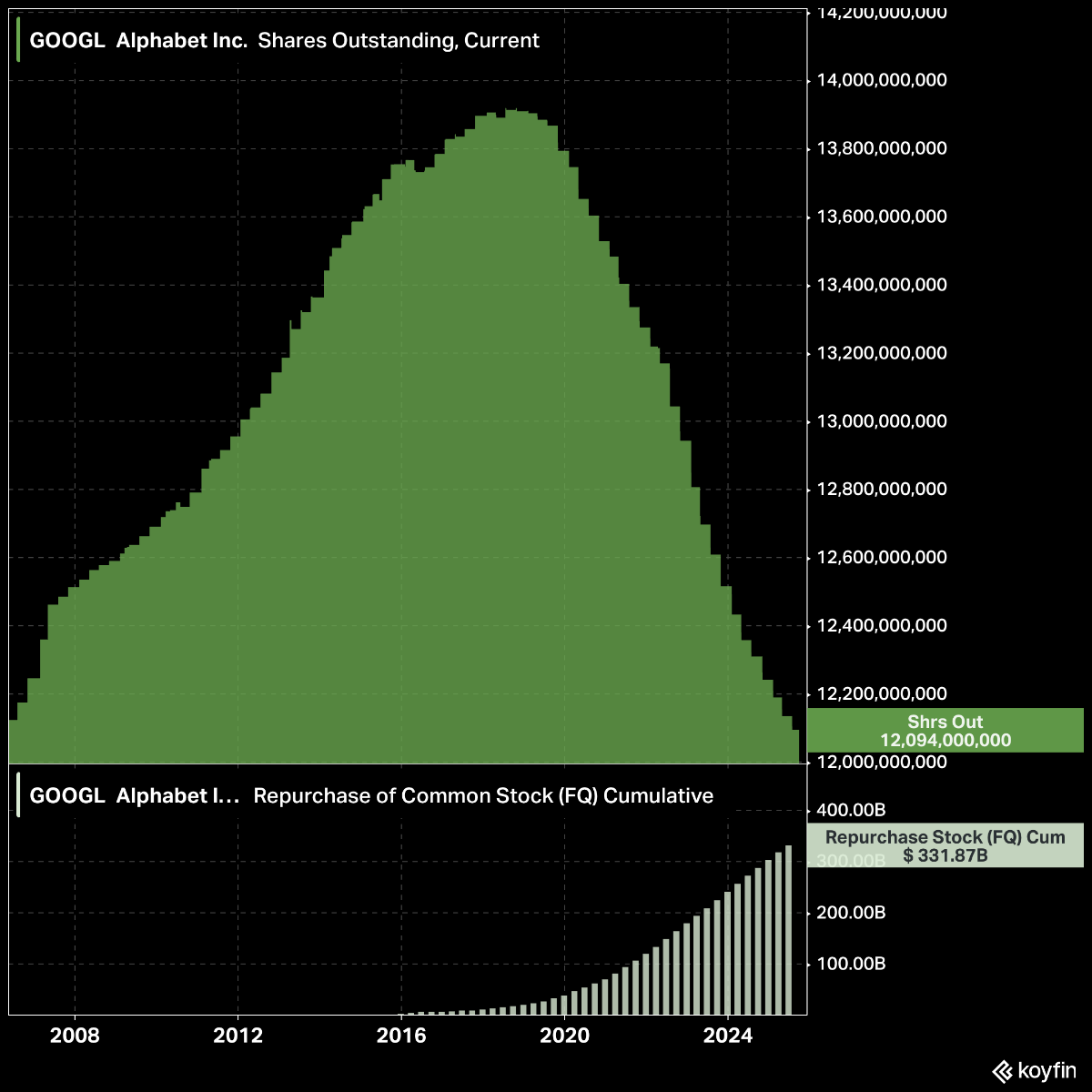
Management is showing notable discipline in the process. While billions are being invested in data centres and AI infrastructure, Alphabet is simultaneously returning substantial amounts to shareholders. Since 2018, the company has bought back more than $330 billion worth of shares, bringing the number of shares outstanding down to its lowest level since 2006, as shown in the figure above. Over the same period, net profit has more than tripled, which amplifies the impact of the buyback programme on earnings per share. At the same time, management is purposefully pushing through reforms to make the organisation leaner and more AI-driven. In early October, more than 100 employees in design and UX teams within the Cloud division were let go, with management layers trimmed and resources shifted towards AI priorities. These restructurings show that the company is focused not only on growth but also on profitability and scalability. Analysts underline this confidence.
The recent re-ratings by, among others, MoffettNathanson, BMO Capital, TD Cowen and HSBC are based on tangible improvements in the core business: an acceleration at Google Cloud, a rising profit contribution from YouTube, and a recovering advertising market in which AI functionality is further fuelling growth. Declining regulatory risk around Search and increasing operational efficiency are also contributing to a more stable profit profile. Analyst Michael Nathanson of MoffettNathanson goes even further, arguing that it is not Nvidia but Alphabet that deserves the title of the world's most valuable company, pointing to the unique combination of market leadership, diversification and scale that positions Alphabet to capitalise optimally on the opportunities in AI. In our view, the combination of growing adoption of Gemini, robust data centre investment, profitable buybacks and strong management positions Alphabet well for sustainable value creation. We therefore remain positive on this holding company.
Alphabet ended the trading week on the New York stock exchange at a price of USD 239.38 per Class A share.
Investor AB portfolio company ABB sells robotics division
ABB, the principal holding of the Swedish investment holding company Investor AB (Stockholm: INVE-B), announced this week the sale of its robotics division to Japan's SoftBank. The transaction is valued at $5.4 billion (approximately €4.6 billion), which means the previously planned 2026 listing of this division has been cancelled. Investor AB, with a 14.3% stake, is the largest shareholder in ABB.
The division, which generates $2.3 billion in revenue and employs around 7,000 people, is one of the world's largest producers of industrial and autonomous robots, with clients including BMW. SoftBank founder Masayoshi Son views the acquisition as a strategic step within his long-term vision for "Physical AI", the merging of artificial intelligence and robotics to enable machines to autonomously perceive, reason and act.
The acquisition fits within the so-called Stargate project, SoftBank's internal master plan to accelerate the next phase of artificial intelligence. This project focuses on developing what is known as Artificial Super Intelligence (ASI), systems that, according to Son, should become 10,000 times smarter than humans. Robotics plays a key role in this strategy: linking advanced AI to physical applications should, in Son's view, lead to the next industrial revolution.
In this context, ABB Robotics will be integrated with existing SoftBank investments such as AutoStore, Agile Robots and Skild AI, allowing the group to build a complete ecosystem of hardware, software and sensor technology. By combining ABB's global production capacity and industrial expertise with SoftBank's AI portfolio, Son aims to gain a head start in what he sees as the "era shift from digital to physical AI".
For ABB, the sale marks a clear reorientation under CEO Morten Wierod, who has since 2024 been focusing on the more profitable electrification and automation segments. The proceeds of the transaction will be deployed in line with ABB's capital allocation policy, likely for debt reduction, a higher dividend and targeted acquisitions (France's Legrand is reportedly among the candidates under consideration).
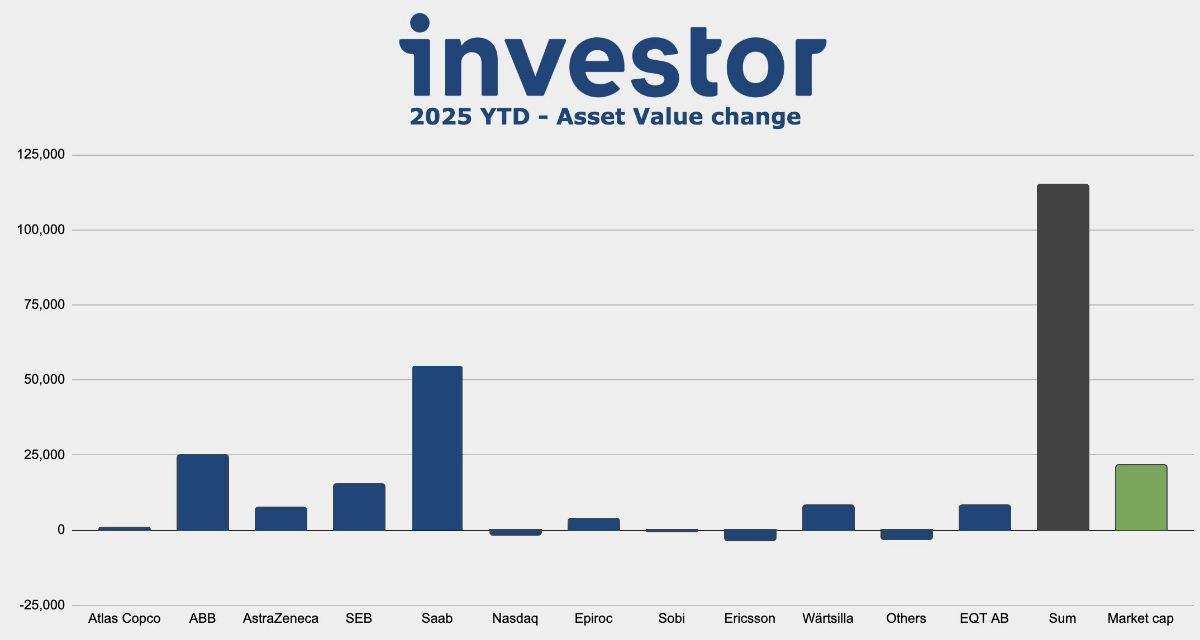
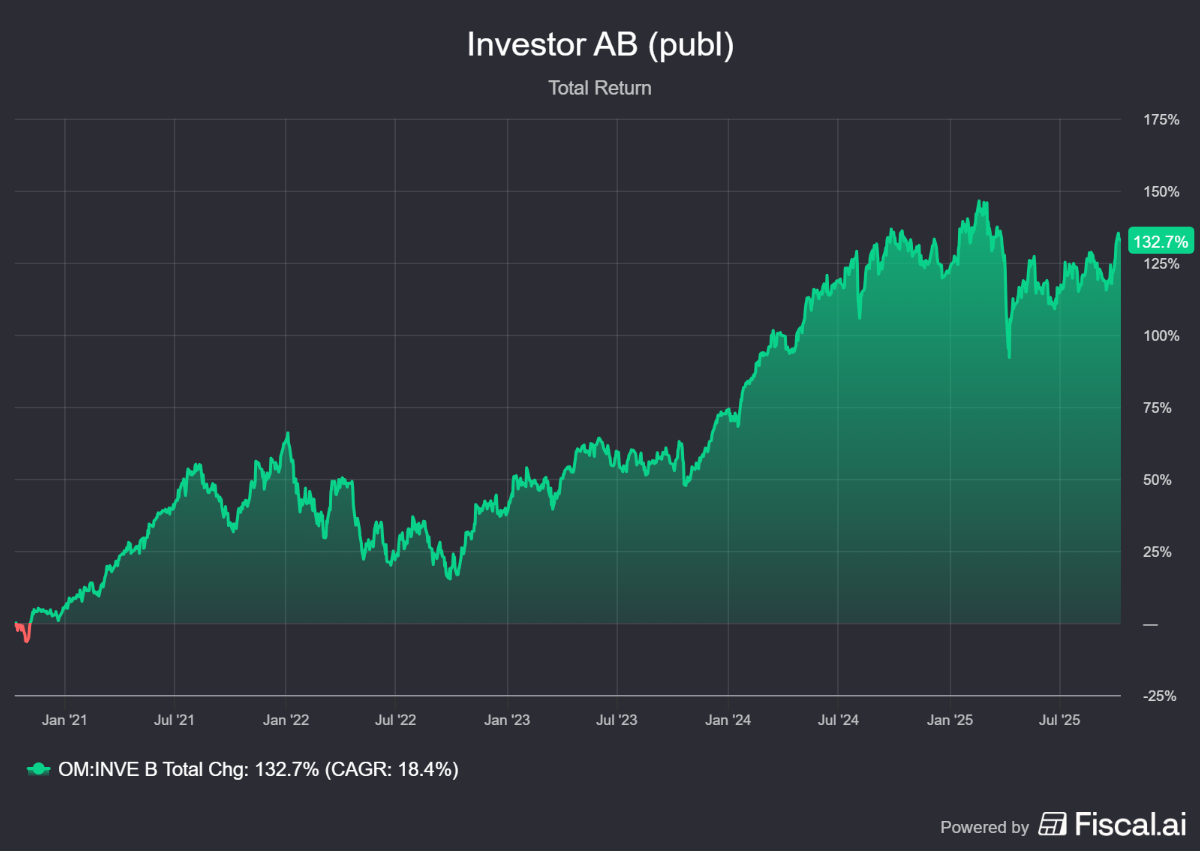
The news about ABB comes at a time when the valuation gap within Investor AB is once again in the spotlight. As the chart shows, the underlying holdings, in particular Saab and ABB itself, have risen substantially in value this year, while Investor AB's share price has clearly lagged behind.
This means that Investor AB's holding discount, the difference between the intrinsic value of the portfolio and the market value of the holding company, has widened sharply in recent months. According to our models, the discount even reached a level not seen since early 2024.
For Tresor Capital, this was reason to further increase our already high conviction in the Investor AB position.We temporarily overweighted the position, anticipating a normalisation of the discount. In the meantime, that valuation gap has partly closed again, but Investor AB remains an attractively valued company.
Investor AB ended the trading week on the Stockholm exchange at a price of SEK 303.60 per B share.
Scottish Mortgage is banking on AI and SpaceX as the driving forces behind its next phase of growth
The British investment holding company Scottish Mortgage Investment Trust (London: SMT) searches the globe for the most exceptional companies, both listed and private, with the intention of holding them for five, ten or even more years in order to fully benefit from their potential growth.
The managers acknowledge that investing in the future inevitably comes with uncertainty and volatility. A long-term horizon is therefore not a preference but an absolute requirement. Still, the hard lessons of recent years have raised the bar considerably for what truly makes a company exceptional. Today's world is marked by deep unpredictability. This demands more from companies than just a visionary concept.
Managers Tom Slater and Lawrence Burns have taken the hard lessons of recent years to heart. As Slater himself wrote in a recent publication for Scottish Mortgage, the sharp rise in interest rates and the painful bankruptcy of Swedish battery maker Northvolt have produced one clear conclusion. Without a foundation of operational and financial resilience, even the most brilliant idea is doomed to fail.
The anatomy of a durable winner
The theme of resilience, or resilience, translates in practice into uncompromising requirements. Scottish Mortgage is now searching, with renewed focus, for companies with rock-solid balance sheets and minimal debt. Robust profit margins that can absorb economic headwinds and positive cash flow that enables them to keep investing are also absolutely crucial.
Manager Lawrence Burns emphasises that true 'outlier companies' are capable of delivering exceptional returns even against the most challenging macroeconomic and geopolitical backdrop. He repeatedly points to Mercado Libre in this respect. Burns stresses that Latin America has not been an attractive place to invest from a macroeconomic perspective over the past ten to fifteen years. Despite this, Mercado Libre has managed to create enormous shareholder value.
This focus on operational excellence is also visible in other core holdings. Shopify, the e-commerce platform, got caught up during the pandemic in the euphoria surrounding accelerated digitalisation. The company hired staff on a massive scale, anticipating uninterrupted growth. When growth normalised, the inefficiency of the organisation was painfully exposed. Management, however, intervened decisively, cut costs and refocused on core operations. The result is a spectacular transformation into a profitable company.
Meta (the parent company of Facebook, Instagram and Whatsapp) went through a similar journey. After a period in which the company invested billions in the metaverse and even renamed itself, a vision that was punished by the market, Mark Zuckerberg announced a 'year of efficiency'. The organisation was streamlined and profitability was forcefully restored. Both Shopify and Meta have proven that they can not only grow but also adapt. They emerged from their crises stronger and more resilient.
The collapse of Northvolt serves here as the ultimate counter-indicator. The vision of a European battery champion was strategically sound, but the reality was that the company struggled with operational delays. Scottish Mortgage's recent investment in CATL, the undisputed Chinese global leader in batteries, is the logical consequence of this lesson. This is not a bet on a start-up. It is an investment in a proven winner with a global market share of around 40% and superior operational execution.
Dissecting the hidden value of SpaceX
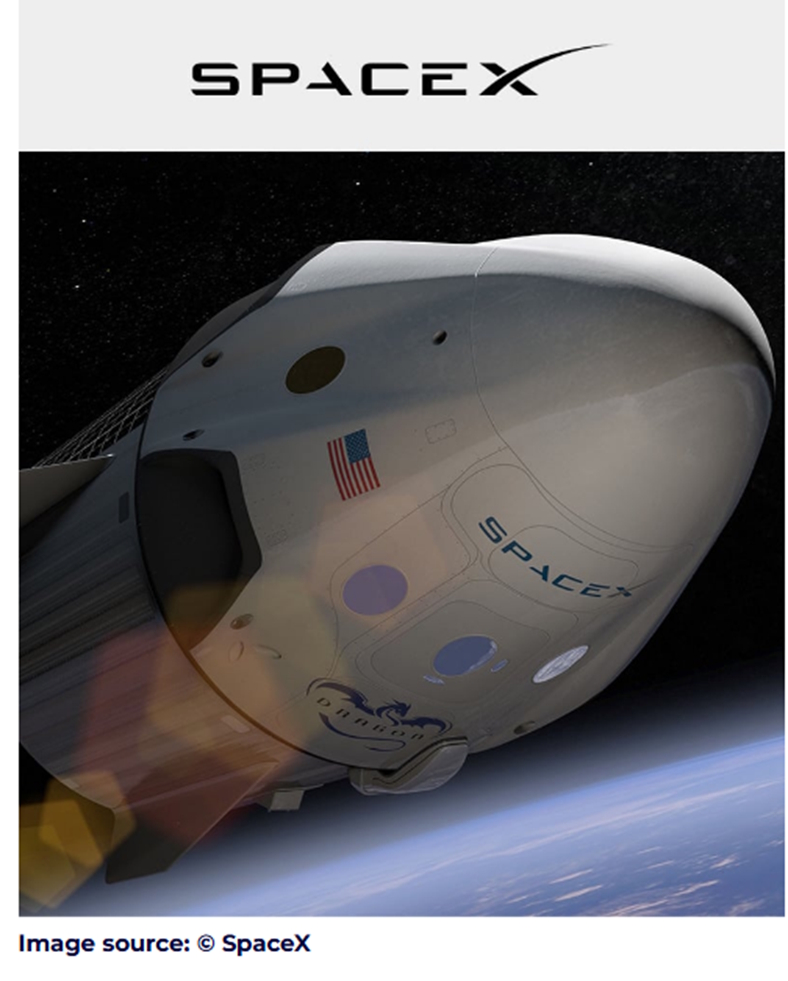
The most impressive contribution to returns over the past 12 months came from the unlisted position in SpaceX. In an interview with Trustnet, manager Lawrence Burns described Elon Musk's company as "one of the most important geopolitical assets in the world." That claim is not an exaggeration. With around 78% of all active satellites in orbit around the earth, SpaceX has a de facto monopoly on access to space. The crucial role played by the Starlink network in the conflict in Ukraine has made painfully clear how strategically irreplaceable the company is for the West.
Manager Tom Slater offered, in another conversation with Trustnet, an analysis of the most recent valuation of around USD 400 billion. According to Slater, this valuation can be fully justified by looking at the Starlink division alone. His calculation is based on the explosive growth in the number of subscribers. Starlink ended last year with 4.5 million users and, according to recent statements by Elon Musk himself, has already grown to 7 million. Slater extrapolates this trend and expects the company to end the year with around 9 million subscribers, which amounts to growth of 100% on an annual basis. Assuming a monthly price of USD 75, this leads to annual revenue of around USD 8 billion.
According to Slater, this revenue, combined with the extreme growth and potentially high profit margins, is enough to support the entire valuation of SpaceX. As an investor, you essentially get the entire launch division, which has eliminated global competition, for free. The perspective becomes even more compelling when you consider that Starlink currently holds less than 0.5% of the global USD 1 trillion broadband market, while the technology keeps getting better and cheaper. Given the high margins and the subscription model, his analysis suggests it is plausible that Starlink alone justifies the company's entire enterprise value.
Investing in the foundations of AI
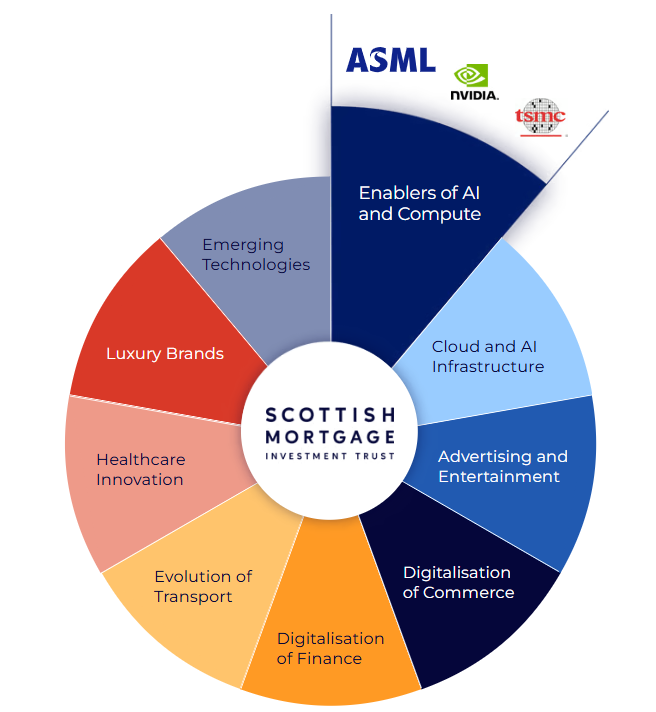
The managers are convinced of the transformative power of artificial intelligence (AI). The portfolio has been carefully positioned to benefit from this development by investing across the entire value chain.
The investments in AI start at the foundation, the hardware. A position in Nvidia is an investment in the 'excavators' of the AI gold rush. A stake in the Dutch company ASML is an investment in the only party in the world able to build the machines needed to produce the most advanced chips. TSMC is the Taiwanese giant that can actually manufacture these designs on a large scale. Together, these three companies form an almost irreplaceable ecosystem.
Further along the chain, the holding company invests in businesses that apply AI directly to gain a competitive advantage. Burns cited the Brazilian digital bank Nubank as an excellent example. By integrating AI into its credit assessment processes, Nubank is able to profitably serve millions of customers who are overlooked by traditional banks.
However, the confidence placed in Elon Musk through SpaceX does not mean that every Musk venture is a blind investment. The position in Tesla was significantly reduced at the end of last year. The original investment case, based on dominance in the transition to electric vehicles, has largely played out. The valuation of the stock, however, increasingly appears to be based on a speculative future of self-driving taxis and humanoid robots. At the end of last year, Scottish Mortgage judged that the market had run too far ahead of the facts and was paying too high a price for a future that has yet to prove itself.
Scottish Mortgage Investment Trust ended the trading week on the London Stock Exchange at a price of GBP 11.22 per share.
Receive weekly insights in your inbox
Exclusive analyses and updates on family holding companies and global market developments.
Would you like more information about our services? Please feel free to get in touch.
Get in touch
Disclaimer:
No rights can be derived from this publication. This is a publication of Tresor Capital. Reproduction of this document, or parts thereof, by third parties is only permitted after written consent and with reference to the source, Tresor Capital.
This publication has been compiled by Tresor Capital with the greatest possible care. The information is intended in a general sense and is not tailored to your individual situation. The information must therefore explicitly not be regarded as advice, an offer or a proposal to purchase or trade investment products and/or to take up investment services, nor as investment advice. The authors, Tresor Capital and/or its employees may hold positions in the securities discussed, for their own account or for their clients.
You should carefully consider the risks before you start investing. The value of your investments can fluctuate. Past performance is no guarantee for the future. You may lose (part of) your investment. Tresor Capital disclaims any form of liability for any inaccuracies or errors. This information is purely indicative and subject to change.
Read the full disclaimer at tresorcapitalnieuws.nl/disclaimer .
This article was originally written in Dutch and automatically translated into English with the help of AI. In case of any difference, the Dutch original prevails.