Family Holdings #42 - Investor AB rides the megatrends of AI and defence
Also in this edition: Scottish Mortgage on keeping investing simple; Brookfield increases its exposure to private credit and energy.



This week's topics:
Scottish Mortgage emphasises that its success stems from patience, resilience and a long-term vision: real value only emerges when you dare to sit through volatility. MercadoLibre, its second-largest holding, embodies this principle. The company has grown into the digital backbone of Latin America, with leading positions in e-commerce, fintech and logistics, strong profitability and a sustainable competitive advantage. This makes it a perfect illustration of the type of "outlier company" that Scottish Mortgage believes in: businesses that do not merely react to change, but shape it themselves.
Brookfield Corporation positioned itself powerfully this week as the linchpin of the next capital cycle, where energy, infrastructure and credit converge. With the launch of the $20 billion Global Transition Fund and the full acquisition of Oaktree Capital, the group is strengthening its grip on both sustainable energy and credit markets. At the same time, Howard Marks is taking a more measured view of valuations in the current market: unlike during the dot-com bubble, today's AI revolution rests on strong cash flows, proven profitability and mature business models. Brookfield is thus investing not in hype, but in the infrastructure that makes the technological future possible.
In Brief:
Constellation Software (Toronto: CSU) has, through its subsidiary Harris, acquired Germany's TECVIA GmbH for an estimated USD 150-200 million. TECVIA develops software for driver training, simulation and digital education systems, used by training centres, government bodies and companies in the mobility and automotive sector. The solutions help train drivers, simulate traffic situations and manage learning pathways. The company generated revenue of approximately USD 110 million in 2024 and has around 450 employees. The deal underscores Constellation's impressive acquisition growth and its increasingly powerful capital allocation towards larger transactions, following the earlier USD 100 million plus acquisition of Cipal Schaubroeck (via Topicus) earlier this year. In addition, Vela Software Group (also part of Constellation) made its first acquisition in Thailand with CAN Innovation Co., Ltd., a provider of CRM and distribution software for customers in Southeast Asia.
Topicus (Toronto: TOI) has also been busy, acquiring Germany's MeData EDV-Systeme GmbH, a software company active since 1990 and specialising in transport management systems (TMS) for the distribution of fuels, industrial gases and oxygen. MeData serves customers in Germany and other European markets and offers, among other things, the cloud solution Margo and the mobile app MTMx for drivers. Topicus also acquired the UK's Cindercone Solutions Limited, a developer of an integration platform that automates data flows between ERP systems, e-commerce and logistics platforms. Cindercone complements Topicus's existing UK operations and is now its tenth acquisition in the UK and Ireland. These acquisitions bring the total to 21 acquisitions for 2025.
Brown & Brown (New York: BRO) has, through its European arm, acquired Sunderland-based 1st UK Broking. The company, founded in 2014, specialises in fleet and commercial insurance, including employers' and liability insurance, as well as buildings and contents cover. It is Brown & Brown's second acquisition in Europe within a short period.
Sofina (Brussels: SOF) is once again facing turmoil at an Indian holding. The Belgian holding company, which previously had to take heavy write-downs on its investment in edtech company Byju's, is now seeing problems at brewer B9 Beverages, maker of the popular beer brand Bira 91. The company is grappling with heavy losses, liquidity problems and internal tensions: hundreds of employees have called on shareholders to replace CEO Ankur Jain. The problems arose after a legal name change led to months-long sales halts in several states. Sofina is estimated to hold 6.4% of the outstanding shares, and the stake accounts for only a small part of its net asset value. At the same time, there is better news brewing at another Indian investment: fintech company Pine Labs is preparing for an IPO in mid-November at a targeted valuation of USD 6 billion. Pine Labs is active in payment and credit solutions, turned profitable in FY25, and sees the IPO as a means to accelerate its "credit-at-checkout" services and regional expansion. Sofina is estimated to hold 2.45% of the outstanding shares.
D'Ieteren (Brussels: DIE) is bringing together the luxury brands of its subsidiary D'Ieteren Automotive under a single banner. The Belgian car group is combining the dealerships of Porsche, Bentley, Lamborghini, Maserati, Bugatti and Rimac under the new label Luxury Performance. The aim is to create synergy between the exclusive brands and offer customers additional services, such as storage, maintenance and logistical support for track use.
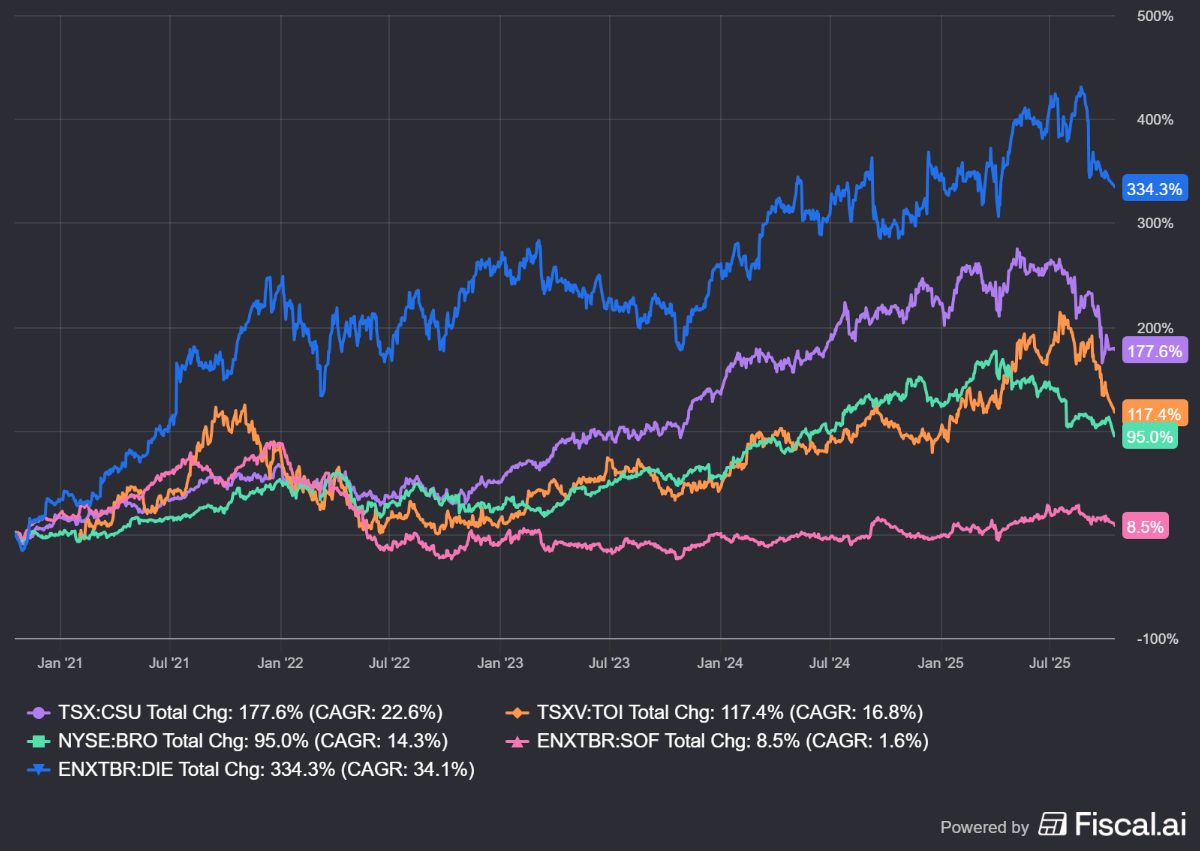
Constellation Software, Topicus, Brown & Brown, Sofina and D'Ieteren ended the trading week on the Toronto, New York and Brussels exchanges at prices of CAD 3,814.13, CAD 137.41, USD 87.91, EUR 239.40 and EUR 156.90 per share, respectively.
Investor AB rides the megatrends of AI and defence
The Swedish investment holding company Investor AB (Stockholm: INVE-B) published robust results this week for the third quarter of 2025. This quarter it was the listed companies that led the way, while Investor once again invested across all three divisions.
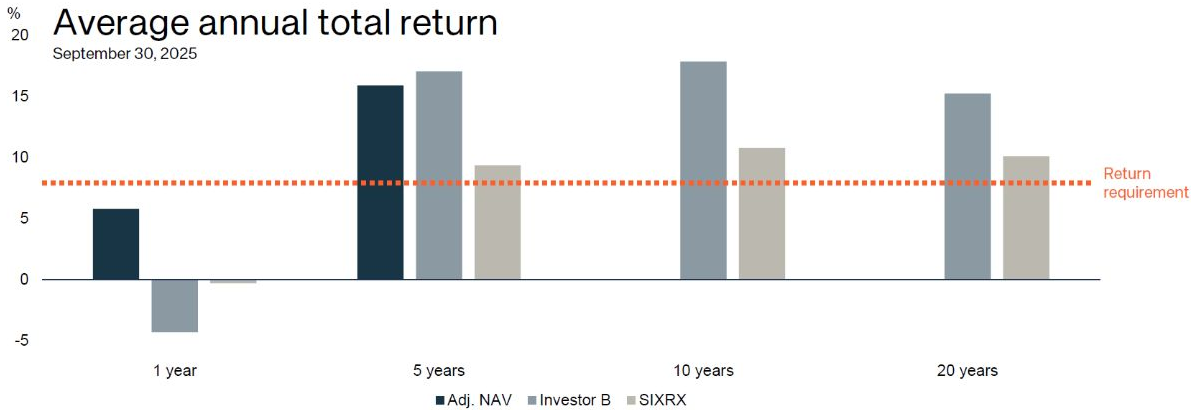
Investor AB saw its net asset value rise by an impressive 7% in the third quarter. The shareholder return (share price return plus dividend) was 5%, considerably better than the 3% recorded by the Swedish stock index SIXRX. Since the start of the year, net asset value has increased by 8%. The shareholder return over the same period was 2%, while the Swedish stock market rose by 6%.
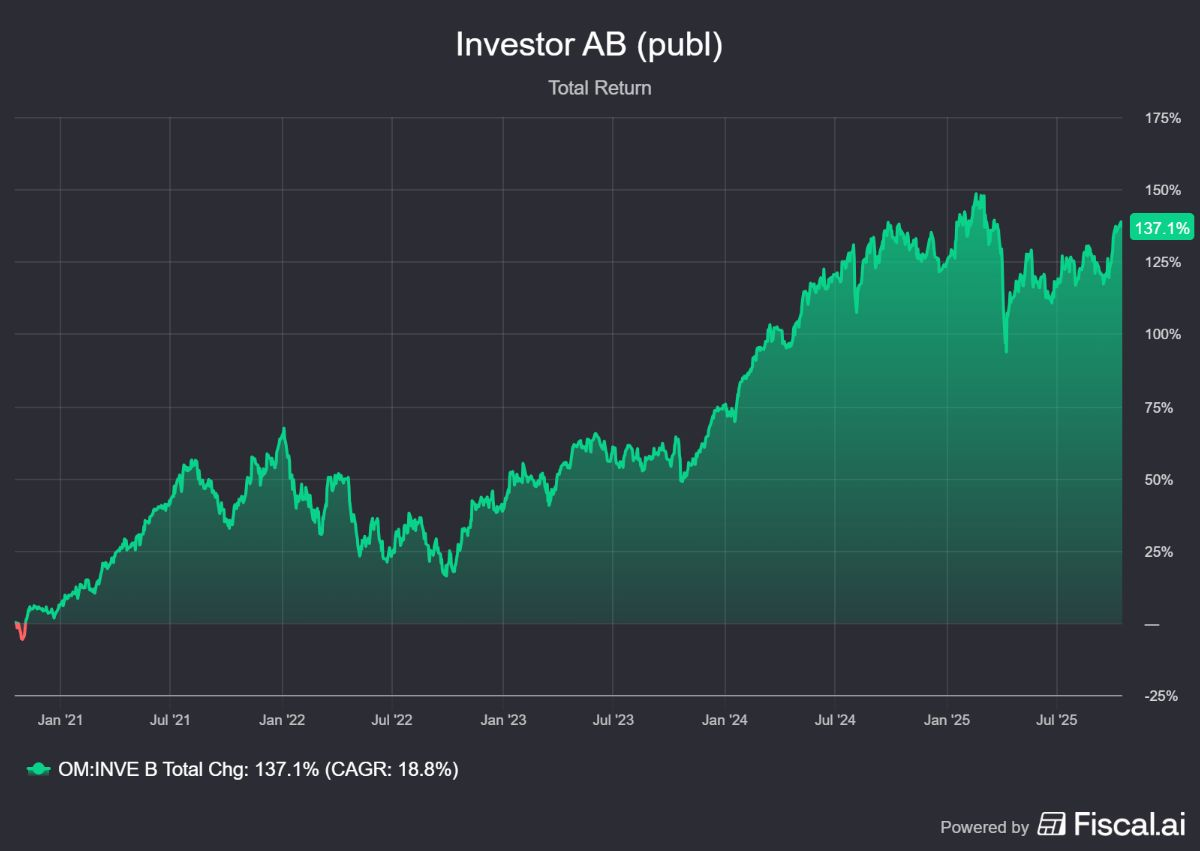
Looking at the past twelve months (see the figure below), a notable phenomenon emerges: Investor AB's share price performance is weaker than that of the Swedish SIXRX stock index. Net asset value, by contrast, is performing clearly better, meaning that the undervaluation has widened over this period. Investor's long-term performance, however, remains comfortably ahead of the reference index.
CEO Christian Cederholm wrote in his letter to shareholders about the challenging global climate and the resilience of the portfolio companies:
- "As a strong advocate of free trade as a catalyst for innovation and global economic growth, it is troubling to see trade friction continuing to increase due to tariffs and significant geopolitical tensions. In this environment, it is encouraging to see our portfolio companies doing good work by focusing on what they can control, such as cost efficiency. Our companies also continue to invest in future-proofing their businesses, positioning themselves for stronger long-term performance.
The current environment offers opportunities to further strengthen the positions of our companies and of Investor itself, which supports our ability to continue generating an attractive total return for you, our fellow shareholders."
Listed companies
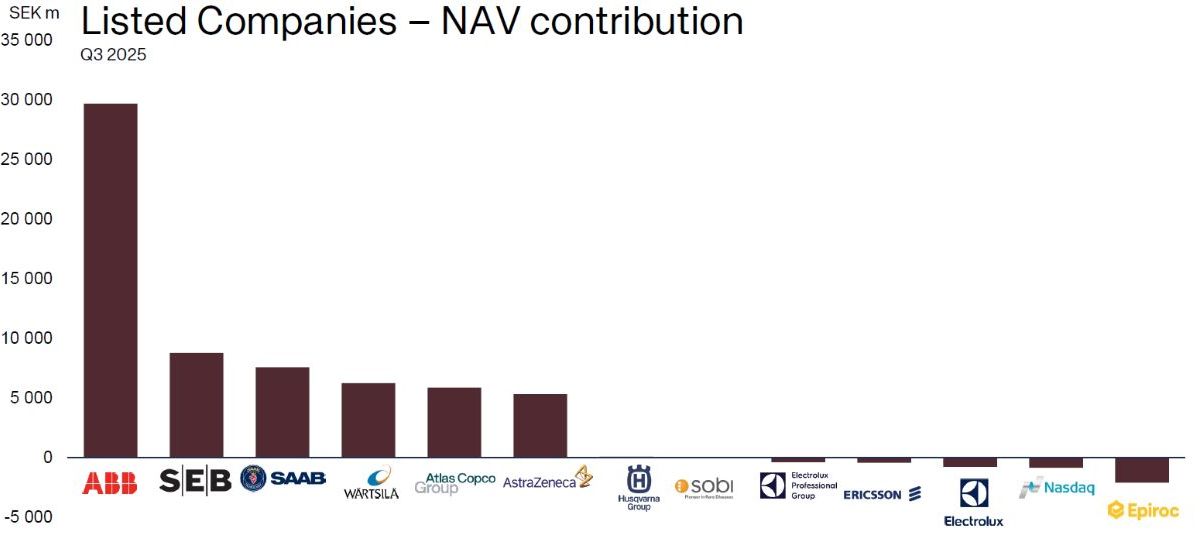
The listed portfolio delivered a total return of 8% in the third quarter, significantly outperforming the Swedish stock index's 3%. This excellent performance was led by Wärtsilä and ABB, which both posted substantial returns. The figure above shows the contribution to net asset value growth per company. Investor is clearly reaping the benefits of AI enabler ABB being its largest position.
Investor remained disciplined in investing in its core positions. During the quarter, SEK 0.6 billion was invested in Atlas Copco and SEK 0.5 billion in Ericsson, at levels the family holding company considers attractive. In addition, an agreement was reached to sell 5 million shares in SEB in order to maintain the current ownership stake, as SEB continues its share buy-backs (to stay below the regulatory threshold).
Meanwhile, the listed companies continue to work on future-proofing their operations. For instance, Atlas Copco has acquired more than 30 companies over the past twelve months. AstraZeneca announced plans to invest USD 50 billion in the US by 2030, while Wärtsilä further streamlined its portfolio by selling its Marine Electrical Systems business.
A key event after the end of the quarter was ABB's agreement to sell its Robotics division to Softbank, which we already wrote about last week. When Tresor Capital asked whether ABB had been offered a price too good to ignore, CEO Cederholm confirmed during the conference call that Investor shares the view of ABB's board that this transaction is financially attractive for ABB and provides a good new home for ABB Robotics.
Unlisted companies: Patricia Industries
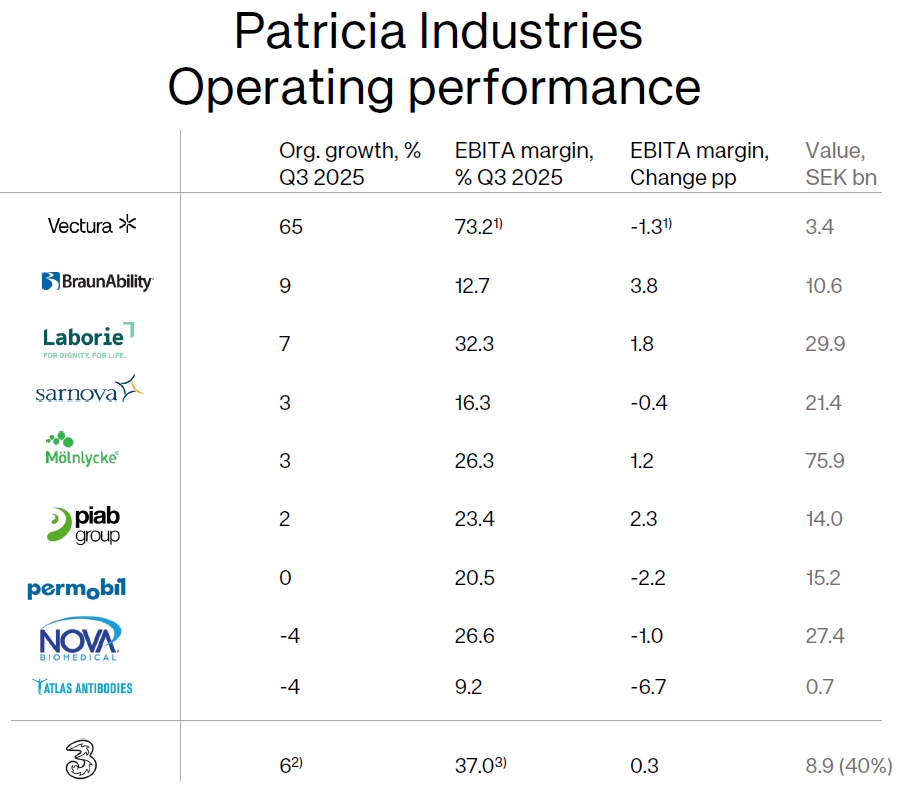
The unlisted companies, grouped under Patricia Industries, achieved a total return of 4% in the third quarter. This increase was mainly driven by higher valuation multiples in the market and cash flow generation, but was partly offset by a negative currency effect.
Operationally, the picture was mixed. The large subsidiaries reported organic revenue growth of 4% (excluding currency effects), with BraunAbility and Laborie growing significantly faster. However, operating profit (EBITA) fell by 2%, largely due to negative currency effects from a weakening US dollar.
The quarter was dominated by the completion of Advanced Instruments' strategic acquisition of Nova Biomedical, a transaction worth USD 2.2 billion. Patricia Industries contributed USD 1.6 billion in equity to finance this acquisition. Integration of the two companies, which now operate under the name Nova Biomedical, has begun and is on track. Organic growth in the first quarter following the acquisition was negative at 4%, which, according to Investor AB CEO Cederholm, was due to a very strong comparison period and a cyber incident that disrupted business operations. He emphasised that the company's underlying qualities are in line with the investment case and that the focus is now on rapid integration to realise its full potential.
Mölnlycke, the largest subsidiary, reported solid organic growth of 3%, driven by Wound Care and Gloves, which both grew by 5%. Investor CFO Jenny Haquinius noted during the conference call that Mölnlycke continues to gain market share in a market with low, single-digit underlying growth, but also acknowledged weakness in parts of Europe, such as Germany and France, due to pressure on healthcare budgets.
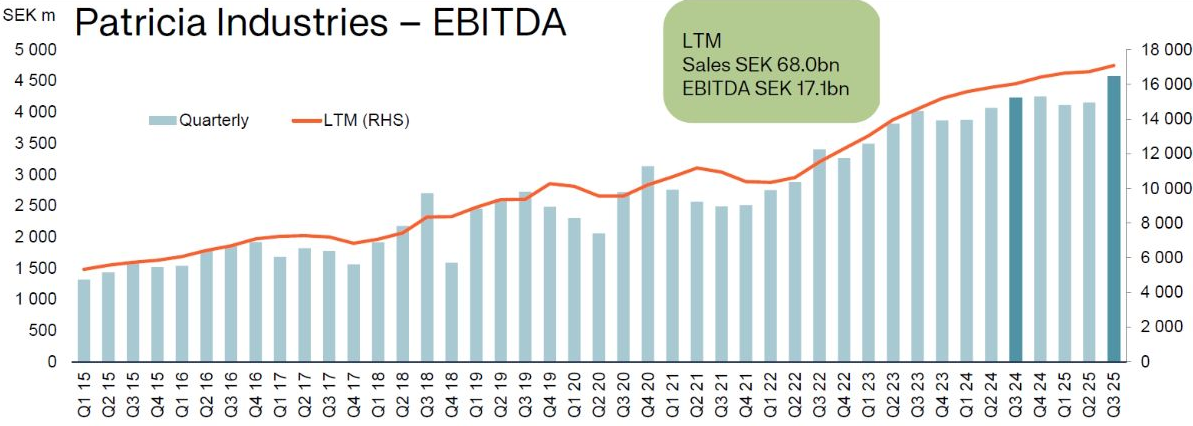
Over the long term, Patricia Industries shows impressive and steady profit growth, as shown in the figure below.
EQT AB and private equity funds
The value of the EQT segment grew by 1% in the third quarter. Investor AB includes both its stake in the shares of this private equity fund manager and its direct investments in EQT's investment funds. The share price of EQT AB rose by 2%, while the return on the private equity funds was 1% negative. This is reported with a one-quarter delay and therefore relates to Q2; according to EQT's call, the result in Q3 was positive, which will therefore show up in Investor's figures in the fourth quarter.
Investor continued to strengthen its partnership with EQT by investing an additional SEK 1.8 billion in the co-investment in Fortnox, bringing the total investment close to the communicated SEK 4.5 billion. This investment is part of a strategic transaction in which a consortium, led by EQT X and Fortnox's largest shareholder, took the company private in order to pursue its next phase of growth outside the public markets. Fortnox is a Swedish software company that offers a cloud-based platform for financial administration to more than 600,000 small businesses. Investor AB is participating as a major co-investor in this deal to support the investments needed in product development and possible acquisitions, which should lay the groundwork for future scaling and growth.
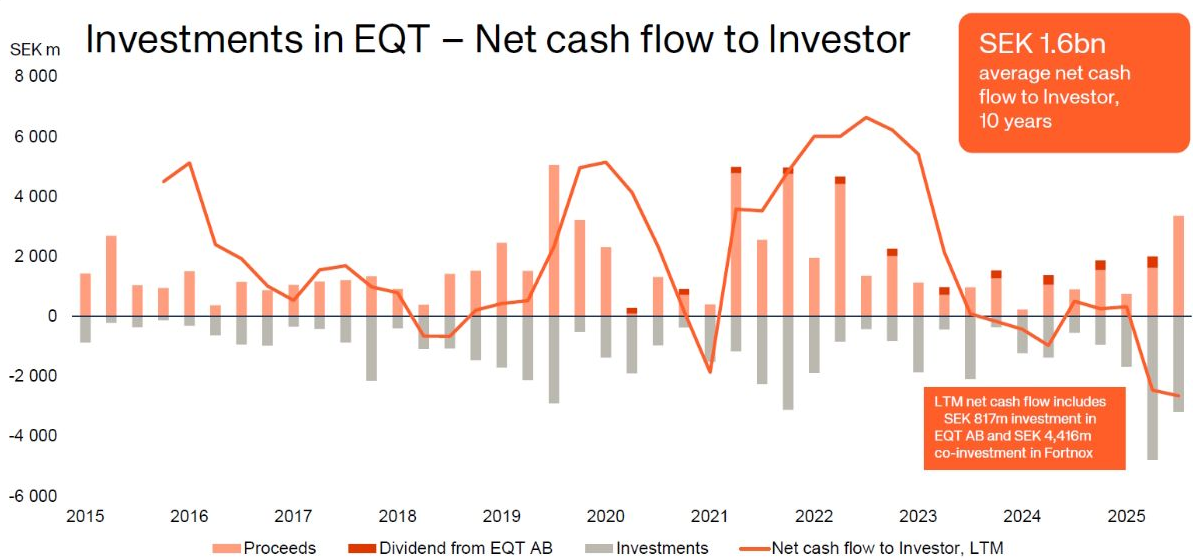
Cash flows from EQT were positive this quarter. A net SEK 165 million flowed to Investor. Although this amount is modest, a look at the longer term shows a very healthy picture. Over a ten-year period, the net cash flow to Investor has averaged a positive SEK 1.6 billion per year. This demonstrates that the investments and proceeds from the EQT funds are well balanced. CFO Jenny Haquinius explained that the negative cash flow over the past twelve months (-SEK 2.7 billion) is distorted by the large investments in EQT AB shares and the co-investment in Fortnox. Adjusted for these items, the underlying net cash flow was in fact a positive SEK 2.5 billion.
Outlook and future-proofing
Investor AB is placing strong emphasis on future-proofing its portfolio companies. Digitalisation and artificial intelligence (AI) rank high on the agenda in this respect. During the results presentation, Tresor Capital asked for concrete examples of how Investor is addressing this theme through its position on the boards of directors. CEO Cederholm indicated that the opportunities in this area extend across the entire value chain, from research and development to more efficient production, administration and marketing. Ultimately, AI should also improve the products and services delivered to the end customer. He stressed that this topic is high on the agenda and that Investor actively promotes it through its role on the companies' boards. In addition, knowledge sharing between the companies is encouraged so that they can learn from each other's successes and failures and create healthy mutual competition.
Regarding the establishment of Sferical AI, an initiative of Wallenberg Investments AB and various portfolio companies, it was clarified in response to questions from Tresor Capital that Investor AB itself is not an investor in it. It involves a partnership between a separate entity of the Wallenberg family and the companies that will use the AI infrastructure, for example for training models for research and development. Through its subsidiaries, Investor AB will benefit from this partnership.

The private portfolio also remains a key area of focus, with additional capital committed to EQT and the completion of the substantial acquisition of Nova Biomedical. Investor AB is clearly not a passive investment holding company that sits back and relaxes. With EQT co-investments such as Fortnox, the capital allocation spectrum is being broadened even further.
We consider the private portfolio to be the crown jewel of the family holding company. Patricia Industries is an attractive serial acquirer with a strong position in the less cyclical healthcare sector. Combined with the investments in EQT's private equity funds on favourable terms (Investor AB pays no performance fees), shareholders gain liquid exposure to this asset class.
The listed portfolio also offers highly attractive exposure. ABB and Atlas Copco, for instance, are crucial players in Artificial Intelligence infrastructure. Atlas Copco supplies essential vacuum and compressor technology for semiconductor (chip) manufacturing and data centre cooling, while ABB supports AI infrastructure with its automation, electrical systems and energy management solutions. With Saab, shareholders also gain exposure to the booming defence industry.
So it turns out that Investor AB is not a dull, solid Swedish family business, but an attractive and dynamic investment holding company that offers exposure to megatrends and continually manages to add value through active management. Ever since its founding in 1916, the Wallenberg family has successfully optimised the portfolio and made it future-proof, something they continue to achieve to this day. This provides a strong foundation for sustained strong returns going forward. As one of the larger positions in the Tresor Capital Family Holdings portfolio, we are riding along on the success of this Swedish stock market gem.
Investor AB ended the trading week on the Stockholm stock exchange at a price of SEK 306.70 per B share.
Patience as a weapon: how Scottish Mortgage wins with companies like MercadoLibre
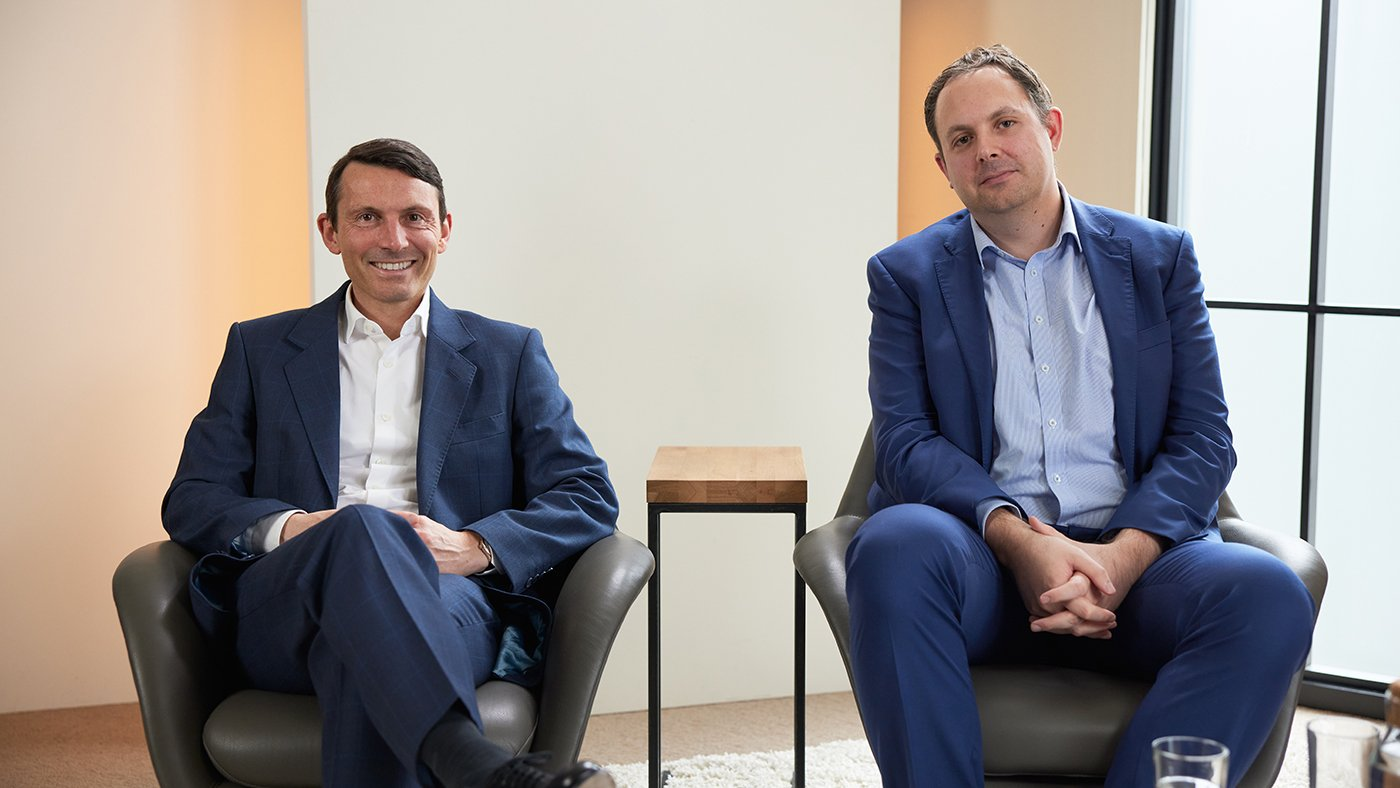
Last week we already wrote about how Scottish Mortgage Investment Trust (London: SMT) bets on structural themes such as artificial intelligence and space travel. This week, new sessions with fund managers Tom Slater and Lawrence Burns were released, in which they discussed something more fundamental: how, as an investor, you learn to use time, imagination and patience as your greatest advantage. An important theme in the current market, where euphoria and fear take turns in rapid succession.

Staying power as a competitive advantage
Slater opened the conversation with a simple but powerful message: “Rome wasn't built in a day.” According to him, days or weeks on the stock market sometimes feel like an eternity, but they rarely say anything about a company's actual progress. The success of Scottish Mortgage Investment Trust is not built on quick decisions, but on the discipline to look five to ten years ahead, not five to ten days.
Patience alone, however, is not enough, the management notes. Time is only valuable when it is supported by resilience. That attitude requires calm and confidence, qualities that are becoming increasingly rare in a world full of headlines, volatility and social media. Lawrence Burns put it aptly: “The price you pay for chasing exceptional companies is volatility.” Great winners never grow in a straight line; they are shaped during periods of uncertainty. Even the most successful companies experienced deep troughs along the way: Apple once lost more than 70% twice over, Amazon even lost more than 90%.
Only companies with genuine profitability, healthy margins and strong teams are able to grow through such shocks. It was precisely in those moments that the foundation was laid for their later exponential growth. Slater sums it up in one principle: “You can only lose 100% once, but you can earn back your stake many times over if you're right.”
That is why positions within the Scottish Mortgage trust, and likewise at Tresor Capital, are only reduced when the original investment case fundamentally changes.
The managers' thinking aligns seamlessly with our own philosophy. We too believe that patience is the rarest, yet most powerful, investment factor. After all, it is the only factor that cannot be copied. Whoever masters it has a permanent advantage.
In essence, the principle is simple: if you want to trade as little as possible, you need to understand your investment case in detail. Only then can you muster the discipline to stay put when the market is screaming for action. It brings to mind the famous words of Johan Cruijff: “Football is simple, but playing simple football turns out to be one of the hardest things there is.” The same applies to investing: it is seemingly simple—buy great companies and hold them for the long term—but truly understanding those companies requires patience, dedication and staying power.
MercadoLibre as an example of these core values
Alongside the two videos featuring the fund managers, an interview with Scottish Mortgage's second-largest holding was also published this week. Where last week we wrote about the largest position, SpaceX, this time the spotlight is on MercadoLibre. The company has long been the trust's most important listed holding and embodies many of the principles that Tom Slater and Lawrence Burns discussed at their conference: long-term thinking, resilience, innovation and independence.
In the conversation with incoming CEO Ariel Szarfsztejn, it quickly becomes clear why Scottish Mortgage remains so convinced of this company. MercadoLibre is not just an e-commerce platform, but the digital backbone of Latin America. The company now serves more than 100 million active buyers in a region of 650 million people and combines e-commerce, payments, lending, logistics and digital media into one integrated ecosystem. This interconnectedness makes it both the dominant player in online trade and the continent's largest fintech company.
MercadoLibre's position within its markets is remarkable. In Brazil, the region's largest economy, the company's market share has grown in recent years from around 20% to 42%, while Amazon rose only from 8% to 11% over the same period. In digital payments, Mercado Pago is the clear number one, with a reach that traditional banks and international fintechs cannot match. And in other domains too, such as digital advertising, MercadoLibre has established a strong position, now ranking third in Latin America, right behind Google and Meta. This spread shows that the company is not dominating a single market, but redefining multiple sectors at once.

What appeals to Scottish Mortgage about this company goes beyond growth. MercadoLibre meets virtually all the criteria that Slater and Burns previously identified as prerequisites for sustained exceptional returns: strong cash flow, structural profitability and a defensible competitive advantage.
In eight years, it built up its logistics network to more than 70,000 employees and hundreds of fulfilment centres, enabling it today to deliver faster and more reliably than Amazon in the same region. At the same time, the company remains profitable, a rarity in emerging markets that are often characterised by inflation, volatility and political noise.
For Scottish Mortgage, MercadoLibre is therefore a textbook example of what they call “outlier companies”: businesses that not only move with change but actively shape it.
The scale of Latin America makes that potential even more impressive. With a combined economy of around USD 7 trillion, the continent, if it were one country, would be the third-largest economy in the world. Yet e-commerce penetration remains below 15% of total retail sales, and more than half of all transactions are still conducted in cash. For a company that is the market leader in both sectors, that points to a long runway for growth ahead.
This also explains why Scottish Mortgage is once again drawing attention to this. Not to promote the stock, but because MercadoLibre illustrates their way of thinking: investing in companies that use time to their advantage, grow stronger through scale and data, and have a culture that can withstand crises. The conversation with Szarfsztejn shows that this company does not depend on short-term trends, but is instead built to grow alongside the economic modernisation of an entire continent.
For investors, MercadoLibre's story thus offers insight above all into the quality and direction of Scottish Mortgage's portfolio. It shows what the trust looks for: companies that not only generate profit but also drive structural progress, economically, technologically and socially.
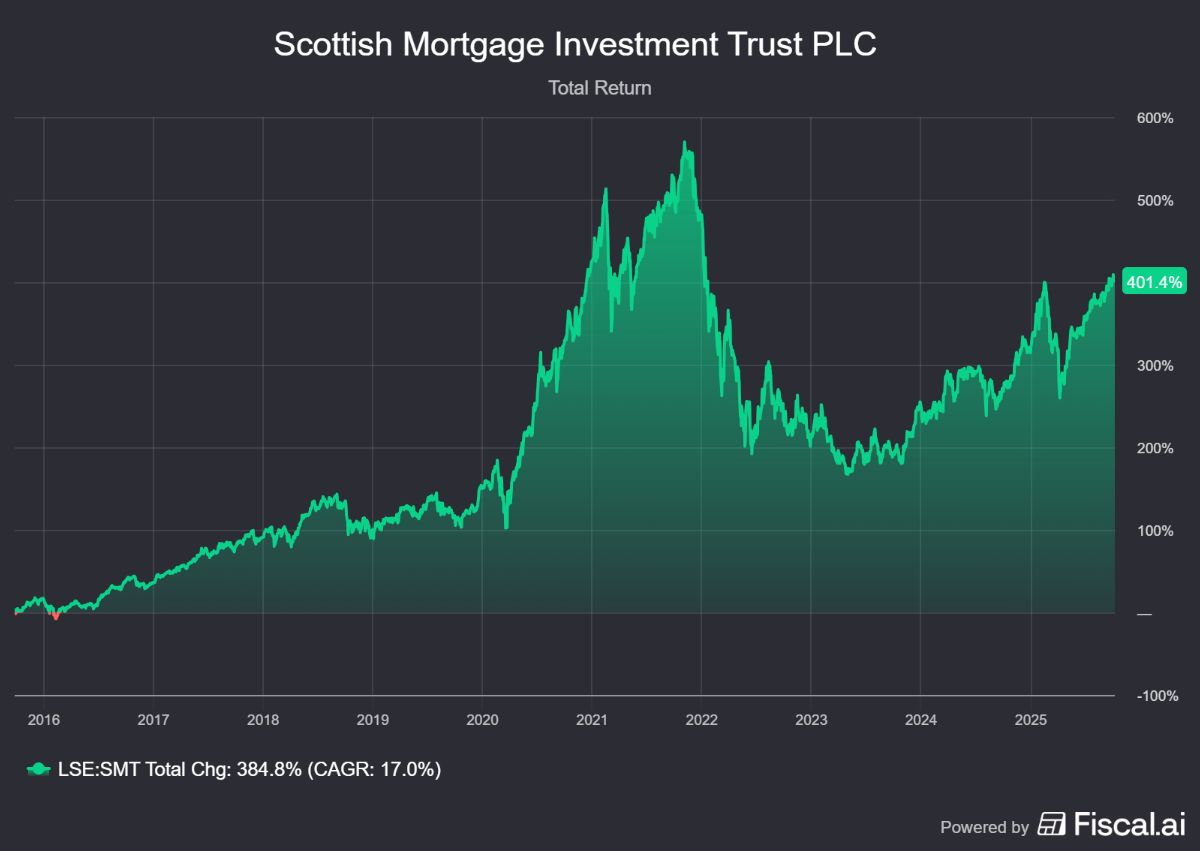
Scottish Mortgage Investment Trust ended the trading week on the London Stock Exchange at a price of GBP 11.07 per share.
Brookfield’s multi-billion offensive towards the future
The Canadian investment giant Brookfield (New York: BN) has had a remarkable week. Within just a few days, it announced three strategic moves that together paint a clear picture: the group is positioning itself as the linchpin of the next capital cycle, where energy, infrastructure and credit intersect.
Launch of the largest sustainable energy fund ever
First, Brookfield Asset Management announced that it has closed its second Global Transition Fund, with an impressive size of $20 billion. The fund, focused on sustainable energy and infrastructure, is thereby one of the largest private capital injections ever in the global energy transition. Significant contributions came from Alterra (the investment arm of the UAE, $2 billion) and Norges Bank Investment Management ($1.5 billion), while Brookfield Corporation itself is contributing approximately 25% of the total capital – an unusually large share for a fund manager, and a clear signal of conviction.
The fund invests broadly: from solar and wind farms to nuclear technology and CO₂ storage, but also in infrastructure that enables the growth of artificial intelligence. The latter is no coincidence. According to president Connor Teskey, the AI boom is driving global energy demand up faster than anticipated: “The world doesn't need less energy, it needs more – clean, abundant and cheap. The AI industry is becoming a major new consumer, and that's accelerating our investment cycle.”
More than $5 billion of the fund has already been allocated, including to the French company Neoen (battery storage and solar farms) and to the Indian company Everen, a joint venture for wind and storage. The same logic applies to its investment in Bloom Energy, where it put up to $5 billion into fuel cell technology earlier this week to help satisfy the power hunger of AI data centres.
By investing in both the production and consumption side of energy, Brookfield is building, step by step, an integrated ecosystem that powers the technological revolution. The group thereby appears not to be speculating on the future, but literally supplying it with energy.

Acquisition of remaining Oaktree shares
As if that weren't enough, Brookfield Corporation also announced this week that it is acquiring the remaining 26% of Oaktree Capital Management for approximately $3 billion. Brookfield and Brookfield Asset Management are each financing roughly half of the transaction, fully completing the merger from 2019, which was worth $5 billion at the time.
With this step, Oaktree, the legendary distressed debt manager led by Howard Marks, becomes fully integrated into Brookfield's structure. Together they manage more than $1 trillion in assets, firmly positioning Brookfield alongside Blackstone and Apollo as one of the largest private equity holding companies in the world. Oaktree is known as the temple of value investing and credit discipline, a counterweight to the exuberance of the equity markets.
Mark Howards changes course
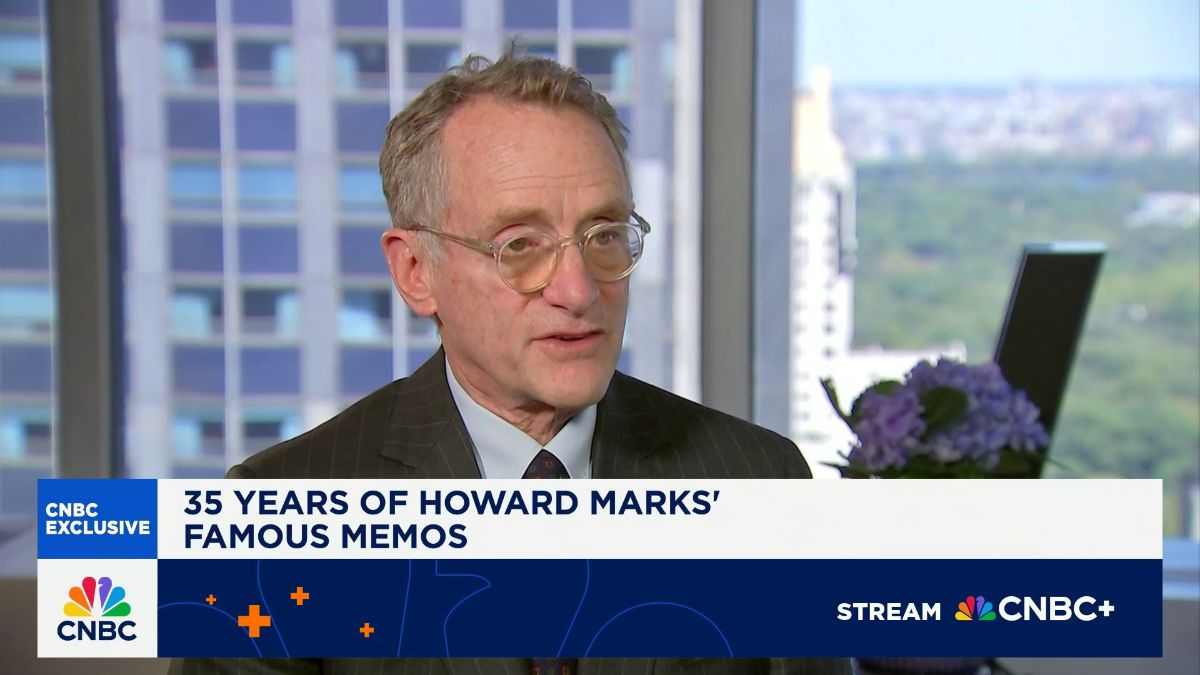
Marks, for years a sharp critic of overvaluation and market euphoria, appeared just a month ago in an interview in which he argued that stocks were expensive relative to fundamentals and that investors were “optimistic out of habit.” At the time, he even spoke of “the early days of a bubble.”
However, in a more recent interview this week, he sounded noticeably more measured. Although he acknowledges that valuations are high, he sees no signs of the “psychological excesses” that, in his view, define any true bubble:
“There's enthusiasm, yes, but no mania. Today's companies are better, more dominant and more profitable. Optimism is justified as long as it isn't blind.”
Marks' comment touches on a point that is often overlooked in today's market. As soon as there's talk of euphoria around technology or AI, comparisons are quickly drawn with the dotcom bubble of the early 2000s. But a closer look reveals that the situation is fundamentally different.
The companies that set the tone back then, think Yahoo, Pets.com or Netscape, had barely any free cash flow. The market's value was built on promise. The average earnings per share of the technology index at the time stood at less than a tenth of current levels in early 2000, and the combined free cash flow of the ten largest tech companies amounted to less than $20 billion per year. Today, those same leading companies, Apple, Microsoft, Alphabet, Meta, Amazon, Nvidia and TSMC, together generate well over $400 billion in free cash flow per year. That's twenty times as much. In other words: whereas valuations back then were completely detached from reality, today's valuations rest on an exceptionally profitable and capital-rich foundation.
On top of that, today's scale of investment, however large, is relatively manageable. When Mark Zuckerberg says he would rather misspend $100 billion than fall behind in the AI trend, that sounds excessive, but it's only a fraction of the cash flow Meta expects to generate in the coming years. Other companies, too, are investing from a position of abundance, not debt.
The difference with the dotcom era is therefore not only financial but also structural. The current generation of technology companies has proven business models, monopolistic market shares, and the scale to absorb billions in R&D without undermining their profitability. Whereas the internet revolution of back then ran on hope, the AI revolution of today runs on cash flows, infrastructure and mature markets.
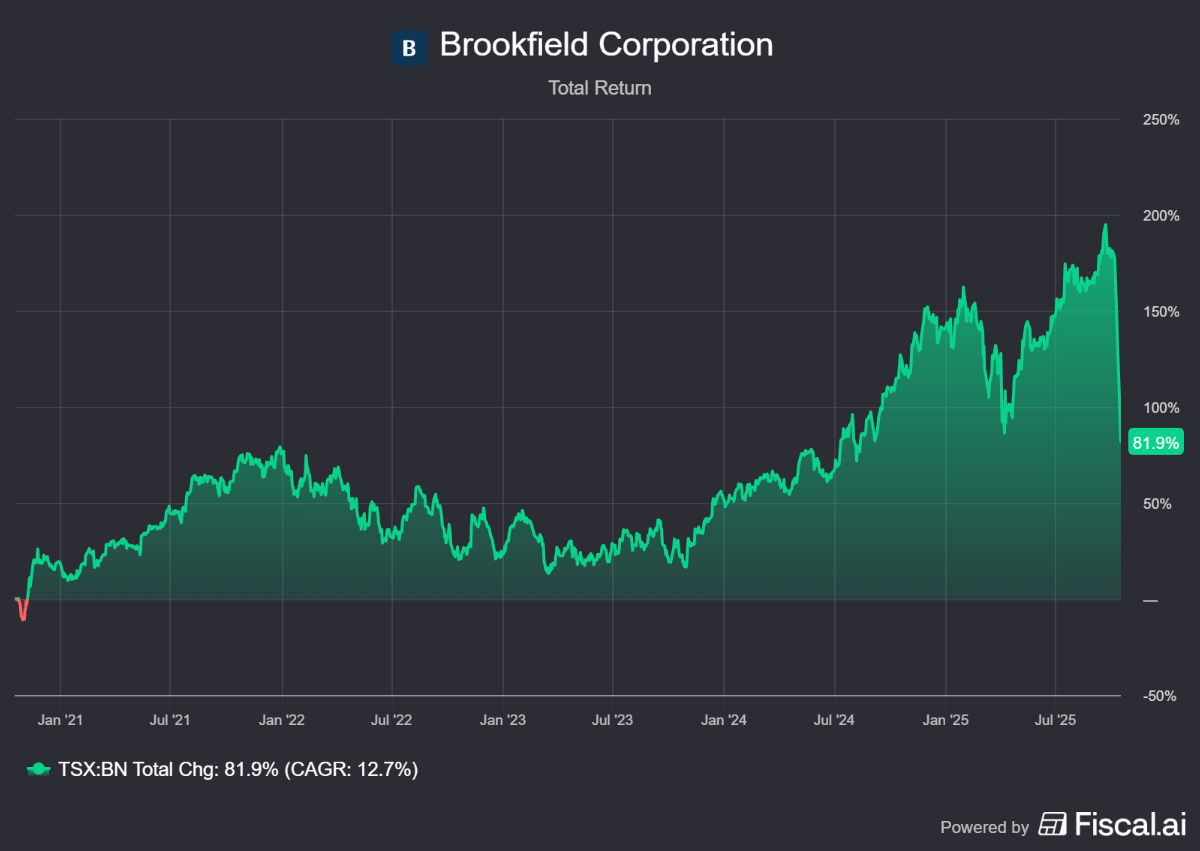
Brookfield Corporation is currently trading on the New York Stock Exchange at a price of USD 44.18 per share.
Receive weekly insights in your inbox
Exclusive analyses and updates on family holding companies and global market developments.
Would you like more information about our services? Feel free to get in touch.
Get in touch
Disclaimer:
No rights can be derived from this publication. This is a publication of Tresor Capital. Reproduction of this document, or parts thereof, by third parties is only permitted with written consent and with reference to the source, Tresor Capital.
This publication has been compiled by Tresor Capital with the greatest possible care. The information is intended in a general sense and is not tailored to your individual situation. The information may therefore expressly not be regarded as advice, an offer or a proposal to purchase or trade investment products and/or to make use of investment services, nor as investment advice. The authors, Tresor Capital and/or its employees may hold positions in the securities discussed, either for their own account or on behalf of their clients.
You should carefully consider the risks before you start investing. The value of your investments may fluctuate. Past performance offers no guarantee for the future. You may lose (part of) your invested capital. Tresor Capital disclaims any form of liability for any inaccuracies or errors. This information is purely indicative and subject to change.
Read the full disclaimer at tresorcapitalnieuws.nl/disclaimer .
This article was originally written in Dutch and automatically translated into English with the help of AI. In case of any difference, the Dutch original prevails.