
Family Holdings #43 – Record results at MBB leave us wanting more
Also in this issue: Swedish serial acquirers show how it's done; Chapters CEO Jan Mohr on the 'Shotgun' and 'Rifle' AI approach.



This week's topics:
The Swedish serial acquirers Addtech and Lifco reported strong quarterly results, with profit growth of around 10% and margins above 15–22%. Both companies demonstrate that the decentralised serial-acquirer model remains resilient even amid shifting market conditions. Lifco added 13 new companies and keeps its balance sheet rock-solid. The share price jumps of >10% reflect investor confidence in this robust growth model.
Chapters Group CEO Jan Mohr does not see AI as a threat but as a catalyst for the VMS sector. Chapters uses a 'shotgun' approach for broad adoption alongside targeted 'rifle' projects with quick ROI. AI strengthens efficiency, customer retention and data infrastructure in mission-critical environments such as police services. In doing so, Chapters is consolidating its strategic position, while the market for niche software is growing towards USD 500 billion.
In Brief:
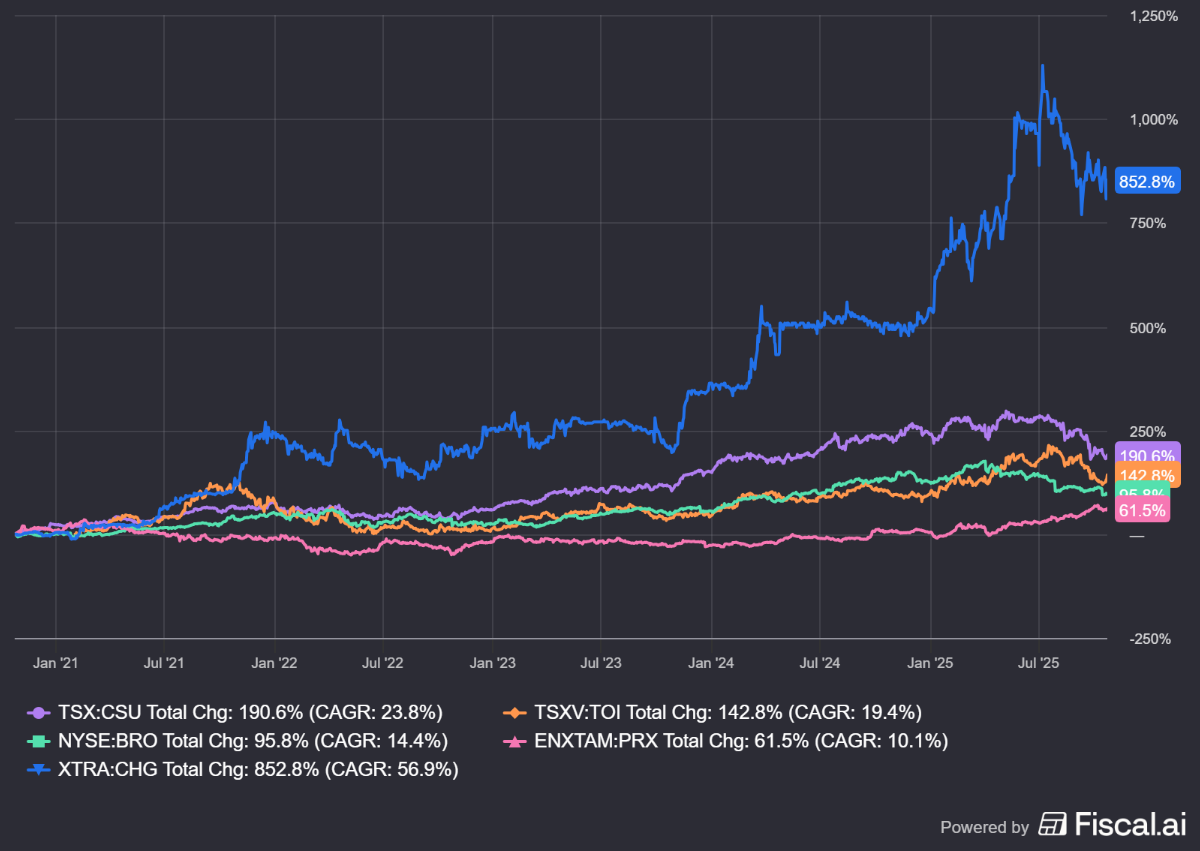
Brown & Brown (New York: BRO) has seen some share price pressure recently. Management made its confidence in the long term clear by raising its share buyback programme by USD 1.25 billion to a new total of USD 1.5 billion. A serious signal from the board. The company also decided on a 10% increase in the quarterly dividend to USD 0.165 per share, the 32nd consecutive dividend increase. Finally, it announced the acquisition of Pardus Underwriting, a UK-based MGA specialising in property and commercial insurance products.
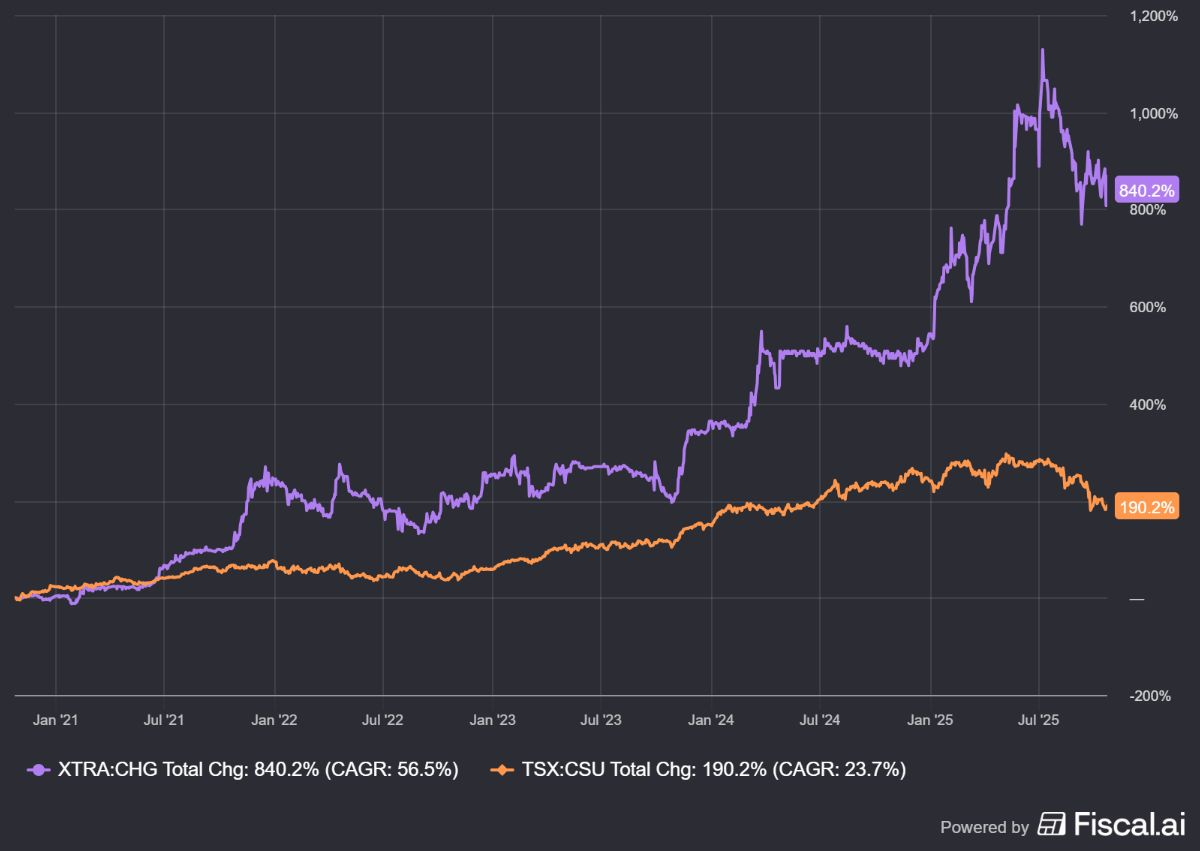
Constellation Software (Toronto: CSU) continues to step up its pace of expansion with three new acquisitions through its subsidiaries. Volaris acquired the UK's Fintilect Ltd., a provider of digital banking software for secure front-end solutions. In Singapore, Volaris also acquired Quantum Inventions from Continental AG, which is active in connected-car and mobility data. Harris expanded its portfolio with Canada's Constellio, which specialises in content management and data security. These three acquisitions bring the 2025 total to 73 deals so far.
Topicus (Toronto: TOI) has acquired the UK's Sendible, a social media management platform that helps companies and agencies manage their online presence through one integrated system. Sendible offers tools for scheduling and publishing content, monitoring responses and analysing performance across multiple channels.
Prosus (Amsterdam: PRX) continues to actively restructure its e-commerce portfolio. The company has announced it will not sell any shares in the IPO of Indian online retailer Meesho, in which it holds a 12.3% stake. The IPO, with expected proceeds of ₹58–66 billion (≈$700–800 million), marks an important moment for the Indian tech market. While early investors such as Elevation Capital and Peak XV (Sequoia India) are partially exiting, Prosus is deliberately opting for a long-term position in the fast-growing platform, which has become one of the biggest competitors to Flipkart and Amazon in India. Prosus also continues to refine its portfolio by divesting non-core activities. For instance, subsidiary OLX Group sold its operations in Kazakhstan for $75 million. With this move, Prosus is further concentrating on core markets and more profitable digital ecosystems, while being able to reinvest the proceeds in strategic growth pillars such as e-commerce, fintech and education.
Chapters Group (Frankfurt: CHG) continues to actively reposition its capital structure. On 16 October, the company once again reduced its stake in Software Circle, this time to 10%, a clear step away from the more expensively valued listed software market towards the more attractively priced private sector. Shortly thereafter, Chapters announced an expansion of its 7% 2025/2030 bond by €40 million, bringing the total outstanding volume to €72 million within a framework of up to €100 million. The strong demand among investors confirms confidence in Chapters' model and provides additional financial room to accelerate its active M&A pipeline in vertical market software.
Brown & Brown, Constellation Software, Topicus, Prosus and Chapters Group are currently trading on the exchanges of New York, Toronto, Amsterdam and Frankfurt at prices of USD 88.08, CAD 3,784.48, CAD 148.77, EUR 59.48 and EUR 37.30 per share, respectively.
Vorwerk propels MBB to new record highs
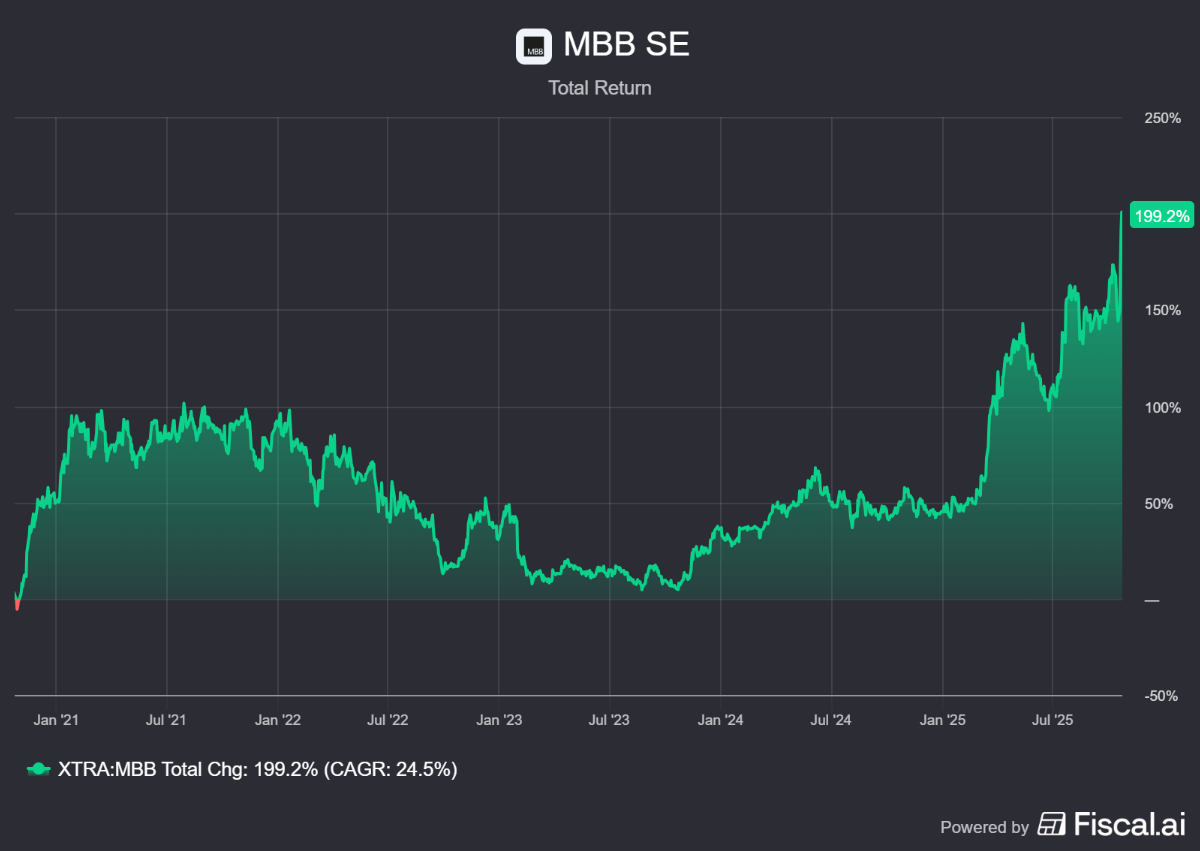
German investment holding company MBB SE (Frankfurt: MBB) published a reverse profit warning this week. Whereas companies issuing such a warning normally do so ahead of the official results publication to flag disappointing results, at MBB the opposite is the case.
MBB SE has presented impressive preliminary figures for the third quarter of 2025. Operating profit (EBITDA) saw an explosive rise of 80% compared with last year, reaching €67.4 million. This growth is particularly significant given that revenue over the same period increased by a more modest 6.5% to €316.8 million. The direct result is an extraordinary improvement in the operating profit margin, which rose by 8.7 percentage points to an estimated 21.2%.
The heart of this excellent performance lies with subsidiaries Friedrich Vorwerk and DTS. MBB did not disclose details about the unlisted cybersecurity specialist DTS IT, beyond noting that Vorwerk too made a significant contribution to these strong figures. We will know more during the full quarterly report on 13 November, but the earlier announcement of a major IT contract and the ongoing negotiations over several similar deals offer some reassurance.
Vorwerk, a leading supplier of energy infrastructure solutions for gas, electricity and hydrogen, reported absolute record figures. Vorwerk's revenue rose by 39% in the third quarter to €202 million. Vorwerk's operating profit more than doubled, from €25.3 million last year to €51.3 million this quarter. This resulted in a very strong operating profit margin of 25.4%. Vorwerk accounts for more than three-quarters of the operating profit for the quarter.

Vorwerk continues to benefit from a high-quality order book worth €1.1 billion as at 30 September 2025. This provides enormous visibility for the coming periods. Vorwerk is also benefiting from continued success in attracting staff, with headcount growth of 13% in the first nine months. Not so long ago, this was still the bottleneck preventing the company from converting its order book into revenue.
Although order intake in the first nine months amounted to €419 million, compared with €516 million last year, this needs to be seen in the right context. The total project volume, including the proportional ARGE order volumes (joint ventures) of projects acquired in the first nine months, actually rose by 45% to €886 million.
Financial fortress
Looking back over the first nine months of 2025, MBB as a whole shows a strong trend. Consolidated revenue rose by 12.8% to €862.3 million. Operating profit grew by 54% over this period to €143.7 million. This results in a solid operating profit margin of 16.7%.
The capital position remains strong. Net liquidity for the MBB group as a whole stood at €526.9 million at the end of Q3. Even more important, however, is the cash position at the level of the holding company itself. This increased to €317.6 million, compared with €280.8 million at the end of 2024. This shows that the holding company is building financial firepower, which can be deployed for future capital allocation decisions.
Raised guidance confirms momentum
Management, led by founder and majority shareholder Christof Nesemeier, has clearly expressed confidence in the future. As a result of the strong performance, both companies have significantly raised their guidance for the full year 2025. Vorwerk now expects revenue of between €650 million and €680 million, up from a previous range of €610 million to €650 million. Even more impressive is the upgrade to Vorwerk's operating profit margin guidance. This has been raised to 20.0%–22.0%, compared with a previous range of 17.5%–18.5%.
This strong momentum at the key subsidiary allows MBB to also raise its own group guidance. MBB now expects consolidated revenue of €1.1 billion to €1.2 billion, up from a previous expectation of €1.0 billion to €1.1 billion. The expected operating profit margin for the group has been substantially raised to 15%–17%, compared with 11%–14% previously.

Even so, the holding company discount remains fairly high, as evidenced by the fact that the cash position together with the listed subsidiaries Vorwerk, Aumann and Delignit represent a combined value of more than €265 per MBB share. On top of that, we get the fast-growing cybersecurity business thrown in for free. So this is not a case of valuation expansion (in other words, a narrowing of the holding company discount), but rather a share price increase driven by fundamentals. We therefore continue to hold firmly onto this family holding company.
MBB ended the trading week on the Frankfurt exchange at a share price of €201.
Swedish serial acquirers demonstrate a robust business model
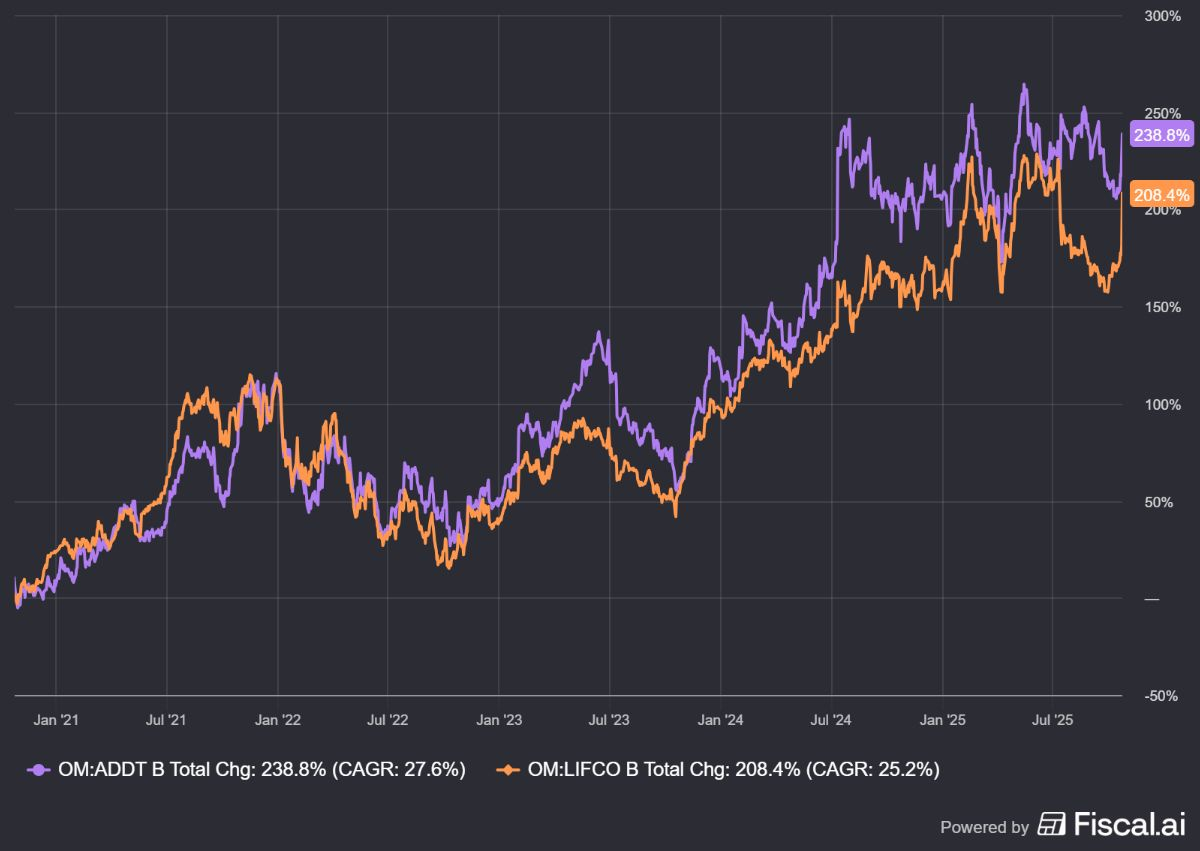
The Swedish investment holding companies Addtech (Stockholm: ADDT-B) and Lifco (Stockholm: LIFCO-B) reported their quarterly results this week. Investors' reaction was exceptionally positive. Both shares posted gains of more than 10% following the figures. These results confirm the strength of the decentralised acquisition model used by these serial acquirers.
A third Swedish serial acquirer in our portfolio showed a similarly strong rise. However, the name of this company remains reserved for our clients.
Addtech beats expectations
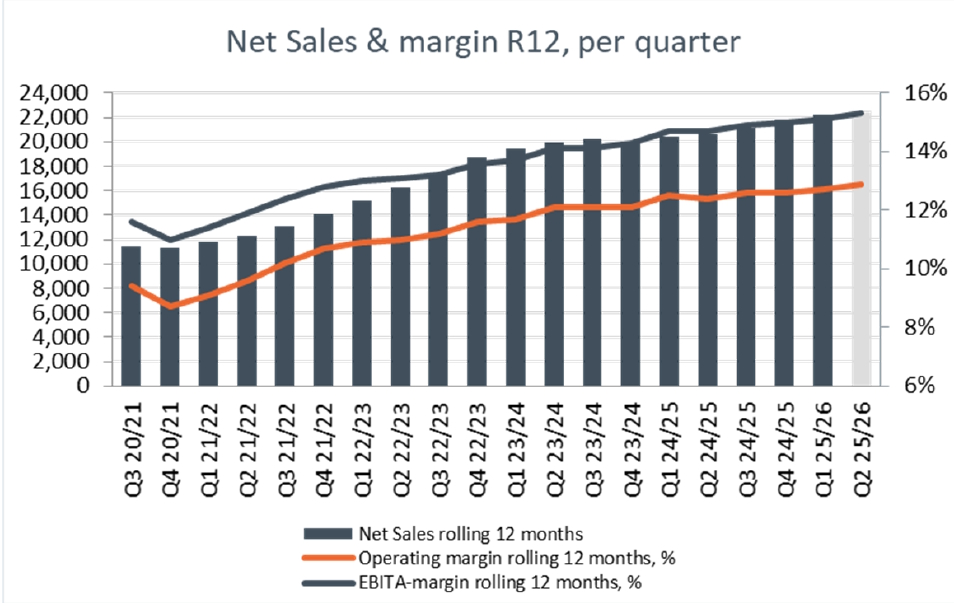
Addtech presented a very strong second quarter (2025/26). Net sales rose by 6% to SEK 5.5 billion. Operating profit (EBITA), the most relevant profit metric, grew by 11% to SEK 844 million. This was significantly better than the analyst consensus of SEK 808 million. The operating margin strengthened further to 15.5%, compared with 14.9% last year.
Organic growth came in at 4%. During the conference call, however, CEO Niklas Stenberg offered a crucial nuance. Roughly half of this organic growth came from exceptionally strong project deliveries within the Industrial Solutions division, particularly in the sawmill industry. Stenberg emphasised that this specific project revenue should not be extrapolated to coming quarters.
This strong performance was delivered despite headwinds in other segments. The Energy division experienced a temporary slowdown in demand for national grid infrastructure. The Automation division additionally reported a one-off restructuring cost of SEK 10 million. Operating cash flow was exceptionally strong at SEK 859 million, representing an increase of as much as 45% compared with last year.
Lifco continues to deliver stable performance
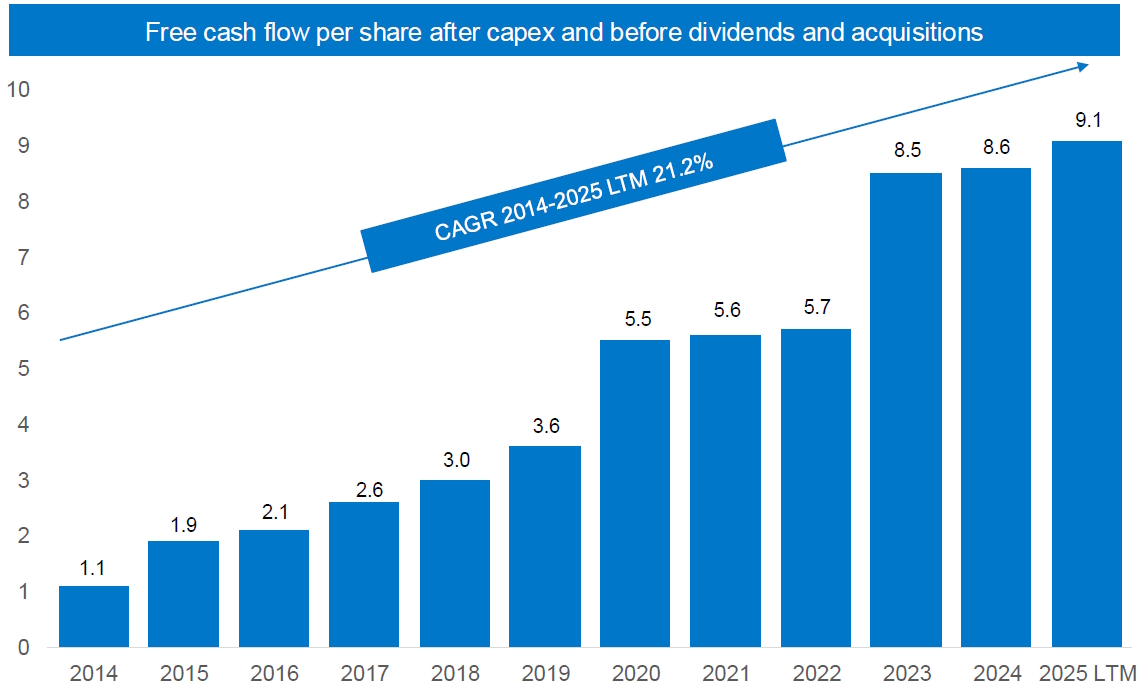
Lifco also reported solid figures for its third quarter. Net sales rose by 8.9% to SEK 6.8 billion. Organic growth was robust at 4.9%. Operating profit increased by 10.4% to SEK 1.54 billion. This resulted in a strong operating margin of 22.6%. The Demolition & Tools division made a strong comeback after a weak 2024, particularly in the attachments segment. Systems Solutions saw its margin dip slightly due to weaker organic demand in the Transportation Products and Special Products divisions.
These solid results were complemented by an undiminished pace of acquisitions. During the first nine months of 2025, Lifco consolidated 13 new companies. These acquisitions, which include various niche businesses in the UK, Italy and the Netherlands, account for approximately SEK 1.9 billion in additional annual revenue. Lifco's balance sheet remains a fortress. Interest-bearing net debt stands at just 1.3 times operating profit. This gives the company ample ammunition for future acquisitions.
Conclusion
The sharp share price gains of both Addtech and Lifco last week are a clear validation from investors. Both companies prove that the decentralised serial acquirer model is capable of generating predictable profit growth and strong cash flows, even when individual divisions temporarily slow down or restructure.
The strength of this business model lies in diversification and financial discipline at the holding company level. With more than 150 (AddTech) and 250 (Lifco) subsidiaries, there is more than enough resilience to deliver attractive consolidated figures. This once again confirms our strategy, within the family holding companies approach, of investing in these proven compounders.
AddTech and Lifco ended the trading week on the Stockholm stock exchange at SEK 331.40 and SEK 381 per share, respectively.
AI as a flywheel for vertical market software
Is artificial intelligence an existential threat to established vertical market software (VMS) companies? Or is it in fact an unprecedented commercial opportunity? That question lies at the heart of the technology sector. Many fear that 'legacy' software, often deeply entrenched but decades old, will quickly be replaced by new, AI-native startups. A recent podcast interview with Jan Mohr, CEO of the German serial acquirer Chapters Group (Frankfurt: CHG), offers an illuminating perspective that runs directly counter to this prevailing (investor) opinion. Mohr argues that AI is not a threat, but the greatest commercial opportunity the VMS sector has ever seen.

The 'shotgun' and 'rifle' approach
Implementing new technology is a particular challenge for a decentralised acquisition machine, a model we recognise from companies such as Chapters Group or Constellation Software. Mohr explains their two-pronged strategy. First, there is the 'shotgun' approach. This involves a cultural shift that requires all leaders and employees to embrace AI in their daily work. It is a new way of thinking and working that needs to be woven into all existing processes, aimed at broad adoption and efficiency gains. The 'rifle' approach, however, is far more interesting. These are targeted, highly specific business cases with a clear and rapid return on investment (ROI). In the best case, these 'rifle shots' can even expand a software company's total addressable market.
Jan Mohr identifies three concrete 'rifle' opportunities for AI in VMS. First, AI offers direct efficiency gains, such as automating simple helpdesk tasks (which can account for 50-70% of calls) with voice bots. Second, and commercially the most important, is adding a new AI functionality layer on top of the customer's existing 'core system of record', without replacing it. Third, there is an often underestimated opportunity in significantly speeding up (10-20% 'velocity' gains) the maintenance of legacy code and the delivery of professional services, which shortens customer waiting times, books revenue faster and increases customer satisfaction.
The myth of disruption
Mohr calls the idea that AI start-ups will disrupt the established VMS order a misconception. He argues that customers are looking for a reliable solution, not technology. The real opportunity for AI lies not in replacing existing software, but in digitising a world that is still largely analogue. He stresses that companies do not simply swap out mission-critical software, such as Chapters' systems for Swiss police forces or the German firearms licensing administration.
Mohr calls it a "funny thought" that the Hamburg police would implement a cheap, unproven tool that was "coded two days ago". When it comes to purchasing decisions, cybersecurity, data protection and reliability are decisive. The cost of failure in these sectors is dramatically higher than the cost of the software itself, which creates a barrier to entry that is virtually impenetrable.
This sentiment is echoed by acclaimed software investor Orlando Bravo. In a recent interview (see image above), Bravo states that AI is a "tailwind" for the software industry. AI does not make software redundant. On the contrary, it makes software better, more efficient and more valuable. Established software companies already own the customers. They own the data. And they own the distribution channels. AI is simply a new, powerful feature set they can add to their arsenal.
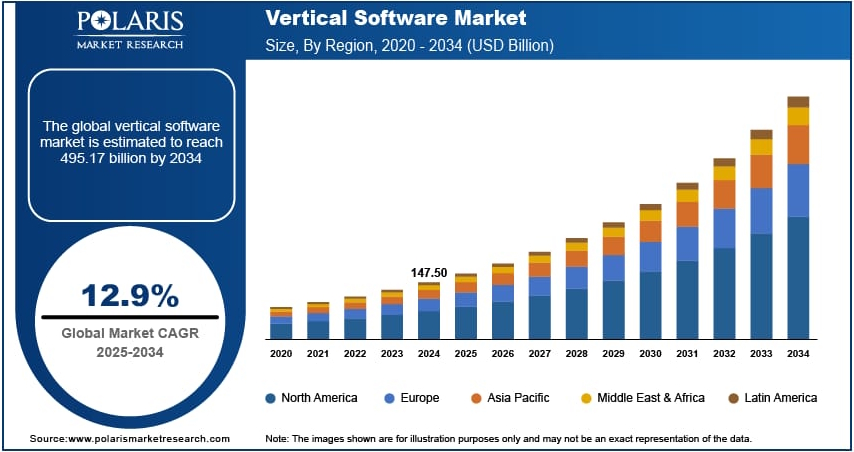
Recent research supports this view. Polaris Market Research expects the global niche software market to grow to USD 495.17 billion by 2034. This represents a compound annual growth rate (CAGR) of 12.9%. The driving force behind this impressive growth is precisely the integration of AI and machine learning. Polaris's analysis emphasises that AI models trained on domain-specific data (exactly where VMS companies have an edge) deliver far better automation, higher accuracy and more relevant insights than generic AI tools.
New opportunities for VMS companies
Mohr points to the new European data legislation (EU Data Act) as a new catalyst. This law gives companies access to their data, but they lack the infrastructure to make use of it. The VMS provider, as the custodian of that data, possesses the crucial data infrastructure to safely translate that data into business decisions. The magic lies not in the AI model, but in the infrastructure to apply it effectively and securely in sensitive environments, such as with the Hamburg police's data.
This approach strengthens customer retention (often above 97%) by increasing trust. Mohr identifies cybersecurity as the next big opportunity, comparable to what payment systems were for Tyler Technologies. For Chapters, which manages systems for German firearms licences and Swiss police forces, this is a societal duty of the utmost strategic importance. Mohr's conclusion is that AI is not a threat but a powerful enabler that further cements the mission-critical position of VMS companies, a view we fully endorse.
Chapters Group and Constellation Software are currently trading on the Frankfurt and Toronto stock exchanges at prices of EUR 37.10 and CAD 3,789.85 per share, respectively.
Receive weekly insights in your inbox
Exclusive analyses and updates on family holding companies and global market developments.
Would you like more information about our services? Feel free to get in touch.
Contact us
Disclaimer:
No rights can be derived from this publication. This is a publication of Tresor Capital. Reproduction of this document, or parts thereof, by third parties is only permitted after written consent and with reference to the source, Tresor Capital.
This publication has been compiled by Tresor Capital with the greatest possible care. The information is intended in a general sense and is not tailored to your individual situation. The information must therefore expressly not be regarded as advice, an offer or a proposal to purchase or trade investment products and/or to take up investment services, nor as investment advice. The authors, Tresor Capital and/or its employees may hold positions in the securities discussed, for their own account or on behalf of their clients.
You should carefully consider the risks before you start investing. The value of your investments can fluctuate. Past performance is no guarantee of future results. You may lose (part of) your invested capital. Tresor Capital disclaims any form of liability for any inaccuracies or errors. This information is purely indicative and subject to change.
Read the full disclaimer at tresorcapitalnieuws.nl/disclaimer .
This article was originally written in Dutch and automatically translated into English with the help of AI. In case of any difference, the Dutch original prevails.