Family Holdings #44 - Alphabet's 'small' investments are turning big
Also in this edition: Brown & Brown and Markel report results; Scottish Mortgage on AI; and Brookfield bets on the nuclear energy renaissance.



This week's topics:
Brown & Brown reported revenue growth of 35.4% in Q3, driven by acquisitions, but the shares fell 8% on a weak Q4 outlook. The disappointing outlook is caused by an expected organic decline of 4-6% in the important Specialty Distribution division.
Scottish Mortgage Trust sees AI as the foundation for a new economic era and invests across the entire chain, including the new position in Anthropic. The holding company remains focused on the long term and reinvests the proceeds from reduced positions such as NVIDIA and Tesla into the next generation of "inevitable" growth companies.
Markel Group shows renewed confidence after a successful restructuring, which CEO Gayner described as "We're back" and which is evidenced by a sharply improved combined ratio of 93%. Management is now focused on further efficiency, while the company has already bought back USD 344 million of its own shares in 2025 in line with its capital strategy.
Brookfield , as controlling shareholder of Westinghouse, is entering into a USD 80 billion strategic partnership with the US government and Cameco. The deal, driven by the explosive energy demand from AI, is aimed at building scale to restore the US nuclear supply chain, according to CEO Bruce Flatt. The US government is facilitating the financing and, in return, receives a 20% profit interest above USD 17.5 billion and a possible IPO warrant in Westinghouse.
In Brief:
Brown & Brown (New York: BRO) strengthens its position as the largest provider of flood insurance in the US with the acquisition of Poulton Associates. The Salt Lake City-based company operates the CATcoverage.com platform and provides coverage through the National Catastrophe Insurance Program. The integration within subsidiary Wright Flood is intended to further increase market share; financial details have not been disclosed.
KKR (New York: KKR) remains notably active in the deal market. Together with Apollo Global Management, the company is investing USD 7 billion in Keurig Dr Pepper to finance the split into a global coffee arm and a North American beverages arm. The investment comprises a USD 4 billion joint venture for pod production and USD 3 billion in preferred shares. At the same time, KKR is once again in talks with Coca-Cola about a possible acquisition of Costa Coffee, which has more than 3,000 stores worldwide and an estimated value of GBP 1.5 billion.
Constellation Software (Toronto: CSU) has once again carried out three acquisitions through its subsidiaries. Jonas Software acquired the British company Fidelity EPoS (a supplier of point-of-sale software and loyalty and inventory management systems for the retail and hospitality sector), Volaris Nordic bought TimeSolutions A/S in Denmark (a specialist in time registration and staff scheduling for accounting and administration office software), and Vela's Aquila division acquired Media Carrier Solutions in Germany (a digital library and content distribution service).
Lifco (Stockholm: LIFCO-B) saw, after strong quarterly results, Martin Roland Linder, Senior Executive Vice President of the Dental division, purchase additional shares worth SEK 2.1 million (approximately EUR 180,000), a clear sign of confidence in the company's further growth path following the recent rise in profit.
Chapters Group (Frankfurt: CHG) is further expanding its public software portfolio with the acquisition of UniSoft Gesellschaft für Software Engineering mbH through its platform Waterkant Software. The German company, founded in 1993, has for decades supplied specialist software to local health services with its product Äskulab. The solution supports, among other things, infection control, youth health and medical administration.
Brown & Brown, KKR, Constellation Software, Lifco and Chapters Group ended the trading week on the exchanges of New York, Toronto, Stockholm and Frankfurt at prices of USD 79.74, USD 118.33, CAD 3,691.08, SEK 368.20 and EUR 37.50 per share, respectively.
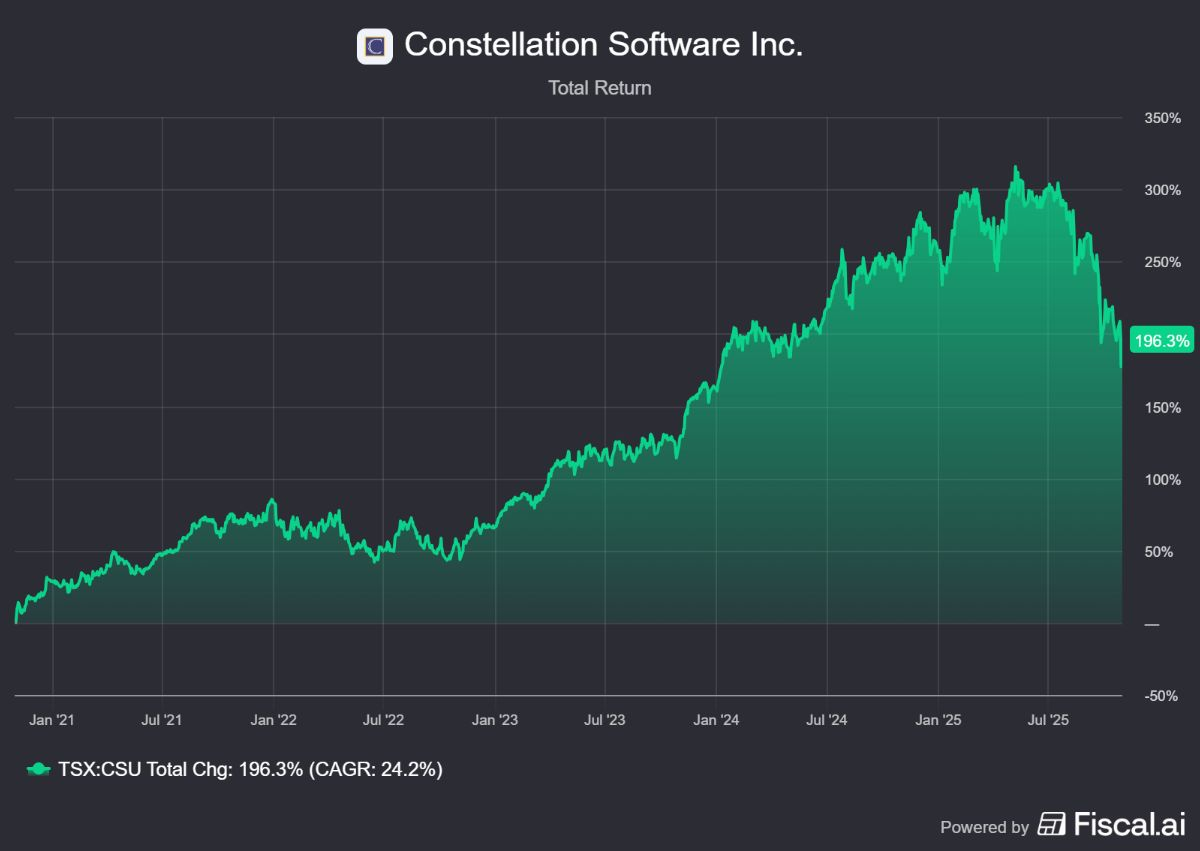
AI no death blow for Constellation Software
The rise of artificial intelligence (AI) dominates conversations in boardrooms and on investor forums. The technological progress is undeniable, and the potential impact on various sectors is immense. For investors in the software sector, and particularly in vertical market software (VMS), this raises a crucial question: does AI pose an existential threat to the durable, 'sticky' business models that characterise this sector, or is it instead a catalyst for a new phase of growth?
The Canadian investment holding company Constellation Software (Toronto: CSU) is a leading player in this sector, with an impressive portfolio of more than 1,000 companies. At an analyst meeting in January of this year, Constellation emphasised that its software is difficult to replace with AI, as it is deeply embedded in the daily, business-critical functions of end customers, is complex, and comes with high switching costs.
This deep integration creates a significant 'moat', or competitive advantage. An analysis by Royal Bank of Canada confirms this picture. The conclusion was that while AI can shorten development timelines, it does not destroy the moat. Factors such as customer trust, domain-specific knowledge and workflow integration remain decisive.
During Constellation's shareholder meeting in May 2025, Dexter Salna, CEO of the Perseus division, added an important economic perspective. He reasoned that a developer of a new AI product would rather target a market with a million customers than a niche market such as the pulp and paper industry, with only 40 to 50 companies. The investment and effort required to understand a complex, vertical market simply do not outweigh the limited size of the potential customer base. This economic reality forms a natural protection for the deepest niches in which Constellation operates.
A nuanced picture of threat and opportunity
Experienced software engineer and investor Brandon Wang emphasises that AI does not replace the human factor. He argues that AI is a tool that makes coding easier, but it does not replace the crucial, hands-on process of truly understanding the customer and their needs.
In an era of rapid technological change such as the rise of AI, one crucial but often underappreciated element may well be the most important line of defence: trust. The question for customers is no longer simply 'which software is best?', but increasingly 'which party do I trust with my most critical data and processes to guide the transition to AI?' This is where the deeply rooted culture of VMS companies becomes a strategic advantage.
"I believe that in many cases we are our customers' trusted IT partner and the most logical source for AI knowledge and learning," says founder Mark Leonard. Even if it only amounts to "90% solutions", customers are willing to take those first steps with their trusted partner. Constellation's organisational structure, with hundreds of independent business units, offers a unique advantage. "Who else can run hundreds of real-world experiments, across more than 700 markets, with customer data and without regulatory friction?" The answer is: virtually no one.
Constellation Software ended the trading week on the Toronto stock exchange at a price of CAD 3,691.08 per share.
From experiments to the new and future growth pillars at Alphabet
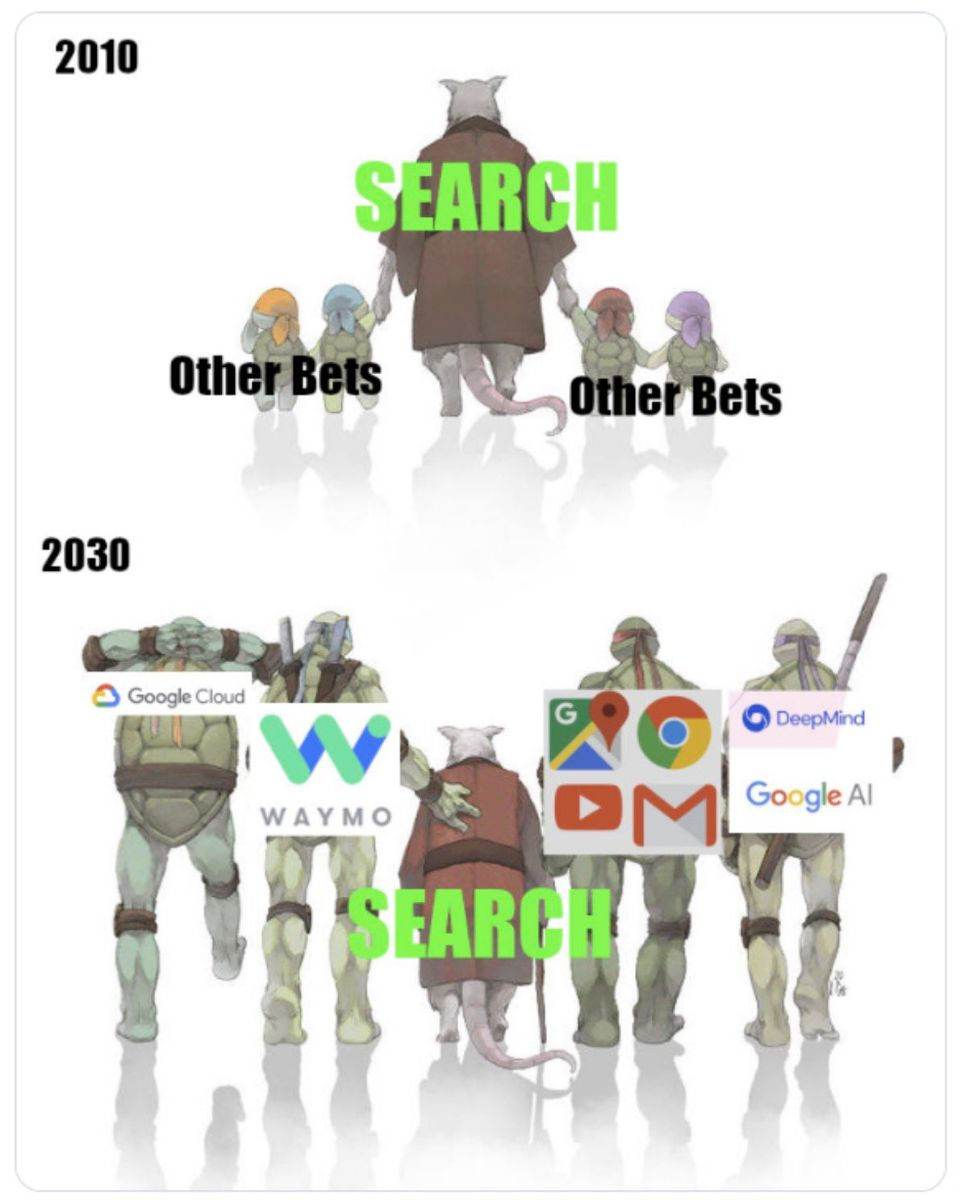
The American investment holding company Alphabet (New York: GOOGL) reached a milestone in the third quarter of 2025: for the first time in its history, quarterly revenue surpassed the $100 billion mark. What was once a company that relied almost entirely on search advertising is now a broadly diversified technology powerhouse with four divisions, each generating more than $10 billion per quarter.
The illustration by @wintermoat on X sums it up nicely: whereas Search was the 'father figure' to small experimental "Other Bets" back in 2010, those children have since grown up into mature pillars. In Q3, $56.6 billion came from Search, $15.2 billion from Cloud, $12.9 billion from subscriptions and devices, and $10.3 billion from YouTube advertising.
Yet Alphabet's innovative spirit is still very much alive. Alongside these four core segments, new "Other Bets" also keep emerging, experiments that could lay the foundation for the next technological wave. A recent example is the breakthrough in quantum computing. Google announced that its new Willow chip performed complex calculations 13,000 times faster than the world's most powerful supercomputer.
The research marks the first verifiable evidence of quantum advantage: results that can be independently confirmed by other quantum computers. According to CEO Sundar Pichai, this development brings Google "a step closer to practical quantum applications", with potential for major breakthroughs in drug development, materials science and molecular modelling. While it leads the AI race with Gemini and Cloud, Alphabet is also working on a technology that could lay the foundation for the next computing era.
Google vs. OpenAI
In late October, the launch of ChatGPT Atlas, OpenAI's own AI browser, caused brief turmoil on Wall Street. Alphabet lost a significant amount of market value that afternoon, on fears that the newcomer would erode the dominant position of Google Chrome and Search. But the optimism surrounding Atlas proved short-lived. Within a few days sentiment turned, and it became clear that the browser is mainly an early test version of what OpenAI ultimately wants to achieve, rather than the immediate threat some had feared.
Atlas is an experimental web browser with the ChatGPT interface built directly in. Users can have webpages summarised in a sidebar, compare products or have texts rewritten. In the paid version, OpenAI introduced a new "agent mode", in which ChatGPT can independently navigate websites, fill in forms and even prepare online purchases. The company calls this concept "agentic browsing", a next step towards a digital assistant that carries out tasks on the web on the user's behalf.
In theory, that sounds revolutionary. In practice, it is still far from mature. The current agent mode is limited to simple interactions and has no direct access to payment systems, shipping services or personal data. The much-discussed promise of an AI that autonomously orders your groceries or plans a trip is, for now, still a long way off.
What's more, Atlas, ironically enough, runs entirely on Google's own infrastructure. The browser uses Chrome's engine and relies on Google's search index to retrieve information. Without this backbone, the browser simply cannot function. Rather than competition, Atlas is more of an illustration of how deeply Google's technology is woven into the fabric of the internet.
At the same time, Google itself is working towards a similar vision. At its I/O event in May, the company already announced that it is developing such an AI agent for Chrome and Search, designed to perform exactly the same functions: making purchases automatically, completing bookings and carrying out web tasks. The difference is that Google controls the entire chain itself. It owns the browser, the search platform, the payment network (Google Pay), email and calendars, and through Android also manages billions of devices. Where OpenAI depends on partners and complex integrations, Google has the complete infrastructure in place to roll out agentic browsing on a global scale.
That infrastructure advantage also shows up in the numbers. Google's Gemini, the AI assistant built into Android, Chrome, Pixel and Workspace, is growing at a rapid pace. In a single quarter, the number of monthly active users rose from 450 million to 650 million. According to figures from SimilarWeb, Gemini doubled its global market share of generative AI traffic within twelve months, from 6.5% to 13.7%, largely at the expense of ChatGPT.
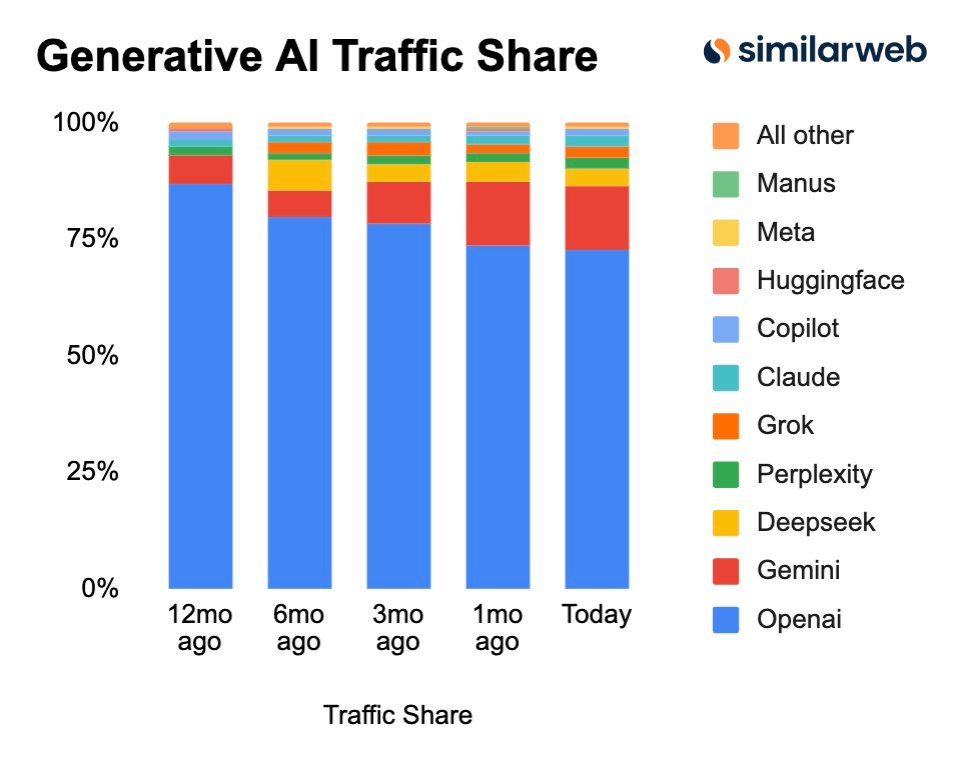
OpenAI remains the largest player for now, with an impressive 800 million weekly active users. According to Bloomberg, the company would be targeting a valuation of around $1 trillion in the event of an IPO, a figure largely based on that enormous user base and the assumption that ChatGPT will develop further into an everyday digital platform.
If the same valuation logic were applied to Google's Gemini, its current user base of roughly 650 million monthly active accounts would translate into a value of around $800 billion. Of course, that comparison is mostly theoretical, but it does illustrate just how large Google's model has become.
Google Cloud as a new growth pillar, driven by AI
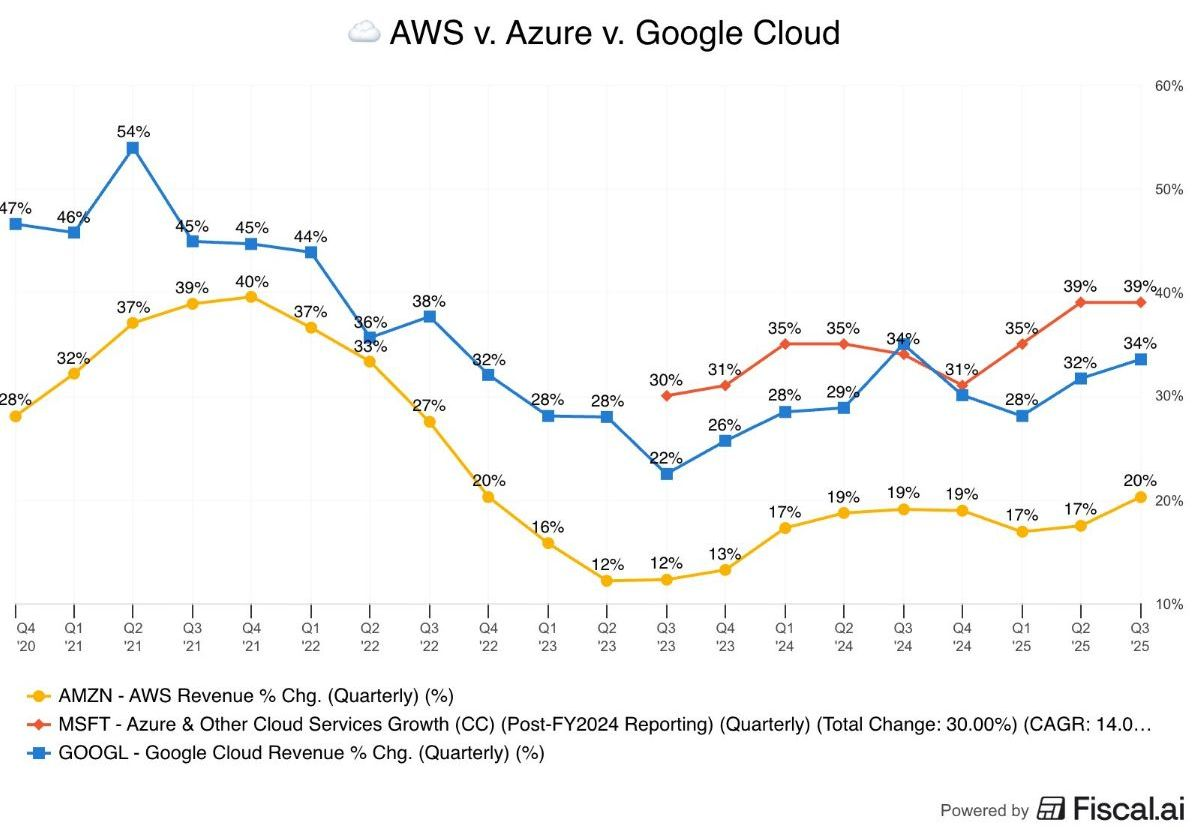
While Search still forms Alphabet's financial foundation, Google Cloud has grown into the group's fastest-growing pillar. In the third quarter, revenue rose by 34% to $15.2 billion, a clear acceleration compared with previous quarters. Even more impressive is the profit development. Operating profit nearly doubled, from $1.9 billion to $3.6 billion, an increase of almost 90%. The operating margin consequently rose from 16.7% to 23.7%, meaning the division has become not only larger but also significantly more efficient.
Google Cloud's growth stems not only from attracting new customers but above all from rising demand for AI-related infrastructure. According to CFO Anat Ashkenazi, the majority of the revenue growth is attributable to "enterprise AI products", applications in which companies use Google's own Gemini models and Tensor Processing Units (TPUs) to train and run their own AI systems.
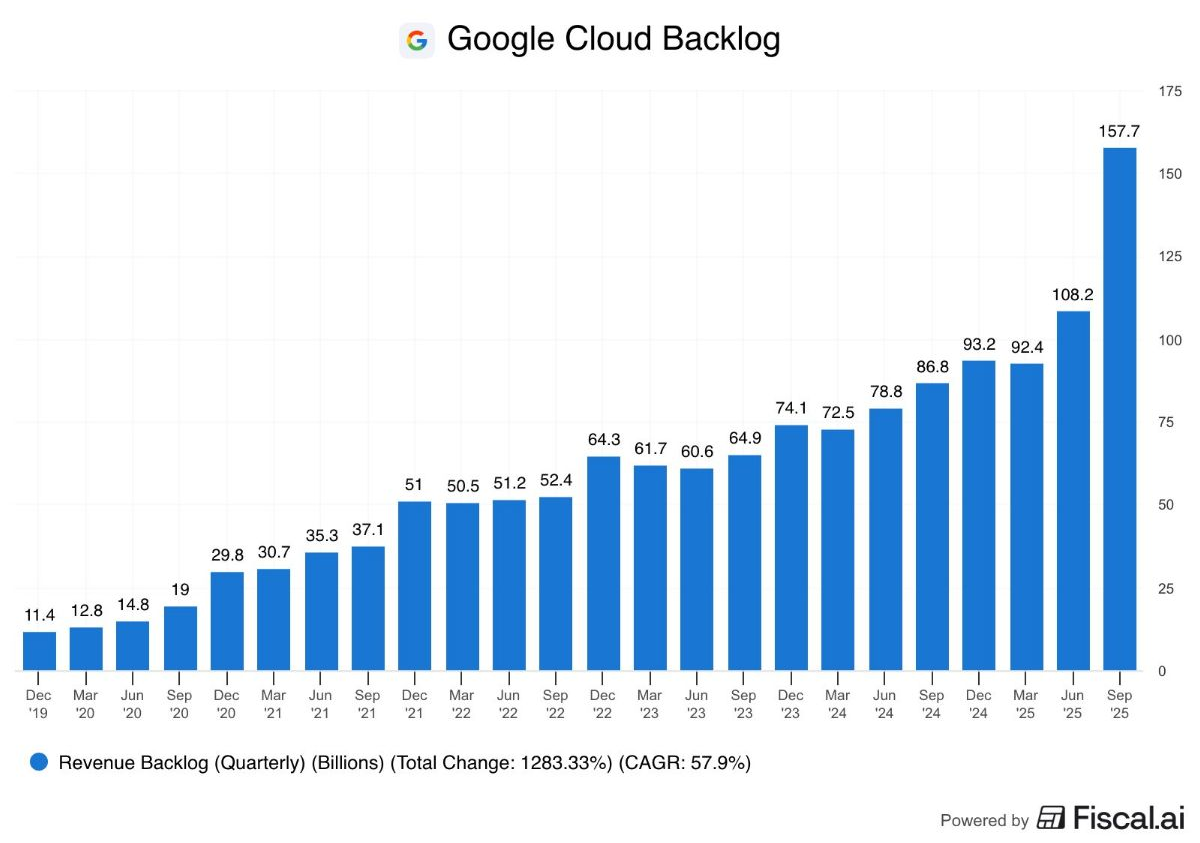
One of the most striking figures of the quarter is the explosive growth of the cloud backlog, the total of signed but not yet fulfilled contracts. This rose in just three months from $108 billion to $157.7 billion, an increase of almost $50 billion, or 46% quarter-on-quarter. It is the highest level ever and a clear sign that demand for Google's cloud capacity will remain robust in the years ahead.
The competition also reported strong results. Both Microsoft Azure and Amazon Web Services (AWS) saw their cloud revenue grow further, by 39% and 20% year-on-year respectively. That means Microsoft remains the market leader for now, with both the largest revenue base and the fastest growth rate in the sector.
The figures make clear that demand for cloud and AI capacity is not being driven by Google alone. The market is growing so fast that there is currently room for all three major players, each benefiting from the global shift towards generative AI and the growing need for computing power. Google's strong momentum shows above all that it has firmly established itself alongside Amazon and Microsoft as a third fully-fledged player in a market that still seems far from saturated.
TPUs as a distinguishing advantage
Google also announced one of its biggest AI deals ever. Anthropic, the developer of the Claude model and one of the fastest-growing AI companies in the world, will gain access to one million of Google's Tensor Processing Units (TPUs). The agreement, estimated to be worth tens of billions of dollars, delivers more than a gigawatt of computing power, comparable to the capacity of an entire power plant. It is the largest TPU deal ever and a powerful signal that Google's self-designed chips are no longer merely an internal engine, but an export product that is beginning to conquer the global AI market.
While Nvidia remains the undisputed market leader in AI chips with its GPUs, Google's TPU offers an increasingly attractive alternative. This purpose-built processor is designed to train and run AI models faster, more efficiently and more cheaply. Where Nvidia has a strong lead thanks to its CUDA software ecosystem, which has become the industry standard for AI development, Google is now trying to build a similarly integrated stack, in which hardware, software and data centre infrastructure work fully together. An important strategic consequence is that once a customer sets up its AI environment on TPUs, switching back to Nvidia becomes difficult because of the specific optimisations and dependencies within Google's ecosystem.
A former Google employee who himself worked on the TPUs, found via @RihardJarc on X, shares some striking insights into the performance gap with Nvidia. According to him, Google's TPUs outperform Nvidia's GPUs in many AI applications by between 25% and 200%, depending on the use case. That difference stems mainly from the deep integration between hardware and software within Google's infrastructure. Where Nvidia's chips are universally deployable, TPUs are fully optimised for Google's own algorithms and workloads, making them extremely efficient in terms of energy consumption and speed.
According to the same source, TPUs are also suitable not only for inference (running existing models) but also for training, the most capital-intensive part of AI development. In practice, multiple customers are already actively using TPUs for both purposes, which nicely illustrates the sustained demand. This picture is confirmed by recent statements from Google's VP and head of AI & Infrastructure, who said that even six- and seven-year-old TPUs are still running at 100% capacity utilisation, a sign that the chips remain both technically robust and highly sought after commercially. Internally, Google's market share in AI training is currently said to be around 2–4%, compared with Nvidia's 80%, but that share is expected to grow slowly as demand for alternatives increases.
Conclusion:
The figures speak for themselves: more than $100 billion in quarterly revenue, a doubling of profit from Google Cloud, and an exploding order backlog that will fuel sustained growth in the coming years. At the same time, Gemini is growing at a record pace and, through Android, Chrome and Workspace, is already deeply embedded in billions of devices worldwide. Applied to OpenAI's valuation logic, that user base alone would represent a value of around $800 billion. Where OpenAI is still loss-making, Google generates tens of billions in free cash flow every quarter, capital that is immediately reinvested in data centres, AI capacity and chip development. The rise of OpenAI therefore turns out to be no threat at all, but rather a catalyst. Artificial intelligence increases demand for search capacity, cloud infrastructure and computing power, precisely the domains in which Google excels. In fact, many AI companies, including OpenAI itself, run (partly) on Google's infrastructure.
As Michael Fitzsimmons sharply concluded in his recent analysis on Seeking Alpha:
“OpenAI may have captured the headlines, but Google wrote the playbook and started executing it a decade ago.”
That observation gets to the heart of the matter. Google developed its first AI chips back in 2014, went on to build the most efficient data centres in the world, and today uses its own technology to keep the AI economy running. OpenAI may have the attention, but Google owns the backbone on which that attention rests.
Anyone wanting to explore this theme further can read the excellent article “OpenAI Won't Catch Google” by Michael Fitzsimmons for free through our newsletter. We have made this piece, which goes deep into Google's technological lead, infrastructure and valuation, available free of charge to our readers via the link below.
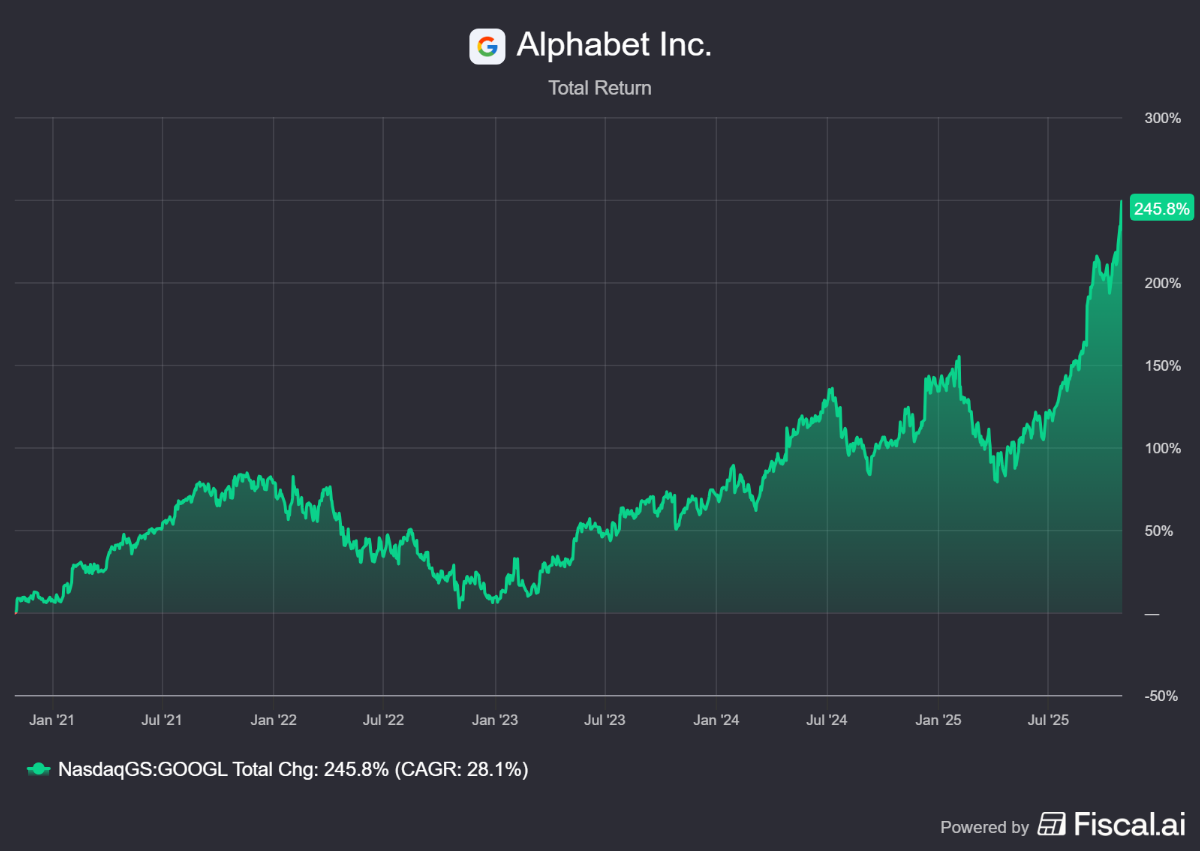
Alphabet ended the trading week on the New York exchange at a price of USD 281.19 per Class A share.
Brown & Brown delivers a mixed picture; weak outlook weighs on the share price
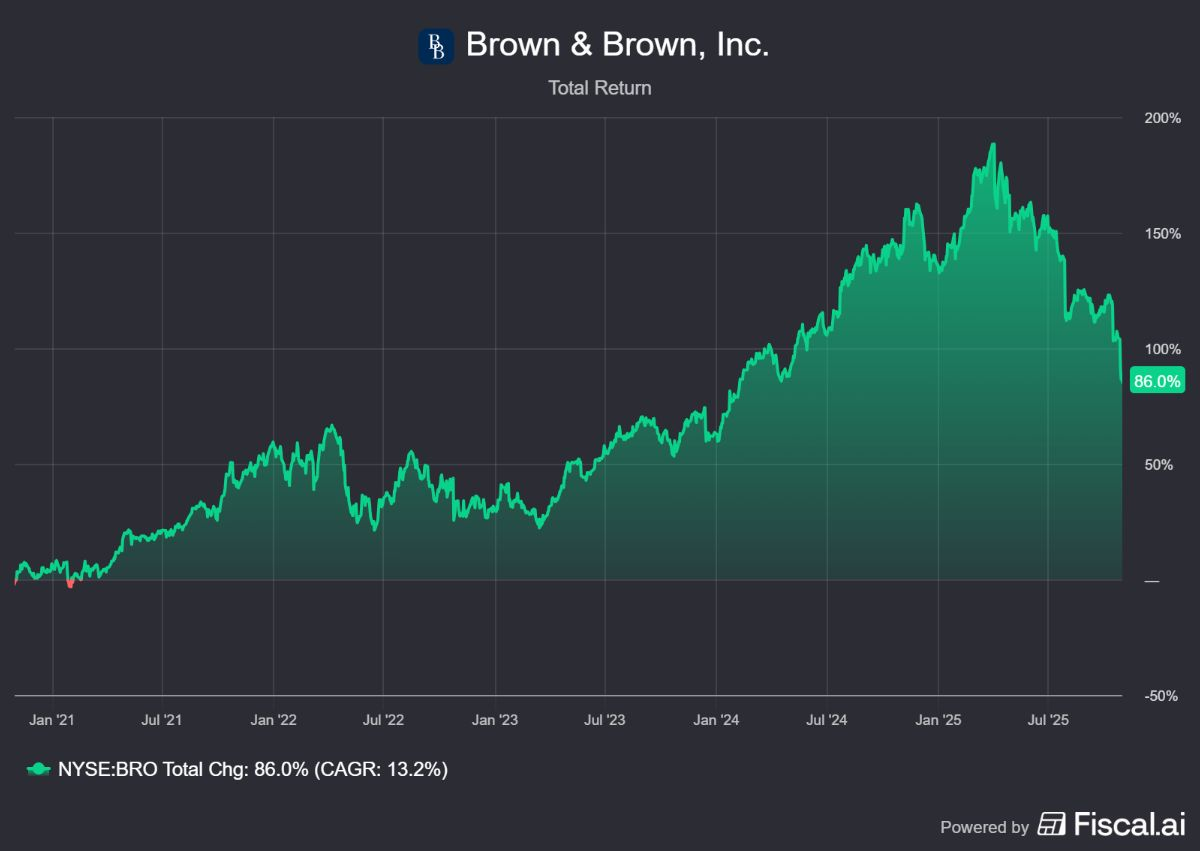
The US investment holding company Brown & Brown (New York: BRO), a serial acquirer that buys up insurance brokers, presented its results for the third quarter of 2025 this week. This triggered a sharp share price reaction. The stock traded more than 8% lower over the two trading days following the publication. This sell-off appears to have been primarily driven by the disappointing outlook management provided for the fourth quarter. The weak organic growth forecast overshadowed what were, at first glance, strong figures for the past quarter, which were mainly driven by acquisitions.
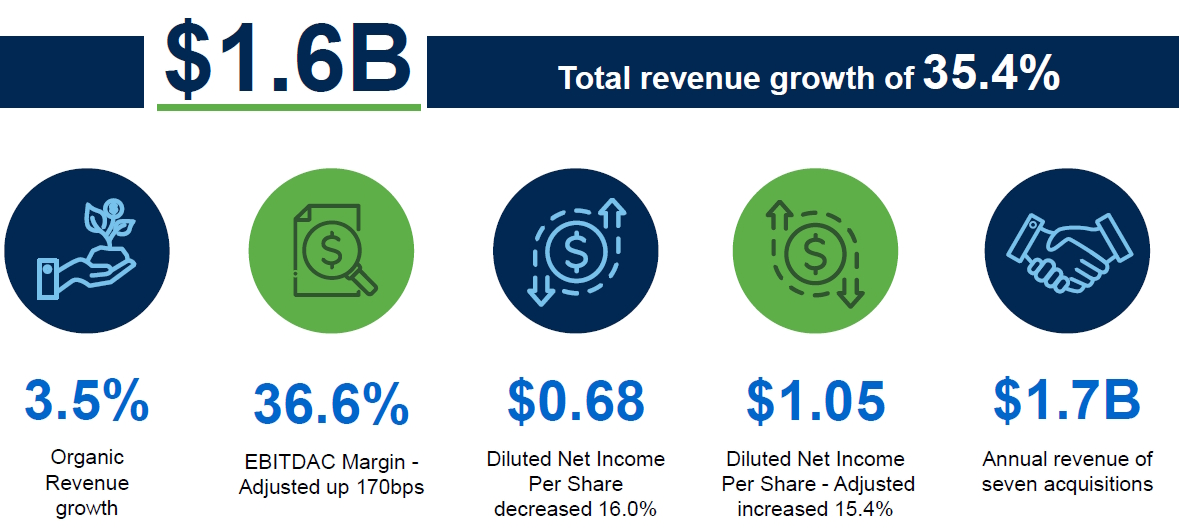
On the surface, the third-quarter results looked robust. Total revenue jumped 35.4% to USD 1.6 billion. Earnings per share also rose, by 15.4%, to USD 1.05. Even more impressive was the operating profit margin, which expanded by 170 basis points to 36.6%. This substantial revenue growth was largely the result of M&A activity, in particular the recent major acquisition of Accession. Underlying organic revenue growth remained modest, at just 3.5%.
A deeper look at the segments, however, reveals a more nuanced picture that explains the market reaction. The Retail division reported organic growth of 2.7%. Management specified in its commentary that this figure included a negative impact of roughly 1 percentage point due to technical adjustments in incentive compensation. For the fourth quarter, CFO Andy Watts expects organic growth in this segment to remain at a similarly low level.
Analysts' attention, however, was focused mainly on the Specialty Distribution division. This new segment, which now combines the wholesale and programs divisions, posted organic growth of 4.6% in Q3. For the fourth quarter, however, management is anticipating an organic decline of 4-6%. CFO Watts pointed to an extremely strong comparison base in the prior year. Specifically, he cited USD 28 million in non-recurring income from the handling of flood claims in Q4 2024. This factor, combined with ongoing pricing pressure in the E&S market, results in a negative growth outlook.
Despite the weaker organic outlook for the final quarter, management raised its expectation for the full-year operating profit margin. Brown & Brown now expects the margin to rise slightly compared with 2024, evidence of strong cost control and the positive impact of recent acquisitions on profitability.
CEO J. Powell Brown described the economic climate as "relatively stable". He noted that pricing for casualty (liability) cover continues to rise, while the E&S (Excess & Surplus) property market is, by contrast, facing rate declines of 15 to 30 percent.
Brown & Brown's quarterly figures illustrate a dual picture. The company is succeeding, through an active M&A strategy spearheaded by the recent acquisition of Accession, in raising both total revenue and profitability. The seven deals closed during the quarter represent an estimated annual revenue of USD 1.7 billion. The acquisition engine is therefore running at full speed, but investors are also focusing on organic growth.
Investors are also likely seeking a bit more certainty regarding the realisation of synergies from the large-scale acquisition of Accession, which at the time accounted for a third of the company's total market value. Successfully completing this integration and reigniting the organic growth engine will be the focus areas in the coming quarters.
Brown & Brown ended the trading week on the New York stock exchange at a price of USD 79.74 per share.
Scottish Mortgage foresees a new golden age of change
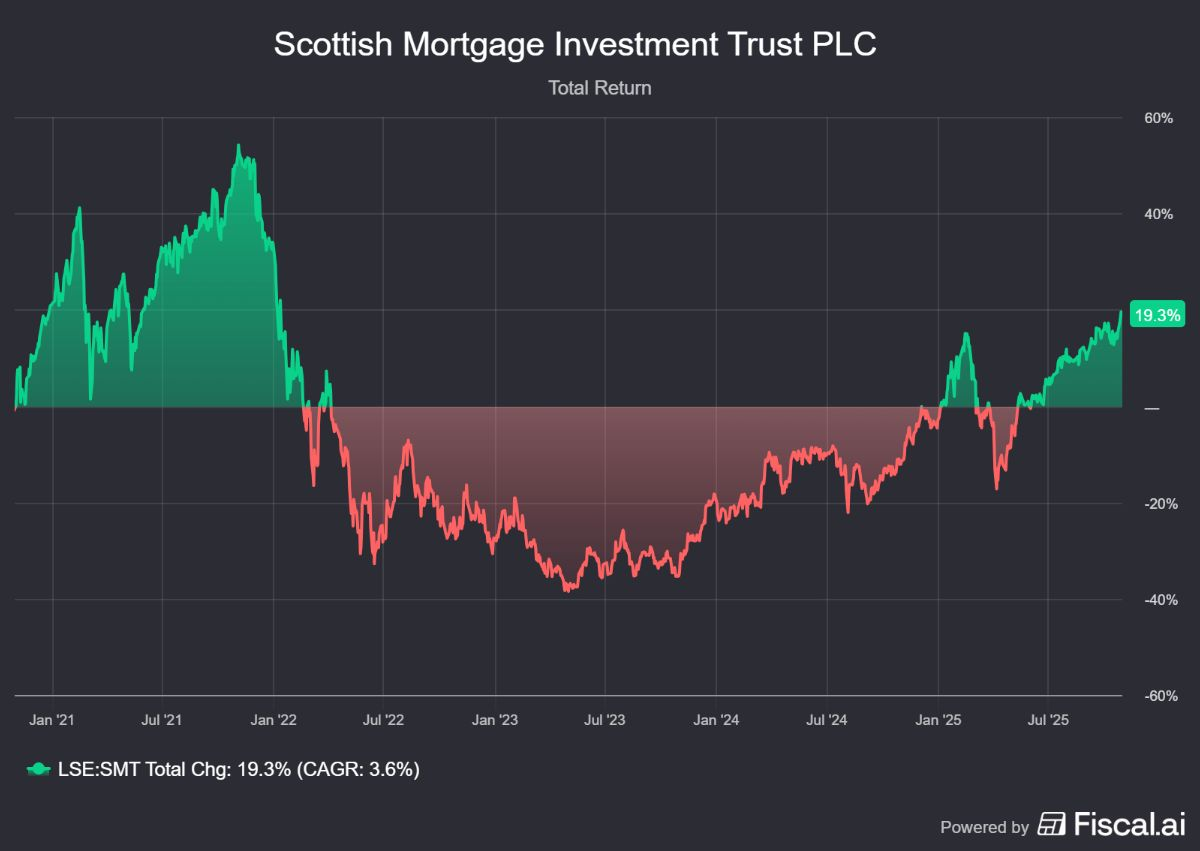
The British investment holding company Scottish Mortgage Investment Trust (London: SMT) recently gave an update on its portfolio and outlook during its reporting for the third quarter of 2025. The managers argue that we are entering a period that will surpass the transformations of the past twenty years, such as the rise of e-commerce and mobile computing. Artificial intelligence (AI) lies at the heart of this shift. Scottish Mortgage views AI as a new foundation underpinning the global economy. This technology is also reinforcing progress in other sectors, such as digital commerce and transport.
Although AI is currently a "hot topic", the trust's investment philosophy remains focused on the long term. The aim is to maximise total return by investing in the most exceptional listed and private growth companies. Success in growth investing stems from embracing asymmetry. A small number of companies are expected to create the bulk of the value.
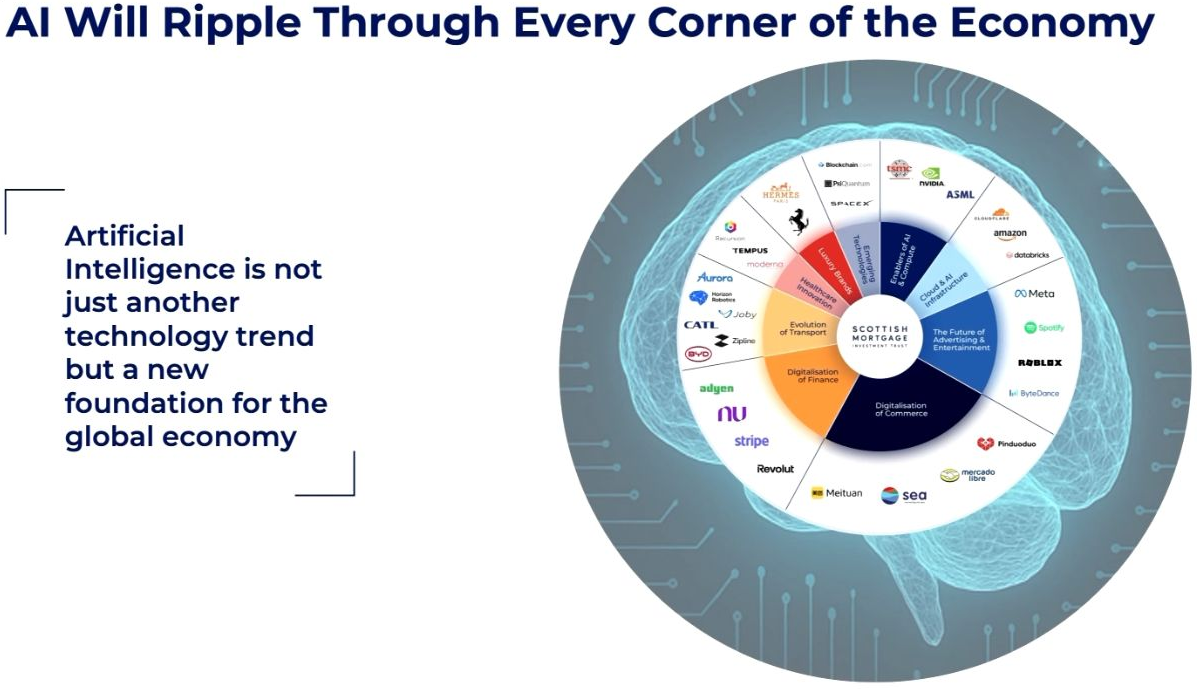
The AI economy is currently consolidating around a handful of major infrastructure giants. Scottish Mortgage has built up positions across the entire AI chain. This includes computing power (NVIDIA, TSMC), data (Databricks, Snowflake) and the core AI models (the recently added Anthropic). The strategy is to identify winners early and hold on to them through volatility. As stated in the video: "It's about recognising what is inevitable, not chasing a market hype."
Besides AI, the holding company sees a profound revolution in transport, driven by electrification (CL, BYD, Tesla) and autonomy (Aurora, Horizon Robotics).
Scottish Mortgage has recently trimmed some positions and "recycled" the proceeds into the next generation of transformational growth. Positions in, among others, Wayfair and Shinik were sold. Investments were made in new platforms such as Figma and AppLovin, and in AI leader Anthropic. Positions in NVIDIA and Tesla were trimmed, with reference made to the high valuations.
Investment specialist Hamish Maxwell concludes that avoiding growth in a rapidly changing world is dangerous. True prudence lies in seeking meaningful exposure to what is inevitable. You can access the Q3 update video by clicking on the image above.
Scottish Mortgage Investment Trust ended the trading week on the London Stock Exchange at a price of GBP 11.72 per share.
Markel finds its rhythm again
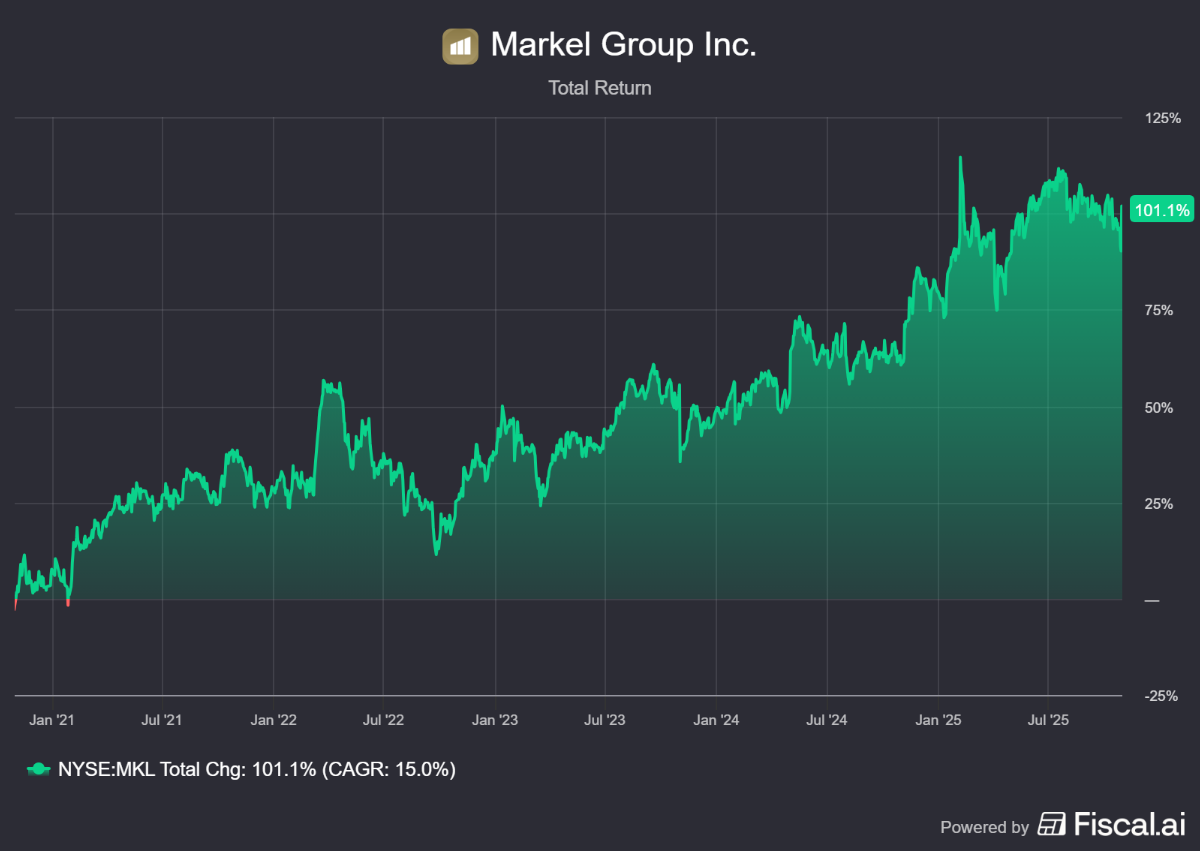
The tone at Markel Group (New York: MKL) was clearly different this quarter: more optimistic, more confident and carrying a sense of regained momentum. CEO Thomas Gayner opened the call with the words "We're back", a statement that symbolises the first tangible recovery after a period of pressure on insurance margins and far-reaching restructuring within the company over the past year. The focus now lies on execution and further efficiency improvements, with an emphasis on cost control, digitalisation and profitable niches within the insurance market.
The combined ratio, a crucial metric for insurers reflecting the ratio of claims paid and costs incurred to premiums received, improved by four percentage points to 93%, meaning that Markel paid out only 93 cents in costs and claims for every premium dollar collected. This means the core insurance division is once again clearly profitable, following a period in which higher claims costs and restructuring expenses had weighed on margins.
According to Simon Wilson, CEO of Markel Insurance, the company is now fully focused on execution, with continued emphasis on cost reduction, underwriting discipline and developing "bottom-up, customer-focused business plans" for 2026 and beyond. CFO Brian Costanzo added that Markel expects to further lower the expense ratio and improve return on equity (ROE), with management stating that the current margin improvement marks the beginning of a structurally more profitable phase.

CEO Thomas Gayner emphasised that all business segments have contributed positively to value creation within the group, pointing to the tangible results of the interventions carried out in recent years. The loss-making reinsurance division, for instance, was fully wound down, and under the leadership of new divisional CEO Simon Wilson, Markel Insurance underwent a restructuring that places greater focus on accountability, profit orientation and more stable cash flows within each business unit. These measures, combined with a sharper focus on profitable niches and stricter underwriting discipline, are now translating into a clearly healthier profit contribution from the insurance operations and more stable cash flows for the group.
At the same time, Markel remains true to its capital-efficient model, in which share buybacks play a central role in value creation for shareholders. In 2025, $344 million worth of own shares have been repurchased so far, bringing the number of shares outstanding down to 12.6 million. Gayner indicated that the next reduction target of 10% could potentially be reached within three to five years, supported by consistently strong operating cash flows. Since 2020, the total share base has already been reduced by almost 9%, a clear illustration of Markel's consistent and shareholder-focused capital strategy.
Markel Group ended the trading week on the New York Stock Exchange at a price of USD 1,974.53 per share.
Brookfield pivotal in USD 80 billion American nuclear power renaissance
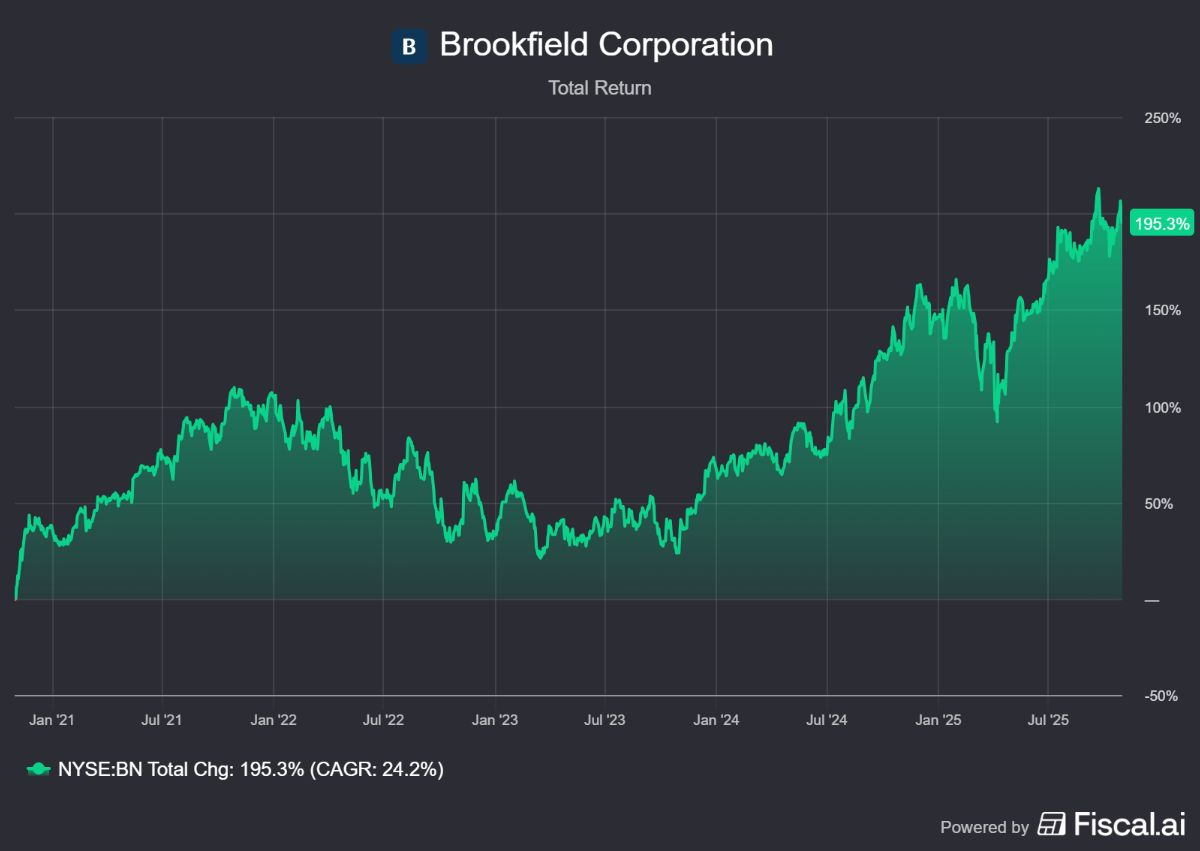
Canadian investment holding company Brookfield Corporation (New York: BN) is at the centre of a transformative development in the US energy sector. Together with its partner Cameco, the company has entered into a strategic partnership with the United States government. This agreement covers the construction of new nuclear reactors with a total value of at least USD 80 billion.
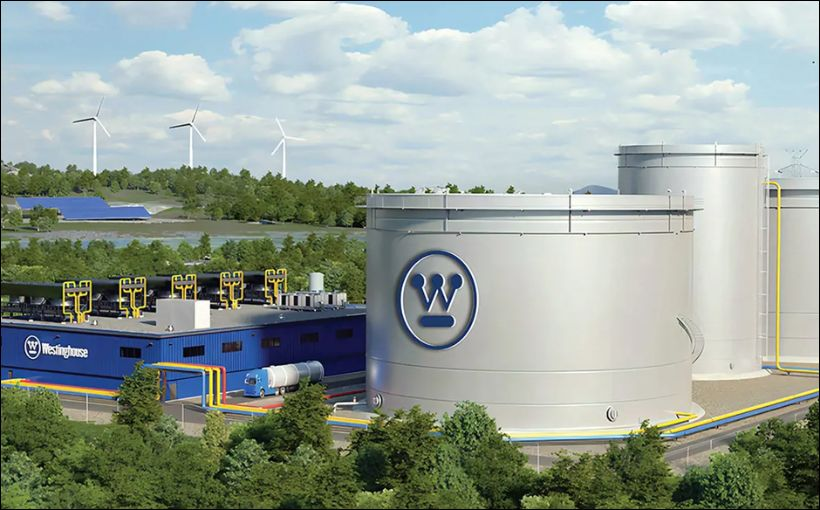
The reactors will use Westinghouse technology. This nuclear technology company is 51%-owned by Brookfield Renewable Partners and 49%-owned by Cameco. Brookfield Corporation is the controlling shareholder of both Brookfield Renewable Partners and asset manager Brookfield Asset Management. As a result, the holding company is the ultimate strategic and financial beneficiary of this long-term development. Shares of Brookfield Corporation and Cameco reacted significantly positively to the announcement.
The recent agreement is not an isolated event. It is the culmination of a strategic vision set in motion years ago. CEO Bruce Flatt explained this in detail this week. He noted that Brookfield acquired the then-bankrupt Westinghouse in 2018. The investment case was based on the fundamental properties of nuclear energy. Flatt defined it as "continuously available power, clean, extremely efficient and very safe". He regarded a return to nuclear energy as "inevitable".
The catalyst that forced the world to recognise this inevitability was the revolution in artificial intelligence. Energy demand is exploding. According to Flatt, the world is on the verge of doubling the size of the electricity grid within the next fifteen years. Meeting this demand requires every form of power generation. Solar, gas, hydropower and nuclear energy will all have to coexist.
The new infrastructure
The driving force behind this energy demand is the construction of 'AI factories'. Bruce Flatt sketched the immense scale of these facilities. Whereas a data centre consumed 50 to 100 megawatts ten years ago, customers today are asking for 1,000 megawatts, or one gigawatt, for a single location.
The capital intensity of such a project is extremely high. A one-gigawatt AI factory requires a total investment of USD 50 billion. This amount covers the buildings, the infrastructure, the servers and the chips. Flatt stressed that this shields the market from competition. It "can't be done by just anyone". He countered the notion of a 'bubble' by arguing that these projects are "difficult to execute".
According to Flatt, AI infrastructure has become the new essential infrastructure. It is comparable to the construction of roads and railways in previous generations. Countries that fail to build sovereign AI capacity will see their companies leave. The United States was the first to recognise this.
Scale is the strategic goal
Brookfield's CEO put the USD 80 billion figure into perspective. The amount itself is not the most important element of the deal. The strategic goal is to achieve scale. This scale is necessary to rebuild the entire nuclear supply chain in the United States.
The US nuclear industry had been significantly scaled back. To make the construction of the first reactor profitable, the supply chain needs confidence that a sustained, long-term programme will follow. That is precisely the aim of the partnership. It creates a "new industrial platform for nuclear energy" in the United States.
Under this structure, the US government will buy and own the plants. Westinghouse will act as the builder. This differs from other projects, such as a recent transaction in South Carolina, where Brookfield itself will own the plant.
The financial structure of the partnership
The details from the press release confirm the deep interconnection with the US government. The government is not only facilitating the financing and permits. It is also acquiring a so-called 'Participation Interest'. This interest is activated as soon as the government takes a final investment decision for the construction of the USD 80 billion worth of reactors.
Once activated, this interest entitles the government to 20% of all future cash distributions from Westinghouse that exceed the amount of USD 17.5 billion. In addition, the government has the right to demand an IPO of Westinghouse before January 2029. This can only happen if the expected valuation at that time is USD 30 billion or more. In the event of such an IPO, the interest is converted into a warrant to buy 20% of the shares after deducting the first USD 17.5 billion in value.
The Brookfield blueprint
This nuclear strategy fits seamlessly into Brookfield Corporation's broader model. Flatt confirmed that the organisation will "heavy up" on sectors where capital is flowing. Today, that means AI infrastructure and the energy supply needed to power it.
Just as Brookfield created a highly successful separate fund for the energy transition and renewable energy five years ago, it has now spun off AI infrastructure into its own fund. This prevents the enormous capital requirements of AI from disrupting the diversification of the regular infrastructure funds.
The acquisition of Westinghouse, initially placed within private equity subsidiary Brookfield Business Partners, was later moved to subsidiary Brookfield Renewable with Cameco as partner. This illustrates the holding company's flexibility. The partnership with the US government, under which the government shares in the success above a certain threshold, is embraced by Flatt. It fits with Brookfield Corporation's core philosophy. This philosophy is "to partner with the best and own the best assets".
Brookfield Corporation ended the trading week on the New York stock exchange at a price of USD 46.05 per share.
Get weekly insights in your inbox
Exclusive analyses and updates on family holding companies and global market developments.
Would you like more information about our services? Please feel free to get in touch.
Get in touch
Disclaimer:
No rights can be derived from this publication. This is a publication of Tresor Capital. Reproduction of this document, or parts thereof, by third parties is only permitted after written consent and with reference to the source, Tresor Capital.
This publication has been compiled by Tresor Capital with the greatest possible care. The information is intended in a general sense and is not tailored to your individual situation. The information must therefore expressly not be regarded as advice, an offer or a proposal to purchase or trade investment products and/or to use investment services, nor as investment advice. The authors, Tresor Capital and/or its employees may hold positions in the securities discussed, either for their own account or for their clients.
You should carefully consider the risks before you start investing. The value of your investments may fluctuate. Past performance offers no guarantee for the future. You may lose (part of) your investment. Tresor Capital disclaims any form of liability for any inaccuracies or inaccurate information. This information is indicative only and subject to change.
Read the full disclaimer at tresorcapitalnieuws.nl/disclaimer .
This article was originally written in Dutch and automatically translated into English with the help of AI. In case of any difference, the Dutch original prevails.