Family Holdings #45 – While the world invests, Berkshire's cash gathers dust
Also in this edition: Acquisitions in Sweden; Alphabet gets approval for its largest acquisition ever and wants to reach for the stars.



This week's topics:
Alphabet is strengthening its position as the backbone of the global AI economy. The approved $32 billion acquisition of Wiz bolsters Google Cloud with advanced security capabilities. At the same time, Apple has chosen Google's Gemini model as the engine behind the new Siri, a partnership worth roughly $1 billion a year that reaches billions of users. This comes alongside the faster TPU Ironwood and the futuristic Project Suncatcher, which aims to bring AI computing power to space via satellites.
In brief:
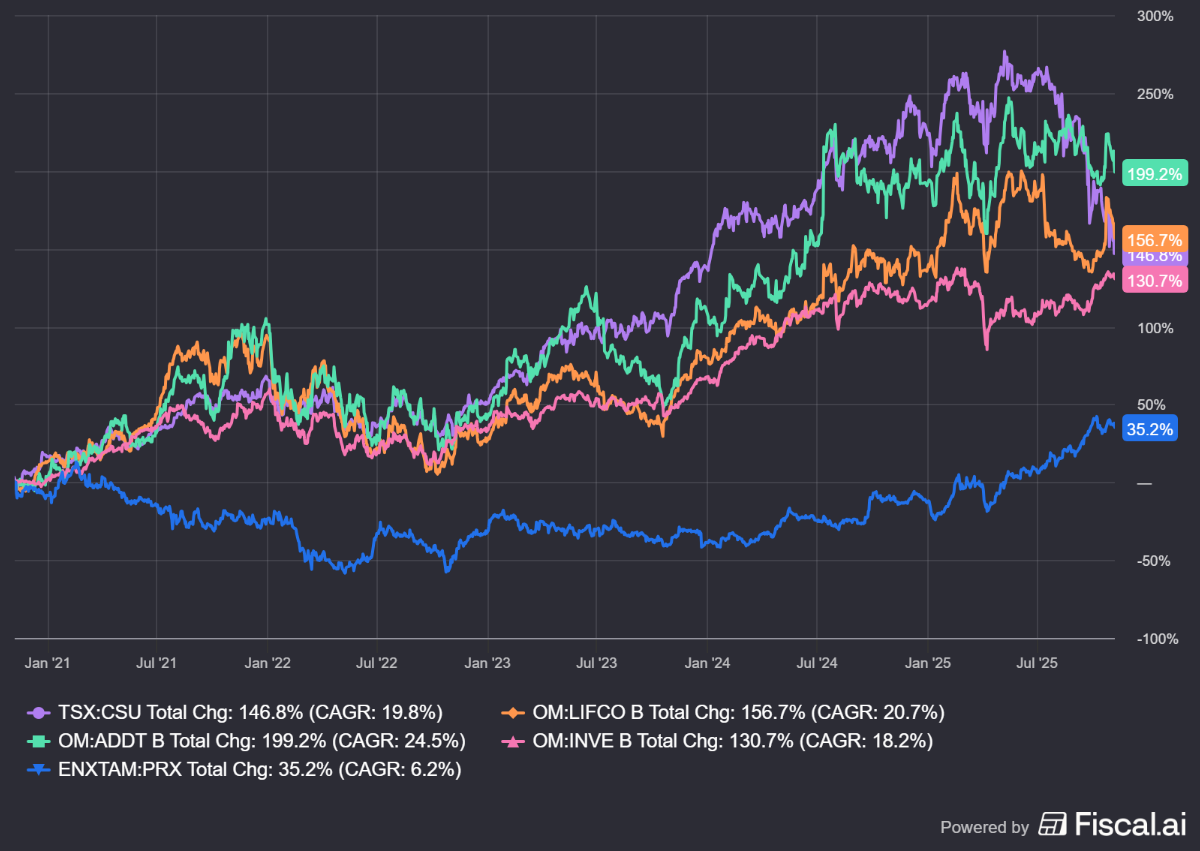
Constellation Software (Toronto: CSU) completed three acquisitions through its subsidiaries for the second week running. Volaris Group acquired the software division of HeartCore Enterprises in Tokyo, the group's first acquisition in Japan. HeartCore supplies CMS and digital transformation software to large enterprises and generated revenue of approximately USD 15.6 million in 2024. Jonas Group expanded its geographic footprint with its first acquisition in Mexico, through the purchase of Apesa Software in Mexico City. The company develops banking software solutions, including the IKOS system, which manages roughly a quarter of the assets and liabilities of Mexico's central bank. In addition, Juniper Group acquired the UK's Inspiretec, a leading software platform for travel agencies and tour operators, active in twelve countries and specialised in booking and CRM systems.
Lifco (Stockholm: LIFCO-B) has acquired Germany's HEGUtechnik GmbH, a manufacturer of electronic components for automation applications in industrial environments. HEGUtechnik, based in Oberasbach with 83 employees, generated revenue of EUR 10.3 million in 2024 and will be consolidated within the Contract Manufacturing division of Systems Solutions.
AddTech (Stockholm: ADDT-B) has acquired an 80% majority stake in Germany's Axion AG, a developer of camera and sensor systems for vehicles with a focus on traffic safety. The company, based in Ulm, has 28 employees and generated revenue of approximately EUR 23 million in 2024. Axion will be placed within the Vehicle Solutions business unit of Addtech Industry.
Prosus (Amsterdam: PRX) has expressed interest in Mobile.de, Germany's largest online car marketplace. According to Reuters, Prosus is exploring a possible bid through its subsidiary OLX, while current owners Permira and Blackstone are leaning towards an IPO with a valuation of up to EUR 10 billion. Prosus previously expanded its European activities in the car sector with the acquisition of France's La Centrale for EUR 1.1 billion.
Constellation Software, Lifco, Addtech and Prosus are currently trading on the exchanges of Toronto, Stockholm and Amsterdam at prices of CAD 3,353.95, SEK 348, SEK 310.80 and EUR 58.95 per share, respectively.
A mountain of cash but a lack of action at Berkshire Hathaway
The American investment holding company Berkshire Hathaway (New York: BRK.B) published its third-quarter 2025 results last week. It is the second-to-last quarterly update under the direct leadership of Warren Buffett, who steps down as CEO at the end of this year.
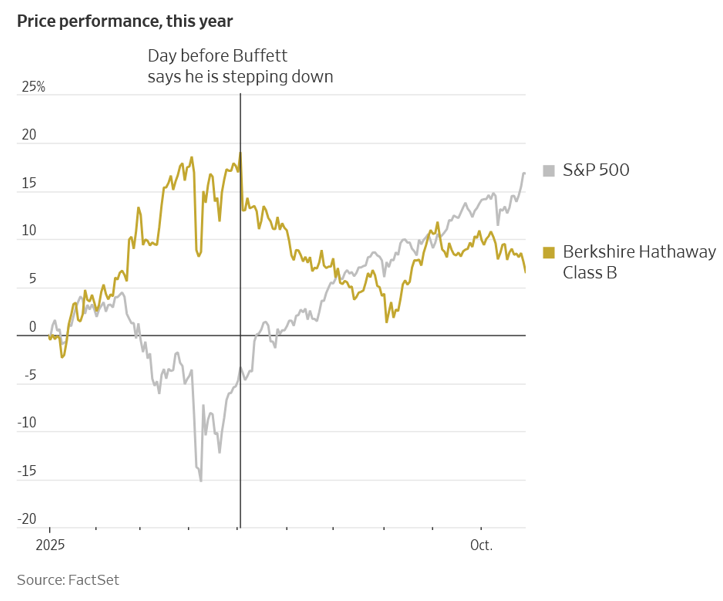
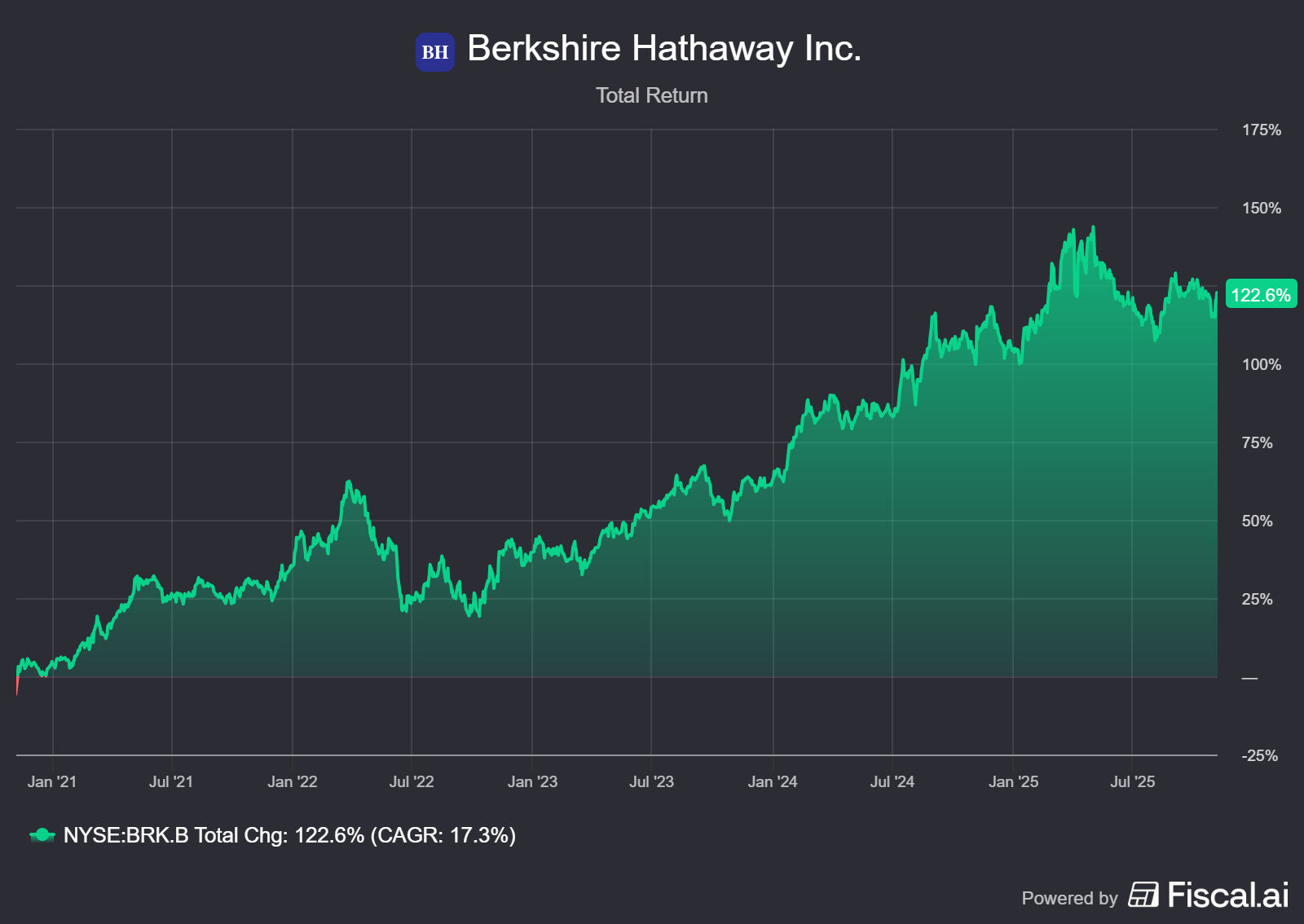
The insurance holding company is experiencing a rare weak year on the stock market. Since Buffett's departure was announced, the shares have lagged the broad market by more than 25%, an unusual situation for the world's most successful investor. Expectations were accordingly low. Analysts had previously pointed to the hefty cash balance of $344 billion as at 30 June 2025 and wondered whether Berkshire would finally resume share buybacks in Q3 after half a year without repurchases.
The somewhat gloomy sentiment even led to a downgrade to 'Underperform' ahead of the results by KBW analyst Meyer Shields, who concluded that "a lot of factors are moving the wrong way at the same time."
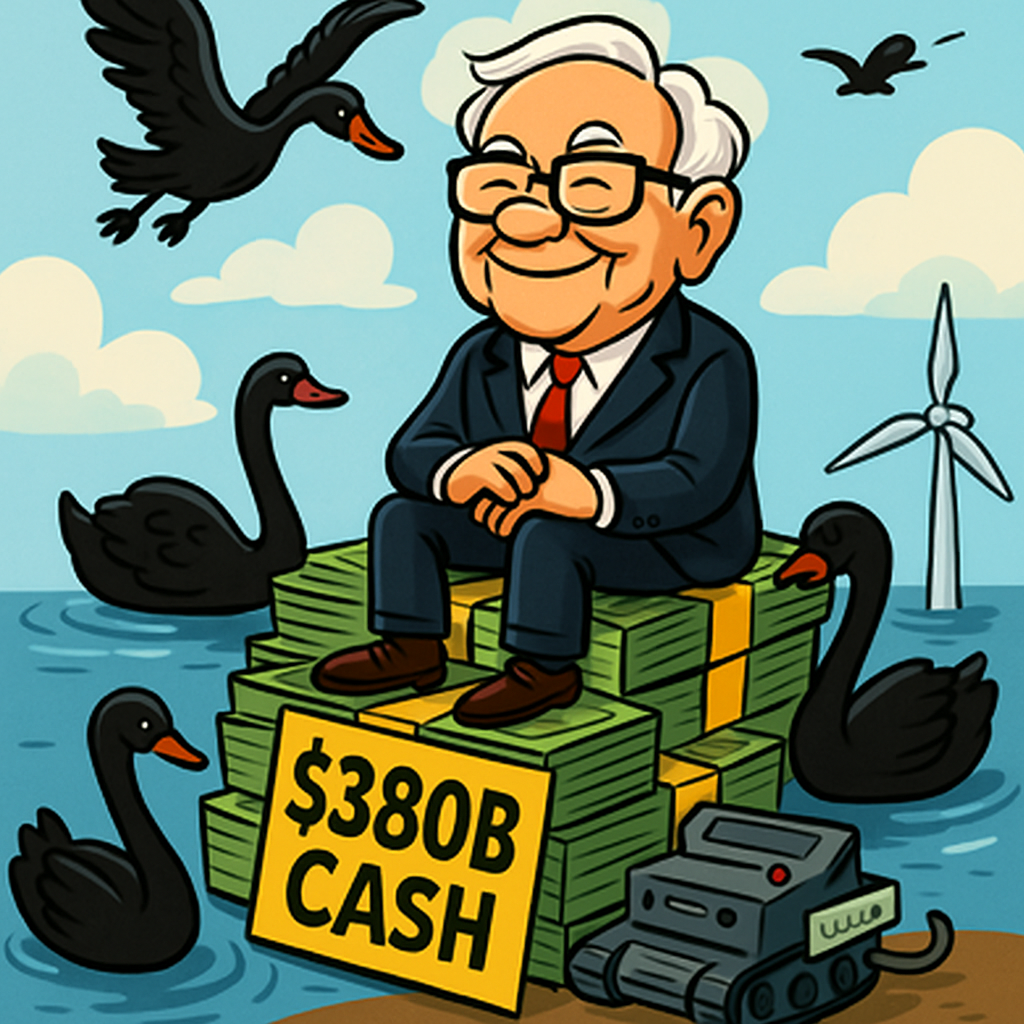
The figures themselves show a striking dual picture. On one hand, operating profit recovered strongly, rising 34% year-on-year to $13.5 billion, driven by a more than tripled profit from insurance underwriting activities ($2.37 billion). On the other hand, it remains remarkable how little is happening with Berkshire's record cash position. It rose further to roughly $354 billion (adjusted for the purchase of $23 billion in short-term bonds), a level at which the cash position alone would rank among the twenty largest companies in the world.
Despite this enormous financial firepower, no shares were repurchased again this quarter. The buyback programme, which between 2020 and 2023 still amounted to billions per quarter, has now been on hold for more than a year. Even during the weaker share price performance of recent months, Berkshire thus remained on the sidelines.
The fact that Buffett himself is barely active is, paradoxically, precisely what is generating more movement in the market. Investors are asking themselves: what does Buffett see that we don't? Are markets simply too expensive, or is he deliberately building up a position so he can act during a future correction, a possible 'black swan' moment that others don't foresee or simply don't want to see?
For successor Greg Abel, that situation means one thing: an unprecedented amount of 'dry powder' to work with. In our view, even too much to leave in government bonds over the long term. A restart of the share buyback programme, or even the introduction of a dividend from 2026, therefore seems inevitable. The latter would be ironic, given that as an investor Buffett receives billions in dividends from companies such as Apple and Coca-Cola, yet has never paid one out himself in all these decades.
Buffett's original idea, that Berkshire can reinvest capital more effectively in attractive opportunities than its shareholders can themselves, no longer seems to hold true, and has not for some time now. In recent years, Buffett has consistently let opportunities in the market pass him by, such as the sharp coronavirus correction of 2020. Who knows, Greg Abel may take a different view on the allocation of this capital.
The insurance operations, the core of Buffett's empire, delivered solid figures, perhaps contrary to the expectations of some analysts. GEICO achieved a combined ratio of 84.3% and nearly $1.8 billion in pre-tax profit, while the reinsurance division benefited from a mild hurricane season and reported a profit of $884 million. Total float rose to $176 billion, still at a negative cost of float, a sign of structural profitability in underwriting.
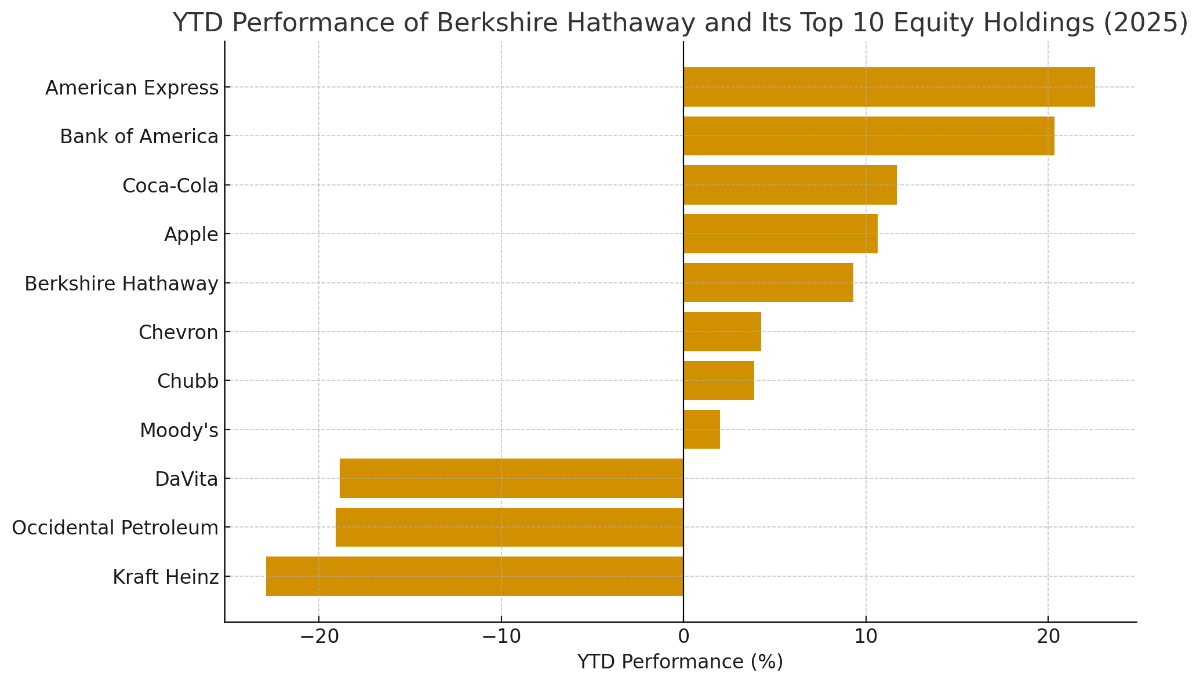
Berkshire's equity portfolio closed the quarter at a value of $283 billion. The financial holdings performed well, with solid share price gains for American Express (+22.6%) and Bank of America (+20.3%), while Apple (+10.6%) and Coca-Cola (+11.7%) also performed solidly, once again confirming their role as stable providers of cash flow through dividends.
Notably weak, by contrast, were Kraft Heinz and Occidental Petroleum, two investments closely associated with Buffett's name. The former continues to struggle with stagnating margins and weak volume growth, something Buffett openly criticised earlier this year. At the same time, Berkshire is actually expanding its involvement with Occidental, with a planned acquisition of chemicals division OxyChem worth $10 billion.
According to Whitney Tilson of Stansberry Research, Berkshire Hathaway currently trades roughly 7% below its estimated intrinsic value, which he puts at $535 per B share. In his recent analysis, Tilson states that Berkshire's intrinsic value has grown by approximately 8–10% this year (it previously traded at a premium). Tilson therefore views the current valuation as attractive, particularly given Berkshire's balance sheet strength and cash position of more than $350 billion.
Berkshire Hathaway's B shares ended the trading week on the New York stock exchange at a price of USD 497.85 per share.
Alphabet is heading to space, and taking TPUs along
The American investment holding company Alphabet (New York: GOOGL) continues to reposition itself at a rapid pace as the technological backbone of the global AI economy. While competitors focus on a single part of the value chain, Google remains active at every stage, from infrastructure to application. Recent developments underscore this strategy.
Strengthening the cloud
This week, Alphabet finally received the green light from the US Department of Justice (DOJ) for its $32 billion acquisition of Wiz. Founded in Tel Aviv and now headquartered in New York, the company is regarded as one of the fastest-growing software companies in the world. Wiz offers a cloud-native security platform that detects vulnerabilities and risks in real time within corporate and government environments. More than 40% of the Fortune 100 already use Wiz's technology.
The acquisition was announced back in March 2025, but remained under scrutiny by the DOJ's antitrust division for months, as it assessed whether the deal would excessively strengthen Google's dominant position in the cloud market. This was a notable step, given that competitors Amazon AWS and Microsoft Azure are still considerably larger than Google Cloud. Now that approval has been granted, Alphabet can complete its largest acquisition ever. Strikingly, the decision comes just two weeks after Alphabet announced a donation towards the White House's new ballroom.
For Alphabet, integrating Wiz into Google Cloud represents a strategic reinforcement of significant scale. With Wiz, the company adds a leading player in cloud security to its ecosystem, further building an infrastructure in which AI, data and security come together completely.
Gemini as the new Siri
Alphabet also surprised the market on the partnership front. After months of testing, Apple has decided to use Google's Gemini model as the core of the new generation of Siri. In doing so, the world's largest hardware maker has explicitly chosen Google's AI technology over alternatives such as ChatGPT (OpenAI) and Claude (Anthropic).
According to Bloomberg, the partnership is worth approximately $1 billion per year, giving Alphabet not only a new revenue stream but also access to an unmatched scale of distribution. There are an estimated more than 2.2 billion active Apple devices worldwide, including over 1.5 billion iPhones. This means that within a few years, billions of users will indirectly interact with Google's AI through Siri.
The choice for Gemini follows an extensive evaluation by Apple, in which various models were tested for accuracy, speed, contextual understanding and scalability. Ultimately, Google's model proved superior, not only in terms of performance but also because of its ability to run within Apple's tightly guarded Private Cloud Compute infrastructure. The latter was crucial, as Apple insisted that user data should never pass through Google servers, unfortunately for Alphabet.
Data centres among the stars
Google is also widening its technological lead with its seventh-generation Tensor Processing Units, known internally as TPU Ironwood. The new chip delivers a fourfold speed improvement over its predecessor and can be linked in clusters of more than 9,000 chips to train the world's largest AI models. This strengthens Alphabet's position as one of the few technology companies with its own AI hardware and reduces its dependence on Nvidia. Major customers, including Anthropic, have already indicated that they will use the new TPUs on a large scale.
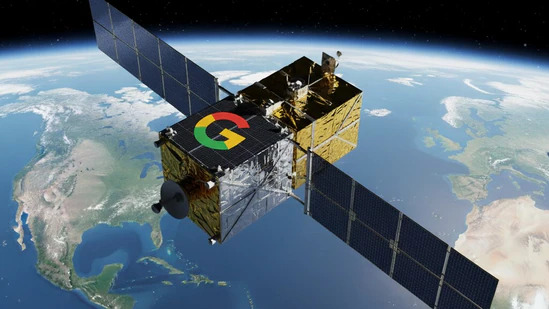
At the same time, Alphabet is thinking even further ahead with Project Suncatcher, a research initiative within Google Research exploring how AI capacity could literally be moved into space. The plan envisions constellations of satellites equipped with solar panels and Google TPUs, connected to one another via optical links and jointly functioning as a single distributed data centre.
The goal is ambitious and almost sounds like something out of a science-fiction film. In the right orbit around the earth, a solar panel can generate up to eight times more energy than on earth, and do so almost continuously, without nightly interruptions. This theoretically creates a way to scale up computing power to levels that are barely achievable on earth, physically and energetically. Although the project is still in an early research phase, the first test mission is already planned. In 2027, Google aims to launch two test satellites together with Planet Labs to put the technology to the test in practice.
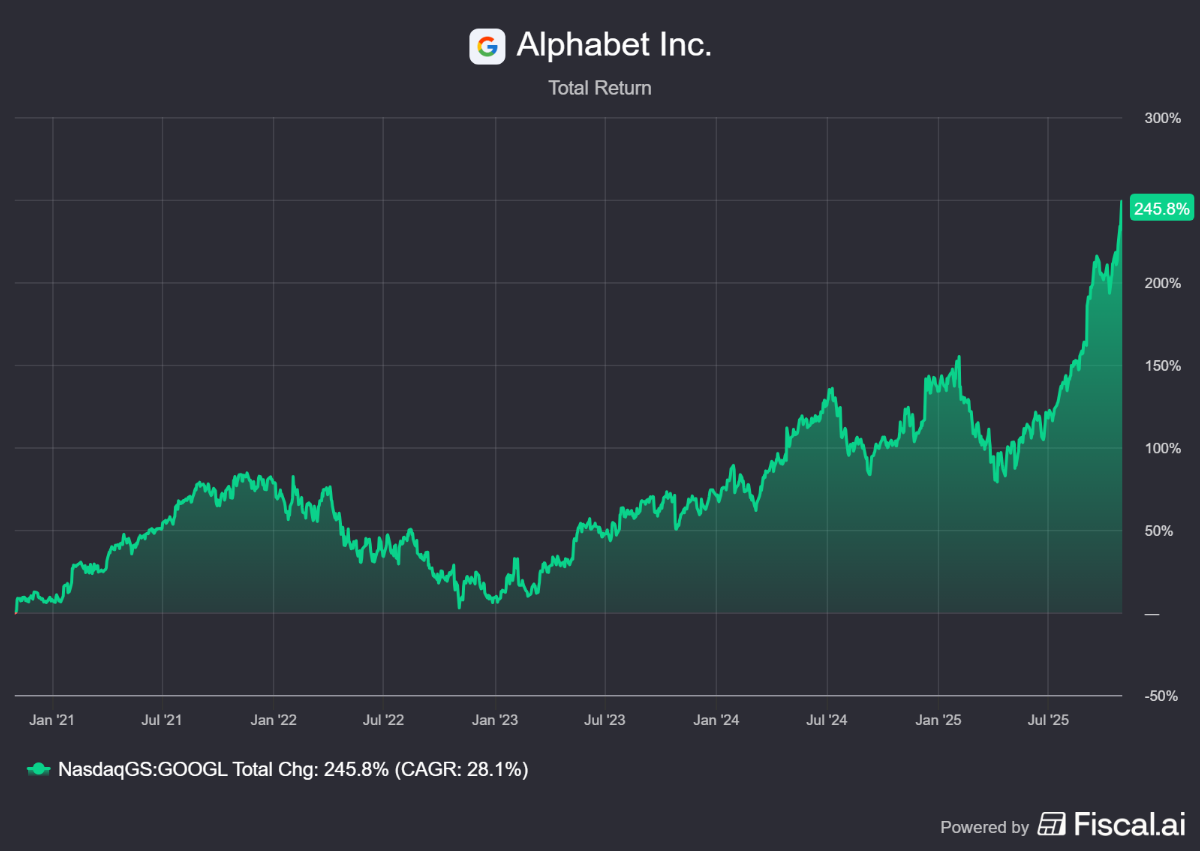
Alphabet ended the trading week on the New York stock exchange at a price of USD 277.07 per A-share.
Receive weekly insights in your inbox
Exclusive analyses and updates on family holding companies and global market developments.
Would you like more information about our services? Please feel free to get in touch.
Get in touch
Disclaimer:
No rights can be derived from this publication. This is a publication of Tresor Capital. Reproduction of this document, or parts thereof, by third parties is only permitted with written consent and with reference to the source, Tresor Capital.
This publication has been compiled by Tresor Capital with the greatest possible care. The information is intended in a general sense and is not tailored to your individual situation. The information must therefore expressly not be regarded as advice, an offer or a proposal to purchase or trade investment products and/or to use investment services, nor as investment advice. The authors, Tresor Capital and/or its employees may hold positions in the securities discussed, for their own account or on behalf of their clients.
You should carefully consider the risks before you start investing. The value of your investments may fluctuate. Past performance offers no guarantee for the future. You may lose (part of) your original investment. Tresor Capital disclaims any form of liability for any inaccuracies or errors. This information is purely indicative and subject to change.
Read the full disclaimer at tresorcapitalnieuws.nl/disclaimer .
This article was originally written in Dutch and automatically translated into English with the help of AI. In case of any difference, the Dutch original prevails.