Family Holdings #51 – HEICO once again proves why it is a quality compounder



This week's topics:
Berkshire Hathaway is reshuffling its top team ahead of the formal transition to Greg Abel as CEO in 2026. The departure of Todd Combs, who played a key role as investment manager and as turnaround CEO at GEICO, marks a clear phase change: from analytical reform to operational stability, with Nancy Pierce as his internal successor at GEICO.
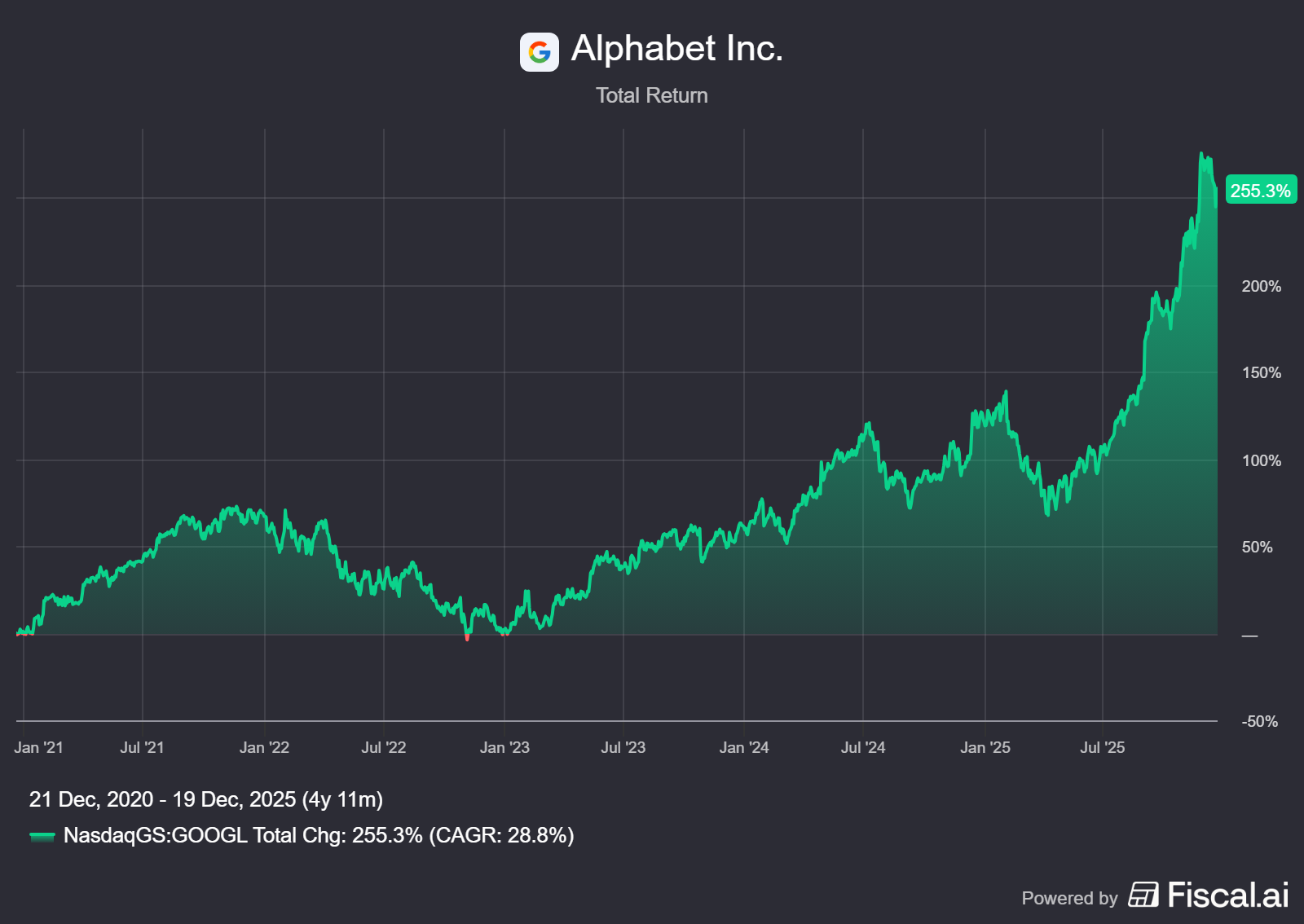
Alphabet once again benefited this week from revaluations within its ecosystem, which leads us to speculate about a higher intrinsic value for the company. Waymo is in talks about a new financing round at a valuation of roughly USD 100 billion, more than double last year's figure, driven by strong growth in fully autonomous rides and further international expansion plans. At the same time, the announced OpenAI revaluation to roughly USD 750 billion raises questions about the implied value of Gemini, which is increasingly regarded by market participants as technologically leading and is being rolled out rapidly worldwide thanks to its integration with Apple.
In brief:
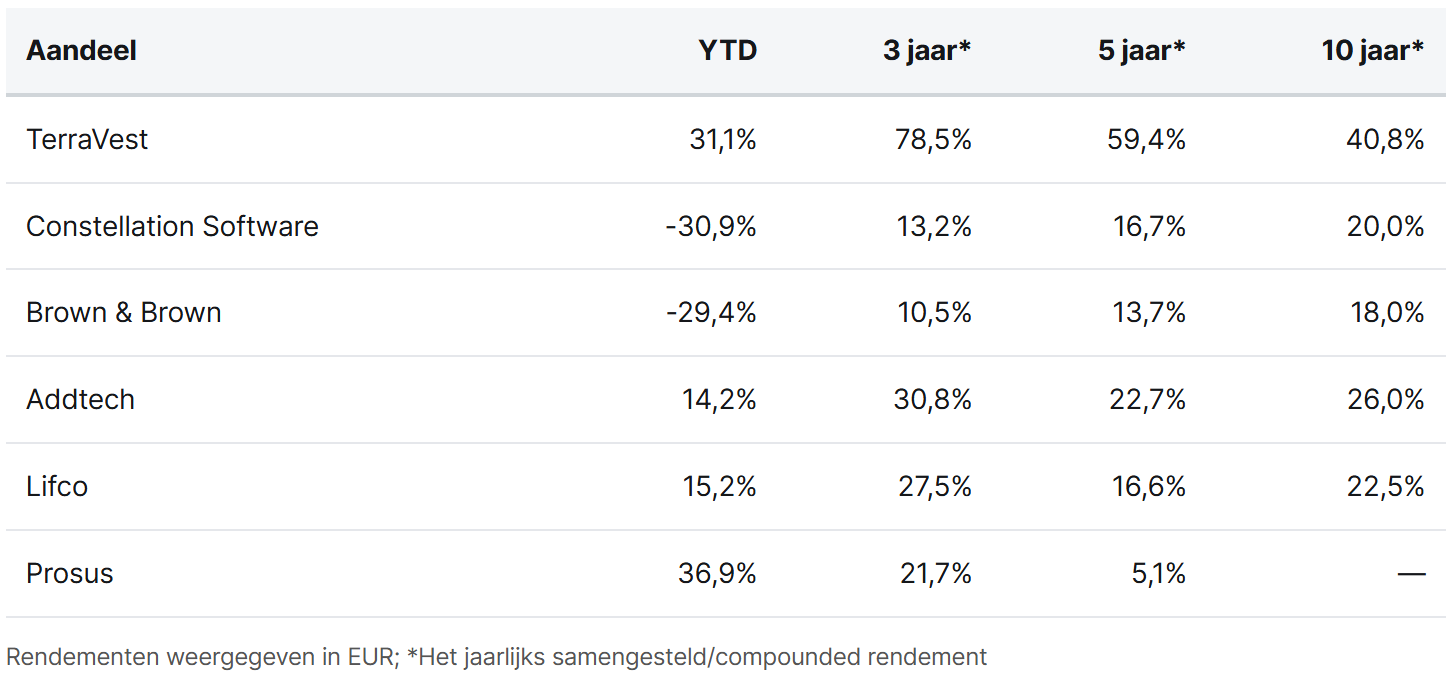
TerraVest (Toronto: TVK) saw its first insider purchase this week from new CFO Guillaume Cloutier, who has held the position since November. He bought 800 shares at CAD 154.92 apiece, a purchase that took place after the recent share price rise of roughly 30%.
Constellation Software (Toronto: CSU) also reported new insider activity: recently appointed CEO Mark Miller bought a further 1,520 shares, worth approximately USD 3.5 million. It is his second purchase since September, continuing the tradition of CSU leaders investing substantial amounts of their own capital.
In addition, subsidiary Jonas made a new acquisition, taking over Pennsylvania-based Site Service Software, a provider of software and mobile solutions for companies active in elevator servicing, maintenance, repairs and inspections.
Brown & Brown (New York: BRO) this week acquired the Campbell Agency, an agency founded in 1991 specialising in workers' compensation insurance. Founder Kevin Campbell and partner Kian Ostovar will join Brown & Brown's offices.
Addtech (Stockholm: ADDT-B) once again expanded its operations with three further acquisitions. Within its Automation division, the company acquired BCK Holland and Kramer & Duyvis, two Dutch manufacturers of internal transport systems for, among others, the packaging and food & beverage industries, together accounting for €8 million in revenue and 35 employees. Addtech also bought Norway's Purenviro AS, a specialist in solutions for processing environmentally harmful and odorous gases, with revenue of roughly NOK 55 million and seven employees. With these transactions, Addtech's total number of acquisitions this year reaches ten.
Lifco (Stockholm: LIFCO-B) expanded its Dental division with the acquisition of Germany's Karl Kaps GmbH & Co. KG, a niche manufacturer of medical and dental microscopes. Karl Kaps generated revenue of roughly €10.1 million in 2024 and has 33 employees. The company will be consolidated within Lifco's Dental Business Area in the first quarter of 2026.
Prosus (Amsterdam: PRX) accelerated its share buyback programme over the past two weeks. According to CEO Fabricio Bloisi, this was financed with proceeds from earlier divestments, a signal of confidence in the current valuation.
TerraVest, Constellation Software, Brown & Brown, Addtech, Lifco and Prosus are currently trading on the Toronto, New York, Stockholm and Amsterdam exchanges at prices of CAD 162.23, CAD 3,343.60, USD 81.39, SEK 325.60, SEK 351.80 and €53.54 per share, respectively.
HEICO confirms its status as a structural compounder
Last quarter we already wrote about HEICO's (New York: HEI.A) impressive quarterly results, which at the time resulted in new record highs. This quarter, which also marks the close of the financial year, the company continues that trend unabated. Once again, multiple records have been tightened and the results leave little room for doubt: operationally, HEICO continues to perform exceptionally well.

The compounding machine keeps turning steadily. Growth does not stem from one-off windfalls, but from a consistent and repeatable model that adds value year after year. In our earlier deep dive, we explored in more depth why we expect HEICO to be able to keep delivering this performance over the long term. Central to this is a management team with a pronounced long-term focus that deploys capital with extreme discipline and operates in niches with structural growth tailwinds.
For those who want to gain a deeper understanding of why we believe HEICO can continue creating value for years to come, we refer below to our earlier analysis.
 Michael Gielkens
Strong organic growth, margin expansion and accelerating cash flow
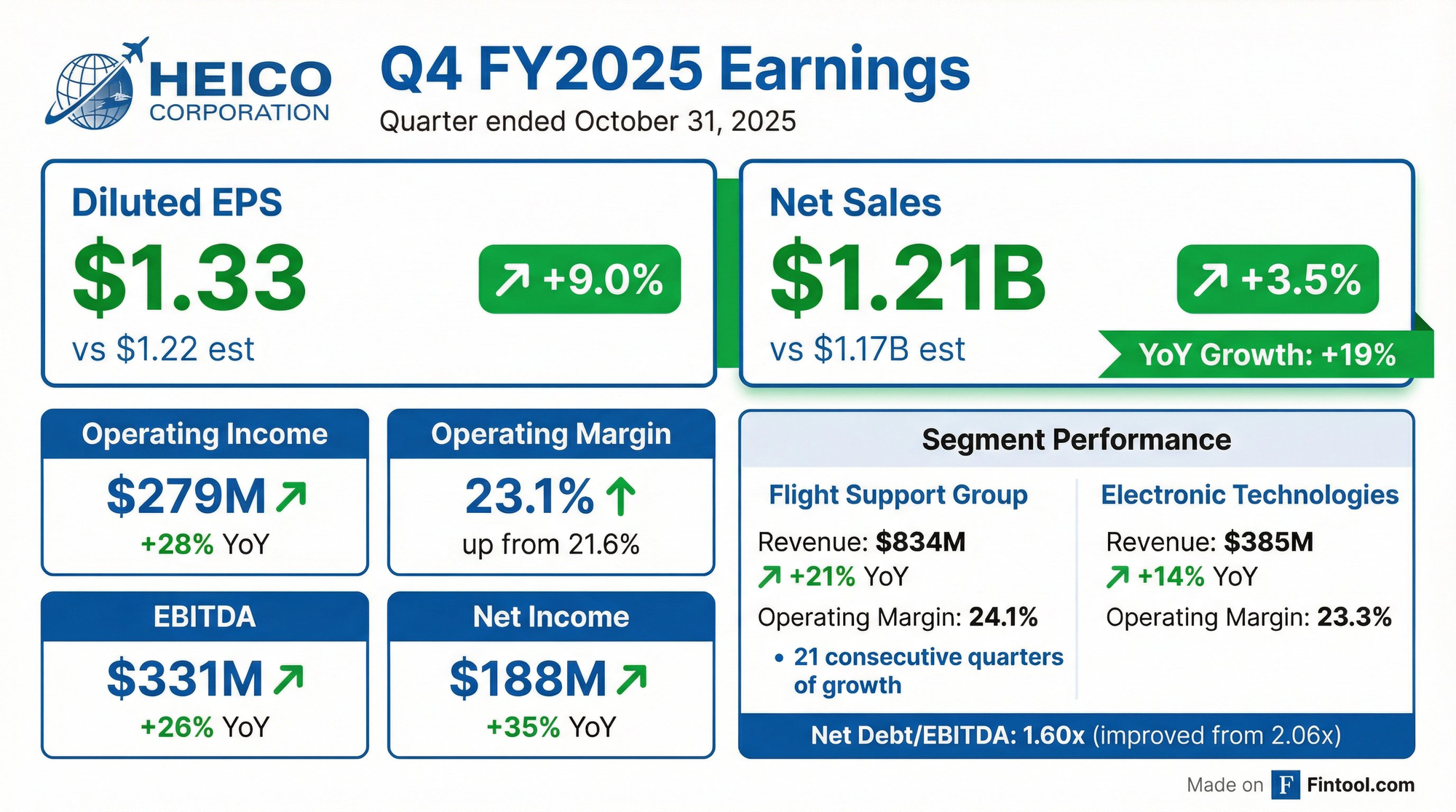
The figures presented once again underline why HEICO ranks among the most consistent compounders within the industrial and aerospace space. In the fourth quarter, revenue rose by 19%, with the bulk of that growth clearly organic in nature. Roughly 12 percentage points of that growth stemmed from higher volumes and structurally strong end markets, supplemented by a modest but valuable contribution from recent acquisitions.
At least as relevant is the development on the profitability and cash flow side. The operating margin improved by around 1.5 percentage points over the year to 23.6%, a strong achievement for a company already operating at a high level and a clear sign of economies of scale. Growth is therefore not coming at the expense of efficiency, but is actually reinforcing it. This translates directly into the figures: EBITDA rose by 26% and operating cash flow by as much as 44%, both well above the historical growth trends of 17% and 19% respectively.
This brings us to the point that investors in this sector typically scrutinise most closely: debt. HEICO operates in a capital-intensive industry where debt is the rule rather than the exception, but the recent figures show that the company is actively reducing risk here. The ratio of total debt to net income improved from 4.34x to 3.14x, while the net debt-to-EBITDA ratio fell from 2.06x to around 1.6x over the course of a year. This gives HEICO considerably more financial flexibility than many of its industry peers. By comparison, a direct competitor such as TransDigm structurally operates with a net debt-to-EBITDA ratio of around 6x.
Recent acquisition and AI positioning
With such strong figures, it comes as little surprise that co-CEOs Eric and Victor Mendelson once again place considerable emphasis on the role of culture, long-term thinking and employees at HEICO:
"We are beyond proud of HEICO's team, who generated our organic and acquired growth, by continuing our 35-year track record of exceptional performance. These results stem from hard work and actions taken over decades, not just the past year, and demonstrates the value creation of HEICO's long-term focus in everything we do."
In the past week, the company announced yet another acquisition. Subsidiary Wencor is taking over the operations of EthosEnergy Accessories & Components. Ethos specialises in the repair of engine components for gas turbines, aviation and defence, and employs around 175 people across three locations. With this acquisition, HEICO strengthens its position within the fast-growing industrial gas turbine segment, a market that, according to management, structurally benefits from rising energy demand, partly driven by the rollout of AI infrastructure. This positions the company within a long-term growth market that is expected to continue attracting substantial investment in the years ahead.
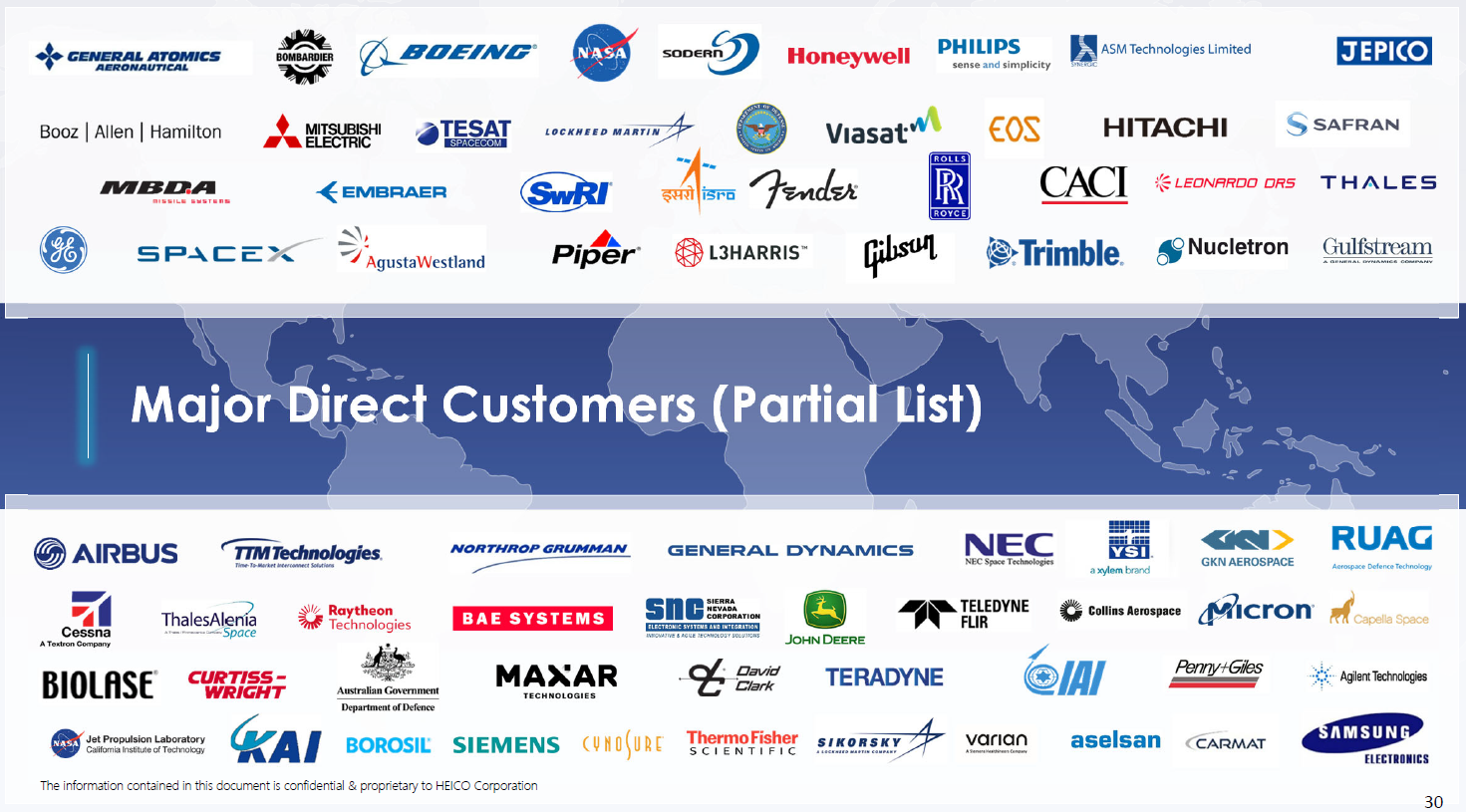
The fact that HEICO is not building exposure here from scratch, but is already active within these end markets, becomes clear from a recent overview image of its largest direct customers. Alongside the familiar names from aviation, defence and aerospace, we also see players such as Samsung, Micron and Siemens. These are companies that play a central role in semiconductors, industrial automation and data centre infrastructure, essential building blocks of today's and tomorrow's AI economy.
This creates indirect but tangible exposure to the further rollout of AI infrastructure, without fundamentally changing the nature of HEICO's core activities.
HEICO is currently trading on the New York stock exchange at a price of USD 253.09 per Class A share.
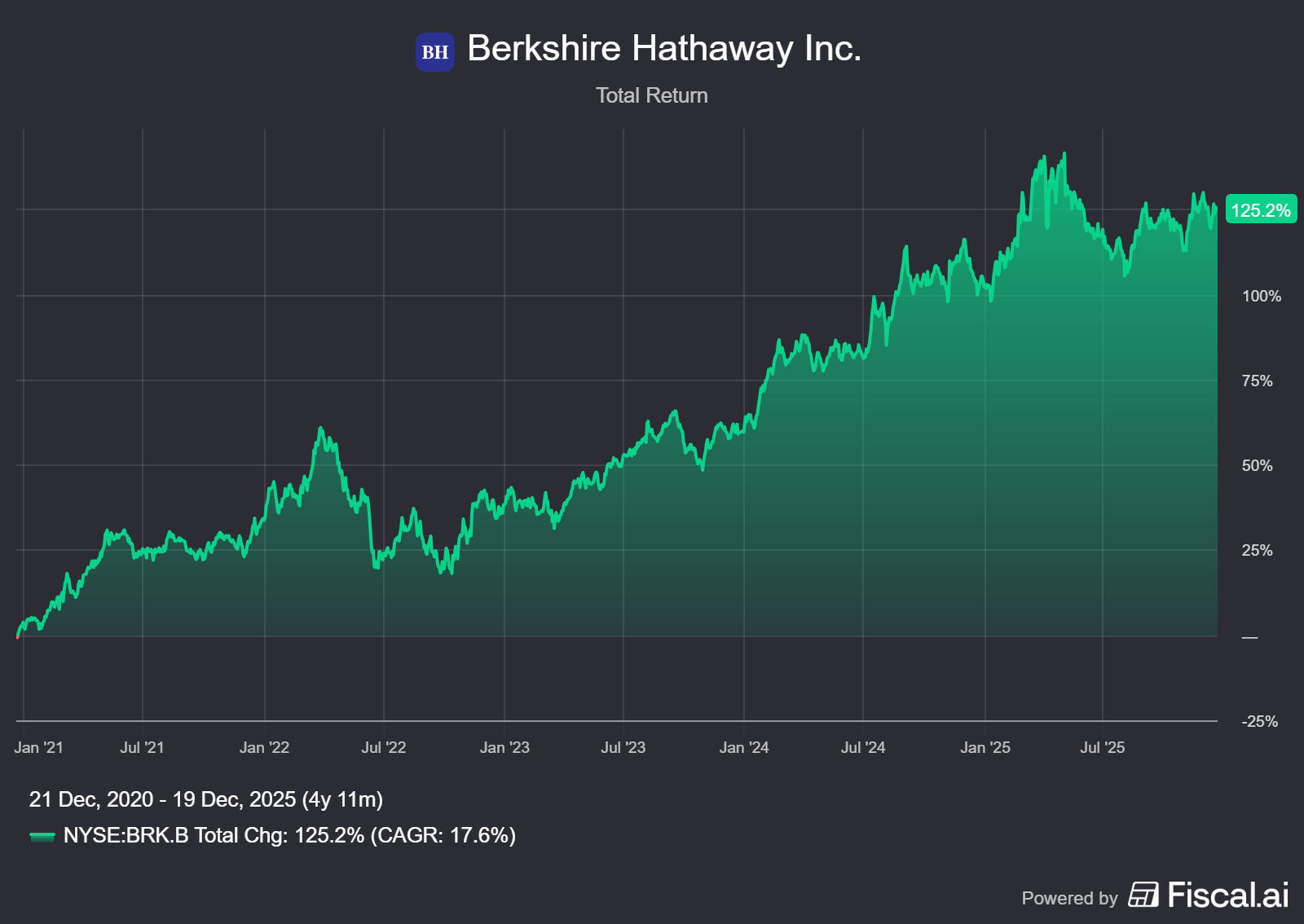
Berkshire reshuffles top team ahead of the Abel era
Berkshire Hathaway (New York: BRK.B) recently announced a series of important appointments, reshuffling both its insurance and non-insurance operations as the holding company prepares for the formal transition to Greg Abel as CEO on 1 January 2026.
The most notable change is the departure of Todd Combs. He had been one of Buffett's investment managers since 2010, combining that role since 2020 with an operational position as CEO of GEICO. Berkshire has now confirmed that Combs is leaving for JPMorgan Chase, where he will take on a senior investment role under Jamie Dimon.
The departure of Todd Combs
Todd Combs joined as an investment manager in 2010 and grew into one of the very few people to whom Warren Buffett structurally entrusted portfolio responsibility. In 2020, an atypical dual role was added: Combs remained active as a portfolio manager while simultaneously becoming CEO of GEICO.
Buffett later emphasised that Combs attracted many strong people to GEICO and broadened the organisation substantively. Under his leadership, GEICO was gradually transformed from a traditional, heavily cost-driven insurer into an organisation with greater emphasis on data, pricing discipline, technology and long-term underwriting quality. The focus shifted from market share at almost any price to structural profitability in an increasingly competitive and inflation-sensitive car insurance market.
That strategic shift in course took place against a particularly difficult backdrop. Between 2021 and 2023, the US car insurance sector suffered heavy losses, leaving Combs with a substantial turnaround task on his hands. Within Berkshire, he was seen as someone willing to take unpopular measures to get GEICO back to profitability. That translated into a management style that insiders often described as harsh, technocratic and lacking in empathy.
It is therefore no surprise that the Reddit forum r/GEICO saw plenty of critical comments during that period from users who took a negative view of his leadership. Remarks such as “I survived Combs” and stories about a deteriorating company culture, increased workloads and heavily top-down management crop up there regularly. At the same time, some nuance is warranted, since anyone can present themselves online as a (former) employee. Anonymity makes verification impossible, and negative experiences tend to be shared disproportionately on platforms like these.
Mainstream media called Todd Combs "stellar" and said he was "snagged" by JPMorgan
— Edwin Dorsey (@StockJabber) December 14, 2025
His GEICO employees wrote:
"Is it too soon to sell 'I survived Combs' t-shirts?"
"This will be one of those rare moments when a whole company celebrates their CEO leaving" pic.twitter.com/xWnmXUgb0J
It is precisely against the backdrop of this mixed legacy that the choice of Nancy L. Pierce as new CEO is telling. Where Combs was brought in as an analytical reformer and turnaround manager, Berkshire is now deliberately opting for stability, operational continuity and deep internal knowledge of the insurance business.
Pierce has worked at GEICO since 1986 and built her entire career within the organisation. Over the past decades she has held leadership roles in claims, underwriting, product development and regional operations, and most recently served as Chief Operating Officer. As a result, she not only knows the numbers and processes but also understands the culture, dynamics and sensitivities within GEICO in detail.
Surprising timing after building up Alphabet
Combs, together with Ted Weschler, symbolised Berkshire's gradual broadening into technology, outside Buffett's classic comfort zone. Charlie Munger once explicitly noted that, without the influence of this younger generation, Berkshire would probably never have invested in Apple and would thereby have missed out on what remains its best-performing investment to date. That is precisely why the timing of Combs's departure feels striking. Recently, investors got the impression that the internal investment managers would be given more room to allocate opportunistically to new sectors, partly on account of the recent build-up of a position in Alphabet. That investment was widely interpreted in the market as a decision that came primarily from the investment team, rather than from Buffett himself.
Other changes to the structure
Alongside Todd Combs's departure, Berkshire Hathaway announced several further appointments that together reveal a clear pattern. First, the company announced that Berkshire Hathaway veteran and CFO Marc Hamburg will retire as of June 2027. Hamburg had held that role since 1992 and had been with the company for more than 40 years. His successor is Charles Chang, currently CFO of Berkshire Hathaway Energy. Chang will take up the post as of June 2026. A one-year transition period points to a deliberate, risk-averse handover of financial responsibility.
In addition, Berkshire is appointing an in-house General Counsel for the first time in its history. Michael O'Sullivan, who joins from Snap and was previously a partner at Munger, Tolles & Olson, starts in Omaha in January 2026. Observers see this step as a logical professionalisation of an organisation that is becoming increasingly complex, both legally and from a regulatory standpoint.
Investors, including Christopher Bloomstran on X, point out that, taken together, these changes do not represent a break with Berkshire's DNA, but do mark a clear shift: from an extremely lean, Buffett-dominated model to a more structured leadership team around Abel. The autonomy of the subsidiaries remains intact, but the central organisation is gaining more formal clout.
Berkshire Hathaway is currently trading on the New York Stock Exchange at USD 501.90 per B share.
Revaluations lift Alphabet's intrinsic value
Last week we wrote about the revaluation of SpaceX and how Alphabet (New York: GOOGL) and other holding companies, as shareholders in the space company, are benefiting from it:
 Joep Dikken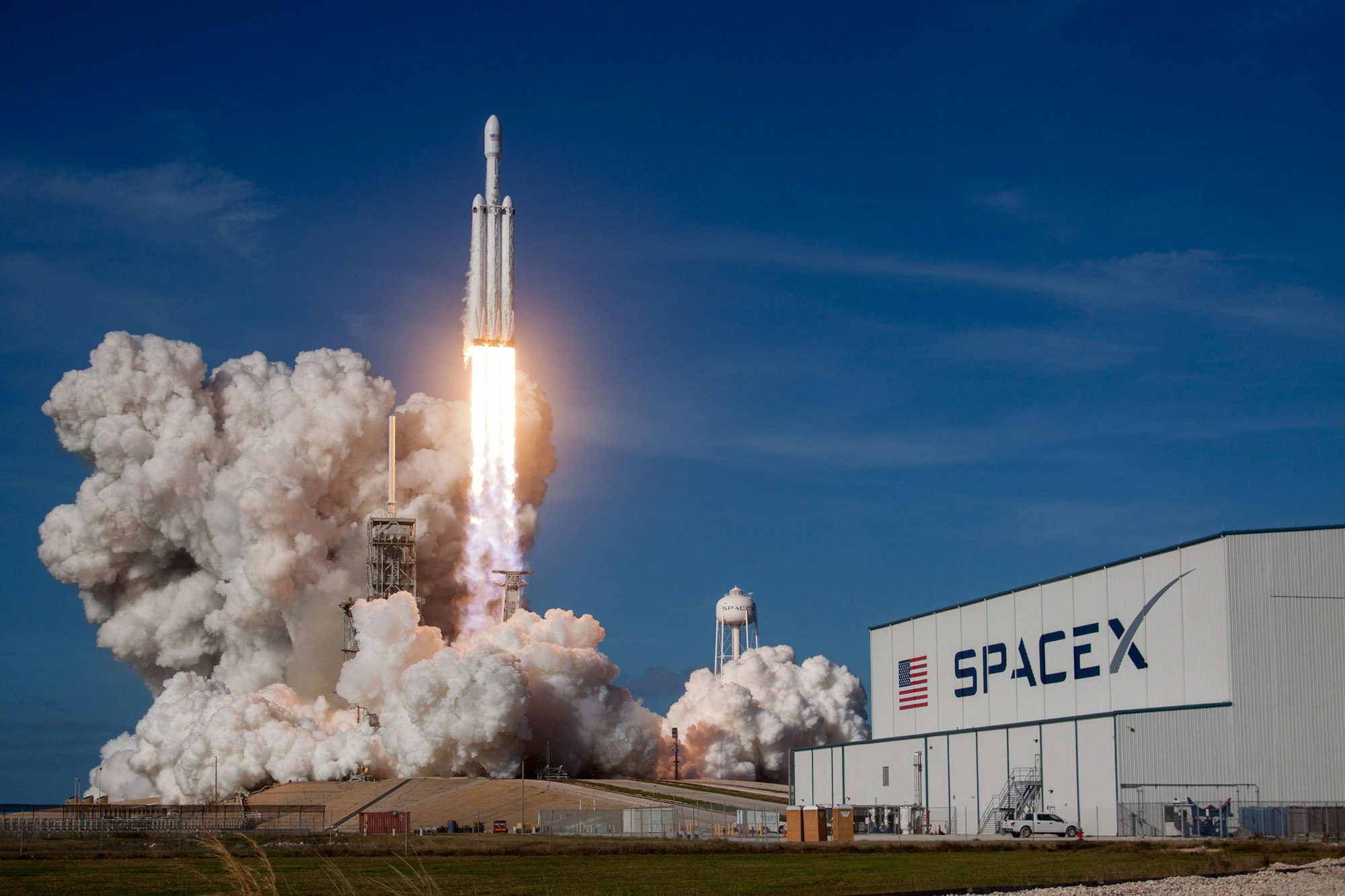
This week saw two further revaluations within and around Alphabet, which have once again set analysts thinking about the company's current intrinsic value.
Waymo is rising in value, but how sustainable is that lead?
Waymo, Alphabet's autonomous driving subsidiary, is in talks with investors about a new funding round that would value the company at approximately USD 100 billion. According to both The Information and Bloomberg, this would involve a financing round of several billion dollars, possibly even more than USD 10–15 billion, with Alphabet itself leading the round. This would mean Waymo's valuation more than doubling in a short period compared with the previous external valuation of USD 45 billion in September. The transaction is expected to close in early 2026.
That higher valuation does not come out of nowhere. Waymo is currently the only party in the US offering paid robotaxi services at scale without a safety driver or attendant in the vehicle. The company has a fleet of more than 2,500 vehicles and reached an important tipping point this spring: more than 1 million fully autonomous rides per month, amounting to 14 million rides this year, a tripling compared with 2024. In operational terms, this now equates to 3.8 million driving hours, with, according to Waymo, a tenfold lower accident rate and avoided emissions of 18 million kilograms of CO₂. The growth plans are equally concrete: in 2026, Waymo aims to expand into 20 additional cities, including Tokyo and London, and to further increase the number of airports served alongside San Francisco, San Jose and Miami.
Although Waymo's recent revaluation underscores growing confidence in the commercial breakthrough of autonomous mobility, it remains far from clear how profitability, and with it Waymo's intrinsic value, will develop over the longer term. At the heart of that uncertainty lie the margins per ride and the capital intensity of the model.
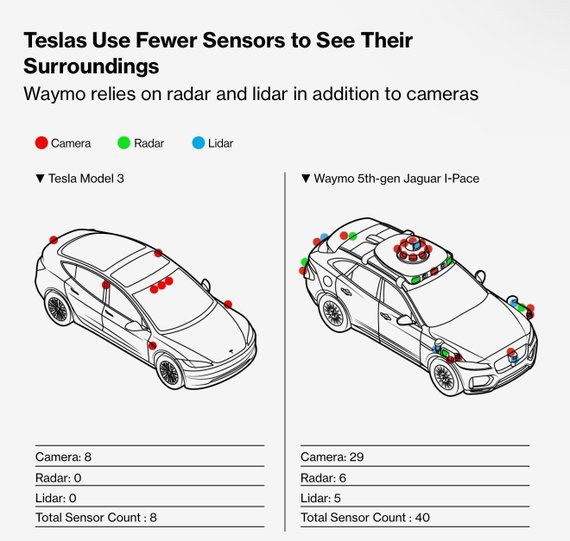
Waymo takes a fundamentally different technological approach to many of its competitors. Whereas Tesla relies on a camera-only strategy, Waymo uses a redundant sensor stack of cameras, radar and lidar, supplemented by highly detailed HD maps for each city. This approach increases operational reliability in complex urban environments and explains why Waymo already offers fully driverless robotaxi services in multiple cities today.
At the same time, this choice leads to significantly higher hardware costs. The production costs of a Waymo robotaxi are estimated at around USD 100,000 to 150,000 per vehicle, compared with roughly USD 25,000 for a Tesla Model 3. This difference underscores the tension within the business model: operational lead versus scalability and cost structure.
In the short term, Waymo clearly has momentum. The company holds the necessary permits, has operational experience, and is already generating revenue. Over the medium term, however, the valuation question becomes more complex. Competitors, Tesla in particular, are building up driving data at large scale through their existing vehicles, data intended for future robotaxi applications. Over time, this could lead to lower costs per mile and greater pricing pressure in the market.
Elon Musk, at least, leaves little doubt about who he believes will be the long-term winner:
Waymo never really had a chance against Tesla. This will be obvious in hindsight.
— Elon Musk (@elonmusk) December 10, 2025
OpenAI's revaluation as a reference point for Gemini's worth
This week, news emerged that OpenAI is in talks with investors about a new funding round at a valuation of approximately USD 750 billion. If realised, this would represent a substantial step up from the earlier valuation of roughly USD 500 billion in October and would position OpenAI as one of the most valuable private technology companies in the world.
The proposed revaluation underscores the AI sector's ongoing hunger for capital, but it also raises fundamental questions. Although ChatGPT still holds the largest market share among large language models, the competitive landscape is quickly becoming more dynamic. Gemini, Alphabet's AI model, is visibly gaining ground and is increasingly being regarded by market participants as technologically leading. Strategic partnerships, including integration within the Apple ecosystem, are also significantly increasing the distribution and usage of Gemini.
Against that backdrop, our focus naturally shifts from OpenAI's valuation to the question of what Gemini itself might be economically worth. That exercise inevitably remains an estimate, since Gemini is not a separate entity and is deeply interwoven with Alphabet's broader product and infrastructure stack. Nevertheless, it is clear that Gemini's implied value within Alphabet's sum-of-the-parts is becoming increasingly difficult to ignore.
Alphabet is currently trading on the New York stock exchange at a price of USD 305.24 per A-share.
Receive weekly insights in your inbox
Exclusive analyses and updates on family holding companies and global market developments.
Would you like more information about our services? Feel free to get in touch.
Get in touch
Disclaimer:
No rights can be derived from this publication. This is a publication of Tresor Capital. Reproduction of this document, or parts thereof, by third parties is only permitted with written consent and with reference to the source, Tresor Capital.
This publication has been compiled by Tresor Capital with the utmost care. The information is intended in a general sense and is not tailored to your individual situation. The information must therefore expressly not be regarded as advice, an offer or a proposal to purchase or trade investment products and/or to take up investment services, nor as investment advice. The authors, Tresor Capital and/or its employees may hold positions in the securities discussed, for their own account or on behalf of their clients.
You should carefully consider the risks before you start investing. The value of your investments may fluctuate. Past performance offers no guarantee for the future. You may lose (part of) your original investment. Tresor Capital disclaims any form of liability for any inaccuracies or errors. This information is purely indicative and subject to change.
Read the full disclaimer at tresorcapitalnieuws.nl/disclaimer .
This article was originally written in Dutch and automatically translated into English with the help of AI. In case of any difference, the Dutch original prevails.