Family Holdings #7 - Record Growth Meets Rising Concerns



This week's topics:
KKR achieved a record level of assets under management of USD 744 billion in 2025 and raised USD 129 billion in new capital despite market unease surrounding software and private credit. The investment company is strengthening its position through the acquisition of Arctos Partners to tap into sports investments, and continues to lean heavily, via its infrastructure arm, into the physical backbone of AI. Although the share price is under pressure, the current valuation of 12x expected 2027 earnings offers an interesting perspective given the robust management fees and diversification.
TerraVest delivered an exceptionally strong first quarter, with substantial revenue and cash flow growth, supported both by acquisitions and by solid 9% organic growth in the fully integrated core portfolio. Cash Available for Distribution rose by 34%, but at the same time the company is facing a mixed macro environment. Uncertainty around import tariffs and new US CDL regulations is temporarily weighing on transport-related activities, while demand from the data centre sector is sitting at a record level.
Where the market underscored its confidence in Alphabet with massive oversubscription of a bond issue, the European Union is instead distancing itself. Google is simultaneously being investigated for its use of content in AI Overviews and for possible manipulation in advertising auctions. Meanwhile, Alphabet is benefiting from the higher valuation of Anthropic, in which it holds a strategic stake of 7%.
In Brief:
Constellation Software (Toronto: CSU) further expanded its operations through two additional acquisitions within the Jonas division. In the United Kingdom, Pollution Monitors was added, a supplier of specialised gas detection and environmental monitoring systems for sectors such as academic institutions, pharmaceutical manufacturing sites and defence. In addition, Jonas acquired the Colombian company Suplos, a cloud platform for supply-chain automation active in Colombia, Panama and Peru. Suplos helps buyers digitalise their supply chain and achieve transparency and cost savings.
Brown & Brown (New York: BRO) announced an accelerated share buyback of $250 million, carried out via an Accelerated Share Repurchase programme with JPMorgan. The programme forms part of the previously approved buyback capacity of $1.0 billion and is expected to be fully completed in the second quarter of 2026.
Addtech (Stockholm: ADDT-B) further expanded its operations with the acquisition of Kapp Nederland B.V., a specialist in measurement and calibration solutions for, among others, the process industry, water sector and research institutions. The company, with around €8 million in revenue and 20 employees, will be integrated into the Process Technology division.
Chapters Group (Frankfurt: CHG) has, through portfolio company Icomedias, acquired a stake in HybridForms, a low-code platform for digital workflows and mobile data collection within areas such as public services, healthcare and infrastructure inspections. HybridForms is used for critical processes such as construction and safety inspections, medical records and on-site documentation, and is positioned as a scalable complementary product within Chapters' broader software stack.
Constellation Software, Brown & Brown, Addtech and Chapters Group are currently trading on the Toronto, New York, Stockholm and Frankfurt exchanges at prices of CAD 2,314.72, USD 68.98, SEK 317 and EUR 30.40 per share, respectively.
| Share | YTD | 3 years* | 5 years* | 10 years* |
|---|---|---|---|---|
| Constellation Software | -30.3% | -4.1% | 7.0% | 18.4% |
| Brown & Brown | -14.2% | 2.8% | 10.2% | 16.3% |
| Addtech | -1.3% | 22.3% | 19.9% | 29.0% |
| Chapters Group | -27.7% | 28.8% | 44.7% | 27.4% |
Returns shown in EUR; *The annualised/compounded return
Brookfield grows on the back of BAM and BWS
The Canadian investment holding company Brookfield Corporation (New York: BN) and its listed asset management arm Brookfield Asset Management (New York: BAM) recently published their results for 2025. The past year once again underscored the scale and resilience of the Brookfield platform. Management characterised market conditions as "improving but demanding": capital markets gradually recovered, but remained marked by volatility, heightened interest rate uncertainty and geopolitical tensions. In that climate, operational execution remained remarkably solid. Where other private equity holding companies and other alternative asset managers had to absorb sharp corrections at times, Brookfield remained relatively resilient, and the share held up notably steady during various phases of market stress.
At the same time, 2026 marks an important governance milestone. Following a carefully structured multi-year succession plan, BAM will get a new CEO for the first time. Bruce Flatt, for many years the face of both BAM and the broader group, is handing over day-to-day leadership of the asset management arm, while remaining CEO and Chairman of Brookfield Corporation. Flatt describes it as the next phase of institutionalisation for the company.
Distributable Earnings
The key performance indicator for Brookfield Corporation remains Distributable Earnings (DE). This figure shows how much profit is actually available for reinvestment in new projects or for distribution to shareholders. Within DE, a distinction is made between earnings before and after realisations of investments. The purest measure is earnings before realisations, as it best reflects what the platform earns operationally, independent of incidental sale gains, exit timing or market cycles. These are the structural cash flows generated by asset management, insurance activities and operating holdings.
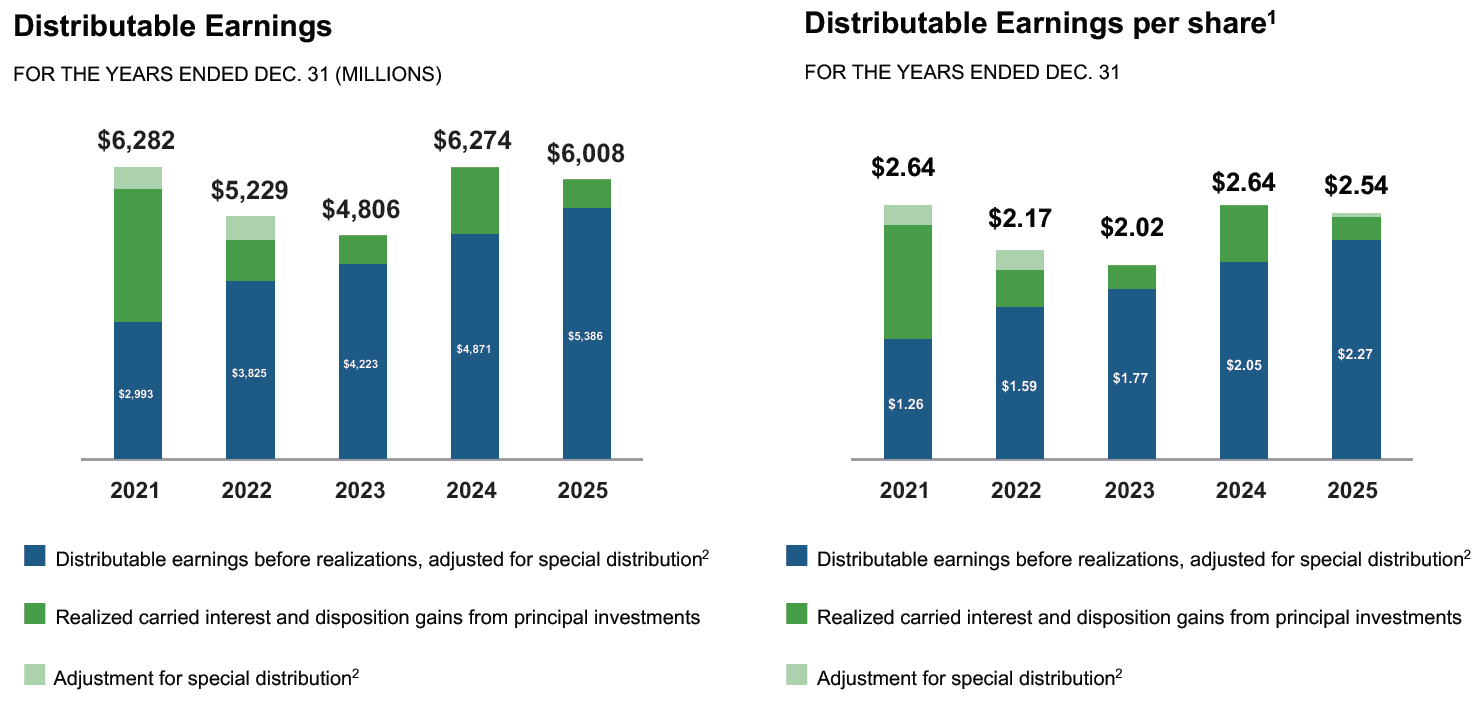
Looking at the blue bars in the chart on the left, we see that DE before realisations rose to $5.386 billion in 2025, a growth of 11% compared with 2024. This means the platform's underlying earning power increased again, despite a year in which market conditions were not always straightforward.
The fact that total DE (including realisations) came in lower in 2025 than in 2024 requires some nuance. In 2025, total DE amounted to $6.0 billion, versus $6.27 billion a year earlier. The difference is almost entirely explained by an exceptionally large realised gain in 2024. That year included a disposition gain of $1.0 billion, whereas in 2025 this amounted to only $62 million. That 2024 gain was related to the sale of part of the stake in Brookfield Asset Management, which freed up capital for other growth divisions within the group. Adjusted for this one-off factor, Brookfield would have shown growth of approximately 13.9% in 2025 even after realisations. The apparent decline is therefore primarily a timing effect and not an indication of deteriorating fundamentals.
On the right-hand side of the chart, we also see that DE per share before realisations reached a new record high. In 2025, this came in at $2.27 per share, equivalent to a compound annual growth rate of roughly 16% since 2021. This underscores how consistently the platform has been able to grow value per share. This record level is therefore not solely the result of higher absolute earnings, but also of purposeful capital allocation. Just as in 2024, management again repurchased more than $1 billion of its own shares in 2025, at an average price of $36 per share. That price level was only briefly reached during a sharp market correction around the so-called "Liberation Day". In hindsight, this has proven to be an excellent move by management.
Asset Management Division
Alongside BN's own balance-sheet activities, Brookfield Asset Management (BAM) forms the group's structural fee engine. Whereas BN is partly dependent on investment results and realised gains, BAM earns the bulk of its income by managing capital for third parties. This is done through management fees and performance fees on funds in private equity, infrastructure, real estate and credit.
In that respect, 2025 was an exceptionally strong year. BAM raised $112 billion in new capital, of which $35 billion in the fourth quarter alone. This inflow brought Fee-Bearing Capital (FBC) — the portion of assets under management on which management fees are actually received — to $603 billion, up 12% year on year.
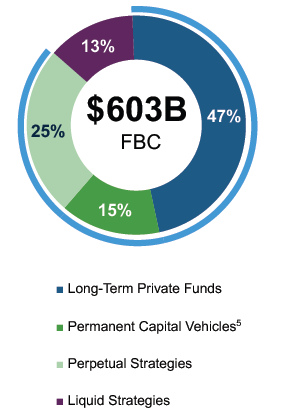
That figure is more important than it may seem at first glance. Fee-Bearing Capital forms the basis on which future management fees are calculated. The larger this base, the more stable and predictable future cash flows become. Reassuringly, no less than 87% of this capital is locked in for the very long term. This means management has an exceptionally high degree of visibility into future income, which considerably increases the predictability of earnings.
That structural growth in FBC translates directly into higher Fee-Related Earnings (FRE), the profit derived from recurring management fees, excluding performance fees and investment gains. Since 2021, FRE has grown at a compound annual growth rate of approximately 19.5%. In 2025 alone, FRE rose by 22% to $3.0 billion. This translated into DE of $2.7 billion, bringing them a step closer to the 2030 target of $4.2 billion, for which a compound growth rate of 18% was previously required.
Insurance Division
The second emerging growth engine within Brookfield Corporation is the insurance division, Brookfield Wealth Solutions (BWS). Whereas Brookfield was historically best known as an investor in real assets, since 2020 a new pillar has been built up that now contributes an increasingly large share of total profit. We previously wrote at length about the strategic significance of this division in our newsletter. What was then still seen as an ambitious expansion of the platform is becoming increasingly tangible in the figures.
 Michael Gielkens
Although BWS was only founded in 2020, the division now manages $143 billion in insurance assets. In 2025, that scale translated into $1.67 billion in Distributable Earnings, up almost 24% year on year. This meant the insurance arm surpassed, for the first time, the combined contribution of the traditional operating subsidiaries, which together generated $1.60 billion in DE. To put this shift into perspective: in 2023, the operating subsidiaries still generated roughly twice as much DE as the insurance division. Within just two years, that picture has completely turned around.
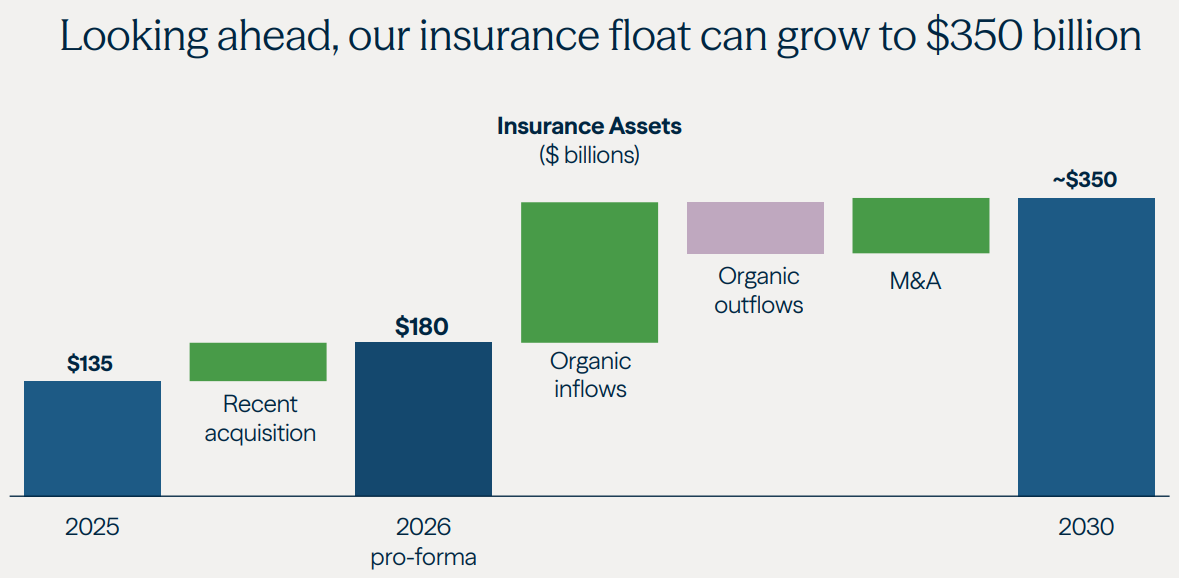
Notably, the returns achieved now exceed the division's own targets. Management indicated that in 2025 a return on equity above the mid-teens target (14-16%) was achieved, confirming that the combination of scale, funding mix and investment strategy is starting to work effectively.
The outlook for 2026 reinforces this picture. During the 2025 Investor Day, a target of $185 billion in insurance assets was still assumed. CEO Sachin Shah has since raised this expectation to approximately $200 billion by the end of 2026, an increase of around 40% relative to the current level. This should translate into more than $2 billion in Distributable Earnings, representing a profit increase of roughly 20% compared with 2025. In absolute terms, this would put BWS on a comparable scale to many mid-sized listed insurers, but with the unique advantage of access to Brookfield's global real-asset platform for investing premiums and float.
Looking ahead
Over the past month, Connor Teskey has been formally appointed CEO of Brookfield Asset Management (BAM). Bruce Flatt remains Chairman of BAM and retains his role as CEO of the holding company, Brookfield Corporation (BN). In his Letter to Shareholders, Flatt emphasises that this is not a sudden change of course, but the culmination of a multi-year succession plan. The message is that Brookfield has now become so institutionalised that its culture and investment discipline are safeguarded independently of individuals.
Furthermore, a central theme in Flatt's vision is the exponential demand for infrastructure driven by the rise of Artificial Intelligence (AI). Brookfield finds itself in the unique position of being able to supply both the necessary renewable energy and the physical data centres. In his letter, Flatt speaks of the "enormous capital need for global digitalisation". Through partnerships with tech giants such as Microsoft and NVIDIA, Brookfield is positioning itself as the indispensable financier and builder of the AI backbone.
Expectations for the coming years are ambitious, but underpinned by a well-stocked pipeline:
- Carried Interest (BN): Management expects realisations from investments to increase significantly in the second half of 2026, with a further acceleration in 2027 and 2028. This will drive profit sharing as a source of income to new heights.
- Growth outlook (BAM): During the presentation, management was notably optimistic about 2026. It stated that if current market conditions persist, 2026 will show a "step-by-step improvement" on an already record-breaking 2025. Whereas the current five-year plan assumes growth of 15%, management indicated that current prospects could even exceed this level, moving towards 20%.
With growth of around 20% in the key divisions (Asset Management and Wealth Solutions) and confirmation that this growth will continue into 2026, Brookfield appears to be more than living up to its promises. Bruce Flatt sums it up well in his letter: global uncertainty is precisely what creates the opportunities from which a capital-rich player like Brookfield benefits.
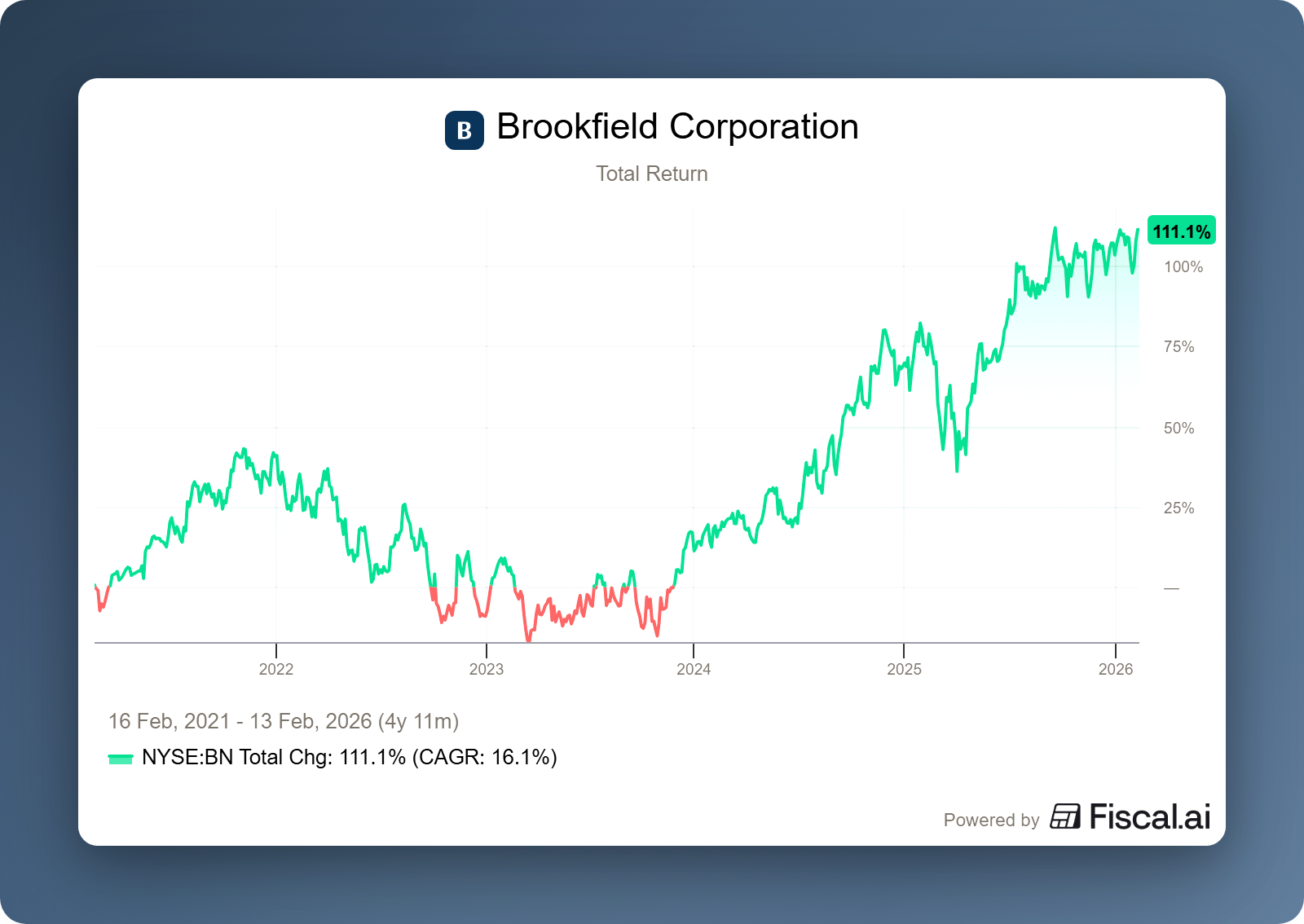
Brookfield Corporation ended the trading week on the New York stock exchange at a price of USD XXX per share.
Receive weekly insights in your inbox
Exclusive analyses and updates on family holding companies and global market developments.
KKR delivers robust figures in a turbulent market environment
The American investment holding company KKR & Co. (New York: KKR) closed out 2025 with record figures for capital deployment and assets under management (AUM), despite a recently challenging stock market climate. While the alternative investments sector is under pressure due to concerns about the impact of AI on software investments and risks in private credit (see our deep dive this week for more on this), the core of KKR's results points to a robust business model that is largely decoupled from the current market panic.
The past year was historic for KKR in many respects. Total assets under management (AUM) rose by 17% to a record high of $744 billion. This growth was driven by strong fundraising, with $28 billion in new capital raised in the fourth quarter alone.
The key financial highlights of 2025 are:
- Stable income: 85% of profit now comes from recurring income streams, providing a buffer against market volatility.
- Management fees: Fees from asset management rose by 18% to $4.1 billion for the full year.
- Strategic growth: The insurance division, Global Atlantic, saw its AUM grow to $219 billion, of which $164 billion is invested in credit strategies.

In addition, KKR managed to raise a record $129 billion in new capital in 2025, the highest level in the firm's 50-year history. Within credit alone, $68 billion was raised, underlining the strong demand for private credit and asset-based finance strategies.
Operationally, too, profitability remained impressive: fee-related earnings (FRE) rose by 15% year-on-year, while the FRE margin came in at approximately 69% for the full year, a level that ranks among the highest in the sector and points to significant operating leverage.
Importantly, KKR had $118 billion in 'dry powder' at the end of 2025. In a volatile market, this represents not only defensive flexibility but, above all, offensive firepower to invest whenever opportunities arise.
Despite the strong growth figures, there are clear pain points that are worrying investors. In the fourth quarter, KKR narrowly missed profit expectations ($1.12 per share versus an estimated $1.14). This was mainly due to a one-off repayment of 'carried interest' in one of the private equity funds that underperformed. In addition, the entire sector is grappling with "software fears". Although there is concern in the market that AI developments will disrupt the business models of software companies in private equity portfolios, KKR emphasised that its software exposure, at 7% of assets under management (AUM), is manageable.
Management stresses that AI does not only pose a risk but in fact offers an enormous investment opportunity. Through its infrastructure division, KKR is investing heavily in the physical backbone of this technology, including data centres, power supply and cooling technology. The infrastructure business has grown organically from USD 18 billion to USD 100 billion in five years, underscoring the successful focus on this growth market.
At the same time, management points out that periods of market volatility have historically proven to be strong investment years. With a globally diversified portfolio, limited exposure to '2021 vintages' and record embedded gains of approximately $19 billion on the balance sheet, KKR considers itself well positioned to accelerate future realisations once market conditions improve.
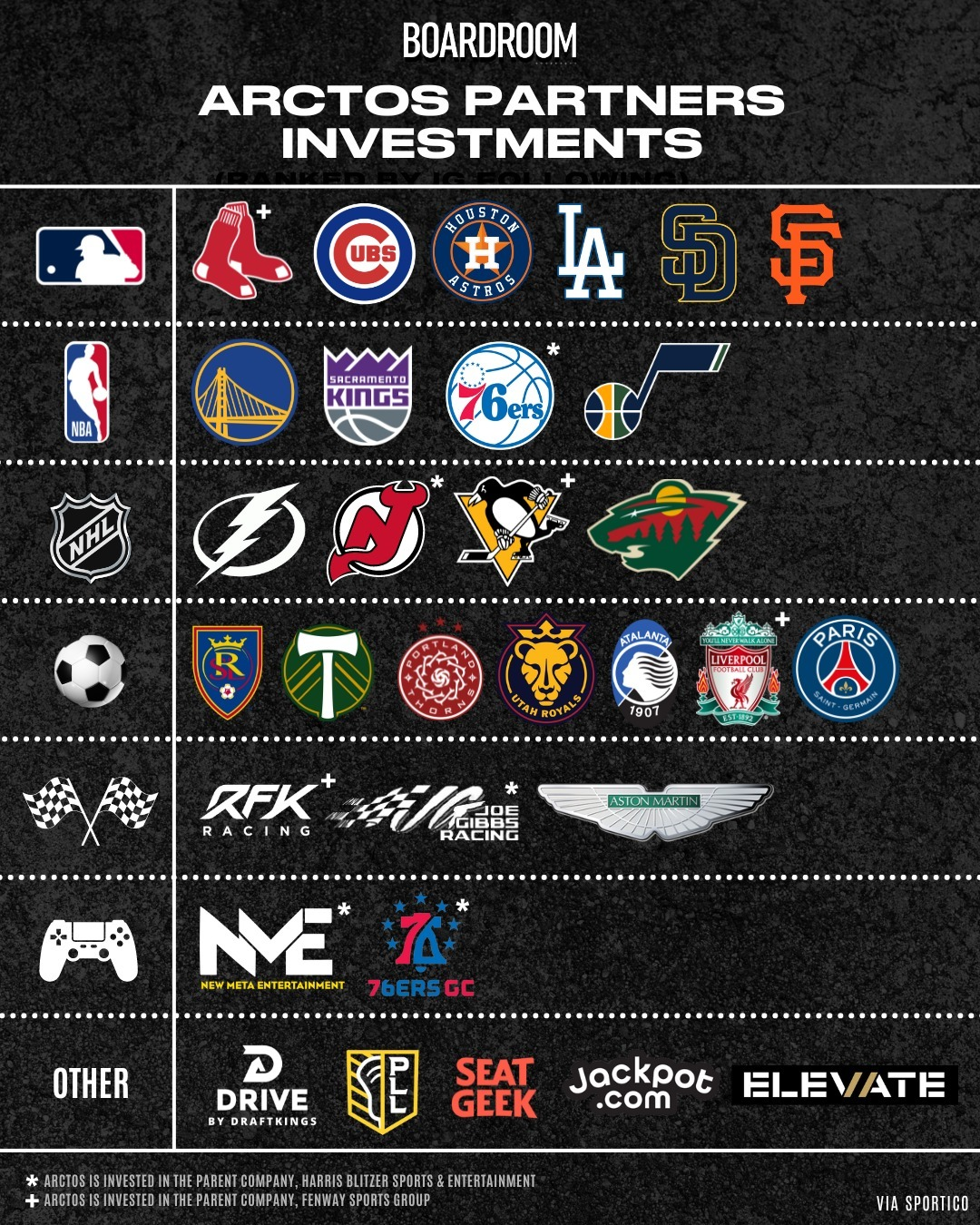
Acquisition of Arctos Partners
During the presentation of its 2025 annual results, KKR officially announced the acquisition of Arctos Partners. For many investors, Arctos is a new name, but within the industry the firm is known as a pioneer in institutional investment in professional sports teams. With $15 billion in assets under management, Arctos has secured a unique market position as the only party permitted by the major American sports leagues (such as the NBA, MLB and NHL) to hold minority stakes in multiple teams simultaneously.
KKR's management sees Arctos as the ideal foundation for setting up an entirely new division within the company: KKR Solutions. This new division will integrate Arctos's current activities and serve as the platform for a broadly based 'multi-asset class secondaries business' that KKR aims to build out in the coming years. According to Co-CEOs Joseph Bae and Scott Nuttall, this step provides access to three specific growth areas: sports, capital solutions for asset managers, and secondary markets. Scott Nuttall explained that the sports world is at a tipping point, where professional capital management is becoming essential for the next growth phase of clubs and leagues. By combining KKR's deep pockets and global network with Arctos's specialised expertise, management expects KKR Solutions to make a significant contribution to the targeted earnings growth for 2026 and beyond.
Conclusion
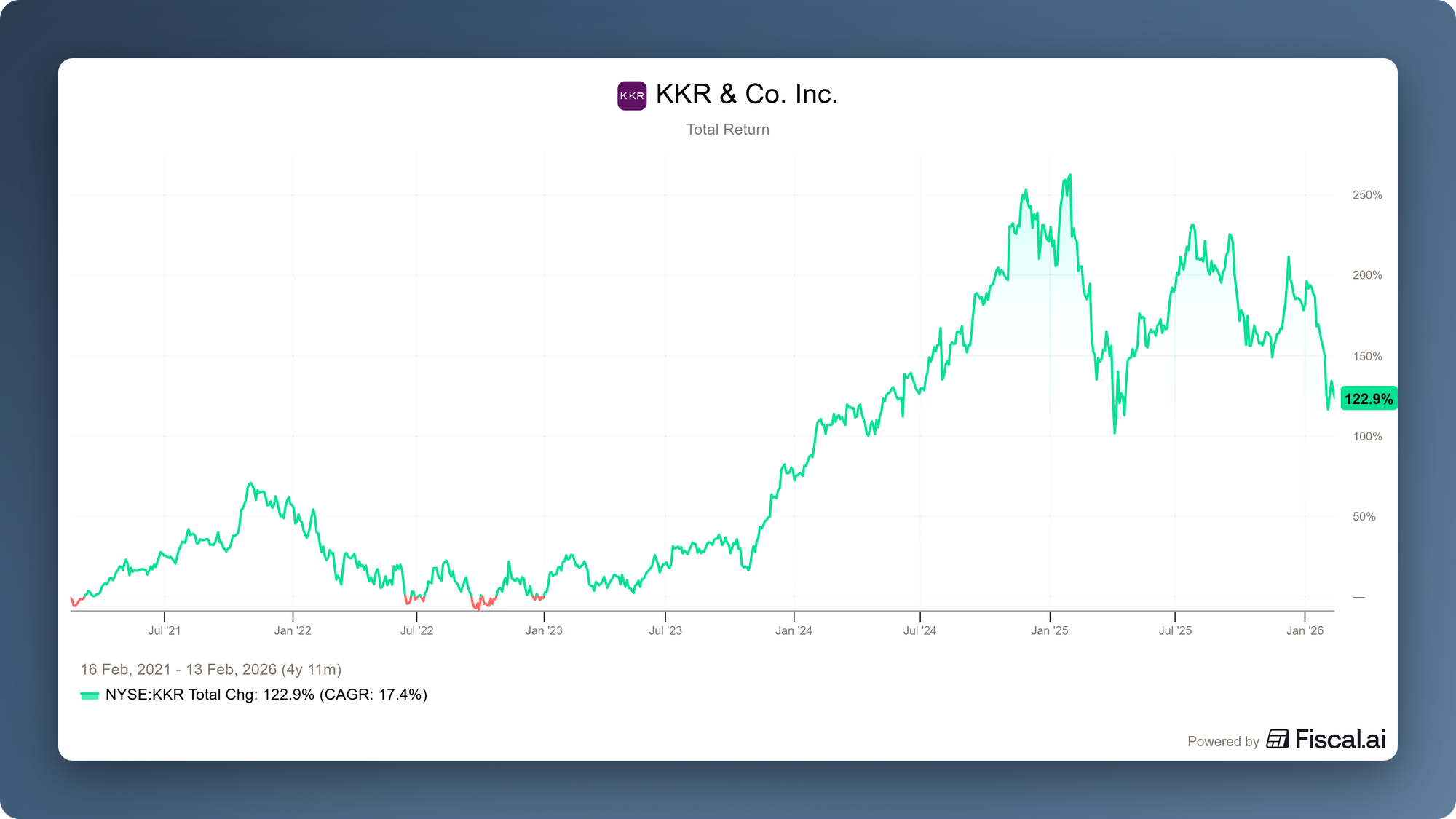
Although KKR's share price is under pressure and moving towards 52-week lows, analysts point to a historically low valuation of approximately 12x expected earnings for 2027. The correction in KKR shares is larger than the company's full exposure to the software sector would justify. We would like to refer you to this week's deep dive.
Against this stands a company that managed to increase its management fees by more than 50% over three years (while costs rose by only 25%), raised record amounts from investors and structurally improved its profitability through operating leverage. With a strongly diversified model spread across asset management, insurance and strategic holdings, KKR is today less cyclical and less dependent on any single asset class than ever before.
If the monetisation climate normalises in 2026, KKR has both the embedded value gains ($19 billion) and the balance-sheet capacity and capital to capitalise on this fully. For long-term investors, the current weakness may therefore be more of an entry opportunity than a structural warning sign.
KKR is currently trading on the New York Stock Exchange at USD 102.23 per share.
TerraVest between tariffs and technology
The Canadian investment holding company TerraVest Industries (Toronto: TVK) recently published its results for the first quarter of fiscal year 2026. The company reported revenue growth of 74% to $408 million, while cash flow from operating activities rose 164% year-on-year. Naturally, for a serial acquirer such as TerraVest, most of this growth comes from acquiring new companies; however, the company's core portfolio also showed impressive organic growth of 9%. We should note, though, that this figure includes the two companies Aureus and Wave, which have been added to the core portfolio because they are now fully integrated into the ecosystem.
The key measure of value creation at TerraVest is Cash Available for Distribution (CAFD). This rose by a solid 34% in the past quarter, to $33.2 million, underscoring the effectiveness of the recent acquisition strategy and the focus on free cash flow.
Headwinds and tailwinds
In the recent press release, CEO Dustin Haw stressed that the outlook for the company will remain uncertain for as long as the unrest over import tariffs between the United States and Canada persists. Although TerraVest itself is barely directly affected by these tariffs, thanks to its broad North American manufacturing footprint, the resulting market uncertainty is nonetheless weakening demand for capital goods such as tank trailers. Customers are postponing their investments until the political dust has settled.
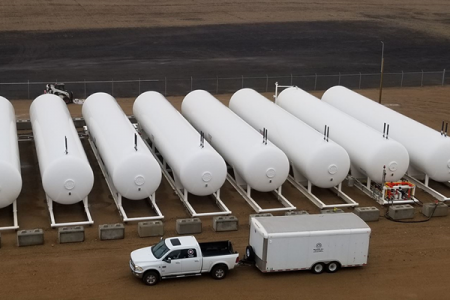
Shortly after the results were released, this was compounded further by US Secretary of Transportation Sean Duffy. He announced a strict "Safety First" policy, under which a crucial rule has been finalised with immediate effect that drastically restricts access to commercial driver's licences (CDLs) for non-resident drivers.
While Duffy's policy and the tariff disputes are putting a temporary brake on the transportation division, the explosive growth in the data centre sector is acting as a powerful counterweight. Several of TerraVest's subsidiaries are currently experiencing unprecedented demand for products that are essential to the large-scale rollout of data centres across North America. According to National Bank Financial, January—a month not yet reflected in the current quarterly figures—was the strongest month for order intake for data-centre-related infrastructure in the company's history.
Although the industrial sector remains under sustained pressure, TerraVest's results clearly demonstrate how strongly the company is performing. They confirm the quality of the business and the management team's consistent execution capability.
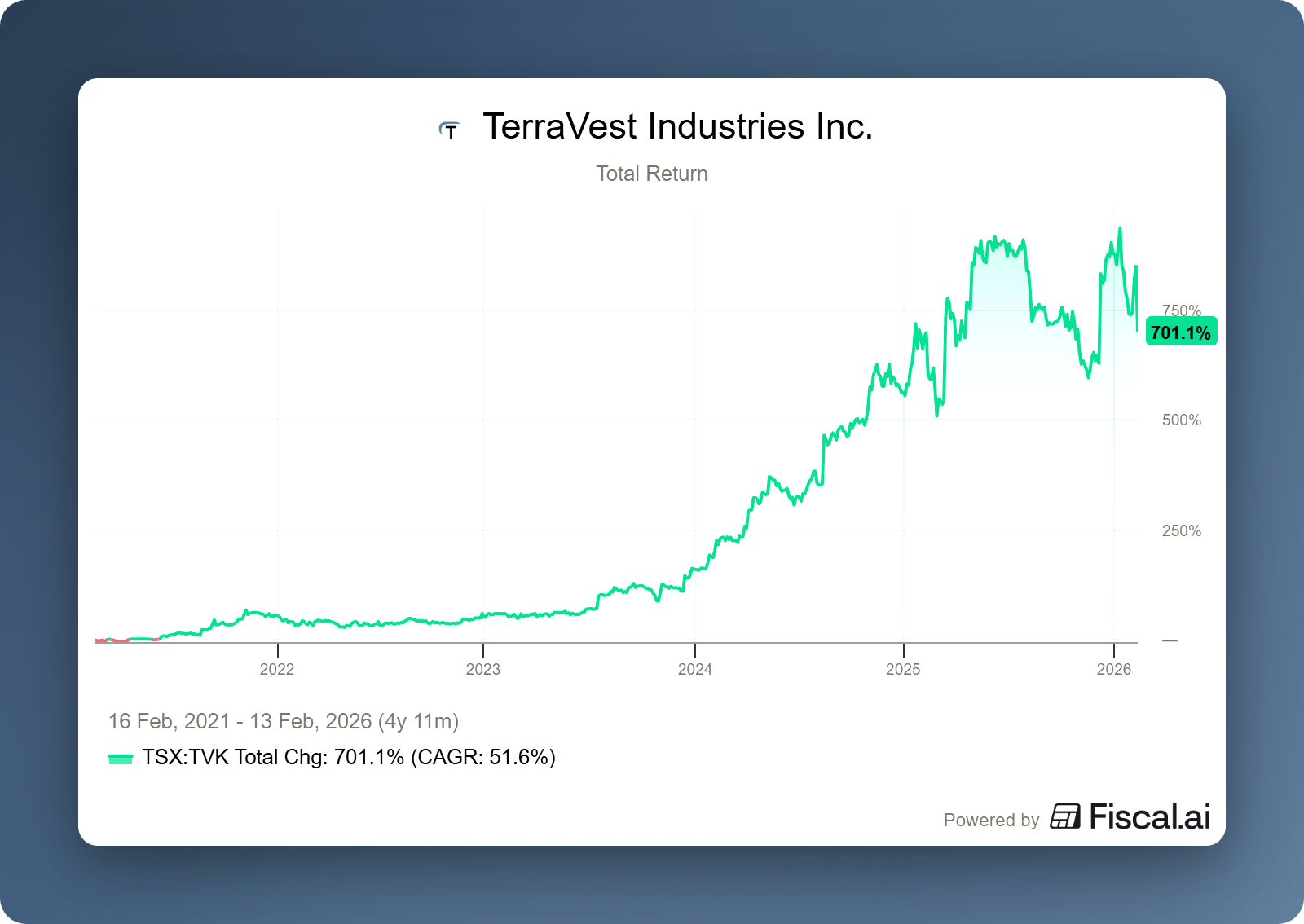
TerraVest currently trades on the Toronto Stock Exchange at a price of CAD 137.64 per share.
Receive weekly insights in your inbox
Exclusive analyses and updates on family holding companies and global market developments.
A century of trust and fines
In the dynamic world of Big Tech, a week is an eternity. For a giant like the American investment holding company Alphabet (New York: GOOGL), there is therefore always something to report. This week was no exception; we have set out the most notable developments for you below.
A Century of Trust
Alphabet kicked off the week with a powerful signal to the capital markets. Immediately after announcing a gigantic investment plan of $180 billion for 2026, the company turned to the bond market. What began as an intention to raise $15 billion turned into a genuine stampede of investors. With subscriptions reaching as much as $100 billion, Mountain View decided to increase the issuance to $20 billion.
The most striking part of the issuance was a 100-year bond. A unique phenomenon previously seen with Disney and Coca-Cola. The fact that Alphabet can place debt with a maturity stretching into the 22nd century underscores the market's rock-solid confidence in the company's ultra-long-term viability.
The AI Race
The long-awaited funding round for Anthropic has closed at a valuation of $380 billion, a touch higher than the previously estimated $350 billion. Alphabet still holds a 7% strategic stake in the company and can therefore book $2.1 billion in unrealised gains on paper. The British holding company Scottish Mortgage Investment Trust also has a position in Anthropic, and thus shares in the gains.
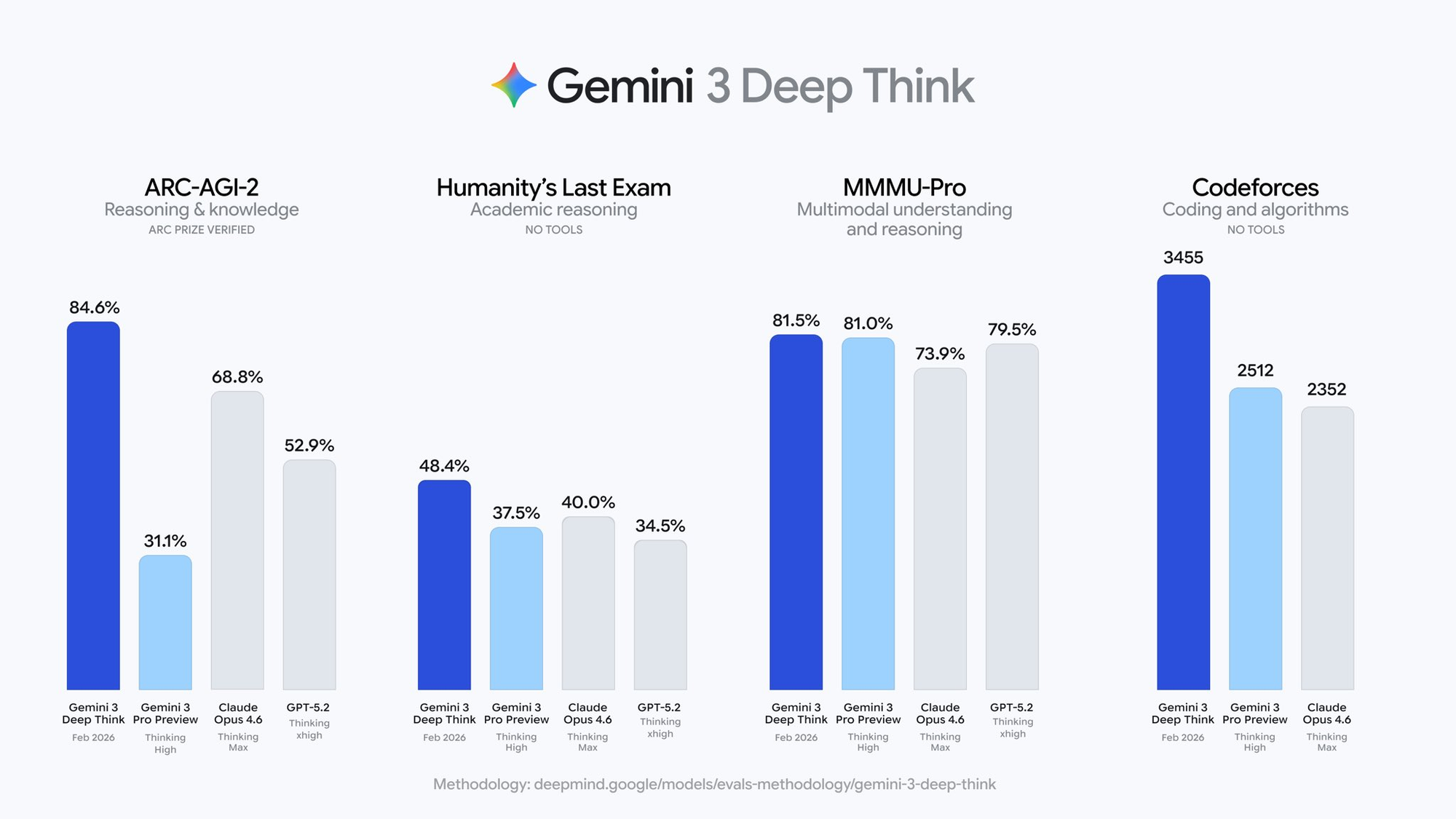
The question, however, is how stable these valuations are in a market where the "throne" changes hands weekly. Just seven days after Anthropic raised the bar again with Claude Opus 4.6, Google claims to have reclaimed the top spot with Gemini 3 Deep Think. At Tresor Capital, we remain level-headed about this: for an outsider, the technical significance and legitimacy of these weekly benchmarks are barely verifiable. It looks like a permanent state of leapfrogging in which the truth often lies somewhere in the middle.
A Century of Rules
Where Alphabet receives blind trust from investors, it receives nothing but rules and fines from the European Union. Just five weeks ago, we wrote in a recent analysis about Gemini's approaching dominance. This prediction became reality faster than expected this week.
 Joep Dikken
The European Publishers Council (EPC) is now officially accusing Google of "hijacking" content for its AI Overviews, without permission or fair compensation. According to the EPC, this undermines the economic foundation of the open web. Where Google defends the new features as a matter of consumer convenience, the watchdog sees an emerging digital infrastructure monopoly and a dangerously skewed balance of power.
The cup of woes was not yet empty: two days later, Bloomberg revealed that the EU has also launched an investigation into manipulation within advertising auctions. The Commission suspects that Alphabet is artificially inflating prices to the detriment of advertisers. While the market looks 100 years ahead, Brussels is focused on curbing its current dominance right now.
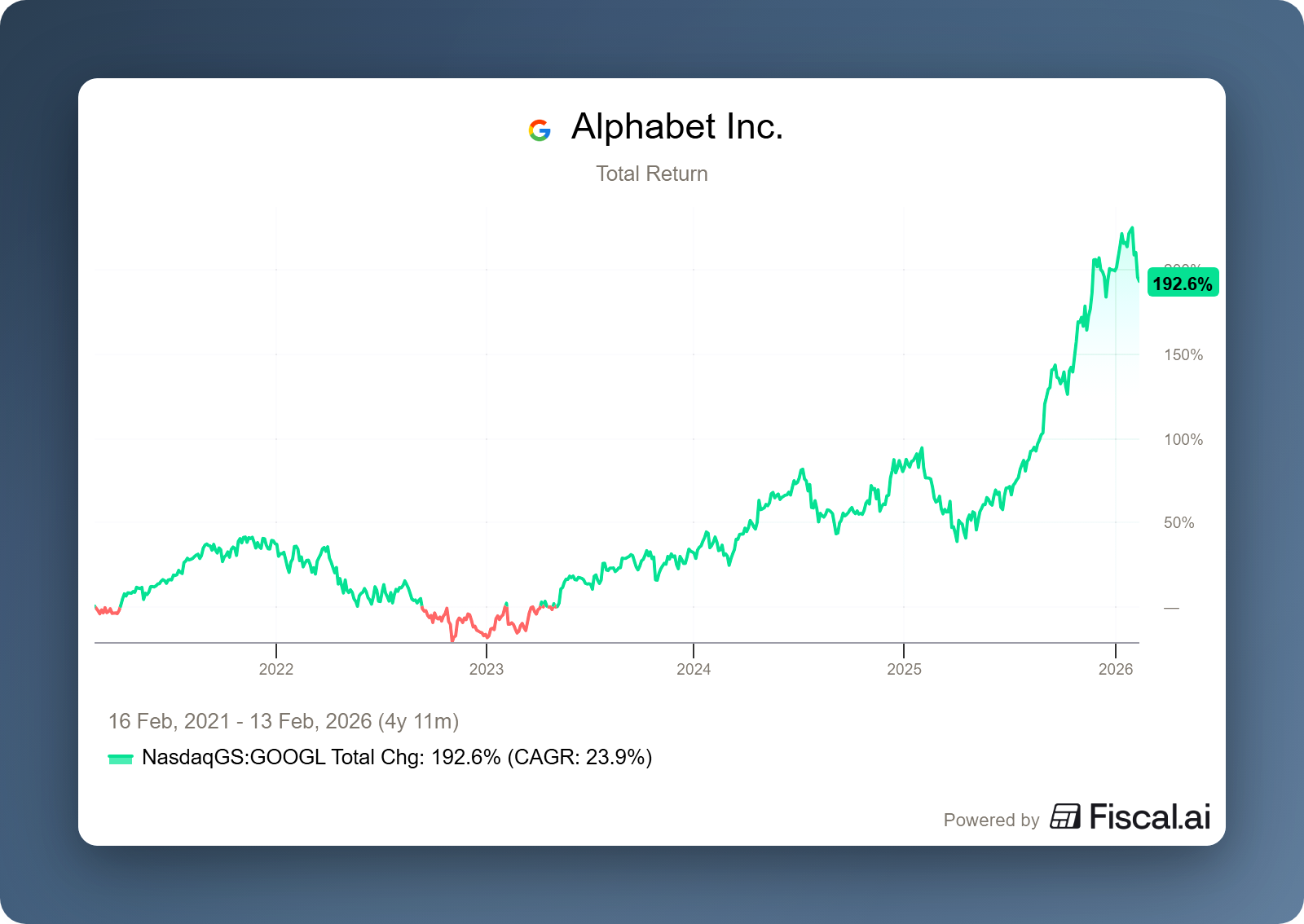
Alphabet is currently trading on the New York exchange at a price of USD 306.33 per A share.
Receive weekly insights in your inbox
Exclusive analyses and updates on family holding companies and global market developments.
Would you like more information about our services?
Get in touch
Disclaimer:
No rights may be derived from this publication. This is a publication of Tresor Capital. Reproduction of this document, or parts thereof, by third parties is only permitted after written permission and with reference to the source, Tresor Capital.
This publication has been compiled by Tresor Capital with the greatest possible care. The information is intended in a general sense and is not tailored to your individual situation. The information should therefore explicitly not be regarded as advice, an offer or a proposal to purchase or trade investment products and/or to make use of investment services, nor as investment advice. The authors, Tresor Capital and/or its employees may hold positions in the securities discussed, for their own account or on behalf of their clients.
You should carefully consider the risks before you start investing. The value of your investments may fluctuate. Past performance is no guarantee of future results. You may lose (part of) your original investment. Tresor Capital disclaims any form of liability for any inaccuracies or errors. This information is indicative only and subject to change.
Read the full disclaimer at tresorcapitalnieuws.nl/disclaimer .
This article was translated automatically from Dutch using AI. In case of any difference, the Dutch original prevails. Read the original in Dutch.