Economy & Markets #4 - Geopolitical risk falling, or is it not?

This week's topics:
Japanese government bonds under further pressure: is a definitive “Liz Truss moment” coming to Tokyo?
The Japanese government bond market (JGBs) has been notably turbulent in recent months. Whereas Japan was for years the very model of stable (and above all low) interest rates and an economy characterised by deflation (good for bondholders), we are now seeing a clear sell-off, particularly at the long end of the curve. This is relevant not only for Japan itself, but also for global markets via the well-known JPY carry trade. In this trade, not only Japanese retail investors (the well-known “Mrs Watanabe”) but also hedge funds and banks borrow at low Japanese interest rates in order to reinvest in (higher-yielding) assets in the US, Europe and Australia. Given the scale of the JPY carry trade, with BIS data based on FX derivatives pointing to a “yen supply” of roughly $1.3–1.7 trillion, a rise in JPY funding costs could trigger unrest worldwide, as investors unwind JPY carry positions and repatriate capital.
What exactly is going on?
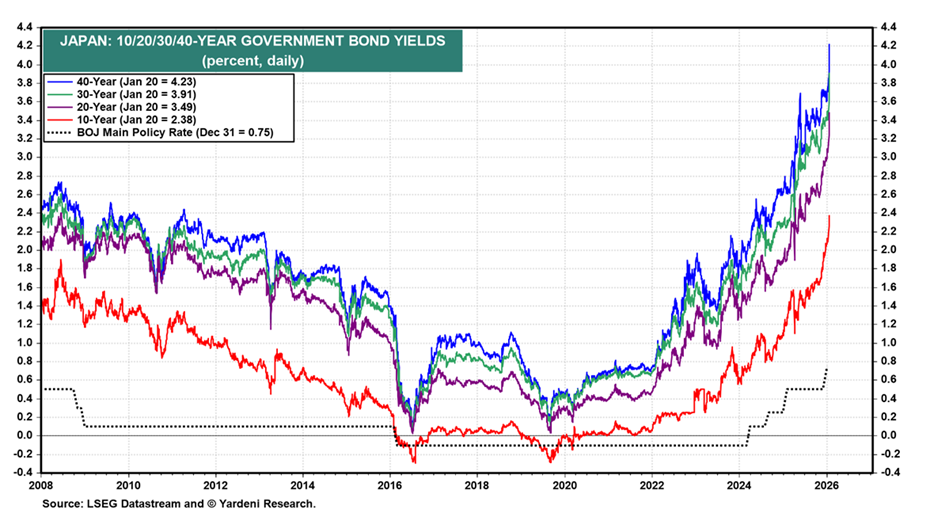
The deflationary period from the late 1990s to the mid-2010s was the result of several factors: the bursting of Japan's property bubble (the anecdote goes that the land beneath the Imperial Palace was once worth more than all the real estate in Florida combined), an ageing population (deflation is beneficial for savings and pension income), and a strong yen. Thanks to this period, the Japanese central bank was able to keep short-term rates very low for a prolonged period. After decades of deflation, Japan now suddenly finds itself in an uncomfortable mix of persistent inflation and still-low short-term rates. The weak yen effectively imports inflation, partly via the energy bill (Japan, like China, has relatively few natural resources) and higher prices for imported goods (such as rice). With inflation of roughly 3% and a short-term rate of around 0.75%, the real interest rate is clearly negative. Under normal circumstances, that is almost “policy-ideal” for a government wanting to inflate away its (high) national debt. But that negative real rate only works for as long as investors believe that:
- inflation will eventually come back under control, and
- the yen will not keep weakening structurally.
Once that confidence starts to falter, investors demand a higher compensation on long maturities. And that is precisely what is happening now. Whereas Japan's long-term rate stood at around 0.6% in 2020, it has risen sharply in a short period to around 4.3%. This implies substantial losses, roughly in the order of tens of percent for long-dated bonds, and is reminiscent, in terms of volatility, of the performance of ultra-long Austrian government bonds. The major difference, however, is that in Japan the risks lie in the public sector (the Bank of Japan has already bought up 55% of government debt), whereas with Austrian bonds the risks lie mainly with European insurers and pension funds.
Japan is known for its exceptionally high government debt (more than 260% of GDP (IMF)). At the same time, the government holds substantial financial assets, and a large part of the debt is held domestically. As a result, net debt (150% according to the MOF, and 78% according to an estimate by the St Louis Fed) is less dramatic than the gross figures suggest. The key question for investors is therefore not “can Japan pay?”, but rather: does the combination of inflation, policy and yen stability remain credible? Not because Japan is identical to the UK, but because the underlying mechanism could play out in a similar way. Once investors start to doubt the fiscal course or the role of policy as an anchor, the risk premium rises and interest rates can climb sharply within a short period. For Japan, where stability has been the norm for decades, that would represent a clear regime shift. High inflation also typically spells the end of a government. Japan is not an isolated market. A shock in JGBs can spill over into other markets through several channels:
- The search for the next weak link in (unsustainable) government debt: how long can countries such as Belgium, Spain, France, Italy and Portugal keep financing their government debt on their own strength?
- Interest rate differentials: higher Japanese rates change relative valuations worldwide.
- Exchange rates: movements in the yen directly affect international portfolios.
- Positioning and leverage: in moments of stress, positions are not “reconsidered” but often quickly unwound.
Fiscal pressure and politics increase the risk premium
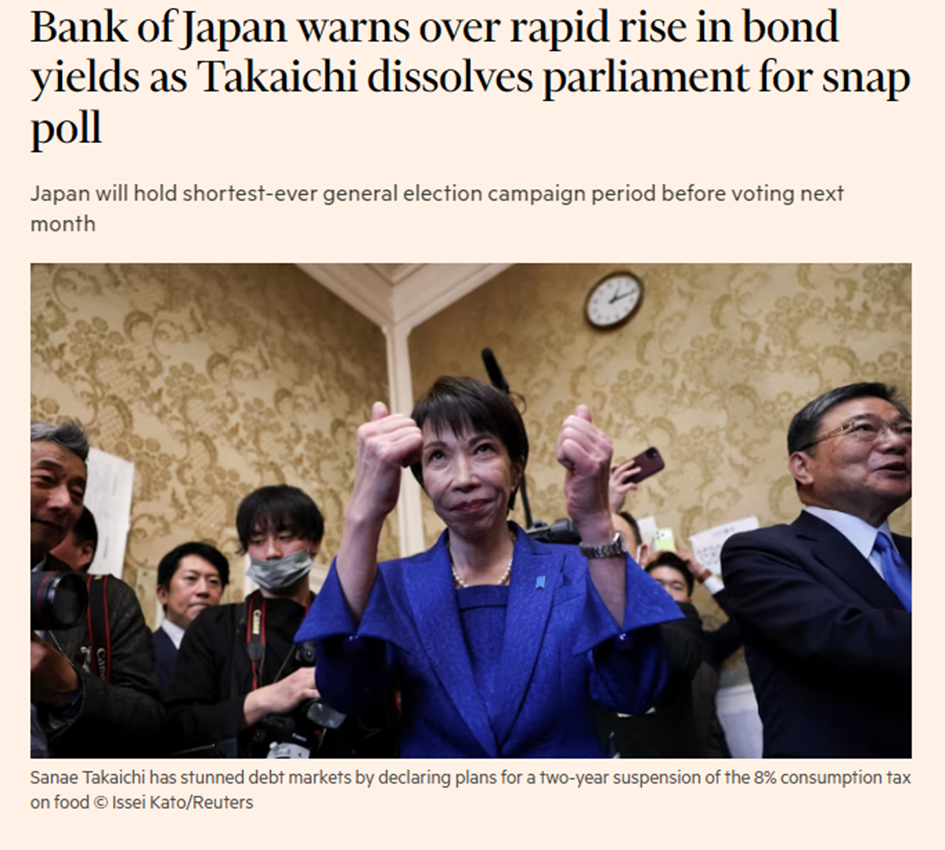
The risk premium may rise further as government deficits widen again. Prime Minister Sanae Takaichi is pursuing a more assertive international policy, with elements reminiscent of a Japanese “chips act” for industry. At the same time, tensions with China are escalating, which could lead to higher defence spending. And naturally, higher interest rates also mean a greater burden of interest costs on the budget. This week, Prime Minister Takaichi unexpectedly dissolved parliament and called an early election for 8 February. Her campaign includes, among other things, a proposal to suspend the 8% consumption tax on food for two years (in the order of ~¥5 trillion), which is raising concerns among investors about additional spending and fiscal discipline.
Receive weekly insights in your inbox
Exclusive analyses and updates on family holding companies and global market developments.
Star investor Ken Griffin critical of European politicians: Just do it!
Ken Griffin is the founder and CEO of Citadel (hedge fund) and owner of Citadel Securities (market maker). Forbes estimates his wealth at approximately USD 51.8 billion. Griffin, who is known as Republican-leaning, called in Davos for more decisiveness in Europe: less talking and faster reform, particularly to strengthen growth and competitiveness. At the same time, he is critical of the debt dynamics in countries such as Japan and France. He is relatively more positive about the US: in his view, the American economy remains resilient; the BEA reported real GDP growth of 4.4% (annual rate) for Q3 2025, while the GDPNow forecast (Atlanta Fed) for Q4 2025 stood at around 5.4% (as of 21 January 2026). His main warning to Washington: do not undermine the independence of the Federal Reserve, as political pressure on monetary policy, according to Griffin, increases the risk of new inflation shocks.
Ray Dalio in Davos: monetary order under pressure, more “money printing” and a flight to hard assets such as gold
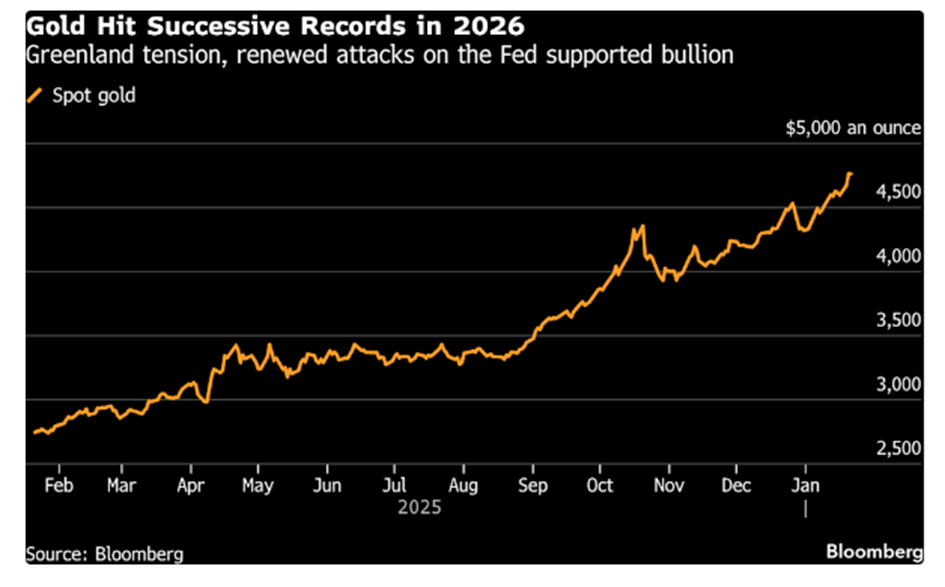
Star investor Ray Dalio (founder of hedge fund Bridgewater) warns in his book "How Countries Go Broke" that rising debt levels increase the pressure on central banks to "prop up" the system with extra liquidity, risking currency weakening and new waves of inflation. The developments in Japan are not an isolated case: in this new regime, Dalio seeks protection in gold and other hard assets and advises stepping away from government bonds. He is also looking at gold and defence-related investments, in keeping with a world in which geopolitical tensions are structurally higher. Earlier, he explicitly named gold as a hedge/"reserve asset" for this new regime, with a guideline of 5–15% in gold in a well-diversified portfolio. His view is supported by analysts at Goldman Sachs, who even see the gold price rising to USD 5,400 per troy ounce (versus USD 4,900 per ounce now).
We stress that the combination of rising geopolitical tensions and exceptionally high government debt levels (Japan, Europe and the United States) is increasing demand for 'safe havens'. This partly explains why precious metals have structurally been in the spotlight over the past period.
Gold miners: long gold - short oil
Last year, following on from this, we already pointed out the attractiveness of gold miners in our (model) portfolios. Miners benefit not only from a rising gold price, but in many cases also from lower (or falling) energy prices, particularly for fossil fuels. Metal extraction is, after all, highly energy-intensive, partly because ore grades are, on average, increasingly lower in concentration. That means more rock needs to be moved, ground and processed for the same amount of metal, and therefore rising energy demand per unit produced.
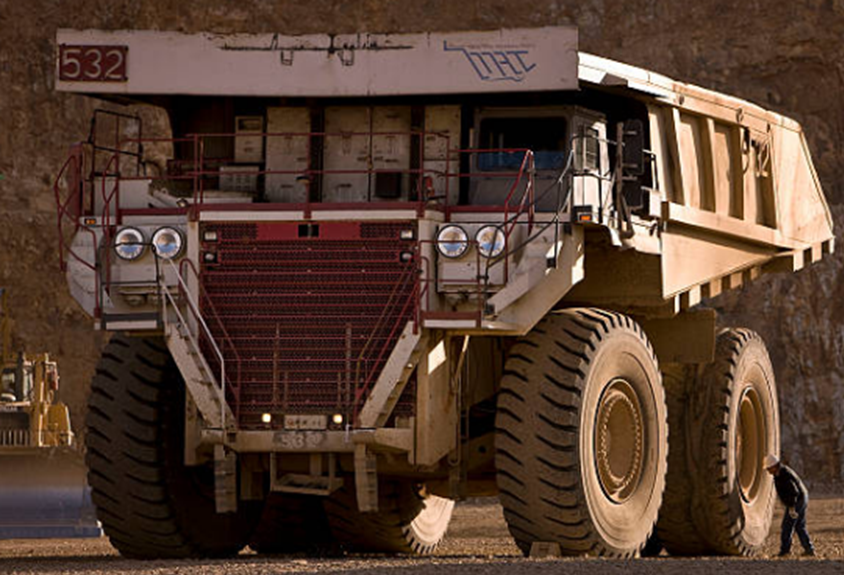
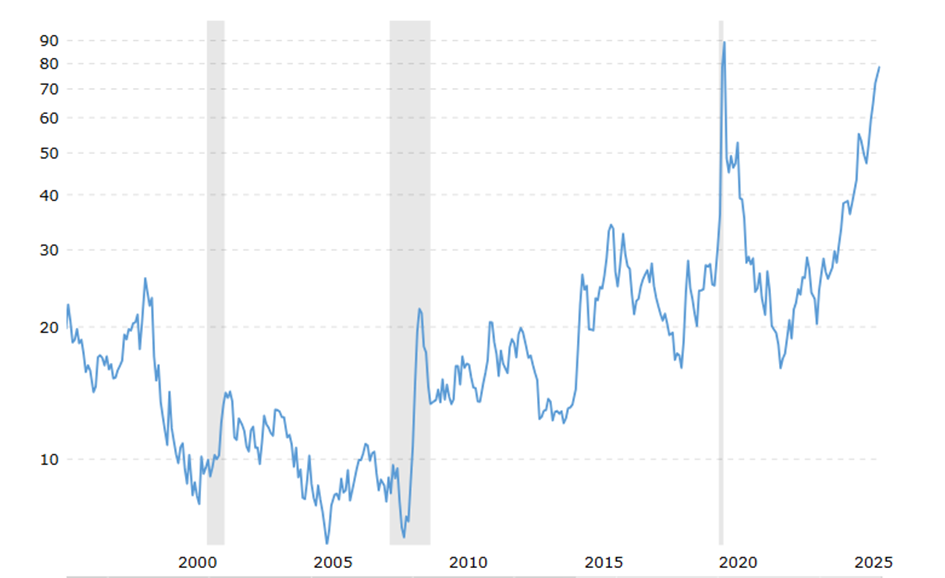
This is already particularly relevant for copper, which plays an important role in the energy transition. Very rough calculations conclude that producing 1 tonne of copper consumes more than 4,000–7,000 litres of diesel (with wide variation depending on the ore, mining method and process route). For gold, this is unimaginably many orders of magnitude higher: the same calculations lead to extreme estimates of as much as 7,000–18,000 litres of diesel consumption for the production of 1 kilogram of gold. The chart below shows that the gold price–oil ratio has historically sometimes reached extreme levels. The previous peak occurred when oil briefly traded negative during the coronavirus period. The current, again very high, ratio suggests that the margins of gold miners could accelerate further.
DNB's risk lenses: strict on gold and Big Tech, but possibly blind to "safe" long-dated debt?
De Nederlandsche Bank (DNB, the Dutch central bank) has for years explicitly warned of risks in gold, and more recently also in US Big Tech stocks. That is defensible from the standpoint of limiting concentration-risk exposure to momentum stocks, but it raises an uncomfortable question. Precisely because these categories in many cases keep performing well, while the biggest value shock for pension investors in recent years came from a different corner: namely long-term interest rates and bonds.
DNB itself holds more than 600 tonnes of gold, worth around €49 billion at the end of 2024, and describes this as a "trust anchor". At the same time, in 2011 it forced Pensioenfonds Vereenigde Glasfabrieken to reduce its gold position from around 13% to 1%, on the grounds that this would not fit within the prudent-person approach. The return on gold has since risen by around 200% (in euros), while long-term bonds have at best remained stuck at 0% since 2011.
A similar risk of repetition is emerging with US technology. DNB warns that, at the end of July 2025, pension funds had invested around €150 billion in the 'Magnificent Seven', almost 43% of their listed equity portfolio. That analysis is substantively defensible, but again, the biggest realised risk lay elsewhere. According to DNB's own figures, total pension assets fell by €406 billion in 2022, largely due to price losses on long-term bonds. This underscores that interest-rate hedging does not eliminate risk, but shifts it. The funding ratio can remain stable while real earning capacity comes under pressure.
In our model portfolios, we remain critical of bonds for as long as financial repression persists (central banks keeping interest rates lower than inflation, resulting in a negative real interest rate). There is also a degree of fiscal repression involved in investing in bonds. Dutch retail investors must pay at least 2.2% tax on bonds, while Belgian investors face a 30% Reynders tax on the capital gains of bond funds.
Incidentally, it appears that another major Dutch pension fund read our advice in last week's newsletter not to invest in US government bonds, on either a hedged or unhedged basis. 😉
Receive weekly insights in your inbox
Exclusive analyses and updates on family holding companies and global market developments.
Geopolitical risks are rising, but not where you might expect
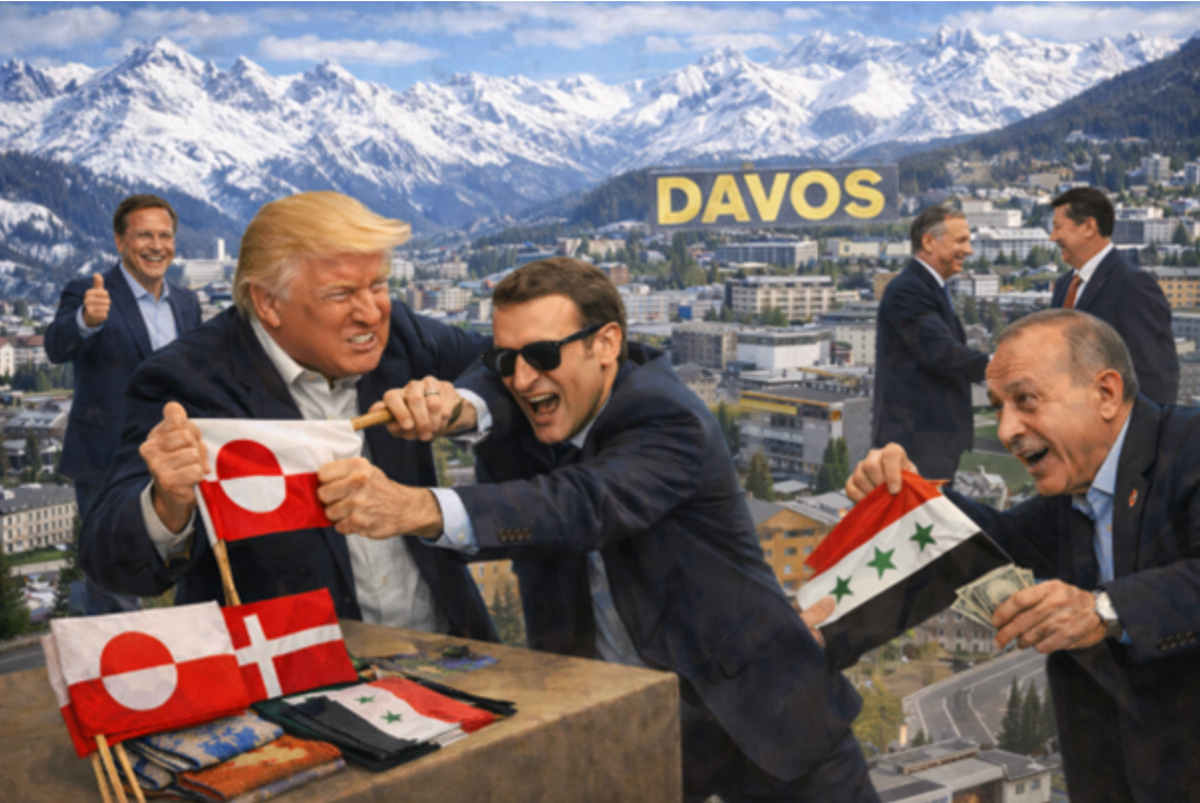
Equity markets faced higher volatility this week. A significant part of this was driven by renewed concerns about a possible resurgence of last year's trade conflict. We have grown accustomed to strong statements from Washington, but markets were nonetheless rattled when President Trump threatened military escalation over Greenland and import tariffs of up to 200% on European (particularly French) goods. This shifted attention to his speech in Davos: would it remain mere rhetoric, or would concrete measures follow?

In Davos, Trump spoke of a "framework" for a future deal regarding Greenland, in coordination with NATO Secretary-General Mark Rutte. At the same time, it was reported that previously announced trade measures targeting several European countries had been withdrawn or softened, presented as a gesture of goodwill within a broader negotiating framework. For investors, the emphasis on de-escalation was particularly relevant: "I don't want to use force" fits the familiar pattern of the so-called "TACO trade" ("Trump Always Chickens Out"): sharp rhetoric that ultimately gives way to a more pragmatic compromise (and thus an ideal buying opportunity).
Why Greenland remains strategic
Trump's blunt approach is fuelling growing resistance, mounting distrust and increasing talk of a multipolar world order. Both Canadian Prime Minister Carney and French President Macron are now speaking openly about (exploratory) trade deals between Canada and China and about closer cooperation between Europe and China. In doing so, they are positioning themselves more explicitly at a distance from the US, which is hardly surprising given the now strained relations.
In that light (of escalation), it is likewise not entirely unexpected that the Trump administration is reportedly voicing support for an independence referendum in the Canadian province of Alberta. The US could be steering towards a similar initiative in Greenland. It is worth remembering that Greenland is the first territory ever to have left the EU. It joined in 1973 via Denmark, despite considerable opposition among the Greenlandic population. After the introduction of home rule in 1979, the island voted by a narrow majority in a 1982 referendum to withdraw, mainly over fishing rights, natural resources and autonomy. Since 1985, Greenland has held OCT (Overseas Countries and Territories) status and maintains limited, specific economic ties with the EU.
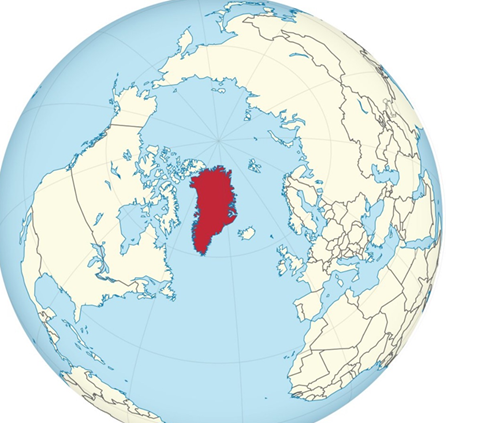
For the United States, the strategic significance lies mainly in geography. Greenland sits between North America and Europe and forms a crucial element of the so-called GIUK gap (Greenland–Iceland–UK), a zone important for tracking Russian submarine activity in the North Atlantic region. Missiles fired at the US from China or Russia would approach via the North Pole. In a scenario of strategic threat, every extra minute of detection time can be valuable. Within NATO as well, Greenland is relevant for air, sea and logistical operations in the Arctic region, which is receiving increasing strategic attention precisely because of climate change and changing shipping routes.
Resource wealth with strategic potential
Greenland holds substantial reserves of rare earth metals such as neodymium, praseodymium, dysprosium and terbium, which are essential for applications in the energy transition (wind turbines, electric vehicles) as well as for defence technology. To date, large-scale production has remained limited, partly due to political considerations, permitting processes and environmental frameworks. The strategic potential, however, is evident: with a more favourable investment climate and greater US involvement, Greenland could become an alternative to China's current dominance in parts of this value chain. Estimates of the scale vary widely and depend on further exploration, but the subject is now prominently on the geopolitical agenda.
Boiling point approaching in Iran and Syria
While the media focus on the symbolism surrounding Davos and Greenland, hard facts point to a growing US military presence in the Middle East. The aircraft carrier USS Lincoln is steaming at full speed towards the Indian Ocean with its radars and transponders switched off. B-2 bombers and tanker aircraft have flown from the US and the UK to Jordan and Diego Garcia (a US base in the Indian Ocean), while non-essential ground personnel have been withdrawn from Iraq, the Emirates and Qatar. This military build-up resembles the build-up that preceded the bombing of Iran's nuclear facilities in 2025. Although the uprising in Iran appears to have been brutally suppressed, the Iran file has not disappeared from the agenda of the hawks in the US. Fears remain, however, of a power vacuum emerging as previously happened in Iraq and Libya. Washington considers the risks of regime change to be substantial and has so far opted for strategic restraint. Yet the risk of doing nothing is also significant, as developments in Syria are now demonstrating.
Interesting interviews this week in Davos
Jamie Dimon (CEO of JPMorgan Chase) warned in Davos that the societal impact of AI is being underestimated. According to him, the technology could displace jobs faster than societies can absorb, creating risks for social stability. He stressed that retraining and policy need to keep pace with technological progress.
Jensen Huang (CEO of Nvidia) argued that the world is only at the beginning of the AI cycle. He called the current investments in data centres, chips and energy "the largest infrastructure build-out ever" and dismissed concerns about an AI bubble. According to Huang, AI is actually creating new demand for labour, particularly in construction, energy and engineering.
Larry Fink (CEO of BlackRock) said that AI investment is not a speculative bubble but a strategic necessity. He explicitly framed the development in the context of geopolitical competition and warned that the West is losing ground if it does not invest faster and jointly, with China as the key reference point.
German Chancellor Merz stated in Davos that the old world order is crumbling and that great-power politics is back: Russia and China are challenging the US and the existing order, with direct consequences for freedom, security and prosperity. To play a role, Europe must more quickly strengthen its competitiveness and invest heavily in defence and deterrence, backed by alliances "among equals". At the same time, he pointed to structural European weaknesses that are holding back progress: high and volatile energy costs, fragmented policy, too much and too complex regulation, slow decision-making, and a lack of scale in industry and capital markets, meaning that Europe often does formulate ambitions but falls short on execution and speed.
Receive weekly insights in your inbox
Exclusive analyses and updates on family holding companies and global market developments.
Would you like more information about our services?
Contact us
Disclaimer:
No rights can be derived from this publication. This is a publication by Tresor Capital. Reproduction of this document, or parts of it, by third parties is only permitted after written consent and with reference to the source, Tresor Capital.
This publication has been compiled by Tresor Capital with the greatest possible care. The information is intended in a general sense and is not tailored to your individual situation. The information should therefore explicitly not be regarded as advice, an offer or a proposal to purchase or trade investment products and/or to obtain investment services, nor as investment advice. The authors, Tresor Capital and/or its employees may hold positions in the securities discussed, for their own account or on behalf of their clients.
You should carefully consider the risks before you start investing. The value of your investments may fluctuate. Past performance is no guarantee of future results. You may lose (part of) your invested capital. Tresor Capital disclaims any form of liability for any inaccuracies or errors. This information is purely indicative and subject to change.
Read the full disclaimer at tresorcapitalnieuws.nl/disclaimer .
This article was translated automatically from Dutch using AI. In case of any difference, the Dutch original prevails. Read the original in Dutch.