
Economy & Markets #23 - The North Converges towards the South


Number of dollar millionaires rises in the Netherlands and Belgium
The number of dollar millionaires in the Netherlands rose by 2.5% last year compared with 2024. According to Capgemini, the Netherlands now counts 343,400 people with at least USD 1 million in investable wealth. This explicitly does not refer to total private wealth, but to wealth available for investment, such as equities, bonds, cash and real estate. A person's own family home, art, cars and jewellery are not included. Combined investable wealth grew by 3.8% to USD 909.8 billion, equivalent to roughly €783 billion (an average of €2.2 million per person). Belgium also saw a rise for the first time in four years and now counts 146,400 millionaires, an increase of 8.8% compared with 2024. Together they hold around €333 billion, equivalent to an average of roughly USD 2.2 million per person.
 anjumukeshmadnani
According to Capgemini, this growth is explained partly by a stronger economy, higher incomes and a recovery in equity markets. The number of wealthy individuals also increased globally. Worldwide, the number of dollar millionaires rose by 7.9% to 25.3 million, with combined wealth reaching a record USD 98.3 trillion. The segment of ultra-wealthy individuals in particular grew strongly. Globally there are now more than 250,000 people with investable wealth of USD 30 million or more. In the Netherlands, this group numbers 618 people. The United States remains by far the largest market for wealthy individuals. There, 736,000 new millionaires were added, bringing the total to 8.7 million. In Asia-Pacific, too, combined wealth increased sharply, helped by demand for semiconductors and rising Asian equity markets. Only in the Middle East did both the number of millionaires and their combined wealth decline slightly, affected by lower oil prices and regional uncertainty.
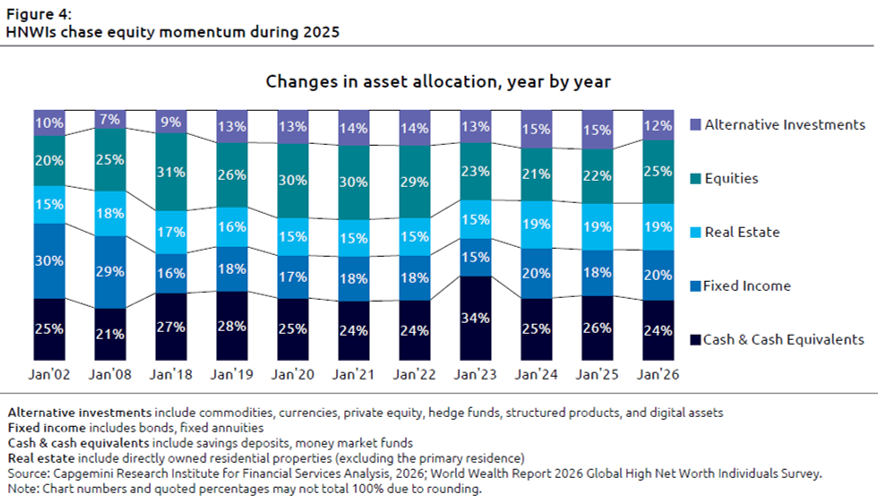
Capgemini also points to shifts in investment portfolios. In January 2026, equities made up an average of 25 percent of portfolios, bonds 20 percent, while alternative investments fell to 12 percent. It is notable that investment portfolios are being managed relatively conservatively.
According to Capgemini, the need for tailor-made wealth management continues to grow. Wealthy clients are asking for broader access to investment products, more personal guidance and advice that better matches their lifestyle, goals and financial planning.
Eurobonds: solidarity, a stepping stone to a transfer union? Or the beginning of the end?
Two weeks ago, I wrote in this newsletter that the Netherlands fits poorly into a monetary union in which monetary and fiscal policy structurally diverge. My argument was that the Netherlands, as the eurozone's only major AAA economy, should actually borrow more: not to finance deficits, but to invest in productive assets outside the eurozone as a hedge against further deterioration of the monetary union.
Japan is an interesting example in this respect. Thanks to the combination of a structurally weak yen, low financing costs and extensive foreign investments, the development of net government debt looks far less dramatic than the gross debt ratio suggests. Through, among others, pension fund GPIF, Japan has effectively benefited from a carry trade: borrowing in yen while the currency weakens, and earning returns on international investments. Because of the assets built up in this way, Japan's net government debt is about 80% lower than its gross debt. A similar approach could be attractive for the Netherlands: use its strong creditworthiness not for European debt mutualisation, but to build up national wealth outside the eurozone. Unfortunately, the political debate is moving in exactly the opposite direction.
This week, BNR's podcast Het Grote Plaatje focused on the discussion around eurobonds: joint European debt issuance through eurobonds could, in theory, lower financing costs, reduce the fragmentation of small capital markets and give Europe greater investment capacity. This is the line taken by professor Wim Boonstra, former Rabobank economist and advocate of eurobonds. In his view, the costs of a Nexit are so high that further European integration is ultimately the wiser course. Under certain conditions, he sees room for joint debt issuance as a way of softening a future euro crisis. This is where it becomes problematic. What hard conditions apply to participating countries? And who enforces compliance once political pressure mounts? The fact that the Netherlands, Austria, Denmark, Sweden and Germany are branded as "misers" by other eurozone countries is telling, despite their role as the de facto backstop for weaker member states. Remarkably, Sweden and Denmark have deliberately stayed outside the euro, yet are still expected to show solidarity.
Edin Mujagić (economist at Hoofbosch) and Han de Jong (former Chief Economist at ABN AMRO) raised serious concerns about eurobonds. Without strict budgetary discipline, eurobonds will grow into a mechanism whereby financially strong countries implicitly guarantee countries with weaker public finances. This does not solve the eurozone's structural problem; at best, it merely masks it temporarily. Anyone studying the history of the Euro currency will quickly be reminded of Mark Twain's words:
History does not repeat itself, but it often rhymes
The eurozone indeed proves that a shared currency does not automatically make countries converge. Differences in productivity, budgetary culture and economic structure persisted, while the Maastricht criteria, a maximum government deficit of 3% and government debt of 60% of GDP, were undermined at an early stage. Germany (Schröder) and France (Chirac) breached the deficit norm within just a few years, Spain and Ireland built up property bubbles, and Greece manipulated its figures. The irony is that Germany and the Netherlands once thought they would discipline Southern Europe through the euro, but are now themselves increasingly moving towards that same model. It is not the south converging towards the north; the north is converging towards the south.
Debt in itself is not always the problem. In Europe, the lack of nominal growth is the crucial factor. The debt ratio is determined by nominal growth, interest rates and the budget balance. If nominal GDP grows fast enough, the debt ratio can fall even if debt in euro terms barely decreases. Greece illustrates this. After the euro crisis, debt did not suddenly become low, but the debt ratio stabilised because nominal growth returned and deficits were reduced: the denominator (GDP) grew faster, while the numerator (debt) rose more slowly. A simple example: if a country starts with government debt at 100% of GDP, that debt ratio will eventually halve on its own given sufficient nominal growth, even without substantial nominal debt reduction.
The key point is that it is not only the deficit that matters, but above all the relationship between nominal growth and fiscal discipline. At 5% nominal growth, a deficit of 3% can still go hand in hand with a falling debt ratio; at 2.5% nominal growth, the ratio actually rises. Greece illustrates this: between 2023 and 2024, its debt ratio fell by more than 10 percentage points, mainly due to strong nominal growth and an improved fiscal balance. For countries such as Italy, France, Belgium and Spain, however, debt reduction is becoming increasingly dependent on inflation-driven nominal growth. But within the euro area, the classic release valve of a national currency is absent: there is no lira, peseta or drachma that can depreciate. The correction has to run collectively via the euro, or via higher interest-rate spreads on national bonds. Eurobonds precisely weaken this latter disciplining mechanism. Weaker countries benefit from lower spreads, while stronger countries bear more risk. That is why I fear, along with Edin Mujagić, that eurobonds will not resolve the tensions within the eurozone, but will ultimately increase them.
Why does Switzerland perform economically so much more strongly than Germany?
The Renaissance shows that economic strength does not stem from scale alone. City-states such as Venice, Florence, Genoa and Pisa flourished precisely through competition, trade, financial innovation and institutional renewal. It was not their size that was decisive, but good governance, capital formation and open trading networks.
In my view, Wim Boonstra too easily overlooks the fact that smaller European countries outside the eurozone are actually performing well, while Germany and France have ended up on a dead-end track. Sweden, Norway, Poland and Switzerland show that having your own currency need not be a handicap, but can instead be a disciplining force. The Swiss franc in particular forces companies towards productivity, innovation and price discipline: they cannot lean on devaluation, but must compete on quality, specialisation and technology. Germany, by contrast, actually benefited from a relatively cheap euro.
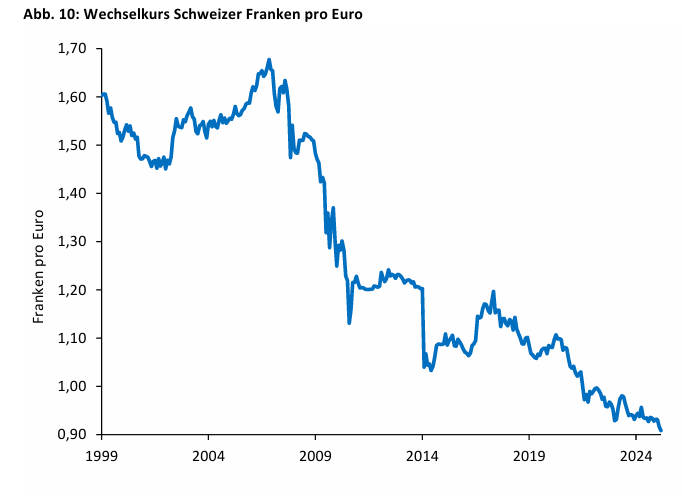
That initially helped exports to other eurozone countries and China, but from 2010 onwards it also masked structural weaknesses: lagging digitalisation, high energy costs, bureaucracy, ageing and dependence on China.
A recent study by the Flossbach von Storch Research Institute compares the economic performance of Switzerland and Germany. According to the authors, Switzerland's lead lies mainly in its institutional and economic policy choices.
 03.06.2026 - Gunther Schnabl , Christoph Schaltegger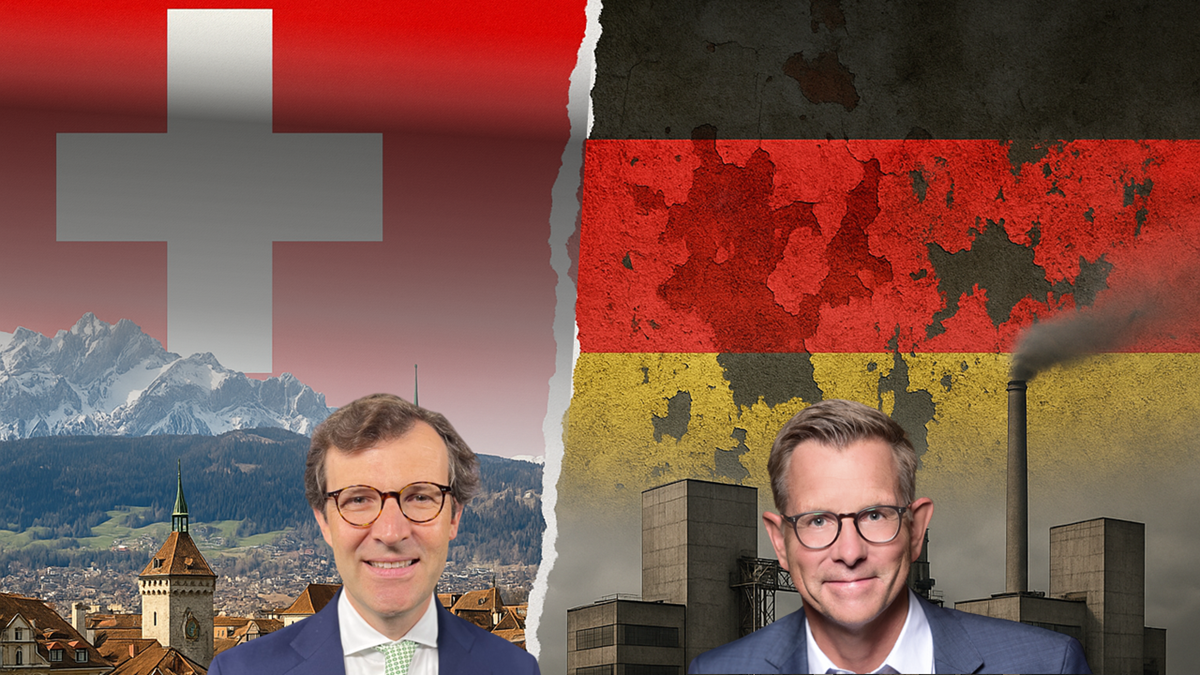
Switzerland has stricter fiscal discipline, partly due to its debt brake (see the Maastricht criteria), direct democracy and a more decentralised governance structure. The Swiss debt brake resembles the Maastricht criteria in purpose, but works more strictly. Whereas Maastricht mainly sets European threshold values of a 3% deficit and 60% debt relative to GDP, the Swiss debt brake structurally forces the government not to spend more than it receives, adjusted for the economic cycle. Germany, by contrast, has loosened its fiscal rules and has seen government spending, social costs and debt rise more sharply.
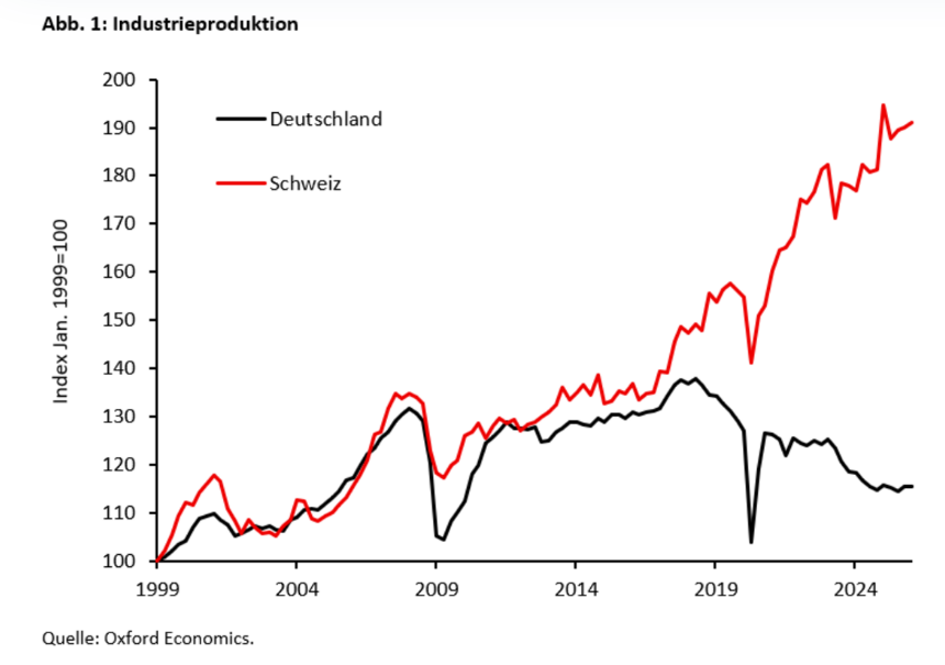
Monetary context also plays a role. Switzerland, through the Swiss National Bank, pursues a more independent policy focused more strongly on stability, whereas Germany is part of the eurozone and therefore has less influence over monetary policy. The persistently strong Swiss franc also forces companies towards productivity, quality and cost control. Germany is grappling with persistent inflationary pressure and weak growth. In addition to the costly and inefficiently organised energy transition, rising defence spending is now also placing an increasing burden on the budget.
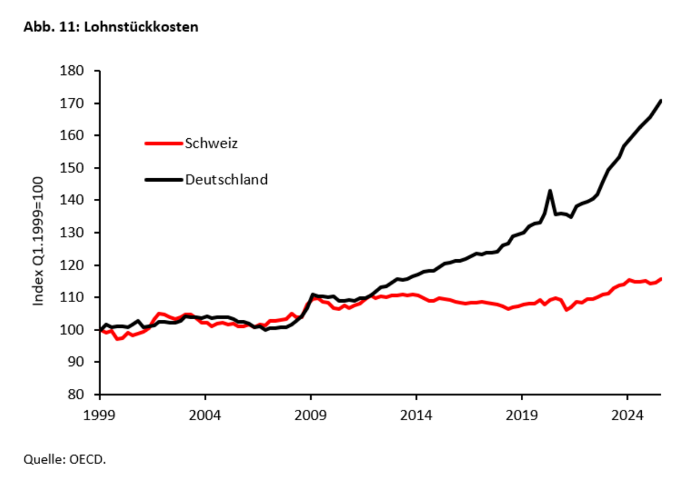
It is hardly surprising that Flossbach also points to the difference in regulation and industrial policy. Germany is burdened with extensive EU regulation, high reporting requirements and an ever-growing role for subsidies. Switzerland, too, faces increasing regulation, but for now retains greater economic flexibility. Social spending in Germany is also considerably higher than in Switzerland, which increases the tax and contribution burden on labour.
The lesson is that Germany is suffering not only from external shocks, but above all from internal rigidity. The recent clash between Rheinmetall CEO Armin Papperger and Ukraine's drone industry is illustrative of this.

Rheinmetall is Germany's leading defence group, a producer of tanks, armoured vehicles, ammunition, artillery and military systems. Precisely for that reason, Papperger's condescending tone stood out. He dismissed Ukrainian drone-building as "playing with Lego" and spoke disparagingly of "housewives" with 3D printers. President Zelensky responded sharply: if every Ukrainian housewife can build drones, then every housewife could also be CEO of Rheinmetall. The row touches on a broader question: can Germany truly renew its economy through higher defence spending, or will the money here too flow mainly to established industrial champions?
Receive weekly insights in your inbox
Exclusive analyses and updates on family holding companies and global market developments.
Memory chips: a cycle that could last longer than usual
A report from Goldman Sachs, Higher for Longer DRAM/NAND/HBM Cycles to Expand Memory Valuation Multiples, sketches a strikingly positive picture of the global memory market this week. The core message: the current cycle in DRAM, NAND and HBM is not only strong, but could also last longer than previous memory cycles.

That does not mean the sector has suddenly become defensive. DRAM and NAND remain cyclical markets. The difference is that the likelihood of a classic boom-bust pattern appears smaller, according to Goldman Sachs. Demand is now being driven more strongly by AI infrastructure and servers, while supply growth is being held back by long construction times for new capacity and the high wafer consumption of HBM. Long-term contracts with major customers also provide more visibility and potentially less abrupt price swings. Historically, the memory sector followed a harsh pattern: strong demand led to aggressive capacity expansion, followed by oversupply, price pressure and lower margins. Goldman Sachs identifies three factors that could extend the current cycle.
First, demand has become more structural. Whereas previous upcycles were mainly driven by cyclical consumer goods such as PCs, smartphones or cloud data centres, the current impulse comes primarily from AI infrastructure, demand for which will only keep increasing in the coming years. GS previously wrote that total capex by hyperscalers through to 2033 would amount to USD 7,500 billion! Servers now make up a much larger share of total DRAM and NAND demand. Moreover, in AI systems, memory is no longer a supporting component but a decisive factor for performance. Large language models require substantial memory capacity and high bandwidth. HBM (high bandwidth memory) in particular benefits from this.
Second, supply is growing more slowly than in previous cycles. New fabs take years to build, and available cleanroom capacity is limited. In addition, HBM consumes significantly more wafer capacity than conventional DRAM. As a result, strong HBM demand can actually lead to scarcity in traditional DRAM markets. According to Goldman Sachs, the market for DRAM, NAND and HBM could therefore remain tight until 2028.
Third, contract structures are changing. Given the substantial production undercapacity, major customers are trying to secure volume through long-term agreements. These contracts appear more binding than in previous cycles, with greater commitment around volumes, price ranges and, in some cases, even advance payments. This can improve earnings visibility for memory producers and partially dampen the classic cyclicality.
Hmm pic.twitter.com/wppNkmq8lI
— Jukan @COMPUTEX (@jukan05) June 2, 2026
For investors, the key implication lies in valuation. Memory companies such as SK Hynix, Samsung and Micron have traditionally been valued at low multiples, precisely because of their cyclical earnings profile. If the sector can demonstrate that current profit levels are sustainable for longer, room emerges for higher valuations. This explains the huge share price gains this year, but it also means the sector is not risk-free. A pullback in AI capex, faster capacity expansion or weaker end markets such as PCs and smartphones could quickly change the picture. Still, the report underlines that memory is becoming ever more central to the AI chain.
Goldman Sachs expects that consumer and enterprise agents could push token consumption to more than 24x above the estimated global capacity of 2026 by 2030. That matters for memory, because more AI inference and agent usage leads to higher demand for server DRAM, HBM and storage capacity.
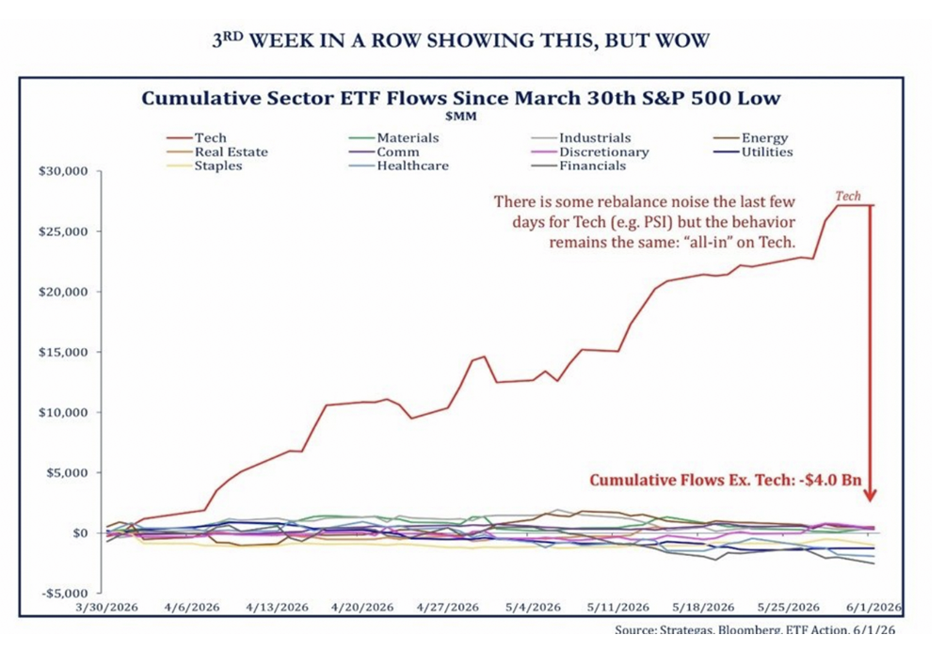
Besides the structural buying pressure in technology, Goldman Sachs points to another factor: US companies are expected to buy back around USD 1.3 trillion of their own shares this year. Those buybacks, too, are heavily concentrated in the technology sector. Nvidia alone has a substantial buyback programme running (totalling 80 and 30 billion USD this year), while Qualcomm also intends to repurchase tens of billions of dollars' worth of shares.
It is notable that Alphabet features less prominently in this list, even though the company is investing extremely aggressively in AI infrastructure. This week Alphabet raised USD 85 billion to further finance those investments, with participation from Berkshire Hathaway. That is an important signal: even traditionally valuation-driven capital is now seeking exposure to the AI infrastructure chain. Favourable technology sentiment is essential ahead of the expected IPO of SpaceX on Friday 12 June. After all, a successful listing will depend heavily on investors' willingness to continue putting a value on very high expectations surrounding AI, space travel, satellite connectivity and infrastructure.
Google is now selling $80B of its own stock to fund AI capex, ending a decade of buybacks pic.twitter.com/cRTBK5IWXV
— Hedgeye (@Hedgeye) June 2, 2026
A sharp shift by Google from share buybacks to raising capital.
Receive weekly insights in your inbox
Exclusive analyses and updates on family holding companies and global market developments.
Would you like more information about our services?
Get in touch
Disclaimer:
No rights can be derived from this publication. This is a publication of Tresor Capital. Reproduction of this document, or parts thereof, by third parties is only permitted with prior written consent and with reference to the source, Tresor Capital.
This publication has been compiled by Tresor Capital with the greatest possible care. The information is intended in a general sense and is not tailored to your individual situation. The information should therefore explicitly not be regarded as advice, an offer or a proposal to purchase or trade investment products and/or to make use of investment services, nor as investment advice. The authors, Tresor Capital and/or its employees may hold positions in the securities discussed, for their own account or on behalf of their clients.
You should carefully consider the risks before you start investing. The value of your investments may fluctuate. Past performance is no guarantee of future results. You may lose (part of) your investment. Tresor Capital disclaims any form of liability for any inaccuracies or errors. This information is purely indicative and subject to change.
Read the full disclaimer at tresorcapitalnieuws.nl/disclaimer .
This article was translated automatically from Dutch using AI. In case of any difference, the Dutch original prevails. Read the original in Dutch.