
Economy & Markets #26 - OpenAI IPO delay and mass layoffs at VW


In the technology sector, Micron confirmed with excellent quarterly results that demand for AI memory and HBM remains structurally strong. The South Korean stock market benefited as well, although concentration risk around Samsung and SK Hynix remains a point of attention. At the same time, reports of a possible postponement of the OpenAI IPO to 2027 caused nervousness among closely linked names such as Oracle, CoreWeave and SoftBank.
Finally, Volkswagen announced a restructuring of unprecedented scale, with possibly 100,000 job losses and four plant closures. It underscores the structural pressure on the European car industry, which simultaneously has to cope with high costs, weak EV margins and increasing Chinese competition.
Falling inflation, or not?
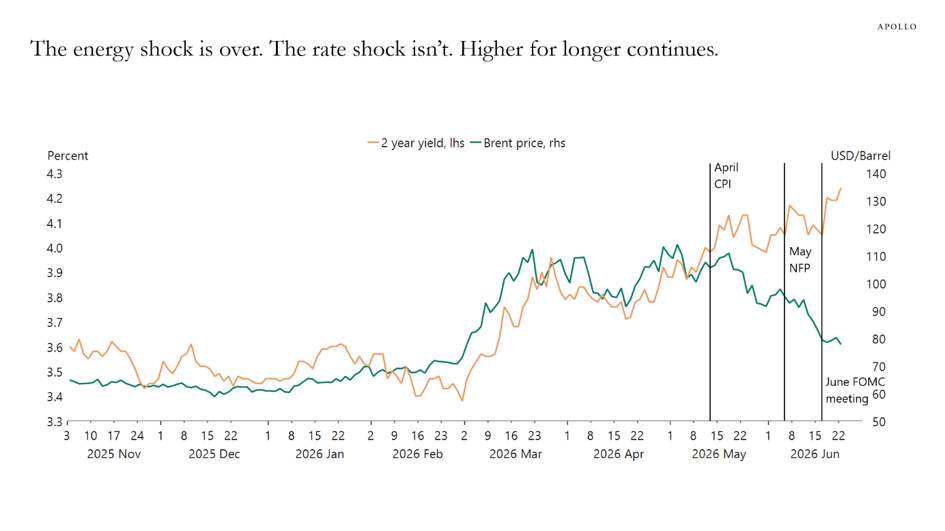
The past two weeks marked a clear shift in the macroeconomic picture. Central banks again appear less willing to ignore inflation risks, while markets still assume the scenario in which falling oil prices will eventually create room for rate cuts. Particularly in the United States, given expected economic growth of around 2.5%, the policy rate remains relatively low in real terms. Kevin Warsh struck an immediately firmer 'hawkish' tone during his first meeting as chairman of the Federal Reserve. The Fed left the policy rate unchanged at 3.50–3.75%, but put one or more rate hikes later this year on the table. Economists at Bank of America are even factoring in three rate hikes (+0.75%) in 2026.
The rate picture also shifted in Europe. The ECB raised rates by 25 basis points, bringing the deposit rate to 2.25%. That is striking against a backdrop of weak economic growth of just 0.7% this year. Higher energy prices and high taxes are leading to structural inflationary pressure, limiting scope for accommodative monetary policy and introducing the risk that the ECB, during a period of stagflation (falling economic activity, rising inflation), raises rates and thereby slows economic activity even further.
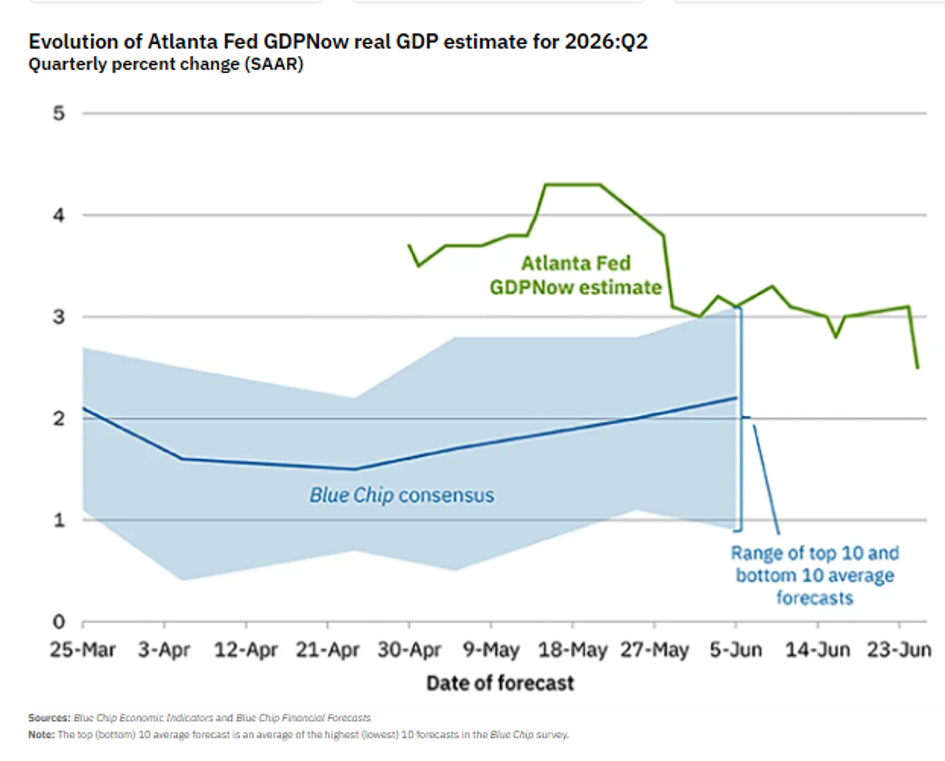
The policy dilemma for the Fed is that not everyone in the US is benefiting from the buoyant economic growth. In the so-called 'K-shaped' economy, AI-related sectors are running at full capacity, while 'Joe Sixpack' is seeing his purchasing power decline. Although falling oil prices have offered consumers some relief in recent weeks, this effect is being partly offset by rising electricity prices. As a result of strong energy demand from data centres, 'experts' expect electricity prices in the US to triple.
Trump determined to secure a deal with Iran ahead of the mid-term elections
Meanwhile, the oil price has fallen back below USD 70 per barrel for WTI, back to the level seen before the recent escalation in the Middle East. The main reason is that oil flows through Hormuz have not been structurally disrupted, while extra supply from OPEC countries, including Iraq and the United Arab Emirates, is further dampening the risk premium. Although Iran has no incentive whatsoever to accommodate President Trump, it cannot be ruled out that Trump will put his boxing gloves back on after the mid-term elections on 3 November.
Gold also remains under pressure and fell below the USD 4,000 per ounce mark this week. Higher interest rates are unfavourable for gold: the precious metal pays no interest and therefore becomes less attractive relative to bonds and cash. In addition, temporarily reduced geopolitical risks are dampening demand for safe havens. At the same time, the Turkish central bank continues to sell gold to support its own currency. Despite a domestic policy rate of around 37%, the Turkish lira keeps weakening, partly because Turkey, as an energy importer, is vulnerable to higher oil and gas prices. These weigh on the current account, the lira and inflation expectations.
Chinese house prices fall for the 35th consecutive month
China's housing market remains under pressure. Prices of new homes in 70 major cities fell 3.5% year-on-year in May, the same rate as in April. This marked the 35th consecutive month of price declines. On a monthly basis, the decline accelerated slightly, from 0.1% in April to 0.2% in May. The weakness is broadly visible: in Beijing prices fell 2.1%, in Guangzhou 3.3%, in Shenzhen 4.5%, and in Chongqing and Tianjin 4.7%. Shanghai remained a positive exception, although even there price growth slowed from 3.7% to 3.2%
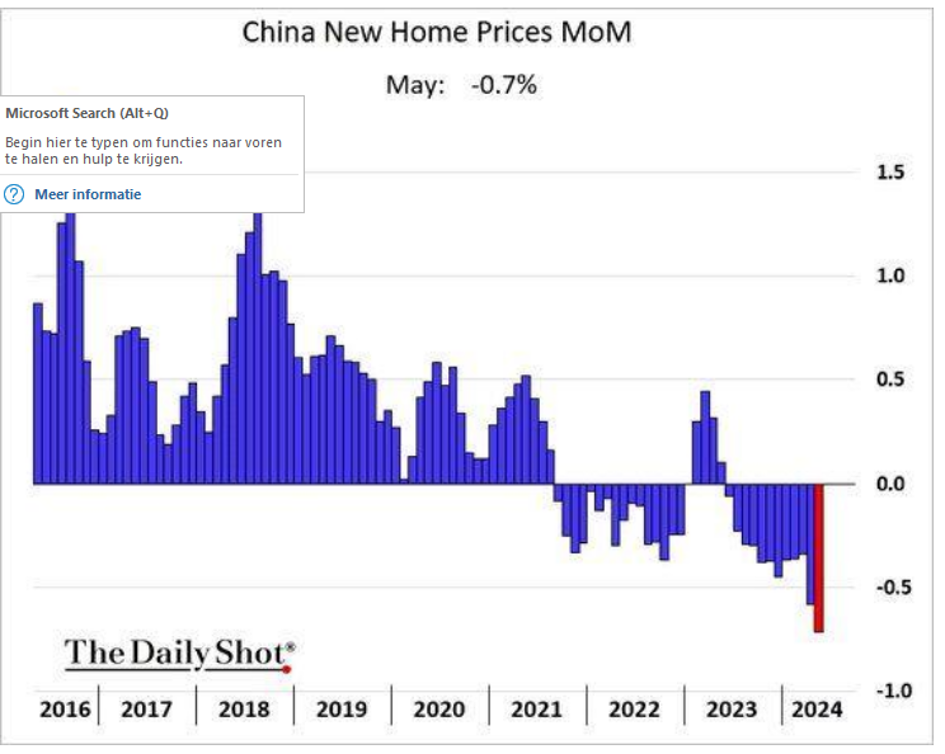
The persistent price pressure shows that earlier stimulus measures are insufficient to structurally restore housing demand. This matters macroeconomically, because real estate plays a central role in the wealth accumulation of Chinese households. Falling house prices therefore directly weigh on consumer confidence and willingness to spend.
The correction is also being reinforced by structural factors: oversupply of housing, a shrinking workforce and rapid ageing. As a result, natural demand for new housing is declining, while the existing supply remains large. In China, home ownership and savings deposits are, moreover, important pillars for financing retirement later in life. The property crisis is therefore not only a cyclical headwind, but also a structural drag on growth, consumption and wealth accumulation
US: younger generations remain stuck in the housing market
The US housing market remains under pressure from high house prices, limited affordability and mortgage rates that are rising again. The 30-year mortgage rate briefly fell below 6% in February, but then climbed back to around 6.5% by the end of June due to inflation concerns, geopolitical uncertainty and a hawkish Fed. As a result, the temporary improvement in affordability remained limited, and demand for housing remains fragile.
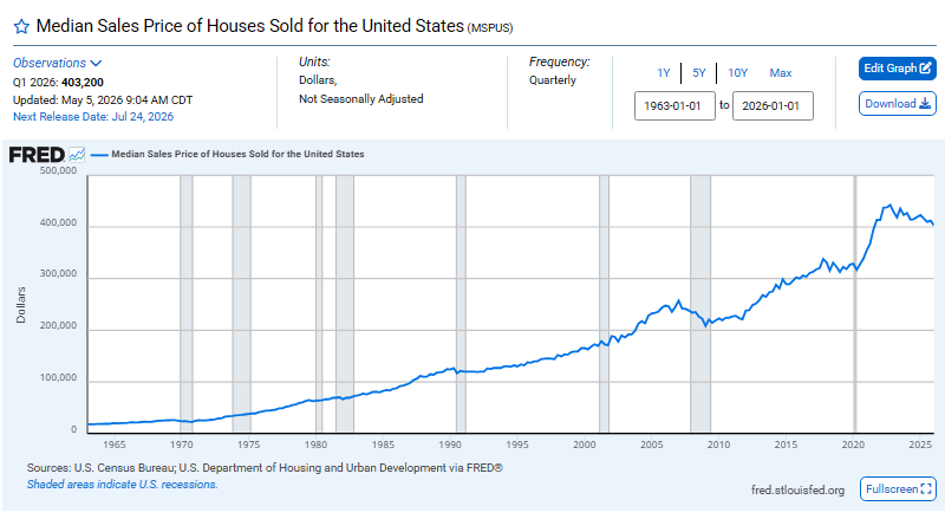
Millennials in particular are getting stuck as a result, while Gen Z risks inheriting the same affordability problems. High mortgage rates, high house prices and substantial down payments are making home ownership increasingly out of reach. The median age of a first-time US buyer has now risen to around 40. At the same time, household formation is lagging: in 2025, there were an estimated 1.8 million fewer households among 18- to 44-year-olds than would have been expected based on earlier trends.
The housing market is therefore not only an interest-rate problem, but also a structural issue of supply and demographics. Baby boomers are staying in their homes for longer, while the total housing shortage is estimated at around 4 million homes. For Gen Z, the situation could improve over time once older households free up more homes, but that process is slow. As long as supply remains tight and young households struggle to build wealth, the housing market will continue to act as a drag on consumption, labour mobility and intergenerational wealth accumulation.
Receive weekly insights in your inbox
Exclusive analyses and updates on family holding companies and global market developments.
Korea: Micron confirms the AI cycle, but also the concentration risk
The South Korean stock market has grown this year into one of the most distinctive ways to invest in the global AI infrastructure cycle. Whereas Korea was traditionally seen as a cyclical market, sensitive to oil prices, export demand and currency movements, the centre of gravity has increasingly shifted towards memory, semiconductors and, in particular, high bandwidth memory (HBM).
Worldwide, there are only three producers capable of supplying HBM at scale: SK Hynix, Samsung Electronics and Micron. SK Hynix is the market leader, while Samsung is accelerating in new HBM generations. As a result, the KOSPI has increasingly become a concentrated exposure to Samsung Electronics, which has risen by around 180% this year, and SK Hynix, which has gained almost 290%. Together, these two semiconductor heavyweights now account for around 55% of the index.
That concentration works both ways. In an upward phase, the entire index benefits from the strong share price performance of these two names. But as soon as investors take profits or start doubting the sustainability of the AI rally, the broader market moves down with them. Daily price swings of 5% to 8% in Samsung and SK Hynix are then no longer exceptions, but decisive for the picture of the South Korean stock market as a whole.
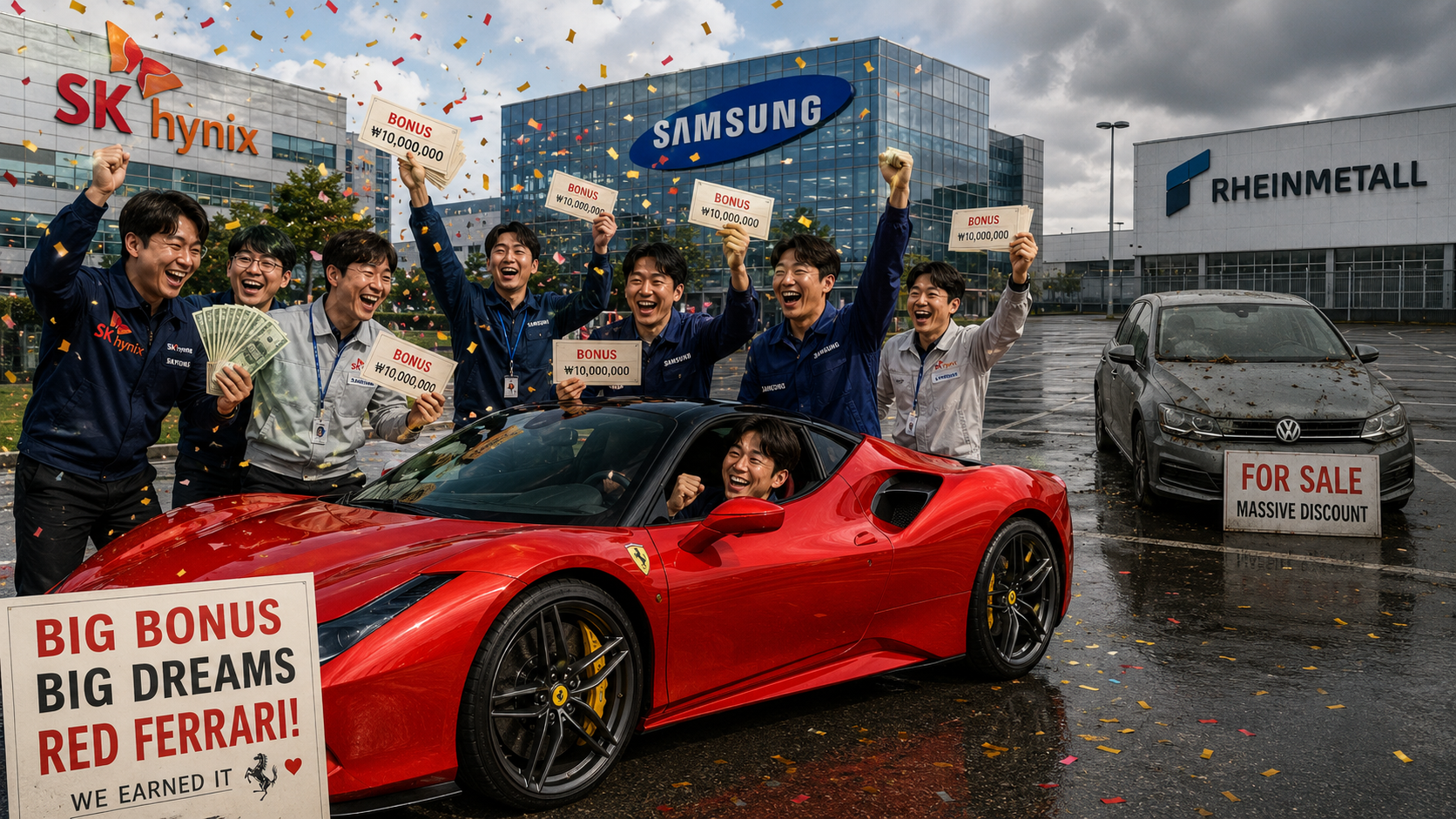
Over the past few weeks, that concentration risk became visible. Following disappointing signals from parts of the semiconductor chain, South Korea saw a sharp correction. That move appeared to be driven less by a structural deterioration in fundamentals than by positioning: leveraged positions, ETF flows and foreign selling reinforced one another.
The positive turnaround this week came from Micron. The American memory producer reported very strong results and confirmed that demand for AI memory - DRAM, NAND and especially HBM - remains exceptionally strong. Revenue rose by around 345% year-on-year to just over USD 41 billion, while earnings per share came in at USD 25.11. More important than the profit jump itself was the underlying message: the memory market remains tight, HBM capacity is largely committed, and customers are signing multi-year supply contracts.
This gave the market renewed confirmation that AI infrastructure is not merely a narrative but is genuinely translating into revenue, margins and order books. HBM is a crucial link in this. Without fast memory alongside AI processors, the latest accelerators cannot make efficient use of their computing power. Precisely for this reason, HBM has grown into one of the most powerful segments within the technology sector.
Samsung is accelerating in new generations such as HBM4, SK Hynix remains market leader, and Micron's results confirmed that demand is structurally stronger than in previous memory cycles. The combination of limited capacity, high technical complexity and structural AI demand gives producers exceptional pricing power.
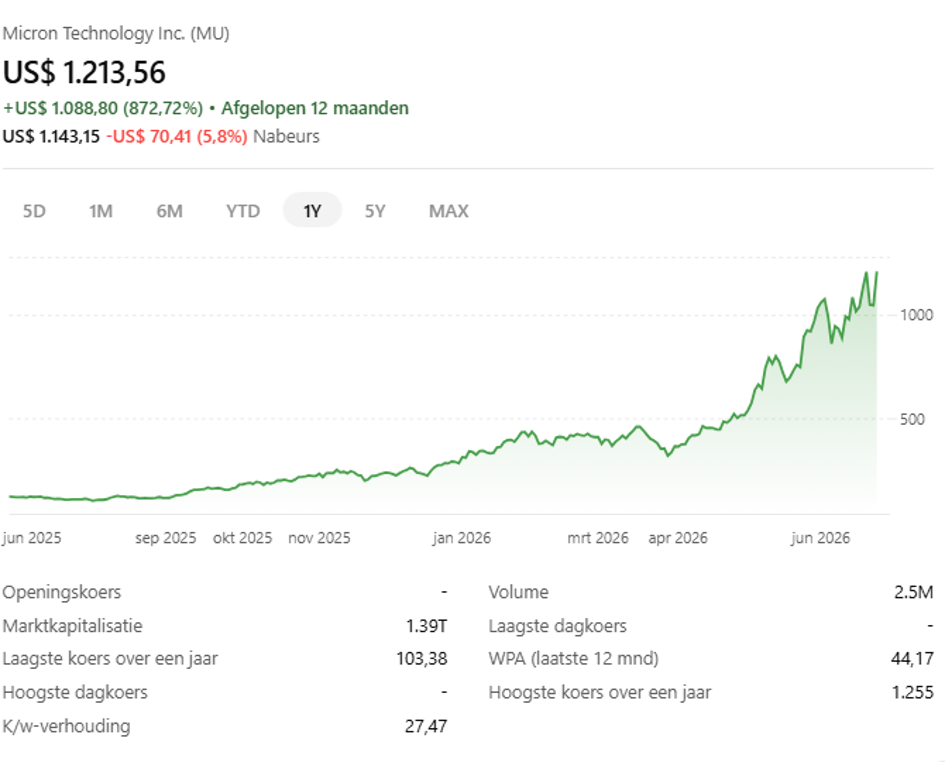
At the same time, tightness in memory creates new risks. Rising memory prices are positive for producers' margins, but can ultimately feed through into higher prices for end products such as laptops, tablets and consoles. Investors react nervously to this: if technology companies have to pass on higher component costs, this could eventually affect end demand or put pressure on margins elsewhere in the technology sector.
 Lim Hui Jie and Blair Baek
OpenAI: delayed IPO increases nervousness around AI financing
Given the sharply higher prices for memory chips, the question increasingly arises as to whether hyperscalers and LLM players can keep financing the AI infrastructure cycle. Following the IPO of SpaceX, the market was therefore watching with anticipation for the next major AI listing: OpenAI.
According to recent reports, OpenAI might postpone its IPO until 2027. That is not a strong signal for the market, which had been counting on a listing at a possible valuation approaching USD 1,000 billion. Earlier private valuations stood at around USD 850 billion, following a large funding round.
At the same time, profitability remains uncertain. OpenAI is growing fast, with a reported revenue run rate of around USD 25 billion, but costs for chips, cloud capacity and data centres remain exceptionally high. Some sources suggest that profitability may not come into view until around 2030. This shifts the key question from "how big will OpenAI become?" to "who will finance the infrastructure needed to make that growth possible?"
Reports that OpenAI might delay its IPO until 2027 put pressure this week on shares with significant exposure to the company. Oracle, CoreWeave and SoftBank in particular came under pressure. Oracle lost around 1.5%, CoreWeave a few percentage points, and SoftBank even fell by around 13% in Tokyo.
The nervousness centres mainly on financing. OpenAI has enormous capital needs for cloud capacity, data centres and chips, but does not yet have the cash flows of the likes of Microsoft, Alphabet or Amazon. This makes access to private capital or a future listing more important.
This directly affects companies that have partly built their growth story on OpenAI. Oracle reportedly has a multi-year cloud deal worth around USD 300 billion with OpenAI, while CoreWeave supplies billions of dollars' worth of AI capacity. SoftBank is also a major investor in OpenAI and closely involved in broader AI infrastructure projects such as Stargate.
Volkswagen: restructuring underscores pressure on the European car industry
According to media reports, Volkswagen is preparing a far more severe restructuring than previously announced. The German car group is said to want to cut up to 100,000 jobs and could close four factories, including sites in Hanover, Zwickau, Emden and Audi's plant in Neckarsulm. This would make the restructuring roughly twice as large as the previously agreed reduction of around 50,000 jobs.
The plans underline the pressure on the European car industry. Volkswagen is grappling with high costs in Germany, weak margins on electric vehicles, growing competition from China and uncertainty around import tariffs. Chinese manufacturers in particular are putting the market under pressure with cheaper and rapidly improving electric models. At the same time, the transition to electric driving demands enormous investments, while the profitability of traditional models comes under pressure.
 Sam Meredith
For investors, this is a clear signal that the European car sector is still in the midst of a difficult adjustment phase. Volkswagen remains an industrial heavyweight, but the market is increasingly doubting whether traditional carmakers can simultaneously cut costs, invest in electrification and defend market share against Chinese competitors. The restructuring may be necessary in the long term, but in the short term it mainly underlines how much pressure the sector is under.
Receive weekly insights in your inbox
Exclusive analyses and updates on family holding companies and global market developments.
Would you like more information about our services?
Get in touch
Disclaimer:
No rights can be derived from this publication. This is a publication by Tresor Capital. Reproduction of this document, or parts of it, by third parties is only permitted after written consent and with reference to the source, Tresor Capital.
This publication has been compiled by Tresor Capital with the greatest possible care. The information is intended in a general sense and is not tailored to your individual situation. The information should therefore expressly not be regarded as advice, an offer or a proposal to purchase or trade investment products and/or to take up investment services, nor as investment advice. The authors, Tresor Capital and/or its employees may hold positions in the securities discussed, for their own account or for their clients.
You should carefully consider the risks before you start investing. The value of your investments may fluctuate. Past performance is no guarantee of future results. You may lose (part of) your investment. Tresor Capital rejects any form of liability for any inaccuracies or errors. This information is purely indicative and subject to change.
Read the full disclaimer at tresorcapitalnieuws.nl/disclaimer .
This article was translated automatically from Dutch using AI. In case of any difference, the Dutch original prevails. Read the original in Dutch.