
Family Holdings #10 - From poison pills in software to the AI assault on your brain


This week's topics:
Investor AB has invested more than SEK 1 billion extra in private equity firm EQT within a short period, while EQT is simultaneously buying back SEK 842 million worth of its own shares. This double buy-back underscores confidence in the company, right as EQT, together with BlackRock, has announced a multi-billion-dollar acquisition of AES Corp. With this move, EQT positions itself directly in the energy infrastructure that is crucial for powering AI data centres.
Manager Tom Slater of Scottish Mortgage Investment Trust warns that the impact of AI goes beyond economic gains; it is physically rewiring our brains and our ability to learn. Although AI is spectacularly boosting efficiency at portfolio companies such as NVIDIA and Shopify in the short term, there is a risk that "productive friction" will disappear. The Trust argues that we must be careful not to lose, in our drive towards AI-driven optimisation, the human skills that are crucial when technology fails.
Prosus finds itself in a geopolitical area of tension now that the American White House is investigating the gaming interests of crown jewel Tencent for security risks. Although a forced sale of Western gaming assets would affect Tencent's international growth, it would also free up an enormous 'cash pile'. Meanwhile, Prosus is focusing on local growth through a new multi-million investment in quick-commerce delivery service Flink, which has by now become profitable in the Netherlands and Germany and is benefiting from the still-low online penetration of the grocery market.
In Brief:
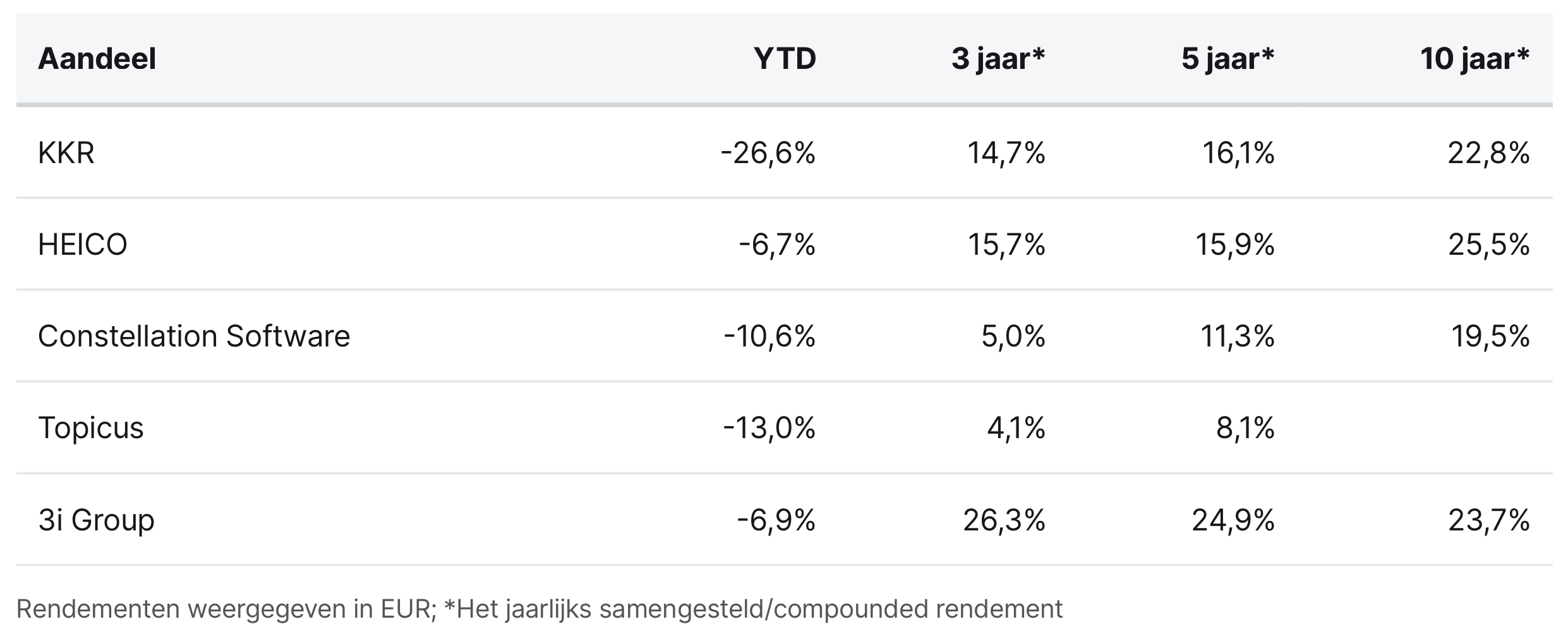
The conviction among KKR's (New York: KKR) top management that the share is currently significantly undervalued was confirmed once again this week. The most recent transactions show that the co-CEOs and supervisory board members have once again allocated millions of their own capital. Co-CEOs Joseph Bae and Scott Nuttall, along with several supervisory board members, bought more than 60,000 shares on the open market this week. This brings the total amount insiders have put into the share out of their own pocket over the recent period to well over $45 million.
HEICO (New York: HEI.A) saw a significant show of confidence from within its own ranks this week. Nandakumar Cheruvatath, a director at one of the company's subsidiaries, purchased 4,082 shares on 4 March for an amount of approximately $1 million. With this purchase, the director substantially expands his modest position of 64 shares to a total of 4,146 shares.
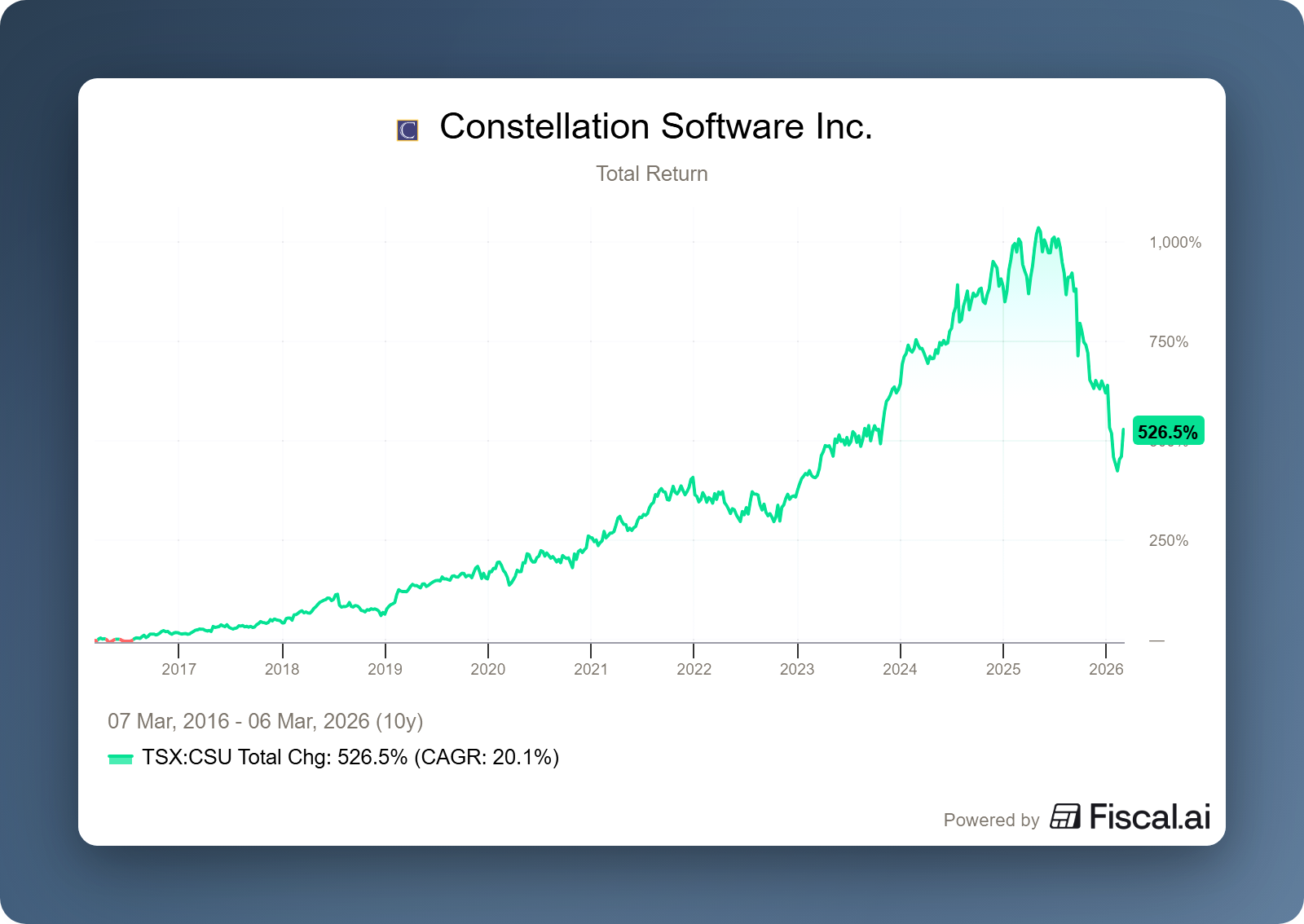
Constellation Software (Toronto: CSU) is further expanding its presence in Latin America through its subsidiary Vesta. The company has acquired Argentina-based Nodum Argentina. This acquisition follows the earlier takeover of the Uruguayan branch in 2023. Nodum has been offering ERP and CRM solutions to hundreds of customers in the region since the 1990s. The new addition will be merged, together with the Uruguayan operations, into the joint entity Nodum Global.
Topicus (Toronto: TOI) had a particularly active week with three strategic acquisitions through its operating company Total Specific Solutions. The group acquired the Dutch company Desyde, which plays a leading role in the management of parking permits for municipalities with its SaaS solution. In addition, Topicus strengthened its position in the French aviation sector with the acquisition of Cyberjet, a specialist in systems for flight operations and crew management. Finally, the education division was expanded with the Rotterdam-based PortalPlus to further optimise student support, from intake through to alumni management.
3i Group (London: III) finally reported a successful divestment through its listed entity 3i Infrastructure. The division has sold its 71% stake in the Belgian airport ground-handling equipment specialist TCR for an amount of €1.14 billion. This sale, which was 22% above the most recent valuation from September 2025, allows the investment company to free up capital to repay loans and finance new investments following a successful growth period of almost ten years within the TCR platform.
KKR, HEICO, Constellation Software, Topicus and 3i Group are currently traded on the exchanges of New York, Toronto and London at prices of USD 91.53, USD 232.18, CAD 2,902.02, CAD 108.84 and GBP 30.14 per share, respectively.
Constellation Software and Sabre's 'Poison Pill'
Over the past week, Canadian software giant Constellation Software (Toronto: CSU) and the listed American travel technology provider Sabre Corp (New York: SABR) reached a strategic agreement following a hectic negotiation process.
Over the course of 2025, Constellation quietly built up an economic interest of 9.7% in Sabre. In January 2026, the Canadian acquisition machine disclosed this stake to Sabre's management, proposing a long-term partnership. Constellation's aim was to secure a controlling interest and board seats, a model it had previously applied successfully with listed holdings such as Topicus and Asseco.
However, Sabre's management was not immediately receptive to such a controlling interest and responded defensively to the approach. To safeguard its independence and block an unwanted expansion of Constellation's stake, the board activated a so-called 'poison pill' (Shareholder Rights Plan). This measure was intended to make any further share purchases above 15% virtually impossible without board approval.
What happened?
Although Constellation's intentions initially appeared constructive, a notable friction arose in February. According to statements from Sabre, negotiations over board seats stalled after Constellation suddenly halted talks with the cryptic message that their plans "would become clear over time." This caused unease at Sabre's board. They feared that Constellation would build a controlling interest through the open market without paying the customary takeover premium.
In direct response, Sabre activated a Shareholder Rights Plan, better known as a 'poison pill'. This mechanism is triggered as soon as a party owns more than 15% of the shares. At that point, all other shareholders gain the right to purchase additional shares at a steep discount. For the "raider" (in this case Constellation), this would mean an immediate and enormous dilution of its stake, effectively making a hostile takeover impossible and forcing Constellation back to the negotiating table.

On 5 March, the definitive breakthrough came: Sabre and Constellation Software announced a strategic partnership under which Constellation takes a 12.7% stake in the company and receives a seat on the board of directors. Damian McKay, the current CEO of the Vela division (which includes Juniper, the central travel platform within the Constellation ecosystem), joins Sabre's board of directors on behalf of the group. Given his extensive experience in the sector, this appears to be a logical choice.
Investors see in the group's involvement the much-needed operational discipline that Sabre requires to get its balance sheet in order. The Sabre share surged 50% in just one week to a peak of $1.99. Although the price has since given back some of these gains, the sharp move illustrates just how much confidence the market places in the company's recovery potential under the wing of the experienced software investor.
What does Sabre do, and why is it financially interesting?
Sabre Corporation, as one of the three dominant players in Global Distribution Systems (GDS), forms the indispensable backbone of the global travel industry. The platform facilitates the complex link between suppliers such as airlines and hotels on one side, and buyers such as travel agencies and booking sites on the other.
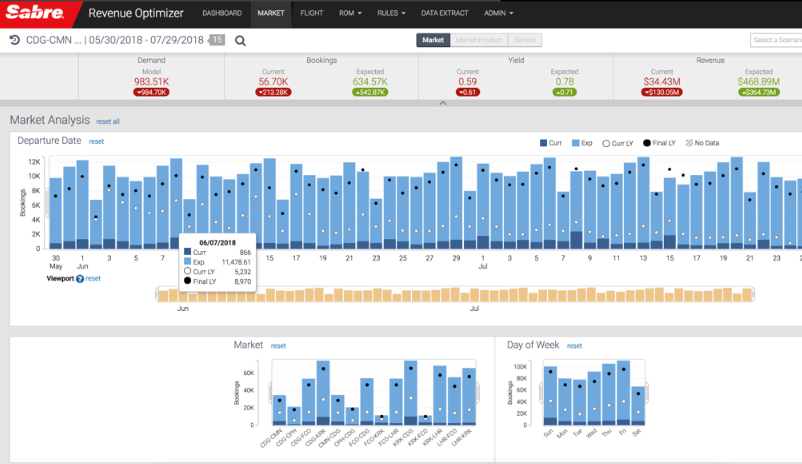
A quick look at the figures quickly reveals that this is a special case. With a market capitalisation of approximately $640 million and adjusted operating profit before interest, tax, depreciation and amortisation (EBITDA) of $500 million, the company at first glance appears very attractively valued. There is, however, a catch. The underlying enterprise value (calculated as: market capitalisation + net debt − cash) amounts to approximately $4.4 billion, which immediately reveals where the crux lies: a substantial debt position that makes the picture considerably more complex than an initial glance suggests.
At the end of 2025, gross debt stood at $4.3 billion. Adjusted for cash reserves, net debt amounted to $3.74 billion. Measured against adjusted operating profit of $500 million, this yields a net debt ratio of approximately 7.5x; a substantial leverage for a company operating in a sector where AI and direct distribution are challenging the traditional GDS position. In a climate of higher interest rates and uncertainty surrounding these developments, this has weighed on Sabre's share price by more than 50% over the past year.
It is precisely this tight balance sheet that lies at the heart of the investment case that many investors are currently raising around Constellation Software's involvement. Net interest expense in 2025 amounted to $447.8 million. This means that nearly 90% of operating cash flow is directly absorbed by creditors. The result of this top-heavy capital structure is that the bottom line is completely underwater; after deducting interest, tax and depreciation, a net loss of $255 million remained over 2025.
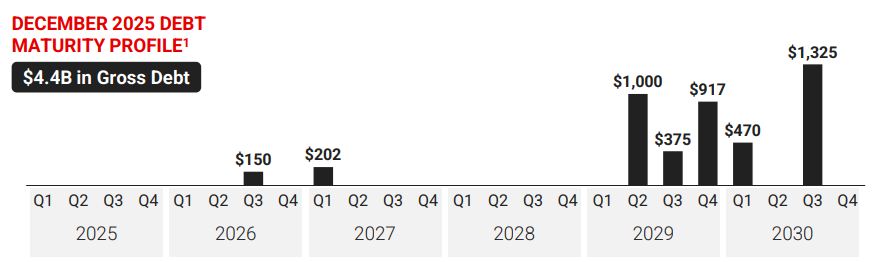
Nevertheless, the debt maturity structure offers some breathing room. More than 90% of the outstanding debt does not need to be repaid until 2029 or later. This gives the management team ample scope to optimise cash flows and gradually reduce the debt position. Given the enormous leverage effect, every percentage-point improvement in operating margin or reduction in financing costs will directly lead to a disproportionate boost to net profit.
Alongside the debt management case, there is a second, more long-term-oriented optionality in potential margin improvements. Constellation Software has repeatedly stated in the past that it can lift software companies to Adjusted EBITDA margins of around 30% through its proven operational blueprint. Sabre's current Adjusted EBITDA margin stands at 18.1%. That is not a bad starting point, but it does imply that, in theory, some twelve percentage points of margin improvement remain on the table. It is worth stressing that this is very much a prospect for the future. Constellation currently holds one board seat and has no operational control. Whether, and at what pace, its blueprint will actually be applied cannot be quantified at this stage. But as a second-order effect following the primary debt reduction, it forms an interesting additional option within the investment case.
Conclusion
For Constellation, this position behaves like an option structure. With a stake of $65-85 million, it is buying asymmetric exposure: as a minority shareholder, it bears no financial responsibility for the $4.3 billion debt burden, yet through Damian McKay's board position it does have direct influence over capital allocation. The flip side is that this option can also expire worthless, not only if debt reduction stalls, but also if Sabre fails to keep pace with AI and new direct distribution models before any competitive pressure becomes untenable.
Constellation Software is currently trading on the Toronto Stock Exchange at a price of CAD 2,902.02 per share.
Receive weekly insights in your inbox
Exclusive analyses and updates on family holding companies and global market developments.
Double purchase of EQT shares
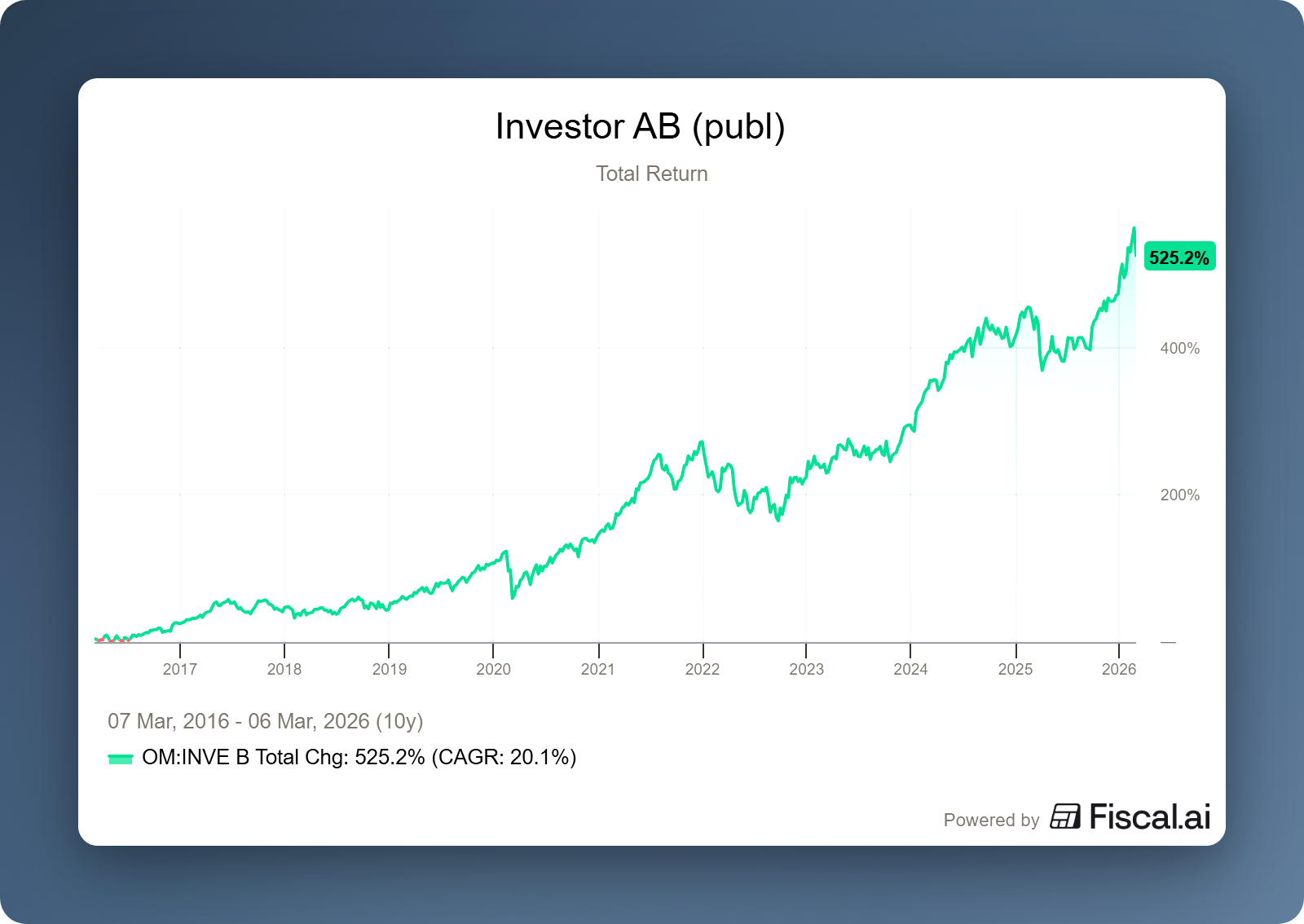
The Swedish family holding company Investor AB (Stockholm: INVE-B) is losing no time when it comes to its stake in private equity holding company EQT AB (Stockholm: EQT). Following an earlier substantial purchase of 2.26 million shares in February (worth SEK 657 million), the holding company struck again between 27 February and 2 March. According to data from the Swedish regulator, Investor bought a further 1.14 million shares for an amount of just over SEK 318 million. This brings the total amount Investor has invested in private equity holding company EQT in just a few weeks to above SEK 1 billion, or EUR 93 million.
While Investor AB is increasing its stake on the stock market, EQT has also itself launched a buyback programme for just over 3 million of its own shares (around SEK 842 million) in order to optimise its capital structure.
This buying spree coincides with a strategic collaboration by EQT. Together with BlackRock (Global Infrastructure Partners), EQT has reached an agreement to acquire the US-listed energy company AES Corp. for a total enterprise value of no less than $33.4 billion. The acquisition is a direct bet on the explosive growth of AI data centres, which consume gigantic amounts of electricity. AES already supplies sustainable energy to tech giants such as Google, Microsoft and Amazon, positioning EQT at the heart of the physical infrastructure that underpins the AI revolution.
Investor AB is currently trading on the Stockholm stock exchange at a price of SEK 356.10 per B share.
AI isn't after your job, it's after your mind
The British holding company Scottish Mortgage Investment Trust (London: SMT) has been known for decades for its unwavering belief in 'disruptive technology'. Director Tom Slater manages billions in companies such as NVIDIA, Amazon and Tesla. He recently published an in-depth and highly interesting analysis: "AI Isn't Coming For Your Job. It's Coming For Your Mind." In it, the manager shifts the focus from the economic benefits of AI to its biological and psychological impact on humans.


The Great Rewiring
Slater argues that AI is not merely a tool, but the "next great rewiring" of the human brain. He compares this to the rise of literacy 200 years ago. When we learned to read, our brain structure physically changed; areas for facial recognition were repurposed for letter recognition.
AI is now doing the same thing, but at a blistering pace. The trust warns of three fundamental shifts:
- Variation: AI generates ideas that humans would never come up with (think of new medicines or AlphaGo's unorthodox moves).
- Transmission: We no longer learn from individual people, but from central models (such as ChatGPT) that filter the knowledge of the whole of civilisation.
- Selection: Algorithms determine what we see. They don't select for truth or usefulness, but for engagement.
The core of Scottish Mortgage's warning lies in the so-called efficiency paradox: although AI dramatically improves short-term performance, it systematically erodes the underlying human capabilities that make this performance possible. When 'productive friction' (the laborious struggle with a piece of text or a complex analysis) disappears, so too does the deep anchoring in our memory. Users turn out to barely remember their own AI-generated work, simply because the neurological effort required for durable learning has been bypassed.

This neurological impoverishment goes right to the heart of Tom Slater's investment thesis. Why is a director of a trust that invests heavily in companies such as NVIDIA and Shopify so concerned about this? Because it affects the long-term sustainability of their portfolio. Companies like Shopify now require teams to first prove why AI cannot perform a task before new staff can be hired. Although this gives a huge short-term boost to the trust's profit margins, Slater sees a creeping danger for the future: the disappearance of mastery.
"Pilots still learn to fly manually before they use the autopilot. Not because the autopilot isn't good, but because on the day it fails, someone needs to be able to land the plane."
For Scottish Mortgage, AI is a powerful tailwind for their portfolio companies, but they warn investors that in our drive for efficiency, we must not throw the captain overboard.
Scottish Mortgage Investment Trust is currently trading on the London stock exchange at a price of GBP 11.61 per share.

Receive weekly insights in your inbox
Exclusive analyses and updates on family holding companies and global market developments.
Prosus: Tencent under the microscope and a new investment
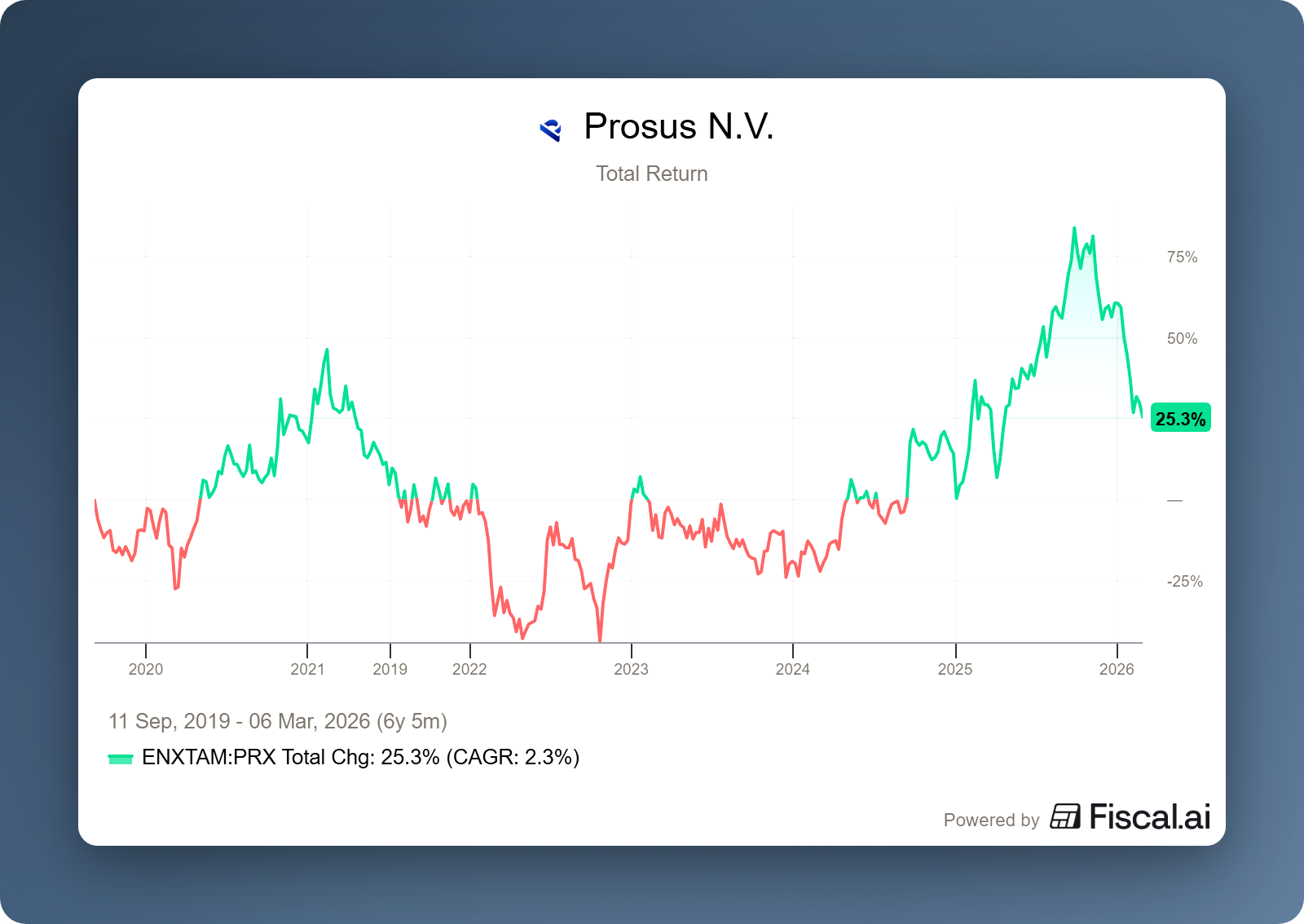
This week it became clear that the most important value driver in the portfolio of Prosus (Amsterdam: PRX) has come under the microscope as a result of the geopolitical chess game between Trump and China.
The White House is currently investigating whether Tencent's stakes in major American and European gaming companies, such as Riot Games (League of Legends), Epic Games (Fortnite) and the Finnish company Supercell (Clash of Clans), pose a national security risk.
With a meeting between Trump and Xi Jinping approaching in April, the market is left wondering whether Tencent will be forced to divest these stakes. Gaming accounts for approximately 30% of Tencent's total revenue. Although two-thirds of that gaming revenue still comes from China, these three international heavyweights are crucial for growth outside the saturated home market. A forced divestment would mean Tencent having to sell off its most lucrative Western assets. It would significantly weaken Tencent's international arm, but would simultaneously free up an enormous cash pile.

Closer to home, however, there is other news from within the portfolio itself. This week Prosus led a new $100 million financing round for quick-commerce delivery company Flink. For most people in the Netherlands, Flink is a familiar sight in the streets, as the delivery riders with their distinctive pink backpacks have by now become an inseparable part of our city centres.
After a turbulent period of consolidation in the quick-commerce market, Flink reports that it is now profitable at the EBITDA level in the Netherlands and Germany. With online penetration of grocery shopping standing at just 6% in the Netherlands (compared with 14% in the UK), Prosus still sees enormous growth opportunities and is expanding its food-delivery portfolio even further following the earlier acquisition of Just Eat Takeaway in 2025.
Prosus is currently trading on the Amsterdam stock exchange at a price of EUR 41.98 per share.
Receive weekly insights in your inbox
Exclusive analyses and updates on family holding companies and global market developments.
Would you like more information about our services?
Get in touch
Disclaimer:
No rights can be derived from this publication. This is a publication of Tresor Capital. Reproduction of this document, or parts thereof, by third parties is only permitted after written consent and with reference to the source, Tresor Capital.
This publication has been compiled by Tresor Capital with the greatest possible care. The information is intended in a general sense and is not tailored to your individual situation. The information should therefore explicitly not be regarded as advice, an offer or a proposal to purchase or trade investment products and/or to take up investment services, nor as investment advice. The authors, Tresor Capital and/or its employees may hold positions in the securities discussed, for their own account or for their clients.
You should carefully consider the risks before you start investing. The value of your investments may fluctuate. Past performance is no guarantee of future results. You may lose (part of) your invested capital. Tresor Capital disclaims any form of liability for any inaccuracies or errors. This information is purely indicative and subject to change.
Read the full disclaimer at tresorcapitalnieuws.nl/disclaimer .
This article was translated automatically from Dutch using AI. In case of any difference, the Dutch original prevails. Read the original in Dutch.