
Economy & Markets #36 - Rising interest rates weigh on sentiment

Bond markets are putting everything back on edge
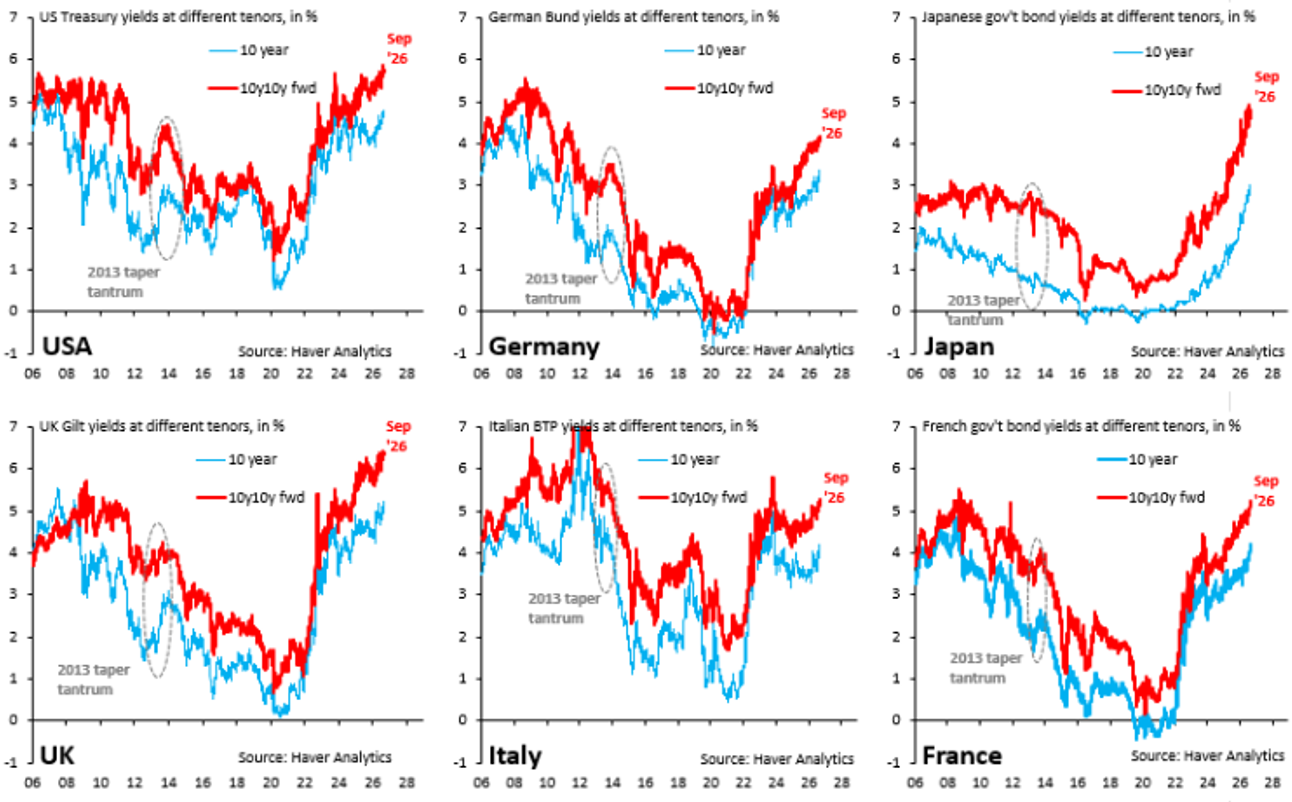
Bond markets worldwide are undergoing a synchronised sell-off, pushing 10-year interest rates to their highest levels in a decade:
- United States: ~4.8%
- United Kingdom: ~5.25%
- Germany: ~3.35%
- Japan: ~3.00%
Investors are demanding a higher risk premium amid growing doubts about the sustainability of government debt. Structural factors such as ageing populations, rising healthcare and pension obligations, and low economic growth are limiting the scope for debt stabilisation, while governments keep increasing their spending despite higher tax revenues.
A look at the macro dashboard below shows that the underlying cause of the interest rate pressure differs by region.
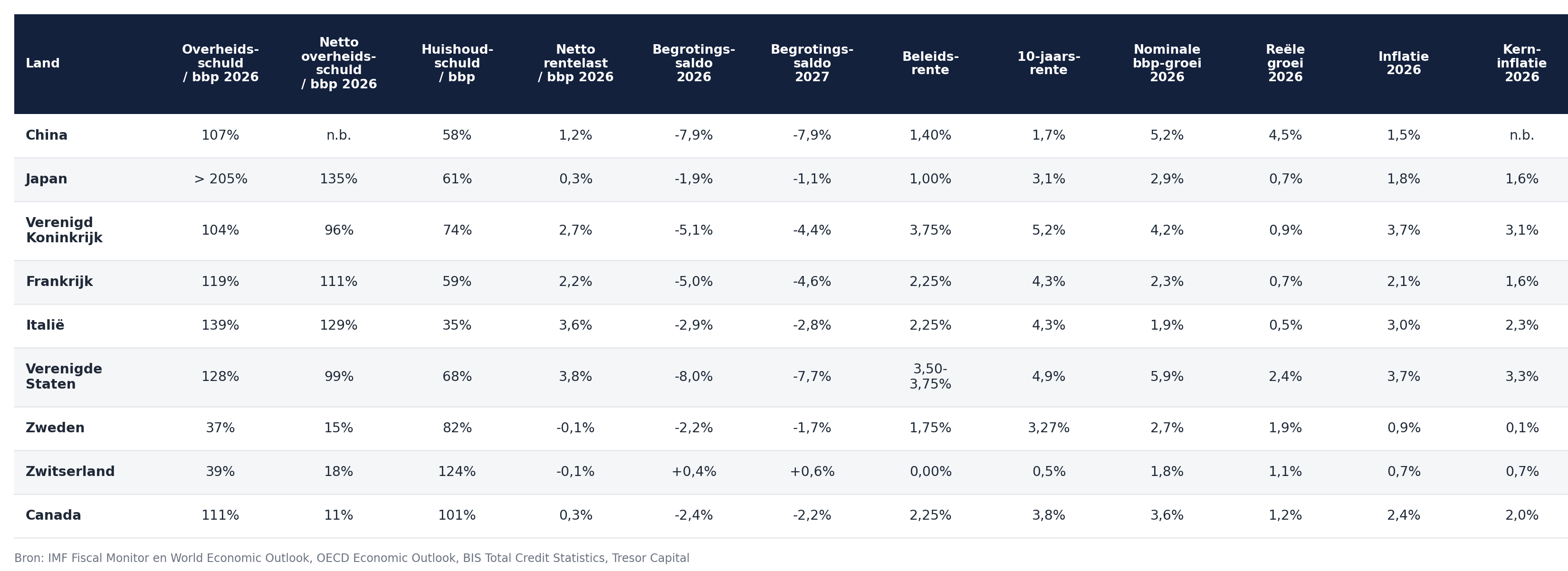
The US economy is showing more underlying resilience than the official GDP figures initially suggest. With real growth of 2.5% and nominal growth of 6.0%, the economy in theory has sufficient economic resilience to reduce its debt ratio. The fiscal reality, however, is more stubborn: due to the fiscal policy of the Trump administration, which focuses on keeping profit and turnover taxes low in combination with rising defence spending, the budget deficit remains persistently high.
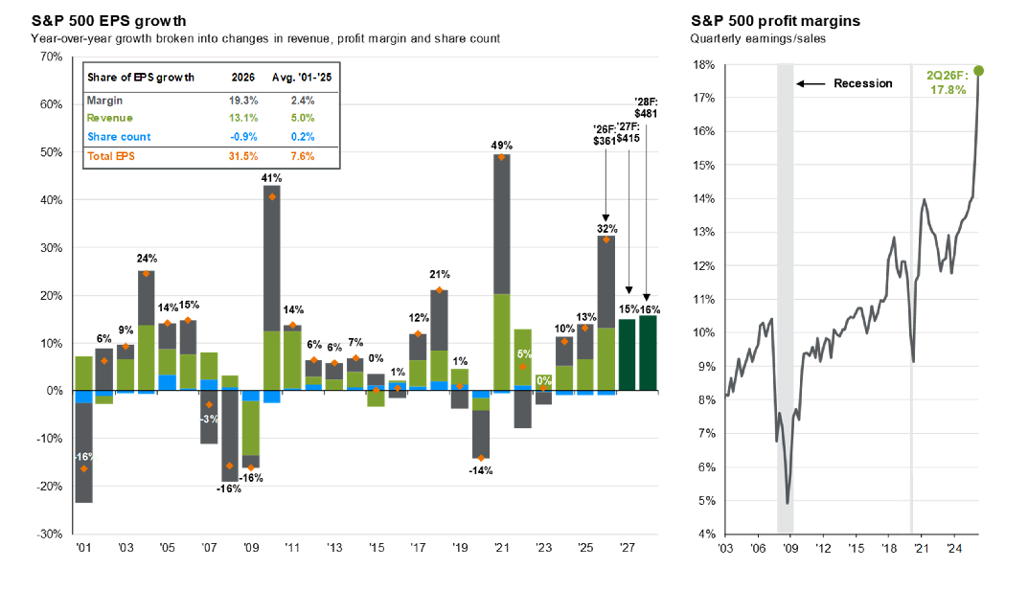
Behind the scenes, a remarkable power struggle is unfolding between the Treasury Department under Scott Bessent and the Federal Reserve under Chair Kevin Warsh. During the recent Jackson Hole meeting, Fed Chair Warsh hinted at a restrictive stance and possible interest rate hikes to bring inflation back to the 2% target. Warsh also signals that tech companies (the so-called hyperscalers) are increasingly financing their record investments in AI infrastructure and energy with corporate bonds. Although this capital expenditure is boosting economic activity, the resulting demand for capital is pushing up long-term interest rates. This causes a classic crowding-out effect in the capital market, which raises the financing premium for the broader business community and for consumers. In broad terms, it amounts to a situation in which corporate profits are showing their strongest growth in decades (independent of any post-recession rebound), while low- to middle-income consumers are struggling to maintain their purchasing power.
The US Secretary of the Treasury (Scott Bessent) is therefore operating more opportunistically and, with an eye on the upcoming elections, wants to bring down the rising mortgage and financing costs faced by American consumers. By buying back long-term government bonds (with maturities of 10 to 30 years), Bessent is attempting to keep the US 10-year interest rate consolidated around 4.8%.
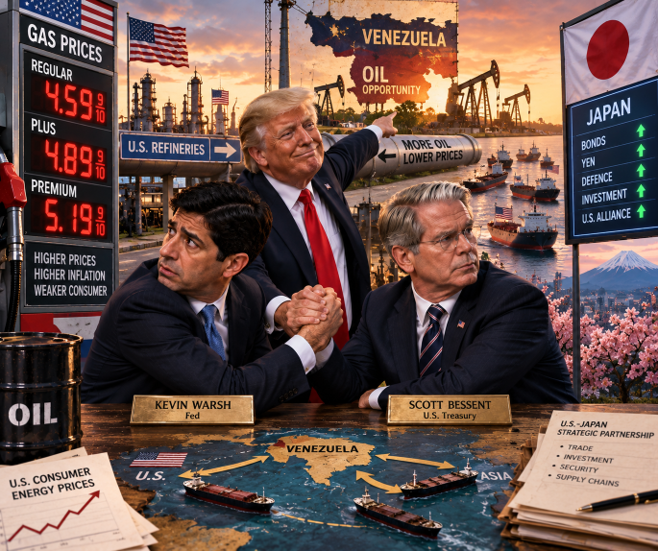
Assuming these actions dampen the rise in interest rates in the short term, the trajectory of the oil price remains the ultimate litmus test for bond markets. Will the Trump administration's policy, driven by oil deals with Venezuela, maximum pressure on Iran and the restoration of oil flows through the Strait of Hormuz, succeed in structurally increasing global supply and lowering the price at the pump?
The expectation is that within two to three years, hyperscalers' free cash flow will recover towards historical records as the enormous investments in data centres and chips level off, causing capital expenditure (capex) as a percentage of revenue to decline. At the same time, software platforms, enterprise cloud subscriptions and AI cloud services are generating recurring, high-margin revenues on a large scale. Thanks to this operational leverage, AI services scale up very efficiently to strong profitability once the fixed infrastructure costs have been absorbed.
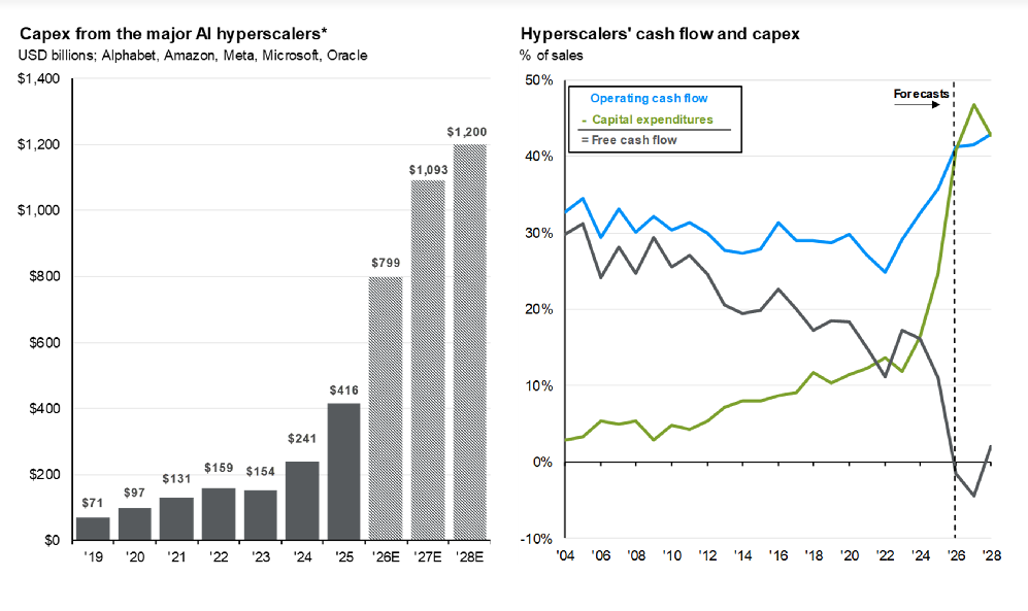
Although Fed Chair Warsh is trying to steer the markets with hawkish rhetoric (talking the talk), the question is whether he will actually follow through with interest rate hikes (walking the walk) should the oil price fall towards $70 per barrel.
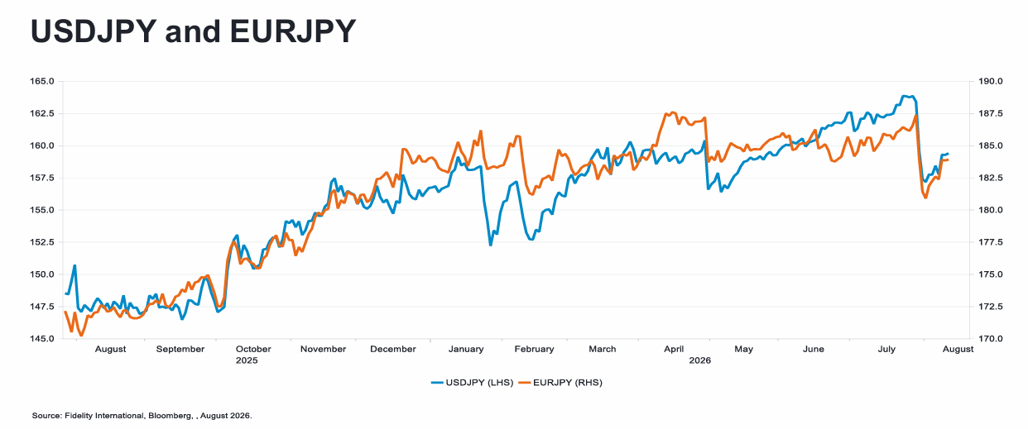
Looking beyond the US, three countries stand out for a toxic cocktail of high debt burdens, rising capital market rates and macroeconomic stagnation. Japan finds itself in a critical transition phase here. With gross government debt of just over 205% of GDP, fiscal sustainability is extremely sensitive to any further normalisation of monetary policy by the Bank of Japan. Although the effective interest burden currently remains historically low at 0.3% of GDP (thanks to the low average coupon on the outstanding volume of Japanese government bonds), the capital market is signalling a clear trend break. The 10-year rate has now risen to 3.1%, thereby exceeding nominal GDP growth of 2.9%. This negative gap between nominal growth and interest rates (g - r) means that as refinancing takes place at current market rates, the budgetary pressure will increase exponentially through the snowball effect. Moreover, Japanese interest rates cannot fall too far behind US rates, in order to limit capital outflows to the US and counter further weakening of the yen (JPY).
A comparable fiscal vulnerability, but with a different transmission into the real economy, is manifesting itself in the United Kingdom. The British government combines net government debt of almost 95% of GDP with a structural budget deficit of 5.1%, while the private balance sheet is being burdened by household debt of 74% of GDP. The annual interest burden is already consuming 2.7% of GDP, which completely paralyses budgetary flexibility in Westminster. Against the backdrop of persistent core inflation and stagnating real growth (below 1%), fiscal policy room is nil. The bond market is consequently reacting extremely nervously to new budgetary plans and remains alert to a new 'Liz Truss moment'. After all, the memory of autumn 2022 is still deeply embedded in the market's collective memory. At that time, an unfunded fiscal stimulus package led to an acute confidence crisis, a crash in long-dated government bonds (gilts) and a free fall in the British pound.
In the eurozone too, and particularly in France, Italy, Belgium and Spain, the sustainability of government debt is once again coming under the magnifying glass due to the threat of renewed energy-driven stagflation. The fact that heavyweights such as France, Italy and Germany are no longer managing to achieve trend growth above 1%, combined with high budget deficits, towering debts and unfunded pension liabilities, forms the recipe for a new euro crisis in the coming years. The question is how Brussels and Frankfurt will respond this time. Greece was a relatively small economy that had to reform under harsh German political pressure and is now even regarded by the market as more creditworthy than France. As long as interest rate differentials (spreads) within the euro area remain limited, the system appears stable. However, the real crisis only begins once the market starts to doubt whether the ECB can simultaneously protect the euro, combat inflation and keep propping up fiscally irresponsible member states.
Receive weekly insights in your inbox
Exclusive analyses and updates on family holding companies and global market developments.
Oil markets watch the wave
Given oil's strong influence on global price levels, central bankers and investors are watching the oil price closely. This global oil market is balancing between American attempts to free up new supply and rising geopolitical risks in the Middle East. Through OFAC General License 50C, Washington gave BP, Chevron, Eni, Maurel & Prom, Repsol and Shell more room to operate in Venezuela. In addition, North American Blue Energy Partners (NABEP) was granted concessions for 17 oil fields with approximately 65 billion barrels of proven reserves, roughly 21% of Venezuela's total. According to the White House, these concessions run for 100 years. Washington may buy 20% of production at cost price and receives a right of first refusal on the remaining 80%. The oil is intended, among other things, for American refineries and the Strategic Petroleum Reserve. NABEP has pledged up to $100 billion in investments; Caracas is counting on more than $209 billion in taxes and royalties.
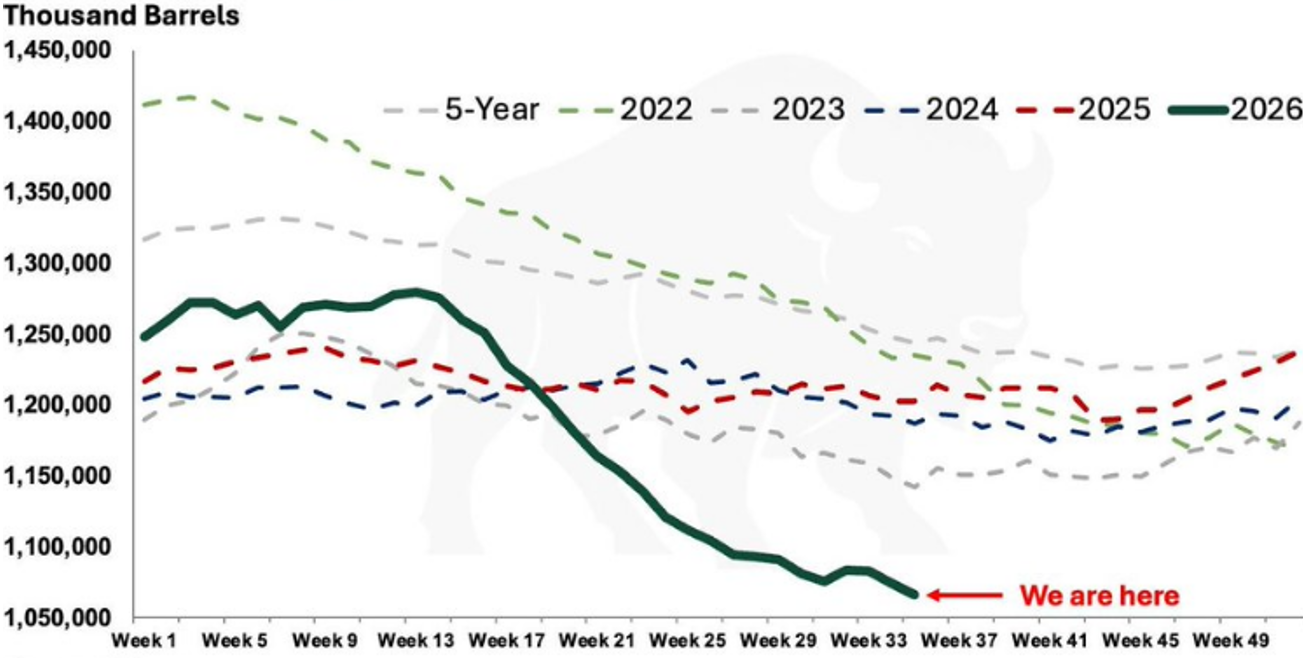
With approximately 300 billion barrels, Venezuela holds the largest proven oil reserves in the world. However, production stands at just 1.18 million barrels per day, less than 1.2% of the global total. Due to years of underinvestment and outdated infrastructure, a return to the former level of 3 million barrels per day will take years. Venezuela can supply additional supply over the longer term, but does not form an acute buffer against a global supply shock. The immediate risk remains the Middle East. Although large volumes of oil still pass through the Strait of Hormuz, it is Iranian exports in particular that are under pressure. Heightened maritime friction around Kharg Island is hampering both the departure of loaded tankers and the return of empty vessels. This is disrupting precisely the logistical model of Iran's shadow fleet. At the same time, Washington is stepping up financial pressure on Iran. Banks, shipowners and other parties that facilitate Iranian oil flows face growing risk of US secondary sanctions and exclusion from the dollar system. This is also increasing the incentive among Chinese parties to limit their exposure. Oil exports have fallen by 80%, leaving Iran unable to generate revenue.
Risks of a new energy shock in Europe
This escalation in the Middle East is not only affecting the oil market, but is spilling over directly onto the European continent via the gas market. Asset manager BlueBay is now warning of an acute stagflationary trap in Europe. The European gas benchmark TTF has broken out to above €70 per MWh, almost 140% higher than before the recent escalation.
This new supply shock hits Europe from an extremely vulnerable starting position. Gas stocks are historically low for this time of year, with key markets such as the Netherlands and Germany even diving well below the European average, while the Netherlands has sharply scaled back domestic production and Russian pipeline supply has almost completely dried up. Because Europe has rapidly become dependent on liquefied natural gas (LNG), a direct squeeze is now emerging. Qatar, the world's second-largest LNG exporter, ships its gas almost entirely via that same contested Strait of Hormuz. The obstructions on this shipping route are forcing European buyers to compete aggressively with Asia on the international spot market for the scarce remaining LNG cargoes, which is once again fuelling energy prices and inflation on the continent.
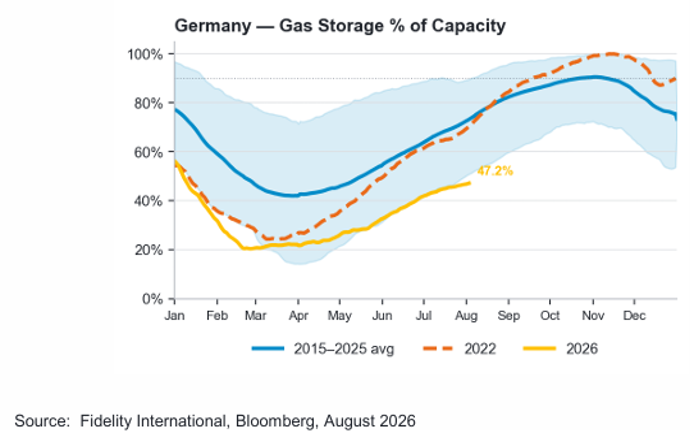
According to Fidelity and Gas Infrastructure Europe, EU storage facilities were 65.39% full on 1 September. Germany stood at 53.28% and the Netherlands at 47.29%. The EU framework maintains a binding target of 90%, with flexibility to reach this between 1 October and 1 December. In a normal winter, storage supplies around 30% of EU gas consumption; a low starting point therefore increases sensitivity to cold weather, LNG competition and new supply disruptions.
A price gap of this magnitude works its way through electricity, chemicals, fertiliser, glass, paper and metal. American producers have a structural cost advantage; European energy-intensive companies must offset this through productivity, hedging or higher selling prices.
The sharply higher oil price is also hitting the European consumer directly in the wallet. The first blow becomes visible at the pump: fuel and lubricants in the EU were on average 13.7% more expensive in June 2026 than a year earlier. More expensive diesel raises the cost of road transport and therefore of almost all goods in shops, while higher kerosene prices make flying and tourism more expensive. Here too, rising diesel prices are partly the result of deliberate policy.

Since 2000, the number of refineries in Europe has been reduced by as much as 35% under pressure from government policy. Now that many refineries in the Middle East cannot guarantee their exports, this capacity reduction is exposing an enormous bottleneck for the continent.
While many investors fixate on a crude oil price of around $80 per barrel, the real problem lies in refining capacity. The so-called crack spreads (the margin between crude oil and the final fuel at the pump) recently added as much as a further $100 per barrel on top of that. After all, for the European consumer and industry, it is not only the price of crude oil that counts, but also the price of the refined product. In countries such as the Netherlands, the government then doubles that bill again through excise duties and taxes.
Is Trump about to lose his grip on Congress in November?
The US midterm elections take place on 3 November 2026. Historically, the sitting president's party tends to lose seats in midterm elections. Against the current macroeconomic backdrop (persistent inflationary pressure, high interest rates and discontent over the cost of living), President Donald Trump and the Republican Party therefore face a real risk of losing their current trifecta: simultaneous control of the White House, the House of Representatives and the Senate. As of early September, prediction markets and quantitative election models are increasingly pointing towards a divided Congress and, with it, a period of political gridlock.
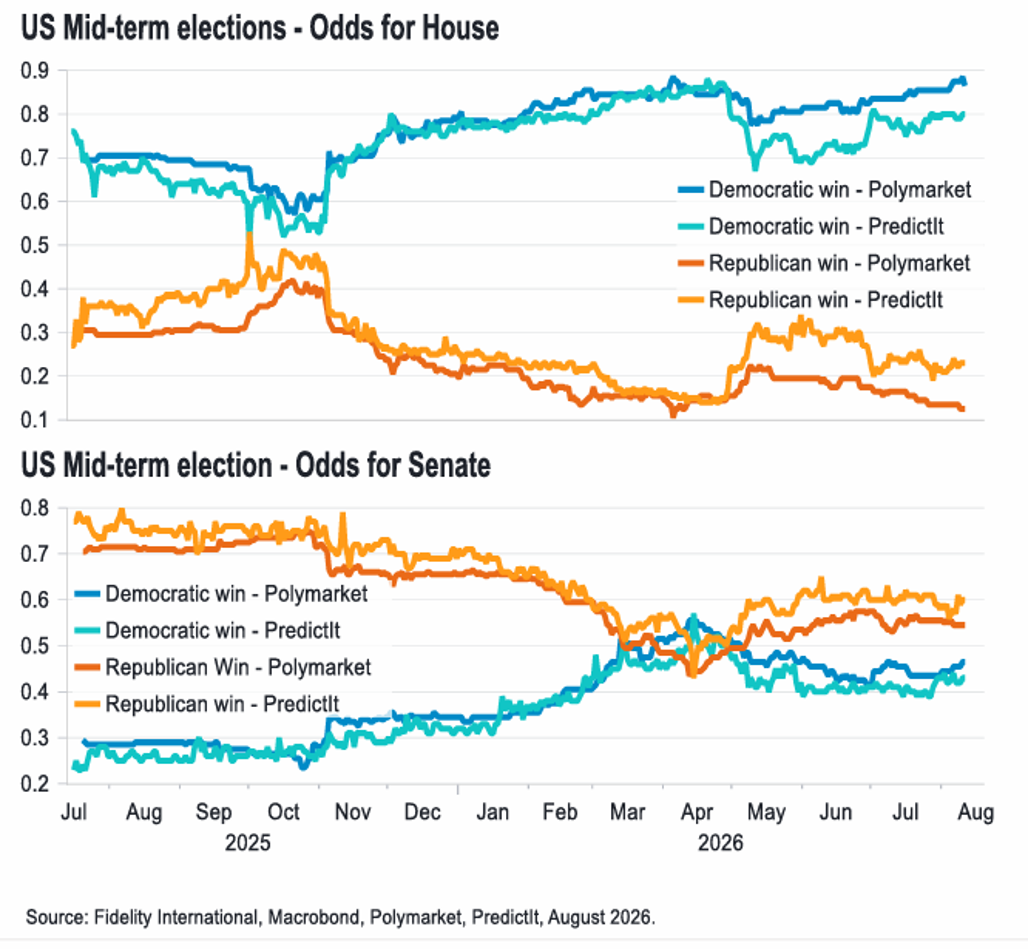
The electoral risks for the Republicans are particularly significant in the House of Representatives. Cornell University's election model, dated 3 September 2026, gives the Democrats a roughly 80% chance of retaking the majority and projects a central outcome of around 226 Democratic seats versus 209 Republican seats. Prediction markets are even more pronounced. As of 1 September, Polymarket priced in an implied probability of around 90% for Democratic control of the House. Other models likewise point to a clear Democratic advantage, meaning that retaining full Republican control of Washington has become considerably less likely.
The battle for the Senate, by contrast, remains almost entirely open. Decision Desk HQ currently puts the chance of Republican control at 51%, versus 49% for the Democrats. The model's average outcome is around a 50-50 split, a scenario that would favour the Republicans, since Vice President JD Vance can cast the deciding vote in the event of a tied vote. The fact that the Senate map is becoming more competitive is evident, among other things, in Texas. The traditionally Republican Senate seat has turned into a toss-up, with Democratic candidate James Talarico, according to recent market prices and polls, even holding a marginal lead over Republican Ken Paxton. The Republican Party itself now also regards the race as a serious risk.
Economic implications of a divided Congress
If the Democrats capture at least one of the two chambers on 3 November, the policy environment in Washington will change fundamentally. New large-scale tax cuts, additional discretionary spending and further parts of Trump's domestic economic agenda would become considerably harder to push through Congress. Budget negotiations and future debt-ceiling discussions could therefore once again result in political confrontations, temporary budget crises and higher market volatility.
A Democratic majority in the House would gain control of key congressional committees, and with it the ability to hold hearings, subpoena documents and issue summonses. Democratic leadership is already preparing for more intensive oversight of the Trump administration should it regain the majority. This could absorb the administration's political and administrative capacity and slow the implementation of its domestic policy agenda.
When legislation is blocked by political gridlock, the relative importance of policy areas where the president has more autonomous room for manoeuvre increases. International trade and tariffs are important examples of this. A Democratic House therefore need not automatically lead to less protectionism. On the contrary: when fiscal and domestic legislation stalls, the White House can lean more heavily on trade measures, tariffs and other executive powers that require less congressional support.
A divided Congress probably lowers the likelihood of large-scale new fiscal stimulus and additional tax cuts, but does not necessarily mean a less activist economic policy. The policy mix may instead shift away from fiscal expansion towards a greater emphasis on trade policy, tariffs and Executive Orders.
This means that after the midterms, a regime could emerge in which fiscal gridlock coincides with persistent trade-policy uncertainty. For investors, this potentially means less upward pressure on budget deficits from new legislation, but at the same time a greater risk of episodic volatility around trade tariffs, budget negotiations, the debt ceiling and political confrontations between Congress and the White House.
A political stress test for Germany as well
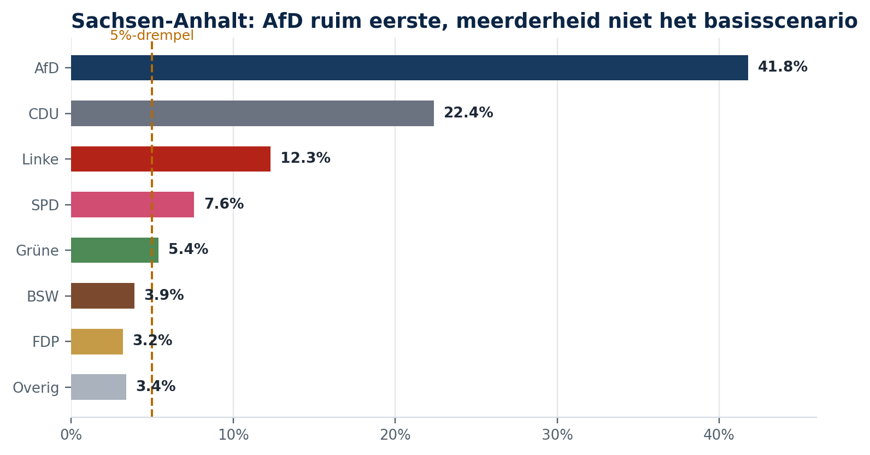
The state election in Saxony-Anhalt on Sunday 6 September transcends regional politics. At 41.8% in the PolitPro trend, the AfD is miles ahead of the CDU (22.4%). It is precisely the 5% electoral threshold that could make the outcome explosive.

When several smaller parties fail to clear the electoral threshold, their votes fall outside the seat allocation. This automatically inflates the seat share of the remaining parties, considerably increasing the chance of an absolute majority for the AfD.
Even without such an absolute majority, an AfD score above 40% would be politically significant. Since the established parties rule out any cooperation with it, extremely complex coalition-building looms. The CDU in particular finds itself caught between its Brandmauer [firewall] against the AfD and the need to form majorities with far-left parties such as Die Linke.
This election therefore represents a direct stress test for Chancellor Friedrich Merz. An AfD result above 40% would undermine his strategy of politically isolating the party; an absolute majority would effectively sideline the Brandmauer in Saxony-Anhalt. Moreover, the political shockwave reaches far beyond the state's borders and will further fuel the debate on migration, energy, industrial policy and European integration.
A great deal is also at stake economically. Saxony-Anhalt has strategic industrial and chemical clusters, but the region is vulnerable: the definitive cancellation of the planned Intel gigafactory in Magdeburg painfully exposed its sensitivity to foreign investment decisions. Rising political polarisation threatens to further undermine Germany's already strained business climate, although Elon Musk caused a stir by suggesting he would actually like to invest heavily in a state under AfD administration.
Finally: political tensions are also rising in France
In the run-up to the 2027 French presidential election, institutional investors' focus is shifting definitively from political rhetoric to the actual feasibility of fiscal consolidation. French government debt is heading towards 119% of GDP, while the budget deficit remains stubbornly above 5%. This fiscal pressure is being reinforced by a cooling labour market, where unemployment is now climbing towards 8.3%.
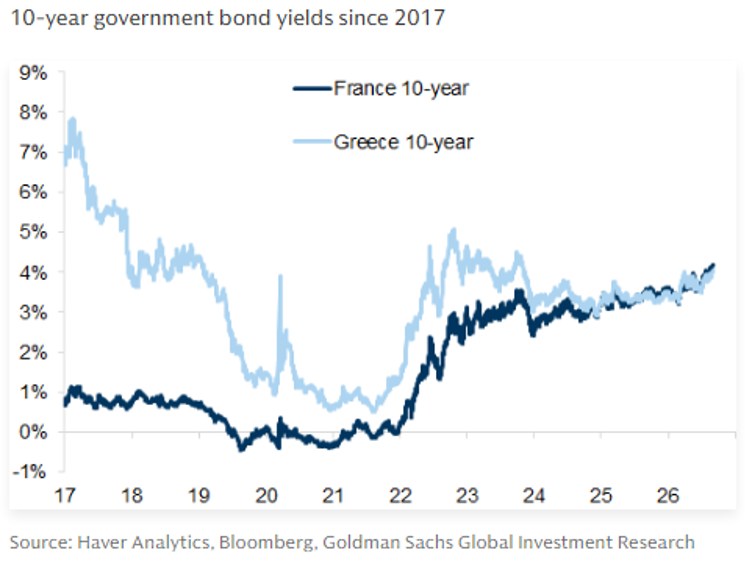
The core of the problem lies in the mathematical divergence between financing costs and nominal economic growth (g - r). While real GDP growth is stagnating around 0.8% and nominal growth does not exceed roughly 2.3%, the French ten-year yield (OAT) has recently risen to 4.21–4.25%, the highest level since 2008. The fact that French capital market rates are now above those of countries such as Greece underscores the fundamental shift in bond investors' risk perception. Without credible fiscal discipline, a debt snowball looms: rising interest costs would autonomously push the debt ratio further up, structurally anchoring the risk premium over German Bunds at a higher level.

Political fragmentation as the key risk
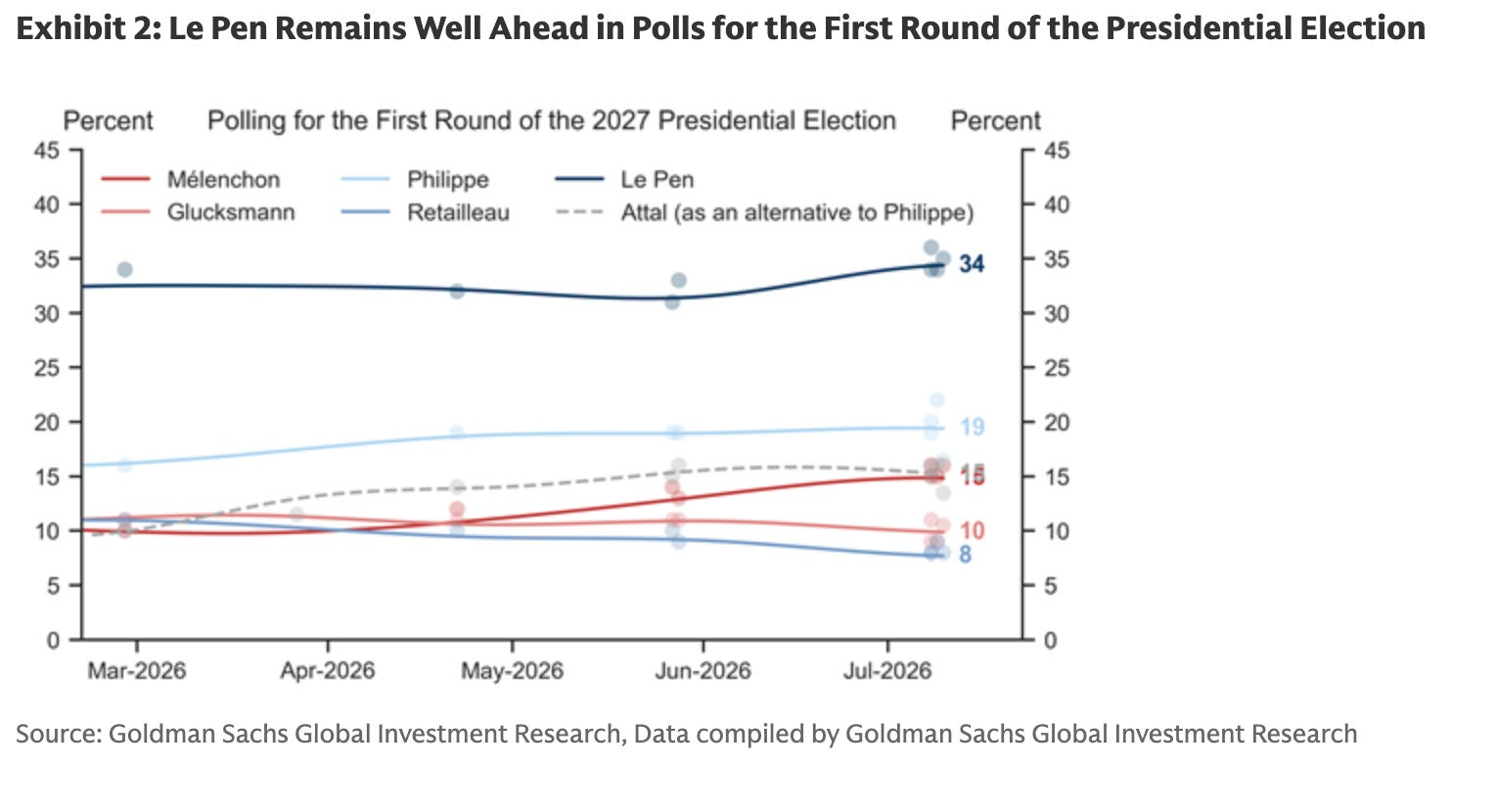
For financial markets, a pro-European centrist president is regarded as the most market-friendly scenario, given the greater likelihood of continuity in structural reforms and fiscal discipline. The radical left, led by Jean-Luc Mélenchon, is by contrast seen as the least favourable outcome for financial assets. Marine Le Pen and the Rassemblement National (RN) occupy an intermediate position, partly because the RN has abandoned its ambition of leaving the eurozone and now places greater rhetorical emphasis on budgetary discipline.
Vulnerability is concentrated in the banking sector
The greatest direct risk lies with French financial institutions. They are heavily exposed to the rising domestic risk premium through their sizeable holdings of French government bonds and rising refinancing costs. Through sector correlations and broader spread stress within the eurozone, these risks could then spill over into the wider European banking sector.
This risk is especially relevant given the starting position. Over the past five years, European banks have been among the best-performing equity sectors in Europe. They significantly outperformed the large French banks specifically, and over this period even achieved outperformance relative to the US technology sector. This strong starting position offers resilience on the one hand, but on the other hand means there are substantial share price gains to protect. When the political and macroeconomic risk premium within the eurozone rises structurally, it is precisely the European banking sector that becomes vulnerable to profit-taking and multiple compression.
Receive weekly insights in your inbox
Exclusive analyses and updates on family holding companies and global market developments.
Would you like more information about our services?
Get in touch
Disclaimer:
No rights can be derived from this publication. This is a publication of Tresor Capital. Reproduction of this document, or parts thereof, by third parties is only permitted after written consent and with reference to the source, Tresor Capital.
This publication has been compiled by Tresor Capital with the utmost care. The information is intended in a general sense and is not tailored to your individual situation. The information should therefore expressly not be regarded as advice, an offer or a proposal to purchase or trade investment products and/or to make use of investment services, nor as investment advice. The authors, Tresor Capital and/or its employees may hold positions in the securities discussed, for their own account or on behalf of their clients.
You should carefully consider the risks before you start investing. The value of your investments may fluctuate. Past performance is no guarantee of future results. You may lose (part of) your investment. Tresor Capital rejects any form of liability for any inaccuracies or errors. This information is purely indicative and subject to change.
Read the full disclaimer at tresorcapitalnieuws.nl/disclaimer .
This article was translated automatically from Dutch using AI. In case of any difference, the Dutch original prevails. Read the original in Dutch.