
Economy & Markets #2 - Trump plays real-life Risk


This week's topics:
Whoever controls energy controls continents
In our newsletters in early December, we pointed out that the Trump administration has major strategic plans on the geopolitical chessboard. In the United States' National Security Strategy, Europe is viewed as a 'weakened' and 'dysfunctional' power bloc, which is therefore losing geopolitical relevance over time and is starting to harm American interests. As a result, the American government is shifting its focus to China and the strategic backyard of the US, namely Latin America. Global energy flows play a significant role in this.
President Trump has repeatedly indicated that he is aiming for structurally lower oil prices, with a level of around USD 50 per barrel seen as economically desirable. Lower energy prices help to reduce inflation, increase the policy room for lower interest rates, and thereby indirectly ease the financing burden of American government debt. This policy fits with efforts to increase global oil and gas production, both through domestic production and through the geopolitical reorientation of supply flows.
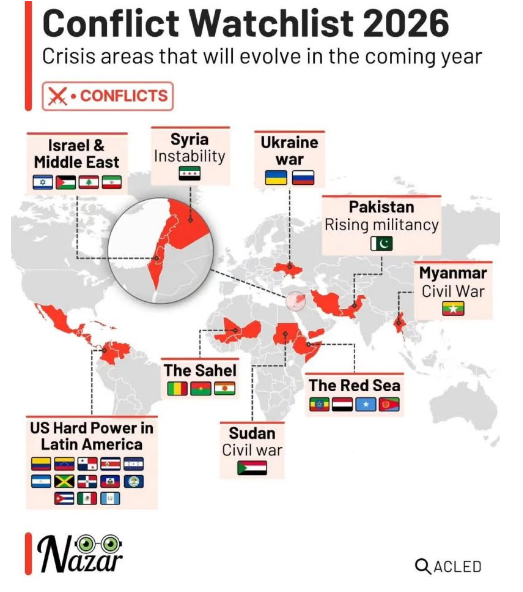
Venezuela: a first strategic move on the chessboard
Against this backdrop, the arrest of Venezuelan President Maduro did not come entirely out of the blue. Although there is formally (still) no regime change, the strategic long-term benefits for the tightened American security strategy are considerable. Through soft or hard power, the US will ultimately want to achieve the following in Venezuela:
- Control over the largest proven oil reserves in the world.
- Choking off the oil supply to China (in the event of escalation around Taiwan). China consumes around 16 million barrels a day, a large part of which is sanctioned oil from Venezuela (~0.5-1 million), Iran (~2 million) and Russia (~3 million), traded at a discount.
- Eliminating Venezuela as a springboard for Chinese geopolitical influence in Latin America.
- Cutting off funding to allies such as Cuba and Iran, and indirect flows of money to Hamas and Hezbollah.
- Building goodwill among the Venezuelan population. More than 25% live as refugees and are predominantly pro-American (comparable to the Cuban diaspora).
- Inspiring other oppressed populations to rise up against authoritarian regimes.
- Ending the dispute over exploration rights, which would stimulate investment in oil and gas fields in French Guiana and Trinidad and Tobago.
Although the arrest of Maduro has created a power vacuum in Venezuela and it is unclear who will determine policy (on behalf of the US), financial markets are pricing in de-escalation. Geopolitical risk premiums fell, leading to a 'risk-on' sentiment last Monday:
- Bonds of Venezuela and state oil company PDVSA rose by 20%.
- American oil companies also rebounded strongly: Chevron (+11%), Valero (+11%), ConocoPhillips (+10%), Marathon (+10%), ExxonMobil (+7%), Phillips 66 (+6%), Occidental (+4%), EOG (+4%), Devon (+4%) and Kinder Morgan (+3%).
- Technology stocks gained ground on the prospect of lower inflation.
- Gold and silver rose in value, also driven by expectations of declining inflation.

A downward effect on oil prices? A decade of deflation on the horizon
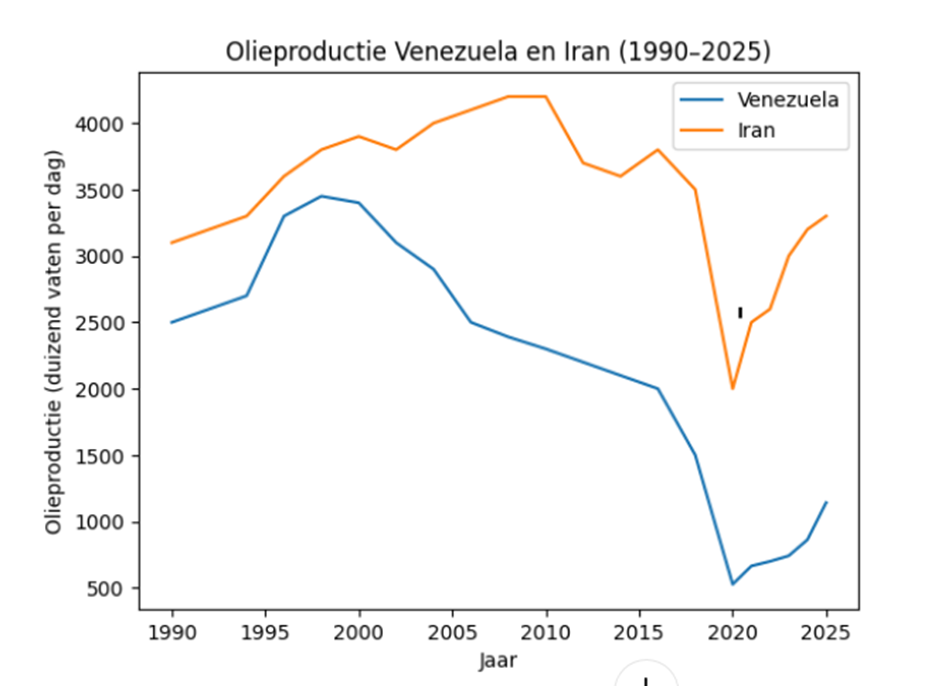
Capital markets are already pricing in the scenario in which the US gains access to the world's largest oil reserves. Venezuela holds an estimated minimum of 303 billion barrels. This is roughly 20% of the world's reserves and equivalent to around 8 years of global consumption. Nevertheless, an immediate increase in Venezuelan supply is not a given. The oil is very heavy, which makes extraction and refining technically complex and capital-intensive. A structural increase in production to 3 million barrels per day (the level seen in 1998, before the nationalisations under Chávez) would require years and substantial investment. In the short term, additional supply of around 0.4 million barrels per day is more realistic. In a market with oversupply and a lower oil price (down from USD 85 to USD 55), this prospect could give OPEC+ an incentive to increase production. This would push prices down further and could cause capital-intensive American investments in Venezuela to be delayed.
In addition, the US will actively steer the new oil supply away from China and Russia towards refineries on the American Gulf Coast, creating an attractive alternative to the relatively expensive Canadian tar sands oil. This is of similar quality, but costly due to transport via pipelines from Canada to the Gulf of Mexico.
Venezuela, incidentally, holds very substantial natural gas reserves and is internationally known as one of the largest 'gas flaring' countries. Due to insufficient incentives and investment in gas processing and transport infrastructure, a large proportion of the gas released during oil production is flared off rather than utilised. With Western technical expertise and investment, this waste can be reduced, allowing significantly more gas to be effectively used or exported.
Iran as the next strategic move?
Since the Islamic Revolution of 1979, Iran's clerical regime has pursued an outspoken anti-Western and geopolitically destabilising policy. This stands in sharp contrast to the demographic and societal reality. Iran has around 80 million inhabitants, a young population, and is culturally and economically strongly oriented towards the West. An estimated 40% of the population is not actively religious, and among young people this figure is even above 80%.
Set against this reality is a foreign policy of structural support for armed groups such as Hezbollah, Hamas and the Houthis, and active involvement in Syria and Iraq. This tension has been a source of instability in the Middle East for decades.
Where the Obama and Biden administrations primarily relied on diplomacy and sanctions (soft power), President Trump opted for a harder security-based approach. In 2020, General Qassem Soleimani, a key architect of Iran's military strategy, was targeted and eliminated. The confrontation escalated in 2024 when the US, in cooperation with Israel, attacked critical nuclear infrastructure. According to sources, a large part of the military command structure and technological expertise was destroyed in the process.
Iran has paid a heavy economic price for its nuclear ambitions: around USD 50 billion in direct costs and more than USD 300 billion in indirect damage from sanctions. At the same time, its missile programme proved ineffective for credible retaliation, which has significantly weakened its military strike capability.
Since the summer of 2025, tightened sanctions, combined with extreme drought, have put further pressure on the economy. This has deepened social discontent. According to the Foundation for Defense of Democracies (FDD), protests have increased sharply since the start of 2026, both in spread and intensity. Given the growing internal instability and Trump's confrontational doctrine, it seems plausible that Iran is the next target for regime change.
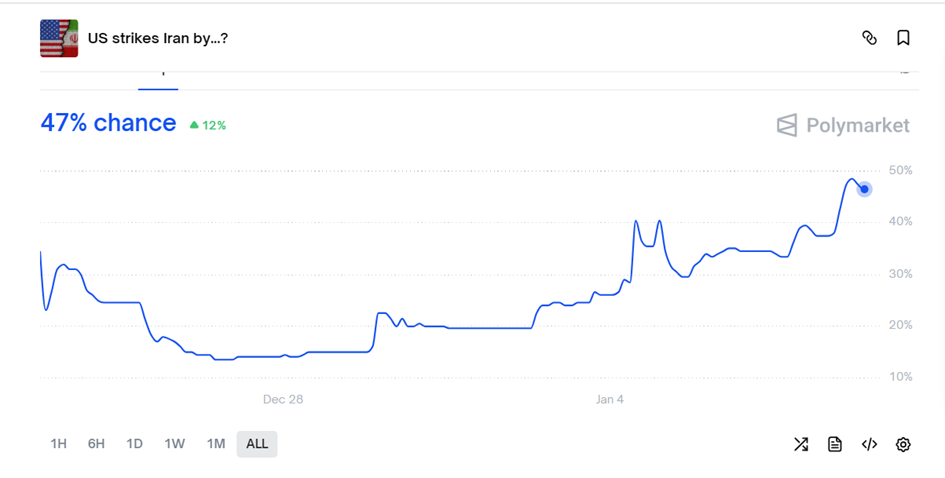
Strategic implications of a possible regime change (from a US/Israel perspective)
- Iran currently produces around 3.5 million barrels of oil per day, largely for domestic use and sanctioned export (smuggling), particularly to China.
- With foreign investment, technology and sanctions relief, production could be ramped up relatively quickly to around 5 million barrels per day.
- Iran holds around 9% of the world's proven oil reserves and roughly 17% of global gas reserves.
- A structural end would emerge to the hostile relationship with Israel, but also with Saudi Arabia.
- The funding, training and arming of Hamas, Hezbollah and other proxy actors would cease.
- Sunni-Shia tensions would ease, particularly in Iraq and Yemen.
- The structural risk around the Strait of Hormuz would diminish. This strategic chokepoint currently drives high geopolitical risk premiums, which could fall as a result.
- Greater geopolitical predictability gives markets room for lower volatility, lower risk premiums for the Middle East, and more stable capital flows.
- Iran is a major supplier of weapons and technology to Russia. A change of power in Tehran would put Moscow under additional pressure and weaken Russia's negotiating position in Ukraine.
Receive weekly insights in your inbox
Exclusive analyses and updates on family holding companies and global market developments.
China and Russia cornered: “The ends justify the means” (Machiavelli, Il Principe, 1532)
In many European debates, the emphasis lies on the legal and ethical questions surrounding the actions and pressure tactics of the Trump administration in the Middle East and Venezuela. At the same time, relatively little attention is paid to the far-reaching geopolitical consequences that may unfold over the coming days, weeks and months. The possible shift of Iran and Venezuela towards a more pro-Western political and economic profile represents one of the most significant geopolitical scenarios of this decade. Such a transition would have far-reaching implications for energy, security and market dynamics worldwide.
Positive scenarios (US perspective)
- Renewed energy security: If Iran and Venezuela open up their energy sectors to Western investment and governance, oil and gas production could rise substantially over time. This puts downward pressure on global energy prices and lowers risks. It reduces energy-driven inflationary pressure and could increase scope for monetary stability (recycling of petrodollars).
- Regional stabilisation: An end to structural hostility towards Israel and reduced support for armed proxy groups could lead to lower regional tensions and risk premiums in the Middle East.
- Strategic reorientation: China and other rivals would gain less unhindered access to cheap oil. This could lead to geopolitical reconsiderations and financial pressure on Beijing and Moscow.
Negative or risk scenarios
- Instability during transition: A change of regime, if not orderly or broadly supported, could lead to a power vacuum, domestic unrest and even violence. This increases the risks for international investment. The US is successful at regime change, but less successful at nation-building.
- Regional counter-reactions: Changes in Iran and Venezuela could prompt rival states or groups to intensify their own strategies, putting pressure on stability on other fronts.
- Mobilisation of counterforces: China and Russia will seek to mobilise counterforces, as they benefit from destabilisation in Iran and Venezuela. The uncertain factor is which allies they will deploy in doing so.
- Overplaying its hand: The Trump administration risks pushing allies away. For instance, President Trump has once again spoken of American interests regarding Greenland, which directly creates tensions with NATO. The political risk is that allies come to regard the United States as unpredictable because of this go-it-alone approach.
Which direction these developments will take, and within what timeframe, remains highly uncertain. Given the potential geopolitical shifts, we consider the following statement applicable: “There are decades where nothing happens; and there are weeks where decades happen” (Vladimir I. Lenin). In our view, the movement potentially looks very positive for global capital markets.
Tresor Capital, incidentally, does not comment on the moral or legal justification of American policy choices. We observe geopolitical and macroeconomic developments and adjust our investment portfolios solely on the basis of the dominant macro-strategic scenario that we identify, with ongoing attention to risk and return profiles. This is not done out of a blind conviction that a drastic shift is inevitable, but on the basis of scenario analysis and probabilistic thinking.
Poor man's gold (silver) rises faster than gold
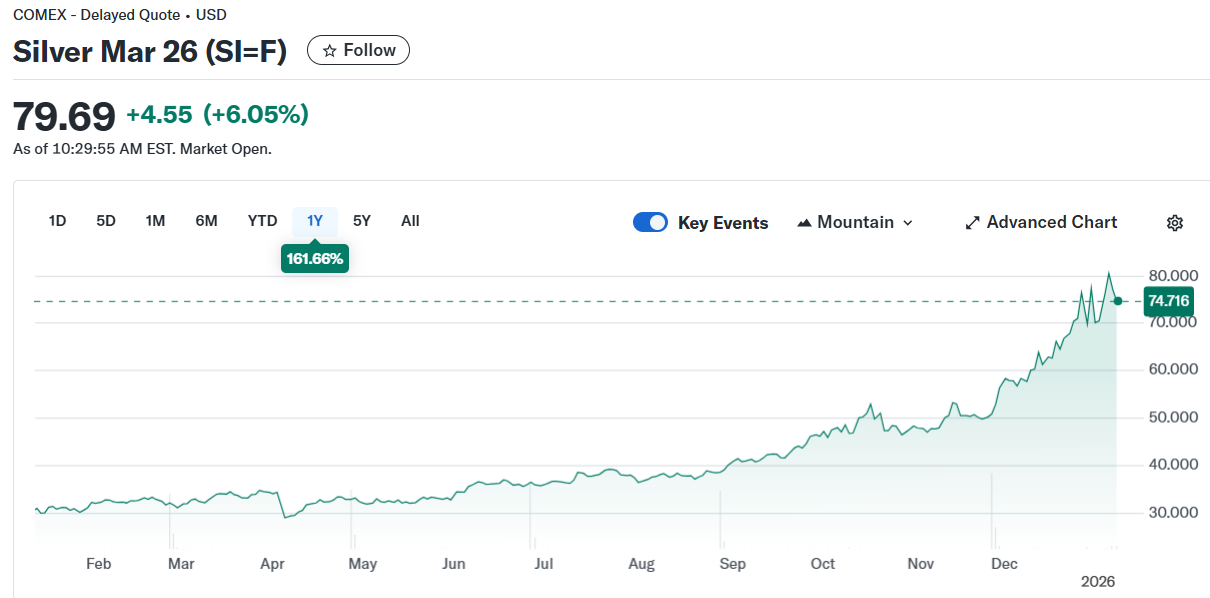
The precious metals market continues to perform exceptionally strongly this year too. In 2025, gold recorded one of its best years since 1979, with a price increase of around 60–70%, as the gold price broke records and traded well above USD 4,500 per troy ounce. Silver saw an even more spectacular rally: prices rose by more than 140–150% and reached levels above USD 80 per ounce, one of the sharpest increases in decades.
The strong rise in silver is also being driven by increased geopolitical uncertainty and expectations of lower interest rates. Investors are seeking protection in safe havens, while a weaker dollar provides additional support for precious metals. Silver is also benefiting from strong industrial demand for solar panels, relatively tight inventories and the freezing of Chinese silver exports, which is reinforcing the price movement. The rise in the silver price is expected to lead to hardly any increase in production, since roughly three-quarters of supply comes as a by-product of copper, lead, zinc and gold mining.
2026: AI boom or bubble? What do the major banks say?
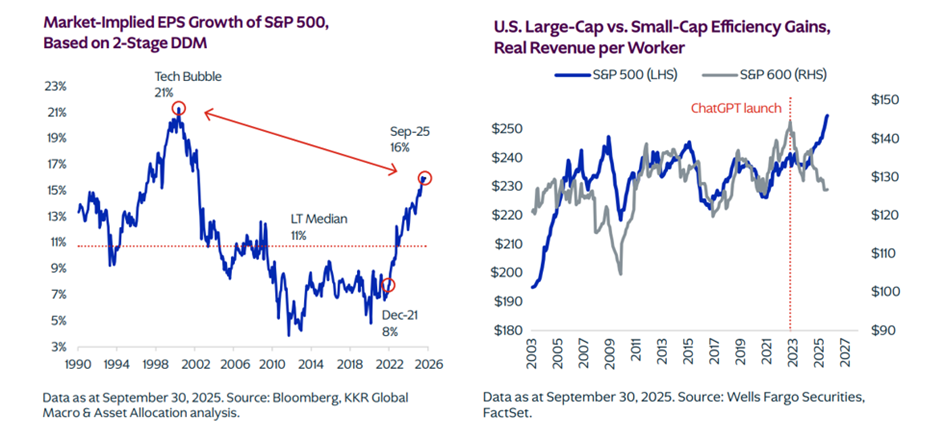
Around the turn of the year, the major banks traditionally publish their outlooks. This year too, they are positive on equity markets heading into 2026, with the emphasis on structural profit growth at large American companies. Artificial intelligence plays an important role in this, not as hype, but as an accelerator of productivity and profitability. According to banks such as Goldman Sachs, JPMorgan and Morgan Stanley, there is no question of a broad AI bubble. Investments are being made by capital-rich market leaders, including Meta, Google, Microsoft and Amazon, which are investing on a large scale in AI infrastructure and where productivity gains and strong EPS growth are already visible.
So far, investments in artificial intelligence are barely being financed with debt, in contrast to the IT and telecom bubble of 2000. And even where debt financing is used, it helps that data centres and chips retain their value and therefore offer solid collateral against bankruptcy risk. In its 2026 outlook, KKR points to a clear acceleration in profit growth, which, thanks to AI, is being achieved mainly by large companies in the services sector.
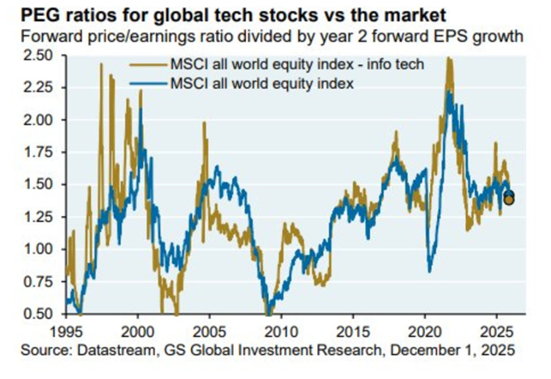
At first glance, current price/earnings ratios (P/E ratios) suggest that equities are expensive, especially compared with historical averages. This picture changes, however, once valuations are adjusted for expected profit growth using the PEG ratio (Price/Earnings Growth). During the IT bubble of 1995–2000, share prices ran far ahead of profits that still largely had to be realised. As a result, PEG ratios were often well above 2, a signal of overvaluation.
Today, PEG ratios are significantly lower, despite higher P/E levels. This indicates that valuations are now, in many cases, being supported by actual and visible profit growth, as illustrated by KKR. Particularly among large, profitable technology companies, AI is quickly translating into productivity improvements, margin expansion and EPS growth. Whereas the P/E ratio on its own may give an impression of overvaluation, the PEG ratio shows that, unlike in the late 1990s, the current market is more strongly underpinned by fundamental profit development.
Receive weekly insights in your inbox
Exclusive analyses and updates on family holding companies and global market developments.
Inflation is falling sharply worldwide, except in the Netherlands
Inflation in the United States came in significantly lower than expected in November: the consumer price index stood at approximately 2.7% (both headline and core), below analysts' expectations and the previous reading. This strengthens the scope for the Federal Reserve to implement earlier, and possibly multiple, interest rate cuts in 2026, as price pressure is moving towards the target level of around 2% faster than previously thought.
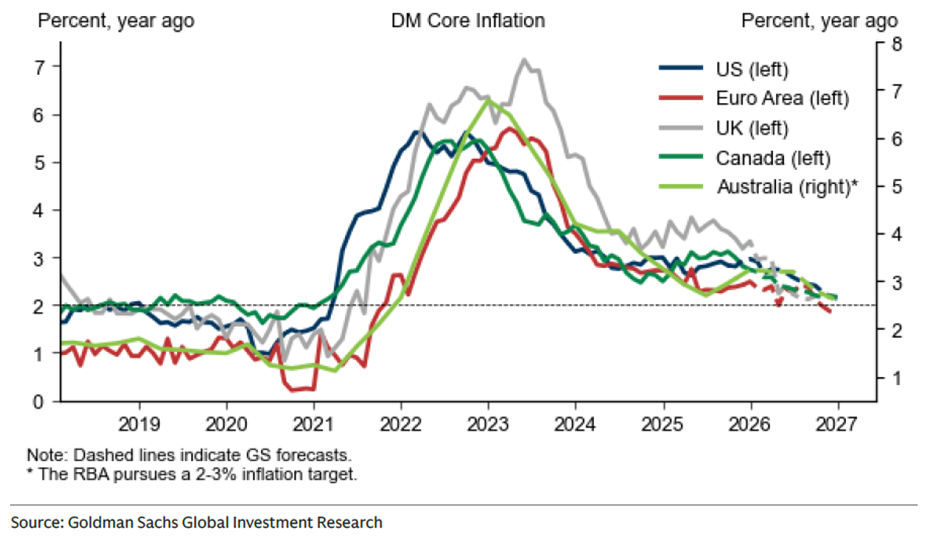
In the Netherlands, however, inflation remains structurally higher than in many other European countries. According to De Nederlandsche Bank (the Dutch central bank), Dutch inflation will continue to hover around approximately 3% in 2025–2026, clearly above the eurozone average. This gap is mainly caused by domestic factors: higher wage growth resulting from an imbalanced labour market, sharply rising prices in the services sector, and indirect tax increases (such as excise duties) have kept price pressure higher than elsewhere in Europe.
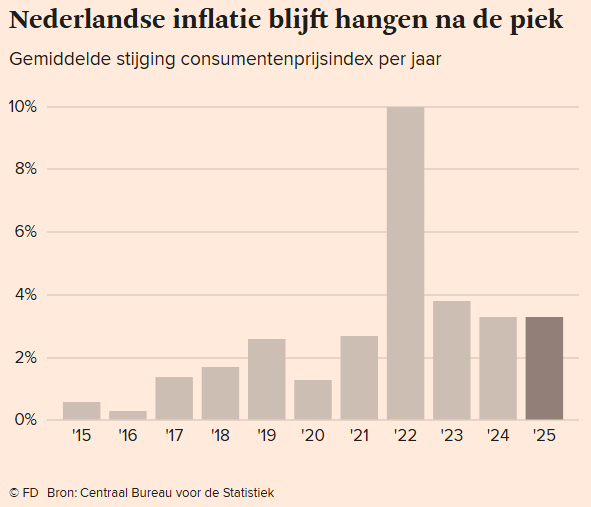
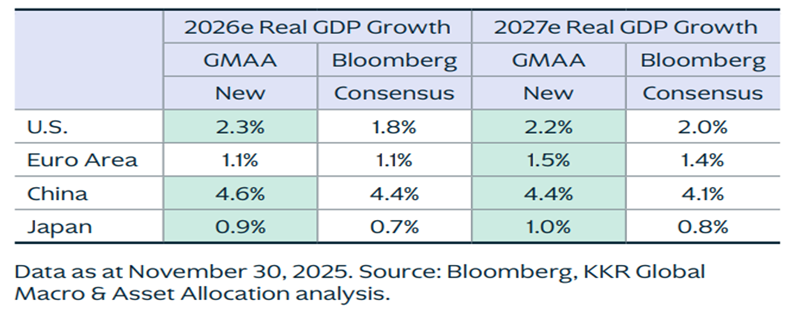
The new government in the Netherlands will need to work hard to prevent the Dutch competitive position from deteriorating further, particularly given that high inflation in the Netherlands is not a sign of an overheating economy or high structural economic growth. Falling inflation gives central banks worldwide room to cut interest rates. According to KKR, an accommodative monetary policy combined with high productivity driven by artificial intelligence will translate into strong economic growth in the US and China in 2026 and 2027 as well, while growth expectations for Europe continue to lag behind despite Germany's efforts.
Get weekly insights in your inbox
Exclusive analyses and updates on family holding companies and global market developments.
Would you like more information about our services?
Contact us
Disclaimer:
No rights can be derived from this publication. This is a publication of Tresor Capital. Reproduction of this document, or parts thereof, by third parties is only permitted after written consent and with reference to the source, Tresor Capital.
This publication has been compiled by Tresor Capital with the greatest possible care. The information is intended in a general sense and is not tailored to your individual situation. The information should therefore explicitly not be regarded as advice, an offer or a proposal to purchase or trade investment products and/or to obtain investment services, nor as investment advice. The authors, Tresor Capital and/or its employees may hold positions in the securities discussed, for their own account or for their clients.
You should carefully consider the risks before you start investing. The value of your investments may fluctuate. Past performance is no guarantee of future results. You may lose (part of) your investment. Tresor Capital disclaims any form of liability for any inaccuracies or errors. This information is purely indicative and subject to change.
Read the full disclaimer at tresorcapitalnieuws.nl/disclaimer .
This article was translated automatically from Dutch using AI. In case of any difference, the Dutch original prevails. Read the original in Dutch.