
Economy & Markets #33 - Inflation falls, oil is cheap: what does this mean for the Fed?


This week's topics:
US heads towards rate cuts, while China and Europe keep struggling
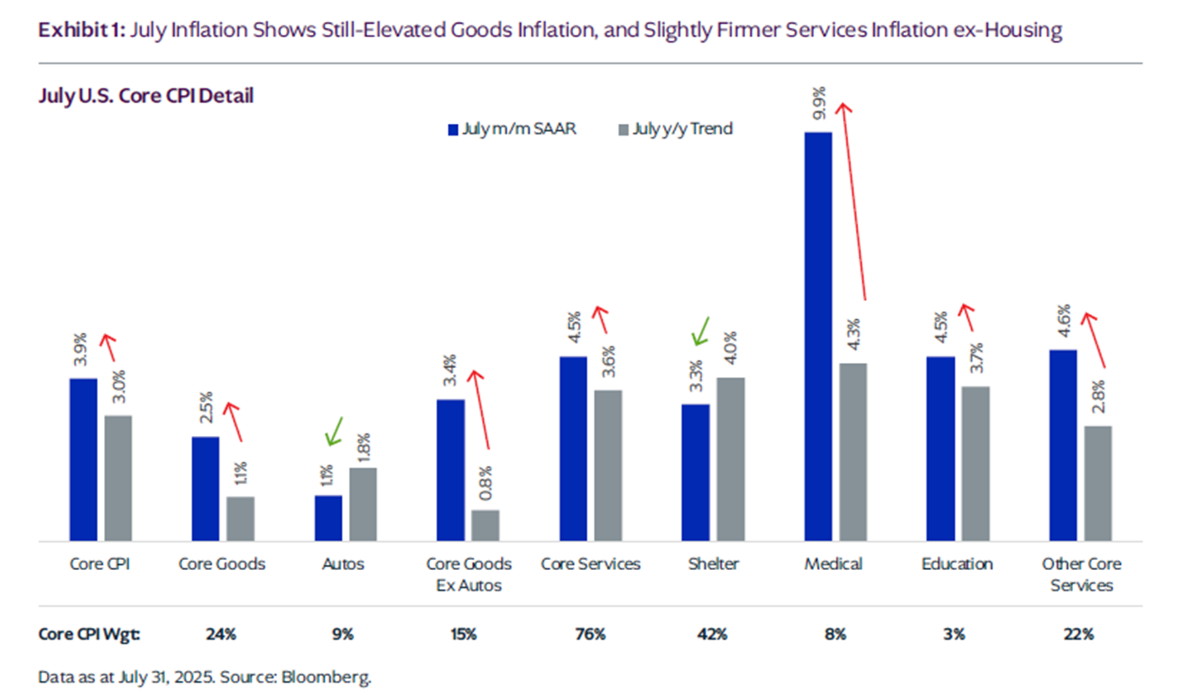
(Consumer) inflation in the United States rose by 0.32% in July compared with June, and is expected to remain within the 0.3% to 0.4% range in the coming months as well. While the tariff war is pushing up prices for consumer electronics, cars and clothing, its effect on services prices remains limited. Since the US economy relies on the services sector for around 70% of output, it may prove less vulnerable to the many doom scenarios predicted earlier this year.
Import tariffs are causing a one-off increase in prices, with the consensus now expecting inflation to hover around 3.2% through the end of this year, before falling rapidly to 2% in 2026. As KKR's macro economists show in the chart below, import-driven inflation remains contained, while the housing market ('shelter') is pushing inflation down. Medical costs and transport and airfare prices are creating upward price pressure within the services sector, but thanks to the rapid adoption of AI, productivity within services is rising faster than previously expected. Later in the week, producer prices were published that came in higher than expected (up 3.3% year-on-year versus 2.4% in May, the highest level since early 2025).
This week further reinforced the picture that the US policy rate could fall quickly. The market now expects a first rate cut in September, followed by further steps in October, December and twice in the first half of 2026.
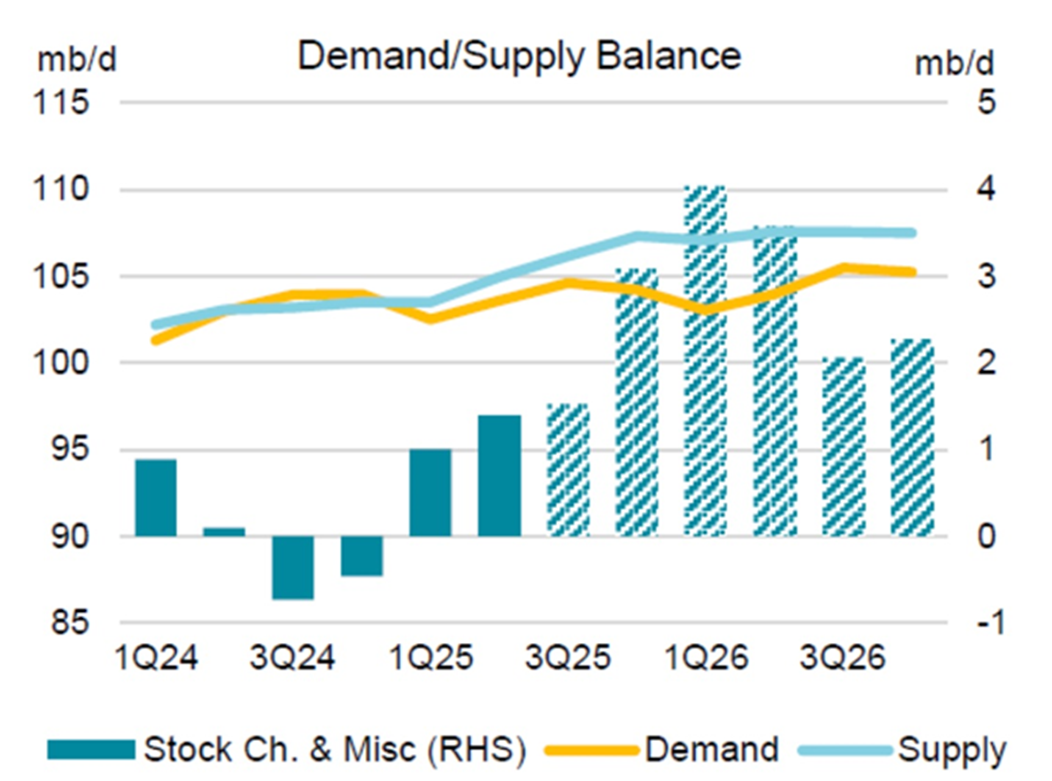
With the recently changed composition of the policy committee, the Fed appears to want to keep acting proactively in order to stay "ahead of the curve". On top of that, oil prices have recently fallen sharply following a production increase by OPEC, resulting in a clear surplus in the oil market.
The chart below shows that there has been an oversupply in the market since the start of this year. As this oversupply grows to more than 1 million barrels per day, downward pressure on oil prices will increase further in 2026. Looking ahead, we can therefore conclude that, thanks to lower petrol prices and, indirectly, lower transport and production costs, headline inflation in the US will continue to fall.
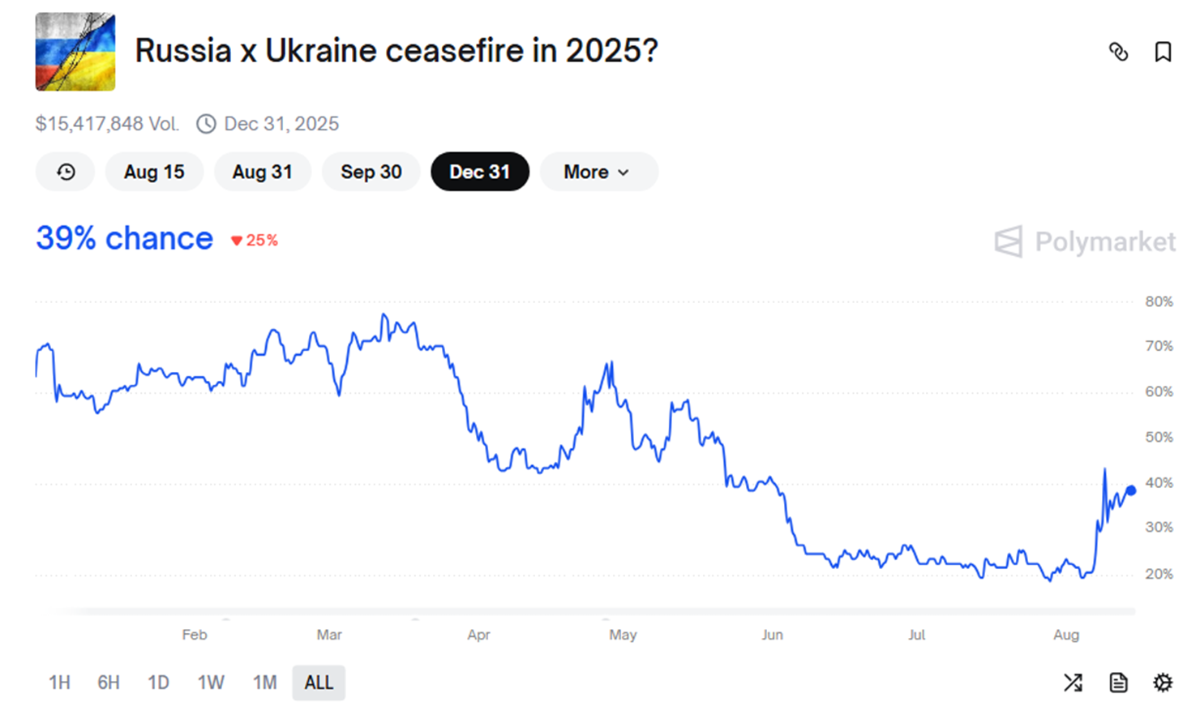
Politically, a great deal of attention is focused on the meeting between Donald Trump and Vladimir Putin in Alaska. Polymarket (a prediction market) puts the probability that President Trump will win the Nobel Peace Prize this year at 12%. Further meetings are likely to follow. What stands out is that, since the talks were announced, some European defence stocks have also been falling.
It is striking that, while prices in the US are still rising, China continues to struggle with persistent producer price deflation. This is partly because the Chinese consumer has never truly recovered from the Covid shocks and the property market crash, while the services sector accounts for only half of the economy. The consensus expects PPI to contract by around -2.8% in 2025 and -1.0% in 2026, despite government measures against aggressive price competition. Overcapacity in sectors such as steel, electric vehicles, solar energy and batteries remains a structural problem, part of which is being exported to Europe.
Other disappointing figures reported this week: property investment fell by -11% year-on-year, and retail sales rose by 3% year-on-year, but turned out to be much lower than expected (expectation: 4.6% growth). In Europe too, economic activity remains weak, and a stagflation scenario (low growth, high inflation) looms. The UK in particular, but also Germany, continue to struggle to adapt to a changed world.
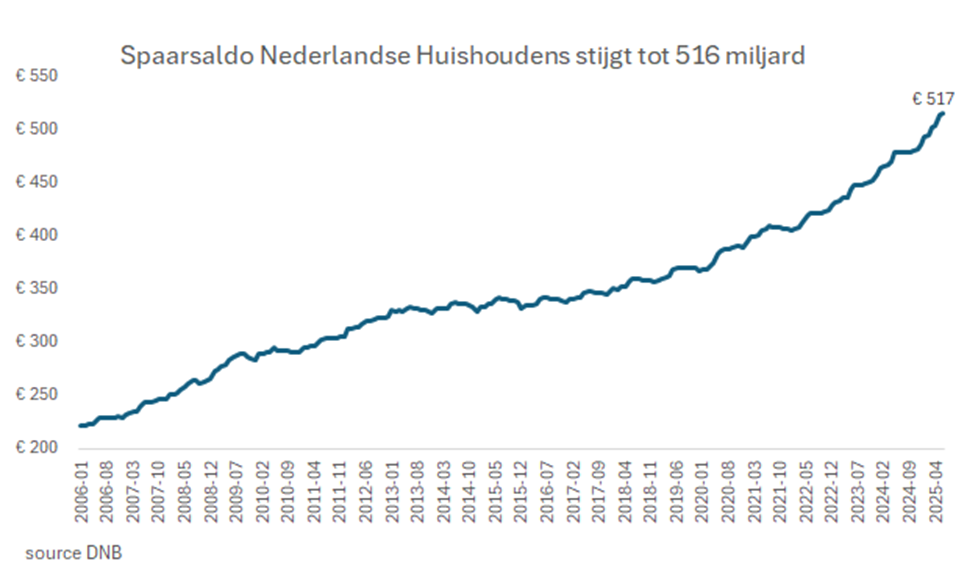
Dutch households keep saving, but without return
As at the end of June 2025, Dutch households held a combined €516 billion in savings and current accounts. The average balance per household is around €52,300, but the median of just €21,100 shows that half of all families have to get by with a much smaller buffer. Warren Buffett once put it succinctly: "If you don't find a way to make money while you sleep, you will work until you die." In other words, savings that earn no return are like never buying a house in Monopoly: you miss out on the rent and the assets that let your wealth grow passively.

The biggest risk of investing is not investing
That is why we advise starting to build wealth as early as possible, even though many people are afraid to invest and prefer to keep building wealth through a safe savings account. In previous newsletters, we already wrote about Sweden and the US, where a strong equity culture prevails, allowing even the middle class to benefit from the compounding effect. By comparison, Germany is dominated by a savings culture, fuelled by a fear of inflation dating back to the Weimar Republic, leaving an increasing number of Germans with too little wealth to retire on.
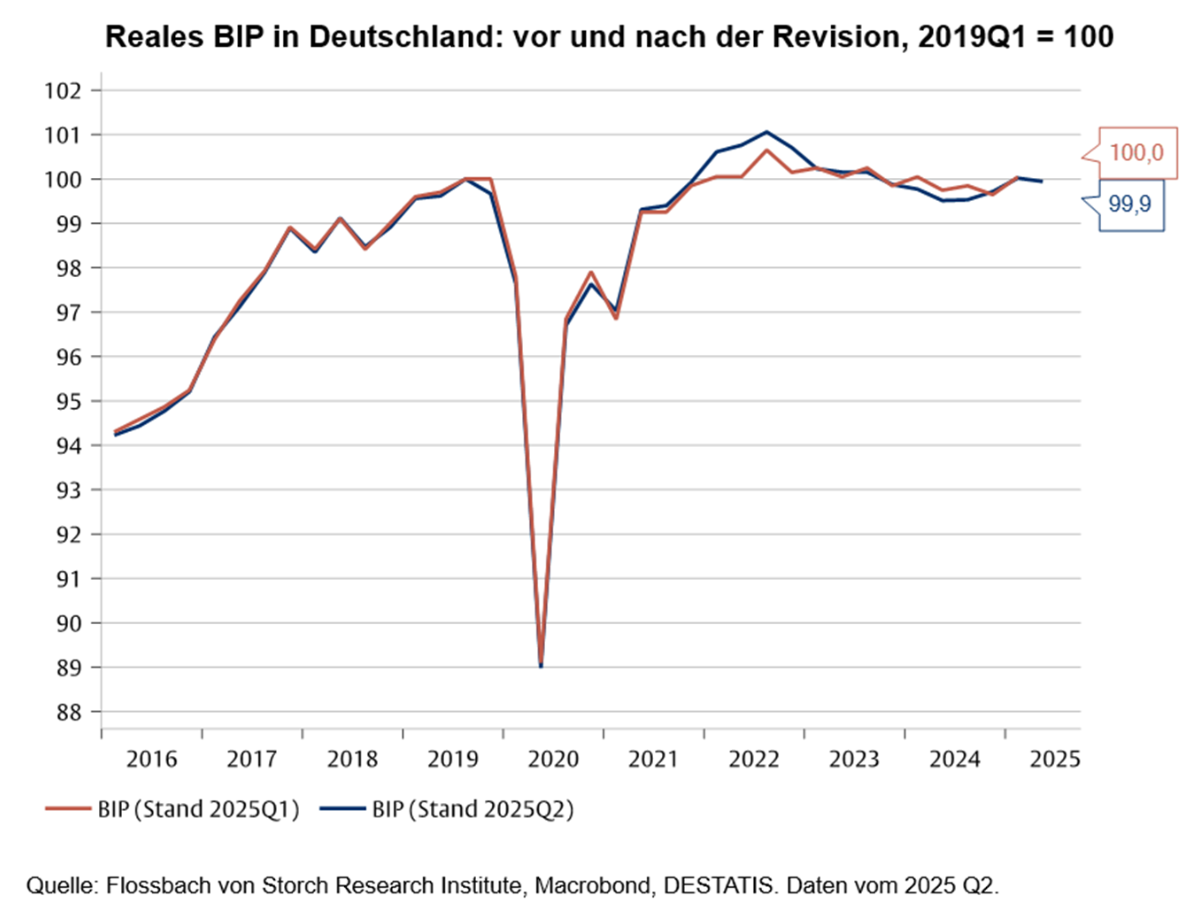
It isn't only in the US that macroeconomic data are being revised; in Germany, too, the latest revisions show that gross domestic product (GDP) grew slightly faster after the pandemic, but then contracted more sharply than had previously been assumed (see chart).
The chart below from Flossbach von Storch shows that German GDP still stands at the level of mid-2019. The economy has not grown in six years: this, combined with an ageing population and poorly performing private investment, explains why poverty in Germany is rising. By comparison: if we were to also set US GDP at 100 at the end of 2019, it would have grown to 115.
Expensive technology stocks, cheap small- and mid-cap stocks?
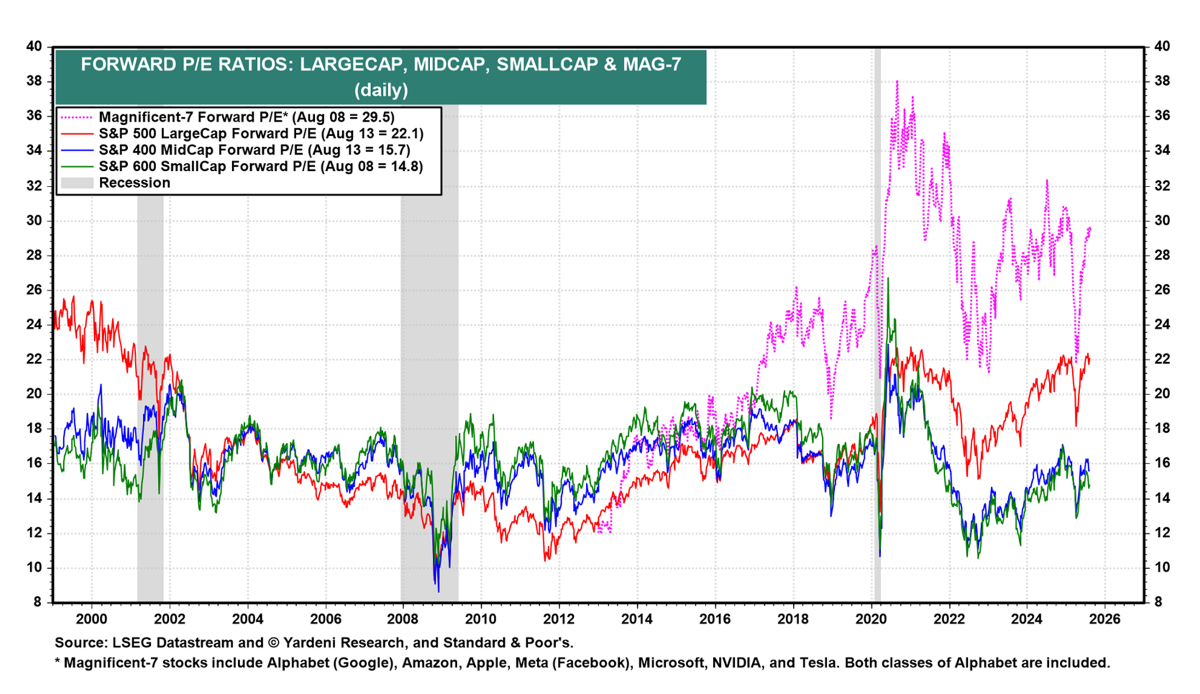
We came across an interesting chart from Yardeni Research that clearly illustrates how expensive US technology stocks (the so-called Magnificent 7) currently are, as measured by the price/earnings ratio. While this ratio appears to be heading towards new highs for technology stocks, it has fallen to its lowest level this century for small- and mid-cap stocks. Besides their low valuation, small- and mid-cap companies have historically always shown strong share price rallies whenever the policy rate was cut. Given the earlier picture that the US central bank appears set to cut rates sharply over the coming months, the question naturally arises as to whether now is the perfect moment to buy small- and mid-cap companies.
However, Yardeni Research raises some clear caveats here. Firstly, there is the question of whether the price/earnings ratio is even the right yardstick, given that earnings growth at technology companies is continuing strongly, while it has structurally stagnated at small- and mid-caps. There is thus a fundamental reason why small- and mid-cap stocks appear cheap. According to Yardeni, the forward earnings of small- and mid-caps have been stuck in a kind of coma since 2022. Yardeni Research also doubts whether earnings growth at small- and mid-caps will suddenly pick up simply because the Fed cuts rates again. After all, the federal funds rate was already cut by 100 basis points at the end of 2024, yet these stocks still lagged the broader market.
Receive weekly insights in your inbox
Exclusive analyses and updates on family holding companies and global market developments.
Would you like more information about our services? Feel free to get in touch.
Get in touch
Disclaimer:
No rights can be derived from this publication. This is a publication of Tresor Capital. Reproduction of this document, or parts thereof, by third parties is only permitted with written consent and with reference to the source, Tresor Capital.
This publication has been compiled by Tresor Capital with the greatest possible care. The information is intended in a general sense and is not tailored to your individual situation. The information must therefore explicitly not be regarded as advice, an offer or a proposal to purchase or trade investment products and/or to make use of investment services, nor as investment advice. The authors, Tresor Capital and/or its employees may hold positions in the securities discussed, for their own account or on behalf of their clients.
You should carefully consider the risks before you start investing. The value of your investments may fluctuate. Past performance offers no guarantee for the future. You may lose (part of) your invested capital. Tresor Capital disclaims any form of liability for any inaccuracies or errors. This information is purely indicative and subject to change.
Read the full disclaimer at tresorcapitalnieuws.nl/disclaimer .
This article was originally written in Dutch and automatically translated into English with the help of AI. In case of any difference, the Dutch original prevails.