
Economy & Markets #37 - Reforms in France remain difficult and the US corrects


This week's topics:
New vacancy: Prime Minister of France
Last Tuesday, the French prime minister submitted his resignation to President Macron. With Lecornu, France now has its third prime minister in a single year at the helm. His mandate is a delicate one: he must bridge the divide between the parties while simultaneously steering the 2026 budget through parliament – a near-impossible task.
At the same time, pressure from the opposition is mounting. Marine Le Pen is demanding new elections, a position backed by around 65% of the French population. Her opponents fear a Le Pen victory and are therefore calling for sweeping institutional reform: the introduction of a Sixth Republic, in which the president would lose power and referenda would play a greater role in decision-making.
Public discontent was on full display on Wednesday. Protest groups such as Bloquons Tout, the Gilets Jaunes and various trade unions brought much of the country to a standstill. This, ironically, also partly undid the intended economic benefit of Bayrou's reform: by swapping public holidays such as Easter Monday and Liberation Day for extra working days, productivity was supposed to rise.
The tensions required a massive security deployment: 80,000 police officers were mobilised to maintain order.
Ideally, a combination of higher growth and substantial savings would stabilise France's national debt. In practice, however, this appears barely achievable. The working-age population is shrinking, productivity growth remains stuck (with no meaningful contribution from AI), and social unrest is making it harder to lower labour costs.
Bond managers are now flagging deteriorating fundamentals: French government bonds carry a higher risk premium than Italian ones, a remarkable reversal. France's debt position now stands at around €3.4 trillion. By comparison, the Greek debt crisis of 2012 – the largest single sovereign debt restructuring of the modern era – involved just $264 billion.
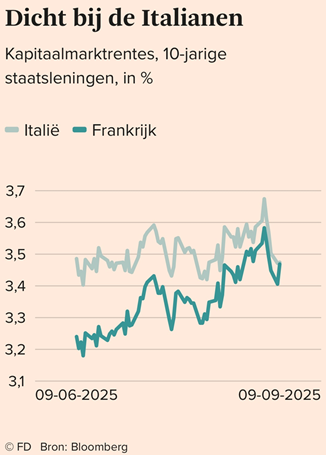
In the event of a French debt crisis, savers and bondholders are particularly vulnerable: pension funds, banks and insurers would suffer direct losses. The question is not whether the burden will be shifted, but onto whom. Options range from higher costs for households and businesses (already attempted) to European solidarity through contributions or Eurobonds. An alternative scenario is that the ECB opts for financial repression: higher inflation and artificially low real interest rates to erode the debt burden away.
The politically most likely route is a combination of European solidarity and financial repression. For investors, this means bonds will remain under pressure, while alternatives become more attractive. The extra liquidity created by the ECB will find its way into markets that offer protection against negative real interest rates.
In this context, equities (outside France) and gold stand out as the obvious choices. Equities act as a natural inflation hedge, particularly in sectors that can pass on price increases directly. Gold has historically benefited from negative real interest rates and acts as a safe haven in times of monetary and political uncertainty.
Largest ever revision to US labour market figures
In the US too, bad economic news is now good news. On Tuesday, the Bureau of Labor Statistics published a major revision to employment data: over the period from April 2024 to March 2025, 911,000 fewer jobs were created than initially reported. It is the largest downward revision on record.
As a result, the picture of the labour market under President Biden looks considerably less robust than previously thought. The figures for the last three months of Trump's term had already been revised sharply downward earlier (May: −125,000, June: −133,000). August recorded just +22,000 jobs, while June even showed a loss of 13,000 jobs. Momentum in the labour market now appears to be weakening for good.
The political dimension is clear: on 1 August, President Trump dismissed the BLS's chief statistician, Erika McEntarfer, after the revisions came to light. The figures did not fit the picture he wants to paint of the American economy. Indirectly, the weak data reinforce Trump's attack on the Federal Reserve. After all, the key question is: on which indicators does the Fed base its interest rate policy, and do these figures still provide a reliable and up-to-date picture of the economy?
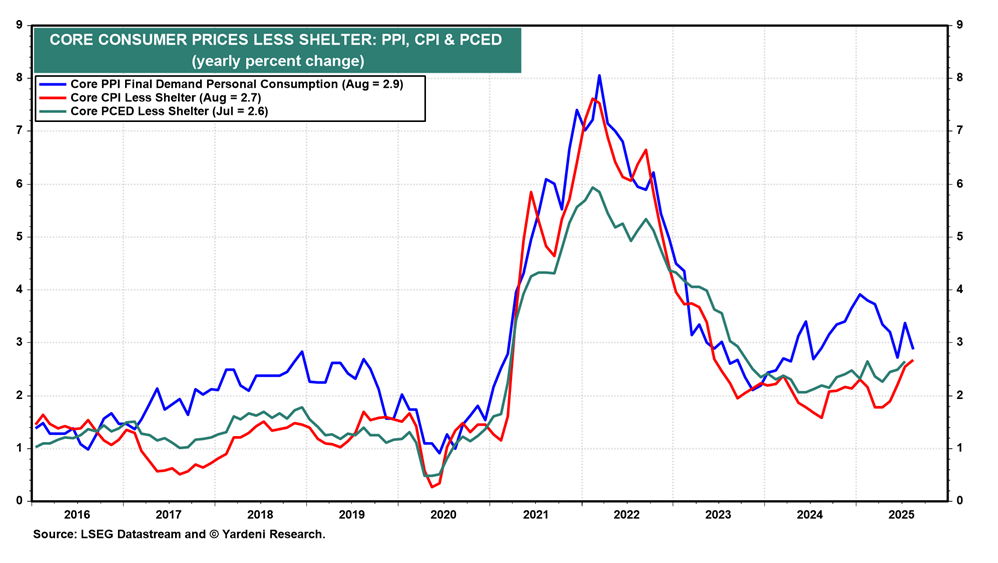
Criticism that the Federal Reserve relies on outdated data has been voiced for some time. For instance, official house price indices such as Case-Shiller lag by up to six months, while more current sources such as Zillow are not taken into account. Now that labour market statistics also appear to be unreliable, Trump's criticism of Chair Jerome Powell carries more weight: the economy is cooling, inflation is stabilising around 3%, and the policy rate could or should come down more quickly.
At the same time, the most recent price data paint a mixed picture. Producer prices (PPI) fell by 0.1% month-on-month in August, whereas economists had actually expected an increase of +0.3%. This suggests that the effects of import tariffs are not yet visible. Consumer prices (CPI), on the other hand, rose more than expected: +0.4% month-on-month and +2.9% year-on-year, the highest level since January.
Either way, the trend of recent weeks is clear: interest rates continue to fall, in anticipation of a possible policy adjustment by the Fed next week.
Gold miners enjoy a strong rally: “long gold, short oil” as the winning trade
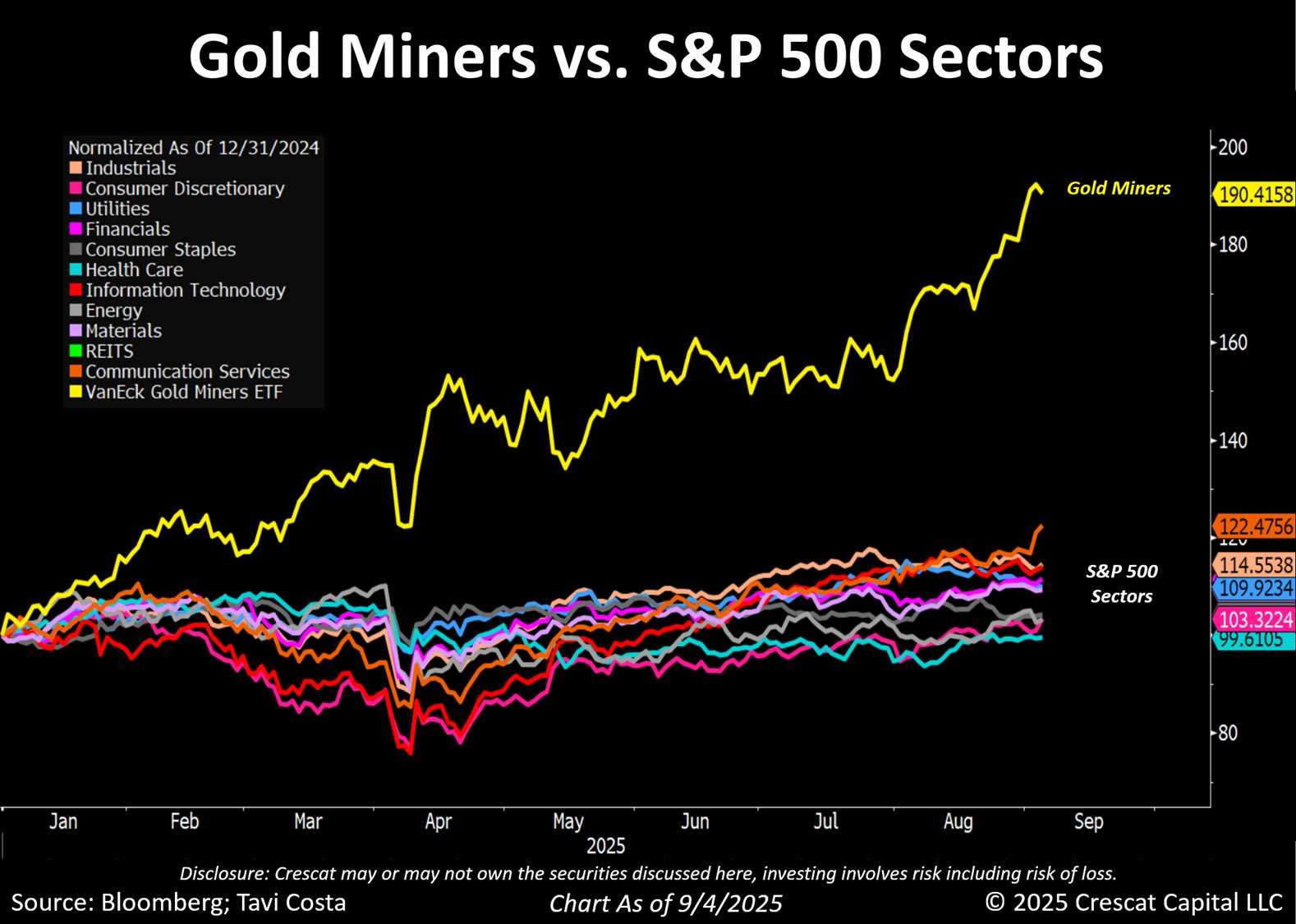
As mentioned earlier in this newsletter, gold is the hedge in a period of financial repression. The gold price has already risen by around 40% in USD this year. Even more striking: gold mining stocks have surged ahead, up by 80–100%. For years they underperformed physical gold due to cost inflation, political risks and operational setbacks, but that gap is closing rapidly this year.
The sector is benefiting from a unique combination: higher revenues thanks to the rising gold price, combined with lower costs due to the falling oil price. Energy and transport are key components of the cost base, and the drop in the oil price is lifting margins significantly.
UBS already pointed out earlier this year that miners are still trading around 30% below their pre-Covid average (price-earnings ratio). That discount mainly reflects investor distrust after years of disappointment, not weak fundamentals. In the meantime, the major players have sharpened their strategies.
- Newmont has increased capital distributions to shareholders, now focuses solely on Tier 1 mines, and recently reported strong profits and cash flows, with a positive outlook (gold > $4,000/oz in 2026).
- Barrick has sold non-core assets and is focusing on more profitable projects.
Notably, it is the smaller miners that are showing the strongest performance. According to the fund manager in zone portfolio, their production can grow by +5–7% per year over the coming years, compared with 2–3% for the sector as a whole. After years of restructuring and divestment, they are once again becoming attractive acquisition targets. Insiders at small caps often own 3–10% of the shares, a strong signal of skin in the game.
Looking ahead to 2025, record margins are expected: an operating margin of around 50% and net profit of over $900 per ounce (~30%). Despite the sharp rally, gold miners therefore remain attractively positioned.
European AI invests in European AI
ASML announced this week an investment of €1.3 billion in the French AI start-up Mistral. Under the leadership of new CEO Christophe Fouquet, ASML is taking a stake of around 11% and becoming the largest shareholder. The company will also receive a seat on the strategic committee. The transaction is part of a €1.7 billion funding round, which values Mistral at €11.7 billion, making it Europe's most valuable AI start-up.
According to Fouquet, the investment is primarily aimed at leveraging AI within ASML's own R&D and product development, rather than at European strategic autonomy. Mistral, founded in 2023, develops its own Large Language Models (LLMs) and is regarded as Europe's challenger to OpenAI and Anthropic. Mistral's valuation rose to €12–14 billion within two years, but remains small compared with the American market leaders (OpenAI ~$500 billion, Anthropic ~$170–183 billion).
Sofina was also an early participant in Mistral's growth. The Belgian holding company invested €385 million back in December 2023, building up a 0.38% stake. It is unclear whether Sofina also took part in this latest round.
The investment expands ASML's ability to integrate AI into the development of its chip-making machines, for instance through proprietary software that further optimises production processes. The deal fits into a broader wave of AI-related investments, which keep disproving the previously suggested “DeepSeek moments”. While AI stocks came under temporary pressure this year amid concerns over Chinese competition and MIT studies on slower adoption, the capital expenditure of hyperscalers (Meta, Alphabet, Amazon, Microsoft) has time and again exceeded expectations.
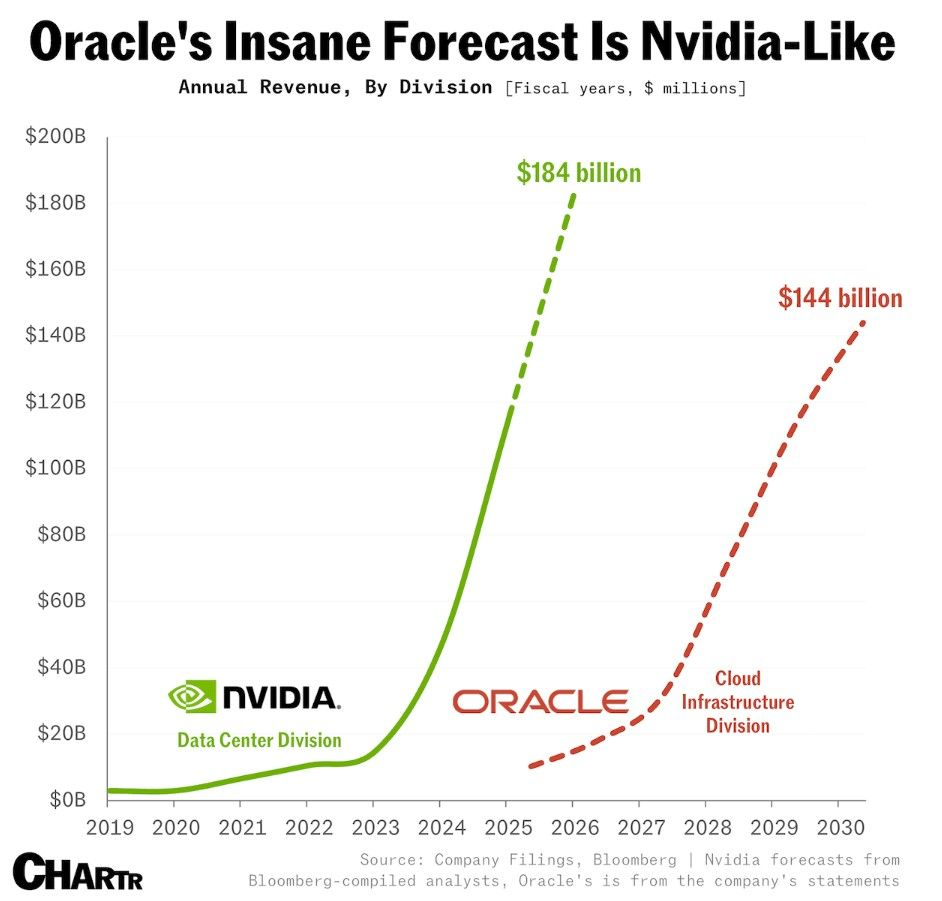
A striking example came this week from Oracle. The company reported a record backlog (RPO) of $455 billion, up 359% year-on-year, entirely driven by AI contracts. OpenAI alone signed a commitment of $300 billion for Oracle data centres over the next four years – a remarkable amount given Oracle's current annual revenue of just $15 billion. Oracle's cloud business is growing 77% this year to $18 billion and is targeting revenues of $32 billion, $73 billion, $114 billion and $144 billion in the years ahead. The stock jumped 38% in a single day; chairman and largest shareholder Larry Ellison (a 40% stake) saw his wealth rise to $393 billion.
Receive weekly insights in your inbox
Exclusive analyses and updates on family holding companies and global market developments.
Would you like more information about our services? Please feel free to get in touch.
Get in touch
Disclaimer:
No rights can be derived from this publication. This is a publication of Tresor Capital. Reproduction of this document, or parts thereof, by third parties is only permitted with prior written consent and with reference to the source, Tresor Capital.
This publication has been compiled by Tresor Capital with the utmost care. The information is intended in a general sense and is not tailored to your individual situation. The information must therefore explicitly not be regarded as advice, an offer or a proposal to purchase or trade investment products and/or to make use of investment services, nor as investment advice. The authors, Tresor Capital and/or its employees may hold positions in the securities discussed, for their own account or for their clients.
You should carefully consider the risks before you start investing. The value of your investments may fluctuate. Past performance is no guarantee of future results. You may lose (part of) your original investment. Tresor Capital disclaims any form of liability for any inaccuracies or errors. This information is purely indicative and subject to change.
Read the full disclaimer at tresorcapitalnieuws.nl/disclaimer .
This article was originally written in Dutch and automatically translated into English with the help of AI. In case of any difference, the Dutch original prevails.