
Economy & Markets #38 - US rate cuts and pressure on European pension funds


This week's topics:
Rate cut marks the start of monetary easing in the US
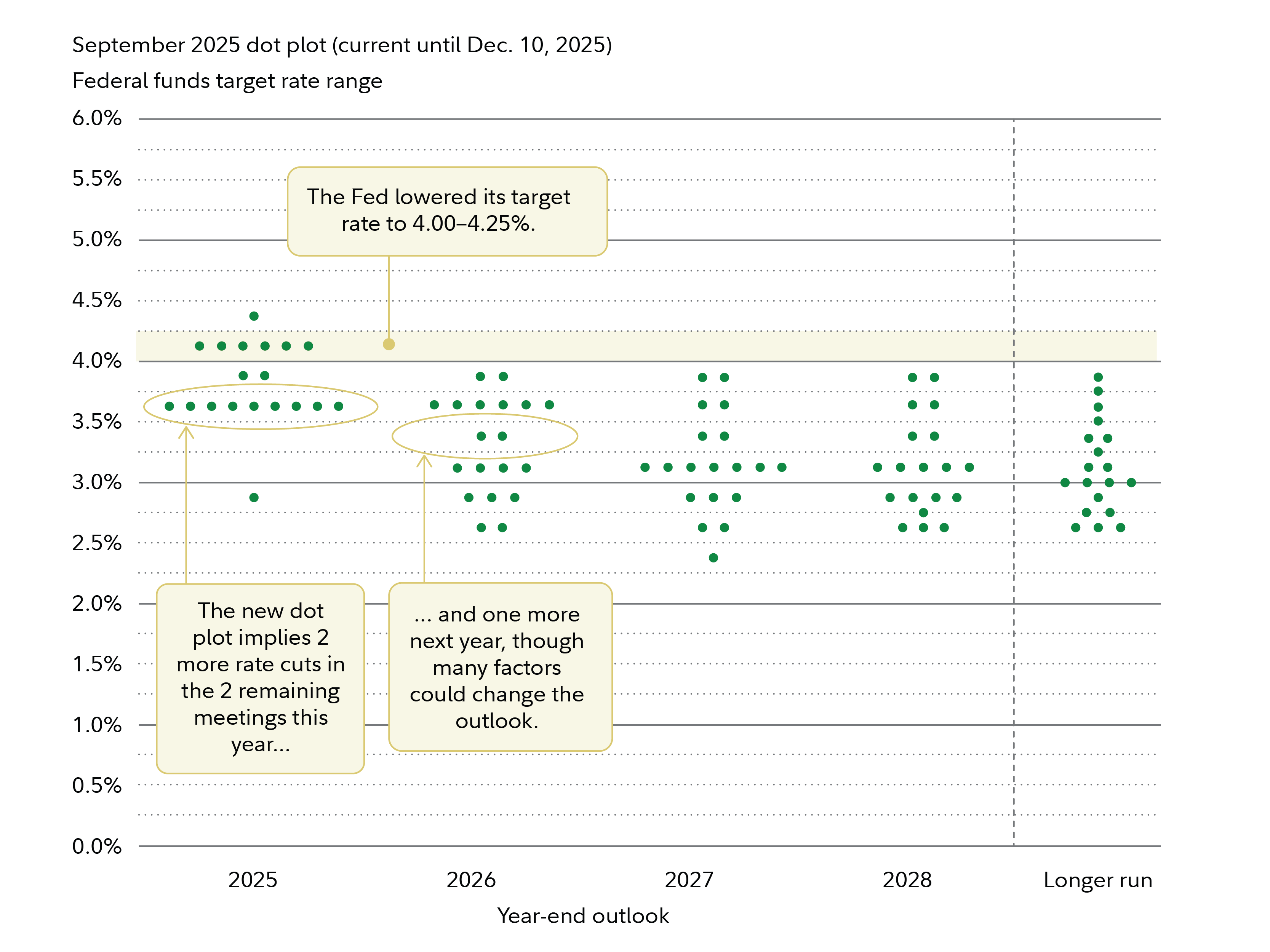
This week, during its September meeting, the US Federal Reserve (the Fed) cut interest rates by 25 basis points to 4–4.25%. Everything points to this being the start of a series of successive cuts. In his remarks, Fed Chair Jerome Powell indicated that this move should be seen as a ‘risk management cut’. Although inflation, at 3%, is actually still too high to justify a rate cut, the risks of overly tight monetary policy are increasing. The cut is therefore primarily intended to prevent economic growth and the labour market from coming under pressure.
The official statement and Powell's remarks are widely interpreted as dovish: policy is now more focused on supporting growth and employment than on curbing inflation. That marks a clear shift from the past nine months, during which concerns about rising prices were the main focus.
Several investment banks point to similarities with 2024, when the Fed likewise carried out a series of rate cuts to stave off a recession. The consensus among economists is that two more cuts will follow this year, in October and December, with two further steps towards a neutral policy rate of 3–3.25% expected in 2026.
Dot plot reveals division within the Fed
The dot plot is a chart published by the Federal Reserve itself, showing the rate expectations of each policymaker on an anonymous basis. Each dot represents one Fed member's estimate of where the policy rate will stand at the end of this year and in the years ahead. It is therefore not a fixed path, but rather a glimpse into the committee's thinking.
This week there turned out to be no broad support for a 0.5% cut. The median expectation points to three rate cuts in 2025, more than the market had priced in beforehand. One notable development is the new voice on the committee: Stephen Miran, a confidant of Trump's, who was sworn in as a Fed member on 16 September. He advocates a far more aggressive policy and wants to see rates at 2.75% by the end of this year already, which would amount to a total cut of 1.75% in 2025, starting with a 0.5% move this week. An interesting detail: there was even one policymaker who would have preferred to raise rates on Wednesday.
Falling policy rates are good for the stock market
A new phase of rate cuts is getting under way worldwide this week. Because the US dollar remains the world's reserve currency, accounting for roughly 50% of international payments (SWIFT) and involved in 90% of all currency transactions, every rate move by the Fed has a major direct or indirect effect on lending, currency markets and rate cycles. It is therefore no surprise that other central banks are following suit: the Bank of Canada cut its rate by 0.25 percentage point to 2.5%, Hong Kong lowered its rate by 0.25% to 4.5%, and Norway took a similar step to 4.0%.
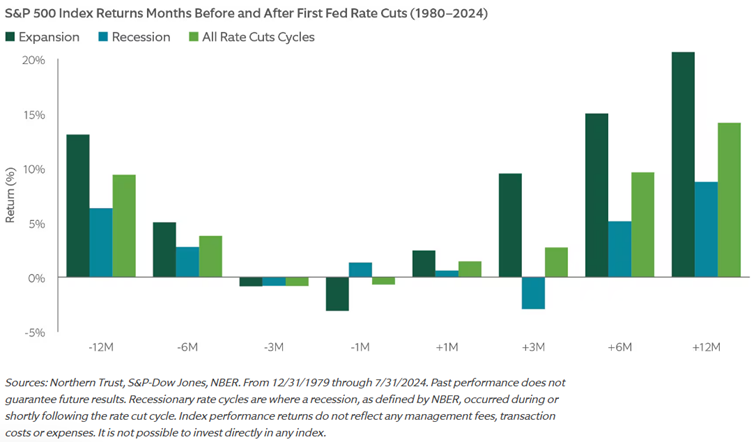
Asset manager Northern Trust examined, in “How stocks historically performed during Fed rate cut cycles”, how the S&P 500 has behaved since 1980 following rate cuts. The conclusion: stocks rise by an average of 14% in the 12 months after the start of a cutting cycle. An important distinction here is between growth and recession scenarios:
- Growth scenarios – When the economy is still growing (as is the case now, with US GDP growth expected at 1.6% in 2025 and inflation around 2.5–3%), stocks often show strong returns of up to 20% after a rate cut.
- Recession scenarios – When rate cuts occur during a recession, the outlook is much weaker. Since 1980, the average return in these cases has still been +14.1%, but considerably less stable.
- Volatility – In the first three to six months after a cut, volatility typically increases, after which markets usually stage a strong recovery.
- Factor performance – Factors such as quality, value, momentum and low-volatility tend to perform positively on average after rate cuts, with quality showing the most consistent results.
The US economy is expected to grow by around 1.6% this year, while inflation remains at around 2.5–3%. The crucial difference for the current cycle is that the Fed is not cutting rates because of recessionary pressure, but in an environment of moderate growth and falling inflation. On top of that, the cuts are being supported by fiscal stimulus: higher government spending, substantial investment in infrastructure and energy, and targeted support for consumers and businesses.
That creates a unique climate in which equities benefit both from lower financing costs and a healthy economic foundation. Combined with the historical data from Northern Trust (bearing in mind that past returns are no guarantee for the future), the outlook for US equities is currently positive.
The power of the credit impulse
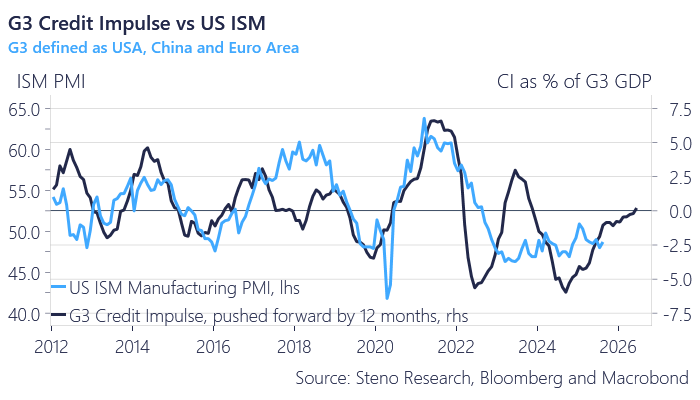
The credit impulse, introduced in the early 2000s by economists Patrick Artus (Natixis) and Michael Biggs (then at Deutsche Bank), is regarded as an important leading indicator for both economic growth and capital markets. Artus showed that whenever China opened the credit taps to stimulate its economy, global equities performed strongly in the months that followed.
The credit impulse looks beyond bank lending alone and encompasses total money creation in the economy. Artus also concluded that monetary easing, whether through rate cuts, quantitative easing (QE) or other liquidity injections, becomes less effective as government debt rises. Additional liquidity then reaches the real economy more slowly and flows more often towards financial markets or alternative assets such as art, luxury goods or cryptocurrencies.
Biggs likewise emphasised that changes in credit growth (relative to GDP) are highly predictive: when the credit taps open, a market recovery usually follows. This proved crucial after the 2008 financial crisis and again in 2020, when global credit stimulus during the coronavirus crisis drove a powerful market rally, albeit one that resulted in inflation spikes once central banks intervened too late.
The low real interest rate is therefore no coincidence, but the result of structurally weak fundamentals and high government debt. As early as 2010, Reinhart and Rogoff concluded in “Growth in a Time of Debt” that countries with debt above 90% of GDP experience structurally lower growth and find it difficult to escape the debt trap. Because nominal growth is often lower than interest costs, central banks are implicitly forced to keep rates artificially low.
All this explains why investors in Europe, such as the pension funds mentioned earlier, continue to struggle with low bond yields. And why wealth accumulation is increasingly coming under pressure in this interest rate climate, a theme that also came to the fore emphatically in the Dutch context via Prinsjesdag (the day the government presents its budget plans to parliament).
Prinsjesdag: higher pressure on wealth accumulation
Investors in the Netherlands are also feeling the effects of this interest rate climate. During Prinsjesdag, it became clear that the tax burden on wealth is set to rise further. From 2026, the deemed return rate in box 3 (the Dutch tax category for savings and investments) will increase from 6.00% to 7.78%, which, at a rate of 36%, amounts to an effective levy of around 2.8%.
For savers, bond investors and property owners with low rental income, this means the tax burden could end up higher than the return actually achieved. This increases the pressure to take on more risk and shift towards equities or alternative investments in order to achieve the required return.
The low real interest rate climate in Europe is therefore not a temporary phenomenon, but the result of structural weaknesses, high debt and lagging investment. While the US and China accelerate in technology and growth, Europe remains dependent on low financing costs to keep its economy running. For investors, this means an environment in which bonds offer ever less protection, forcing different choices in the search for returns.
Low real interest rates squeeze pension funds
For institutional investors, generating returns remains challenging in an environment of low or even negative real interest rates. Earlier this year, major Dutch pension funds such as ABP (–3.7%) and PFZW (–4.8%) already reported negative returns. In Belgium, 150 pension funds achieved an average return of just +0.3% over the first six months.
The difference in performance lies mainly in investment strategy: Dutch pension funds value their liabilities at the current interest rate and therefore buy large amounts of long-dated bonds as a hedge, which makes them extra sensitive to interest rate movements. Belgian pension funds hold more short-dated paper, which limited losses this year. But the broader problem remains: at low real interest rates, bonds barely preserve purchasing power.
Why does the real interest rate remain so low?
For bond investors, a low or negative real interest rate (the nominal rate minus inflation) is highly unfavourable, because future purchasing power is insufficiently protected. This raises the question: why does the ECB keep the real interest rate in Europe so low, often even negative?
At its core, the interest rate acts as a steering mechanism: it determines the incentive to consume now or to save and spend later instead. Yet criticism is growing that central banks keep interest rates low mainly to help governments finance their high debts. According to economic theory, the real interest rate is determined by factors such as structural growth, which in turn depends on developments in the labour force, the number of hours worked and labour productivity. On top of that comes a premium for expected inflation, which together form the nominal interest rate.
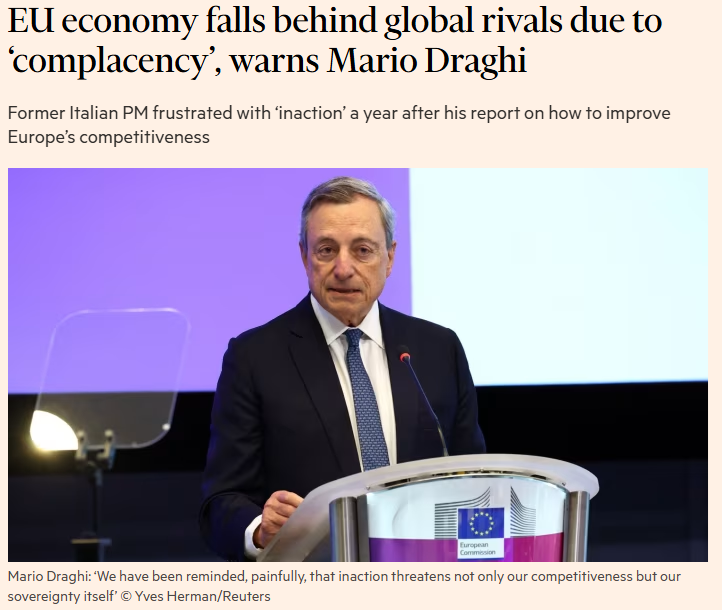
The problem is that many of these sources of growth are drying up in Europe. The labour force is shrinking, productivity growth is stagnating, and high energy costs, sick leave, generous holiday allowances and heavy regulatory burdens are driving jobs to the US and China. As a result, the foundation underpinning structural growth is eroding further and further. Mario Draghi warned about this trend again this week:
"Our growth model is crumbling. Vulnerabilities are increasing… and we have been painfully reminded that inaction threatens not only our competitiveness, but our very sovereignty."
"Too often, excuses are made for this slowness. We say that this is simply how the EU is built. Sometimes inertia is even presented as respect for the rule of law. That is complacency."
According to Draghi, former ECB president and appointed by the European Commission to draw up a reform plan, the EU risks falling permanently behind. Only a fraction of his previously presented 383 recommendations has been taken up. The biggest pain points are high energy prices, slow regulation and insufficient investment. Europe lags well behind the US and China in particular in the field of digital technology and artificial intelligence, where both are investing billions and rolling out applications on a large scale. This puts pressure on both the Union's technological sovereignty and its long-term growth potential.
Today, the credit impulse is still widely used as a temperature gauge for the markets, including by Steno Research. Their analyses show that the indicator has recently turned from restrictive to expansionary. With the start of interest rate cuts in the US, Europe and China, and proposals to ease bank reserve requirements, more liquidity is once again entering the system. This points to an upcoming upturn in industrial activity, and ultimately in the capital markets as well.
Receive weekly insights in your inbox
Exclusive analyses and updates on family holding companies and global market developments.
Would you like more information about our services? Please feel free to get in touch.
Get in touch
Disclaimer:
No rights may be derived from this publication. This is a publication by Tresor Capital. Reproduction of this document, or parts thereof, by third parties is only permitted after written consent and with reference to the source, Tresor Capital.
This publication has been compiled by Tresor Capital with the greatest possible care. The information is intended in a general sense and is not tailored to your individual situation. The information must therefore explicitly not be regarded as advice, an offer or a proposal to purchase or trade investment products and/or to take up investment services, nor as investment advice. The authors, Tresor Capital and/or its employees may hold positions in the securities discussed, for their own account or on behalf of their clients.
You should carefully consider the risks before you start investing. The value of your investments can fluctuate. Past performance offers no guarantee for the future. You may lose (part of) your invested capital. Tresor Capital disclaims any form of liability for any inaccuracies or errors. This information is purely indicative and subject to change.
Read the full disclaimer at tresorcapitalnieuws.nl/disclaimer .
This article was originally written in Dutch and automatically translated into English with the help of AI. In case of any difference, the Dutch original prevails.