
Economy & Markets #40 - AI momentum versus inflation concerns and US shutdown


This week's topics:
Capital markets show a strong third quarter
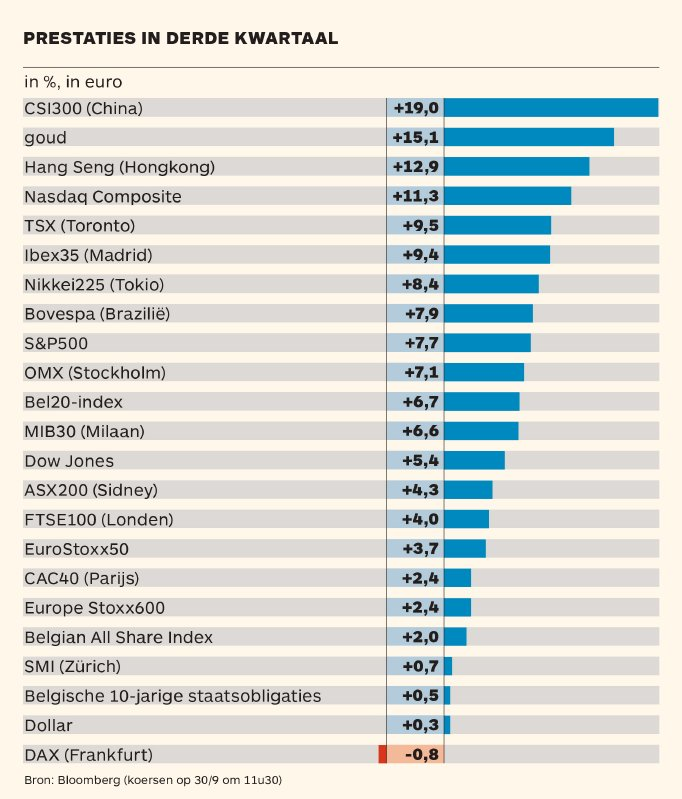
The third quarter was marked by pronounced differences between regions and sectors. The strongest performances came from Asia, with the stock markets in Taiwan and China (for technology companies in particular) showing a powerful recovery. Chinese companies introduced new AI models and in-house chip solutions, strengthening their technological independence and boosting their growth potential. Confidence among Chinese consumers in investing (again) on their domestic stock market also rose markedly.
Globally, technology stocks benefited from sustained demand for digitalisation and artificial intelligence. Increasing investment in data centres, cloud solutions and AI applications continues to support the technology sector. The US technology index, the Nasdaq, rose by +11.3%. Gold also remained in demand, supported by accommodative monetary policy from central banks and investors seeking protection against inflation and geopolitical uncertainty. In the United States, expectations of interest rate cuts provided fresh support to equity markets. Because the US started cutting interest rates later than Europe, we are seeing higher returns there than in Europe. The S&P 500 thus outperformed the broader Eurostoxx 600, returning +7.7% versus +3.7%.
Whereas European equities performed well in the second quarter, sentiment remained more subdued last quarter. Economic headwinds (uncertainty for the export sector, weak domestic consumption) and political uncertainties weighed on the markets in Frankfurt, Brussels and Paris. Despite strong performances from defence stocks, the broader German DAX index lagged behind, partly due to disappointment over the lack of structural reforms in Germany. Defensive sectors such as healthcare and traditional consumer goods suffered from rising costs and lower profit growth.
Inflation picks up again in the Netherlands and Belgium
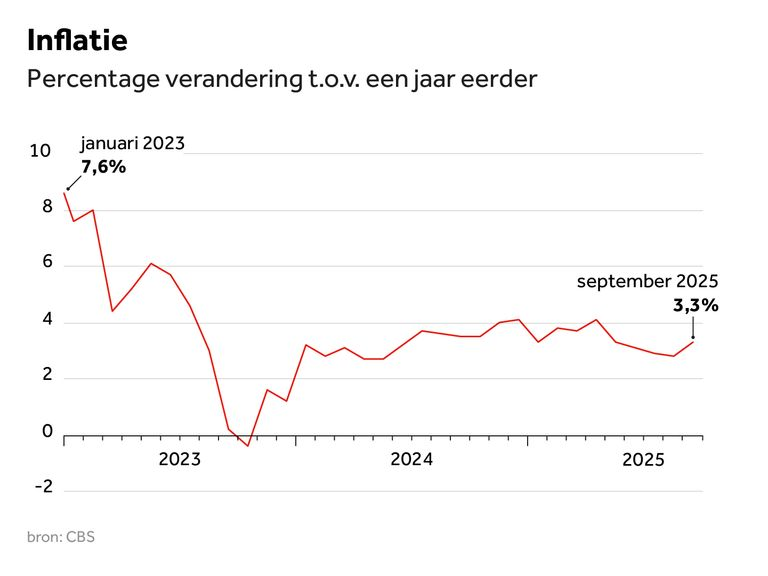
New figures on inflation in the Netherlands (for September) indicate it is rising again, to +3.3% year-on-year, up from 2.8% year-on-year in August. The increase in the Dutch price level was mainly driven by higher energy prices (+4.0%), services (+4.1%) and food (+3.7%). The harmonised European measure (HICP) came in at 3.0%. Notably, the oil price (-10%) and the euro/dollar exchange rate (-6%) are significantly lower than a year ago, yet distortions (taxes and greening measures) in the Dutch energy market mean that energy is once again driving inflation.
In Belgium, inflation rose from 1.9% to 2.1%. There, however, it is not so much energy costs pushing up the price level, but mainly food and hospitality. In both countries, we therefore see that inflation remains higher than the short-term interest rate (which banks pay on savings). To preserve purchasing power, you will need to ask your bank or wealth manager to take a somewhat more active approach to building wealth. Inflation will actually need to stay high in order to finance Belgium's government debt. According to Bloomberg, Belgium, like France, risks a downgrade of its credit rating. With government debt heading towards 120% of GDP, a budget deficit rising to 5.4% in 2026, and interest costs of €17 billion, public finances remain vulnerable. The difference with France is that Belgium currently does have a stable government, which is pushing through reforms to the labour market and social security. Nevertheless, the deficit remains structurally too high, and the finances of Brussels and other regions continue to spiral further out of control.
The Belgian De Wever government faces a tough budgetary challenge: between now and 2029, a further €8.2 to €13 billion still needs to be found to curb the deficits. The focus is on stricter controls on long-term sick leave (a potential saving of €1-3 billion), while declining tax revenues since 2014 are adding further pressure (down from 52% to 48.7% of GDP). Economists also warn that the planned tax cut, which is being financed entirely with borrowed money, will drive up the debt even further.
US: Trump plays the shutdown hard, but for how long?
The US government has been in shutdown since Wednesday, after the Senate and the White House failed to reach agreement on the federal budget. Almost all non-essential services have come to a halt and 800,000 civil servants have been placed on unpaid leave. President Trump blames the Democrats for the impasse, but is also actively using the situation as political leverage.
On Truth Social, he announced that he would “take advantage of the opportunity” to determine which government agencies, which he labelled as “Democrat”, could be cut either temporarily or permanently. His spokesperson confirmed that the White House is examining how thousands of jobs could be eliminated for good. Trump's budget director Russel Vought also sees the shutdown as an opportunity to push through structural spending cuts and reforms that Republicans have long sought. This turns the standoff into not just a battle over budget figures, but also an ideological fight over the size and role of government.
So far, the dollar, equity markets and bonds have reacted relatively calmly. Still, Trump's approach increases the likelihood that the shutdown will drag on for a long time. After all, the conflict is not just about budgetary details, but about a fundamental redrawing of the federal government. For markets and credit rating agencies, that is concerning: the longer the deadlock lasts, the greater the damage to confidence and economic activity. The economic impact is already noticeable: the shutdown could cost the US up to $15 billion in economic growth per week. A prolonged standstill risks the loss of millions of jobs and billions in consumer spending.
Analysts warn that the combination of political turmoil, paralysed government services and waning confidence in financial markets could also cause substantial damage in the long run. This is precisely why, in the past, the politically weaker party quickly backed down and markets bounced back swiftly. The longest US government shutdown was the one in 2018–2019 (35 days), when Trump and the Democrats clashed over funding for the wall on the Mexican border. Belgium, incidentally, set a world record by functioning for 541 days without a fully-fledged federal government.

Investment in AI infrastructure is growing far faster than expected: Citibank sharply raises its growth forecasts
Global investment in artificial intelligence (AI) is developing at an unprecedented pace. So fast, in fact, that several critics are now speaking of a hype: growth expectations that are too high, and companies being valued as though their future profits were guaranteed.
This stands in sharp contrast to the sentiment in the first quarter of 2025. At the time, the Chinese software DeepSeek seemed to be the breakthrough that would render massive investment in data centres and cloud infrastructure unnecessary. Investors feared that AI would be commoditised faster and that the enormous capital flows into infrastructure would prove excessive.
Reality turned out differently. The second-quarter results of the so-called hyperscalers, the global providers of cloud infrastructure and AI services, in fact showed that the investment cycle has shifted into an even higher gear. Not only did capital expenditure rise, but new strategic partnerships and product launches were also announced. In recent weeks, this positive momentum has only grown stronger. The string of announcements resembles a veritable good-news show, with hyperscalers trying to outdo one another.
A new report by Citibank, “Raising AI Infrastructure Forecasts”, describes the scale and flow of these investments. In it, growth expectations and investment estimates for the coming years are once again revised sharply upward. This confirms that AI infrastructure is not merely a hype, but a structural investment wave that is unmatched by earlier technological revolutions, both in scale and in the speed of adoption.
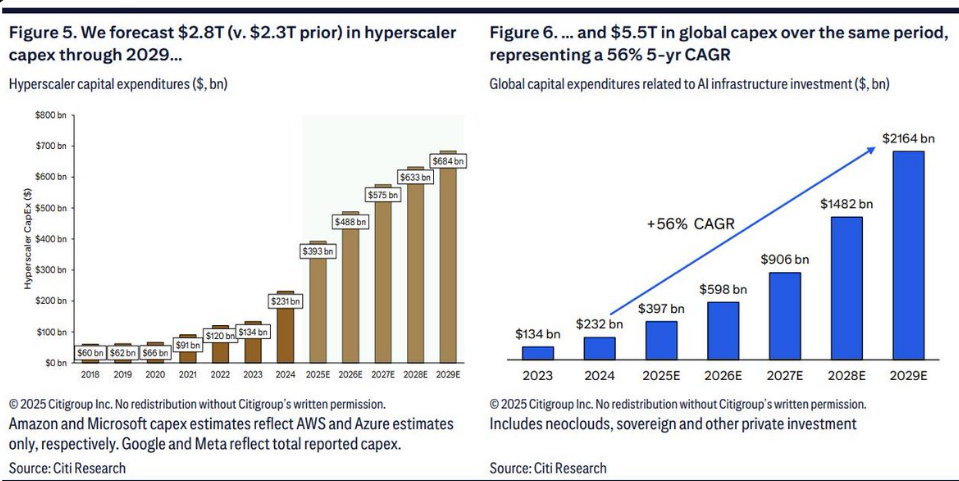
For 2026, global CAPEX spending is now expected to rise from $420 billion to $490 billion. That amounts to an expected +24% year-on-year growth, after market consensus had already been raised by +20% in Q2. For the period 2023–2029, the total investment volume has now been revised from $2,300 billion to $2,800 billion. Citi also expects major technology companies to announce further increases to their investment plans once again when presenting their Q3 2025 results.
At the same time, Citi outlines robust expectations for demand for computing power and energy. The need for AI compute is growing exponentially and, according to the bank, will comfortably outstrip available supply through to 2030. Citi and other investment banks expect effective demand for computing power for AI training and inference to double roughly every 12–18 months, a far faster scaling path than earlier IT transitions such as cloud and mobile.
This acceleration is being driven mainly by the mass adoption of AI inference: think of AI services built into search engines, office software, e-commerce and gaming. Research by Epoch AI confirms this picture: since 2010, demand for computing power for frontier model training has grown by a factor of 4.6 per year.
By comparison, under Moore's Law computing power typically doubles only once every two years. The growth in AI compute therefore significantly outpaces the rate at which supply can scale up. Despite improvements in model efficiency and software optimisation, the structural trend of ever-greater computing and energy demands clearly continues unabated.
Rising energy demand
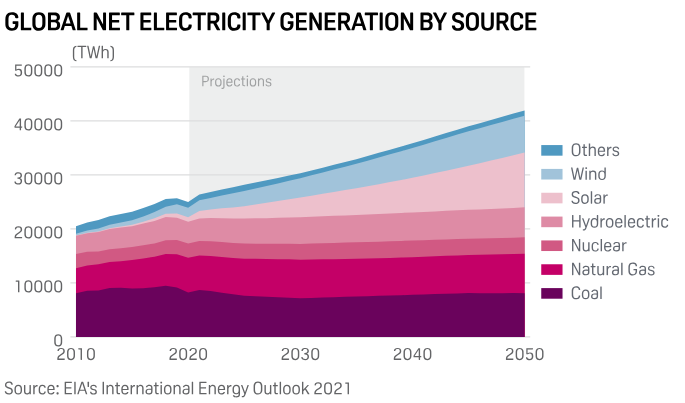
Demand for energy is also increasing sharply. By 2030, an estimated +55 GW of additional power capacity will be needed worldwide to meet AI-related demand. In the United States alone, this could result in $1,400 billion in additional AI infrastructure spending on electricity. This growth is being driven by the mass rollout of AI services, both in model training and in inference at companies and research institutions. The AI race is therefore also becoming a battle over who can deliver electricity most efficiently and reliably. For Europe, this creates a threefold disadvantage relative to the US and China:
- Regulation – Europe is already imposing rules before the market has fully developed, which slows down testing, implementation and adaptation.
- Smaller technology companies and a shortage of specialised labour / venture capital – apart from players such as ASML, Siemens Energy and Mistral, Europe has few large listed technology companies that benefit directly or indirectly from this trend. Financial firepower is also limited.
- Higher electricity prices – the energy transition is leading to structurally higher energy prices in Europe than in the US and Asia.
New forms of financing: the AI race calls for unprecedented capital
As Sam Altman (OpenAI) recently emphasised: the scale of AI infrastructure is so vast that it requires "new forms of financing". Whereas earlier investment cycles (cloud, mobile, internet) were largely funded out of operating cash flows, the emphasis is now shifting towards debt-driven and contract-driven financing. This week, OpenAI reached a valuation of around $500 billion through a secondary sale of shares, making it one of the most valuable startups in the world.
To be able to build the required infrastructure, the company entered into strategic partnerships with Samsung and SK Hynix for the supply of advanced memory chips. According to Reuters, discussions are underway on a possible supply of up to 900,000 DRAM wafers per month for the production of memory chips needed for AI data centres. Note that this demand for wafers is equivalent to 30–40% of total global production at present. This is part of the large-scale "Stargate" initiative, which provides for the worldwide expansion of AI data centres.

Earlier in September, OpenAI had already reported its partnership with Oracle and Nvidia. OpenAI has committed to purchasing approximately $300 billion worth of computing power and cloud services from Oracle. This gives Oracle the certainty of long-term revenue streams and justifies billions in investment in data centres, networks and power supply. At the same time, OpenAI is investing in the mass purchase and deployment of Nvidia's GPU systems, which directly generates revenue and profit for Nvidia.
- OpenAI guarantees long-term uptake of capacity.
- Oracle finances and builds the data centres.
- Nvidia supplies the crucial hardware and books direct revenue.
This construction makes clear that AI is not merely a technology project, but increasingly a capital-intensive infrastructure race. As a result, investment risks are also rising: instead of financing out of free cash flow, debt financing is increasing, dependence on a handful of suppliers is growing, and uncertainty remains over the returns on long-term contracts. The scale of the projects is immense. Because this scale is increasingly difficult to express in terms of computing power, capacity is now expressed in gigawatts. After all, it is no longer about the number of servers, but about the energy footprint of such mega-clusters. 10 GW corresponds to the electricity consumption of around 10 million households, or roughly 10 nuclear power plants.
Get weekly insights in your inbox
Exclusive analyses and updates on family holding companies and global market developments.
Would you like more information about our services? Please feel free to get in touch.
Get in touch
Disclaimer:
No rights can be derived from this publication. This is a publication of Tresor Capital. Reproduction of this document, or parts thereof, by third parties is only permitted with written consent and with reference to the source, Tresor Capital.
This publication has been compiled by Tresor Capital with the greatest possible care. The information is intended in a general sense and is not tailored to your individual situation. The information must therefore expressly not be regarded as advice, an offer or a proposal to purchase or trade investment products and/or to make use of investment services, nor as investment advice. The authors, Tresor Capital and/or its employees may hold positions in the securities discussed, for their own account or on behalf of their clients.
You should carefully consider the risks before you begin investing. The value of your investments may fluctuate. Past performance offers no guarantee for the future. You may lose (part of) your original investment. Tresor Capital disclaims any form of liability for any inaccuracies or errors. This information is purely indicative and subject to change.
Read the full disclaimer at tresorcapitalnieuws.nl/disclaimer .
This article was originally written in Dutch and automatically translated into English with the help of AI. In case of any difference, the Dutch original prevails.