
Economy & Markets #41 - From Tokyo to Silicon Valley: how politics and AI are reshaping markets once again
Japan got its first female prime minister, Sanae Takaichi, who is focused on defence and AI. OpenAI and AMD struck a mega-deal for 6 GW of computing power, symbolising the AI supercycle. Analysts remain torn between growth and bubble, while the US labour market continues to cool.


This week's topics:
Japan opts for an "Iron Lady": Sanae Takaichi becomes first female prime minister
On 4 October, Japan's ruling LDP party elected Sanae Takaichi as its new party leader, making her virtually certain to become Japan's first female prime minister. The 63-year-old politician is seen as the heir to Shinzo Abe's economic line and combines economic nationalism with classic conservatism.
Takaichi wants to continue the core of Abenomics, with an emphasis on state investment in strategic sectors such as semiconductors, defence and artificial intelligence. She supports an accommodative monetary policy from the Bank of Japan and opposes rapid interest rate hikes. In her view, a weaker yen fits within Japan's competitive strategy. On the foreign policy front, she advocates a more assertive stance towards China, closer cooperation with the United States, and a revision of Article 9 of Japan's constitution to strengthen the country's defensive capabilities. Socially and culturally, she is known for her conservative positions and her preference for restrictive immigration policy.
Financial markets reacted notably positively to her election. The Nikkei 225 rose by around 3%, led by technology and defence stocks that stand to benefit from Takaichi's investment agenda. At the same time, the yen weakened by over 2% against the dollar on expectations of continued accommodative monetary policy. Japanese long-term yields rose, particularly at the long end of the curve, on prospects of higher government spending.
This situation could once again put pressure on the Bank of Japan to resume its bond-buying programmes, given that the central bank already owns more than 50% of the Japanese government bond market. The combination of rising equities, a weaker currency and climbing yields is strongly reminiscent of the earlier Abenomics period (2012–2020), during which fiscal stimulus and monetary easing together drove the markets. Historically, this policy led to global liquidity growth and the so-called 'Mrs Watanabe trades': Japanese investors borrowing cheaply in yen to invest in higher-yielding assets worldwide. A repeat of that pattern does not seem unthinkable. In a context where Europe is already cutting interest rates and the US is moving towards easing, renewed Japanese stimulus could further boost global risk appetite, a scenario that would particularly benefit equity and commodity markets.
OpenAI and AMD close mega-deal for 6 gigawatts of computing power
Following the string of strategic partnerships in recent weeks, another major chapter has been added to the AI industry. AMD and OpenAI announced a multi-year partnership for the delivery of no less than 6 gigawatts of GPU computing power. From 2026, AMD will deploy its Instinct GPUs in OpenAI's data centres.
The deal includes a striking hybrid structure: OpenAI receives a warrant to acquire up to 10% of AMD, around 160 million shares, depending on delivery and share-price milestones, including price targets of up to $600 per share. According to market analysts, the contract could generate tens of billions in additional revenue for AMD.
For OpenAI, it marks a strategic shift: the company wants to reduce its reliance on Nvidia and is deliberately opting for supplier diversification within its hardware strategy. Investors reacted euphorically. AMD shares rose by more than 25% on the day of the announcement, while analysts estimate that the agreement could generate more than $100 billion in additional revenue over the next four years. The rally in technology and data centre stocks continued, although critics point out that OpenAI remains a young and capital-intensive company. The scale of the announced investments exposes significant financing risks, a dynamic reminiscent of the speculative phase of the dotcom bubble more than twenty years ago.
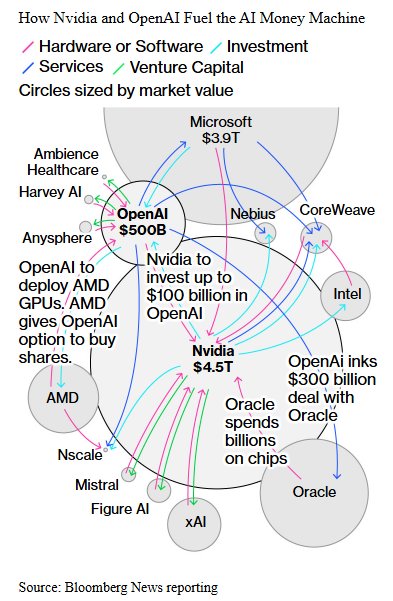
The interconnections between the major players in the AI ecosystem are becoming increasingly complex. Not only is Nvidia investing directly up to $100 billion in OpenAI, but parties such as Microsoft, Oracle and AMD are simultaneously building strategic positions across the value chain, from chip production to cloud services and AI applications. The chart below from Bloomberg visualises this "AI money machine": how capital, hardware, cloud capacity and equity stakes among the biggest players are interlocking at a rapid pace. Together, they form the engine behind the current AI boom and illustrate how the boundaries between cooperation and competition are increasingly blurring.
AI supercycle or Dotcom Bubble 2.0?
According to investment banks such as Goldman Sachs, Citibank and Morgan Stanley, the global economy finds itself in the midst of a new AI supercycle, in which capital expenditure and infrastructure investment are increasing exponentially. The five major technology companies (Microsoft, Google, Meta, Amazon and Oracle) are set to invest more than $1.7 trillion between 2025 and 2027 in computing power, data centres and semiconductors. This represents a tripling of AI-related capital outflows compared with the 2022–2024 period. In particular, recent mega-deals such as Oracle–OpenAI ($300 billion) and AMD–OpenAI (6 GW of GPU capacity) underline the unprecedented scale of this spending.
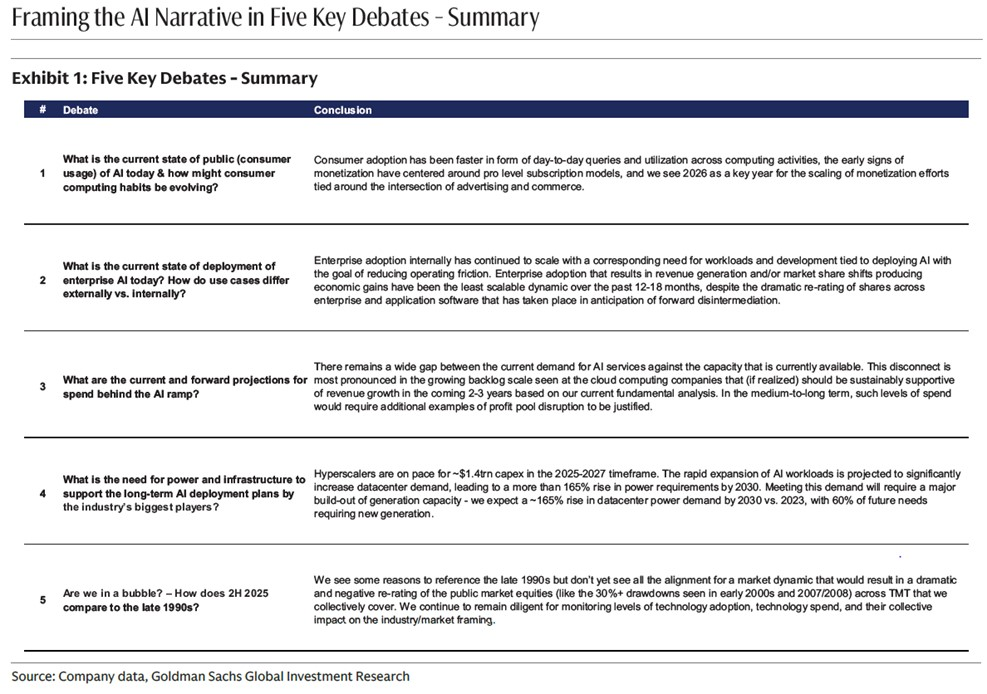
At the same time, doubts are growing as to whether this boom still has a solid fundamental basis. Goldman Sachs attempts to frame the discussion around five key debates concerning the current AI euphoria, ranging from consumer adoption and corporate integration to the need for energy infrastructure.
Their analysis shows that the technology is spreading at breakneck speed, but that monetisation remains limited. Companies are mainly using AI internally to improve processes, while only around 5% of businesses already report a measurable impact on profits. The bank sees this as a sign of an early growth phase, in which enormous capital flows are running ahead of actual returns.
A second finding is that physical infrastructure, particularly energy supply, network capacity and chip production, forms the new bottleneck. In the US alone, investment in the electricity grid would need to rise to $780 billion in order to support growing AI demand. Goldman warns that this capital-intensive phase continues to depend on low interest rates and ample liquidity: conditions that cannot be taken for granted in the coming years.
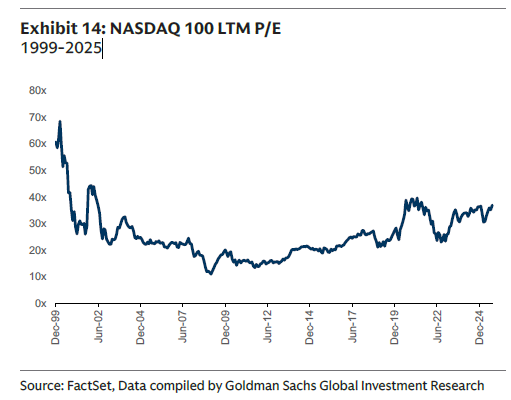
Even so, there are important differences compared with the dot-com bubble of the late 1990s. The chart above from Goldman Sachs shows that valuations today are much healthier: around 37x earnings, versus 68x at the peak in 1999. Moreover, companies such as Microsoft, Nvidia and Alphabet generate substantial free cash flows, something that was exceptional back then. The IPO market has also matured: fewer, but more profitable IPOs, with companies staying privately financed for longer. On the macro front, interest rates are lower, at around 4.3%, compared with 6% at the time, while the Fed is presumably moving towards easing.
Goldman Sachs summarises these insights in its diagram "Framing the AI Narrative in Five Key Debates", in which the bank concludes that the current momentum, while extremely capital-intensive, does not yet have the speculative character of the late 1990s. There is no "bubble" in the classic sense, but rather a growth phase in which expectations are rising faster than profits.
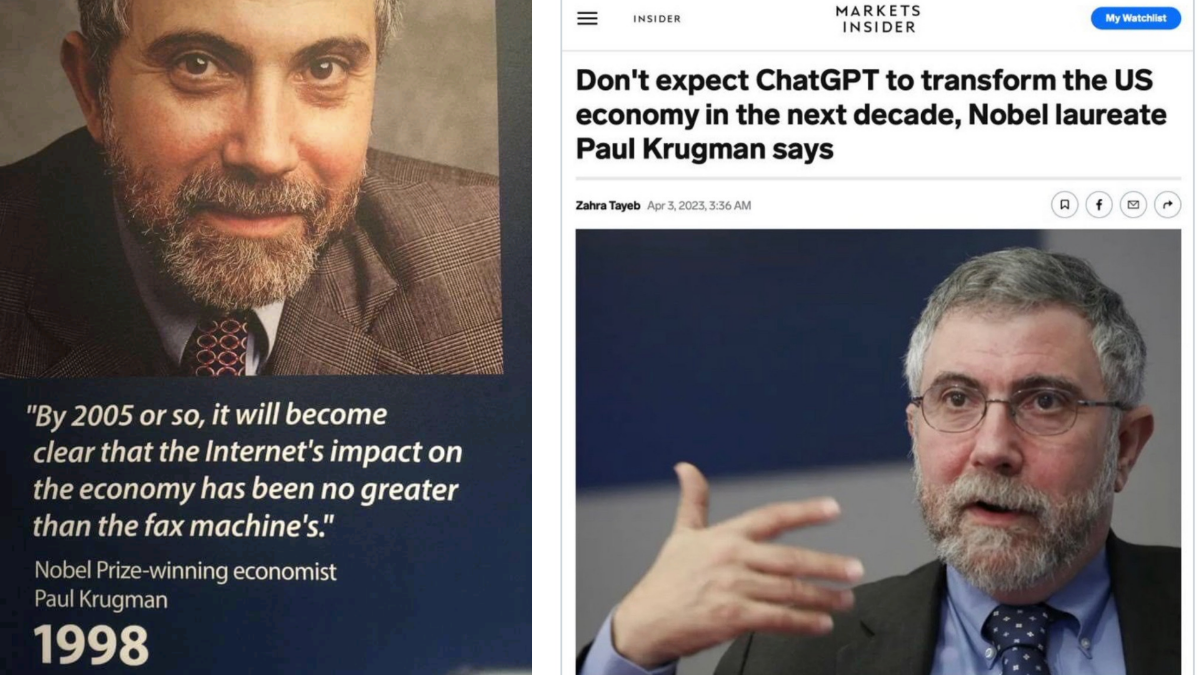
Nevertheless, the comparison with the dot-com era is hard to avoid. At the time, the impact of the internet was massively underestimated, even by Nobel laureate Paul Krugman, who stated in 1998 that "by 2005 or so, it will become clear that the internet's impact on the economy has been no greater than the fax machine's." A quarter of a century later, he repeats his scepticism, this time about ChatGPT and artificial intelligence. The now-viral collage of his statements symbolises how technological revolutions are often dismissed at first, only to subsequently and fundamentally change economic reality.
The truth probably lies somewhere between the two extremes. The current AI boom shows signs of overheating, but also of structural progress. While some analysts warn of overinvestment and energy scarcity, others see a new industrial cycle in which data, computing power and energy form the factors of production of the future. Just as the dot-com crash ultimately sowed the seeds for winners such as Amazon and Google, this phase too will produce new leaders, but not every player in the AI race will survive.
For investors, caution therefore remains warranted. Valuations are currently moving mainly on expectations, not on realised profit growth. The coming years will have to show whether the AI supercycle represents a lasting transformation, or merely another chapter in the eternal swing between vision and euphoria.
US labour market: growth slowdown despite a strong economy
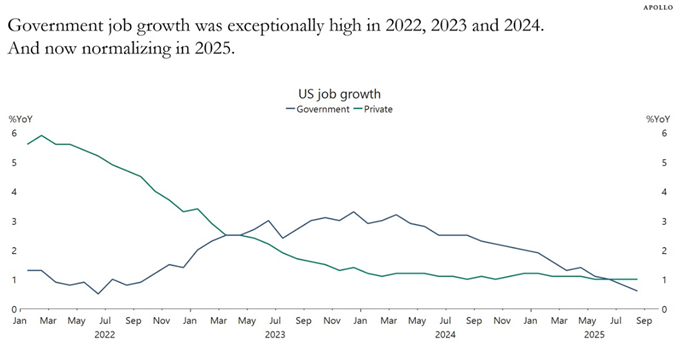
The US labour market is beginning to show clear signs of cooling. According to Apollo's chief economist Torsten Sløk, in his recent analysis The Daily Spark, there are now, for the first time since 2021, more unemployed people (7.4 million) than job openings (7.2 million). Sectors particularly sensitive to import tariffs and higher financing costs, such as manufacturing, construction and logistics, are seeing a decline in employment. At the same time, various confidence indicators are falling among consumers, especially those on lower incomes and in the middle class, as well as among small businesses. This points to a further slowdown in job growth and a gradual normalisation of wage inflation.
Sløk emphasises that this slowdown is not the result of a weak economy. GDP growth, consumer spending and business investment remain robust. In his view, the cause lies on the supply side of the labour market. Three structural factors play a key role here:
- First, lower immigration is reducing the available labour pool.
- Second, the rapid adoption of AI and automation is leading to higher productivity, meaning companies need fewer staff.
- Third, the number of government jobs is falling after the sharp expansion under the previous administration.
That latter trend is being reinforced by cost-cutting measures from the new Department of Government Efficiency (DOGE) under President Trump, which is carrying out large-scale layoffs within the federal government. According to Sløk, the combination of retrenchment and digitalisation, with AI being deployed ever more widely in public services, points to a structural reshaping of the US labour market.
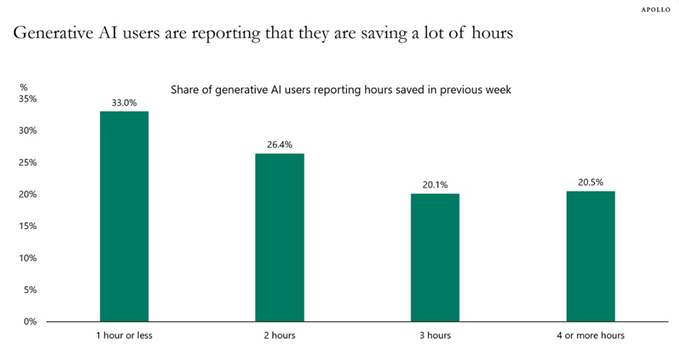
For financial markets, this implies a more accommodative policy stance from the Federal Reserve. A slowing labour market increases the likelihood that the central bank will pause or even reverse its tightening cycle, particularly if inflation continues to ease. Yields on US Treasuries have edged lower in recent days, while equities found support in the expectation of looser monetary policy.
Remarkably, markets remained relatively calm despite the federal shutdown in early October, which saw more than 900,000 civil servants temporarily furloughed. Investors appear to assume that the political impasse will be short-lived and will not cause lasting damage to the US economy. All in all, a shift is taking shape: no longer overheating and wage inflation, but gradual normalisation and higher productivity are now defining the new picture of the US labour market.
Receive weekly insights in your inbox
Exclusive analyses and updates on family holding companies and global market developments.
Would you like more information about our services? Please feel free to get in touch.
Get in touch
Disclaimer:
No rights can be derived from this publication. This is a publication of Tresor Capital. Reproduction of this document, or parts thereof, by third parties is only permitted after written consent and with reference to the source, Tresor Capital.
This publication has been compiled by Tresor Capital with the greatest possible care. The information is intended in a general sense and is not tailored to your individual situation. The information may therefore explicitly not be regarded as advice, an offer or a proposal to purchase or trade investment products and/or to take up investment services, nor as investment advice. The authors, Tresor Capital and/or its employees may hold positions in the securities discussed, for their own account or on behalf of their clients.
You should carefully consider the risks before you start investing. The value of your investments may fluctuate. Past performance offers no guarantee for the future. You may lose (part of) your invested capital. Tresor Capital disclaims any form of liability for any inaccuracies or errors. This information is purely indicative and subject to change.
Read the full disclaimer at tresorcapitalnieuws.nl/disclaimer .
This article was originally written in Dutch and automatically translated into English with the help of AI. In case of any difference, the Dutch original prevails.