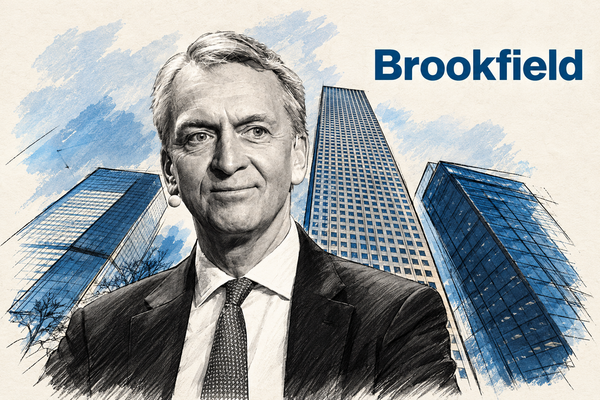
Economy & Markets #43 - Private credit: Wall Street's wild west
According to JPMorgan boss Jamie Dimon, private credit represents the new frontier of financial risk. The losses at Tricolor and Jefferies illustrate the vulnerability of this fast-growing market, even as systemic banks post strong quarterly results.


This week's topics:
“When you see one cockroach, there are probably more.”
During the presentation of the third-quarter results, Jamie Dimon, the influential CEO of JPMorgan Chase and one of the most authoritative voices on Wall Street, warned of hidden risks in the fast-growing private credit market, lending that takes place outside the traditional banking system. According to Dimon, the loss of roughly $170 million on a loan to subprime auto lender Tricolor Holdings is an early sign of broader vulnerabilities.
He also pointed to the bankruptcy of First Brands Group, an auto parts supplier with more than $10 billion in debt, as an example of how quickly these risks can materialise. Dimon stressed that, as the economy weakens, similar problems could emerge in sectors heavily reliant on consumer credit, such as cars, home improvement, credit cards, travel and leisure.
A concrete example is the substantial exposure of Jefferies Financial Group. Through its subsidiary Point Bonita, a hedge fund within its asset management division, Jefferies had roughly $715 million in receivables tied to First Brands, on which payments were abruptly suspended. The direct loss for Jefferies is estimated at approximately $173 million, including potential legal and reputational damage, but the overall impact may prove to be wider.
The private credit market has grown explosively over the past decade and is now estimated at well over $3 trillion. According to the IMF report The Risk and Rise of Private Credit (April 2024), this segment is not only substantial in size but also highly varied in quality and transparency. These loans are provided outside the traditional banking system, mainly by specialised funds and so-called non-bank lenders.
Unlike commercial banks, these lenders are not subject to strict oversight, do not hold capital buffers and are not required to report their risks in a comparable manner. This gives the sector a great deal of flexibility, but also makes it less transparent and more vulnerable in times of stress. Dimon warns that the risks in this market are therefore "less visible" and can escalate more quickly as a result.
For investors, private credit is attractive because of its higher interest payouts: the illiquid and riskier nature of these loans is compensated by a substantial risk premium. In the past, that premium proved more than sufficient to offset the higher default risk. According to the IMF report, private credit funds have historically even achieved higher returns than the S&P 500, venture capital and broad global equity indices. The explanation lies in the exceptionally favourable market conditions of the past decade. Private lenders were often able to lend at rates of around 15%, while that period saw no genuine default cycle that structurally eroded returns.
| Category | Description | Transparency | Liquidity | Risk / Return |
|---|---|---|---|---|
| Private Credit | Loans provided outside the banking system, often to SMEs and PE portfolios. | Low – limited visibility and oversight. | Low – illiquid, buy-and-hold. | High risk, high potential return. |
| Leveraged Loans | Loans to highly leveraged companies (CLO structures). | Medium – partly reported by banks. | Medium – limited trading. | Medium to high risk, floating rate. |
| High Yield Bonds | Public bonds with a low rating (BB or lower). | High – listed and regulated. | High – liquid, daily price formation. | High risk, fixed rate, more transparent. |
The private credit sector has so far not benefited from the recent interest rate cuts initiated by the Federal Reserve. Despite historically strong returns and attractive yields, analysts warn that the rapid growth of this market increases the likelihood of "weak links" appearing in the system. Competition between banks and private lenders has also intensified: private players have by now taken over parts of the leveraged loan market, while banks often remain involved in these structures as financiers or guarantors.
Jamie Dimon noted that he "doesn't know what everyone's underwriting standards are", a concern that he believes poses a material risk to the stability of the broader financial system. Data from Lipper show that syndicated loans, often packaged into collateralised loan obligations (CLOs), saw an outflow of around $1.5 billion in October, the first monthly withdrawal in six months. This suggests that investors are becoming more cautious about this complex and fast-growing form of lending.
At the same time, opinions in the market diverge. Blackstone warned this week that the "golden decade" for private debt is coming to an end, while Henry Kravis of KKR dismisses those concerns as unfounded. According to Kravis, "not a single dollar of private credit was lost" in the bankruptcies of Tricolor Holdings and First Brands, and KKR does not fund its private credit vehicles with deposits, meaning there is, in his view, no systemic risk. Only inexperienced investors in these vehicles, Kravis argues, are now feeling the downside of their risk-seeking behaviour.
US major banks report solid results
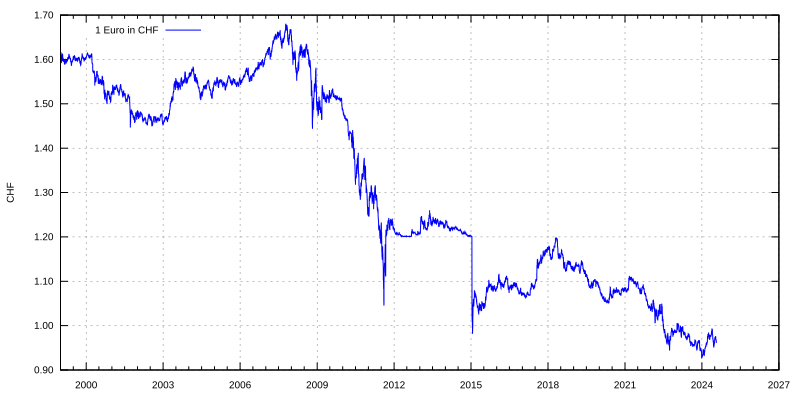
The large US systemically important banks remain financially robust and well capitalised. For the third quarter, they again reported strong results: JPMorgan Chase posted a profit of $13.2 billion, Bank of America came in at $6.9 billion, Wells Fargo saw profit rise on lower loan loss provisions, and Citigroup kept results stable thanks to cost discipline and a strong trading division.
The stability of these institutions is supported by the strict oversight of the Federal Reserve, which imposes high requirements on capital buffers, liquidity and stress tests. The resilient US economy also contributes to profitability and the soundness of balance sheets. According to the Federal Reserve's July 2025 stress test, CET1 capital ratios remain well above the required minimum: JPMorgan 14.4%, Bank of America 13.2% and Citigroup 13.7%.
Provisions for credit losses also remain stable, with an average net charge-off rate of just 0.4%, well below the levels seen during previous recessions. This means the greatest risk currently lies not with the systemically important banks, but with the less transparent parts of the credit market, such as private credit. For now, systemic risk appears to be well contained.
Swiss franc holds its strength despite low interest rates
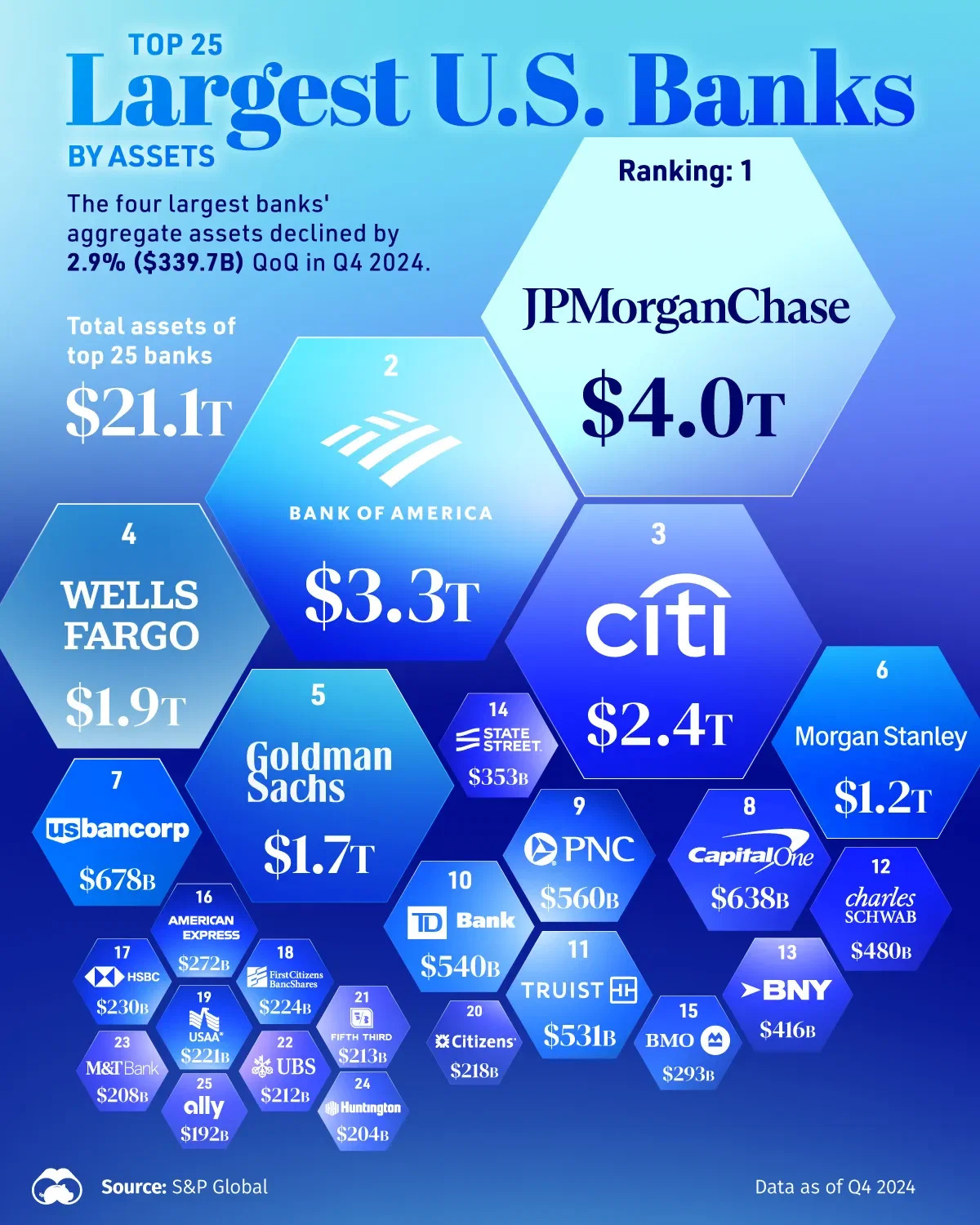
The Swiss franc (CHF) remains one of the strongest currencies in the world, confirming its status as a safe haven in times of uncertainty. The currency is trading close to a ten-year high against the euro and remains remarkably stable against the US dollar. Growing concerns about debt, budget deficits and political instability in the US, Japan and the eurozone are driving a renewed preference for currencies with solid fundamentals.
Switzerland stands out as one of the few developed economies with structural stability: low inflation, prudent fiscal policy and a strong external balance. Remarkably, the franc has maintained its strength despite years of negative and later extremely low interest rates. Whereas other currencies depend on interest rate differentials to attract capital, demand for the franc is driven mainly by confidence in Swiss policy and the soundness of its financial system. Foreign capital, including that of wealthy private investors, continues to flow in and is being reinvested in francs.
According to Bloomberg Intelligence, the franc is benefiting not only from the credible monetary policy of the Swiss National Bank (SNB), but also from the weak outlook for the euro. For the domestic economy, however, the strong currency poses a challenge. The SNB has cut its policy rate by 175 basis points to 0% since early 2024, but further easing appears unlikely. The franc's appreciation has led to falling consumer prices: in June, inflation came in at –0.1% year-on-year, partly due to a 2.4% price decline in imported goods. Since imports make up around 23% of the CPI basket, this directly weighs on domestic price developments.
As long as the macroeconomic outlook in the eurozone remains weak, the franc is expected to fluctuate around CHF 0.92–0.93 per euro. The currency therefore remains a natural hedge against market uncertainty and an anchor of monetary stability in Europe. Where the German mark once played that role, the euro has lost more than 46% of its value against the franc since its introduction in 1999, a powerful reminder of how rare confidence in monetary discipline has become.
Gold undergoes a rare correction, but confidence remains intact
After months of strong price gains, the gold market experienced an abrupt correction this week. Within a few days, the precious metal lost more than seven percent, as profit-taking, a stronger dollar and rising real interest rates triggered a rotation out of so-called momentum assets. Gold mining stocks, which typically react more sharply than the underlying metal price, also fell heavily. According to Goldman Sachs, there was no clear fundamental trigger; the decline mainly reflects a technical cooling-off after an exceptionally strong rally. After nine consecutive weeks of gains, the market had become overcrowded with long positions, which ultimately resulted in a sudden "panic outbreak" among investors.
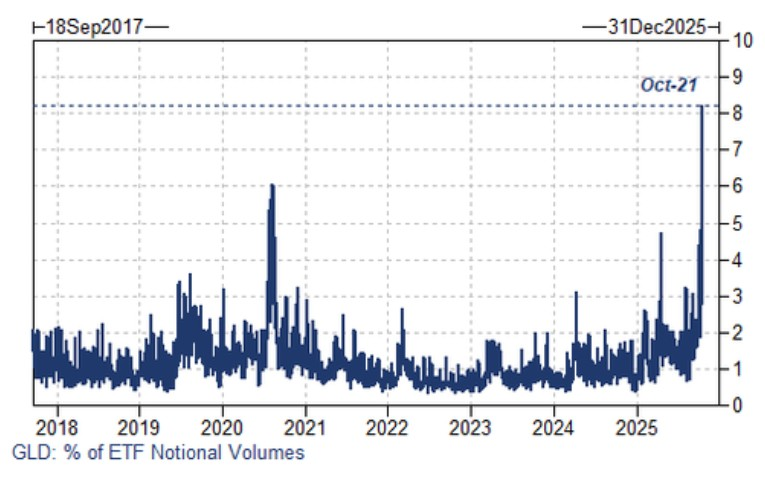
On 21 October, the spot gold price fell at one point by 6.3%, to just below the $4,000 per ounce mark, the largest one-day decline in more than twelve years. Analysts described the volatility as a rare "5-sigma event", which statistically translates to odds of just one in 3.5 million. Silver took an even harder hit, temporarily falling by 8.7%. The correction abruptly ended the strong momentum of the previous week, during which gold and silver repeatedly reached new record highs. Shares of leading gold producers such as Barrick Gold, Newmont Mining and Agnico Eagle Mines all lost more than eight percent that day. At the same time, the gold ETF GLD recorded a record trading volume, accounting for eight percent of all ETF transactions in the US, the highest share ever measured.
Despite the sharp pullback, the underlying fundamentals for gold remain just as strong. Expectations of financial repression, whereby central banks artificially keep real interest rates low to ease high government debt burdens, along with sustained demand from central banks, continue to provide support. Even the most fervent gold bugs see the correction mainly as a healthy pause for breath within a broader upward trend. In a world of high debt, geopolitical tensions and monetary uncertainty, gold continues to fulfil its role as a strategic diversifier and insurance against systemic risks, even if the road there is filled with volatility.
Receive weekly insights in your inbox
Exclusive analyses and updates on family holding companies and global market developments.
Would you like more information about our services? Feel free to get in touch.
Get in touch
Disclaimer:
No rights can be derived from this publication. This is a publication of Tresor Capital. Reproduction of this document, or parts thereof, by third parties is only permitted with written consent and with reference to the source, Tresor Capital.
This publication has been compiled by Tresor Capital with the greatest possible care. The information is intended in a general sense and is not tailored to your individual situation. The information must therefore explicitly not be regarded as advice, an offer or a proposal to purchase or trade investment products and/or to take up investment services, nor as investment advice. The authors, Tresor Capital and/or its employees may hold positions in the securities discussed, for their own account or for their clients.
You should carefully consider the risks before you begin investing. The value of your investments can fluctuate. Past performance offers no guarantee for the future. You may lose (part of) your investment. Tresor Capital disclaims any form of liability for any inaccuracies or errors. This information is purely indicative and subject to change.
Read the full disclaimer at tresorcapitalnieuws.nl/disclaimer .
This article was originally written in Dutch and automatically translated into English with the help of AI. In case of any difference, the Dutch original prevails.