Economy & Markets #44 - Opportunities for a new wave of investment in the Gulf states
KKR researchers cite five reasons why the Middle East is the place to be for investors in the coming decade.


This week's topics:
At the same time, artificial intelligence is rapidly transforming the financial world. OpenAI's Project Mercury aims to automate the work of analysts and bankers, while McKinsey estimates that AI could affect up to 40% of the cost base in asset management. Yet human judgement remains crucial: technology democratises data, but not temperament, discipline and patience, the qualities that, according to the principles of Warren Buffett, continue to determine lasting investment success.
From geopolitical risk to investment opportunity: the new roadmap for the Middle East
After years of tension between Israel, Hamas and Iran, the Middle East appears to be slowly but surely recovering. The recent peace agreement between Israel and Gaza has reduced the immediate threat of a regional conflict and created room for economic reconstruction and cooperation. Despite new incidents in 2025, such as air strikes in Syria and confrontations between Iran, Israel and the US, large-scale disruption failed to materialise. Both equity markets and commodity prices reacted remarkably calmly, partly because physical deliveries of oil and gas from the Gulf states remained largely unaffected.
According to KKR's most recent report (Thoughts from the Road – Middle East, October 2025), the region finds itself in a phase of structural reorientation. Reforms, investment and cooperation once again form the common thread, with the Gulf Cooperation Council (GCC) countries in particular evolving from traditional capital exporters into destinations where international investors themselves want to actively deploy capital, across the following themes:
1. Diversification
The Gulf states are investing heavily in broadening their economic base. Where oil was the main source of income for decades, the focus is now shifting towards industry, tourism, technology and sustainable energy.
- Through the Public Investment Fund (PIF), Saudi Arabia is directing roughly 80% of its more than $1 trillion in capital towards domestic megaprojects, including NEOM, green hydrogen and manufacturing capacity. These projects offer ample opportunities for foreign partners.
- The United Arab Emirates (UAE) is strengthening its position as a regional hub for trade and capital flows. In 2024, around $6 billion was raised through IPOs, and the pace of IPOs and private equity transactions has remained high in 2025 as well. For investors, the main opportunities here lie in export-oriented manufacturing, sustainable commodity chains and energy infrastructure.
2. Infrastructure and private lending
According to KKR, ongoing and planned projects in the Gulf states now represent more than $3 trillion, equivalent to one and a half times the region's combined GDP. This creates an exceptionally attractive playing field for private infrastructure vehicles, asset-based finance and project financing. Real estate and logistics are benefiting from rapid urbanisation and population growth, while private lending is playing an increasingly important role as an alternative to commercial banks, which have become more cautious due to stricter regulation. As a result, the Gulf region is developing into a new hotspot for private credit, a means of diversifying beyond the saturated Western markets.
3. Policy stability and reforms
An important difference from previous decades is the markedly improved policy stability. Governments are now pursuing long-term agendas with clear strategic goals. In this regard, KKR speaks of a "new investment architecture" in the Gulf region.
Public debt ratios are low: according to GCC-Stat, average debt fell to around 29.8% of GDP in 2023, well below the peak of 40.3% in 2020, and fiscal positions are solid. At the same time, free zones and tax incentives are attracting multinationals, while regulations around foreign ownership are being further relaxed. In Saudi Arabia, a law was passed in early 2025 granting foreigners broader rights to property ownership. The UAE now has more than 40 free zones where 100% foreign ownership and full profit repatriation are possible.
4. Demographics and digitalisation
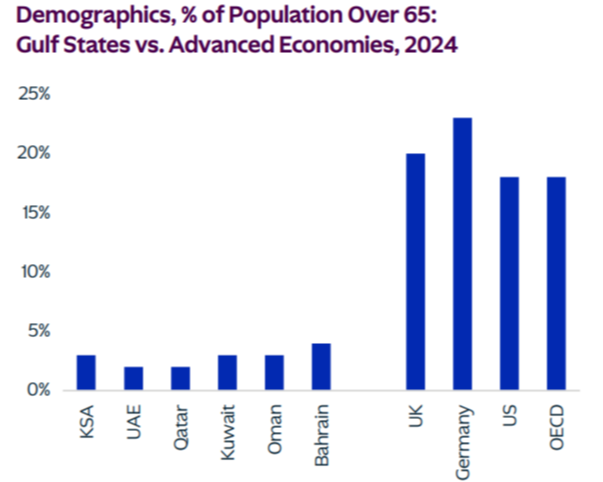
The young population of the Gulf states is a powerful driver of domestic growth. With an average age under 30 and a rapidly growing middle class, demand for education, healthcare, fintech, e-commerce and housing construction is rising. Strong digital adoption, supported by 5G networks, artificial intelligence and data centres, is also opening up new investment opportunities in technological infrastructure, cloud capacity and consumer services.
5. Capital inflows on a global scale
Capital flows into the Gulf region are rising rapidly and are now reaching levels comparable to those of developed markets. Saudi Arabia has already awarded $440 billion worth of projects, with another $1.5 trillion in the pipeline. The UAE continues to attract international investors through a strong inflow of IPOs, venture capital and partnerships with sovereign wealth funds.

AI and the future of the analyst
A recent edition of Barron's Magazine featured an intriguing analysis of a question that is being asked ever more loudly in the financial world: could artificial intelligence eventually take over the role of buy-side and sell-side analysts as well? The debate gained fresh momentum in October after Sam Altman revealed that OpenAI had set up a secret division called Project Mercury.
According to Barron's, OpenAI has since hired around a hundred former investment bankers from firms including JPMorgan Chase, KKR, Goldman Sachs and Morgan Stanley. Their task is to design prompts and financial models that allow AI systems to take over routine tasks currently performed by junior bankers, such as building valuation models, analysing financial data and preparing transaction documentation.
The ambition behind Project Mercury is to train AI into a digital analyst capable of modelling, analysing and reporting independently or semi-autonomously, a fundamental step towards large-scale automation within investment banking. This would also affect valuation work, corporate actions and IPO preparations. In 2024, researchers Li, Tu and Zhou concluded in their paper 'The Promise and Peril of Generative AI: Evidence from GPT-4 as Sell-Side Analysts' that human analysts still outperformed AI models at the time. Altman's goal is now to close that gap quickly.
The impact on banks and wealth managers
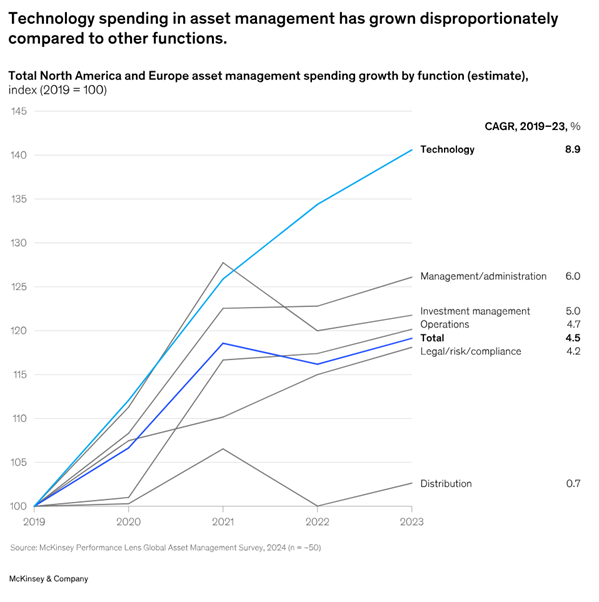
The question is not only when, but also how AI will transform the banking and wealth management model. According to research by McKinsey & Company (How AI could reshape the economics of the asset-management industry, July 2025), generative AI could affect between 25% and 40% of the cost base in asset management.
According to McKinsey, the sector is at a tipping point. For years, wealth managers benefited from low interest rates and steady growth, but margins have been under pressure since 2022. Management costs are rising, revenues are becoming more volatile and competition from passive strategies is increasing. In North America, margins have fallen by around three percentage points over the past five years; in Europe, by as much as five.
It is also becoming increasingly difficult to prove the added value of active management. This year, only around five percent of active US fund managers are beating their benchmark indices. As a result, the pressure is shifting towards scale, automation and cost reduction, developments that further reinforce the role of AI.
McKinsey sees the greatest efficiency gains in distribution processes, support for investment teams and compliance automation. Yet the researchers warn that many institutions are struggling to generate returns on their technology investments. Despite sharply rising IT spending, averaging 8.9% growth per year, there is barely any link to lower costs or higher productivity. This is because 60% to 80% of IT budgets are still spent on maintaining outdated systems, rather than on fundamental digital renewal.
Value investing in the age of AI
The rise of artificial intelligence bears a striking resemblance to the internet bubble of the late 1990s. In December 1999, Barron's mockingly asked: "What's Wrong, Warren?" The internet revolution was then at its peak, and Warren Buffett, who deliberately ignored the hype, was dismissed as out of touch.
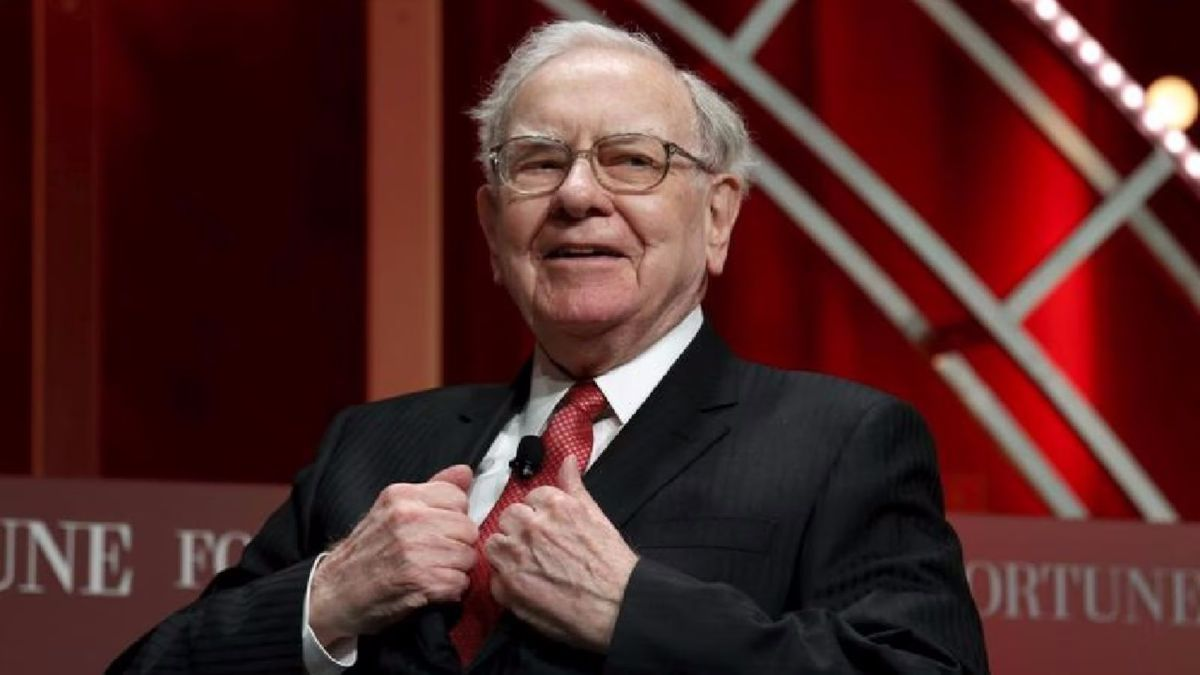
Twenty-five years on, history is repeating itself in a new guise. AI is the new internet: a revolutionary technology that propels markets upward and tempts investors into impatience. Some, such as investor Guy Spier, believe that AI heralds the end of value investing, because it has erased the information advantage human analysts once had.
Spier describes how, back in the 1990s, he would spend days poring over annual reports, calling companies and attending shareholder meetings to uncover insights others had missed. Nowadays, virtually all information is instantly available via the internet and large language models such as ChatGPT or Gemini. Access to data and the speed of analysis have been levelled out, but that does not mean the essence of value investing has disappeared.
The authors of the recent Barron's article, themselves seasoned value managers, argue that this is precisely the moment at which the value philosophy is being reinvigorated. In a market where index funds buy and sell blindly, inefficiency increases, the very oxygen on which value investors thrive. The strength of value investing lies not in an information edge, but in two irreplaceable human qualities: time and temperament. Time, because true value only reveals itself after years. Temperament, because few people have the calm and discipline to stay the course when markets panic.
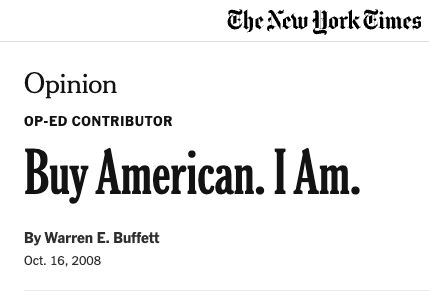
AI can process billions of data points, but it possesses no courage, the trait that defines Buffett. He bought when others sold, as during the credit crisis and the eurozone crisis. The opinion piece by Buffett below in the New York Times, titled "Buy American. I Am.", published exactly one month after the collapse of Lehman Brothers, speaks volumes in this regard.
Buffett's true strength lay not in technology, but in consistency and adaptability. Ironically, the man who once said he would never invest in technology later became a major shareholder in Apple and IBM. His principles remained unchanged, but their application evolved with the times.
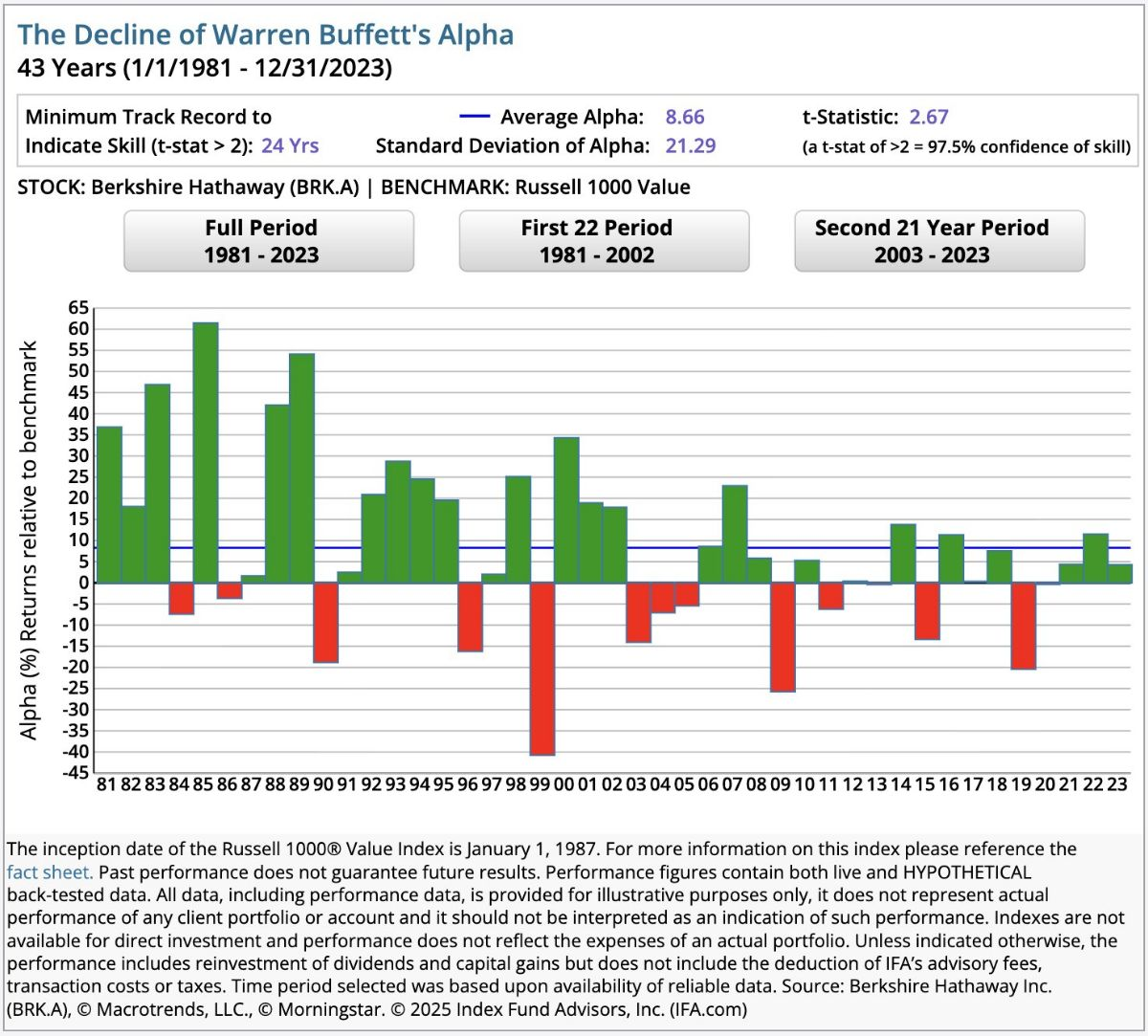
Likewise, the modern value investor will use AI as a tool, not as an oracle. Technology speeds up research and dissects patterns, but assessing (intrinsic) value and risk remains a human task. Buffett once summed it up succinctly:
"The stock market is a device to transfer money from the impatient to the patient."
Research by Frazzini, Kabiller & Petersen (2011) shows that Buffett's returns can partly be explained by leverage (insurance float), quality and valuation, but that his behaviour and culture are decisive. His self-control and long-term vision form the true source of his alpha, qualities that, unlike technology, cannot be modelled.
The authors close with a reassurance Buffett himself offered in 2023: new technologies do not take away opportunities, they create new ones. People remain susceptible to overconfidence and emotion, and as long as markets are driven by psychology, value investing will not disappear but will in fact flourish.
Receive weekly insights in your inbox
Exclusive analyses and updates on family holding companies and global market developments.
Would you like more information about our services? Please feel free to get in touch.
Get in touch
Disclaimer:
No rights can be derived from this publication. This is a publication of Tresor Capital. Reproduction of this document, or parts thereof, by third parties is only permitted with written consent and with reference to the source, Tresor Capital.
This publication has been compiled by Tresor Capital with the greatest possible care. The information is intended in a general sense and is not tailored to your individual situation. The information must therefore expressly not be regarded as advice, an offer or a proposal to purchase or trade investment products and/or to take up investment services, nor as investment advice. The authors, Tresor Capital and/or its employees may hold positions in the securities discussed, for their own account or on behalf of their clients.
You should carefully consider the risks before you start investing. The value of your investments may fluctuate. Past performance offers no guarantee for the future. You may lose (part of) your investment. Tresor Capital disclaims any liability for any inaccuracies or errors. This information is purely indicative and subject to change.
Read the full disclaimer at tresorcapitalnieuws.nl/disclaimer .
This article was originally written in Dutch and automatically translated into English with the help of AI. In case of any difference, the Dutch original prevails.