Economy & Markets #45 - Two speeds in one economy: why the Fed is caught between growth and inequality
Strong profit growth at the top is masking the pressure on the middle class and SMEs, making monetary policy ever harder to balance.


This week's topics:
A K-shaped recovery: a divided rebound confronts the Fed with dilemmas
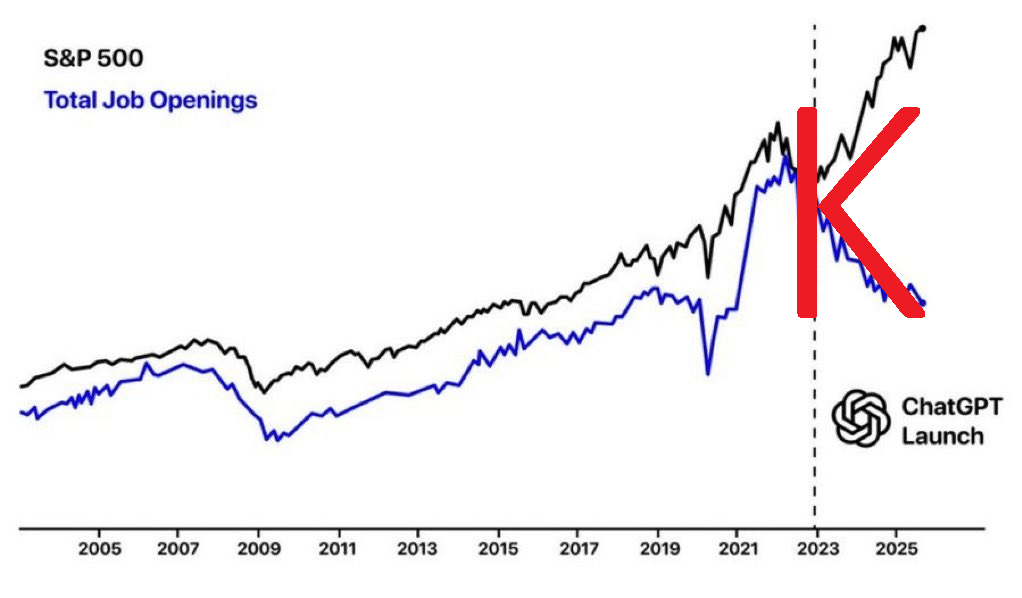
The US economy is at a crossroads. At first glance, the figures look solid: growth remains above expectations at around two percent, unemployment is hovering around four percent and inflation has fallen from almost nine percent in 2022 to around three percent now. Equity markets are also trading at record highs. Yet the picture behind these figures is less reassuring. Beneath the surface, a so-called K-shaped recovery is unfolding, a recovery moving in two directions at once. The upper arm of the K represents the winners of the new economic era, while the lower arm represents those being left behind.
The top of the K: capital pays off
At the top are the sectors and groups benefiting from structural trends and abundant capital. The technology sector remains the growth engine of the United States: companies active in artificial intelligence, cloud computing and semiconductors are posting record profits, driven by rising productivity and major investment in data centres. The efficiency gains from AI are offsetting rising wage costs and widening margins. Thanks to strong cash flows, these companies can largely finance their own growth and are barely affected by higher interest rates.
Large companies outside the technology sector are benefiting too. Their scale, cash reserves and access to credit make refinancing relatively cheap, an advantage smaller players do not have. Wealthy households are also riding this recovery, buoyed by equity markets reaching new highs and prime real estate holding its value. For this group, higher interest rates even reinforce a sense of financial security.
These factors are keeping consumption steady and making the macroeconomic picture look robust. Companies with strong balance sheets, low debt levels and pricing power remain attractive, while interest-rate-sensitive sectors remain vulnerable. At the top of the K, affluent consumers continue to buy premium products with ease, from Ferrari sports cars to Hermès bags and Apple's iPhone 17 Pro.
The bottom of the K: labour and the middle class under pressure
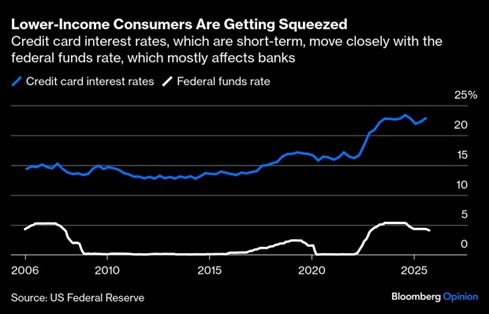
For a large share of American households, reality looks very different. Although inflation has officially come down to three percent, the prices of rent, insurance, electricity, healthcare and everyday groceries are rising faster than the official figures suggest. The real purchasing power of the middle class remains below pre-pandemic levels. Small and medium-sized enterprises, the backbone of employment, are grappling with financing costs that have doubled since 2021. While large companies have no trouble accessing capital markets, small business owners often pay eight to ten percent interest on loans. This curbs investment, squeezes margins and forces many to cut staff or postpone expansion plans.
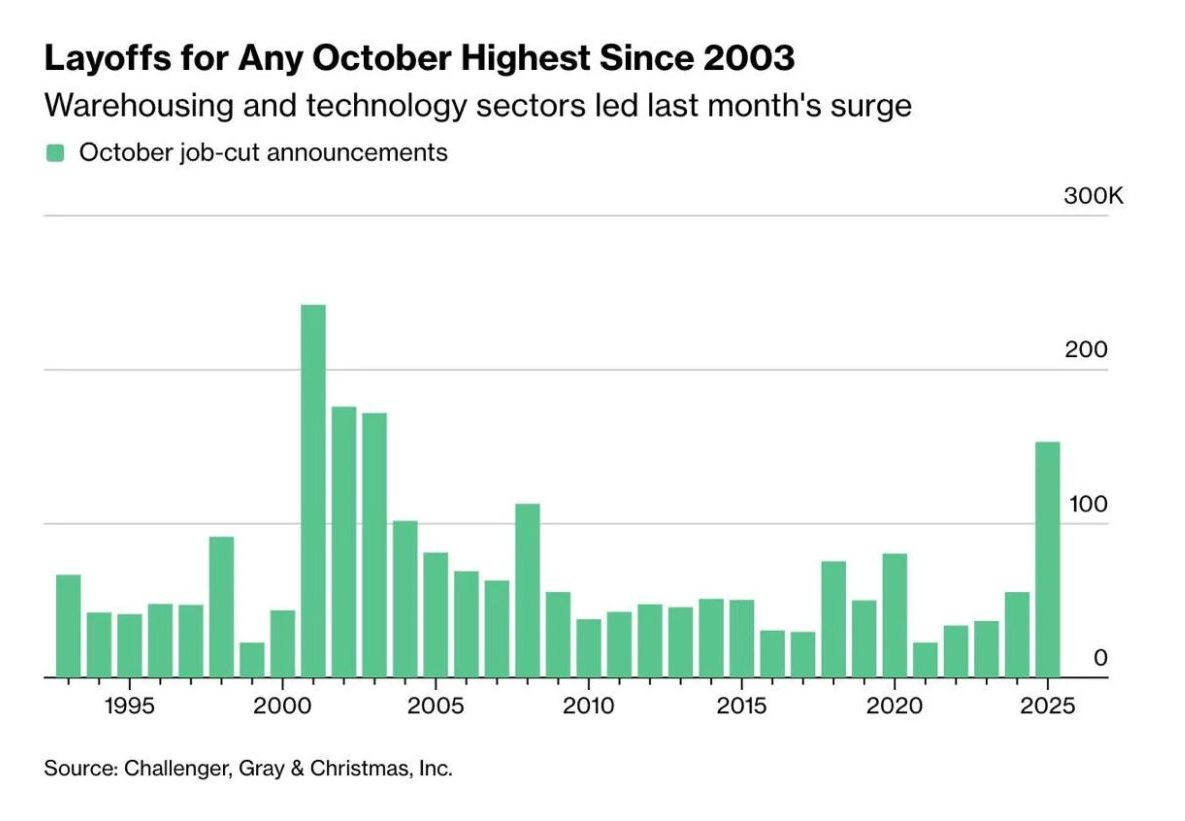
The labour market is also showing cracks. Behind the low national unemployment rate lies a growing gap between the highly educated and the less educated. In technology, consulting and engineering, demand for staff is greater than ever, while jobs in logistics, hospitality and retail are disappearing. The economy as a whole looks healthy, but inequality between occupational groups keeps widening.
What we are witnessing is not a temporary phenomenon but a structural shift. Technological progress is raising productivity in capital-intensive sectors but displacing labour in traditional industries. Capital is concentrating among a limited number of companies and households with access to financial markets, while the rest remain dependent on expensive credit and wage income.
Demographic and regional differences are reinforcing this trend. Older, wealthier households benefit from higher interest rates and have less need for credit, while younger families with mortgages and student debt are under pressure. Growth is concentrated in southern states that benefit from industrial policy and tax incentives, while the old industrial states continue to fall behind.
Even government policy is contributing to this divergence. Fiscal stimulus and subsidies flow mainly to strategic sectors such as energy, defence and technology, not to labour-intensive services. According to the National Federation of Independent Business, small businesses' investment plans for the coming six months remain below pre-pandemic levels. At the bottom of the K, we see companies such as Chipotle, Airbnb and hotels in Las Vegas suffering from cautious consumers.
The Fed caught between two fires
The US central bank finds itself in a difficult position. Unlike the European Central Bank, the Federal Reserve has not one, but two statutory mandates. On the one hand, it must bring inflation back towards its 2% target, in order to protect purchasing power and the credibility of monetary policy. On the other hand, it has the task of keeping employment at the highest possible level, the so-called full-employment mandate.
In stable times, these two goals often go hand in hand. Low inflation stimulates consumption, and high employment supports growth. But in today's divided economy, the two missions are pulling in opposite directions. Curbing inflation requires restrictive policy, while the weaker segments of the labour market actually need monetary easing. As a result, the Fed finds itself in a classic bind: every decision that helps one half of the economy appears to harm the other.
The K-shaped recovery is partly a consequence of this tension. Interest rate hikes are a blunt instrument, far less targeted than fiscal policy's tools of taxation and redistribution. As former Fed economist Claudia Sahm once put it: “Interest rates are a blunt tool, far less targeted than the tax-and-transfer toolkit of fiscal policy.”
The paradox is that the Fed's policy, intended to restore balance, is actually widening inequality. Higher interest rates restrict lending and suppress consumption at the lower end of the economy, while the upper end benefits from higher returns on savings and rising asset prices. In this way, every interest rate and inflation decision reinforces the very divide it is trying to correct.
The central bank knows that cutting rates too early risks a renewed rise in inflation expectations, which would undermine the credibility of its policy. But further tightening increases the pressure on lower-income households and small and medium-sized enterprises, which are already struggling with high financing costs. The result is a deadlock in which no policy option is without side effects.
The market is currently pricing in a decline in the policy rate to around 3.75% by the end of this year, and further towards 3.25% by the end of 2026. Should that scenario materialise, it would result in a steeper yield curve, which is favourable for credit creation: banks can borrow short-term at lower rates and lend long-term at higher returns. Yet the dilemma remains fundamental: how do you keep inflation under control without further damaging the recovery of the lower end of the economy?
US political deadlock deepens economic damage
The US federal government has now been partially shut down for over five weeks due to a political stalemate in Washington. The Republican majority in the House of Representatives and the Democratic Senate cannot agree on the budget for the new fiscal year. The dispute is not only about spending caps, but also about policy areas such as healthcare subsidies under the Affordable Care Act and federal support programmes.
The economic damage is becoming increasingly visible. According to Goldman Sachs, the shutdown is costing around 1.15 percentage points of GDP growth in the fourth quarter of 2025, although part of that will be recovered in early 2026. With federal services at a standstill, crucial economic data, including employment figures, are not being released, leaving policymakers and investors in the dark.
The Federal Aviation Administration (FAA) is also warning of staff shortages, forcing 40 US airports to cut flight capacity by around ten percent. Construction and infrastructure projects have also ground to a halt, further eroding confidence in the real economy.
Democratic gains increase pressure on Republicans
Political pressure on the Republicans is meanwhile increasing following clear Democratic victories in this week's regional elections. The party achieved strong gains in New York, Virginia and New Jersey, and in California voters approved a reform of the electoral district system, which is expected to hand Democrats five additional seats after 2026. In New York City, 34-year-old Zohran Mamdani was convincingly elected mayor, decisively beating former governor Andrew Cuomo and Republican Curtis Sliwa.
Mamdani, an outspoken democratic socialist, is mockingly referred to by President Trump as the “little communist,” a nickname that underscores both his popularity among progressive voters and his polarising reputation. His victory shows that the Democrats, when they manage to put forward young and charismatic candidates, can once again build momentum ahead of the 2026 midterm elections. Whether the party should push further in a more progressive, socialist direction, as previously advocated by Bernie Sanders, remains unclear.
The fact remains that public discontent with the economy stays high: almost two-thirds of Americans rate it as “bad” or “very bad,” while 54% of the population disapproves of President Trump's policies. Analysts therefore see the recent results as an early warning sign for the Republicans. Historically, the opposition party gains an average of 25 seats during the midterms, a scenario that increases the likelihood of the Democrats retaking the House of Representatives.
Market impact and policy risks
The political impasse also has market effects. Mamdani’s plans to borrow $70 billion for affordable housing construction clash with New York’s constitutional debt ceiling and its reliance on state support. Proposals for higher taxes and free public transport appear politically unfeasible, although they do indicate the direction of his policy.
According to S&P and J.P. Morgan, there is no direct threat to New York’s creditworthiness, thanks to budgetary rules and state oversight. Nevertheless, property companies focused on New York, such as SL Green Realty Corp. and Vornado Realty Trust, have already seen sharp share price declines. New York muni bonds are also underperforming the broader market. President Trump has once again added New York to the list of “anarchist cities”, alongside Portland, Los Angeles and San Diego, threatening to limit federal support. The political stage in Washington thus remains completely deadlocked: Democrats sense momentum, Republicans are blocking the budget, and the US economy is paying the price.

Political division curbs Europe’s reform capacity
The Netherlands: coalition talks still searching for a reform coalition
The Dutch cabinet formation process is proving difficult. A coalition with parties on the left appears unlikely, as the VVD rules out cooperation with GroenLinks–PvdA. Within the VVD, moreover, more conservative candidates received the most preference votes, pushing the party’s course further to the right. The most likely option remains a centre-right combination of D66, VVD, CDA and JA21, although cooperation between D66 and JA21 in particular faces considerable resistance among D66’s rank and file.
Belgium: impasse over multi-year budget delays reforms
In Belgium too, political uncertainty remains high. On 6 November, Prime Minister Bart De Wever reported to King Philippe on the deadlocked negotiations over the 2026–2029 multi-year budget. Because the De Wever government failed to meet the deadline, Belgium is for now operating under so-called “provisional twelfths”: monthly spending based on the previous budget year. As a result, new fiscal measures, including the capital gains tax, cannot be submitted or voted on. This is creating a budget gap of roughly €1 billion in 2026. The prime minister has set a new fifty-day deadline to still reach an agreement, but key issues such as pensions, wage norms, tax reform and night work remain unresolved.
Political fatigue is weighing on Europe’s reform agenda
Developments in the Netherlands and Belgium fit into a broader European trend. In an increasing number of countries, including Germany and France, the reform agenda is stalling due to fragmentation and coalition fatigue. Centrist parties are losing ground, populist parties are gaining influence, and consensus politics is giving way to short-term thinking.
Recent analyses, such as 'Navigating a Fractured Horizon' (European Central Bank) and 'Unity or Fragmentation?' by Collignon & Orsitto, show that political fragmentation is directly linked to lower growth, rising debt levels and declining market confidence. Their conclusion is clear: without renewed governmental stability and consensus, Europe risks entering a phase of policy paralysis, in which populism and debt accumulation reinforce one another. This represents a structural risk to the continent’s economic resilience and a factor that investors are watching closely.
Stock market momentum is fading
After a strong summer, the equity market is clearly losing strength. The major US indices closed lower this week, with technology and AI-related stocks under particular pressure. Concerns about high valuations, a more cautious tone from the Federal Reserve, and political uncertainty surrounding the government shutdown are driving investor caution.
The technology sector, for years the engine behind the stock market rally, was in the spotlight again this week, but this time on the weaker side. Investors are starting to question the high valuations of leading tech and AI stocks. The Nasdaq trades at a forward P/E of around 29, well above its ten-year average of 25, leaving little room for disappointments in earnings growth or inflation. In addition, the high concentration of investors in popular momentum positions is adding extra volatility. Where technology companies previously led the rally, we are now seeing profit-taking and a shift towards more defensive sectors.
Market sentiment has noticeably turned more risk-averse. Investors are favouring defensive positions and increasingly seeking refuge in safe havens such as government bonds and the US dollar. The recent decline in oil prices is reinforcing the market’s wait-and-see character. After months of strong share price gains, many parties are opting to take profits. Analysts point out that a temporary correction of around 10% is common and healthy within a longer bull market, especially after periods of excessive optimism.
Earnings growth within the S&P 500 is now being carried by an increasingly small number of companies. Whereas major AI names dominated sentiment in recent months, we are now seeing a rotation towards more defensive sectors such as healthcare and utilities. The market thus appears to be shifting from euphoria to consolidation.
Doubts over financing of OpenAI's plans
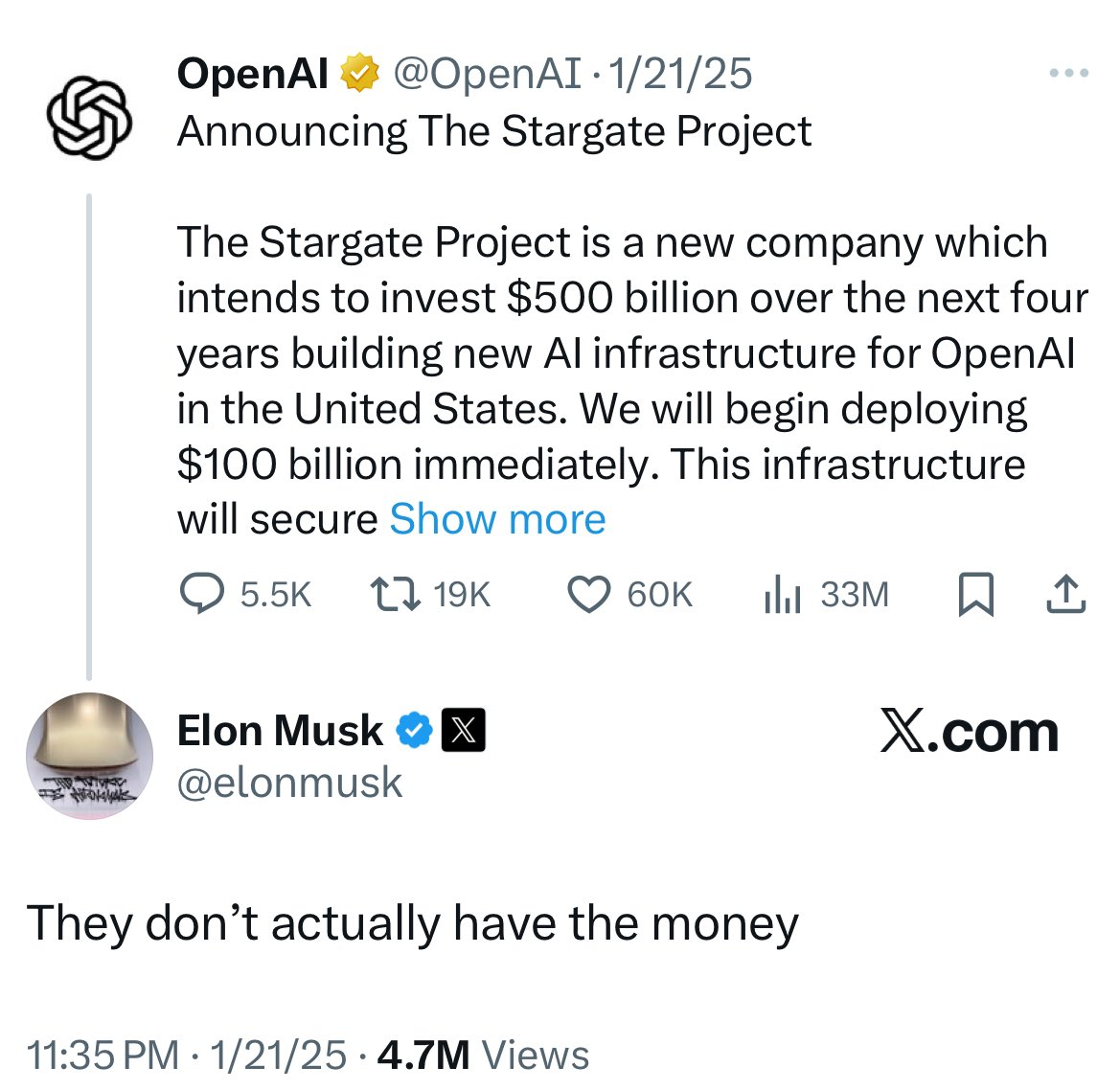
The debate around OpenAI's investment ambitions flared up again this week following remarks from CEO Sam Altman. Where previous discussions referred to several hundred billion dollars, Altman confirmed that the company is targeting roughly USD 1.4 trillion in investment through to 2030 to build out a global AI infrastructure. That scale raises questions about financing. OpenAI is expected to generate annual revenue of just over USD 20 billion by the end of 2025, but is counting on explosive growth towards hundreds of billions per year by 2030. Altman denied that OpenAI is seeking government support or guarantees, stressing that "the government shouldn't be picking winners or losers." That said, he does see scope for cooperation on building national AI infrastructure and strengthening the US chip supply chain. According to Altman, global demand for computing power is growing faster than supply. He considers the risk of too little capacity greater than that of too much, calling it a "necessary bet to build the infrastructure of the future."
Conclusion – a new wall of worry
Investors face a familiar challenge: navigating an environment of high valuations, mixed economic signals and growing political uncertainty. The US stock market is once again climbing a wall of worry: a classic feature of a mature bull market, in which confidence and caution continually keep each other in check.
Receive weekly insights in your inbox
Exclusive analyses and updates on family holding companies and global market developments.
Would you like more information about our services? Please feel free to get in touch.
Get in touch
Disclaimer:
No rights can be derived from this publication. This is a publication of Tresor Capital. Reproduction of this document, or parts thereof, by third parties is only permitted after written consent and with reference to the source, Tresor Capital.
This publication has been compiled by Tresor Capital with the utmost care. The information is intended in a general sense and is not tailored to your individual situation. The information must therefore explicitly not be regarded as advice, an offer or a proposal to purchase or trade investment products and/or to procure investment services, nor as investment advice. The authors, Tresor Capital and/or its employees may hold positions in the securities discussed, for their own account or for their clients.
You should carefully consider the risks before you start investing. The value of your investments may fluctuate. Past performance offers no guarantee for the future. You may lose (part of) your invested capital. Tresor Capital disclaims any form of liability for any inaccuracies or errors. This information is purely indicative and subject to change.
Read the full disclaimer at tresorcapitalnieuws.nl/disclaimer .
This article was originally written in Dutch and automatically translated into English with the help of AI. In case of any difference, the Dutch original prevails.