
Economy & Markets #46 – Markets look for direction without data


This week's topics:
End of the US shutdown brings no relief for investors
The 43-day shutdown of the US federal government is over, but its impact is considerable. Around 670,000 employees were placed on furlough (employed but on unpaid leave), while more than 1 million civil servants were required to keep working without pay. Had the shutdown lasted longer, this latter group could have grown to over 2 million. According to the Congressional Budget Office, the economic damage from the shutdown in the fourth quarter will therefore amount to 1 to 2 percentage points of GDP, equivalent to a loss of roughly USD 14 billion.
The deadlock between Republicans and Democrats was broken when a small but crucial group of Democratic senators decided to support a temporary funding bill after all (with a vote on the Affordable Care Act scheduled for a later date). Since reopening, the government has been working to pay out overdue salaries: some employees are already receiving a so-called supercheck quickly, while others will not be compensated until late November. Incidentally, the Trump administration has suggested that not all civil servants are automatically entitled to back pay, unless Congress explicitly mandates it.
Despite the economic damage, the White House remains notably optimistic that the losses will be made up in Q1 2026. Economic adviser Kevin Hassett is counting on catch-up growth of 3–4% in Q1. It will be difficult to establish the true extent of the damage, as the quality of US macro data will remain impaired for some time due to the disruption. Two months' worth of government statistics are likely to remain unprocessed.
There is also a significant risk that the US central bank will have to fly blind due to the absence of macro and labour market data, leaving it indecisive as a result. The potential costs of a resulting policy error are addressed later in this newsletter.

'Fossil-free' agenda shifts towards energy security and affordability
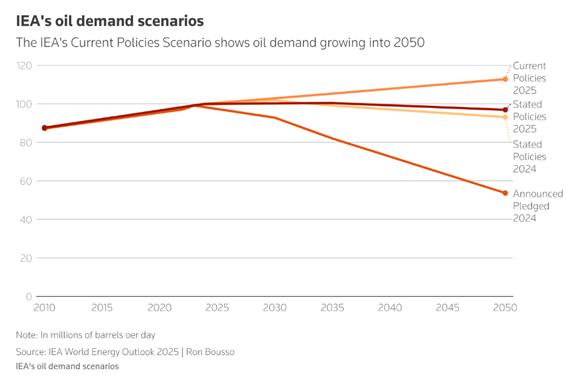
While politicians and NGOs flock en masse to the Amazon to discuss stricter CO₂ targets, the latest report from the International Energy Agency (IEA) points to a very different reality. As long as countries stick to their current policies, demand for oil and gas will keep rising for decades to come. That means: no peak in fossil energy this decade, barely any emissions reduction, and virtually no chance left of staying below 1.5°C of warming.
Despite 2024 being an exceptionally warm year, we see that governments and influential climate voices, including Bill Gates, are placing increasing weight on energy security and affordability. This explains why the relative growth of renewable energy is flattening out and why the adoption of electric cars is also starting to stagnate. The result: global oil demand keeps climbing, from around 103 million barrels per day in 2024 to more than 113 million barrels in 2050. This is notable, as until recently the IEA was still assuming a peak of 106 million barrels in 2025.
This marks a fundamental shift in the outlook for the energy transition. The optimistic "pledged policies" scenario, based on promised climate measures, is giving way to the far more realistic "stated policies" scenario, based on actually planned policy. In the even more conservative "current policies" scenario, in which virtually nothing changes, the peak in oil demand is not expected until around 2050. The picture for gas is similar: the previously predicted peak in 2030 is being pushed back to after 2035.
Electricity demand explodes, driven mainly by data centres
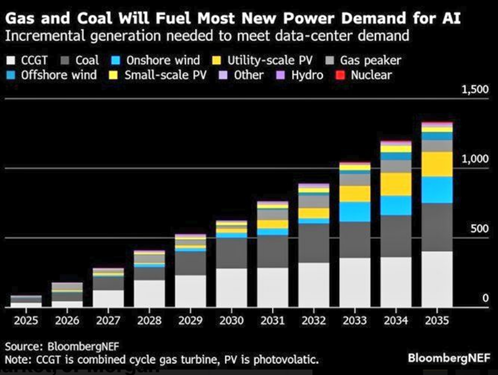
Global demand for electricity is meanwhile rising rapidly, driven by the massive construction of new data centres, the explosive growth of air conditioners and an expanding chemical sector in Asian and African economies. China remains for now the largest CO₂ emitter, but if countries with comparable population sizes (such as India, Indonesia, Pakistan and Nigeria) achieve the same economic growth, their emissions too will inevitably rise sharply.
In the United States, many federal climate targets have by now been abandoned. The decline in US CO₂ emissions in recent years is almost entirely due to the switch from coal to cheap shale gas. At the same time, Washington is pushing hard for reindustrialisation, made possible by extremely low energy prices. This is actively taking market share away from European industry.
As a result, Europe faces a double disadvantage. CO₂ pricing is making energy-intensive sectors structurally less competitive, precisely at a time when global electricity demand is exploding due to the rise of AI data centres. High government debt levels also mean there is ever less budget available to compensate consumers for high electricity prices. The result: rising inflation and continued job losses in Europe.
BloombergNEF expects that electricity demand from data centres could potentially increase by a factor of 20 by 2035, a structural shift that further increases the pressure on the energy system.
Oil supply rises sharply due to Trump policy and OPEC
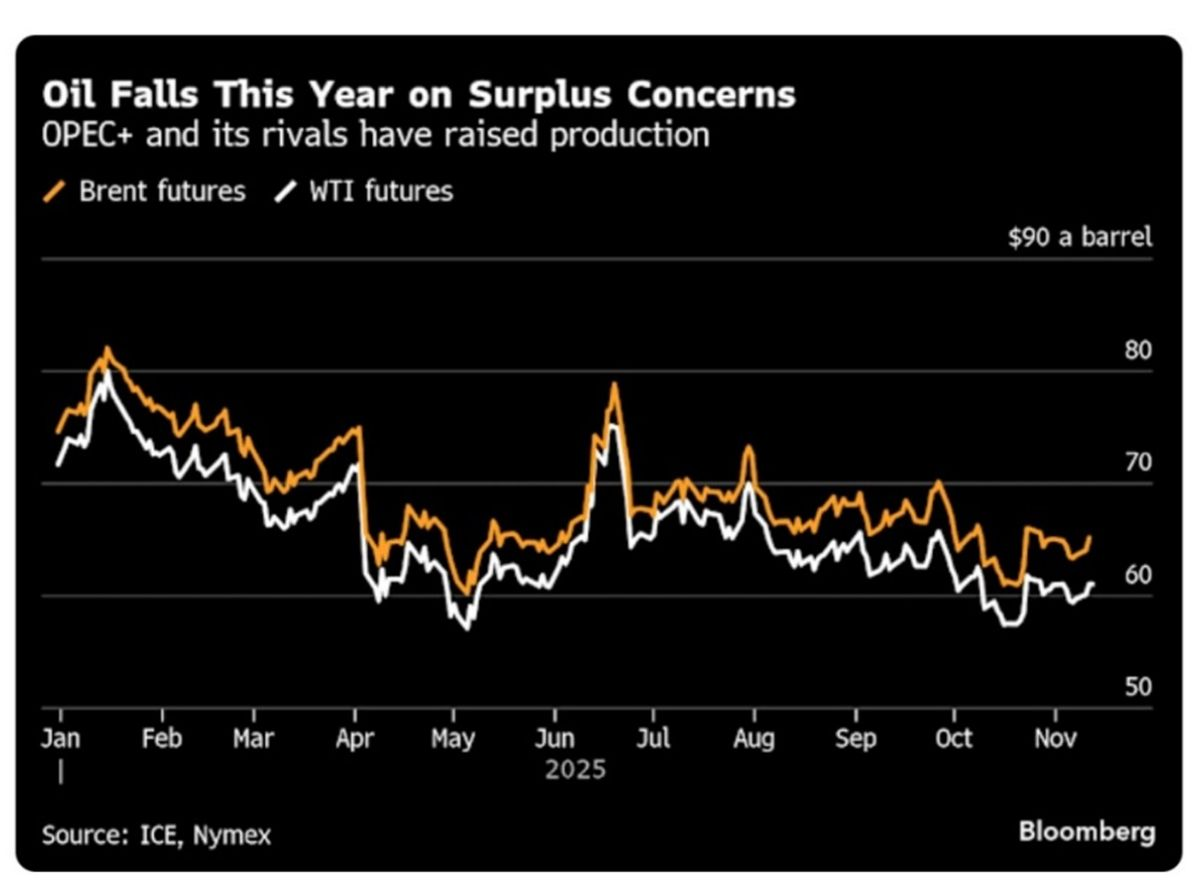
At the same time, global oil supply is rising rapidly. Under President Trump's policy and through coordinated action by OPEC, production has increased faster than global demand. Earlier this year we wrote that, as part of the so-called Mar-a-Lago Accord, an increase in oil production was initiated to curb US inflation.
OPEC is now producing around 2 million barrels per day more than a year ago. In the US too, oil production has risen to 13.8 million barrels per day (compared with 12 million in 2022). This makes the US the largest oil producer in the world, which pushed the US oil price (WTI) back below USD 60 per barrel again this week (currently around USD 58–59, compared with ~USD 80 twelve months ago).
Brent crude, however, remains considerably more expensive, recently trading around USD 64 per barrel. For European consumers, the lower WTI price therefore offers little relief. Moreover, the euro has risen by around 14% against the dollar this year, meaning currency effects are further driving up the pump price.
As a result, the Netherlands recorded the highest petrol price of 2025 so far this week, at €2.195 per litre of Euro95. The raw purchase price is estimated at around €0.95; the difference is entirely explained by higher VAT and excise duties, major drivers of inflation in the Netherlands.
US rents fall sharply
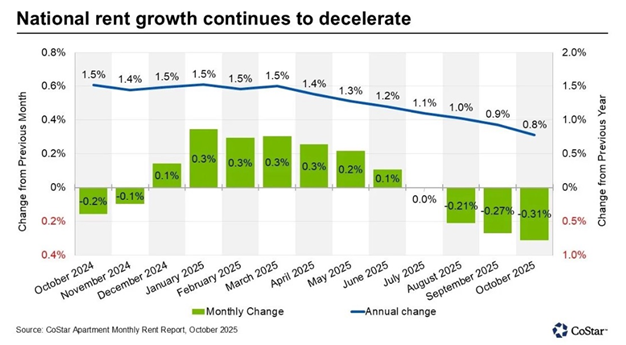
In addition to the recently lower oil prices, US rents are now also starting to fall month on month. According to CoStar, one of the largest real estate data providers in the US via Apartments.com, the rental market saw its sharpest decline in more than fifteen years in October: a month-on-month decrease of -0.3% and year-on-year growth of just 0.8%. A combination of substantial new construction, weakening demand and large regional differences is putting further pressure on rents. These are admittedly "asking rents", but historically they move almost in lockstep with the contract rents included in the official inflation basket.
This means one of the heaviest components of US inflation is finally starting to exert clear downward pressure. Rent accounts for 15.5% of core PCE inflation (excluding energy), the Federal Reserve's preferred measure. Energy does not count directly in this PCE calculation, but through second-order effects, a 10% decline in the oil price translates into roughly 0.4 percentage points lower PCE inflation. With both energy prices and rents now falling, broader deflationary pressure is emerging that should further temper US inflation in the coming months. Inflation currently stands at around 2.9%, driven by rising costs in healthcare and insurance, categories that traditionally respond slowly to economic cooling.
Last week we already wrote that the exceptionally strong AI sector is clouding the view of the broader cooling of the US economy: a pronounced K-shaped recovery in which the upper arm of the K is being carried by a historically unique investment wave in data centres (as much as 7% of US GDP), while the lower arm of the K is rapidly weakening. Consumers with credit, SMEs, the auto industry and other financing-sensitive sectors are cooling at a rapid pace. The signals are piling up: demand fatigue, rising payment arrears and tighter lending conditions all confirm the picture of a cyclically slowing economy.
At the start of this month, the market was still pricing in roughly a 70% probability that the Federal Reserve would cut its policy rate by 0.25 percentage points to 3.75% in December. With the new rental data and an increasingly weak lower arm of the economy, that scenario is only becoming more convincing. The likelihood is increasing that the Fed will have to ease further, either later this year or at the latest early next year.
Stock markets take a breather
After the exceptionally strong market rally since April, the recent pullback looks mainly like a healthy breather. The US technology exchange Nasdaq is now showing a correction of around 6% from its peak at the end of October. We are also seeing many shares fall sharply even when companies report strong earnings. The euphoria around AI has visibly cooled as a result, although the underlying fundamentals remain solid: US technology companies are still delivering strong earnings growth and the economy continues to show resilience.
At the same time, concern is growing over how the enormous wave of investment in AI infrastructure is being financed. An increasing number of data centre projects are no longer being funded entirely out of operating cash flow, but are relying more and more on debt financing. Credit spreads for major players such as Oracle and CoreWeave are widening rapidly, raising the question of whether all these ambitious investment plans are sustainable at their current scale.
Despite these financing risks, AI remains a structural trend that is expected to contribute substantially to productivity growth and innovation in the years ahead. Outside the technology sector too, companies worldwide are reporting strong earnings, and valuations in many sectors remain attractive. Emerging markets, meanwhile, are benefiting both from their exposure to global technology trends and from the prospect of looser monetary policy in the United States.
Now that equity markets are easing off the accelerator for a while, attention is shifting to the other building blocks in the portfolio and their role as stabilising diversifiers. Gold and the Swiss franc remain strongly positioned in this respect. It is encouraging that gold is showing a clear comeback after October's steep correction. Hedge funds, high-yield bonds and catastrophe bonds are also performing well this year, making them valuable alternatives to government bonds.
Receive weekly insights in your inbox
Exclusive analyses and updates on family holding companies and global market developments.
Would you like more information about our services? Please feel free to get in touch.
Get in touch
Disclaimer:
No rights can be derived from this publication. This is a publication of Tresor Capital. Reproduction of this document, or parts thereof, by third parties is only permitted after written permission and with reference to the source, Tresor Capital.
This publication has been compiled by Tresor Capital with the greatest possible care. The information is intended in a general sense and is not tailored to your individual situation. The information must therefore explicitly not be regarded as advice, an offer or a proposal to purchase or trade in investment products and/or to acquire investment services, nor as investment advice. The authors, Tresor Capital and/or its employees may hold positions in the securities discussed, for their own account or for their clients.
You should carefully consider the risks before you start investing. The value of your investments may fluctuate. Past performance offers no guarantee for the future. You may lose (part of) your invested capital. Tresor Capital disclaims any form of liability for any inaccuracies or errors. This information is purely indicative and subject to change.
Read the full disclaimer at tresorcapitalnieuws.nl/disclaimer .
This article was originally written in Dutch and automatically translated into English with the help of AI. In case of any difference, the Dutch original prevails.