
Economy & Markets #47 - How Asian turmoil and AI doubts are testing market sentiment


This week's topics:
Meanwhile, enthusiasm around AI stocks cooled on concerns over financing, higher capital costs and critical market commentary. Still, the underlying AI trend remains robust. Investment in data centres, computing power and automation continues to rise worldwide, with NVIDIA serving as a barometer for the strength of this structural growth cycle.
A new wave of tension between China and Japan
Relations between China and Japan came under further pressure this week after forceful remarks on Taiwan by Japan's new prime minister, Sanae Takaichi. Takaichi, in many respects dubbed a new Thatcher, stated that a Chinese attack on Taiwan could create a situation that "threatens Japan's survival", which under Japanese security law can serve as grounds for military involvement. Beijing responded immediately and sharply. China called the remarks irresponsible and launched a series of countermeasures, including a negative travel advisory for Japan and the suspension of cultural exchanges. The effect of this is already visible in Japan's tourism sector, where Chinese visitors traditionally account for a large share of arrivals.
An important geographical element in this cycle of tension is once again the Senkaku Islands, known as Diaoyu in China and Diaoyutai in Taiwan. These uninhabited islands lie roughly 220 kilometres northeast of Taiwan and carry both symbolic and strategic value. Japan has administered the islands for decades, but China and Taiwan likewise claim sovereignty over them. In recent days, several Chinese coast guard vessels have been spotted in waters controlled by Japan, with China stepping up pressure and Japan in turn intensifying its patrols.
These recent developments do not stand on their own. Chinese-Japanese relations over the islands saw a sharp escalation before, notably in 2010, when a Chinese fishing vessel collided with two Japanese coast guard ships in the same area. The arrest of the Chinese captain at the time triggered a diplomatic crisis, economic pressure from Beijing and a noticeable cooling of relations between the two countries. That incident has since served as a reference point for how quickly friction can turn into crisis.
Even now, the likelihood of a deliberate military confrontation appears low, but the risk of incident-driven escalation has clearly increased. A maritime or air mishap could quickly take on a dynamic of its own, particularly at a time when diplomacy between the two countries is virtually at a standstill. Economically, the consequences still appear limited, although the cancelled trips and the sharpness of the rhetoric show that both sides are willing to apply pressure when it suits them politically. For now, Japan stresses that there are no indications that China is using strategic raw materials as leverage, but markets are keeping a close eye on this segment.
For investors and markets, this marks a phase of heightened geopolitical uncertainty in Northeast Asia. The combination of diplomatic rigidity, symbolic territorial issues and the sensitivity surrounding Taiwan creates an environment in which sentiment can shift quickly. In the coming weeks, maritime activity around the Senkaku Islands and the tone struck at regional summits will be key in shaping the risk outlook.
Takaichi puts pressure on bond and currency markets
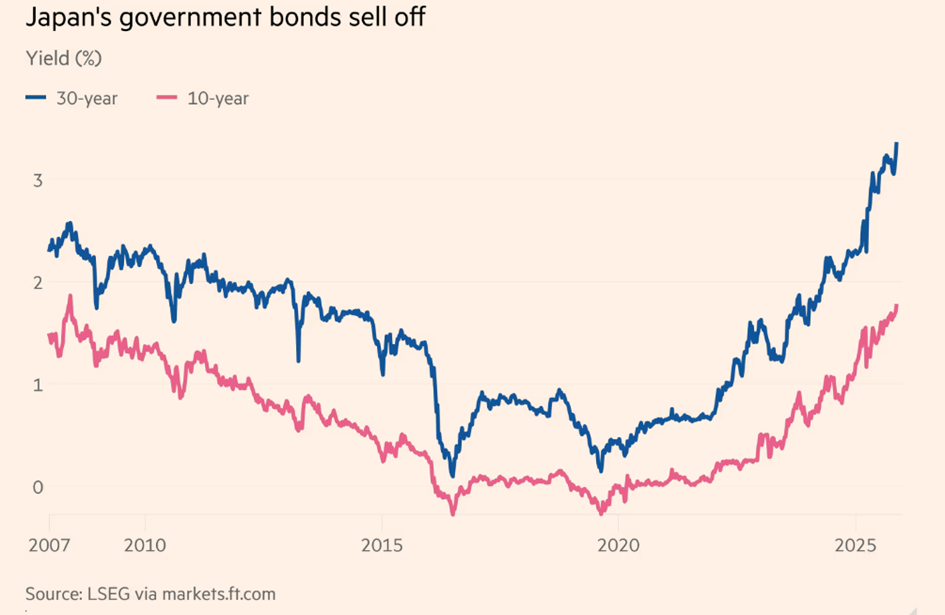
Alongside the geopolitical tension with China this week, unrest also emerged in Japan's financial markets. Government bond yields jumped to levels not seen in Japan since the 2008 financial crisis. The 10-year JGB touched 1.78%, while the 30-year yield rose to 3.35%.
That rise in yields is mainly a reaction to the new budgetary course set by Prime Minister Sanae Takaichi. Markets are factoring in a far larger stimulus package than previously expected; a supplementary budget of around ¥25 trillion now appears to be the base case. That would lead to a substantial increase in government bond issuance, prompting investors to demand higher compensation to absorb the growing supply.
On top of this, Japan has for years been grappling with structural problems: government debt of around 260% of GDP (the highest in the world), an ageing population, low productivity growth and a chronic budget deficit. By comparison, in Europe Italy is among the most heavily indebted countries with debt of around 140% of GDP. Decades of fiscal stimulus have supported the economy, but have also led to a situation in which the government structurally spends more than it takes in. Deficits are expected to rise towards 4% of GDP in 2025 and 2026.
Against this backdrop, the role of the Bank of Japan is once again centre stage. For years, the central bank kept the market in check through massive bond purchases and yield curve control, tools that helped keep the towering debt sustainable. The government now directly and indirectly owns roughly half of all outstanding JGBs, a situation that was only possible in a period of extremely low inflation. Now that inflation has risen to 2.9%, this policy is coming under increasing pressure. The BoJ has cautiously begun to normalise policy, while the market is testing how far the central bank is willing to go. That uncertainty is contributing to the recent rise in yields.
What stands out is that, despite rising interest rates, the yen is actually weakening further and has dropped through the ¥155 per dollar mark. The currency remains relatively stable given the underlying problems, partly because Japanese investors hold large foreign positions and the yen has traditionally enjoyed a reputation as a safe haven. Even so, one risk is becoming increasingly prominent: the possible unwinding of the yen carry trade. For years, investors have been able to borrow cheap yen to invest in higher-yielding assets. If Japanese interest rates normalise or the yen appreciates, this strategy could come under pressure, potentially triggering selling pressure worldwide.
For investors, this means the risk picture is shaped not only by geopolitical tensions with China, but also by a Japanese domestic market that, after decades of artificially low interest rates, is moving towards a new and uncertain equilibrium. In the coming weeks, Takaichi's budget proposals and the tone set by the Bank of Japan will be decisive for sentiment.
NVIDIA keeps sentiment afloat
In recent weeks, there has been growing caution in global equity markets, particularly in the artificial intelligence, data centre and chip sectors. Well-known market figures have publicly voiced doubts about the valuation of data centres and chips, while rising financing costs for companies have fuelled fears that parts of the AI infrastructure chain can no longer sustain their current pace of investment.
Michael Burry, known for his successful short position against the US mortgage market during the 2008 financial crisis (as depicted in the film The Big Short), even suggested that data centres remain on balance sheets for too long and should be depreciated more quickly. In essence, this amounts to lower underlying profitability for the entire sector. At the same time, credit markets continued to show signs of nervousness. The widening CDS spreads at, among others, Oracle and CoreWeave were seen by the market as a warning that financing for major AI projects is becoming more expensive. This fuelled questions about the feasibility of announced investments by companies such as OpenAI, AMD and NVIDIA itself.

Even so, the underlying trend is proving remarkably robust. Capital flows into data centres, training clusters and inference capacity continue to increase worldwide. In this context, NVIDIA serves as one of the key barometers for the strength of the AI investment cycle. The company represents a substantial part of the global hardware chain, and shifts in demand for computing power are reflected almost immediately in its revenue mix. The fact that NVIDIA's market capitalisation now exceeds that of entire national equity markets (including Germany) underscores just how central AI infrastructure has become to the global capital landscape. With a weighting of over 5% in the MSCI ACWI, AI is no longer a thematic niche but a structural pillar of global markets.
On the demand side, OpenAI remains an important bellwether. Growth in business applications, internal automation and generative AI integration shows that adoption is no longer confined to experimental use cases but is increasingly becoming part of companies' core processes. As a result, demand for computing power is rising again, forcing hyperscalers to further expand their investment plans. This dynamic feeds directly through to the hardware chain, and thus to NVIDIA.
The tension between temporarily weaker sentiment and structurally growing AI demand is making the sector more complex, but also more mature. Whereas the rally in 2023 and 2024 was mainly driven by expectations, it is now becoming increasingly clear that the economic value of AI is actually being realised. The strong concentration of capital in a limited number of companies means that movements in these names immediately ripple through the broader AI ecosystem, which calls for careful risk assessment. But this changes little about the underlying direction: the investment wave behind AI remains powerful.
Receive weekly insights in your inbox
Exclusive analyses and updates on family holding companies and global market developments.
Would you like more information about our services? Please feel free to get in touch.
Get in touch
Disclaimer:
No rights can be derived from this publication. This is a publication of Tresor Capital. Reproduction of this document, or parts thereof, by third parties is only permitted with written consent and with reference to the source, Tresor Capital.
This publication has been compiled by Tresor Capital with the greatest possible care. The information is intended in a general sense and is not tailored to your individual situation. The information must therefore explicitly not be regarded as advice, an offer or a proposal to purchase or trade investment products and/or to take up investment services, nor as investment advice. The authors, Tresor Capital and/or its employees may hold positions in the securities discussed, for their own account or for their clients.
You should carefully consider the risks before you start investing. The value of your investments can fluctuate. Past performance offers no guarantee for the future. You may lose (part of) your investment. Tresor Capital disclaims any form of liability for any inaccuracies or errors. This information is purely indicative and subject to change.
Read the full disclaimer at tresorcapitalnieuws.nl/disclaimer .
This article was originally written in Dutch and automatically translated into English with the help of AI. In case of any difference, the Dutch original prevails.