Economy & Markets #50 - Whimsical scenarios for 2026 and a critical look at private equity


This week's topics:
Outrageous Predictions for 2026: thought-provoking, not necessarily predictive
Every December, Saxo Bank publishes its annual Outrageous Predictions: a series of thought experiments with a low probability but potentially very high impact. The aim is not to predict the future, but to challenge investors to think beyond consensus.
Where do the white swans sit, and where might black swans be lurking?
These scenarios are explicitly not official forecasts or investment advice. They serve to test assumptions and stimulate discussion. Historically, some of these "unlikely" ideas turned out to be surprisingly accurate, such as early signals around volatility shocks, the strong gold rally in 2022, the explosive bitcoin rise in 2017, and even the idea that Nvidia would become bigger than Apple.
As investors, we always think in terms of multiple scenarios. With that mindset, we also read Saxo's Outrageous Predictions for 2026 with interest:
1) Q-Day arrives early
"A breakthrough in quantum computing breaks modern encryption, causing panic in crypto markets and triggering a flight to safe havens. Gold rises towards USD 10,000, while cybersecurity and defensive assets benefit."
2) The Swift-Kelce effect
"A global cultural effect around a celebrity marriage (Taylor Swift & Travis Kelce) boosts family formation. An unexpected baby boom fuels consumption and economic growth."
3) Quiet US midterms
"Midterm elections without political chaos bring calmer markets and a revaluation of risk assets, with Democrats gaining relative influence."

4) Obesity medication for everyone (and pets)
"GLP-1-like drugs become widely accessible, structurally changing nutrition, healthcare and consumer behaviour. Demand for fast food falls, while health and lifestyle stocks gain."
5) The SpaceX IPO
"A listing with a valuation above USD 1 trillion marks the breakthrough of mature commercial space travel, including serious applications such as data centres in space."
6) The AI CEO
"An AI model is appointed CEO of a Fortune 500 company. Strategic decision-making partly shifts to AI systems, with human directors providing oversight. Efficiency rises, and governance changes fundamentally."
7) The golden yuan
"China introduces a yuan partially pegged to gold, challenging US dollar dominance and reshaping the monetary system."
8) The trillion-dollar AI clean-up
"Poorly governed AI systems cause large-scale errors and high remediation costs. Investment in cybersecurity, compliance and governance technology explodes after uncontrolled automation fails on a massive scale."
We emphasise that these are not Tresor Capital's market expectations. Saxo's Outrageous Predictions mainly serve as a mental stress test: what if the unlikely happens after all?
We are closely following developments in 2026 and will of course keep you updated as soon as capital markets start moving towards a truly outrageous scenario.
Time Person of the Year: a sell signal for AI or confirmation of a long-term trend?
Time Magazine named the architects of the AI revolution Person of the Year 2025. The cover features, among others, Mark Zuckerberg (Meta), Jensen Huang (Nvidia), Elon Musk (Tesla/SpaceX), Lisa Su (AMD), Dario Amodei (Anthropic) and Fei-Fei Li (Stanford University). Time explicitly frames this in terms of societal influence, but historically this kind of recognition often raises the same question among investors: is this a sign of maturity… or of a peak?

The magazine has, after all, built something of a reputation for putting icons in the spotlight often at or near the top of the cycle. Jeff Bezos, for instance, was named Person of the Year in 1999, just before the dotcom bubble burst; Amazon's share price lost around 90% of its value in the years that followed. Andy Grove (Intel) received the honour shortly before the tech crash of the early 2000s. And Elon Musk was named in 2021, after which Tesla fell from around USD 400 to USD 100 per share in 2022. Patterns like these are often compared to indicators such as the Skyscraper Index: symbols of excessive optimism that, in hindsight, coincide with a turning point.
At the same time, it is dangerous to draw firm conclusions from this. After all, this is anecdotal evidence, not a statistically robust indicator. Both Amazon and Tesla have, over the longer term, actually created exceptional shareholder value, despite sharp interim corrections. Time's choice therefore says more about societal visibility than about valuation, cash flows or future returns.
In fact, if influence remains the criterion, Elon Musk already looks like a serious contender for Person of the Year 2026. His estimated wealth currently stands at roughly USD 480 billion, but with a stake of around 40% in SpaceX and a possible IPO at a valuation of around USD 1,500 billion, Musk could even become the first so-called "trillionaire" in 2026.
The key question for investors is therefore not whether AI has become "too popular", but at which point in the value chain the hype turns into sustainable value creation. The Time cover may point to short-term optimism and possible volatility, but it says little about the long-term trend, which is being driven by structural investment in computing power, infrastructure and productivity.
As is so often the case: iconic covers are rarely a buy or sell signal in themselves. At most, they are an invitation to re-examine valuations, expectations and risks.
Does investing in private equity beat investing in equities?
The Flossbach von Storch Research Institute recently published an extensive study examining whether private equity (PE) structurally outperforms listed equities. The analysis covers 3,752 funds over the period 1999–2023 and is among the most comprehensive studies in this field.
To properly interpret the results, the researchers first outline the development of the private equity market and the key geographic and sectoral shifts.
The size and composition of the private equity market
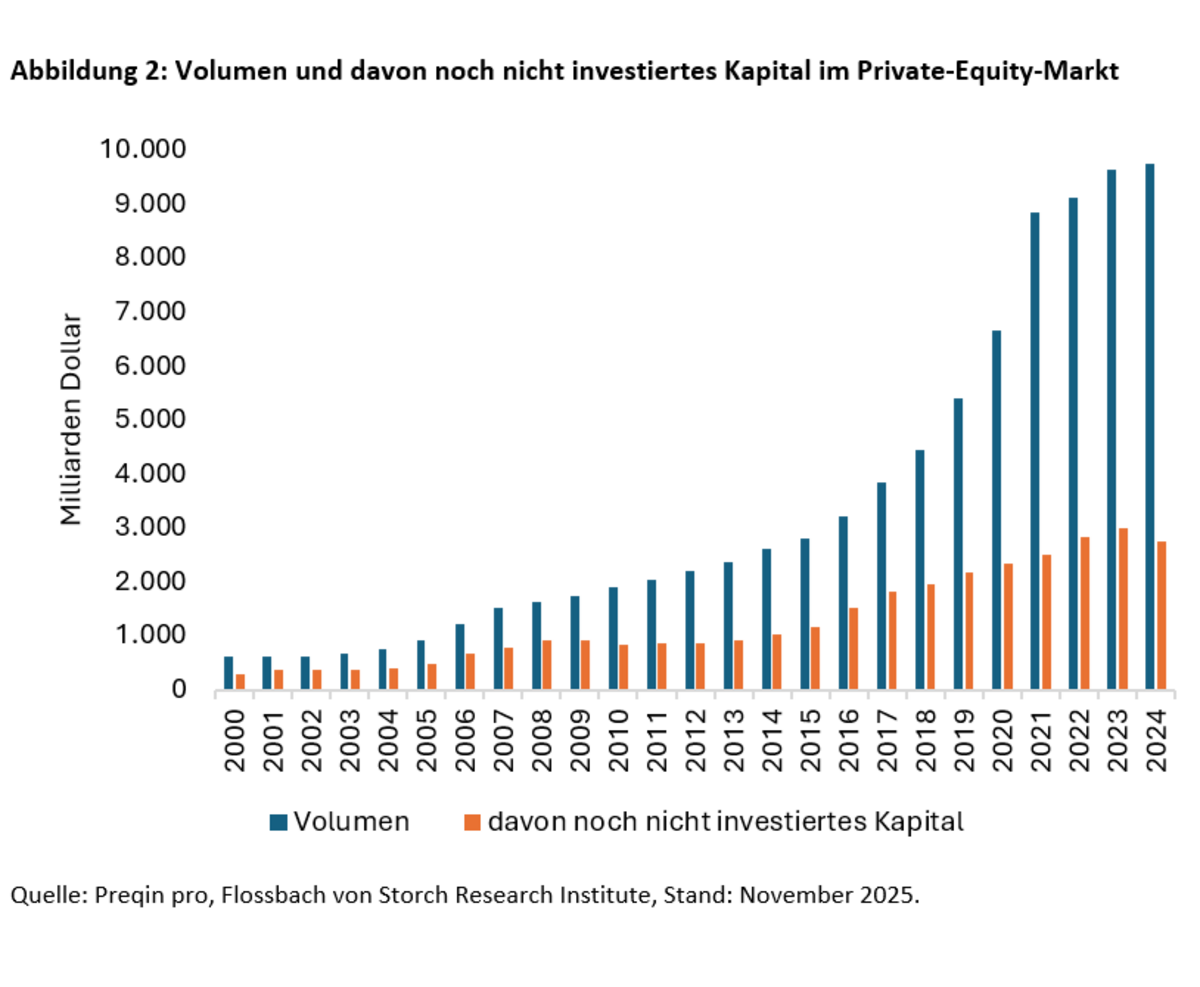
The global private equity market now has a size of approximately USD 9.7 trillion, of which around USD 7 trillion has actually been invested. Buyout funds form by far the largest category, at 59%. The remaining 41% is split roughly equally between growth equity and venture capital.
Geographically, the United States dominates, accounting for 58% of the global PE market. Europe follows with 31%, the lowest share since 2015. According to data from Preqin, US institutional investors allocate on average around 6% of their portfolio to private equity; for endowments, this can rise to more than 10%. The popularity of PE increased particularly after the financial crisis, amid the search for higher returns in a low-interest-rate environment.
High return expectations, limited transparency
Private equity is often associated with double-digit annual returns, but the question is whether this expectation is realistic. Transparency on actually realised returns is limited. Moreover, returns are usually presented as internal rate of return (IRR) rather than as annualised returns, which complicates comparisons with equity market returns.
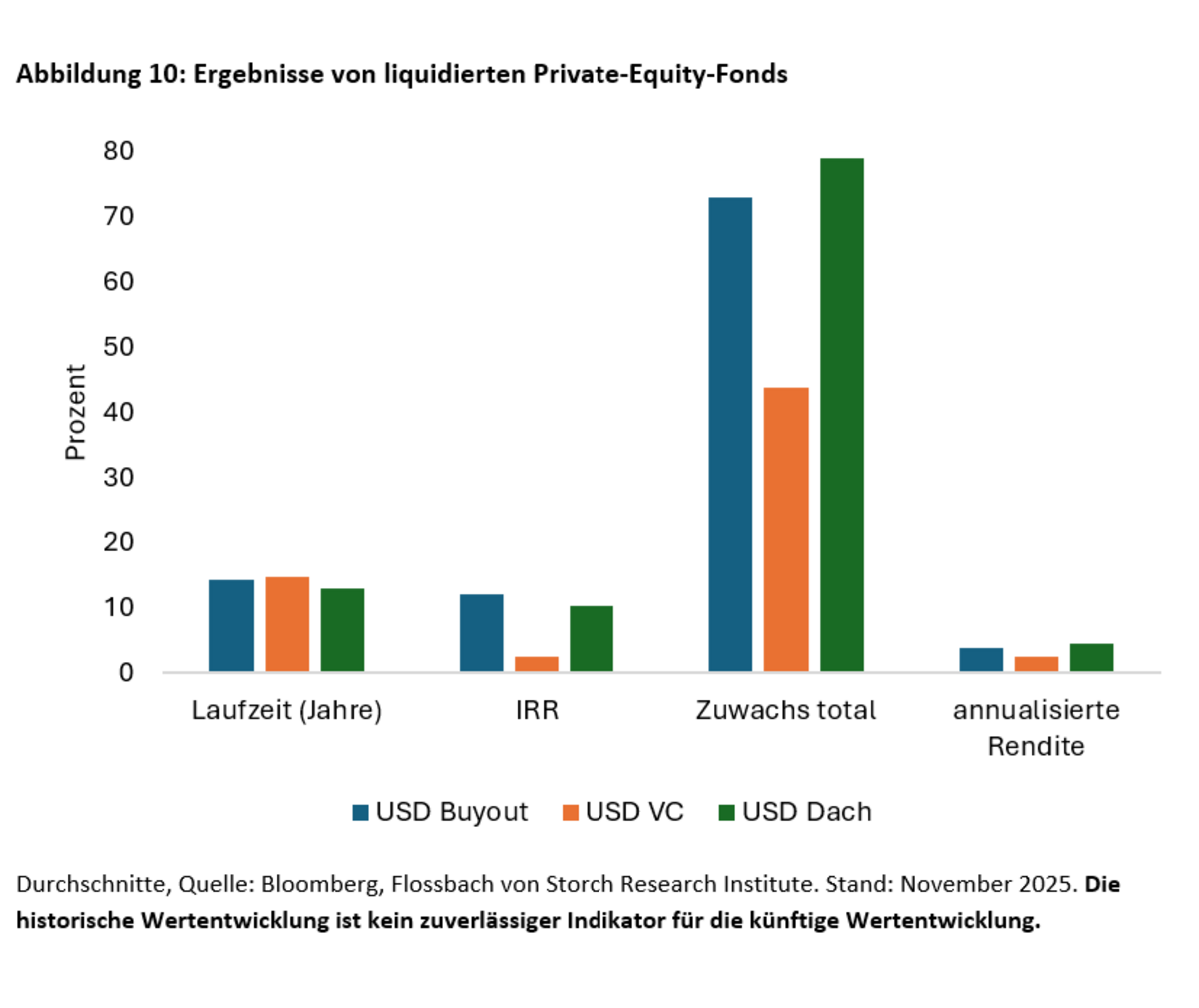
Although fund managers often communicate IRRs of 10–15%, the study shows that these figures are heavily influenced by the timing of cash flows. For USD buyout funds, the average IRR is 13.3%, and for EUR funds 9.4%. However, when looking exclusively at realised cash flows, without assuming reinvestment at the same rate of return, what remains is an average annual return of just 3.8%.
In other words: when returns are assessed on a truly comparable basis, private equity does not, on average, beat the stock market, and in many cases it even underperforms significantly. Flossbach illustrates this with a chart comparing the IRR of a typical buyout fund against the actually realised, annualised return. That chart shows that the IRR rises sharply as soon as early distributions occur, while the underlying economic value creation per year barely increases.
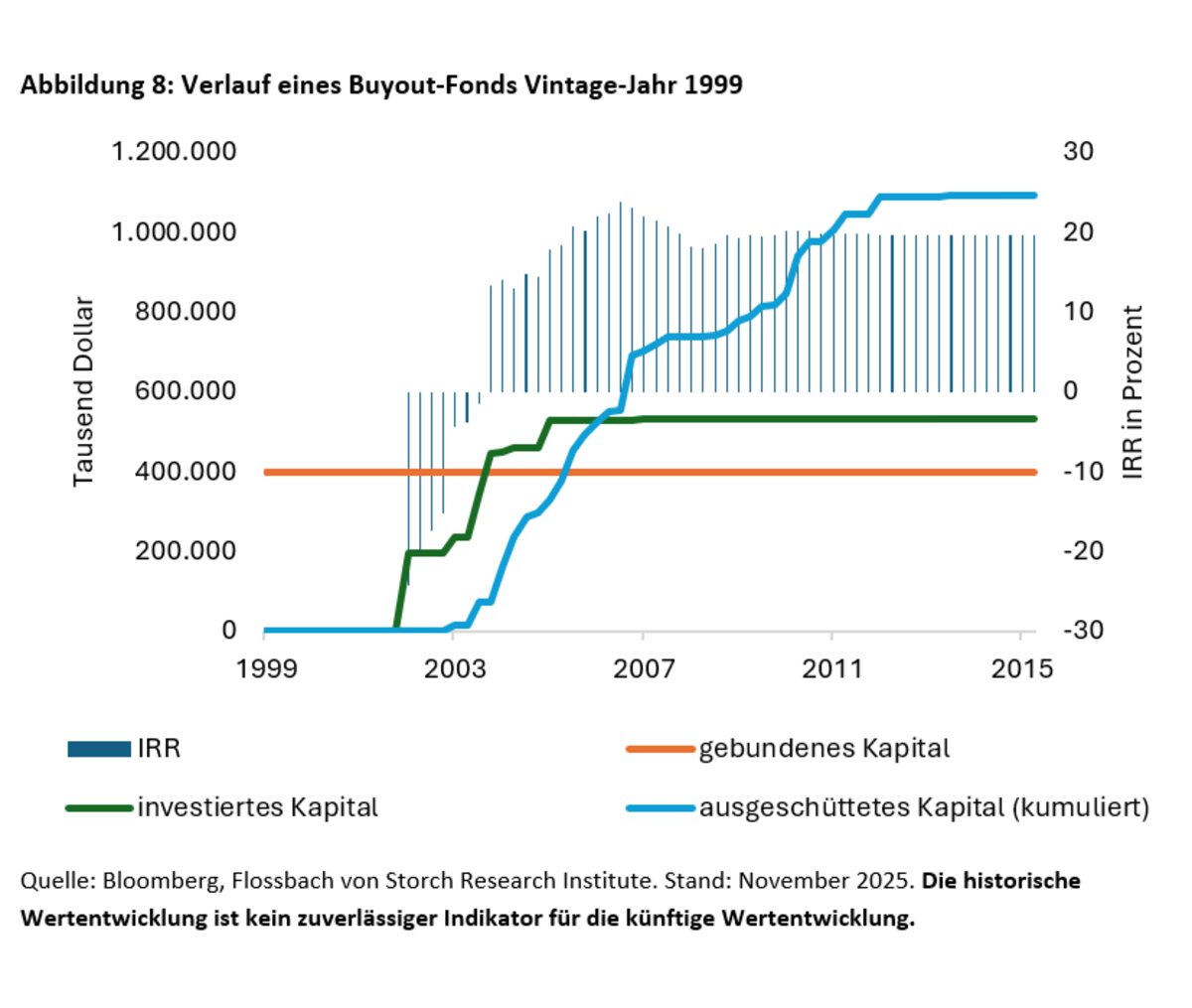
The difference is caused by the nature of the IRR metric: it is highly sensitive to the timing of cash flows and implicitly assumes that distributions received can be immediately reinvested at the same high rate of return, an assumption that is rarely realistic in practice.
In addition, there is a very wide dispersion in returns within each private equity category, meaning that averages on their own have little explanatory value. International research, including by Kaplan, Jenkinson and Harris, shows that outperformance is indeed possible, but remains heavily concentrated in the top 5 to 10 percent of funds and is, moreover, highly dependent on vintage year. For the majority of funds, realised returns lag behind this leading group.
At the same time, Flossbach acknowledges that private equity can give investors access to value creation outside public markets, particularly among small and medium-sized enterprises. It is precisely in this segment that operational improvements, professionalisation and restructuring can genuinely add economic value, an advantage that is less directly available in public markets.
By comparison, the S&P 500 delivered an average total return of around 7.8% per year over the same period, meaning stock market returns in practice turn out to be clearly higher than the net observed returns on private equity. According to the study, this difference is explained in part by the structural characteristics of the asset class: prolonged illiquidity (fund terms of ten to twelve years), limited transparency, selection and survivorship bias, and the cumulative impact of costs, including management fees and carried interest, which substantially reduce the eventual economic profit for investors.
Effect of the cost structure
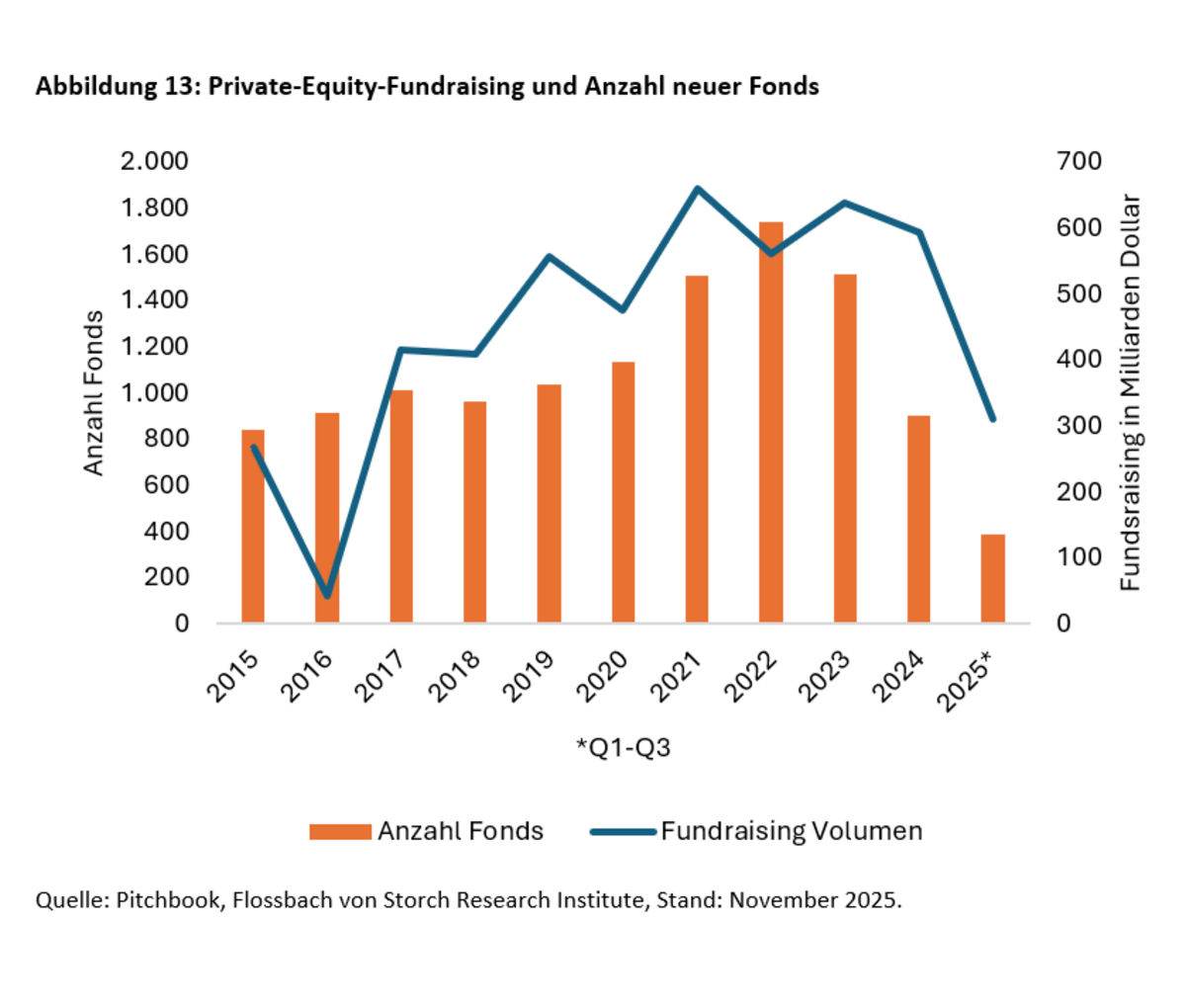
Buyout funds typically operate under the so-called 2-and-20 structure: around 2% in annual management fees on committed or invested capital, supplemented by 20% carried interest above a predetermined hurdle rate, usually around 8%. In practice, according to Preqin, management fees in 2024 averaged around 1.8% for large funds and around 2% for mid-sized funds. Products aimed at retail investors are typically more expensive and often come with lower hurdle rates.
Importantly, these costs are levied not only on capital actually invested, but in many cases also on capital committed but not yet called up. In addition, valuations of portfolio companies are set by the fund manager itself, a practice that regulators regularly flag as a structural risk to transparency and objective performance measurement.
Besides fixed and variable management fees, transaction costs, monitoring fees and advisory fees paid by portfolio companies to the fund manager also weigh on the eventual return for investors. Investors in funds-of-funds additionally face multiple layers of costs, which further erode net returns. Private equity funds are closed structures without a regular secondary market and typically have a term of around twelve years, with outliers ranging from four to as much as twenty-five years.
Term, leverage and sources of return
The term of a fund is therefore a crucial determinant of both the effective cost structure and the eventual net IRR. Liquidity profiles vary considerably from fund to fund, depending on the timing of capital calls and distributions, which makes planning reinvestment and cash management complex for investors.
As for sources of return, the dynamics differ by strategy. Venture capital funds focus primarily on growth and the professionalisation of young companies on the way to an exit, whereas buyout funds derive their value creation mainly from operational improvements, restructurings and economies of scale, and to a lesser extent from financial leverage. According to MSCI, the average debt load in global buyouts over the 2013–2023 period was around 1.74 times equity, significantly lower than in the 2000s. Rising interest rates since 2021 have structurally made the use of high leverage less attractive and have shifted the emphasis towards operational execution as the primary value driver.
Flossbach's conclusion: private equity typically does not beat the stock market
Flossbach concludes that it is difficult to substantiate the claim that private equity as an asset class structurally outperforms listed equities. Only under specific conditions can private equity play a valuable complementary role within a well-diversified portfolio. This requires investors to have sufficient capacity for illiquidity, careful cash management around capital calls, and access to exceptionally high-quality fund managers.
The analysis makes clear that it is not the asset class as a whole, but the quality of fund selection, that is decisive for the eventual return. Outperformance turns out to be concentrated in a limited number of top-performing funds, while the average return after costs, illiquidity and timing effects is often disappointing.
For these reasons, at Tresor Capital we focus primarily on investments in listed private equity asset managers, where scale, transparency and capital discipline are structurally more visible. Only in exceptional cases, when a private equity fund demonstrably stands out with a consistent, reproducible and sustainable track record, do we include a direct fund allocation in our selection and present it to our clients.
What happened this week?
The Fed eases further
The US central bank (the Fed) cut its policy rate by 0.25% this week, as widely expected. More important for the markets, however, was the additional announcement that the Fed will once again expand its balance sheet by purchasing USD 40 billion in short-term government bonds. This pumps extra liquidity into the financial system through quantitative easing (QE).
Historically, this tends to support capital markets: lower financing costs and ample liquidity typically lead to higher valuations for risk assets, including equities.
AI: strong results, but growth less certain
Mixed news came out of the technology sector. AI-related companies such as Oracle and Broadcom reported strong quarterly results, but at the same time tempered expectations for the period after 2025. They pointed to reduced visibility on future growth and potentially more volatile investment cycles among customers.
This is fuelling the broader debate among investors over whether an AI bubble is forming. Sentiment towards Nasdaq stocks in particular has noticeably deteriorated in recent months, despite the fact that short-term earnings growth remains robust.
In this context, the recent publication “Is it a Bubble?” by Howard Marks is particularly relevant. Marks concludes that there is undeniably exuberance, but that no one can say with certainty whether it is irrational, precisely because of the enormous uncertainty surrounding technological breakthroughs. He refers to Mark Twain's adage that “history rhymes” and draws parallels with earlier technological waves such as railways, cars, radio and aviation: it was not the technology but the eventual winners that were difficult to predict at the time.
At the same time, Marks qualifies the comparison with the dot-com bubble. AI is already being applied at scale, and many leading players are generating substantial cash flows. His biggest concern lies in the increasing use of leverage and off-balance-sheet structures to finance data centres and chips. In the event of overcapacity, technological obsolescence or disappointing demand, debt could magnify losses. His practical advice: don't go all-in, but don't go all-out either; diversification within the theme remains crucial.
Trans-Atlantic tensions rise
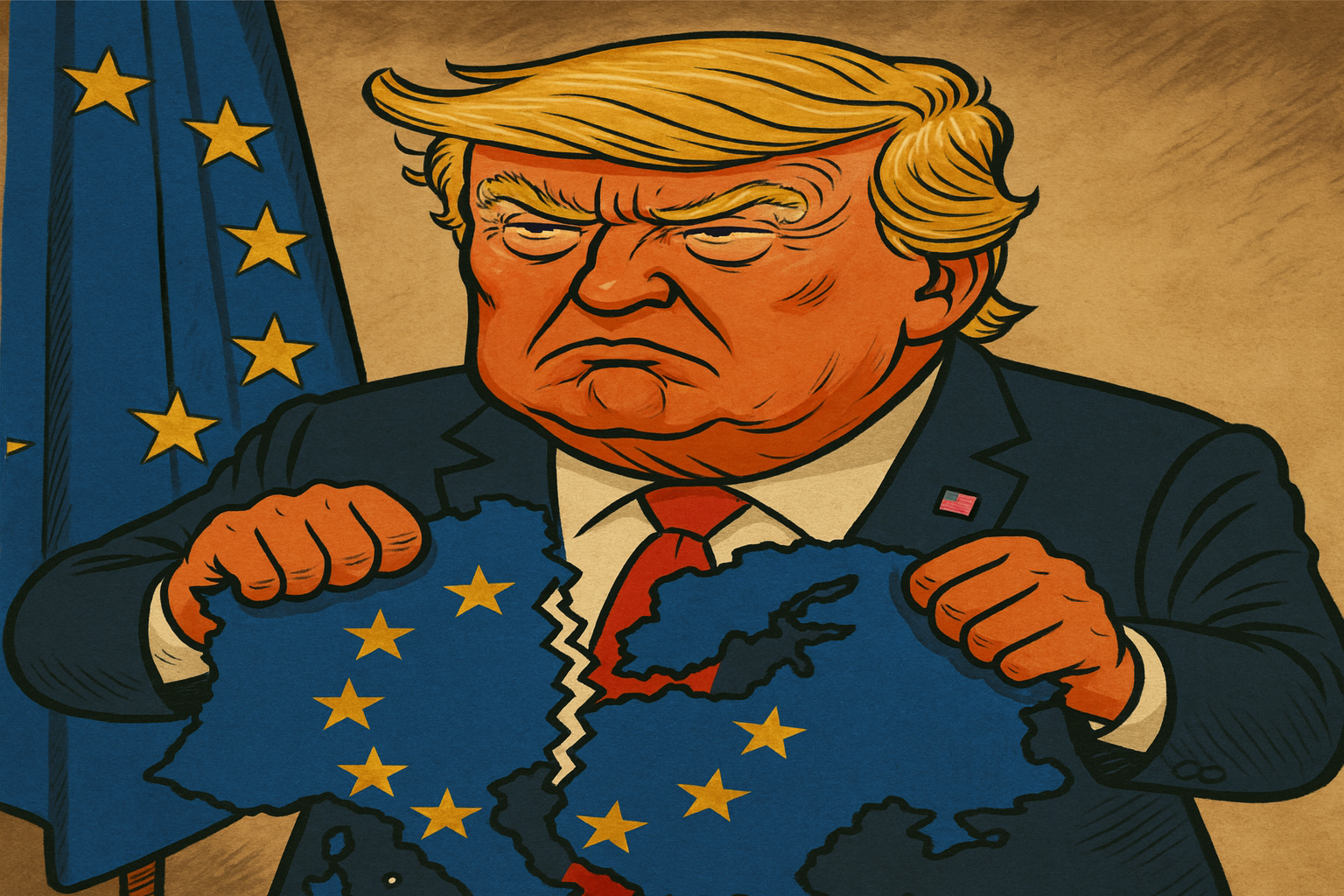
Finally, tensions between the US and Europe increased further. This week, Donald Trump once again showed himself to be highly critical of Europe's economic, military and geopolitical position. It seems that Trump, too, is a loyal reader of our newsletter 😉. After all, we have long been pointing out critically that Europe is structurally weakening itself economically through a number of policy choices.
The recently published US National Security Strategy paints a sombre picture: whereas the European Union's economy was larger than that of the United States in 2008, EU GDP now amounts to only around 65% of US GDP.
Behind this harsh rhetoric lies mainly American frustration over the lack of European unity, including on enforcing a ceasefire in Ukraine. This fits within a broader US strategic reorientation towards Asia, with China as the primary rival and Russia potentially as a tactical counterweight. Europe, by contrast, continues to view Russia as the greatest threat.
European leaders reacted with shock and appear determined to take more control of the Ukraine dossier, a development that will remain relevant both geopolitically and economically in the coming months.
Get weekly insights in your inbox
Exclusive analyses and updates on family holding companies and global market developments.
Would you like more information about our services? Please feel free to get in touch.
Get in touch
Disclaimer:
No rights can be derived from this publication. This is a publication of Tresor Capital. Reproduction of this document, or parts thereof, by third parties is only permitted with prior written consent and with reference to the source, Tresor Capital.
This publication has been compiled by Tresor Capital with the greatest possible care. The information is intended in a general sense and is not tailored to your individual situation. The information must therefore explicitly not be regarded as advice, an offer or a proposal to purchase or trade investment products and/or to take up investment services, nor as investment advice. The authors, Tresor Capital and/or its employees may hold positions in the securities discussed, for their own account or for their clients.
You should carefully consider the risks before you begin investing. The value of your investments can fluctuate. Past performance offers no guarantee for the future. You may lose (part of) your invested capital. Tresor Capital disclaims any form of liability for any inaccuracies or errors. This information is purely indicative and subject to change.
Read the full disclaimer at tresorcapitalnieuws.nl/disclaimer .
This article was originally written in Dutch and automatically translated into English with the help of AI. In case of any difference, the Dutch original prevails.